 By Shashidhar Nanjundaiah
This diary style in which I have been asked to write carries the advantage of a fluid style of writing and I plan to take full advantage of it. This is particularly important when offering personal insights from a country that is so well covered in Indian media that it becomes difficult to manoeuvre! Nevertheless, attempts must be made.
Finally, as the Democrats do spectacularly well to retain the U.S. Senate, the rejection of Donald Trump is writ large on the U.S. electoral map. Even though the Senate is split 50:50 at present, the Vice President, currently a Democrat, holds a tiebreaking vote, so effectively, the Democrats are expected to have the upper hand, unless, of course, naysayers from within the party provide the anguish, as Kirsten Sinema and Joe Manchin have. Votes will continue to be counted into midweek, as mail-in ballots here trickle in well after the election date. (Someone must fix that lag to ensure timely results!) But it is also an extreme form of democracy, where the freedom of choice is multi-faceted. Some states vote by machine, some by paper ballots. In addition, people can vote in person, via mail, or using “ballot drop boxes”-where you can fill out a ballot at home and drop it off into a box.
Such methods encourage people who might not be willing or able to travel and stand in line for hours. Recent surveys show that when images of polling booths with long lines appear live on television, they deter voters from joining those lines. So mailed or dropped ballots, which help avoid daunting queues, especially for aged and wheelchair-bound voters, have become a part of parties’ “absentee chase” programme. If India liberalised voting in similar ways, it will surely be met with suspicion, for obvious reasons. That is why, as a sceptic, I don’t want to go down that suggestion lane.
The Indian news media covered the U.S. elections this time too. In historical terms, this whole elaborate interest is a relatively new trend, in which television networks have managed to create a fascination among their viewers towards U.S. elections over the past few elections. The popularity of any Indian-American in the fray adds to this media interest anyway. Five Indian Americans won, as against four last time, and the excitement among journalists over the “growing influence of the [Indian American] community in politics”. The Hindustan Times headlined the Indian American winners as the Samosa Caucus, a somewhat humorously self-deprecating term used among desi circles in the United States.
Let there be no mistake. The hard political power for the Indian American community is inevitably rising-a community that enjoyed an astonishing increase of 67.3 percent from 1.9 million in 2000 to 2010, and another 44.6 percent from 3.18 million in 2010 to 4.6 million in 2021. The fact that five out of 435 members of the House of Representatives, roughly 1.1 percent, stand for about 4.6 million Indian Americans-just under 1.4 percent of the population-is impressive. This is particularly so when compared with the fact that there are a total of 16 Asian American members of the Congress (three in the Senate and 13 in the House of Representatives). The population of Chinese Americans alone is over 18 million, so their political participation by contrast is relatively low.
So, let me ask, who is Nabeela Sayeed? Hint: She, too, is an Indian American, but uniquely so. The usual NDTV and a Moneycontrol here and The Quint there carried the agency report about her in bits and spurts. Meanwhile, the U.S. media is going gaga over her. At 23, Sayeed is one of the youngest ever members of the Congress to have won. She is a first-generation Indian American—in that her family moved here well after she was born. And as a Democrat, she flipped a Republican seat in this midterm election, making a significant difference to the tight race. A phenomenal success story, ignored because of the hijab around her head.
Instead, we may notice that the Indian interest in identity politics is particularly strident when the candidate has a Hindu name, like Kamala. Although Harris has converted to Christianity, she still makes sure she invokes her half-Indian descent in various ways—such as her interest in the dosa—to keep the hypernationalist desi media fed with good fodder. The Indian media pretty much appropriates Rishi Sunak as our own, despite his multi-nation descent. Hence we observe the “acceptance” of Sunak as a visibly practising Hindu among India’s television channels’ hypernationalistic anchors and equally jingoistic “guests”.
So, no longer do I need to explain to my semi-rural community that I use “Indian” to mean “from India” and not Native American. With 1.2 million U.S. visas promised for Indians just over the next several months, the population will rise even more steeply than it has in the past, the indications are clear: Why export jobs when we can import workers? The rapid rise in acceptance of the Indian American into the mainstream is also the rejection of Donald Trump-style Make America Great Again (MAGA) politics.
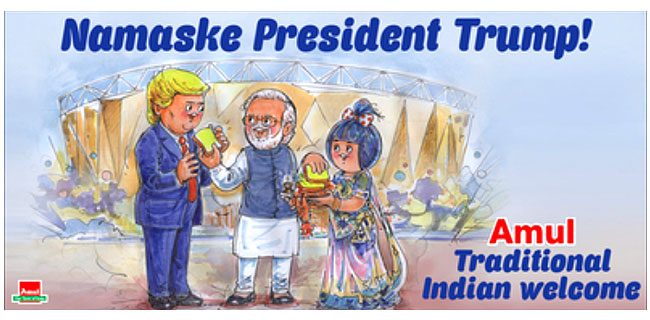
 US President Donald Trump visits India for the first time early next week. And it’s going to be two days of absolute media frenzy. The news media, especially of the television variety, is perpetually looking for big news events, and this is one news event they didn’t see coming till very recently.