Tag: trends

  • GroupM’s Trends 2023


    With every edition of the annual This Year Next Year report, GroupM also presents its trends for the year. Here’s what it presented to the media and the industry at large on Tuesday.


    Moving towards attention planning

    With the acceleration of digital media and shifting experiences of consumers, it’s important to understand the impact of attentiveness of the consumer as he engages with media/media assets. We have enhanced our understanding on exactly how many impressions for a single medium or multimedia lead to cross-channel optimisation.

    What we haven’t been able to capture is the viewability impact of each impression on intent & purchase. The way forward is an “attention response curve”, which allows for new planning and pricing discussions. New measures like quality cost per thousand [qCPM] are beginning to be explored and traded. We need to ensure q is measured in a way that represents real quality.


    Content breaks boundaries and creates new opportunities

    OTT platforms themselves are becoming popular enough to be licensed into products and promotions. From a marketing and promotion standpoint, brands are looking at leveraging platform like Netflix and Prime Video across their portfolio to create campaigns using multiple shows, movie library and even popular music from some shows. Today we see audience embracing content from multiple geographies and language. A Kashmiri from Srinagar is watching and appreciating Malayalam or Telugu content. We all have seen the audience pan-India celebrate RRR, Pushpa or KGF. We have content in abundance to suite consumption patterns for eclectic/niche audiences as well as the masses.

    Likes of Post Malone (Feeding India), Russ (India Tour), Imagine Dragons & Jackson Wang (Lollapalooza) have come to India in the last 12 months; and on the other end we’ve Diljit Dosanjh performing at Coachella 2023 as part of the festival’s expanded global line up. We will more of this in 2023.

    The myth that’s getting broken is the belief that typically Indians don’t pay for content & experiences. As mentioned above, we see that Indians actually do pay and they are willing to pay premium for some curated experiences.

    From an advertiser POV, these are highly engaged, high-spending audiences, making these events a perfect platform to capitalise on.


    Rise in retail media

    Retail media in India is expected to double by 2027.

    With demand for accountability on every single rupee of ad-spend, retail media offers an end-to-end solution from discovery to shopping, with the ability to connect data between consumer, the online marketplace and brands.

    For publishers, monetisation via retail media amplification with the fusion of data and power of programmatic will be growing demand channel.

    In India, the rise of adspends on digital retail media will depend on how the retail media networks are able to demonstrate the value by complementing search efforts and not competing with them.

    Usage of effective hyper-localised and personalised creative at each stage of the funnel of retail media will be critical in realising the full potential.

    While retail media will be used primarily for CPG, it will also be leveraged by non-endemic clients to find audiences with relevant category usage.

    Challenges will continue to exist on measurability beyond end level attribution.

    At GroupM, we have launched our retail media product named Discovery Commerce. It connects all dots from marketplace insights, media, creative, programmatic to purchase in one funnel.


    Visual search goes mainstream

    Visual Search delivers instant relevance to a consumer search. It allows users to get exactly what they want rather than a lookalike.

    Visual search also allows for conversion of interest in one specific product (e.g. apparel) to the entire collection – expanding the shopping cart It leads to a huge edge on SEO and how we enhance our marketing ROI. While tagging for search typically needed real people to tag individual products, with Visual search the images are SEO ready and increase the chances of discoverability More importantly, marketers can tap into consumers’ state of “What I didn’t know I want” and increase the ARPU.


    New dimensions of omnichannel

    The dramatic shifts in consumer behaviour during the pandemic saw most agile brands shift to multichannel retail, with ecommerce getting a huge surge.

    Post the Pandemic, we are seeing further shifts in consumer behaviour. While ecommerce continues to grow, the rate of growth is slowing down. We are witnessing re-emergence of physical trade, with high street rentals moving up and consumers opting for the joy of physical shopping, touch & feel, etc. We see a rise in “Experience centers” across both traditional and new age brands. The emergence of Metaverse and the growth in AR/VR will power new shopping experiences for consumers.

    Brands will go beyond multichannel to deliver a true omnichannel experience. The first step is to recognize consumers across Physical & Online environments and then give them a seamless, consistent and rewarding brand experience at every touchpoint.


    Democratisation of commerce with ONDC

    ONDC is promising to be the new jewel from the India Stack. What UPI did to payments, ONDC is expected to do to Commerce.

    The momentum gained in 2022 will lead to larger participation from brands and marketplaces to be enabled on the ONDC network.

    Currently over 22,000+ sellers are on this open network.

    With transparency and level playing field for all partners at the core, ONDC will help businesses have more choices, larger demand spectrum and avoidance of search bias.

    To build trust in an unbundled and democratic environment, setting up key elements such as Issue and Grievance Resolution, Scoring and Badging, Reconciliation and Settlement, Cataloguing Services will become important.

    In 2023, we will see emergence of hyperlocal marketplaces. Your nearest Kirana shop can possibly be enabled on the ONDC protocols.

    Birth of ecommerce services companies will increase as India’s share of GMV online increases across categories.

    We see exciting times ahead with screen-to-door commerce enabled by ONDC.


    Sporting nation in the making

    We see a strong move towards localisation of sports, encouraging local/ regional players and providing opportunities for the nation to become a playing nation rather than just a “watching” one.

    While top dollars are being committed at the top of the funnel with IPL and ICC Media Rights, we see apps/platforms democratising sports broadcast space at an amateur level by providing streaming platforms to local sports tournaments and amateur games. It’s essentially developing smaller cohorts of sports enthusiasts who play, watch, support and enjoy their friends and family performing on-field at local, community events. With more Indians becoming fitness conscious and participating in active sports, we see this medium developing further, creating and catering to a niche audience and corresponding set of advertisers


    Inclusivity becoming mainstream

    Indian sports ecosystem went through a metamorphosis in 2008 with the advent of IPL. Cut to 2022, IPL hit an unprecedented high with media rights crossing 100 Cr. per match! While that’s been the headline for the sporting industry, diversity, equality and inclusion has been slowly making its presence felt in the Indian sports arena. We saw early signs of it with Women’s Kabaddi Challenge as a part of Pro-Kabaddi OR Women’s T20 Challenge towards the fag end of regular IPL season. Come Mar 2023, India is ready to host a full-fledged Women’s Premier League with 5 franchises (sold at a whopping total 4670 Cr.) and matches broadcast on Viacom18 network. We expect more of these in days to come.


    Docuseries leading to more immersive sports

    GenZ is greatly interested knowing the “inside scoop” when it comes to the sports world and that explains the plethora of sports docuseries making its way into our television sets. We expect this to go a notch up with the shift in content happening from the production house perspective to the athlete themselves reliving the moment to their own fans on their preferred platforms. From an advertiser’s lens, as LIVE sports keeps getting more expensive, docuseries and ancillary content in sports becomes a great asset to leverage and engage with passionate fans in a different context.

     

  • The Anchor: 5 trends to watch for in the ad network space

    By Kiran Gopinath


    #1 Ad networks allow advertisers to focus on audiences rather than just publisher/content-specific deals.


    #2 Advertisers are able to understand and target users most effectively and efficiently using ad networks.


    #3 Data segmentation and analytics drive advertising and marketing efficiencies on ad networks.


    #4 Publisher revenue yields will increase as efficiencies of inventory utilization improve.


    #5 Moving up the value chain to becoming digital media consultants rather than just publisher aggregators.


    Kiran Gopinath is the Founder and Chief Executive Officer of Ozone Media Solutions


  • The world according to JWT, in 2012


    By A Correspondent


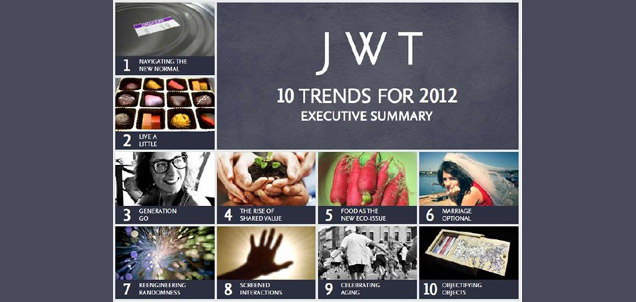
    Ad hotshop JWT feels that in 2012, the economy will push brands into opening up more entry points for cost-sensitive consumers as the “new normal” becomes a prolonged normal in the developed world while at the same time, tough times will generate an unprecedented entrepreneurialism, with the so-called Lost Generation of youth becoming a uniquely resourceful group that creates their own opportunity. The above findings and plenty more, are the result of their annual forecasting exercise – the seventh in the series – of key trends that will drive or significantly impact consumer mindset and behaviour in the year 2012.


    JWT’s ’10 Trends for 2012′ is the result of quantitative, qualitative and desk research conducted throughout the year for the report. It includes inputs from nearly 70 JWT planners across more than two dozen markets and interviews with experts and influencers across sectors including technology, luxury, social responsibility and academia.


    “With our annual trends forecast, we aim to bring the outside in-to help inspire ideas beyond brand, category and consumer conventions-and to identify emerging opportunities so they can be leveraged for business gain,” remarked Ann Mack, director of trendspotting for JWT. “Trends, like any complex and dynamic human phenomenon, are not preordained-once they are spotted, they can be shaped.”


    Previous trends that have been forecasted over the past years include: “De-Teching” in 2011 (more people logging off, at least temporarily, to get a break from technology); “Location-Based Everything” in 2010 (the explosion of location-based or -aware services that leverage data from mobile phones); The Small Movement” in 2009 (the shift away from “bigger is better” in everything from homes to cars to mobile technology); and “Radical Transparency” in 2008 (the “nothing to hide” ethos seen in some online behaviours).


    The top 10 trends that have been predicted for 2012 are as follows:


    1. Navigating the New Normal

    As the new normal becomes a prolonged normal in the hampered developed world, more brands in more categories will open up entry points for extremely cost-sensitive consumers. Marketers will find new opportunities in creating stripped-down offerings, smaller sizes and otherwise more accessible products and services.


    Example: In the US, Heinz is introducing several reduced sizes at a suggested retail price of 99 cents, including a 10-ounce ketchup pouch and a 9-ounce yellow mustard, as well as mini Worcestershire and Heinz 57 sauces.


    2. Live a Little

    Faced with constant reminders about what to do (exercise more, eat better) and what not to do (smoke, overspend), and fatigued from several years of austerity, consumers will look for ways to live a little without giving up a lot. People have been exercising more self-control, and increasingly they are looking to let loose once in a while: indulging in sinful things, splurging on treats and escaping from today’s many worries.


    Example: Whiskey in South Africa, premium beer in the U.K and cheap eclairs in India are small indulgences that consumers with little to spend are enjoying.


    3. Generation Go

    While twenty-somethings in the developed world feel they’ve been dealt an unfair deck, many are finding opportunity in economic adversity. Out of continued joblessness or discontent with the status quo will spring an unprecedented entrepreneurial mindset, enabled by technology that obliterates traditional barriers to entry. A so-called Lost Generation will transform itself into a uniquely resourceful cohort.


    Example: More than half of Millenials in the US agreed that if they lose or have trouble finding a job, they’ll start their own business, according to a JWT survey, up from 25 percent in 2009.


    4. The Rise of Shared Value

    Rather than simply doling out checks to good causes, some corporations are starting to shift their business models, integrating social issues into their core strategies. The aim is to create shared value, a concept that reflects the growing belief that generating a profit and achieving social progress are not mutually exclusive goals.


    Example: Philips is partnering with the Dutch government in a bid to provide affordable, sustainable energy solutions to some 10 million people across 10 sub-Saharan African nations by 2015.


    5. Food as the New Eco-Issue

    The environmental impact of our food choices will become a more prominent concern as stakeholders-brands, governments and activist organizations-drive awareness around the issue and rethink what food is sold and how it’s made. As more regions battle with food shortages and/or spiking costs, smarter practices around food will join the stable of green “best practices”.


    Example: U.K. supermarket Sainsbury’s featured a summer promotion in 2011 offering customers who asked for cod, haddock, salmon, tuna and prawns an alternative, more sustainable species such as herring or mackerel for free.


    6. Marriage Optional

    A growing cohort of women is taking an alternate life route, one that doesn’t include marriage as an essential checkpoint. Both in the West, where this trend is building, and in the East, where it’s gaining momentum, “happily ever after” is being redefined as a household of one, cohabiting or single motherhood.


    Example: In 2010, a third of Japanese women entering their 30s were single, while 37 percent of all Taiwanese women 30-34 were single.


    7. Reengineering Randomness

    As our individual worlds become more personalized and niche-and the types of content, experiences and people we are exposed to become narrower-greater emphasis will be placed on reintroducing randomness, discovery, inspiration and different points of view into our worlds.


    Example: Airtime, due to launch at the end of 2011, is being touted as a random real-time video chat platform where strangers will be “smashed together”.


    8. Screened Interactions

    More flat surfaces are becoming screens, and more screens are becoming interactive. Increasingly, we’ll be touching them, gesturing at them and talking to them – and becoming accustomed to doing so as part of our everyday behaviours. This is opening up novel opportunities to inform, engage and motivate consumers.


    Example: In New York, a restaurant at high-end department store Barney’s features 30 individual screens in a large communal table that’s covered in glass; diners can digitally order their meal, then browse the store’s catalogue while eating.


    9. Celebrating Ageing

    Popular perceptions of ageing are changing, with people of all ages taking a more positive view of growing older. And as demographic and cultural changes, along with medical advances, help to shift attitudes, we’ll redefine when “old age” occurs and what the term means.


    Example: To appeal to Gen Xers and Boomers, Polish beer brand Zywiec launched a campaign with the tagline “The best is ahead of you”. Commercials showed older male celebrities including actors, a boxer and a cartoonist, speaking about their lives, offering insights and advice.


    10. Objectifying Objects

    As objects get replaced by digital/virtual counterparts, people are fetishiZing the physical and the tactile. As a result, we will see more “motivational objects”, items that accompany digital property to increase perceived value, and digital tools that enable creation of physical things.


    Example: Sincerely’s Postagram app allows vacationers and others to turn snapshots into snail-mailed postcards. Similarly, Postcard on the Run reminds potential users that for recipients, a physical card is “a real keepsake they can hold close to their heart, put up on the fridge or display at work”.