New Delhi, April 1, 2014: In a move that has been welcomed by several brands and party organisers, it is learnt from reliable sources that newspapers like Bennett, Coleman and Co Ltd and HT Media Ltd are getting together on a special project.
It may be recalled that since 2005, the year when DNA was launched as were Mumbai Mirror and HT’s Mumbai edition, the two New Delhi-headquartered news media groups have got together on various projects. The HT’s print facility has been used by TOI. Then there’s a no poaching agreement between the two organisations so if an HT journalist had to join TOI, there would have to be interim employer in between. HT ads have appeared in TOI and vice versa. So while there is intense competition on the ad sales and editiorial front, there’s friendship too.
Last week, HT Media and a few other top newspaper brands like Hindu and ABP got together to launch One India (not to be confused with the website company run by BG Mahesh and majority-owned by Rajesh Jain, now affiliated to the BJP). Many media planners, buyers thought it was a brilliant idea with pedigreed B-school graduates several thousand crores of adspend budgets appreciating the innovation of these media managers to create a pull for print.
Buoyed by the success of this initiative, the high priests at a leading newspaper group had a whirlpool of an idea. Why not look at a combined deal for paid-for, promotional content. Feelers were sent to competition, and after some reservations, a deal was struck so as to attract advertisers and individuals who appear on the party pages without paying. A formula has been hammered out, and the feature is likely to be announced soon. This will be done at a tony nightspot in Mumbai and Delhi and will be held at no cost to the media organisations in question as the costs will be offset against free content space in the papers.
Taproot India has released the second part of the farmer suicides campaign it has created for The Times of India. The awareness campaign began in April last year with an exhibition, traffic to which was driven by a print and outdoor campaign. As part of that communication, 12 portraits of dead farmers were created using dry, burnt hay. These portraits were displayed and auctioned and the proceeds from each portrait were given to the families of the deceased.
“The objective of this campaign is to raise awareness of this issue so that steps are taken to support the farmers. In addition the campaign will also attempt to provide an alternative source of income  to the farmers families that have been affected,” said Rahul Kansal, Executive Director, Bennett, Coleman & Co Ltd, the publishers of The Times of India.
“One Indian farmer committing suicide every 30 minutes is indeed a shocking piece of news. Our attempt is to make people realise the seriousness of the issue and request people to donate or spread the message. The more we spread the message the higher our chances of saving a few lives,” said Santosh Padhi, Chief Creative Officer and Co-founder, Taproot India.
All proceeds go towards helping the community learn alternative means of livelihood and to support the families of the bereaved. The initiative has been carried out with support from Samaj Sevak Charitable Trust, an NGO working for the same cause, thereby ensuring the funds reach those rightfully in need. The initiative has also gained support from the National Bank for Agriculture and Rural Development to ensure effective implementation of all its programmes.
“India’s economic strength comes from the farmers and all that they produce. Close to 60 percent of people are still directly or indirectly dependent on agriculture. For centuries, the entire nation has been heavily reliant on the farmers. So it’s only right that now when they are suffering, we try and do everything from donations to awareness programs to ease their pain and put an end to their sufferings,” said Vivek Khilare, Secretary and Divisional Head, Samaj Sevak Trust, Mumbai
The cries of ‘Kai Po Chhe’ could be heard across the streets and skies of Ahmedabad yesterday. Kites of all hues – literally – dotted the sky as Amdavadis celebrated Uttarayan. Kites are popular across the world, but no where is it a religion like it’s in Gujarat’s premier city.
But this Uttarayan – that’s yesterday (Tuesday, Jan 14) – there was reason for another form of excitement, at least amongst media circles. Two days later, on January 16 to be precise, the six million-odd populace of Ahmedabad will wake up to a new Gujarati newspaper from the Bennett, Coleman stable. Called ‘NavGujarat Samay’, the paper will complete with existing players like Gujarat Samachar, Divya Bhaskar and Sandesh which have a loyal readership. Says Suresh Balakrishnan, CEO of media agency network BPN: “It is going to be a bit challenging since it is a broadsheet though they have chosen the right market – Ahmedabad. I don’t know how successful it will be since there are intense competitors but it’s indeed good news for advertisers.”
The general belief is that Gujarat is an untapped market and hence the decision of launching a regional newspaper would only mean that the pie will get expanded. In fact, there are some who believe that there’s scope for two more regional newspapers. Says Bharat Kapadia, Founder of ideas@bharatkapadia.com who spearheaded Divya Bhaskar at the Dainik Bhaskar group and was editor and publisher of Chitralekha: “Henry Ford was once quoted saying that ‘The market never gets saturated for a good product but it can get saturated by a bad product. That means there is a scope when you come up with a good product.”
NavGujarat Samay launched in Ahmedabad
As a part of its strategy to aggressively extend footprint in languages, The Times of India Group has launched NavGujarat Samay in Ahmedabad. Â This launch comes on the heels of a slew of launches like Ei Samay in Kolkata, seven new editions of Maharashtra Times (Pune, Aurangabad, Nagpur, Nasik, Kolhapur, Jalgaon and Ahmednagar) and one new edition of NavBharat Times (Lucknow) in the last couple of years.
The paper is positioned as a new voice for a new Gujarat and focuses on the new age media, that are especially popular with the ‘under-40’ readers. For instance, it is the only Gujarati daily that launches alongwith a wide array of digital platforms – apps, a WAP site and a website (www.navgujaratsamay.com). Going forward, NavGujarat Samay will continue to engage readers via its print, digital and social media innovations and offerings.
The paper will have a strong industry, business and SME focus with a highlight being two front pages, a “first ever innovation in any daily in Gujarat, that delivers double the value for our Gujarati newspaper readers”.
Said Rahul Kansal, Executive President, The Times Group: “The Times Group is well-acknowledged as a thought leader in the English newspaper space as well as for its language brands – NavBharat Times, Maharashtra Times and Ei Samay. Now we are all geared up to achieve the same milestone in other languages as well.
Added Ranjeet Kate, Director Response, BCCL “NavGujarat Samay will provide the right platform and context for the advertisers to creatively engage the Amdavadis in their own language. With a ‘print plus’ approach and a whole lot of brand activations planned over the whole of 2014, NavGujarat Samay will usher in a new era of newspapers in Ahmedabad, that will delight the readers and advertisers like.”
The news of the launch appears to have made media agencies happy who are forever vying for prime positions for their clients at good rates. “The market size of advertising and promotions in Gujarat is Rs 3,500 crore which includes the total 360 degree activities of the clients. And hence everyone wants a prime position. This newspaper will add to our choice,” said Jalpa M Dave, Principal Consultant, View Finder, a Gujarat-based media buying agency.
Welcoming the buzz in the marketplace, Krunal Amin, CEO, Saini Production, a local media and entertainment agency said: “Publicity may not have started in a big way but people are aware because of the brand.”
There are some though who believe that the Gujarat urban market is becoming increasingly aspirational and the challenge would be to be look at growing despite a large number of readers going in for English. Mr Kapadia though feels Gujarati continues to be the dominant media, and the real challenge is about the product.”Production & distribution are not rocket science but the ultimate test is that of the brand.”
This is of course not the first time Bennett, Coleman and Co getting into the Gujarati newspaper marketing. In 1993, it launched Times of India Gujarati but the paper was shut after a couple of years. In 2006, BCCL picked up a 12 percent stake in Gujarati daily Sandesh. BCCL and the publishers of Sandesh – The Sandesh Ltd had also signed a business cooperation and arrangement agreement for cooperation in advertising sales, marketing and printing. However, sometime around December 2012, the stake was sold.
Gujarat is a value-conscious market, said an industry observer requesting anonymity. While smart subscription offers like the one NavGujarat Samay is offering will work, in the longer run what is desired is overall editorial quality and smart business strategies. “The Times group is known for its strengths in both areas, and will use every rule in the book to ensure they outwit competition on both fronts.”
The question then is who will suffer the ‘Kai Po Chhe’ first.
The Hindustan Times is finally exerting itself in Mumbai via various city-linked activities. First it was promoting the various editorial features on improving Mumbai’s infrastructure. Then it was the awards for public-spirited citizens and organizations. And, now, there’s partnering the Kala Ghoda festival which has been a property The Times of India has supported for the last 8 years.
The festival will now be titled ‘Hindustan Times Kala Ghoda Arts Festival’. Â The theme of this year’s festival is ‘Momentum’ and the festival will also have a new section on Urban Design and Architecture.
Speaking on the collaboration with Hindustan Times, Maneck Davar, Chairperson of the Kala Ghoda Association, said: ” Starting with its 16th edition in Feb 2014, the Kala Ghoda Association is proud to be associated with HT. In the period that it has been in Mumbai, HT has been aware of the aspirations of citizens and has instituted many campaigns that reflect the needs of the city.”
Commenting on the collaboration, Nitin Chaudhry, Business Head, HT Mumbai said, “It is a great moment for Hindustan Times to be hosting one of the biggest traditions in Mumbai city. It reiterates our belief in the city and gives us a great opportunity to offer more to the city.”
Speaking on the Kala Ghoda Festival’s role in building the HT brand in Mumbai, Shantanu Bhanja, VP Marketing said: “The true goal for us in Mumbai is to bring meaningful change in the city – change that is socio-economic, infrastructural and cultural. Hosting Kala Ghoda Arts Festival is a significant step in that direction since it integrates us with the arts and culture of the city.”
The Hindustan Times Kala Ghoda Arts Festival (HTKGAF) will be held over nine days from Feb 1- 9, with 450 programmes conducted across 15 venues in South Mumbai.
The Times of India has had an amazing journey of 175 years. It occupies a very unique position in the Indian media landscape. I grew up reading The Times of India. In my later years, as a media planner and buyer I have actively dealt with the TOI group. From 2008-2010, I was an employee of the TOI group in its Private Treaties now called Brand Capital) division. Having worked in media agencies or consulted for startups for pretty much the rest of my 20-odd years in the industry, the only time I didn’t have to explain what I did for a living was when I was employed with the TOI group.
I have always admired the way TOI has built its own brands which in turn helped build some of the country’s best known brands. No matter what the purists might say about its editorial style or whacky headlines, it is a media brand that has not just moved with the times, but has often defined it. If the greatest form of flattery is imitation, then TOI surely has been the leader. Most if not all of its practices have been followed by many of its competitors.
Given the challenging times that lie ahead for print media in general and English print in particular, it will be interesting to see how TOI manages to keep its lead. The forays into language dailies and the increased thrust in digital will need to work. Given the group’s track record, there is every chance that we will see more innovation in the years to come as the transformation from a largely English dailies led media business to a more diversified media company takes place.
As an employee of the Times group, I had the good fortune of working closely with some of the finest minds in the media business. Though I had a short stint of two years, it was incredible learning, especially seeing things from the media owner side as against from the advertiser/agency side.
The first thing that struck me was the sheer scale of the business. And the many moving parts that all synchronized so well day after day as if some magical glue had them all bound together. Despite being a very large organization things seem to happen very smoothly. It has a culture that encourages great ideas, big ideas and the machinery and discipline to execute flawlessly.
For advertisers and agencies, The Times of India isn’t just a strong medium to connect with a powerful, youthful target audience, it is a media brand that adds colour, fizz and hype to a media campaign. A front page ad (or now a days the jacket) in the TOI gets a lot of attention and ends up becoming the topic of discussion for the day. The many innovations, be it in size, shape or placement of the ad, that TOI introduced have had a big role in ensuring print advertising stays relevant and top of mind. By combining digital apps with print ads, TOI is smartly riding the digital wave instead of drowning in it.
The next 10 years in our industry will be much more dramatic than the past 175. Media consumption patterns will change as will business models. I am sure TOI will not just stay relevant but shape the times.
CVL Srinivas is CEO, Group M South Asia
(For the benefit of some our journalist readers who may not be in the know, Group M is billings-wise the largest media management agency in the world. Advertisers use various media agencies some of which are part of Group M – like Mindshare and Maxus – to plan their adspends and place their ads in print/ electronic/ digital/ outdoor/ others. Group M agencies represent the interests of large advertisers like Hindustan Lever)
For most readers of the English language media, the Times of India is not just a newspaper, it is a habit that goes back generations. At least in Bombay, where the paper was founded, there must be families who have got the Times every morning for decades. In my own home, I recall reading it as a schoolboy, a college student and ever since. I have a personal connect too-I worked for its sister concern in the same building.
But I speak of it not as a journalist, nor a former employee of sorts. My relationship with the Times is that of a reader and a Mumbai resident. And, as it turns 175 years, I must confess it is a relationship that has remained strong but one that has seen a few ups and downs.
Ask any old time reader and they will tell you that the Times is no longer the paper it was. This is usually the response of those who love the good old days and feel the paper has given up on many of its earlier values-its journalism is often poor, the language is casual and full of mistakes, and its story selection too leaves a lot to be desired. (Too much entertainment and fluff is what they will say.)
Of course the Times is not what it was, but that is because India is not what it was. India has changed tremendously in the last two to three decades-how exactly is not the point of this piece. But what is to be noted is that as the country’s leading paper, the Times of India has kept in step with those changes. Some may even argue that it has led those changes. The much-maligned Page 3 for example is a reflection of the aspirations of a new class of people who want to be noticed and admired socially. They want to feel they have “arrived.” The Times was the first to understand this emerging trend and introduced a full page which would have pictures of parties, with prominent guests showing off their finery. The older, more conservative readers sniffed at this vulgar display of wealth and status, but it became a hit. Every newspaper has a similar page now. For some years, that section is now run as a paid supplement through “Medianet”, which works on a commercial basis, so it is more an ad than news.
For the record, I do not read that section, and I may not even be its target audience. But the main paper, which I devour every morning for almost an hour, gives me all the news in the city, the nation and the world. It offers cogent and high quality commentary on the edit page. (full disclosure-I occasionally write for it.) The business coverage is flimsy, since the paper no doubt thinks interested readers also buy the Economic Times, but the sports pages are comprehensive. It is the first paper that one picks up and it keeps one engaged over the morning cuppa.
But of course, there is some merit in the statement – allegation? – that the Times of today is no longer the Times of yesterday. A few years ago it was noticed that the news pages of the Times were getting frivolous and devoted a lot of real estate to silly issues. By that people usually mean Bollywood. In recent years, gradually, filmstars have been nudged back into the supplements, though it is also a fact that they have now assumed a larger than life dimension in our daily lives.
Perhaps what is more of a concern is that the paper – and this unfortunately applies to the mainstream media in general too – now speaks to and speaks of almost exclusively about the middle classes. The needs and demands of the middle class have now become most important. At one time, newspapers in India spoke up for the under privileged and the indigent, focusing on their problems and bringing these to the attention of the power structure. In the post-liberalisation era, the mainstream media has become a spokesman for the well off; the poor have been largely forgotten. In this, the media has abdicated a prime responsibility. This is obviously a generalization but one that has some merit. Ironically, the Times of India can be very feisty when it wants to be, and has been more activist than in earlier times. As the country’s leading paper, it needs to show the way through its coverage and articulate the voice of those who remain unheard and unseen.
One hundred and seventy five years is not a small timespan. At a time when newspapers around the world are suffering, the Times of India has survived and thrived. It keeps opening new sections. The daily newspaper scene in India, with all its travails at the moment, is vibrant and robust and serves its purpose of bringing independent news to its readers. That is something to cherish.
Sidharth Bhatia is a senior journalist, commentator and author. He can reached at @bombaywallah
Satyam Joshi, who has worked with The Times of India group for nine years, has put in his papers. As Deputy Chief Manager – Brand, he was actively involved in the language business and was heading marketing for the Delhi edition of Navbharat Times, Sandhya Times and Economic Times (Hindi) since the last 6 years. He is set to take the entrepreneurial route.
Prior to joining Navbharat Times, Mr Joshi helped set up the ‘Non – traditional revenue stream’ for Radio Mirchi, popularly known as Mirchi Activation.
In his 13 years in sales and marketing, he has been associated with different industries as well, specifically ICICI Bank and Bombay Dyeing where he was responsible for building the channel and improving the distribution.
Sporting Times launched by Sachin Tendulkar, Abhinav Bindra along with Boria Majumdar and Shrijeet Mishra- COO Times Group
As part of The Times of India’s 175 years’ celebration, seven books highlighting the best from the last 175 years are being launched. The first of this titled ‘Sporting Times’ and compiled by Boria Majumdar was launched by Sachin Tendulkar, Abhinav Bindra and Shrijeet Mishra, COO, BCCL.
The book is an attempt to document the Indian sporting story through the lens of The Times of India. It talks of 175 events that have made headlines in the history of Indian sport (and in the paper) in the 1838-2013 period.
Both Tendulkar and Bindra congratulated the newspaper on its 175th anniversary and participated in a Q&A with the media. And, no, there was no question asked on the current controversy raging Indian cricket.
This year, The Times of India celebrates 175 years of existence (dodransbicentennial is the word). To celebrate and mark the occasion, the year for Bennett Coleman & Company Ltd began with film awards event TOIFA. And the celebrations will continue through the year.
To kickstart the journey, Vineet Jain, MD addressed all the employees of BCCL and TTN through the Live Video Streaming on Monday, April 22, 2013, simultaneously in 13 offices around the country. Ravi Dhariwal, CEO-Publishing, BCCL and Shrijeet Mishra, COO, BCCL joined Mr Jain on the scope of the year-long programme.
While addressing the employees, Mr Jain said that the group will be launching more television channels and radio stations soon. The television channels would be in the genre of general entertainment and regional channels. Mr Jain also shared the history of the group with the employees.
In a signed full-page editorial, editor Jaideep Bose writes: “Like India, The Times of India too is a mass of niches, and like India, we’ve become adept at managing and marrying contradictions. This big-tent philosophy opens us up to all kinds of criticism. We have been accused of being “hard” and “soft” on the same government; of being “too negative” and “too positive ” in our coverage; of being obsessed with cricket, crime and cinema — and yet being preoccupied with politics. (We have also been accused of being “too commercial”, but how many of our readers know that several companies and governments have stopped advertising with us because we wrote something they didn’t want us to, or we didn’t write something they wanted us to. Our refusal to bend to their will has cost us hundreds of crores.)”
Meanwhile, a TVC starring actor Ranbir Kapoor drives home the message of the celebrations. The emphasis is clearly on attracting the youth. In fact the footnote of a front-page ad created by Taproot states that: “As we complete 175 years, we don’t just look back at what we have achieved but also look ahead at what we hope to do. We aim to begin an intensive year-long programme of initiatives to mobilise the youth and make changes at the grassroot level. And we prepare to not just write, but shape the story of a better, more powerful India.”
It’s not unusual that national dailies (or dailies which have a large footprint in the country) have tried to make a mark in markets where there have been strong, well-entrenched regional players. The Times of India, for instance, set up successfully in Bengaluru many years back, but found the story different with Deccan Chronicle in Hyderabad. In Chennai and Kolkata earlier, it did not outwit competition entirely, but was successful in shaking up the market.
Earlier this month, the TOI group enterted the Bengali newspaper market, taking on the Ananda Bazar Patrika group in possibly the country’s most culturally aware market.
But it is not about one newspaper group spreading its tentacles and the issue we are looking in MxM Mondays today is: Do regional newspapers have it in them to face the competition and clout of national newspapers. We spoke to a cross-section of industrypersons on the issue:
(in alphabetical order of their last names)
?
Anwesh Bose, Senior Vice President, DDB MudraMax Media
Anwesh Bose
The Times of India’s success in Bangalore has a lot to do with Bangalore evolving from a sleepy and quiet retirement paradise to a bulging at the seams metropolis. With Bangalore becoming a metropolis, the swell of urban to urban migration came prominently from Delhi and Mumbai wherein Times of India was already an established brand. The resident Bangalorean is still not satisfied without his Deccan Herald and coffee. Barring this example Times of India has not been able to create a significant dent among any other regional market. The trend of emergence of regional parties (Didi, Amma, Behenji, Nitish ji, Karuna ji, Mulayam ji, Patnaik ji, Abdulla ji, etc) who are calling the shots in the country also mirror the fact that not only are regional entities more relevant than they ever were but are here to stay & dominate. India as a country was, is & will remain to be culturally diverse and local will always be more prevalent than national. To conclude, Vijay Vani is already on its way to unseat the position of Vijay Karnataka… keep watching!
Mitrajit Bhattacharya, President-Publisher, Chitralekha Group
Mitrajit Bhattacharya
I think we should not look at it from the individual brand point of view.
It is actually more from the portfolio point of view from the groups, for example, the English traditional groups like the TOI are expanding into regional markets. Similarly, regional biggies are launching in English. ABP group has launched magazines and got licences for magazines like Fortune. The larger groups are getting larger, and are consolidating by having as many products to cover all the gaps in their portfolio. It is not as simple as saying that the regional biggies are outdoing the English biggies or the English biggies are outdoing the regional biggies.
If you really look at the percentage of advertising which the English media garners vis-Ã -vis their readership, it’s totally lopsided compared to the regional media players. Now the thing is that even if the regional player has much larger readership, they still get much lesser advertising. This was the traditional format. It also happened in television. This format is changing and regional players with their smart marketing moves in the last five years have started garnering a lot more advertising than they used to get probably 5-10 years ago. That shift is happening and that shift will sharpen.
Now there is another point. It is also happening because the tier 2 and tier 3 towns are becoming more and more critical in the marketing mix of most organisations. So when tier 2 and 3 cities become more important the regional players’ share of advertising is bound to go up.
Manajit Ghoshal, MD & CEO, Midday Infomedia Ltd.
Manajit Ghoshal
I am a firm believer in the saying ‘Change is the only constant’. As much as some of our predecessors in the media would like us to believe that brand loyalty is sacrosanct (especially in newsprint reading habits), I beg to differ. Yes, newspaper reading is a habit-forming phenomenon, but like all other things, this is changing and it’s changing at an accelerating pace.
The English print readers are migrating to digital. The newly educated in vernacular languages are adding to the regional language print readership, but these readers are going to be increasingly brand neutral. The regional newspapers have an increasingly older readership profile and these newspapers need to reinvent themselves if they are to appeal to the regional youth as they once appealed to their forefathers.
Having said that, the national newspapers will have to spend huge sums of capital to break the iron grip that some of the regional newspapers have over their markets. The financial resources and the timelines required to do this is naturally an entry barrier and will give some breathing space to the regional newspapers to catch up, but not for long.
The national newspapers have clearly realized that they cannot have ‘one size fits all’ type of content and are playing this round smartly by having increasingly localized content and are challenging the hyper-local content strategy of regional newspapers by playing their own game and beating the regional newspapers through bigger and better resources.
It is up to the regional newspapers to invest in their brands and protect their turf, but the consolidation game has already started in right earnest and it might already be too late for them.
Bharat Kapadia, Chairman, Whatuwant Solutions, and Founder at ideas@bharatkapadia.com
Bharat Kapadia
We do not have any real national newspaper in India. One shouldn’t confuse regional languages with regional papers. Among English language papers, TOI has done very well but it is 5-6 editions that are significant, and it just barely features in the top 10 read newspapers. TOI had started a Gujarati newspaper which they closed down. Their Maharashtra edition is growing well now. In Western countries, for example in the USA , Wall Street Journal will have a national presence but everywhere else it will be NY Times, LA Times Chicago Tribune and so on. There was no national newspaper till the time USA Today was launched!
Speaking of the advertising trend, about 10 years ago, 70-80 percent of advertising went to English newspapers even when English newspapers had limited editions and readership. Today, this percentage stands has come down at less than 60 percent for English newspapers. Surprisingly DAVP also gives importance to English newspapers which as per their policy have to get 30 percent ads and at a premium. Hindi gets 35 percent and all the regional newspapers put together get 35 percent of their advertisements, which is ridiculous.
However, the growth of tier II and III cities, and lower penetration of English (less than 5 percent) will result in advertising buck to follow the regional newspapers. Literacy levels are also rising. When the person gets literate, the chances are it will be in his/her own regional language. Hence, you see, unlike anywhere else in the world, regional newspapers are growing in India when it comes to readership and circulation.
For me, it is definitely in favour of regional media for some time at least.
Basant Rathore, Vice President-Strategy, Brand and BD, Jagran Prakashan Ltd
Basant Rathore
To my mind, there is no one national newspaper in India. There are papers that are available in various languages addressing individual markets and audience segments within each individual market.
If we were to structure the print market, there are there are the South states, Gujarat, Maharashtra, Punjab, West Bengal, Orissa, Assam and North East. Then we have the Hindi belt comprising UP, UT, Bihar, Jharkhand, MP, Chhattisgarh, Punjab, Haryana, J&K, HP, Delhi, Rajasthan – this is by far the largest geographical belt, and the Hindi papers have the highest readership in India. Five of the Top 10 papers of India are in Hindi. The reach of any Hindi daily is 3.4 X of the next language – and this No 2 language is not English. Marathi and Malayalam dailies have a higher reach than English. So therefore, this entire segmentation of newspapers into National and Regional dailies has no basis.
Over the last few years, there has been a significant amount of marketing attention shifting to the tier 2 and tier 3 markets. As benefits of development percolate down the tiers, interest in different geographies is increasing. Marketers want to reach out to a wider market and media that reach these markets are the natural choices. Therefore, these markets will have competition across sectors.
Having said that, each newspaper has its own strengths, on the basis of which it competes. Today there are brand leaders in different languages and different geographies – all of them have a connect with their readers and their marketing strategies are something that are customized based on the individual market conditions. So when a brand which operates in a particular geography launches the brand in another market, to my mind, there is a level competitive playing field for all. Each brand would leverage its existing strength, and the reader chooses to buy the brand or brands he/she wants. So when a so-called “national newspaper” launches in a “regional stronghold” of another daily, it’s competition as usual. Eventually, the brand that strikes a better local cultural connect will win and just credentials alone aren’t enough to guarantee success.
Anita Nayyar, CEO, Havas Media, India & South Asia
Anita Nayyar
The answer is: Yes and No, It depends (on the approach and method). Newspapers as a medium form a relationship and habit patterns with readers. Also here you don’t have a new one dropping in every day as it does in your inbox, so you open it once in a way.
Culturally, India is diverse and its languages without the dialects are vast; 438 as per the Economist. IRS has consistently shown how the top five publications and dailies are not English. Tier 2 and 3 cities are new ports even for luxury brands with their old wealth and new-age entrepreneurs.
Today marketing is getting more footprint-mandated and more segmented as brands are launching many sub-brands catering to these segments to increase revenue and market share. Print traditionally is sustained by this advertising. This is a climate all publications are very aware of. Growth is coming from regional markets, making the national biggies focus on these and in the process expand their footprint. Smaller towns are becoming welcome targets for brands and their consumption is leading to market expansions which are a welcoming sign for publications to reach and target.
Hindustan Times (HT) when only in Delhi did not have the geographical reach and lost in advertising economies of scale to Times of India (TOI). Even the south-based Hindu has focused on increasing its Delhi readership as essential to command ad-rates and advertiser perception. So many major publications will use the strategy to go across and cross region; but readership will belong to those who are able forge either a relevant position or sufficient connect with the customer.
TOI in Bangalore focused on the incoming new audience at the time of the IT boom, its inherent position of youthful and buzzing rendering a profitable mix with the upcoming economic and cultural mindset. The south, however, becomes complicated with its languages and dialects. In Hyderabad, TOI has not been able to penetrate the landscape to reach number 1 while local publications, even new ones launched like Sakshi, are doing well. Even the regional biggies have multiple editions to penetrate the cities, not such an easy infrastructure to follow.
Anand Business Patrika’s Kolkata-based Telegraph has used a regional strategy in its expansion focusing on the east so it has established many roots to be severed before it is de-throned. Ei Samay in Kolkota has definitely made an impact with the shift of some of the editorial team, launch at 79 pages and TOI bundled add on packaging of Rs.150-Rs.200 making it most lucrative. But ABP too has responded in a way it has not done before, by dropping rates and being open to deals even in an approaching festive season when ad sales, down this year are expected to pick up.
Yes, Hindu is the Mount Road Maha Vishnu, but TOI is the old lady of Bori Bunder and she did ‘awaken’ the Lord to an aggressive ‘Good Morning Chennai’; but also, she learnt, has muscle and a flexible attitude. The recent Kerala TOI launch with elephants was theatrical but then TOI does know how to get heard. It also knows how to get inventive, readers can save Rs 50 per month by subscribing to TOI and Mathrubhumi, packaging English and Malyalam, a good idea for a family speaking both. Also the old lady attracts innovation – the aromatic coffee newspaper with ‘Bru’ and ‘Hide & Seek’ or the newspapers with a voice by Volkswagen.
Hence my answer, ‘Yes and No, It depends’. Either way neither national dailies nor regional biggies can afford to get complacent but will have to be aggressive, proactive and inventive to protect their territories or make the break-through, and it will be over time.
Relevance is a very important factor here. Talk to me in my language and you become more relevant. Be present in my environment and you have more retention, customise to my needs and you find a place in my life and get a share of my wallet. This is what brands need to do irrespective of whether it is a publication or any other product category.
PN Vasanti, Director, CMS India
PN Vasanti
I do not see the difference between regional and national biggies. There is no difference when it comes to tactics, strategies, and manoeuvring. It is only that regional newspapers have local advantage, which national newspapers miss. We are in competition era and in media space for next generation everybody will try to establish themselves. And survival of the fittest is going to matter. Everybody, hence, will try to launch as many products to see where they can survive and fit, and where they cannot.
There will be competition. But where there is enough market potential, one will have to enter otherwise one would not be able to survive.
It was launched with much fanfare in Kolkata yesterday. But will Ei Samay from The Times of India stable be able to create enough impact in the Ananda Bazar Patrika-dominated Bengal market? We spoke to Raj Datta, Senior GM, MPG-Kolkata for his first impressions on the new daily.
Raj Datta
On the qualitative front a lot of the editorial team has moved from ABP to TOI, almost to prove a point as DNA had done to TOI, giving ABP a run for its money. So they know the market, its people and the competition, a heady combination. Editorial content being good, the case would be to develop their weekend content and other sections.
On the quantitative front, Ei Samay is offering very competitive introductory pricing. For a six-month subscription, the package is Rs 175, as also special and bumper pricing helping to increase circulation potential and get hold of those initial eyeballs. Re-subscription would remain to be seen, but undoubtedly they will garner a captive audience for the first six months, really quite a bit of time for a reader to get habituated to style and format.
02 Will a Bengali newspaper from The Times of India stable will be able to dent the market?
Historically and in numbers, ABP has been the undisputed leader in Kolkata with a sticky brand loyalty associated with them. TOI has had marketing muscle, been innovative and agile with a strong youth connect and flexibility to changing technologies and trends.
Whether Ei Samay will dent the market or not remains to be seen but certainly they will dent the method of operation of the ABP group making them more aggressive, reactive and proactive. Already there has been a review in its pricing, something they have not with other entrants and Ei Bela launched to target a younger segment in a compact newspaper format akin to a Mid-Day.
03 How was the response for the launch issues= of Ei Samay?
The first issue was out at an inaugural 72 pages, a first-timer for a newspaper anytime, anywhere. The editorial content was very good and it had some great innovations, like there was a French window on the front page which opened half way on both sides. It certainly hit you in one shot as it aimed to do. The response would have to be a wait and watch but certainly it’s something ABP will respond proactively to.
04 About Ei Samay, Times group editorial director Jaideep Bose wrote, “It will be Ei Samay’s endeavour to champion its readers’ causes in every possible way — be it to enhance their quality of life, or help rejuvenate Bengal, or create opportunities for the young, or simply provide a platform for ideas and solutions.” Do you think the product epitomises this thinking?
The recent IRS confirmed that ABP’s youth profile is poor, something which Ei Bela is positioned to counter-act to balance the absolute number rule with the problematic youth area panacea.
Traditionally, TOI has had a strong youth connect with experience in marketing initiatives and the ‘power of ideas’ involving a younger audience. It knows how to bring in the celebrity and style, talk of where the next party, poetry reading or art show is happening; or come up with editorial sections by student or experts. It knows how to create events and awards to take center stage.
05 How are advertisers responding?Â
Ei Samay’s pricing is extremely competitive and the packaging very attractive with add-on rates at just Rs.150-Rs.200 making it a value-for-money part of the advertising offering. It is essentially targeting Kolkota city over the rest of Bengal. Ei Bela by ABP is also targeted to the city and is offering competitive advertising rates as are the ABP group publications but TOI is being extremely aggressive on this front.
The corporate business should be easy for TOI to garner with most of the companies having offices in other cities too, but the real fight is in the retail business, which is huge… like saris, jewellery, etc. And there are other Kolkota publications like Bartaman and Sambad Pratidin too.
Aegon Religare ‘hijacked’ the letter ‘i’ from yesterday’s national daily, The Times of India. The innovation was done to introduce the new and improved iTerm Insurance plan for Aegon Religare. The front page of the TOI in 8 metros carried the letter ”I’ in the masthead and headlines in the colour blue and in small font similar to the ‘i’ used in the word icon in the main copy advertising for Religare.
Talking about the objective behind this campaign, Mukesh Waje, AVP, Branding, Aegon Religare said, “It is very clearly to announce the launch of a product that has been a pioneer in the market. This campaign is to announce the comeback of an icon. The campaign will unfold further on the web and will heavily rely on this medium. Besides we will have radio and print to support for the duration of the next three weeks.”
The campaign is designed by Ogilvy and BCCL has partnered on media. Though Mr Waje refused to put the amount spent on the campaign, he added, “We have already started getting calls post the ad and we are positive that the campaign will do well for us.”
Aegon had earlier created a stir with its KILB campaign during its launch which talks about being underinsured. Last year, during the same time, the company had done another print campaign on the jacket of TOI where the print of the first page was hardly legible, thus asking if one’s insurance was as faint as the words on the paper, again pointing to being underinsured.


 By A Correspondent
 By Sidharth Bhatia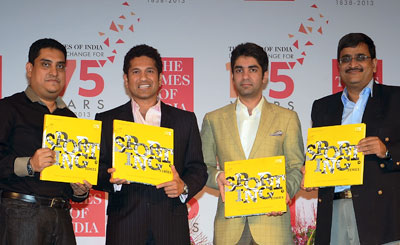
 By A Correspondent








 By A Correspondent