Tag: Times ofIndia

  • Bengal (paper) tigers set to roar


    By Ananya Saha


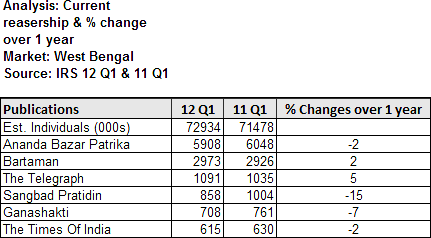
    Once the domain of Ananda Bazaar Patrika,West Bengal is now readying itself for an emerging newspaper war. The Times of India has trumpeted its entry into the traditional market with the announcement of its Bengali broadsheet Eyi Shomoy, and is putting its marketing muscle behind the promotion of the product. The Bengali broadsheet from BCCL will have to fight for numbers with Bartaman, Pratidin, Ganashakti and of course Ananda Bazaar Patrika.


    This is also for the first time that ABP’s dominance is facing a huge challenge. Whether as a gameplan or a coincidence, ABP has announced its evening tabloid Eyi Bela at the same time. The industry veterans are calling it mother of print battles: BCCL’s strong marketing and distribution against ABP’s loyalists. ABP currently dominates the print market with many of its publications aimed at each segment: Ananda Bazaar Patrika (Bengali daily), The Telegraph (English daily), Desh (Bengali magazine), Anandamela (Bengali children’s magazine), Anandalok (Bengali cinema magazine), Sananda (Bengali women’s magazine) and Sportsworld (English sports magazine).


    While some may argue that ABP is entrenched in this polarised Bengali market, others say that TOI will be able to make a definite dent in the market. Call it retaliation or just a good act, but ABP is said to be lowering rates, and increasing the pages of the newspaper. This is something that the Bengali newspaper has not ever done to counter any of the other newspapers’ entry. Meanwhile, it remains to be seen if TOI’s youthfulness will reflect on its Bengali broadsheet as it takes ABP on home turf.


    So far, the Bengali print market has been without any incident, and nobody has been able to impact it. A media veteran said that TOI will not have it easy. Why? “The Kolkata market is biased and opinionated. With its regional paper, TOI will not be able to address the local Bengali readers… It may do well in a Delhi or Mumbai where people do not have the time to read opinions.”


    ABP, moreover, has emerged as a clear (and consistent) leader in the market. It is true that when the English daily Times of India entered, ABP’s Telegraph did feel the jolt. Currently, in the market of 15-16 lakh readers, APB’s readership is close to 12-13 lakh, according to an analyst who has been observing the market keenly. But media specialists are sure that the TOI Bengali edition will pick up well when it launches, and managing two lakh copies initially will not be difficult for Eyi Shomoy. However, a media veteran noted that even with its marketing muscle, TOI’s Eyi Shomoy may find it tough to get the numbers until it  addresses the Bengali janata the way ABP’s Bengali daily does or is capable of.


    Currently, 70-80 percent of newspaper revenues are lapped up by ABP of the Rs 250 crore (rupee/advertisement) Bengali print market. The share of revenue by ABP is much more than readership, noted the media analyst. The idea of ABP’s launch of Bengali tabloid Eyi Bela is probably to target the lower-end advertisers in various districts and smaller cities. This may well become the golden opportunity of revenue for the paper, since it could attract a bulk of advertisers who are not able to advertise in high-priced media vehicles.


    Also, Eyi Bela is aiming to attract the growing youth population of the city. Industry analysts are divided given that the commuting culture in the city is different from Mumbai’s. “The evening segment dynamism is missing in this market,” noted an analyst.


    However, Sundeep Nagpal, Director, Stratagem Media, differs. He said, “I am actually surprised that no one launched an evening tabloid earlier in this market. Wherever there is a commuting culture, the tabloid can succeed. However, in this case, it is going to be the case of high distribution since an eveninger’s content cannot guarantee readership.”


    Even as the politically aligned market is going to see new entrant, the dynamics within the market is also undergoing a change: the rise of double-income couples, the need of smaller retailers to reach out to the aspirational class, evolving youth and rising city phenomenon. The evening tabloid may cater well to this segment.


    Media veteran Sajal Mukherjee shared his observation, “The West Bengal market is one of the oldest traditional markets inIndia. One might argue that the Bengali community is loyal to ABP but it is also true that readers want value for money. And loyalties shift depending on the value they get. In the Karnataka market, Prajavani had a stronghold where Vijay Karnataka challenged it and succeeded. Similarly, Divya Bhaskar was able to make a clear dent in the Gujarat market, which was led by Gujarat Samachar and Sandesh.”
     

    “If there is good marketing support in the new market, combined with good benefits to the readers, the loyalty will obviously be dislodged. TOI has had enough experience in the local markets, and it will be a good war to watch in Bengal,” Mr Mukherjee noted.


    What may also act in favour of TOI is that they will be able to offer a 360-degree national bouquet on good rate to advertisers. Mr Mukherjee opined that Eyi Shomoy has huge scope to gain the second spot in the market. TOI is already making itself familiar to the local audience by sponsoring ground events. This might work in the favour of the new broadsheet since people will be ready to subscribe to it. TOI is clearly aiming at growth for the future, and is not looking at short-term benefits. The industry veterans note that after Eyi Shomoy hits the 3-4-lakh mark, it might get troublesome for ABP.


    But ABP will not let go of its domain so easily. Will it result in a new strategy? Can Eyi Bela actually make a new market in Bengal? And will Eyi Shomoy’s challenge to ABP be tackled more forcefully? Advertisers and analysts might differ, but it is readers who are bound to get the sweetest deal.


  • The Anchor: Asif Syed on 5 Things that are getting hotter in New Delhi

    By Asif Syed


    1. Manmohan Singh – Will the sardar become asardar?

    For a while now, many observers of the Delhi durbar have felt that the real Prime Minister wasn’t Manmohan Singh, (no, not Sonia Gandhi, she’s the super PM) but Pranab Mukherjee. Whether it was with government work, party work, troubleshooting for the UPA sarkar or heading 13 Groups of Ministers that deliberate on government policy, Pranab was the man. The joke is that the PM (Manmohan) spoke so little is because the real PM (Pranab) didn’t let him.


    Now with Pranab on his way to becoming President of our republic, many ministers in the Union Cabinet have found some additional breathing space, but none so much as Manmohan Singh. So much so that the very day he took over the Finance Ministry, the sardar ordered the government to go looking its lost “animal spirits!”


    So will the sardar become asardar or will the real number 2 – P Chidambaram, who was second only to Pranab in the GoM count with 12 in his kitty – muscle in and fill in the vacuum.


    2. The Summer of 2012

    The venerable Times of India has reported that Delhi has had the hottest summer in the past 33 years with the average temperature frizzing the mercury to an average of 41.25 degrees. Interestingly, and what is probably a sign of the times, the data for this investigative story was sourced not from the Metrological Department of India but from the website of the National Climatic Data Centre (NCDC) in the United States.


    Unlike Bombay and (ahem) some other parts of the developed world that have uninterrupted power supply, Delhi seems to have introduced the new concept of uninterrupted power cuts. Add to this the severe water shortage – basically no water at all from the MCD – and one gets situation where residents who are out on the streets to protest the lack of bijli get into a scuffle with each other over tankers delivering water.


    Of course, Lutyens Delhi, home to national level politicians, bureaucrats and businessmen has no bijli or paani problems. The air conditioners in the MPs homes are humming and sprinklers keep their lawns achingly green.


    There is fervent hope that the monsoon rains will bring some respite but they too seem to be avoiding Delhi and are stalled somewhere over central India. Maybe the ToI can talk to the NCDC about what to do…


    3. The most modern thing in Delhi

    Not all is bad in Delhi and the Delhi Metro Rail Corporation is the best thing going on the ground, below the ground and above the ground. It has changed the face of Delhi for the better like nothing else and with every phase of expansion it is bringing the spread out city of Delhi and the other parts of the National Capital Region closer to each other. It is the one thing that works in the city of a thousand hindrances and works very well.


    With two phases completed and almost 200 km of track laid and services running, the DMRC has commenced Phase III which it aims to complete by 2015 and Phase IV by 2021. By then the Metro will have more than 400 km of track and will reach every corner of the megapolis. It is already one of the most advanced metros in the world and soon will also be one of the largest. (check out this map – http://en.wikipedia.org/wiki/File:Masterplan_of_Delhi_Metro.png)


    Like Vicky the eponymous sperm philanthropist of the move Vicky Donor says to his nani, “Dill mein sirf do cheezein modern hain, ek hai metro aur ek tu.” I can’t vouch for the old lady, but he is bang on with the metro.


    4. News Capital

    For a city where the large majority of the people have at best only a passing acquaintance with the English language (or as they say in Delhi – bus sirf hi/hello hai), it is home to more English language newspapers, magazines and television news channels than any city in India.


    At last count there are more than 15 mainstream general and business daily newspapers being published from the city in English. The Millennium Post was the latest of the blocks and a couple more are reportedly in the pipeline. At this rate we run the risk of soon having more English newspapers than readers who read English.


    Throw in Hindi and other language publications and Delhi is probably host to the largest print news industry, with more print journalists than any city in the world. And in no other city can one find such a large number of journalists that speak, report and write in such a range of Indian languages.


    Sucking in all the content produced everyday and spitting it out in a physical form is a robust contract printing industry that is centred largely in neighbouring Noida. The printing industry there probably has the distinction of having not just the largest number of printing presses of all shapes and sizes of any city but of also printing newspapers not just in English in Hindi but also a number of other languages. For example, Vibha Printers (in NOIDA obviously) print newspapers in six languages.


    Never mind the lack of revenue, let alone profits, the news business inIndiais growing faster than ever before.


    5. Rahul Gandhi – naram but still garam

    As ever, Rahul Gandhi remains the hottest politician in India and with talks of an impending Cabinet reshuffle he is hotter property than ever.


    There is now talk about him finally finding a seat in the Cabinet as the Deputy Prime Minister, no less. The logic goes that this will be a suitable post for him to make his entry into the government as it won’t be decried as nepotism at its most obvious and it will still be a prominent enough to position him as the next leader of the party and the government. Party pundits feel the results of the next general election in 2014 will be determined by the ‘Youth Vote’ and who is better to capitalise on this demographic dividend than the youthful Rahul Gandhi.


    His middle-of-the-road pragmatism and firm resolve to stay away from the politics of caste and religion give him a universal appeal. And that, the thinking goes, will lead to a windfall of young urban and rural votes for the Congress and its allies.


    Though it would be wise to recall the ‘Rahul Effect’ in recent elections. Beginning with Bihar and followed by Pondicherry and most recently Uttar Pradesh, the last three assembly elections where he has played a significant role, it has become clear that Rahul’s presence alone does not bring in electoral results for the Congress party.


    However, the party, and specially dye-in-the-wool Congressmen, can’t stop gushing about him like schoolgirls with a crush on Ranbir Kapoor.


    Asif Syed is Editor and Publisher of Current and www.CurrentNews.in. He toggles between New Delhi, Mumbai and Buenos Aires


  • IRS 2012Q1: English readership throws up usual pattern

    By A Correspondent


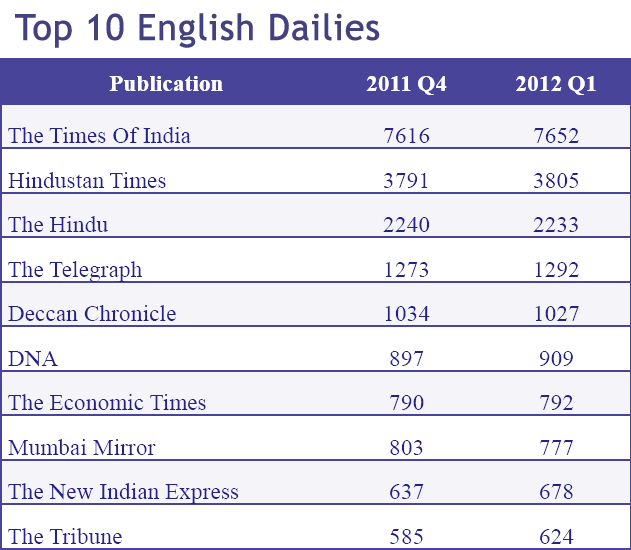
    A favourite with the urban zones and also with the advertisers, English dailies and magazines have shown an average readership trend in 2012Q1. Leading the list yet again for the dailies is Times of India that has recorded an AIR of 7,652 as against 7,616. Hindustan Times is next with an AIR of 3,805. The Hindu has seen a gradual decline with an AIR of 2,233 and occupies the third spot. The Telegraph comes fourth with an AIR of 1,292 while Deccan Chronicle is fifth with an AIR 1,027. DNA has shown a slight growth recording an AIR of 909 as against 897 it recorded in 2011Q4. The Economic Times follows with an AIR of 792 followed by Mumbai Mirror at 777. The New Indian Express is ninth with an AIR of 678 while The Tribune rounds off the list with an AIR of 624.


    (AIR numbers; all figures in ‘000)


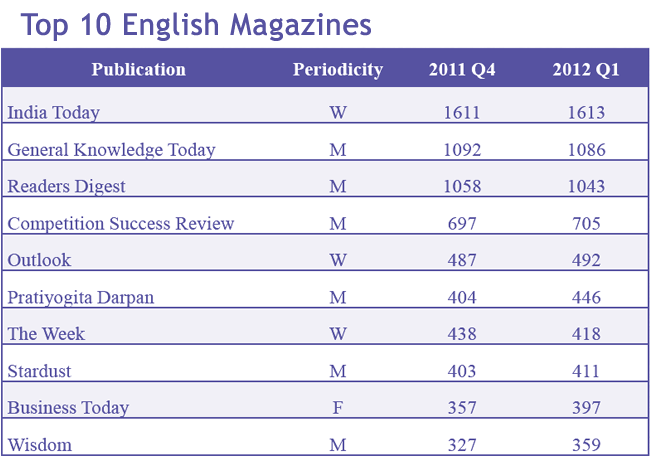
    The trend for magazines is somewhat similar to that delivered by dailies. India Today, retaining its top spot, has shown a small hike with an AIR of 1,613. General Knowledge Today is second on the list with an AIR of 1,086. The going is downhill for Readers Digest that posted an AIR of 1,043. Competition Success Review is next on the list having posted an AIR of 705. Outlook follows next showing growth with an AIR of 492. Pratiyogita Darpan is next with an AIR of 446. The Week follows with an AIR of 418 while Stardust is next with an AIR of 411. Business Today is ninth on the list with an AIR of 397 while Wisdom ends the list with an AIR of 359.


    (AIR numbers; all figures in ‘000)


  • Press Club Bombay honour bigger than Padma Shri: Vinod Mehta

    By A Correspondent


    Acknowledging to the audience that his heart still favoured Mumbai over Delhi and it was Mumbai that saw him at his pioneering best, Vinod Mehta, now advisor to the Outlook Group, was a picture of pride and fulfilment as he received the coveted Lifetime Achievement Award bestowed on him by the Press Club of Mumbai on May 4.


    Receiving the award from Kapil Sibal, Union Minister of Communications & IT, Mehta thanked the members of the fourth estate and said that this award means more to him than even the Padma Shri. Mr Mehta was felicitated for his selfless contribution of more than 35 years to his passion – journalism. Mr Mehta joined a host of winners from the fourth estate that were honoured by the Press Club for outstanding contribution to the trade.


    The evening also witnessed two special awards being given to late Pradeep Vijaykar (formerly with Times of India) and eminent journalist Madhu Shetye for their outstanding contribution to the domain. Gurbir Singh, President of Press Club of Mumbai delivered the keynote address while veteran sports journalist Ayaz Memon was the emcee for the evening.


    Prior to the awards ceremony, the evening witnessed a scintillating panel discussion on the role that media was portraying in the country and whether it was headed in the right direction. The panellists included Arnab Goswami of Times Now, who moderated the session, Vinod Mehta of Outlook Group, Kumar Ketkar of Divya Marathi and Uday Shankar of Star India.


    Mr Goswami began by stating that there is no shortage of attention being showered on media but expressed concern when he said that never has the media done so wrong. “The question that all journalists and editors need to ask ourselves is, are we doing everything right today? Is the chase for news headed in the right direction?”


    Replying to his question, Mr Mehta said: “There is no problem with the direction, what is essential is for us to judge the media in the environment it works in. The judiciary and press media still function with a degree of idealism and integrity but there is so much of self-congratulation that is happening; that is something that is slightly out of proportion.”


    Expressing his views on the issue of responsibility, Mr Mehta said: “Where the young journos are concerned, I feel they have a good sense of idealism and integrity but if there is somebody who has to take the blame for the current state of affairs, it is the editor. Even if somebody from the team has committed an error, the editor has to take ownership of that and find a solution to it. The problem is that the editors have forgotten what their job is and are pursuing their own agenda. The need of the hour is self-examination; we need to introspect and be accountable for our actions.”


    Replying to Mr Goswami’s query on whether there was unity between members of the fourth estate and the role that editors essayed, Kumar Ketkar said: “It is the editors who stop news from being published and not the management as many think. The editors try and control their reporters and that should not be the case.” Mr Ketkar cited the example of the slain BJP leader Pramod Mahajan, who was shot by his brother a few years ago. “When his brother was arrested for his murder, he had written a letter from the jail explaining his stance and he wished to supply the letter to all in the media. I was told that most editors had agreed to play up the letter in their publication and so I went ahead and planned a big editorial spread for the news. But the next day, I was surprised to see that only my paper had carried the news. This shows the lack of unity existing between the media players today.” According to him, “The media today is not clear on the role that it has to essay. They are not mature enough and lack understanding skills. Journalists themselves are timid and lack courage.”


    Uday Shankar, CEO of StarIndia went on to describe how television as a medium emerged in a big way first during the 90s and then again during 2008-09. “A lot is being said about how news television has been crowded space but I feel it managed to rediscover its own agenda during 2008-09. I cannot understand when some people say media doesn’t do self-introspection. If that is what is claimed, then how come they’ve come to rediscover themselves? Personally, I feel media has done the right thing by chasing news. If there are people who still have questions about the role of news channels, then I cannot understand whether media should be responsible for what it does or whether it should concentrate on doing the right thing?”


    The panel went on to discuss how urban centres led by metropolitan cities were receiving maximum attention from the media and how stories from the rural and less important towns were being ignored in a large way. The need of the hour, the panel highlighted, was to bring out stories from these small cities and towns which were inspirational in nature.


    Winnerspeak:

    Ashish Khetan, Editor – Investigations, Tehelka

    “I bagged the top award for my story on the national rural health mission scam that was unfolding in UP. The story was not about the bonds between the corporation and ministers but how corruption was actually killing people. The funds which were allocated for improving healthcare for the needy and rural people were being siphoned off and embezzled by the whole gravy train of bureaucrats, including politicians. Unfortunately the story did not get much play in the national media because it was centered around the poor but I feel the story was more important than 2G, CWG or other scams that were covered by the media.”


    Abhijit Sathe, Sr Asst Editor, Mumbai Mirror

    “I won the runners-up award for Crime (Pradeep Shinde award) for my story Hiranandani vs Hiranandani. The award means a lot to me. The story was a big one that chronicled infighting between families of one of the biggest names in business today. I exposed how two siblings were sabotaging each other’s interests. I am greatful that I was selected for, and eventually won the award.”


    Rafique Baghdadi, Business India

    “More than react to the win, I would like to say this: more than 62 years ago, a lady called Ms Panna Shah, had done a PhD in Indian Cinema and since then there is nobody who has done that course in the industry as yet. It’s high time the business houses, film industry and the state government should give grants and scholarship to aspiring candidates to pursue that course.”


  • BJP suffers the wrath of young India

    By Ranjona Banerji


    It was wishful thinking on my part that Porngate would slowly lose currency on television. Quite the opposite happened, in fact, as emotions in TV studios ratcheted up as the day progressed. By the evening, this was the worst transgression ever committed. Bad as it was, it is still open to question whether it deserved quite so much rage. It usually seems that TV channels inIndiaare quite sympathetic to the rightwing – except of course those which are seen as open Congress supporters.


    But even those with saffronish tinges – or especially those with saffronish twinges – were the angriest with these porn-watching Karnakata ministers. A humble theory could be that the extreme Hindutva rightwing in Karnataka has been making life miserable for young people and this was revenge time for the young people in television.


    The Times of India in its editorial took a sober tone but was no less damning of the behaviour of these MLAs. Nor did it fail to rip into the moral hypocrisy of the Hindutva rightwing. The Hindustan Times decided to take a more jokey tone, which seems as inappropriate as TV’s relentless coverage. Hindustan Times kindly informed us that the minister was mistaken in thinking he was watching a rape when it actually was a “bukkake”. One could thank the newspaper for increasing our knowledge of terms used in pornography but one is not sure if this has any connection to the case in point.


    One has to agree with author and columnist Shobhaa De when she said on Times Now that this was one of the rare times that she actually felt sorry for BJP spokesperson Nirmala Seetharaman, in having to defend her party’s action (or inaction) against the three ministers.


    * * *


    It was heartening to read Shailaja Bajpai in her TV review column in Indian Express asking whether such intrusive coverage was necessary about cricketer Yuvraj Singh’s cancer. It is also intriguing that the cricketer tweeted that he had not spoken to any newspapers since his latest treatment started. So where did all those “interviews” come from?


    * * *


    The Economic Times has front-paged (I’ve decided this is a convenient noun to make into a verb!) a story about how Indian companies are now trying to be kinder to employees who are being laid off. The usual tendency is apparently to be as insensitive as possible. Citibank, for instance, is now looking for jobs for the 100 people it “let go” of. Does this give heart to people who think their jobs are on the chopping block?


    * * *


    Pranab Mukherjee, Union finance minister, is losing sleep over the size ofIndia’s subsidy burden. I suppose that in itself is good news.


  • It’s wait ‘n watch for TOI-Matrubhoomi alliance

    By A Correspondent


    After much speculation, The Times of India has finally made its foray into the Kerala market, forging a strategic alliance with Mathrubhumi to make inroads into this market. While for readers this alliance might be the best deal as just for Rs2 extra they get a copy of Mathrubhumi and the TOI with its many supplements, as a reader quipped: “This is not a bad deal for 2 bucks”.


    This exactly is the sentiment that TOI wants to ride upon – the bundling with a regional newspaper which the readers are familiar with and allow them to test something new definitely is a great way to enter a new market dominated by regional players.


    Kerala, in that sense, is a unique market with high literacy rates and people who are proud of their culture, willing to try something new but not at the cost of old. Hence, it is primarily seen as a two newspaper-market where one paper is regional, which appeals to the older generation and is more of a habit, and the other is an English newspaper appealing to the younger population.


    It is this younger population that TOI is trying to appeal to. The English newspaper market is primarily dominated by The Hindu, The New Indian Express and more recently Deccan Chronicle. The Hindu too has become aggressive and gone all out to protect its turf.


    Recently, on January 29, just two days ahead of the TOI launch, The Hindu and The Hindu Business Line launched its Kozhikode edition. This shows that The Hindu understands the might of TOI and has gone aggressive with its 360 degree campaign to reiterate its hold over this market. In fact, it has also taken around 30-35 hoardings to make itself visible while sources inform that TOI has taken up around 80 hoardings across to announce its presence in Kerala.


    The divide in Kerala, according to reading preference, is: South to Cochin (till Trivandrum) is where readers prefer Malayala Manorama whereas the area from Cochin to Kasaragoda is dominated by Mathrubhumi. This liking is also based on the political inclination too. Currently, TOI has come out with editions fromKochi, Thiruvananthapuram,Kozhikode, Kottayam, Pathanamthitta, Malappuram, Palakkad, Thrissur, Alappuzha and Kollam, thus being seen all over Kerala.


    However, it is learnt that the paper is having teething troubles: The newspaper is not available at many places; the hawkers union’s in Kerala raising ruckus over the availability of the newspapers in some pockets.


    Giving his view, Kiron Kurian, Group Manager, MudraMax said: “For TOI the real competition is The Hindu in this market. Their current strategy of tying up with Mathrubhumi, as I see, suggests that as the former caters to Sec A and B audience it will be easier to convert this TG to also adopt TOI as a second newspaper.”


    Swarup BR, Founder Stark Group, a Kerala-based 360-degree communication agency feels: “I think largely the TOI offering in Kerala market is nothing phenomenal from what has been seen in the other markets. There would be many people who would want to try out the newspaper and along with their aggressive marketing strategy, it should work out well for them.”


    However, for all, it’s ‘wait and watch’ to see how the market evolves. Some feel that a new trend might start with homes having three newspapers, with both Hindu and TOI having their share of readers. Also there could be revised rates to capture more audience.


    This TOI- Mathrubhumi alliance, while is advantageous for the former, will also be good for the latter as it might give it the much needed push that it requires to lessen the gap with the leader Malayala Manorama.


    Vidya Nandakumar, Business Director, LMG based in Cochin is doubtful that TOI will find it easy to break the monopoly of The Hindu. She said: “In Kerala people are die-hard loyalist and if they like a brand, it is difficult to make them switch. So it would be interesting to see how TOI gets them to convert.” She is of the opinion that probably it would be some pockets where TOI might succeed.


    But Mr Swarup countered: “Kerala is a ‘rurban’ economy; hence there is no clear divide between rural and urban. The brand proliferation too is across the market hence it is one big market. The opportunity for a TOI to reach across is immense. The entire state is a captive market, not just few pockets of interests. Yes, The Hindu is a formidable power and people would not be willing to give the newspaper so easily for TOI. So in that sense it would be interesting to see how the market plays itself out. It is possible that a whole new audience will evolve who will be readers of TOI.”