The Times Group has announced the appointment of Varun Kohli as Chief Operating Officer for the News Broadcasting Business. Varun will report to Managing Director Vineet Jain’s office while working closely with N Subramanian , Executive Director and Group CEO, Non-Publishing Business, Times Group. Kohli’s last assignment was with Bharat Express as Director and CEO. MK Anand, who led Times Network as CEO and MD will now work in the Times Group MD’s office and will continue to report to Jain.
All functions in the television news broadcasting business other than finance and distribution will report into Kohli. Jagdish Mulchandani, who heads the Finance, Legal and Distribution function for news broadcast will work with the MD’s office for the finance and legal functions. For the distribution function and the entertainment business, Mulchandani will report to Rohit Gopakumar, CEO – Entertainment Business , Times Group. Mulchandani will continue to work closely with the news, entertainment and the TTN digital verticals.
According to a circular issued, these changes will be effective immediately.
The Times of India has launched a video with Sivakumar Sundaram, Chairman Executive Committee of BCCL in collaboration with Brut India, a digital video publisher, that takes the viewer through a tour of TOI’s Mumbai office, its newsrooms, and the editorial meetings and then gives a glance into the printing press of the Times Group.
Informs a communique: “The video continues with Sivakumar surprising and delighting readers by getting onto a bicycle and distributing TOI to their houses. He then sits down to discuss some of the challenges and future of TOI and how TOI is trying to address the need of its readers in this era of fake news. He talks about the credibility and authenticity of the news as well as the power of the printed word in the age of fake news. He also emphasised how TOI delivers curated news that can be consumed in 30 minutes every morning rather than scrolling through a deluge of digital news and information that may or may not be accurate.”
Said Sivakumar Sundaram, Chairman Executive Committee, BCCL: “It is understanding the whole magic in this– the back story of how so many people at clockwork precision come together every single day to make your morning paper come alive and prepare you for the day ahead. Because print is the final word on the most authentic and credible news.”
Leading newspapers Mathrubhumi, Malayala Manorama and The Times of India have announced a collaboration to create mass awareness for Onam festivities
Commenting on this initiative, M V Shreyams Kumar, Managing Director, Mathrubhumi Group said: “Healthy competition in the marketplace will always stay, so is the opportunity to collaborate meaningfully if the purpose is right. I’m grateful to Malayala Manorama and Times of India for finding merit in the proposition and readily accepting the same too. It is a great pleasure to be working together. Business owners are excited about the opportunities in the market and consumers are waiting to grab their products and services, evident from our daily ad volumes.”
Added Varghese Chandy, Vice President -Marketing & Advertising Sales, Malayala Manorama: “This is indeed a great initiative. Onam is the beginning of the festival seasons in the country. Past few Onams were washed out due to floods, Covid etc. This year fortunately the markets are opened and am sure will be the most opportune time for marketers to leverage the Pent up demand and the Onam sentiments. Who else knows this better than the leading print players in Kerala and that is what this collaboration is all about.”
Said Partha P Sinha, President – Response, The Times Group: “Onam is a celebration of togetherness. In the true spirit of Onam, we are happy to join hands with Mathrubhumi and Malayala Manorama for ushering in positivity and change this festive season. We are glad to see that Malayalis have left the past behind and are ready to welcome businesses with zeal and warmth. Happy Onam!”
The campaign will run across media assets of these three groups for the next few days.
The business of news and entertainment is unique from other businesses as there is no underlying need for consumption and content is easily replaceable with similar alternatives. Hence, the entertainment industries have always relied heavily on glitz, gossip and glamour to garner consumption.
This has taken many avatars through the decades. In the early 2000s, the Times Group innovated and changed the PR landscape when they launched Medianet, renamed as Optimal Media Solutions (OMS) since. It was very successful for the both the media and entertainment industries, because of the blurred lines between ads and news. The audience was oblivious as long as gossip and entertainment was delivered and hence many a film were boosted due to entirely manufactured gossip on link-ups and skirmishes on set. TV news followed soon after. NDTV was the front-runner of branded content in TV with shows like Earth Hour, Greenathon etc. Today, weekend programming across English news channel almost entirely comprises such branded shows.
The digital equivalent of Medianet is the manufactured views, likes, followers and trends because the lines between the inorganic and organic are blurred. This is more dangerous than Medianet, because all social media platforms have Achilles’ heels which can be exploited to manufacture reach that is invisible even to the discerning viewer.
All this changed when last month, the Mumbai police launched an investigation into the 75 Lakhs worth of YouTube views purchased by Aditya Singh Sisodia aka Baadshah for his 2019 single, ‘Pagal’. The song launch was a mega-affair with influencer marketing campaigns on Instagram and TikTok, YouTube advertising and other dubious means employed in an attempt to break records. Baadshah claimed that ‘Pagal’ was the fastest video to reach 75 million views on YouTube, which was promptly shot down by them due to inorganic means employed. This has subsequently lead to the ongoing criminal case filed by the Mumbai police and the investigation thereafter. The case has opened a can of worms, as newer unethical practices of the digital ecosystem of the entertainment industry began slowly getting exposed.
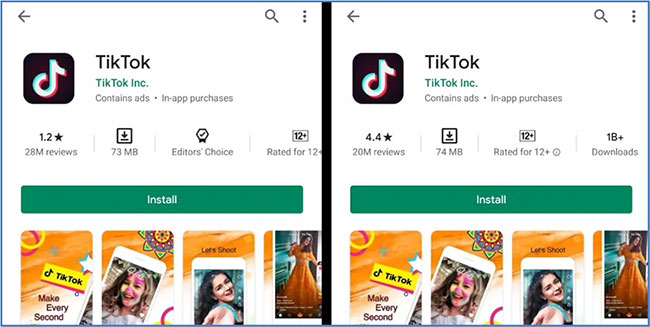
To be honest, in 2020, Baadshah’s admission to buying views would not have come as a shock to most of us. Even the undiscerning viewer sees enough chinks in the digital armour – screenshots of identical tweets from celebs (right down to grammatical errors) praising a government or a popular icon, TikTok’s Playstore ratings being brought down in a day and then restored are two of many examples. What is not common knowledge is the sheer mechanics and extent of what goes into digital influence manufacturing and the reasons behind it.
In May 2020, TikTok’s app store ratings were restored after Google deleted 80 Lakh negative comments made in the span of a week in response to the Galwan Valley skirmish. The Chinese app has since been banned in India.
Why do Indian Artists companies do this?
Creating a buzz in the entertainment business is crucial to remain relevant. Social media metrics have come to define the salability of the artist for producers and distributors. It is a flawed ecosystem exploited by all the players. To elucidate –
The problem with the Algorithm
View counts on YouTube, don’t differentiate between paid and unpaid views or the viewership duration (a view is counted after only 30 seconds of consumption). Views are a key metric for YouTube’s algorithms, especially when it comes to search result rankings and recommendations, which help drive organic views and hence generate revenue. Hence, paying for views is a natural choice because they help recoup advertising investments through organic views, while adding the credibility that higher view counts get.
Not only vanity metrics
For films, OTT and satellite TV, rights are often sold after movie trailers are released and the view metrics of the trailer, contribute to the negotiating power of the producer. Likewise, in the music industry, licensing deals, terms of contracts, concert tours and appearances are often measured basis song popularity. Hence, paying for YouTube views is a natural investment that pays for itself many times over.
The problem with the platforms
It serves social media platforms to have higher view counts because, it drives up daily traffic on the platform, while generating ad revenue. This problem of fake news, fake views, and bots serves social media portals which rely on user metrics to help set ad rates. In the absence of stringent laws, while popular social media platforms do make the right noises about removing bots and fake profiles they have little incentive to actually follow through.
It’s not a crime in India… not yet!
Many countries across the world like Singapore, France and Germany, are enacting strict cyber laws that punish hate-speech, threats, and impersonations (under which fake followers lie) as criminal offences, liable to both imprisonment and fines. In the absence of such laws in India, manufacturing inorganic views becomes dishonest but not illegal. While the fake likes industry has been thriving for the last few years, the case against Badshah may just be a watershed moment in the creation of cyberlaws, which will bring more transparency in Indian cyber space.
Till laws change, as a marketer, I leave you with my content checks to avoid being gamed. On YouTube, I check engagement (likes and comments as a percentage of views), for highly viewed content before investing the time to watch. If the number is low, it is safe to say that the views have been bought. And on Twitter, inorganically trended hashtags will have a majority of tweets with the same sentence structure and central thought – so a quick scan of tweets under a trending hashtag will help check ingenuity.
Bhuvi Gupta is a marketer with over 10 years across industries, of which the last six have been in Media & Entertainment. She has been a part of many launch marketing campaigns – specifically at the Times of India group, Republic TV and the latest in marketing a Bollywood film. She will write on A&M (mostly marketing, but often on advertising too) every other Tuesday. Her views here are personal. She tweets at @bhuvigupta3
The Times of India had bumper issues on Saturday, August 15 with a total of 60 pages in Mumbai, 72 pages in Gurugram, 58 pages in Delhi, 78 pages in Hyderabad, 52 pages in Bengaluru and 46 pages in Chennai including supplements, as per a press release. The paper drew advertisers across Retail, Real Estate, Auto, FMCG, Consumer Durables, E-commerce and many more categories inviting consumers with amazing deals and messages, the communique added.
Said Partha P Sinha, President – Response, The Times Group: “We believe these are the initial signs of good things to come. Companies are confident that this festival will see a big resurgence in spending and the economy will get back on its feet. It also establishes print as a credible and dominant medium for reaching out to premium audiences. There’s no better way to make an impact.”
Added the communique: “The Times of India Group publications have recovered almost 90% of circulation in some markets and over 70% in most markets. This is another reason advertisers are coming back to print to re-build their market shares, as the distribution is fast reaching pre-lockdown numbers. Every Saturday for the last 3 weeks has seen The Times of India come out with 50+ pages across their key markets. Today, has been the highest since lockdown. A great way to unlock a new sense of freedom – that of positivity and confidence.”
It was only appropriate that the announcement and the detailing was done via Tweets. After all, we are talking about the man who set up Twitter in India, and has possibly been living his life in 140 charcters… over the last four years at least.
So here are tweets, as he posted them:
> Today, I’m excited to share I’ll soon be joining Bennett Coleman and the Times Group, India’s largest media company, as CEO of @TimesGlobal!
> At @TimesGlobal, we’ll invest in & partner with world-class tech/media companies to help them realize their India opportunity more fully.
> We’ll build on the success Bennett Coleman & @TimesInternet have had partnering with @uber @Airbnb @coursera @VICE @HuffingtonPost & others.
> India is the world. Every element of the human condition, every wave of civic change, every business possibility exists in India at scale.
> To win India is to win everywhere. No matter your story/cause/business, success in India begets success everywhere, esp in the Global South.
> I’m looking forward to bridging the best ideas from the world’s entrepreneurial centers into India and to sharing insights back to the world
> I’m grateful to be able to draw on my experiences, and those of others, along w/ the unmatched resources of the Times Group to create value.
> I’m from NY so am allowed to quote Sinatra: I’ll make a brand new start of it, If I can make it there I’ll make it anywhere, it’s up to you!
The profile on his Twitter page reads: searching for my treasure. addicted to place. in awe of the untapped power of people. inclusive tech, engagement, storytelling. soon: ceo @TimesGlobal
It’s going to be a lot more just than a Cold Play concert. And, no, tickets aren’t priced at Rs 25,000. November 19 will see a mega-concert starring Coldplay of course and Jay Z, Aamir Khan, Ranveer Singh, Katrina Kaif, AR Rahman, Farhan Akhtar, Shraddha Kapoor, Arjun Kapoor, Arijit Singh, Dia Mirza, Shankar Ehsaan Loy and Monali Thakur. Several major artists and international guests will be announced at different stages of the campaign.
The inaugural Global Citizen Festival India is presented by Colors Viacom18. The festival is being produced by Wizcraft International and enjoys a strategic partnership with the Viacom18 Group and the Times of India Group. So will the event air live on one of the Viacom18 or Times channels? Time, will tell.
Meanwhile, Global Citizen, a social action platform, and The Global Education and Leadership Foundation (tGELF), launched the Global Citizen India platform on Monday, September 12. The platform will comprise a distinctive mix of events, grassroots activism, media campaigning and online activation, to catalyse India’s journey towards achieving theGlobal Goals for Sustainable Development, and to bring about the end of extreme poverty. The inaugural Global Citizen Festival India, to be held in Mumbai, will be Global Citizen India’s first initiative.
Free tickets to the festival can be earned through the new online platform, www.globalcitizen.in, by signing up to become a Global Citizen and completing the festival’s Action Journey. Shiv Khemka, Chairman, The Global Education and Leadership Foundation (tGELF) believes that India and its 800 million young people must play a vital role in the mission to achieve the global goals. “Young people are starting to engage with the challenges facing our country and the planet, and are becoming increasingly committed to taking action for social change. tGELF’s mission is to nurture and support ethical, altruistic and decisive leadership amongst young people at schools and colleges. Each one of us is responsible for our actions and the power of each action taken collectively can help achieve the global goals.â€
Global Citizen, which has mobilised millions since its inception in New York City in 2012, has a capacity to amplify the voices of Global Citizens through social media. In the past four years of this movement, actions taken by Global Citizens has led to commitments from governments, corporates and partners are set to affect the lives of 656 million people.
“The years I spent living and working in India as a teenager was a key catalyst of my passion for challenging the status quo of poverty alleviation. So bringing the Global Citizen movement to India is a moment many years in the making,” said Hugh Evans, CEO, Global Citizen
The Government of Maharashtra is the host partner for the inaugural Global Citizen Festival India, and the Chief Minister Devendra Fadnavis has extended his complete support to the initiative.
Commenting on Viacom18’s strategic partnership with tGELF, Sudhanshu Vats, Group CEO, Viacom18, said, “India is at a powerful confluence in its history. We are one of the oldest civilizations with one of the youngest populations in the world. Our support to tGELF is a natural extension of our work and purpose and I hope to amplify the messages around the causes of quality education, gender equality and clean water and sanitation with this initiative.â€
Viacom18 will be leveraging its brands across all platforms to promote the inaugural festival. While the network will use its popular channels and digital platform to promote the festival, Colors, MTV, Vh1, Colors Infinity and Voot will be airing the festival on their respective platforms. The Times of India Group and the Times TV Network will be leveraging the group’s print, internet and television platforms to highlight and showcase the Global Citizen India initiatives. Google is partnering the Global Citizen India initiative to address the issues of gender equality and women’s empowerment.
UPL’s partnership is focused on showcasing its vision to be a catalyst for a more equitable and inclusive society by supporting long-term sustainable transformation and social integration.
Speaking about the association, Sabbas Joseph, Founder-Director Wizcraft which is partnering the event and will help stage it, said: “Global Citizen India movement is the first such platform wherein popular culture meets public policy. We are especially pleased to showcase the coming together of India’s most powerful entertainers with the world’s most influential policy makers.â€
Limited Tickets would be available at BookMyShow from 12noon on September 15.
MEC India has bagged the TimesJobs digital business account, following a multi-agency pitch. As part of the mandate, MEC India will undertake digital planning, strategy and buying for the brand. Â Founded in January 2004 by Times Group, TimesJobs is an employment website operating in India and Middle East.
Speaking on bringing MEC India onboard as a digital partner, Vikas Deep Verma, Product & Marketing Head, TimesJobs.com said, “TimesJobs was in search of a partner who can offer innovative and media-neutral customer engagement solutions. MEC, with its successful track record, is now onboard as the strategic partner for our business needs. For 2016-2017, we have devised aggressive growth plans and looking forward to do some great work in the coming months.â€
Commenting on the win, Roopam Garg, National Head – New Business Development and General Manager – North, MEC India said, “We are delighted to have the opportunity to partner with TimesJobs. This win reiterates MEC’s credentials with regards to full-service, cutting-edge digital capabilities. MEC has been constantly growing its digital business through such noted clients. We have planned some exciting initiatives for the brand which would deliver positive outcomes for TimesJobs.† The account will be handled from MEC Delhi office.
The Times of India Group has been supporting young talent in the advertising and media industry by creating opportunities on the Young Lions and Young Spikes stages. A great outcome this year was the Silver bagged by the Young Marketer’s team by HUL at the Cannes Young Lions last month. In keeping with this endeavor, The Times of India has announced the Young Spikes contest for two categories – Integrated & Media.
Times Group will sponsor the winning teams with an all expense paid trip to Singapore to represent India and compete internationally at Spikes Asia 2014, happening on 23rd – 26th September 2014. Entries will be judged by a prelim jury and the chosen finalists will make a physical presentation to the final jury in the first week of August in Mumbai. The entire judging process will be overseen by Ernst & Young, Process Partners for Young Spikes.
This year’s Theme for Young Spikes – Integrated is on “Stop Unnecessary & Incessant Honking on Roads”, while the Theme for Young Spikes – Media is on “Naked Overhead Wires, a Threat to Life”.
The final jury for Young Spikes Integrated has a host of prominent names like Josy Paul, Arun Iyer and Senthil. An equally distinguished jury for Young Spikes Media consists of names like Nandini Dias, Yesudas and Ravi Rao.
Advertising agency RK Swamy BBDO has bagged the creative mandate for Magicbricks.com – the property portal from The Times Group. The win comes on the back of a hotly contested multi-agency pitch that was spread over a period of two months.
Speaking about the win, Sunil Kukreti, Senior Partner, R K Swamy BBDO, said, “This is an interesting category with a huge canvas available for creativity. We will make the most of this opportunity by creating interesting clutter-breaking work for Magicbricks.”
Magicbricks.com is India’s number one property portal with a host of specially developed features and tools to aid the users in taking the right decision; making it the most comprehensive platform in the category.
As a part of its foray into the education business, The Times of India group has launched the TimesPro brand under the Times Centre for Learning. TimesPro aims to provide skills to the industry and transform graduates to professionals by offering specific courses in BFSI (Banking and Financial Industry), Media, Organized Retail, Hospitality and Healthcare.
As a part of the launch, the company has set up state of the art learning centres in Mumbai, Noida, Jaipur, Lucknow, Ahmedabad, Hyderabad and Bhubaneswar. The company will leverage the group’s extensive resources, knowledge base and technology expertise to provide a first of its kind learning experience.
In creating this new education initiative, the Times group has taken the lead from the fact that there exists a large gap between industry requirement and skillsets of fresh graduates. The extent of this skill gap has been highlighted in the 2013 employability survey by Associated Chambers of Commerce and Industry of India (Assocham) which states that only 10 percent of graduates are employable.
On the launch of TimesPro, Managing Director Vineet Jain said, “The Times of India Group has innovation and excellence in its DNA. TimesPro through its unique and modern training programmes will provide the industry with graduates having relevant professional skillsets. These programmes will also make graduates more employable and job-ready.”
In its endeavour to upgrade the skills and knowledge of graduates according to the needs of the corporate sector, TimesPro courses will be designed and delivered by industry experts having extensive experience across industry and academia. Its flagship programme – Post Graduate Diploma in Banking Management will be launched in June 2013 and will cater to the rise in demand for skilled graduates in the banking industry that is expected to be created by the influx of private banks in the next few years due to the amendments made by the RBI.
Navbharat Times (NBT), the Hindi daily from Times Group, is launching its special NCR edition in order to further strengthen its position in Delhi-NCR. There will be no change in the pricing and it will remain Rs2.50 per day. Understanding the latent need and growing popularity of regional content amongst its readers, Navbharat Times decided to tailor its offering accordingly.
Ranjeet Kate, Director Languages- Bennett Coleman & Co. Ltd said, “Of late, media buying behaviour has seen a lot of change. Advertisers see language dailies as a medium providing valuable and sizable reach in key markets like NCR. While on the other hand, ‘readers’ of such fast-paced cosmopolitan cities see newspapers as a trustworthy guide. We can deliver value in such a scenario with a customized NCR edition for both our readers as well as the advertisers.”
For most of the advertisers, NCR is an important territory. Advertisers who are advertising inDelhican takeDelhi+NCR package at a nominal add-on cost.
The NCR edition will not only retain its special Delhi and national content but will also offer a complete coverage of the state-level news in UP and Haryana. This special NBT-NCR edition will be available in all the five suburbs (Ghaziabad,Faridabad, Gurgaon, Greater Noida and Noida).
Readers in these areas will also get the hyper local city pullouts in their respective regions, along with the main issue. Regionalizing the main issue will make the product offering appear more promising and customized for its NCR readers.
Aman Nayar, Brand Manager- Navbharat Times said, “Most advertisers who advertise in Delhi would also want NCR and giving the minimal add-on rate, NBT intends to add most of its NBT Delhi advertisers to the NCR edition. The sizable local advertising, of course, will be done separately.”
NCR has always been a booming vibrant market. It has been witnessing huge growth in job opportunities, increased urban migration, increased housing projects and huge investments in the transport infrastructure.
From the advertising point of view, tapping the NCR market has always been an area of interest for all advertisers, as they always look out for mediums which have deeper engagement levels with their audiences. NBT, which aims to be seen as a value provider for its readers as well as advertisers, intends to keep experimenting and expanding in newer and relevant territories.



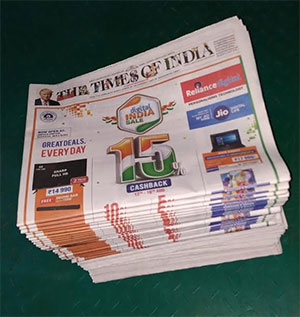 The Times of India had bumper issues on Saturday, August 15 with a total of 60 pages in Mumbai, 72 pages in Gurugram, 58 pages in Delhi, 78 pages in Hyderabad, 52 pages in Bengaluru and 46 pages in Chennai including supplements, as per a press release. The paper drew advertisers across Retail, Real Estate, Auto, FMCG, Consumer Durables, E-commerce and many more categories inviting consumers with amazing deals and messages, the communique added.
 It was only appropriate that the announcement and the detailing was done via Tweets. After all, we are talking about the man who set up Twitter in India, and has possibly been living his life in 140 charcters… over the last four years at least.
 The Times of India Group has been supporting young talent in the advertising and media industry by creating opportunities on the Young Lions and Young Spikes stages. A great outcome this year was the Silver bagged by the Young Marketer’s team by HUL at the Cannes Young Lions last month. In keeping with this endeavor, The Times of India has announced the Young Spikes contest for two categories – Integrated & Media.