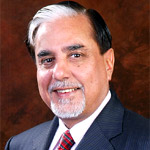
- Subhash Chandra
The origin of the Essel Group may be traced to the end of the nineteenth century, though the company assumed formal shape only in 1926.
Around 1890, Rameshwardas Goenka, the great great grandfather of Subhash Chandra, was running an established agro commodities business under the name of Jagannath Rameshwardas. Jagannath was the name of his partner.
In 1920, Ramgopal Goenka, the son of Rameshwardas Goenka bought a plot of land in Okara in Punjab which is now in Pakistan. Ramgopal had three children – Jagannath, Gopiram and Inder Prashad.
Shops were set up on this plot under a new establishment, Inder Prashad Harchand Rai (Harchand Rai was a family friend). The establishment, however, came to be popularly known as Okara Dukaan.
With business at Okara Dukaan being sluggish, Ramgopal Goenka’s son Jagannath Goenka began exploring greener pastures. This brought him to Adampur Mandi in undivided Punjab. Adampur Mandi is now in Haryana.
In 1926, Jagannath Goenka set up Messrs Ramgopal Indraprasad at Adampur Mandi to deal with food grains. This company is considered the precursor of the Essel Group.
In 1930, Mr Chandra’s father Nandakishore Goenka was born in Sadalpur Village near Adampur Mandi. In 1941, Jagannath Goenka shifted to Hissar town due to poor business at Adampur Mandi. In 1946, Messrs Ramgopal Indraprasad ceased all operations at Adampur Mandi and moved to Hissar.
The same year, Nandakishore Goenka entered the family business at the age of 16. He returned to Okara and tried to revive the business there. The business failed to pick up and subsequently Nandkishore Goenka too shifted to Hissar after wrapping up Okara Dukaan.
In 1948, Jagannath Goenka shifted to Delhi and bought a plot at Mothiakhan where he set up a pulses factory which churned out polished pulses. He suffered heavy losses and the machinery was shifted back to Hissar in 1951. The new unit started operations in Hissar and supplied polished gram to Gujarat and the Southern States. This turned out to be a profit-making venture. By 1966 their firm M/s Ramgopal Indraprasad ran one dal mill and two cotton ginning factories, and the going was good.
Mr Subhash Chandra was born to Nandkishore Goenka and Tara Devi Geonka on November 30, 1950 at Adampur Mandi. He was the eldest of the seven siblings – Laxmi Narain Goel, Jawahar Goel, Ashok Goel, Kusum, Urmila and Mohini.
He was also known as Subhash Chandra Goenka (Goel); he chose to remove the surname and changed his name as Subhash Chandra as he felt that independent India was being divided by the political establishment (as per a notification dated August 31, 1989 of Govt of Maharashtra).
Mr Chandra showed an inclination towards business even as a child. He went to the local village school which taught only up to the primary level. From the fifth grade, he shifted to CAV School in Hissar, where he was placed under the tutelage of his grandfather, Jagannath Goenka.
Jagannath Goenka’s wisdom left an everlasting impression on the young boy. It was at the “Jagannath Goenka University,” as Mr Chandra would say, that he learned the three most important lessons of life: have no fear; never go back on your commitment; and do not stray from the path of truth. If there is one man from whom Mr Chandra draws his inspiration even today, it is his illustrious grandfather.
Jagannath Goenka’s business involved buying grains and selling them for a flat commission, warehousing and money-lending. Every day when Mr Chandra returned from school his grandfather would sit with him and make him write letters to hundreds of people or clients. This was among the first lessons he learnt from his grandfather.
Jagannath Goenka then went on to teach Mr Chandra his earliest lessons in business, the most important being how to analyse people. He taught the young boy to observe people intently and understand their motives or intentions through their behaviour. This is a lesson that has stood him in good stead till today.
The grandfather also impressed upon Mr Chandra that he should not go back on his commitment, even if it is verbal. Even now Mr Chandra is known to seal a deal with a mere handshake.
As a child, Mr Chandra was always in awe of what he calls his grandfather’s native wisdom. Jagannath Goenka played the role of a matchmaker in his spare time. During one of his visits to a house, he lined up all the women along with the prospective bride. When he found that another lady was more beautiful than the bride (to be), he advised that she should not be present lest the boy fall for her. Such small incidents would leave a lasting impression on Mr Chandra.
On school holidays, the young Mr Chandra would go about the village bazaar with his grandfather collecting information and gossip about people. This taught him to constantly keep his ear to the ground. Even today, Mr Chandra is much the same and collects as much information as he can. He is a man who listens to what people say and has no hesitation in taking advice from the most humble of his employees.
Mr Subhash Chandra always dreamt of becoming an engineer, but destiny willed otherwise. The family business suffered a series of reverses in 1967. Due to the mismanagement of the business by a relative, the family suffered heavy losses in cotton trading. The Adarsh Cotton Ginning and Oil Industries which was set up the same year went into the red and had to be subsequently wound up. A major road accident ensured that family had to spend what little resources were left. To make matters worse, Jagannath and Inder Prashad decided to split the business. Though at that time the businesses had net deficit of about Rs 600,000, Inder Prashad was given cash of 50,000 in addition to the equal properties.
The family was not just bankrupt, it owed over Rs 6 lakh to friends and relatives who had lent monies. With the family going through a bad patch, Mr Chandra was told by his father that he now had to help with the business as he could no longer afford to pay his college fees.
But Mr Chandra refused to be bogged down by this twist of fate, and instead took life head-on, turning an adversity into an opportunity. Two years later, that is in 1969, Messrs Ramgopal Indraprasad was renamed as Subhash Chandra Laxmi Narain (SL). In 1976, the company came to be renamed as the Essel Group of Industries, which later took the form of the Essel Group.
Steering a bankrupt business with just Rs 11 in his pocket was no easy task for this 17-year-old.  Mr Chandra struggled to find ways to continue business without making any investment. Fortunately, he met a manager of the Food Corporation of India (FCI) in 1968-69 who took a liking to him. That was the turning point in Mr Chandra’s life.
The Army was a big buyer of grains, pulses and dry fruit. But the FCI was unable to meet the high standards set by the Army. Mr Chandra suggested that his family could upgrade the product by polishing pulses and cleaning barley. The FCI agreed and the family was back in business because he found a way to add value without any significant investment. Mr Chandra also convinced the FCI to supply him with whole dal which would then be split and supplied to the Army.
In 1971-72, Mr Chandra shifted to Delhi and leased a dal mill, at C-35/1, Lawrence Road Industrial Area, Delhi. The initial days in Delhi saw Mr Chandra’s evolution from agriculture to industry as he ventured into several new businesses like fibreglass mouldings, from which he exited soon after.
In 1976, this 26-year-old entrepreneur got his first big break. India was by then thriving on the back of its green revolution, and the crop surplus in the mid-1970s had the FCI frantically looking for space to store 14 million tonnes of food grain. It was Mr Chandra who came to the aid of the FCI.
His solution to store food grains out in the open under polythene sheets found favour with the FCI. Mr Chandra entered this business buying polythene sheets and then cutting and welding them into tents.
The same year, he set up Lamina Packers, which for the first time manufactured flexible packaging and laminates for packaging pharmaceutical tablets and other combination of paper, plastic and aluminium files of international quality on indigenous machinery. Soon, also set up a manufacturing and the plant supplying empty capsules to the pharmaceutical industry, and also purchased a company manufacturing hand tools (mostly food grains). However, he had a mission in his head and that was “to remain in a business where he can be either the No 1 or strong No 2” else exit from that business.
The year 1981 marked Mr Chandra’s entry into the big league. The country had just given its verdict in favour of Mrs Indira Gandhi, who for the first time in the history of the country, decided to open the doors of the economy to private players. For young entrepreneurs like Mr Chandra, this came as a blessing.
These were bilateral trade agreement signed between India and the USSR. Once again, Chandra turned to his favourite business of food grains. Rama Associates, which Chandra had set up in 1976, won a lucrative deal to export rice to the Soviet Union. It was on May 21, 1981, that an agreement was signed to export 30,000 tonnes of rice to Russia at a cost of Rs 5,500 per tonne, under the bilateral trade agreement.
But this was not without its share of hiccups. Barely moments before the agreement was to be signed, the deal threatened to slip through his hands, due to a communication gap with the Russian delegation. In the absence of mobile telephony those days. Mr Chandra who was in Belgium had to cut short his visit and rush to Delhi to salvage the situation. He subsequently won an additional contract to export soya bean. Within 17 months, the company exported grains worth a billion.
The buyers as well as Indian trade authorities was so happy with Mr Chandra’s performance that he was awarded the Russian deal every year during 1981 to 1985. It was also a time when the Soviet Union was beginning to show its first signs of crumbling. The zero taxation policy of the Soviet government on export profits meant huge cash flows for Rama Associates.
By 1982, the turnover of the Group had gone in excess of Rs 1 billion, a far cry from the bankrupt company that he had taken over in 1973.
A cash-rich Mr Chandra now had ambitious plans. But before he took the next big leap, he made his brothers go through a traditional Marwari ritual called pani mein namak daalna, which literally means adding salt to water. It is a sacred vow within the community. Once you agree to do something during this ritual, you can never back out. They decided that they would never do any business outside the books.
With the ambition to explore new avenues of expansion, the 31-year-old Chandra visited a packaging exhibition in Germany in 1981. The visit changed the course of his business. Essel Packaging was incorporated in December 1982 and began commercial production in the second quarter of 1983.
In those days in India, toothpaste was primarily packed only in aluminium tubes and Chandra came across laminated tubes or soft squeeze tubes at the exhibition. In the West, multi-layered lamination tubes were replacing the aluminium tubes, which had earlier virtually monopolised the business of medicines, cosmetics and toothpaste.
Undeterred by the advice of well-wishers that the product would not find a market in India, he imported a new technology and began making laminated tubes which he believed would replace metal tubes as toothpaste containers. As predicted, this Western innovation had arrived ahead of its time in the Indian market and Mr Chandra had to fight to survive for five long years in the face of low capacity utilization and mounting losses.
But Mr Chandra stood to his ground, confident that this was a product that was bound to succeed someday. It was only in 1988-89 that the 50 million tube capacity packaging businesses showed signs of a turnaround. It was then that India saw the launch of gel toothpastes which required a non-aluminium format filling. Essel Packaging which is now Essel Propack is today the world’s largest manufacturer of laminated tubes, with a presence in 13 countries.
Following the success of Essel Packaging, Mr Chandra was once again itching for something new. That was when he began eyeing the business of fun and entertainment. “After Essel Packaging, I became unemployed and was looking for new opportunities,” he says.
In 1983-84, Mr Chandra had bought 753 acres of land in Gorai, on the outskirts of Mumbai. Inspired by his visits to amusement parks abroad, he introduced the Indian version, called Essel World, in 1989.
But contrary to his expectations, the initial response was lukewarm. Mr Chandra was told by his friends that the Indian middle class would prefer entertainment closer home than travel to an amusement park two hours away. A spark instantly ignited in him.
Those were the days when the country was witnessing a boom in video parlours. Mr Chandra initially toyed with the idea of equipping a fleet of video vans that would tour the countryside charging people to watch the videos. He had also made a quick calculation of the revenue he would earn through advertisements.
In 1990, a casual visit to the office of Doordarshan in Mumbai inspired him to launch a satellite television channel, though at one point he had toyed with the idea of entering the cellular phone business too. He decided to pick up a TV station instead.
Mr Chandra had contacted a school friend in Doordarshan who in turn arranged a meeting with the chief engineer. The meeting was a focal point in Mr Chandra’s foray into the television business. He was told that the Indian reputation did not permit television broadcasting as it is reserved for public sector.
Then came another trigger. Mr Chandra was watching the Gulf War on CNN in 1990 and wondered why India could not have a private satellite channel of its own. He asked why and how the foreign TV channels were seen in India and why the law did not permit Indians to start a TV station.
For a while, he also explored the possibility of setting up a terrestrial channel to be beamed from Nepal. But when he learnt that the signals would not reach major Indian cities, he gave up that idea.
That was when he heard about Asiasat. In December 1990, Hong Kong had granted a licence to a joint venture of the Chinese government and Li Ka Shing to launch a satellite to begin a Direct Broadcast Satellite (DBS) service in Asia.
Mr Chandra practically chased the Chief Executive of Asiaset, finally locating him at Canada where he was holidaying in the Christmas of 1991, only to be told that the transponders were leased to one company named Satellite Television of Asian Region (STAR).
Mr Chandra repeatedly knocked only the doors of STAR headquarters in Hong Kong, only to be cold-shouldered. Finally, because of his sheer persistence a meeting was fixed with Richard Li, son of Li Ka Shing, the owner of STAR. But it ended on an unpleasant note.
Mr Chandra’s team was made to wait in a room for a long time. When Mr Li finally made an appearance, his executives told him there was a gentleman from India who wanted to start an Indian language general entertainment channel in a joint venture partnership. “India!” snapped Mr Li, “There is no money in India. I have no interest in India.”
Having outright rejected the joint venture, Mr Li then asked Mr Chandra how much he would pay for the transponder. “I do not want to do joint venture with you, so you can take the transponder on your own,” was his remark. Mr Chandra said the price of $ 1.2 million had been agreed upon with STAR executives. “Not enough,” said Mr Li.
“I do not know what came over me, but I got up and said I would take it for 5 million dollars, provided the agreement was signed within 24 hours,” recalls Mr Chandra. Mr Li refused to take Mr Chandra seriously and walked out of the room in a huff. The meeting ended there.
By then, STAR had hired an investment banker to advice it on potential Indian customers. The banker did not even deem it fit to meet Mr Chandra who had no media credentials. In April 1992, Mr Li arrived in Mumbai to explore the possibilities of leasing the transponder to the highest bidder. His extensive appointment list figured big guns like Hindustan Times, The Times of India and Nusli Wadia of Bombay Dyeing. Finally, nobody was willing to pay as much as Mr Chandra.
Meanwhile, Mr Chandra too was actively looking for opportunities outside the realm of STAR. But this time he was approached by Mr Li. Mr Chandra hired a helicopter and took him to Essel World and to the packaging plant. When Mr Li realised that the Essel Group was dealing with big FMCG companies such as Colgate, Lever and P&G, his opinion changed. The agreement to lease the transponder was signed on May 21, 1992, between Mr Chandra’s Asia Today and STAR.
True to his word, Mr Chandra finally leased the transponder for an astounding USD 5 million. But he needed the cash to fund his ambitions television project. This time, the much-needed assistance came from an unfamiliar corner and in the form of a fund in Hong Kong owned by Sir James Goldsmith and Kerry Packer, three non-resident Indian friends and some other venture funds.
“The existing media companies felt that satellite television would not succeed in the country. Since I did not know anything about the media business, I had nothing to fear,” says Mr Chandra.
But launching a private satellite channel met with roadblocks at every stage. When Chandra broached the subject with the Secretary for Information and Broadcasting, Government of India, he was livid. “You will introduce consumerism and destroy the country. Your proposal can fructify only over my dead body,” the Secretary thundered.
Mr Chandra then approached several legal luminaries, all of who shot down his proposal. Not a man to take no for an answer, Mr Chandra worked out a strategy. His question was simple: “If foreign channels like CNN and BBC could be viewed in the country, why not a private Indian channel?”
In 1992, he entered the business of entertainment software through a company called Empire Holdings Ltd, which he had started in 1983. The name of Empire Holdings was changed to Zee Telefilms Ltd which provided content to Zee TV Hongkong which in turn beamed the signals into India from Hong Kong. That was how Zee was born on October 2, 1992, initially with only two hours of content.
Overnight, Mr Chandra had ended the monopoly of Doordarshan. Initially, he focused on inexpensive programming. The average programming cost was barely Rs 30,000 an hour for the first year. The formula of cheap programming worked and Zee was an instant success. Zee became a hit, with soaps like Tara and Hasratein and interactive musical shows like Antakshari and Sa Re Ga Ma. In six months, Zee had proclaimed its arrival in the television industry and Mr Chandra was slowly giving shape to his television business that was reaching out to almost 12 million homes across the country.
But Mr Chandra had a shock in store. In an unexpected development in 1993, News Corp Chairman Rupert Murdoch bought a 63 per cent stake in STAR. Initially, Mr Murdoch had very little time for India as those days everybody was focusing on China. That was until he heard that out of the 20 million homes that STAR claimed to reach, 12 million were in India and they were Zee homes. Mr Murdoch now upped his ante.
As Mr Murdoch began eyeing the Indian market, he contemplated pulling Zee off from Asiasat. As days passed it become clear to Mr Chandra that he had to look for an alternative to Asiasat.
While Mr Chandra had no funds to invest in another transponder, the threat of Zee’s ouster from Asiasat loomed large. Driven to the wall, Mr Chandra had no option but to sell a 49 per cent stake in Asia Today to Mr Murdoch, the company that had leased Asiasat in December 1993. STAR and Zee set up Zee Cinema and Mr Murdoch became an investor in Siticable which Mr Chandra had started in 1992.
However, relations between the two began to sour in 1996. The shareholder agreement between the two companies had clearly stipulated that STAR would concentrate only on English content. But STAR violated the agreement and began beaming Hindi content.
“He thought being a global media baron, he could run roughshod over us, but his calculations went wrong. We were on the path of truth. He made the mistake of taking us for granted,” says Mr Chandra.
Mr Murdoch then made an unsuccessful bid to take over Zee. He offered Mr Chandra USD 2 billion as against the company’s valuation of USD 500 million. That was when Mr Chandra remarked, “India is not for sale.”
Mr Chandra sued in London and in the face of STAR’s imminent defeat, both the companies finally settled the case in 1998. Mr Chandra paid $180 million for Murdoch’s share of Asia Today and Siticable. The bitter partnership came to a final end in September 1998.
Then on, there was no looking back for Zee or for Mr Chandra. Today, Zee has its presence in 167 countries with a viewership of 500 million.
The rest, as they say, is history.
Text courtesy: The Zee Entertainment Enterprises Limited Corporate Communications team