Tag: TIME

  • Ranjona Banerji: No ‘fine and dry’ puhleez, dear BBC!

    By Ranjona Banerji


    I have spent the last three weeks reading back issues of Time magazine. And I am amazed that their rewriting style (from what I recall, you are not really allowed to have a writing style at Time) has not changed at all. The same inverted sentences. The same twist at the end. The same short phrases to try and be current, even though some go back at least 25 years. This is testament to Time’s covenant with its principles – stick to what you started with even if your readership is shrinking and everyone around you has changed. A tip of the hat to this nostalgia-inducing standard practice: I practically went back to my childhood which was… well, it was a long time ago. You don’t want to know!


    **


    I have to confess that I have not read too many newspapers (this is a gross exaggeration: I have read precisely two) in the past 10 days. I have kept up with the news through social media and through some television. And by watching English news channels, you may forget that India is such a massive country.


    Instead: there is Arvind Kejriwal, chief minister of Delhi. Now New Delhi may be India’s national capital and it may have a state government but it cannot compare to any other state government. The chief minister of Delhi is responsible for about a quarter of the things – I am being generous here – that other chief ministers contend with. Yet, we have national news channels behaving like local cable news channels. What Kejriwal had for breakfast, what he wears to bed, the progress of his cold, how Delhi government officials may well be crooked, how to get a water connection in Delhi and on and on and on. We get it. Kejriwal and his Aam Aadmi Party achieved something miraculous in the Delhi assembly elections. Now move on. Other things are happening in the rest of India.


    The rest of TV news however is as blinkered. We are stuck in an endless spiral of Congress versus BJP fistfights. One party says blue so the other says yellow and it never ends. News channels set themselves up as pasties here as shrewd politicians play them for fools so easily. We understand that newsgathering is expensive and laborious. We know that TV has to look for instant gratification. We are aware that fighting for attention is a mug’s game. But still, it would be interesting once in a while to watch television and just get a picture of what’s happening in the world instead of a tailored picture of what might possibly create the most sensation.


    **


    This is a request to the BBC World Service’s weather department. We understand that the English are obsessed with the rain and crave the sun. But the whole world is not England. India for instance gets most of its rain from the monsoon. It rains sporadically in a few parts of India outside the monsoon – and most of this rainfall follows a very specific meteorological pattern. We in India are taught this as school children. For instance, if it rains in Mumbai consistently after the monsoon is over then it is a possible indication that the world’s climate is undergoing some immediate catastrophic crisis. Similarly, some parts of South India get the retreating monsoon. The North will be affected by westerly disturbances and it will snow in the Himalayas in winter.


    So we need some pertinent weather forecasts from the BBC World Service. Like when people are dying of the cold in North India, we don’t need to be told that the weather is “fine and dry”. We need to be told about falling temperatures. We know that it is not likely to rain in Madhya Pradesh in December. So “fine and dry” are tautological. Conversely, when there is a heat wave in summer and people are dying, “fine and dry” sounds like a slap in face. Summer is when we crave for rain, really, we pray for the monsoon. We sing those Bollywood songs your pop culture experts are so fond of.


    Also, when you run weather forecasts for the British in Britain on the BBC, you can advise them where to holiday. But for the World Service, it might be nice to concentrate on us. And tell us the weather of the world as well – there could have been more on the polar vortex, on the heat wave in Australia, on flooding in Europe. Please don’t take this badly. It’s just we’re so tired of “fine and dry”.


    Ranjona Banerji is a senior journalist and commentator based in Mumbai. She is also Contributing Editor, MxMIndia. She can be reached via Twitter at @ranjona. The views here are her own

     

  • Anil Thakraney: The credibility letdown

    By Anil Thakraney


    Must say I am quite surprised to hear that the suspension imposed on Mr Cut Paste by his bosses at Time mag and CNN has been lifted quite swiftly. I was of the opinion that Fareed Zakaria would have to pay a heavy price. Clearly, I was wrong.


    This is the exact statement issued by Time, as per media reports: “We have completed a thorough review of each of Fareed Zakaria’s columns for Time and we are entirely satisfied that the language in question in his recent column was an unintentional error and an isolated incident for which he has apologized. We look forward to having Fareed’s thoughtful and important voice back in the magazine with his next column in the issue that comes out on September 7.”


    Now, while one wants to applaud Time and CNN for being large-hearted, I am a bit worried about the ramifications of the quick forgiveness. Younger columnists and journalists will get the wrong idea. Because, the message is this: ‘Okay, you made one mistake, but otherwise you have been good at your job. So we’ll let you get away with this dishonest act.’ As a writer, my reading is that it’s okay to do the odd chori. In that sense, I believe Zakaria’s example sets a bad precedent. He directly (or indirectly) lifted passages from another journalist, that is a fact, and he has admitted to it. And Zakaria ought to have been made to face the music for this misdemeanour. Especially because he’s a veteran in the profession.


    There’s another thing: Zakaria’s credibility has taken a body blow following this incident. Why would I trust his writing ever again? How can I be sure he hasn’t played another mischief? Given that, there had to be a cooling-off period ordered on Zakaria for at least one year, if not more. So his readers are assured that, one, the man has been adequately punished. And two, he has had sufficient time to introspect on his misdeed.


    All I can say is, Fareed Zakaria is one helluva lucky guy.


    ***


    PS: I have always wondered why the placards that protesters carry during various andolans are so dull. Well, here’s a link that tells you it need not be the case, that placards can be fun. Hope to see some wit and humour during desi protests. Perhaps ad agencies can pitch in with some thoughts. If we must watch the likes of Anna and Ramdev fasting, may as well have some entertainment going on the sidelines. 🙂


    Link: http://www.thepoke.co.uk/2010/11/01/the-best-protest-march-ever/gallery/image/


  • Plagiarism… a common affliction with senior journalists

    By Ranjona Banerji


    “I apologise unreservedly,” said Fareed Zakaria’s most recent tweet on August 10. And here’s the statement attached:

    “Media reporters have pointed out that paragraphs in my Time column on gun control, which was also a topic of conversation on this blog, bear close similarities to paragraphs in Jill Lepore’s essay in the April 23rd issue of The New Yorker. They are right. I made a terrible mistake. It is a serious lapse and one that is entirely my fault. I apologize unreservedly to her, to my editors at Time and CNN, and to my readers and viewers everywhere.”


    This is how Zakaria describes himself on twitter: “Editor at TIME Magazine. Host of CNN’s GPS: Sunday @ 10am and 1pm ET in the U.S. Blogger at CNN.com/GPS.

    New York, NY”.


    Now he stands suspended from all his jobs, for at least one month pending investigation.


    The odd thing is, Zakaria need not have picked up those bits from Lepore’s article and passed them off as his own. He could have given her due credit, which would have been the right and honourable thing to do. He could have read as much as he could on the subject and drawn his own conclusions. He could have used facts from a variety of sources and made an argument based on that. But why pass off a few paragraphs from someone else’s work as your own?


    Sadly, this is a common affliction with senior journalists. Get someone junior to do the leg work because you’re so busy being a celebrity, obviously you don’t have the time to do it yourself. That obviously means that you don’t have the time to check either. Throw your opinion together, safe in the feeling that your name will carry you through.


    Or, it could be that you did the Google search yourself…


    Either way, there are no excuses which is why Zakaria hasn’t made any.


    Throw your mind back to almost two years ago when huge chunks of Aroon Purie’s publisher’s note in India Today was picked up from a column in Slate magazine. Purie apologised, but obviously, since he owned the magazine, nothing more could be done. Also, it turned out that he didn’t realise that the “research” sent to him by his employees (senior journalists though they may have been) was not written by them but by someone else.


    The funny thing is that these are rookie lapses, which come from arrogance, laziness and carelessness. This is not the work of a scientist trying to get published in some respected journal or a PhD student trying to finish a thesis – not that cheating is justified – who thinks they have just one chance to make it. What are the stakes involved for a columnist who writes regularly? Your whole reputation is built on those daily, weekly, fortnightly or monthly words you come up with. Imagine throwing it away in this sloppy manner?


    Unfortunately for Zakaria, this puts all his work under the scanner. Trust is so ephemeral.


    The odd thing is, one suspects this kind of plagiarism is possibly far more common than this. Stupidity is after all universal. Common sense is not.


    Ranjona Banerji is a senior journalist and commentator based in Mumbai. She is Contributing Editor, MxMIndia. The views expressed here are her own. Twitter: @ranjona


  • Ranjona Banerji: Foreign media is only credible observer of Indian politics

    By Ranjona Banerji


    There is now only one credible observer of Indian politics – the foreign media in India. We cannot fully assess if a politician is good or bad until a foreign journalist pops by, talks to a few taxi drivers and Indian journalists and then writes a complimentary (good) or scathing (bad) comment piece.


    Now, you’re thinking, aha, sour grapes but far from it. It is all a question of perspective. Indian journalists, especially in Delhi, are too close to the centres of power. They are so familiar with what’s going on and party to so many secrets that they now spend more time discussing whether the blue in Manmohan Singh’s turban has changed in the last eight years. (Some say yes, some say no and the rest are fence-sitters.)


    The foreign media however comes in from far away and has no clue about all this inner stuff. They attend a few parties (these are vital sources of information and political analysis, as those who read through the diplomatic cables made public by Wikileaks will know), meet a few Indian print journalists (bluer, paler, maybe both), they may meet a few TV journalists but that’s for entertainment since they have no political perspective, although I hear they throw really good dinner parties. And, obviously, the few taxi drivers. This is imperative as every traveller knows – one taxi driver can be equal to at least five other potential interviewees.


    Yesterday, I met a cabbie in Mumbai who told me that Indian politics turns on Uttar Pradesh. Now I know. If these foreign political commentators are really smart however, they will never even leave whichever country they come from (usually the USA or the UK). How else have I become a world renowned expert on Barack Obama and David Cameron? (Actually, by watching Comedy Central and Graham Norton.)


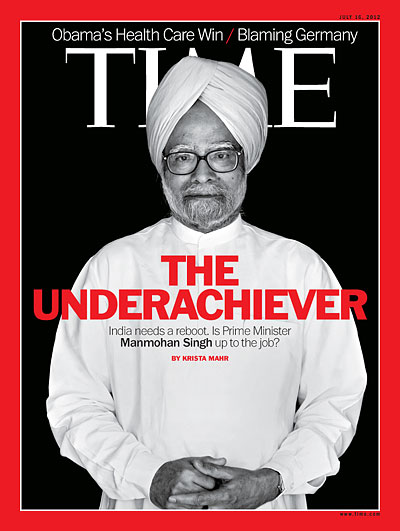
    Therefore we now know that Prime Minister Manmohan Singh is a poodle, useless, confused and steeped in doom and gloom. Everyone has said it from Time to the Economist to The New York Times to the Independent.


    The poodle reference can be translated in Indian terms to a puppet. Yes I know, Indian commentators have been saying that for years. But what do they know, eh? (On the other hand, their view has now been authenticated!) Meanwhile I must be off to watch a few more skits on Comedy Central so I can hone my analytical skills.


  • Ranjona Banerji: Don’t bother, Indian analysts… let Time do it

    By Ranjona Banerji


    The Indian media has taken a round beating here. Day after day, print and TV criticise the government and politicians. Columns, analysis, debates and discussions focus on the weakness, incompetence, “policy paralysis” of the current government. Does anyone care or pay attention? Of course not – unless the criticism comes in cartoon form about a person or issue long dead.


    But an article in the Asia edition of an American newsmagazine criticises the prime minister and the whole political community goes into a frenzy? Let us not be unfair to Time magazine, but the fact is that no one considers it to be a respected analyst of Indian politics. Nor indeed is the magazine the powerhouse it once was. Now if the Economist were to get so seriously critical, since it is known for its carefully considered views, then you might want to sit up and take notice.


    Time’s “crime” is to call Manmohan Singh an “underachiever” and ask whether it is time for him to move over and let someone else become prime minister. This made the Congress jump to his rescue and the BJP to behave as if they’d won Uttar Pradesh.


    The Congress then looked back at an old Time article which had said Atal Behari Vajpayee was “asleep at the wheel” as prime minister. This was supposed to shut up the BJP as the same newsmagazine had also criticised them. Sigh.


    The BJP however could point out that Time’s tally is still higher since last year the magazine appeared to favour Gujarat chief minister Narendra Modi. Then the Congress can point out that Modi did not make it to Time’s poll of the greatest people in the world or whatever because of negative voting.


    And so we can go on and on about the various articles and activities of a barely read newsmagazine and the political classes can carry on doing even less than they do normally.


    As for all you analysts in the Indian media, why do you bother? Clearly, no one pays attention to all your criticisms and opinions. Congratulations are due to Time for having successfully upstaged the entire Indian media. Henry Booth Luce would be happy.


  • Anil Thakraney: Oye, ‘Time’ mein job milega?

    By Anil Thakraney


    TIME mag has termed our Prime Minister an ‘Underachiever’. I completely disagree with this description, it is much too kind. The truth is, and every sane Indian would agree, MMS has been a total flop show since he became PM once again in 2009. His government failed the country on every single parameter, and in particular, his team has damaged India’s growth story. Anyway, enough has been said on Manmohan Singh’s stellar performance, so I won’t delve on that.


    What got me interested is the impact of TIME’s cover story in India. Both, the politicians and the media got their knickers in a twist discussing this article threadbare. Almost as if the final report card had arrived from the Big Boss. As if what the goras, located thousands of miles away from the action, think of our PM is the gospel truth.


    All sorts of insinuations are being flung around. Some people suggest it’s a marketing gimmick from TIME mag to boost its circulation in India. One Left leader claimed it’s a conspiracy hatched by America to put MMS under pressure so that they can launch new businesses in India! And of course, the netas are busy hurling dirt at each other. As the BJP leaders gloat over the article, the Congresswallahs are firing back with: ‘Hello, but they were harsher on Atal Bihari Vajpayee!’
     

    However, what hurt me the most in this tamasha is that various Indian columnists and speakers have been dissing Manmohan Singh’s policies for a long time, but no one takes them seriously. It’s as if what India thinks about India does not matter. Quite obviously, after over six decades of independence, our colonial hangover hasn’t gone. No wonder then that some top industrialists from India happily meet the foreign press, while desi journos don’t even get a response to interview requests.


    My conclusion: To be taken seriously in India, I need to work for a foreign publication. That’s the irony of our existence. Therefore I am busy preparing my CV afresh, and will soon be knocking on the doors of gora editors. Jai Hind!


    * * *


    [youtube width=”400″ height=”225″]http://www.youtube.com/watch?v=aMfSGt6rHos[/youtube]

    PS: Glad this utterly charming ad from Chipotle won the Grand Prix at Cannes. My most favourite commercial of last year. Superb idea backed by terrific animation. It’s all soul, and it makes you think where we are headed. The film is particularly relevant in India, where we have lost our way in the mad ambition to be an industrialized nation. And yes, Coldplay’s haunting track, ‘The Scientist’, works wonderfully out here.


  • Dainik Bhaskar group ties up with Time & HBR

    By A Correspondent


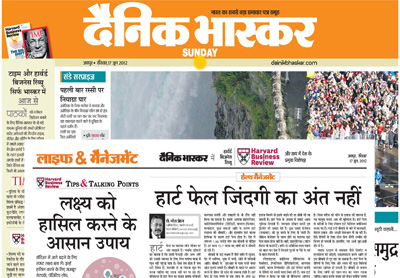
    Dainik Bhaskar Group has become the first newspaper to provide exclusive content from Time, the current affairs magazine and Harvard Business Review to its readers on a regular basis. The exclusive content will feature in the Sunday edition of the newspaper.


    The three media giants have come together to leverage their specific content strengths and collectively provide rich and relevant world class content to the readers. Dainik Bhaskar Group isIndia’s largest newspaper group with 1.9 million readers in 13 states. Time is the world’s largest circulation weekly news magazine with a readership of 25 million, of which 20 million are in theUS. It is widely regarded as one of the most popular magazines. Harvard Business Review delivers the latest techniques, best practices and the most thoughtful advice from the world’s leading management experts.


    Elaborating on the collaboration, Kalpesh Yagnik, National editor, Dainik Bhaskar Group said: “We at Dainik Bhaskar focus at generating the best and most relevant content for our readers. Time and HBR are relied upon by the policymakers, the world over. We will thus, bring to our readers, the latest trends in international politics, strategy, diplomacy, environment, entertainment, science or economy.”


    The content for the Sunday edition has been completely revamped. The edition will focus on management lessons to be applied in day to day life along with wide spectrum of topics like Health, Fitness, Career, Self Help, Money management, Politics, education, Music, Lifestyle, Environment, Good reads through columns by eminent experts of the respective fields.


    Dainik Bhaskar, in reflection to the changing times and women empowerment, will also provide a separate segment devoted to women. Fashion, Food, Travel, Health, Life, Career and money management besides this, there will be a Sunday Jacket, above the regular front page of the newspaper. This will carry exclusive news analysis, ground reports and so on.


    Speaking of the change, Sanjeev Kotnala, VP Dainik Bhaskar group said: “Content is always the king for any media brand. And we are loved by our readers as we focus on them. Our strategy revolves around being ahead of the curve.”


  • [MJR] News TV declares IPL root of most evils

    Ranjona Banerji

    By Ranjona Banerji


    The Indian Premier League has now been declared responsible for all India’s problems. This has been unequivocally stated on our TV news channels, and is thus now the incontrovertible truth. This cricket tournament has destroyed our sense of morality, taken us down a road of sex, drugs, violence and betting, not to mention completely killed cricket. These evils, so far unknown and unseen in Indian society, will soon become widespread.


    Look at what the IPL has done:

    Item: Made a film star fight with a security guard (violence).

    Item: Made a cricketer molest a woman (sex).

    Item: Made two players go to a rave party (drugs).

    Item: Made five players work out spot-fixing deals with bookies (betting).

    Item: Made players restrict matches to 20 overs a side and then made this version popular with – shudder – cheerleaders (killing cricket).


    Against all these charges, the IPL does not stand a chance. It has been clear to the protectors of both cricket and Indian society from year one that the IPL was BAD NEWS. The very fact that so many people were interested was proof enough. And then, all those film stars, starlets, dancing girls, rich people, money, parties – my word, what is the world coming to?


    Each year, the IPL, our TV channels have found, has gotten bigger and thus by conclusion it has become worse.


    Just look, for instance, what it has done to Shah Rukh Khan: Forced him to fight with a security guard and with Mumbai Cricket Association officials. This is unacceptable behaviour and absolutely no way for film stars to behave. It is one thing to run over people, help gangsters bomb the city or beat up your wife (or even wives). For these crimes, if you’re unlucky, you will get a few newspaper editorials and maybe even go to jail but you will just be seen as a lovable rogue. But fighting with a security guard? That is the end of civilisation as we know it.


    It is hard to know what to do to save India after this. No doubt, the TV channels will tell us. A beginning has been made by former cricketers Kirti Azad and Bishen Singh Bedi, who have apparently gone on a hunger strike to save India from the IPL. The TV channels do not appear to have given this hunger strike the 24-hour coverage they granted to Anna Hazare’s hunger strike. But they do assiduously cover the cricket part of the IPL in their sports programmes. Come on, now, the whole country watches the IPL!


    * * *


    Having made it to the TIME magazine’s list of the world’s 100 most important people, West Bengal chief minister is now planning to top the list and every other list which will ever be made. This is the link to her latest dramatic act – storming out of a CNN-IBN audience meeting in Kolkata, leaving even the formidable Sagorika Ghose, TV anchor and event host, at a loss for words. The CM was furious because the students in the audience were “CPM cadre and Maoists”. That is, they asked questions she didn’t like.


    The other link is to the reply written by the erring student.


    Enjoy.


    http://ibnlive.in.com/videos/259724/question-time-didi-watch-the-show-that-mamata-walked-out-of.html


    http://www.telegraphindia.com/1120520/jsp/frontpage/story_15509625.jsp#.T7nCA1In3Vq