
Tag: Threads

  • Engagement drops for ChatGPT & Threads, with reason

    Representative graphic. It doesn’t give the exact drop in engagement of ChatGPT and Threads


    By Omar H. Fares and Seung Hwan (Mark) Lee


    ChatGPT recently experienced a decline in user engagement for the first time since its launch in November 2022. From May to June, engagement dropped 9.7 per cent, with the largest decline — 10.3 per cent — occurring in the United States.

    Meanwhile, Meta’s Threads platform experienced a significant drop in user numbers, going from more than 49 million users on July 7 to 23.6 million active users by July 14. In the same time frame, the average time users in the U.S. spent on the app dropped from a peak of 21 minutes in early July to just above six minutes.

    In the tech world, companies are always racing to be the first ones to introduce new innovations, aiming for the “first mover’s advantage.” This refers to a firm’s ability to get a head start over competitors by being the first to enter a new product category or market.

    However, being a trailblazer doesn’t guarantee an easy ride. While there are perceived benefits, there are also a plethora of challenges that arise.

    A news story about what the drop in Meta Threads engagement means for the social media app.

    The recent declines of Threads and ChatGPT attest to this reality, demonstrating that rapid and widespread acceptance doesn’t necessarily lead to long-term success.

    There are a few reasons why a fast adoption isn’t necessarily the key to success including unsustainable growth, inadequate scaling infrastructure and a lack of user retention strategies.


    Unsustainable growth

    The idea of unsustainable growth stems from a platform’s inability to uphold or maintain the quality of the user experience while scaling up at a rapid pace.

    This is where the real challenge lies: being able to effectively scale up a product or service. It is precisely at this junction that the concept of unsustainable growth intersects with the Gartner Hype Cycle.

    The Gartner Hype Cycle is a model that shows the stages of emerging technology adoption: from the initial hype and inflated expectations, through disillusionment and skepticism, to practical and mainstream productivity.
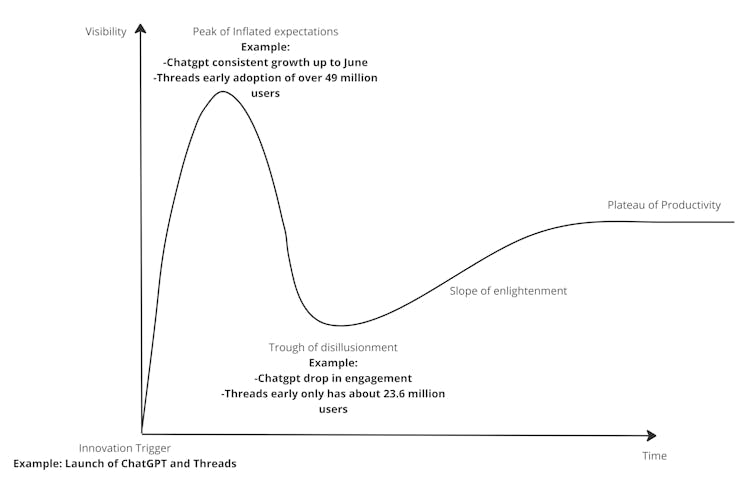
    A line graph illustrating that Threads and ChatGPT both had a period of significant hype and inflated expectations, followed by a drop in user interest.
    A graph illustrating how ChatGPT and Threads fit into the Gartner Hype Cycle.
    (Omar H. Fares and Seung Hwan Lee), Author provided


    In the context of unsustainable growth, products like ChatGPT and Threads appear to have reached the stage known as “peak of inflated expectations,” where the publicity of a new product generates over-enthusiasm and unrealistic expectations. During this stage, users rapidly adopt the product due to its novelty and the hype surrounding it.

    However, this stage often leads to the “trough of disillusionment.” During this stage, the product fails to meet users’ unrealistic expectations, causing a decline in their interest.

    It indicates the product’s growth may have outpaced its ability to provide an excellent user experience. Without enhancing the product based on user feedback, declining user engagement will ensue.

    This rise and fall underscores the challenge of achieving sustainable growth in the face of rapid adoption. The initial hype often attracts a massive influx of users, but without a clear, scalable strategy for maintaining quality and engagement, platforms can quickly lose their appeal.


    Inadequate scaling infrastructure

    When a platform’s user base expands at a rapid pace, the question of whether that platform’s infrastructure can scale to the demands of its users becomes critical.

    The sudden influx of users that accompanies a successful product launch can be a double-edged sword; it brings a wealth of opportunities for data collection, user feedback and revenue, but also tests the scalability of the platform’s infrastructure.

    If the underlying technology, support services or operational strategies are not built to scale, the product might suffer from slow loading times, frequent crashes or a lack of timely customer support — all of which are detrimental to the user experience and a product’s long-term success.

    For instance, OpenAI, the company behind ChatGPT, had to limit ChatGPT-4 users to 25 messages every three hours due to infrastructure constraints — even for those with a paid membership. While this helps manage the infrastructure load, it presents a challenge from the user’s perspective.

    Users who were accustomed to unlimited interactions with ChatGPT-3 now find themselves paying for a service with limitations. This may inadvertently dampen user engagement and drive some users away, underscoring the delicate balance between managing infrastructure and maintaining user satisfaction.


    Lack of user retention strategies

    One reason why tech businesses struggle to retain users is because they don’t prioritize user-centered design. By failing to incorporate user feedback in product development, businesses can end up offering a product that doesn’t meet user needs.

    In addition, businesses must provide effective support for users. Insufficient or unclear onboarding may leave users feeling lost and overwhelmed, leading them to abandon the product. In the case of ChatGPT, OpenAI provides a basic explanation of platform usage, but users are primarily responsible for exploring it themselves.

    Users experiment with prompts without a clear understanding of how to generate impactful responses, resulting in uncertainty and frustration. This lack of guidance may contribute to lower engagement rates, as observed in the recent decline.

    Lastly, increasing concerns about security threats and privacy have raised questions about how new technologies are protecting their users. The conflict between the need for more personalized experiences and privacy can give rise to a phenomenon called the personalization-privacy paradox.

    As individuals grow increasingly uneasy about how their personal information is stored, the lack of proper regulations can lead to a decline in the use of personalised services or technologies.

    While rapid user adoption is a promising start, it doesn’t guarantee long-term success. Striking the right balance between growth and infrastructure scalability, adopting a user-centric approach, maintaining user trust and investing in continuous innovation are the cornerstones for enduring success in the competitive tech landscape.The Conversation


    Omar H. Fares is Lecturer in the Ted Rogers School of Retail Management, Toronto Metropolitan University and Seung Hwan (Mark) Lee is Professor and Associate Dean of Engagement & Inclusion, Ted Rogers School of Management, Toronto Metropolitan University. This article is republished from The Conversation under a Creative Commons licence.  Read the original article.

     

  • Can Threads see the End of Twitter? Perhaps not

    Meta’s new Threads platform is going gangbusters, but that doesn’t mean it will replace Twitter. Logos owned by respective platforms
     

    By Casey Fiesler


    Twitter’s move on July 1, 2023, to limit the number of tweets users can see in a day was the latest in a series of decisions that has spurred millions of users to sign up with alternative microblogging platforms since Elon Musk acquired Twitter last year.


    In addition to a surge in numbers on Mastodon, the acquisition and subsequent changes boosted small existing platforms like Hive Social and has spawned brand new upstarts like Spoutible and Spill.


    Most recently the microblogging platform backed by Twitter founder Jack Dorsey, Bluesky, saw a surge of sign-ups in the days following Twitter’s rate limit, and Meta launched its microblogging platform Threads on July 5. Threads claimed 30 million users on its first day. Even very different forms of social media such as TikTok are benefiting from what many see as Twitter’s imminent demise.


    As an information scientist who studies online communities, this feels like something I’ve seen before. Social media platforms tend not to last forever. Depending on your age and online habits, there’s probably some platform that you miss, even if it still exists in some form. Think of MySpace, LiveJournal, Google+ and Vine.


    When social media platforms fall, sometimes the online communities that made their homes there fade away, and sometimes they pack their bags and relocate to a new home. The turmoil at Twitter is causing many of the company’s users to consider leaving the platform. Research on previous social media platform migrations shows what might lie ahead for Twitter users who fly the coop.


    Several years ago, I led a research project with Brianna Dym, now at University of Maine, where we mapped the platform migrations of nearly 2,000 people over a period of almost two decades. The community we examined was transformative fandom, fans of literary and popular culture series and franchises who create art using those characters and settings.


    We chose it because it is a large community that has thrived in a number of different online spaces. Some of the same people writing Buffy the Vampire Slayer fan fiction on Usenet in the 1990s were writing Harry Potter fan fiction on LiveJournal in the 2000s and Star Wars fan fiction on Tumblr in the 2010s.


    By asking participants about their experiences moving across these platforms – why they left, why they joined and the challenges they faced in doing so – we gained insights into factors that might drive the success and failure of platforms, as well as what negative consequences are likely to occur for a community when it relocates.


    ‘You go first’

    Regardless of how many people ultimately decide to leave Twitter, and even how many people do so around the same time, creating a community on another platform is an uphill battle. These migrations are in large part driven by network effects, meaning that the value of a new platform depends on who else is there.

    In the critical early stages of migration, people have to coordinate with each other to encourage contribution on the new platform, which is really hard to do. It essentially becomes, as one of our participants described it, a “game of chicken” where no one wants to leave until their friends leave, and no one wants to be first for fear of being left alone in a new place.

    For this reason, the “death” of a platform – whether from a controversy, disliked change or competition – tends to be a slow, gradual process. One participant described Usenet’s decline as “like watching a shopping mall slowly go out of business.”

    Meta is launching Threads as an offshoot of Instagram to take advantage of Instagram’s massive user base.


    It’ll never be the same

    The current push from some corners to leave Twitter reminded me a bit of Tumblr’s adult content ban in 2018, which reminded me of LiveJournal’s policy changes and new ownership in 2007. People who left LiveJournal in favor of other platforms like Tumblr described feeling unwelcome there. And though Musk did not walk into Twitter headquarters at the end of October and turn a virtual content moderation lever into the “off” position, there was an uptick in hate speech on the platform, as some users felt emboldened to violate the platform’s content policies under an assumption that major policy changes were on the way.

    What makes Twitter Twitter isn’t the technology, it’s the particular configuration of interactions that takes place there. And there is essentially zero chance that Twitter, as it exists now, could be reconstituted on another platform. Any migration is likely to face many of the challenges previous platform migrations have faced: content loss, fragmented communities, broken social networks and shifted community norms.

    But Twitter isn’t one community, it’s a collection of many communities, each with its own norms and motivations. Some communities might be able to migrate more successfully than others. So maybe K-Pop Twitter could coordinate a move to Tumblr. I’ve seen much of Academic Twitter coordinating a move to Mastodon. Other communities might already simultaneously exist on Discord servers and subreddits, and can just let participation on Twitter fade away as fewer people pay attention to it. But as our study implies, migrations always have a cost, and even for smaller communities, some people will get lost along the way.


    The ties that bind

    Our research also pointed to design recommendations for supporting migration and how one platform might take advantage of attrition from another platform. Cross-posting features can be important because many people hedge their bets. They might be unwilling to completely cut ties all at once, but they might dip their toes into a new platform by sharing the same content on both.

    Ways to import networks from another platform also help to maintain communities. For example, there are multiple ways to find people you follow on Twitter on Mastodon. Even simple welcome messages, guides for newcomers and easy ways to find other migrants could make a difference in helping resettlement attempts stick.

    In this sense, Threads has an advantage over other Twitter alternatives because users sign up via their Instagram accounts. This means Threads’ social graph – who follows who – is bootstrapped by links among Instagram accounts. Users may not be able to easily bring over their communities from Twitter, but they can instantly pull follows and followers from Instagram.

    And through all of this, it’s important to remember that this is such a hard problem by design. Platforms have no incentive to help users leave. As longtime technology journalist Cory Doctorow recently wrote, this is “a hostage situation.” Social media lures people in with their friends, and then the threat of losing those social networks keeps people on the platforms.

    But even if there is a price to pay for leaving a platform, communities can be incredibly resilient. Like the LiveJournal users in our study who found each other again on Tumblr, your fate is not tied to Twitter’s.


    Casey Fiesler, Associate Professor of Information Science, University of Colorado Boulder. This article is republished from The Conversation under a Creative Commons license. Read the original article. An earlier version of an article was pulished on November 3, 2022.The Conversation