 By Sangita P Menon Malhan
Some interesting insights into Samir Jain’s personality emerge from the days when he was taking on the venerable editors of The Times Group. In many ways, it was also a decisive phase in that it laid the ground for the changes that happened later.
He may have developed some dislike for journalists and the predominant position they enjoyed. He was uncomfortable with the fact that while the newspaper’s proprietor kept a low profi le, it was the editor, his employee, who was in the limelight. Politicians and bureaucrats pandered to the journalist while the proprietor was a mere bystander.
There are yet others who concede that there may be a ‘hidden agenda’ against journalists, besides the imperatives for change. An editor, who worked closely with Samir Jain after the reorganization, but did not want to be named, admitted that Samir Jain did hold journalists in ‘deep disdain’ at that time.
He recalled that sometime in 1986, The Times Group hosted a party in honour of Krishna Kumar, then a Union minister in Rajiv Gandhi’s government. When it was time for dinner and the guests were being ushered in, Krishna Kumar pulled a chair for Girilal Jain to sit. ‘I was standing close to Samir Jain,’ narrates the journalist; ‘he (Jain) said, “This party is thrown by the company and me. Is it not strange that the minister should pull the chair for the editorand not the owner of the paper?”‘
So determined was Samir Jain to prove that he was superior to the journalists and to keep them in their place that he issued a directive that everyone be addressed by their designations. So, senior editors, who until then had been calling him by his fi rst name, had to switch to calling him JMD (joint managing director) and later, VC for vice chairman.
When the government had taken control of BCCL for seven years, Samir Jain, then in his early twenties, believed that certain journalists of the paper had started it all by first making allegations of irregularities against the company to the government. It had been a difficult phase, and Samir Jain blamed the paper’s own journalists for creating the mess.
‘Samir carried the memory of those years. He thought the editors had to be shown their place,’ recalled Baljit Kapoor. ‘He thought they considered themselves too important. “After all,” he said, “the editor is just one of the employees of the company. He is just a processor of news.”‘
Samir Jain wanted more control over the newspaper. Editors were taking their autonomy too far. Jain found that he could not appoint people of his choice; that it was tough to get something of his liking included in the paper, among other such ‘restrictions’. These stumbling blocks bothered him. In his early days, one of the top editors tried to belittle Samir Jain by treating him like a probationer. ‘Ladka theek hai. Lekin usey abhi padnaa hai, seekhnaa hai. The boy is okay but let him educate himself fi rst,’ he said. Samir Jain hated that. As a counter, he began circulating articles from The New York Times and other newspapers. He wanted it to be known that he was already educated, and contrary to the editor’s comments, well read.
He began taking the editors head-on. At one interaction, he is believed to have said: ‘Please, all you editors listen. If you have an appointment with the prime minister, and if I call you, you must cancel the appointment and come to me.’ That quote has stuck. Although editors now make reference to it in a light-hearted way, it is unlikely that anyone violates that diktat even today. When the sensei says something, it is followed.
He had trouble over the fact that while the goodwill generated by a newspaper accrued to the editor, the negative fallouts went over to the owners. ‘He would often say, “The balance of inconvenience is always with me.” He wanted his team to be completely on his side and fully with him, no matter what he did. And, when that did not happen, there was friction between the sides. Such situations bothered him, and they did not end well,’ recalled Pradeep Guha.
Independent observers outside the organization have also corroborated Jain’s dislike for journalists. In his acclaimed book, Paper Tigers, Nicholas Coleridge writes: ‘Samir Jain views his editors and journalists as elements whose power needs to be constantly diffused (“those blue-blooded Brahmins of the editorial floor”). He takes pleasure in giving the best offices to his managers instead.’
A rebellious streak, a certain amount of irreverence for convention and tradition – that constant and regular inverting of the pyramid persist even today. Does he go about it in an authoritarian, my-word-no-matter-what manner?
Here again, there is no single or simple view. There are those who believe that in his single-mindedness, he brooks no resistance though his manner and approach may be understated. One of the edit page editors at the Times House said, ‘Samir Jain has established his own regime. His staff has to understand and accept him. The VC will not interfere in the day-to-day functioning of the newspapers.
He is more the Puppet Master. He will throw an idea at you and have you fi gure it out. But you are expected to figure it out. ‘He likes high-quality discussions. He will never call a reporter for a discussion. It will mostly be editors or people on the edit page. He will size you up and treat you accordingly. But he is soft-spoken and gentle and will never give you a direct command. It will all be hints and subtle suggestions, and you will have to pick up cues.
That makes him both interesting and difficult, depending on how much you are willing to invest in him.’ I asked this editor whether Samir Jain is temperamental, as is often alleged. ‘I have never seen him lose his temper. The VC likes equals. One would often see Swami (Swaminathan Aiyar, former editor-in-chief of The Economic Times, who continues to write a column for the paper and is a consulting editor) and the VC standing in the corridor and talking like old friends. When in a good mood, the VC will start his conversations with his Bengali editors with “Kaemon aachho?” (how are you?). ‘The problem is that most journalists don’t like to be given sermons, and certainly not by their publishers. They will not listen. And that becomes a point of confl ict,’ he said.
Shubhrangshu Roy, editor of the Financial Chronicle, who earlier served at the ET, drew up a sketch in a matter-of-fact way. ‘Samir Jain is not the despot he is sometimes made out to be. He is not an anarchist. In fact, he is down-to-earth. I have never seen him lose his temper with anyone. He is actually a compassionate man. People have this terrible habit of demonizing him. One either hero-worships him, or tries to make a monster of him. ‘Samir Jain is an editor-publisher; he isn’t anti-journalist. He is, in fact, a better editor than most editors I’ve known; he knows his journalism. Samir Jain is the Holy Ghost of The Times of India – intelligent, intellectual,’ Roy added. He believed that editors have had trouble with him because of their own vested interests somewhere down the line. ‘Every editor who has worked with him has done so with a huge self-interest and an even huger ego,’ he argued.
‘In the contest between the publisher and the editor, the publisher wants to be the editor of the newspaper as much as the editor wishes to step into the publisher’s role. There is the classic confrontation between the two. But he tried to delink or demystify this. He transcended it. As an observer of journalism, I truly believe that Samir Jain is indeed a quintessential editor,’ Roy said.
It is quite clear from talking to his editors that Samir Jain takes a keen interest in what gets carried in the editorial columns of his newspapers, even to this day. The intervention could be subtle – a gentle cue or a hint, sometimes leaving the editor to struggle with deciphering the full import and intent behind it. Or, given his fascination with good language, Samir Jain could actually get down to performing the task of a sub-editor. T.K. Arun, who was the edit page editor at ET when I met him, told me: ‘The VC is an excellent sub (sub-editor). Occasionally, he reads through articles published in the paper and goes about marking out superfluous words and expressions. He is very particular about the correct use of the definite article. In the old days, one thought that the lalas did not know anything about journalism, leave alone language. But he is exceptionally well read’.
Abheek Barman, consulting editor at ET, seconded his colleague’s comment. He said: ‘The VC is a great one for semantics. He particularly likes interesting words and is very fond of neologisms. Once I used the word “zeitgeist” (German for the spirit of the times) in his presence, and he remarked: “No one uses words like this any more.” On the one hand, he wants the language in his newspapers to be simple and easily understood. But at a personal level, he likes using words that would make a person think’.
Bal Mukund Sinha of the Navbharat Times said: ‘He pushes your boundaries. He will drop a hint, a clue, and you are encouraged to interpret it. If you get it wrong, he will gently tell you what he had envisaged. He will also often pretend that he knows little about the subject being discussed, and as you wax eloquently, he will listen patiently. Then, he will spring a “guru mantra” at you which will sum up the entire matter. His mind is so powerful…also…because he is so spiritual.’
In many cases, the intervention initially leaves his editors aghast, until they come round. Samir Jain once came up with the line that it is alright to use words from the English language in the group’s Hindi newspaper. He believed that newspapers are not meant to nurture language. ‘”That is why in our English newspapers, we do not carry Shakespeare; we carry (author) Shobhaa De’s line which says, ‘That neighbourhood boy is very namkeen.‘ People understand this language and speak like this. And we must be able to relate to them,” he would say,’ said the editor from NBT.
On another occasion, Samir Jain suggested that his Hindi daily do a story that English should be pursued by NBT readers for better career prospects. He wanted the newspaper to conduct a survey, asking readers whether their children studied in English-medium schools, and if so, why? “Expose the puritans,” he would say. “Be real; be practical.”‘ His suggestion wasn’t taken very well but the survey was undertaken. ‘We found out that he was right. Most NBT readers, who were questioned, did aspire for their children to be fluent in English. This is how he intervenes,’ Sinha explained.
A member of the editorial team at ET said: ‘The VC is civilized and evolved. He will share his views with you. If you understand what he is saying, all the better for you…for you will have all the freedom you need to write your edits. And if he likes what you’ve written, you might even get a small note, with just an ‘S’ for a signoff, and a couple of points written almost illegibly.’Autocratic he may not be. But Samir Jain can be overbearing, like handing out diaries to all the editors, asking them to bring those to their meetings with him, take notes, and refer to them at subsequent interactions, and, being a little uncomfortable when the process isn’t followed by the oddball. Notebooks are promptly arranged for those who come to meetings without them. One is also supposed to write in them as he talks and shares his perspective.
Here again, some parts of his speech could seem nebulous. ‘Trying to make sense of what he says could sometimes be an uphill task. That is true,’ said an editor at the Times House, without wanting to be identifi ed, of course. ‘He often cites some Vedic philosophy or complex analogies. His gyan (knowledge) monologue sessions are called “chemotherapy sessions” because it becomes very difficult to put up with them.’
‘When he doles out some religious funda, and sees that our eyes are glazed over, he would say, “I know you are non-religious people, if not atheists. Even so, you must read the Ashtavakra Gita, which was written as an atheists’ manifesto.” He loves it and knows it by heart. That is clearly his favourite book. But he will never insiston any point. He will generally suggest something like “Perhaps you could take a look at it, and see if you can write something,”‘ the editor said.
‘But the sessions with him have to be endured. Those are unstructured monologues. They could start with just two or three people. But if the conversation got interesting, he would keep calling more and more people. He would mention some names and say, “Unko bhi bulaa lijiyey” (Call them as well).’
‘And no matter what you are doing or are about to do, you are expected to just go upstairs, to the fourth floor,* equally perplexed, scribble pad in hand, of course, and listen to him basically talk to himself. But the sensitive part of all this is that he will never call you late in the afternoon or evening because he knows that that time is crucial for the edition to leave.’ (*Â The Fourth Floor is the Mount Olympus at the Times House, Delhi – a hallowed precinct that houses the offi ces of Chairman Indu Jain, Vice Chairman Samir Jain, Managing Director Vineet Jain and the top management of The Times Group. Visits to this part of the building are,more often than not, eventful. Special guests are entertained in the lunch room here. Entry is ‘by invitation only’).
The editor went on: ‘One way to escape the gyan overdose is to feign a cough or perhaps sneeze in his presence. If you do that, he will immediately tell you, “You are not well. Perhaps you should leave.” By the way, he fusses over his health a lot, sometimes bordering on the hypochondriac. He has a sensitive throat. He is acutely averse to pungent smells and scents – perfumes, pickles and scented hair oils.’
I was also told that Samir Jain has a time fetish. He will not be late. He usually comes in to office around 10.30 in the morning when the News Management Committee (NMC) meeting is supposed to start, and, if by any chance, it isn’t on, he is disposed to being rattled. On occasion s, he will mutter that they are ‘slackers’. ‘He doesn’t take very well to this lack of order and discipline,’ said one of the members of the NMC at the Times House The other thing about his morning ritual is that he will walk into the editorial side of the offi ce, put his head into a cabin and talk a bit with one of his editors. Or he may choose to ‘prevail upon’ the NMC. ‘He will sit and watch each and every one. Even if he is not directly looking at you, you better be aware that his eyes are on your every move,’ chuckled the man.
There is a lighter side to Samir Jain, as emerged during a conversation with Gautam Adhikari. I met him in New Delhi in February 2002, the fi rst of three meetings. ‘One thing that most people do not know about Samir Jain is that he has a funny bone in him; he has a huge sense of humour; he can be an absolute imp. Sometimes during meetings with the staff, depending on what struck him as funny, particularly all the nodding and yesmanship, he would wink at me, and later, we would talk about it, and he would burst out laughing,’ he remembered. ‘There is so much to the man. He used to enjoy the comic, Asterix. Inspector Clouseau from the Pink Panther series was a character he was fond of. He liked Agatha Christie’s books and stories with suspense and wit. He has read every book written by P.G. Wodehouse and is very fond of Wodehousian words and sentences. Being from the same school, we spoke a similar, stylized language sometimes. So, we understood each other very well. He had also read enough Shakespeare to quote him back at me. Our conversations would be explosive,’ Adhikari reminisced.
‘He loved the stage, drama and musical comedies just as much as he loved the serious stuff. He would ask me to explain the central theme, the essence of a play to Meera (his wife), and then come up with his own interpretation,’ he recalled. ‘But very few people get to see that side of him. They think that he is either a radical innovator or a media mogul who fl oats in a sort of religious ether. But Samir Jain is far more interesting, far more intriguing,’ Adhikari maintained.
Jug Suraiya is a raconteur with a sense of self-deprecating humour, who in his writings will take potshots at all things ‘sacred’ including The Times Group itself, always going for the ‘jugular’. Senior editors talk about the equation between Samir Jain and Suraiya, who could be the best of friends one moment and arguing animatedly the next. That makes Jug Suraiya one of the chosen few who can provide an incisive look into Samir Jain. I met this aloof, pensive, almost reclusive writer at the Times House when he was in charge of the edit page. He vaguely recognized me from my days at the paper, heard me out and proceeded to answer my questions dispassionately.
‘Samir Jain is a visionary,’ Suraiya said.14 ‘He wanted to cater to an entirely new readership. He did not want to listen to precepts,’ he added. ‘When Gorbachov (former president of the Soviet Union) was going to visit America, I wrote a singeing editorial which was supposed to be the third edit (the slot meant for light, off-beat editorials). But Samir liked it so much that he made it the fi rst edit, and said this is how editorials need to be written,’ he recalled. ‘He is a maverick genius. He likes to take risks. Money means nothing to him. Like a samurai, this is, for him, a game. It may even be a spiritual exercise,’ Suraiya surmised. ‘Samir Jain belongs to no one particular school of thought; he comes from the world of imagination.’
Another person with a long association with Samir Jain, this time from the marketing team, had this to say: ‘Samir Jain is the Howard Hughes of India; a mystery man with an incredible mind. He has no material or worldly ambitions and that seems strange considering his focus on the business. He has no passion for sport, art or money in the raw sense of the word. He is, therefore, highly focused only on his goal.’
Samir Jain is also mentioned as being empathetic and compassionate. But here again, there are sharp paradoxes to the man. He could swing between supreme unconcern, and an empathy that is so extreme as to be almost unnerving. Guha still cannot get over Samir Jain’s ‘acts of empathy and kindness’. When he spoke to me in August 2011, Guha remembered two instances with emotion. The first was when Guha’s father passed away. Samir Jain landed up at his home in Mumbai with homecooked meals in boxes, saying, ‘None of you must have eaten. Please have this.’ Samir Jain and Guha may no longer be as close as they once were. But the latter insisted he can never forget that gesture.
‘And on another occasion,’ Guha recalled, ‘he came back from a trip. He had bought shoes for me, and proceeded to fit my feet into them. He had an idea of the size and of the fit. How did he even do that? It was very surprising. ‘As a person, if he likes you and knows that you are with him fully in everything he does and that your interests – the greater good of the company – are aligned with his interests, then his is an association to cherish,’ Guha maintained. ‘He will look after your needs, your comfort – almost dote over you. He will let you be and allow you to take risks. And he will go all the way to support ideas that are aligned with the overall goal,’ Guha added.
Several editors I met spoke of how the VC would personally serve food on to their plates at parties, or call for tea and proceed to make it for them. There have also been instances of a gentle reprimand at work, being followed by an invitation to dine at his home.
Published with the permission of the publisher and writer
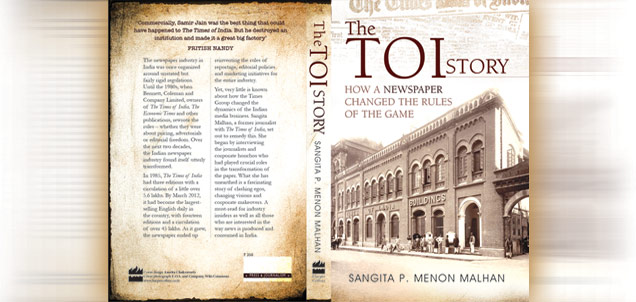
The TOI Story
(How a newspaper changed the rules of the game
By Sangita P Menon Malhan
HarperCollins Publishers India
Cover price: Rs 350*
Paperback, 261 pages
(check amazon.in, flipkart.com for a lower price)
 Said Kaustuv Chatterjee, Senior Vice President – NPI and Languages at BCCL: “Our unbiased credentials and quality of editorial have helped Maharashtra Times emerge as the ‘best in class’ in brand-track reader surveys over the years. This has attracted the most discerning of readers, making Maharashtra Times the No. 1 in affluent, educated, NCCS A readers across Maharashtra as revealed in IRS surveys over the years. We are happy to say that nearly 70 percent of our readers are NCCS A, which means we are able to offer our advertisers the most relevant TG with purchasing power for their brands.”