Tag: The New Indian Express

  • Anto Joseph to join New Indian Express as RE (Tamil Nadu)

    By Our Staff


    Senior journalist Anto T Joseph is all set to join The New Indian Express as Resident Editor (Tamil Nadu), it is learnt. Based out of the paper’s headquarters in Chennai, Joseph will be in charge of all the half dozen editions in the state. He is likely to take charge on Monday, August 2, our sources tell us.

    Joseph has worked with The Economic Times, Deccan Chronicle Group and DNA in various editorial roles including Editor (Infrastructure) at ET, Resident Editor of Financial Chronicle and Managing Editor of DNA. Recently, he flagged off a ‘much-viralled’ series of articles called ‘Who owns your Media’ at Newslaundry. He also wrote for Fortune, Mint, The Caravan and Money9, in the last two years.

    A British Chevening scholar, Joseph has worked with The Guardian (UK) and La Vanguardia (Spain) in the past.

  • Lokmat Samachar’s Pune edition launched

    By A Correspondent


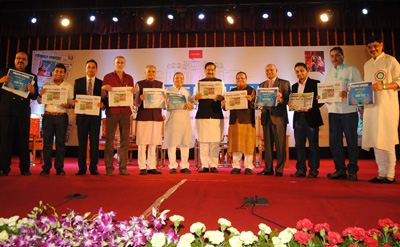
    Maharashtra’s Chief Minister Prithviraj Chavan launched the sixth edition of the popular Hindi daily, Lokmat Samachar in Pune. Also present on the occasion were Minister of State for Education Rajendra Darda along with media luminaries Balbir Punj (senior columnist and RS MP from Rajasthan), Prabhu Chawla (Editor-in-Chief – The New Indian Express), Tarun Tejpal (Editor-in-Chief, Tehelka.com) and Vijay Darda, Rajya Sabha MP and Chairman of Lokmat Media Pvt Ltd.


    “Lokmat Samachar will enhance the quality of life in Pune and will make it more cosmopolitan,” said Chief Minister Chavan at the launch ceremony.


    A panel discussion on “The Relationship between Media and Politicians” was organized to mark the launch. “A journalist is also a politician. Not only should the media help in shaping public opinion, it should also play a critical part in the development of the political process,” the CM observed.


    Senior journalists and editors Mr Chawla, Mr Tejpal and Mr Punj highlighted the increasing complexities of the media world, and the need to maintain a balance in giving coverage and direction.


    “Media is a fish that lives in the vast ocean of democracy,” said Mr Punj. “Hence strengthening the media will result in the strengthening of democracy.”


    Highlighting the sharp difference between the cover prices of newspapers in India and abroad, Mr Tejpal pointed out that the readers India are not willing to pay enough money to run these institutions. “This is the structural flaw due to which quality deteriorates,” he said.


    Mr Chawla decried the increasing incidences of ‘paid news’ inserted by politicians, due to which media is facing a credibility crisis. “Media has become a victim of this phenomenon,” he maintained.


    Speaking about the Pune edition of Lokmat Samachar Rishi Darda, Joint Managing Director – Lokmat Media Pvt Ltd, said: “The Hindi-speaking population of Pune, which has emerged as an education hub and IT city, was in need of a national daily. Since Hindi is our national language and therefore connects people throughout the country, Lokmat Samachar would definitely fill the gap.”


    The newspaper offering consists of the main paper of 12 pages along with a 4 pager Apna Pune that will detail the local civic issues and also leisure options for the Puneites. For You for the young, Sakhi for Women and Lokarang Sunday supplement will accompany the paper on 3 different days in a week.


    This is the sixth edition of the popular newspaper which first appeared in 1989 in Nagpur, and was thereafter launched in Aurangabad, Akola, Kolhapur and Jalgaon in that order. Lokmat Samachar has 13.56 lakh readers as per IRS 2012 Q1 AIR


    Its Pune edition has a cover price of Rs3 plus an attractive subscription scheme.


  • IRS 2011Q4: Not much change in rankings but dailies witness significant growth

    By A Correspondent


    Top 10 Hindi Dailies:

    IRS Q4, 2010 v/s IRS Q4, 2011

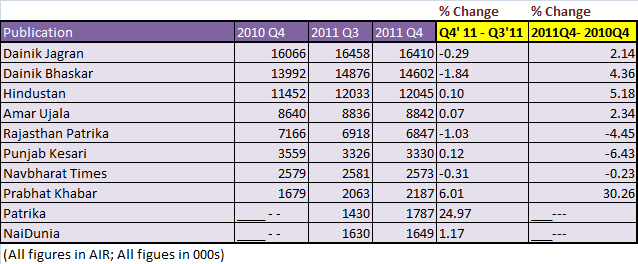
    There is not much of a difference in the rankings of the Top 10 Hindi Dailies. Dainik Jagran, Dainik Bhaskar,Hindustan, Amar Ujala and Rajasthan Patrika continue as the Top 5 Hindi Dailies. When compared to IRS 2010 Q4, IRS 2011 Q4 reveals the Top 4 Hindi Dailies, namely Dainik Jagran, Dainik Bhaskar,Hindustanand Amar Ujala have further strengthened their readership.


    A look at percentage change from Q4, 2010 to Q4, 2011 finds that Dainik Jagran has witnessed a growth of 2.14 per cent, Dainik Bhaskar grew by 4.36 per cent,Hindustanby 5.18 per cent while Amar Ujala grew by 2.34 per cent. The only Hindi daily to have witnessed double digit growth is Prabhat Khabar with a whopping 30.26 per cent growth in Q4, 2011 as against Q4, 2010. A total of five Hindi dailies have witnessed growth Quarter on Quarter.


    Q3, 2011 Vs Q4, 2011

    But the results for IRS Q4, 2011 Vs Q3, 2011 have a slightly different story to tell. The top two most read Hindi dailies – Dainik Jagran and Dainik Bhaskar – have witnessed a decline in Average Issue Readership (AIR), the decline is however marginal. Besides Dainik Jagran and Dainik Bhaskar, the Hindi dailies to have recorded growth in Q4, 2011 v/s Q3, 2011 are Hindustan, Amar Ujala, Punjab Kesari and Prabhat Khabar.


    Top 10 English Dailies:

    IRS Q4, 2010 Vs IRS Q4, 2011:

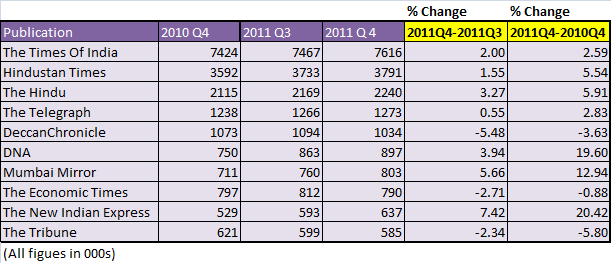
    The English dailies have performed exceedingly well in Q4, 2011. Seven out of the Top 10 English dailies have registered growth in their AIR. While DNA, Mumbai Mirror and The New Indian Express have registered growth in double digits, the top four English Dailies: The Times of India, Hindustan Times, The Hindu and The Telegraph have also witnessed growth quarter on quarter.


    IRS Q4, 2011 Vs Q3, 2011:

    The results for Q4, 2011 in comparison to the previous quarter also highlight the growth for most of the top Ten English dailies.


    Top 10 Language Dailies:

    IRS Q4, 2010 Vs IRS Q4, 2011:

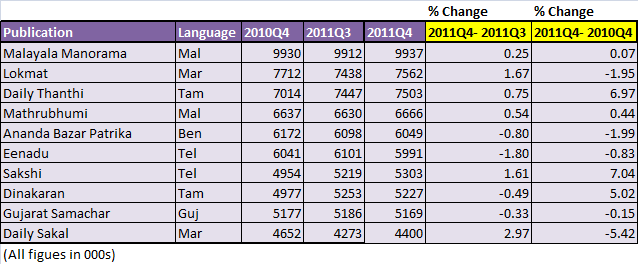
    The Q4, 2011 results as compared to the Q4, 2010 results have shown mixed reactions for Language dailies as only five publications witnessed growth since Q4, 2010 to Q4, 2011. Malayala Manorama continues to be the number one publication among the Language Dailies. According to IRS Q4, 2011 v/s Q4, 2010 findings, the Malayalam daily grew 0.07 per cent.


    Ranked second is Marathi daily, Lokmat which saw a decline of 1.95 per cent. The other Language dailies to have registered growth in their AIR are Daily Thanthi, Mathrubhumi, Sakshi and Dinakaran.


    Unlike the top two dailies, Daily Thanthi, ranked as third Language daily, grew by 6.97 per cent in IRS Q4, 2011 when compared to IRS Q4, 2010.


    It has been observed that the Malayalam dailies – Malayala Manorama and Mathrubhumi and the Tamil dailies – Daily Thanthi and Dinakaran have recorded growth in their AIR. Malayalam, Marathi, Tamil, Telugu, Gujarati and Bengali are some of the popular language dailies to have found a place in the Top 10 Language dailies.


    IRS Q4, 2011 v/s Q3, 2011:

    The top four Language dailies: Malayala Manorama, Lokmat, Daily Thanthi and Mathrubhumi have registered growth in their AIR numbers in IRS Q4, 2011 v/s IRS Q3, 2011. Besides the top four language dailies, Sakshi, the Telugu daily and Daily Sakal, the Marathi daily have also witnessed growth in their readership numbers.


    AIR or Average Issue Readership is defined as the readers of an average issue of a publication i.e. the estimated number of those who have read or looked at any issue of the publication within a specified time interval, which is equal to the periodicity of the publication (excluding the day of the interview). This is the preferred currency of media agencies across the country though often publications quote Total Readership (TR) when their AIR numbers are not impressive. MxMIndia only uses AIR in its IRS reportage.

  • It’s wait ‘n watch for TOI-Matrubhoomi alliance

    By A Correspondent


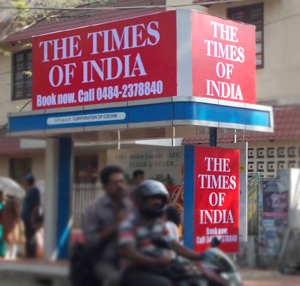
    After much speculation, The Times of India has finally made its foray into the Kerala market, forging a strategic alliance with Mathrubhumi to make inroads into this market. While for readers this alliance might be the best deal as just for Rs2 extra they get a copy of Mathrubhumi and the TOI with its many supplements, as a reader quipped: “This is not a bad deal for 2 bucks”.


    This exactly is the sentiment that TOI wants to ride upon – the bundling with a regional newspaper which the readers are familiar with and allow them to test something new definitely is a great way to enter a new market dominated by regional players.


    Kerala, in that sense, is a unique market with high literacy rates and people who are proud of their culture, willing to try something new but not at the cost of old. Hence, it is primarily seen as a two newspaper-market where one paper is regional, which appeals to the older generation and is more of a habit, and the other is an English newspaper appealing to the younger population.


    It is this younger population that TOI is trying to appeal to. The English newspaper market is primarily dominated by The Hindu, The New Indian Express and more recently Deccan Chronicle. The Hindu too has become aggressive and gone all out to protect its turf.


    Recently, on January 29, just two days ahead of the TOI launch, The Hindu and The Hindu Business Line launched its Kozhikode edition. This shows that The Hindu understands the might of TOI and has gone aggressive with its 360 degree campaign to reiterate its hold over this market. In fact, it has also taken around 30-35 hoardings to make itself visible while sources inform that TOI has taken up around 80 hoardings across to announce its presence in Kerala.


    The divide in Kerala, according to reading preference, is: South to Cochin (till Trivandrum) is where readers prefer Malayala Manorama whereas the area from Cochin to Kasaragoda is dominated by Mathrubhumi. This liking is also based on the political inclination too. Currently, TOI has come out with editions fromKochi, Thiruvananthapuram,Kozhikode, Kottayam, Pathanamthitta, Malappuram, Palakkad, Thrissur, Alappuzha and Kollam, thus being seen all over Kerala.


    However, it is learnt that the paper is having teething troubles: The newspaper is not available at many places; the hawkers union’s in Kerala raising ruckus over the availability of the newspapers in some pockets.


    Giving his view, Kiron Kurian, Group Manager, MudraMax said: “For TOI the real competition is The Hindu in this market. Their current strategy of tying up with Mathrubhumi, as I see, suggests that as the former caters to Sec A and B audience it will be easier to convert this TG to also adopt TOI as a second newspaper.”


    Swarup BR, Founder Stark Group, a Kerala-based 360-degree communication agency feels: “I think largely the TOI offering in Kerala market is nothing phenomenal from what has been seen in the other markets. There would be many people who would want to try out the newspaper and along with their aggressive marketing strategy, it should work out well for them.”


    However, for all, it’s ‘wait and watch’ to see how the market evolves. Some feel that a new trend might start with homes having three newspapers, with both Hindu and TOI having their share of readers. Also there could be revised rates to capture more audience.


    This TOI- Mathrubhumi alliance, while is advantageous for the former, will also be good for the latter as it might give it the much needed push that it requires to lessen the gap with the leader Malayala Manorama.


    Vidya Nandakumar, Business Director, LMG based in Cochin is doubtful that TOI will find it easy to break the monopoly of The Hindu. She said: “In Kerala people are die-hard loyalist and if they like a brand, it is difficult to make them switch. So it would be interesting to see how TOI gets them to convert.” She is of the opinion that probably it would be some pockets where TOI might succeed.


    But Mr Swarup countered: “Kerala is a ‘rurban’ economy; hence there is no clear divide between rural and urban. The brand proliferation too is across the market hence it is one big market. The opportunity for a TOI to reach across is immense. The entire state is a captive market, not just few pockets of interests. Yes, The Hindu is a formidable power and people would not be willing to give the newspaper so easily for TOI. So in that sense it would be interesting to see how the market plays itself out. It is possible that a whole new audience will evolve who will be readers of TOI.”