Tag: The Magic of Print

  • Video: Good effort to evangelize print: Vikram Sakhuja, Shashi Sinha & Josy Paul. Sequel planned: Rajan Bhalla

    By Robin Thomas


    On the sidelines of the HT Media event to unveil the book – ‘The Magic of Print’, MxMIndia caught up with some industry players for their views on the evolution of print advertising, the road ahead for the medium and of course their reactions to ‘The Magic of Print’ and whether such initiatives really help the industry?


    1. Vikram Sakhuja, Global CEO, Maxus

    [youtube width=”400″ height=”220″]http://www.youtube.com/watch?v=gleSCF4K05A[/youtube]

    Your reactions on the book – ‘The Magic of Print’…?

    It’s a great book, it’s a beautiful production, it’s got some very good tips. There are some twelve tips to re-create the magic of print and an absolutely mind blowing compilation of ads. I think Rajan Bhalla has done a brilliant job.


    Does the industry need more such initiatives?

    Yes, absolutely. The good thing about these kind of initiatives that it makes you stop back and think, reflect and when you are tuning with some great minds and if something comes out of it, is always nice.


    2. Shashi Sinha, CEO, Lodestar UM

    [youtube width=”400″ height=”220″]http://www.youtube.com/watch?v=9vILEEM6PeQ[/youtube]

    Your  reactions to the book (‘The Magic of Print’)…?

    It’s a lovely book, and it’s got a combination of some great ads, and there are some simple tips. Copywriting is one area which is very difficult for a beginner in advertising to enter into and the ones that have managed to enter into this field can also learn quite a lot from this book.


    On whether the industry needs more such endeavours?

    There are so many business schools, but no one teaches you the craft of advertising. So I believe this is a great endeavour and for a publisher in-house to do this initiative and to inculcate the spirit, I think it’s a great opportunity.


    Does the industry need more innovation for better growth?

    I won’t be worried if innovations happen or not because ultimately if there are a lot many ads on print, innovation will automatically happen. Innovation is something you do for the long term, so I won’t be worried if innovation happens or not. The fact is that advertising in print will continue to grow and as television rates go up, automatically people will come back to print. Whether it takes two years or five years, I won’t be able to predict, but, this will happen.


    A word of advice for print media…?

    Keep providing great content, contents which are engaging and the rest will follow.


    3. Josy Paul, Chairman and National Creative Director, BBDO India


    [youtube width=”400″ height=”220″]http://www.youtube.com/watch?v=h83bzcVtlck[/youtube]

    Your reactions on the book – ‘The Magic of Print’…?

    It’s a good book, well printed, it’s got some nice images and makes me want to spend more time with it and share it with my team and may be even have some discussions on which of those are fantastic work.


    And does the industry need more such endeavours?

    I think more discussions are good because a discussion makes you think about the medium a little more. Basically it is about focusing on the medium and what makes the medium a little more interesting and exciting. So I think that conversations are good, always.


    Does the print industry need more innovations for better growth?

    I am not sure about the word innovation in print because as a reader if I find people coming in the way of my news, I do get irritated. I believe true innovation is when within the context of the page and with respect to the page you can still create magic and still have a point of view that will make people think again or get excited or share things or put it up on their board, then that’s great. However this whole thing of irritation to the reader is not innovation, in fact is suddenly makes the news a nuisance.


    Where do you see creativity in Print media, five years from now?

    Creativity can never die, it’s forever. I expect newer things to happen, more beautiful things, and younger people will bring in more filters to print and we will see beautiful things that we never thought about. So one cannot really predict, creativity in fact evolves.


    What about print as a medium five years from now?

    I think print will take a new avatar. We all know that education is a big necessity in this Country and newspapers will become an integral part of education and it will start finding new audiences and I think it will further penetrate into the different strata of the society. So, newspapers or print media is like a river that will grow very deep and I don’t think it will just die like that.


    4. Rajan Bhalla, Head, Corporate Marketing and Magazines, HT Media

    [youtube width=”400″ height=”220″]http://www.youtube.com/watch?v=1P8utJgX-EA[/youtube]

    On the idea behind initiating- ‘The Magic of Print’?

    Well, I think the magic of Print is our contribution, our effort to help everybody in the industry associated with print advertising to understand how to create the magic in print advertising. I think it is absolutely clear that print is an absolutely great media vehicle from the point of view of showcasing brands and above all lending a lot of credibility to the message. It is time that we all started looking at how great print advertising can be created and this is our effort in that direction.


    On the process that went behind creating this initiative?

    It was a tedious process that lasted us almost a year. We first identified the content of what we wanted to present in the book. Once we had the content right, we then started scanning for the best examples we could find across the globe to fit into that category. We were not so concerned about picking brands from India, we just looked at global advertising as a market place and we looked at just the best in class advertising that was created under every single theme that you will see.


    How have the advertisers responded to the book?

    The book has just launched, so I am very positive that both the media fraternity as well as the creative fraternity is going to view this as a great initiative, which is also going to help clear a lot of thinking that they put into creating great advertising that works for them. So, it is just the beginning and we would like to probably move on this path as we go forward, year on year.


    So, will there be a sequel to this book – ‘The Magic of Print’?

    Absolutely yes; so we would be looking at various genres in which we can actually help impact the print industry, impact print advertising and help our advertisers in different ways. So you can look forward to another such initiative one year from now.
     

  • The ‘Magic of Print’ is Usain Bolt of Media

    By A Correspondent


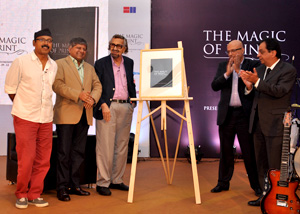
    From left to right: Josy Paul, Shashi Sinha, Alyque Padamsee, Vikram Sakhuja and Rajiv Verma at the unveiling of ‘The Magic of Print’

    We live in an era where technology is at the core of everything that we do. Whether it is about updating ourselves about new product launches or being abreast of the developments that transpire around the world, technology has enabled us to consume news at the quickest time possible – and without burning a hole in our pockets. Amidst this reality, it is the traditional mediums that seem to be taking the brunt of this newfound liking between consumers. From television to out-of-home and even print, mediums today are being threatened to put up a fight and adapt to this new truth or end up being relegated as the medium of yesteryears.


    Celebrating the creativity of print advertising, HT Media on Friday, September 14, 2012 launched a coffee table book on print advertising – ‘The Magic of Print’. The hardbound volume features contribution from prominent Indian advertising expert Mr Alyque Padamsee.  The book comes complete with a treasure trove of outstanding print advertisements of the last few decades from around the world as well as tips on how to create great print ads. The content is put together by Rajan Bhalla, Head Corporate Marketing and Magazines, HT Media and Mr John Thangaraj, Vice President, Planning, LOWE Lintas.


    Addressing a packed audience in Mumbai’s Taj Lands End, Rajiv Verma, CEO, HT Media Limited said that the best ads to remember are all print ads. In the earlier days, there was a certain charm to the print ads which you don’t find today. “I realise news and entertainment will be increasingly consumed on digital media, but print is nevertheless here to stay as long as the content is engaging, good and relevant.”


    A panel discussion was also held which delved on the various aspects of print, the impact of innovations, and the future of print advertising and so on. Print is one of the best reach building medium, and while television basically relies on emotions, print requires more brain power. With the literacy rate growing, newspapers will not decline in a hurry, reading newspaper has become a habit and to break this habit will take a really long time. These were some of the points made at the panel discussion. The panelists included veteran adperson Alyque Padamsee; Vikram Sakhuja, Global CEO, Maxus (and CEO, Group M India and South Asia); Josy Paul, Chairman and National Creative Director, BBDO India; and Shashi Sinha, CEO, Lodestar UM. The session was moderated by Sitaraman Shankar, Deputy Managing Editor, Hindustan Times.


    According to Mr Paul, the magic of print is a sudden impact; it is the Usain Bolt of the media industry.


    Mr Sakhuja pointed out that print is one of the best reach building medium and the top reason why most advertisers use print is for response, reach and editorial credibility.


    Mr Padamsee observed, “Television is basically reliable to emotions whereas print which also relies on emotions at the same time requires brain power. Print is a medium which remains with you and it has a mandate, and the mandate is that it is a very reliable medium. If print is going down today, it is because it is not responding to today’s needs. I don’t think print media even realises, it is an excellent medium for knowledge and education. Once it realises this, the swing will automatically go back to print.”


    So is there a success mantra for the growth of print? Will print die in the long run?


    Mr Josy Paul was of the view that print must not be isolated but integrated and its impact must be maximized. Today innovations is almost a loose word, it has become a bad word, in fact there is a lack of idea today. “Print is in your DNA, so it cannot die, it has been alive for over 800 years, it can only evolve.”


    Mr Vikram Sakhuja  explained, “Print won’t die in a hurry, it may be threatened by television or digital, but it won’t die in a hurry. There will a downward trend, starting with the metros, trickling down to smaller towns and villages, but it will certainly take some generations. In the long run however print will no longer be a mass medium as not many people will be consuming print.”


    Mr Alyque Padamsee was of the view that newspapers have a big advantage of analysing news which is not the case with television as television is a surface medium. “Innovation I believe is great, but some innovations are memorable, and some are clever. However innovations alone won’t sell anything, there is a lack of thinking today as far as print ads are concerned.” He further said, “Any medium will die until they reinvent. Radio would have died a long time ago had they continued the way they were. Yes, even print will die, but they must re-invent to survive and to thrive. Cinema was expected to die after television came in, but they re-invented. As long as print is desirable, it will be buyable.”


    While the panelists were of the view that print advertising needs to regain the charm it once had, there was a near unanimity among the panelists that print media is here to stay. However they were also of the view that if the medium was to die in the future, especially with the advent of digital, the death of the medium will be slow. The impact would first be witnessed in the metros which will trickle down to smaller towns and cities and in the long run, print will no longer remain a mass medium. Nonetheless as of today, the panelists were of the view that print advertising must not depend solely on innovation, that the medium must re-invent and make itself a desirable medium.


    Shortly after the panel discussion, the book -‘The Magic of Print’ was unveiled.


  • HT Brunch Dialogues on the changing face of Indian heroine

    By A Correspondent


    The launch of a coffee table book on print advertising – ‘The Magic of Print’ – by HT Media was followed by the HT Brunch Dialogues. The second edition of HT Brunch Dialogues was launched by Hindustan Times Brunch, and was themed, The Changing Face of the Indian Heroine. Two rounds of panel discussions were held.


    The panellists in the first round included Film Director, Madhur Bhandarkar; Producer, Siddharth Roy Kapur and filmmaker and screenplay writer, Raj Kumar Gupta. The panellists discussed the filmmaker’s role in portraying the Indian female lead. They delved on how the female oriented films and the roles offered to actresses have changed and evolved over the years. They also pondered on whether an actress in the long run would be at par with the actor, in terms of pay.


    “Times have changed, today heroines are willing to experiment with their roles or even their image which was not so earlier, when they were very conscious about their image and the roles they play” said Madhur Bhandarkar.


    On whether heroines will also be paid on par with heroes, Siddharth Roy Kapur said, “If a female oriented film crosses Rs. 100 crore, it may see heroines getting paid as much as the heroes.”


    The second session of the panellists included film personalities Kareena Kapoor, Karisma Kapoor and Sharmila Tagore. Both these sessions were moderated by Vir Sanghvi, Advisor, HT Media.


    Their discussions revolved around the way scripts or films have evolved over the years for the Hindi film heroine. And how they have managed to stay relevant or break the myth about actress only as a show piece in the film and their take on whether things will get any better for the Hindi film heroine in the near future.


    According to Sharmila Tagore, there is a huge difference in the roles women or heroines do today. Times have certainly changed, cinema has become professional today, unlike before, but roles are still not written for women.