Tag: The Indian Express

  • Ramnath Goenka Awards presented for journalism

    By Our Staff


    The Indian Express Group hosted the 16th edition of the Ramnath Goenka Awards for Excellence in Journalism on March 22, 2023, in Delhi, with Dr. Justice D.Y. Chandrachud, the Chief Justice of India, as the Chief Guest. The ceremony honored journalists from both print and broadcast media who have demonstrated exceptional strength of character and integrity while reporting news under challenging or dangerous circumstances.


    Addressing the audience in his speech, the chief guest of the evening, Justice D.Y. Chandrachud, Chief Justice of India, said: “The media is the fourth pillar in the conception of the State, and thus an integral component of democracy. A functional and healthy democracy must encourage the development of journalism as an institution that can ask difficult questions to the establishment – or as it is commonly known, ‘speak truth to power.’ The vibrancy of any democracy is compromised when the press is prevented from doing exactly this. The press must remain free if a country is to remain a democracy. India has a great legacy of newspapers which have acted as catalysts of social and political change. Many journalists, both in our country as well as across the world, work in difficult and unfriendly conditions. But they are relentless in the face of adversity and opposition. It is precisely this quality which must not be lost. As citizens, we may not agree with the approach that a journalist has adopted or the conclusions that they reach. I, too, find myself disagreeing with many journalists. After all, who amongst us agrees with all other people? But disagreement must not distort into hatred and hatred must not be permitted to evolve into violence.”


    Adding to this, Viveck Goenka, CMD, Indian Express group, said: “An independent judiciary and an independent press are — and will remain — inalienable parts of our democracy. Do what is right irrespective of who is before you, who it’s affecting, and, in this case, who you are challenging” and lauding the CJI’s work, the CMD said “his innovative initiatives to open up court hearings; his use of technology to increase public access to the bench; his moves to bring transparency into the court’s decision-making; his thoughtful, nuanced reflections on the role of the court and its limitations; his acknowledgements of differences. All these are enduring reforms that, I am sure, will strengthen the judiciary and deepen public trust in it.”


    As a thank you note, Raj Kamal Jha, Editor-in-chief, The Indian Express, adds “The evening was a “very special story”. 37 pieces of powerful reporting from 27 newsrooms, two books that enriched our understanding of what shaped India and a wonderful applause that cuts across party lines.” Thanking the Chief Justice, he said “Your vision for a free media and your notes of caution affirm our faith that the Supreme Court will remain to borrow a metaphor you used in your recent speech, the north star. For journalists and journalism, year after year, case after case, the star light has illuminated the road ahead. From scrapping the ban of a publication, Romesh Thapar 1950 to protecting the media from executive interference in Indian Express 1984, to extending free speech online, Shreya Singhal 2015 to ensuring journalists personal liberty in Arnab Goswami 2020, the court has kept pushing back at the state to expand our freedoms. That’s why when the lights dim, when a reporter is arrested under a law meant for terrorists, when another is arrested for asking a question, when a university teacher is picked up for sharing a cartoon, a college student for a speech, a film star for a comment, or when a rejoinder to a story comes in the form of a police FIR, we turn to the north star for its guiding light. More so as Chairman Mr Viveck Goenka said a free media and an independent court are kindred spirits. The health of one has serious implications for the health of the other. Both secure an invaluable space. The work we celebrate this evening comes from that space. “Thank you to the winners, we know that an abusive social-media post is more fun to read, summoning righteous rage, needs no effort, being afraid is very easy, but its reporting like yours with fairness and accuracy, with a rigour for detail and a respect for the contrary that best makes the case for journalism.”


    The jury for the 2019 awards included Justice B.N. Srikrishna, jurist and former judge of the Supreme Court of India; Tom Goldstein, professor and dean of the Jindal School of Journalism and Communications at O.P. Jindal Global University; Dr. SY Quraishi, former Chief Election Commissioner, Election Commission of India; and Pamela Philipose, journalist and senior fellow at the Indian Council for Social Science Research. The jury for the 2020 awards included Justice B.N. Srikrishna, jurist and former judge of the Supreme Court of India; Prof. (Dr.) C. Raj Kumar, founding dean of Jindal Global Law School (JGLS) and director of the International Institute for Higher Education Research & Capacity Building (IIHEd); Dr. SY Quraishi, former Chief Election Commissioner, Election Commission of India; and K.G. Suresh, Vice Chancellor of Makhanlal Chaturvedi National University of Journalism and Communication, Bhopal.


    The winners for both 2019 and 2020 were felicitated at this year’s ceremony, as the winners for 2019 were announced digitally due to the pandemic.


    The winners of the 15th & 16th Ramnath Goenka Awards for Excellence in Journalism which were felicitate during the event are:


    S.No | Media | Award Categories | Year | Name | Publication

    1) Print | Hindi | Anand Choudhary | 2019 | Dainik Bhaskar

    2) Broadcast | – | Sushil Kumar Mohapatra | – | NDTV India

    3) Print | Hindi | 2020 | Jyoti Yadav | The Print

    4) Print | – | – | Bismee Taskin | The Print

    5) Broadcast | – | – | Ashutosh Mishra | Aaj Tak

    6) Print | Regional Languages | 2019 | Aniket Vasant Sathe | Loksatta

    7) Broadcast | – | – | Sunil Baby | Media | One TV

    8) Print | Regional Languages | 2020 | Sreelakshmi M | Mathrubhumi.Com

    Rose Maria Vincent Mathrubhumi.Com

    Shabitha Mk Mathrubhumi.Com

    9) Broadcast | Shrikant Bangale | BBC News | Marathi

    10) Print | Uncovering India Invisible | 2019 | Shiv Sahay Singh | The Hindu

    Broadcast Tridip K Mandal The Quint

    Print Uncovering India Invisible 2020 Team Thomson Reuters

    11) Broadcast | Sanjay Nandan | ABP News

    12) Print | Reporting on Politics and Government | 2019 | Dheeraj Mishra | The Wire

    Broadcast Seemi Pasha The Wire

    13) Broadcast | Reporting on Politics and Government | 2020 | Bipasha Mukherjea | India Today TV

    14) Print | Environment, Sciences and Technology Reporting | 2019 | Team PARI People’s Archive Of Rural India

    15) Broadcast | Team Scroll.in Scroll.in

    16) Print Environment, Sciences and Technology  Reporting 2020 Manish Mishra Amar Ujala

    17) Broadcast Faye D’Souza Freemedia Interactive

    Arun Rengaswamy Freemedia Interactive

    19) Print Business & Economic Journalism 2019 Sumant Banerji Business Today

    21) Broadcast Ayushi Jindal India Today TV

    Print Business & Economic Journalism 2020 Omkar Khandekar HT Mint

    23) Print Investigative Reporting 2019 Kaunain Sheriff M The Indian Express

    25) Broadcast S. Mahesh Kumar Manorama News

    Print Investigative Reporting 2020 Tanushree Pandey India Today

    27) Broadcast Milan Sharma India Today TV

    29) Print Foreign Correspondent 2020 Joanna Slater The Washington Post

    Print Sports Journalism 2019 Nihal Koshie The Indian Express

    31) Broadcast Team NewsX NewsX

    33) Print Sports Journalism 2020 Mihir Vasavda The Indian Express

    Broadcast Ajay Singh NDTV India

    35) Print Reporting on Art, Culture & Entertainment 2020 Tora Agarwala indianexpress.com

    37) Print Civic Journalism 2019 Chaitanya Marpakwar Mumbai Mirror

    Print Civic Journalism 2020 Shaikh Atikh Rashid The Indian Express

    39) Print Photo Journalism 2019 Zishaan A Latif The Caravan

    41) Print Photo Journalism 2020 Tarun Rawat The Times of India

    Print Books 2019 Arun Mohan Sukumar Penguin Random House India

    43) Print Books 2020 Tripurdaman Singh Penguin Random House India
     

  • The More you Succumb, the More Dangerous the World Becomes


    By Ranjona Banerji


    Ranjona BanerjiOn July 22, the Income Tax department carried out a series of raids on the offices of the Dainik Bhaskar group across India.



     

    Even for those sleeping under a rock to avoid criticising the Modi government, these raids were a sign that someone up there in the higher reaches of power was angry. Very angry.


    The anger could be two-fold: The revelations this week of the Pegasus Project and that Bhaskar covered it widely.


    And that this Pegasus coverage only added to the rage the government had felt at the relentless manner in which this large chain of newspapers had covered the Covid-19 pandemic. Government lies on Covid cases, lies on the number of deaths, on the lack of oxygen in hospitals, on the dead bodies floating in the Ganga and other rivers and buried in shallow graves in riverbanks were exposed every day in both Gujarat’s Divya Bhaskar and Dainik Bhaskar editions elsewhere.


    National Editor Om Gaur took DB’s coverage even further in his edit page piece for the New York Times about the dire Covid situation during India’s second wave, which was headlined: “The Ganges is returning the dead”. As ever, negative international exposure enrages an image-conscious Prime Minister and his government.


    Whatever has irked the government more, it is clear that it is riled. And when that happens, there is a malicious, vindictive reaction. Perhaps for almost seven years, the Modi government has got so used to the lavish praise piled on it, for all its transgressions, mistakes, lies, aggressions, disasters, any resistance is seen as unacceptable. Okay, cut that “perhaps”. We know that this is a government, more than any other until now, which cannot handle dissent, disagreement, questions, opposition. And has been enabled by a captive mainstream media.


    Between the Pegasus Projects and its revelations, and these raids on a media house, where does the rest of the media stand? The old days when all newspapers ignored each other and operated in their separate silos have gone, and for the better, together with that ivory tower editor who barely comprehended what was happening in his own newsroom forget the nitty-gritties of the world itself. The media has to comment on itself and allow others to comment on it.


    The revelations that someone within the government of India was using/ had used Israeli-made military-purpose malware to both hack into people’s electronic devices, run surveillance on them and possibly also implant material into their devices has shaken the world and forced the media not involved in the investigation to take notice. But the voice of the media has been far from uniform and at times, shockingly pro-government even though journalists, citizens, businesspeople, activists and others have been targets.


    So how did we respond to the Dainik Bhaskar raids.


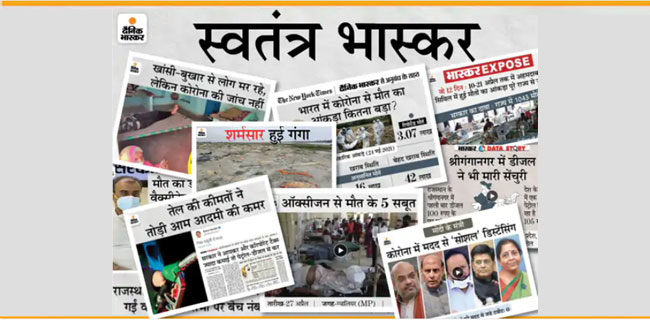
    Bhaskar itself called itself “Swatantra Bhaskar” or Free Bhaskar and announced on its front pages, with a series of images of its Covid and other coverage, that the government had to do what it had to do and the media group what it had to do.


    The Mumbai edition of the Times of India, July 23, had an article on Nation pages 11, the focus of which was the Opposition’s reactions to the raid. Shooting from the opposition’s shoulder, rather than straightforward coverage.


    The Economic Times, Mumbai, July 23, covered the possibility that industrialist Anil Ambani’s phone had been hacked as well as the corporate reaction to Pegasus on Page 6. But page 2 had Union minister Meenakshi Lekhi’s lies that Amnesty had distanced itself from the Pegasus Project, minus the clear clarification to the contrary that Amnesty had issued soon after.


    The Dainik Bhaskar raid was on Page 8.


    Hindustan Times, Mumbai, July 23, did better than its rival TOI. The first two pages were dedicated to the Olympics. Therefore, the Pegasus uproar in Parliament and the Ambani phone hack were on page 3. City page 5 had a single column on the DB raid in Mumbai. Nation page 5 ran with the raid as the lead, above the fold. And Nation page 7 had more Pegasus coverage. However once again, Lekhi, was allowed to run with her lie.


    The Indian Express, Mumbai has upped its game (although in the days to come expect more government ministers pushing Modi/BJP propaganda on their oped pages). The Dainik Bhaskar raid and Pegasus were on Page 1, continued on 2 as is the paper’s style. On Page 8, the Amnesty rebuttal to Lekhi’s claim made an appearance and Pegasus found space on the economy and world pages.


    The Hindu, Chennai had a much better showing, despite the photo of group head Malini Parthasarathy in Modi’s “illuminating” presence, which she put up on Twitter on July 22. Both the raid and Pegasus were on the front page, on page 10 in further detail. Pages 11 (nation) and 13 (world) had further Pegasus coverage.


    Of the English language papers MxM looked at, The Telegraph, Calcutta stood out. Both the raid on DB and Pegasus ran as the lead. The Ambani phone hack also found space. The lead story quoted DB National editor Om Gaur about why he thought the group was raided – the strong Covid coverage – as well as his NYT piece.


    Of the Hindi papers, Amar Ujala, Delhi had the best coverage: The raids on Dainik Bhaskar as well as the independent UP-based news channel Bharat Samachar were second lead, above the fold. No one else mentioned Bharat Samachar, which has been increasingly critical of the government.


    The Pegasus uproar in Parliament was the lead. Amar Ujala also mentioned prominently how Lekhi had called protesting farmers “mawalis” or hooligans. Most English newspapers ignored this stroke of genius from the Union minister.


    Rajasthan Patrika, Jaipur, carried the raid on the front page and also had an edit.


    Hindustan Delhi: Had the Pegasus arguments in Parliament, but focused on the IT minister as the lead. A small mention of the DB raid on Page 1 sent the reader to page 11, where Pegasus was also covered.


    Dainik Bhaskar’s biggest competitor, Dainik Jagran Delhi, carried a tiny mention of the raid on page 4.


    Regardless of the extent of the coverage we went through, all media owners and editors know what all journalists also know: that the more you succumb, the more dangerous the world becomes. You may think I was going to say that the more you resist, the more you are under threat. That is true. But unless you want the threat to last forever, you have to resist.


    Kudos to Dainik Bhaskar for its stand so far.


    And to those who have not been too afraid to cover the actions of a vindictive government.


    For those who cover up, well…


    Ranjona Banerji is a senior journalist and commentator. She is also Consulting Editor, MxMIndia. She writes on MxMIndia every Tuesday and Friday. Her views here are personal


  • Sourav Majumdar joins Business Today as Editor, Siddharth Zarabi to lead TV wing

    By Our Staff


    Close on the heels of Udayan Mukherjee joining as its Global Business Editor, the India Today group has announced two more senior appointments as part of its plans to bolster its coverage of business news in the post-pandemic economic order.


    Sourav Majumdar
    Sourav Majumdar
    Siddharth Zarabi
    Siddharth Zarabi

    Sourav Majumdar is the new Editor of the Business Today Magazine, and Siddharth Zarabi will be Managing Editor of Business Today TV. Majumdar has led the Indian editions of Fortune and Forbes and earlier Entrepreneur magazine.

    Zarabi, who was Editor of BTVI (earlier Bloomberg TV India) until recently, has been with CNBC TV18 in the past as well as Business Standard and The Indian Express.


    Speaking on the appointments, Kalli Purie, Vice Chairperson of the India Today Group, said, “Every once in a while, the business arena goes through an irreversible change. In the midst of this disruptive flutter, the real journalists and real ideas reshape the world. We are happy to be on the leading edge of this transformational journey with the most credible journalists, an enviable legacy and a truly Omni platform multimedia Business Today Experience”


  • Can the Indian media regain public trust?


    By Ranjona Banerji


    In an edit page article on The Indian Express, Rasmus Kleis Neilsen, director of Reuters Institute for the Study of Journalism and professor of political communication, University of Oxford, writes: “In a new survey of English-language Indian internet users, we find that a third name search engines as their main source of online news, and a quarter name social media – in each case overwhelmingly. Google and Facebook respectively. Only 18 per cent claimed going directly to the websites or apps of news publishers as their main source of online news.”
    As if that was not troubling enough, he goes on to say, “Worryingly, many Indians do not seem to understand how the platforms they increasingly rely on for news actually operate.”

    We know this already from life experience. In spite of all the jokes and warnings, people seem to implicitly believe what they receive on Whatsapp, because “X sent it to me” or because “It came on my phone”. The illogic of their belief matches one supposes the illogic of all belief systems but that is a philosophical matter beyond the scope of the media.

    What journalists have to face then is not just a crisis of confidence and trust from their readers and viewers, but a greater crisis of being sidelined or trumped by algorithms. Regardless of the critiques here or elsewhere and regardless of how you feel about this news channel or that news site, the bulk of journalistic work is done by legwork, information-gathering and due diligence. Most platforms also provide a variety of news so that various points of view are presented. This buffet approach to news is not how algorithms work.

    But are media houses and journalists themselves partly to blame for this shift or is it all on the shoulders of Google and Facebook? After all, much of what passes for news or discussion on the news as far as Indian “news” channels are concerned, beggars belief. The drama, the yelling, the violence if not physical then certainly intellectual, has diminished the idea of news and debate far more, to my mind, than Google and Facebook have done.

    In the case of Indian media houses, this degradation is deliberate. Even if one cannot trust the intentions of Google and especially Facebook after the Cambridge Analytica revelations, several decisions are still made by algorithms and not by human editors. As far as Indian news is concerned, the damage has been done wilfully by humans, either by journalists or their owners or both.

    Nielson discusses the greater responsibility that Google and Facebook have on the dissemination of news here:

    https://indianexpress.com/article/opinion/columns/facebook-google-twitter-internet-algorithm-as-editor-5640696/

    But our focus is on the Indian media. Already we have seen that fact-check websites do better work than trained and employed journalists to expose fake news. Most journalists themselves use these fact-checkers as reference points. The irony is that often these sites correct false news put out by the mainstream media itself. The ironies involved are mind-boggling.

    Nielson has located his opinion piece within the upcoming general elections. The questionable use of social media and of targeted algorithms on voters has been seen in the US presidential elections and the popular vote for Brexit in the UK. It is imperative that these internet giants are studied closely.

    Still the greater responsibility, to my mind, lies with the Indian media itself. Where and why has it lost out? Why is the Indian media unable to combat fake news? What can be done now?

    There’s one clear hint here though: Stop catering to the ruling party and try and assume at least a semblance of objectivity. That might help the media regain some public trust. It’s a bit late but no harm trying. The option is subjugation and irrelevance. You don’t need an algorithm to figure out what that means.


    Ranjona Banerji is a senior journalist and commentator. She is also Consulting Editor, MxMIndia. The views here are personal.


  • Media & 2 Years of Modi Rajya


    By Ranjona Banerji


    Two years ago, the Bharatiya Janata Party won the Lok Sabha in historic fashion. After decades of coalition rule, one single party won with a huge majority. The victory was attributed to a campaign that ran on the promise of one person: current Prime Minister Narendra Modi. “The Modi Wave” the media called it and indeed it was a tsunami in some areas.


    Most of the media immediately went into adulatory mode – that is, those who had not already become Modi cheerleaders during the campaign itself. One of the finest examples of the media’s Modi Media Fan Club at work was seen during the prime minister’s first US trip. The event at New York’s Madison Square Garden for non-resident Indians saw the Indian media calling him a “rock star” (was it Barkha Dutt who started it?) and getting brainwashed by such immense popularity.


    Most cynics know that such a honeymoon cannot last. It might be fair to say that in Modi’s case, the honeymoon lasted a little longer than most. Years ago, India Today (the magazine) had a cover on how cartoon depictions and caricatures of Rajiv Gandhi had changed in a year as he went from Mr Clean (after the Congress won with a massive majority following Indira Gandhi’s assassination) who promised youth and change to the same old same old. Made worse of course by Bofors.


    With Modi, the shift from “rah rah” to “ha ha” has been more subtle and incremental. Television and social media have changed the discourse and the news cycle. And the left-right-centre divide of Indian society has become more pronounced. Therefore, we still have news channels that are overtly pro-government, we have prominent journalists who are pro-government and we have websites pretending to be news websites that are almost government spokespersons.


    Let’s take a look at columnist Tavleen Singh who has a popular column in the Indian Express on Sunday. She promised her readers that Modi’s victory would bring a massive and wonderful change to India, as the nation needed to be rescued from the evil Congress and the even more diabolical Sonia Gandhi. But as time has changed, her column has made certain shifts. As the Modi government did not deliver on the promises she made, she started by blaming everyone around him.


    First, the Congress was to blame for its legacy. Then bureaucrats were to blame. Then other ministers were to blame. Then extreme Hindutva organisations were to blame. But now, two years in, now and then Singh finds that Modi himself is to blame. For a fan like Singh, is that a reality check or her fine journalistic prowess from the past re-asserting itself?


    The Times of India has declared itself a “federal” state. This means the newspapers say one thing, often critical of the government, and Arnab Goswami, ruler of Bennett Coleman’s news channels (Times Now, ET Now) says something quite else – hyper nationalism and a tendency to hold the Congress to account for this government’s failures.


    The Indian Express sticks to the old journalistic principle of holding a government in power to account. So does The Hindu. The Telegraph has perfected the fine art of holding a government in power to extreme ridicule, whether at the Centre or the state.


    Our other news channels walk their confused path. NDTV is accused of being anti-Modi and pro-Congress but often that just means that the channel tries to be balanced. The new avatar of CNN-News18 is far more balanced than it has been for three years – all the fears of Mukesh Ambani being only pro-Modi have not come quite true. With R Jagannathan leaving firstpost.com for Swarajya, the flagship website is also less tilted to the right. In fact, one might say Raghav Behl’s Network 18 was far more pro-Modi than the Ambani one. CNN-News18’s choice of “resident commentators” might give one a clue: Swapan Dasgupta (pro-BJP), Vir Sanghvi (not pro-BJP), Ajoy Bose (not pro-BJP) and Ayaz Memon (balanced).


    India Today TV remains the most everywhere. The cartoon series So Sorrry lampoons everyone equally. Rahul Kanwal and Gaurav Sawant are the best pro-Modi pro-BJP pro-nationalist and Super Patriotic TV journalists – my due apologies to Goswami for saying this – with Sawant having a slight edge over Kanwal. These two are balanced by the acerbic and sharp Karan Thapar and the even tone of Rajdeep Sardesai. So depending on time of day, you get a different India Today TV.


    News18 remains in a constant race to become Times Now with Rahul Shivshankar emulating his former boss Arnab Goswami as best he can. Which is not good enough by a long shot.


    May 19 and elections results of five states will be announced. Let’s see how many jump various ships then.


  • Veteran journalist BG Verghese passes away

    By A Correspondent


    BG Verghese, veteran journalist and former editor of The Times of India, Hindustan Times and The Indian Express passed away in New Delhi on Tuesday.

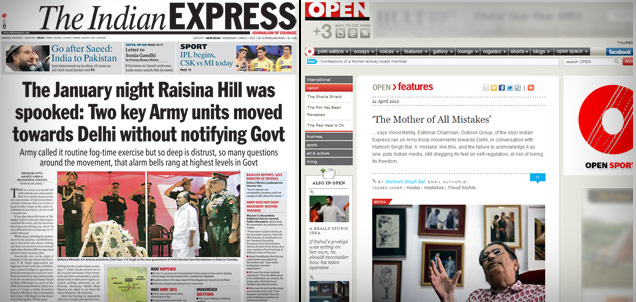
     

    Mr Verghese (June 21, 1927 – December 30, 2014) was with the Centre for Policy Research since 1986. He started his career in journalism with the Times of India and was later Editor of the Hindustan Times (1969-75) and Indian Express (1982-86).


    He was Information Adviser to the Prime Minister (1966-69), a Gandhi Peace Foundation Fellow for some years after the Emergency and Information Consultant to the Defence Minister for a short period during 2001.


    He was a recipient of the Magsaysay Award in 1975, Assam’s Sankaradeva Award for 2005, and the Upendra Nath Brahma Soldier of Humanity Award in July 2013. Verghese has served on a number of official and unofficial boards and committees and continues to be associated with a number of NGOs in the fields of media, education, the environment and community relations. He is chairman of the Commonwealth Human Rights Initiative, Delhi, and a distinguished fellow of the Administrative Staff College of India, Hyderabad.


    Mr Verghese was a member of the Kargil Review Committee and co-author of the Kargil Review Committee Report tabled in Parliament chronicling the sequence of events leading up to the India-Pakistan confrontation and recommendations for the future. He was also a member of the Editors Guild of India Fact Finding Mission to Gujarat in April 2002.


    With a keen and enduring interest in developmental reporting and the social transformation it can help bring about, Verghese has authored several books including the seminal Design For Tomorrow early in his career following an extensive tour of the country and its infrastructure projects, Waters of Hope, Harnessing the Eastern Himalayan Rivers, Winning the Future, India’s Northeast Resurgent, and Reorienting India. Rage, Reconciliation and Security (Penguin 2008) deals with managing India’s diversities. His personal memoir and “worm’s eye” view of India, First Draft: Witness to the Making of Modern India, was released by Tranquebar in October 2010. Post Haste – Quintessential India, (Tranquebar), followed in April 2014 with an official launch in May, chronicling the diversity and history of India as portrayed through its postage stamps and ‘dak’ runners who still traverse jungles and remote Himalayan valleys to get the mail through. Reviews and launch comments in Jansatta, Indian Express, and The Hindu.


    Schooled at Doon School, Dehra Dun, India, Mr Verghese went on to read Economics at St Stephen’s College, Delhi University and Trinity College, Cambridge. Verghese was born in 1927. He resided in New Delhi.


    Mr Verghese passed away on December 30 having lived a life “without regrets”, fearlessly and tirelessly championing the cause of the underprivileged and less fortunate in his crusade for justice, social equality and freedom..


    Information source: http://www.bgverghese.com


  • Ranjona Banerji: Media double faults in Paes-Bhupathi match

    Ranjona Banerji

    By Ranjona Banerji


    After years of working with city reporters, I accepted the fact that many grappled to understand the concept of “presumption of innocence”: If the police made an accusation against someone, why then it had to be true. But, of course, every accused has the right to defence. And while reporting a story, journalists are supposed to be objective. If they cannot provide both sides of a dispute, they must explain to the reader why they have failed.


    But in the initial rounds of this rather unfortunate fight in Indian tennis, where Mahesh Bhupathi and Rohan Bopanna have refused to partner India’s top tennis player Leander Paes in the 2012 London Olympics, the media started out batting for Bhupathi alone. In what appears to be a well-thought-out campaign, the doubles pair of Bhupathi and Bopanna sent out a series of letters and emails signalling their refusal to play with Paes even before the All Indian Tennis Association decided on the Olympic team. Several newspapers and news channels did not even make a willy-nilly attempt to contact Paes.


    The exceptions are possibly DNA and Headlines Today, who got in touch with Paes’s father. But for the most part, it was about the terrible wrong that was about to be done to Bhupathi and Bopanna – being forced to play with Paes for the Olympics. Mail Today and The Times of India seemed like they had stakes in Bhupathi’s career.


    These pressure tactics appeared to have failed and the AITA decided to pair Bhupathi with Paes. This is where objectivity completely failed India’s sports journalists. Bhupathi came on air and was quoted in print making all kinds of allegations against Paes. The Times of India at last informed us that they could not contact Paes. Therefore, the story remained one-sided.


    Bhupathi and Bopanna meanwhile, perhaps emboldened by this out-and-out media support stated firmly that if either had to partner Paes, they were willing to forgo the Olympics. Despite the media’s usual pattern of extreme jingoism, even this display of lack of country love, did not deter the pro-Bhupathi-Bopanna journalists. One cannot state that sports journalists are less jingoistic than the rest – we see what they do to cricketers regularly. In fact I can guarantee that any top cricketer who refused to play for India because he did not like his team members would be hung, drawn and quartered by the media. By the way, cricket is not even an Olympic sport and technically, when Indian cricketers play, they represent the board. Not so for tennis, where professional players put aside career considerations to play Davis Cup and the Olympics.


    However, as the week of allegations by Bhupathi and Bopanna came to a close, the media slowly started to turn. Paes may have contributed to that by issuing a statement that he was willing to go by the AITA’s decision. The Indian Express and Mid-Day started to look at being fair to all concerned. The Hindustan Times later also presented a larger picture. The Times of India came to the party last – but more on its edit pages than its sports pages.


    Where a reader should have been given perspective on this battle and information to negotiate through this unseemly fight, he or she got a minefield of accusations from only one side. Now the villain of the piece is apparently the AITA as Bhupathi has approached the sports ministry to step in. Bhupathi has accused the selection committee of being a bunch of bureaucrats who know nothing about tennis. To me they appear to be former players – perhaps not of the stature of Bhupathi but tennis players nonetheless, a fact which needs to be pointed out in the media.


    Monday night saw Times Now’s Arnab Goswami ask Mahesh Bhupathi some tough questions – some of which he struggled to answer. This is the first time that Bhupathi’s accusations were questioned. Later, the fathers of Paes and Bhupathi were on Times Now, where Paes Senior pointed out that Bhupathi was not blameless in this battle, while Bhupathi Senior tried to shrug that off and say the Olympic riddle had to be solved not the mistakes made by the boys.


    Appalling as this ego battle between India’s top tennis players may be, the media’s partisan stand has been as appalling.


  • How ‘Fake Jhunjhunwala’ writer Aditya Magal impressed the ‘real’ Jhunjhunwala

    By Sruthijith KK


    On Tuesday, 26-year-old Aditya Magal nervously walked into the Nariman Point offices of billionaire investor Rakesh Jhunjhunwala. Most people who looked up from their terminals didn’t glance a second time, possibly concluding that the boy-faced youngster must be an internship-seeker at Rare Enterprises. But Jhunjhunwala himself took a keen interest in Magal, seating him in his private office, enquiring about his background, his family, his stylish haircut and his girlfriends.


    As word about the young visitor spread, Jhunjhunwala’s colleagues – hardnosed traders and analysts – streamed into his office to meet Magal. They shook hands with him. Everyone smiled. Some said they were fans. Magal’s stock was on the rise. The encounter, facilitated by ET, saw uproarious moments.


    For four-and-a-half years, unknown to everyone, Magal has been Fake Jhunjhunwala, the anonymous writer behind ‘The Secret Journal of Rakesh Jhunjhunwala’, a popular parody blog that tore into people in the news – politicians, actors, journalists, other stock market players, anyone – with biting sarcasm.


    He caricatured the identity of Jhunjhunwala, an opinionated ace stock picker with interesting quirks, into a loud, wildly entertaining character who spared none. His blog gets 30,000 unique visitors a month.


    Magal’s Twitter account is followed by more than 45,000. Even his online fan club has 2,500 followers on Twitter. Well-known people on Twitter, such as Gul Panag and Pritish Nandy, are amused by his writing.


    Not everyone’s amused though. Like some journalists, who were mercilessly taken down by the Fake Jhunjhunwala, who then called the real Jhunjhunwala to complain. “I told them I don’t write it,” the real Jhunjhunwala said. “Then they wanted to know who wrote it. Arrey, how do I know?”


    Kingfisher boss Vijay Mallya once told Jhunjhunwala that he liked to start his day by reading his tweets. “The first time I didn’t say anything. Then, another time he again said, ‘Rakeshbhai, you are very funny, what all you keep tweeting?’ Then I told him I don’t write it,” Jhunjhunwala said.


    In his column in The Indian Express, editor-in-chief Shekhar Gupta mistakenly attributed Fake Jhunjhunwala’s tweet to the real Jhunjhunwala, to illustrate the prejudices and dominance of the “upper caste, creamy layer of our society”. The newspaper later apologised.


    Magal carries clear disclaimers on both his Twitter bio and his blog. And as long as he does that, Jhunjhunwala says, he has no problems with what he writes. “Who am I? You have a right to express yourself. And you are saying you are not me. Then what is the problem?” In a country where people compete to take offence, Magal picked the right man to parody.


    As it happened, Magal didn’t pick Jhunjhunwala. The blog was started in 2008 by Mark Fidelman, an American who then worked in Indian real estate. Inspired by the success of the Fake Steve Jobs blog, Fidelman created the blog as a platform to vent his frustrations with India after his business here suffered. After three months, Fidelman told Magal, who he knew through a business association, about the blog, and asked him to take over. Magal says he started laughing.


    “I have been following Rakesh sir since the time I was 20 or so. I was following a number of investors and gradually, what Rakesh sir said started making the most sense for me.” Magal dabbled in the stock markets and like countless retail investors before him, was taken in by Jhunjhunwala’s knowledge and his uncanny ability to make the right bets.


    If he was a follower before, writing the blog for four years turned Magal into something of a devotee. He has read and watched nearly every interview the investor has given. He knows everything there is to know about Jhunjhunwala, from the year his sister got married to the architect of his Lonavala home. From the brands of cigarettes and whiskeys he prefers to the Mercedes S Class he drives. “Why, I also have a Bentley,” Jhunjhunwala helped along, amused by Magal’s grasp of J-trivia. But Magal knows not just trivia about Jhunjhunwala. He also knows his investment portfolio closely.


    But Magal’s natural funny side is more often on display. At lunch with this correspondent, he recited a poem: “Jhunjhunwala goes to Lonavala to live in a house by Killawala.” Nitin Killawala is the architect. In Jhunjhunwala’s office, as his colleagues gathered around to meet the famous blogger, Magal parodied Jhunjhunwala’s TV appearances. His habit of talking up the India story, the peculiar way in which he says ‘humongous’. Everyone laughed.


    When Jhunjhunwala lit another cigarette, Magal told him that he should cut down on his smoking. “What is this sir? Earlier in interviews you used to say you smoked 10-15 cigarettes. Now you say 20-25. And you have stopped doing yoga.” Jhunjhunwala demonstrated some yoga-style breathing for him.


    The atmosphere was warm and convivial. When Magal sought permission to click some pictures of his office, Jhunjhunwala readily agreed. “Please, please, do. Click whatever you want Aditya, we are simple people.”


    Jhunjhunwala found Magal so funny that he saved his number as ‘Aditya Joker’ on his phone. “You are a natural joker. You have a talent for humour,” he said.


    Niraj Dalal, who works with Jhunjhunwala, said he was relieved to meet Magal. “People used to suspect it’s me!” Jhunjhunwala said he also thought the writer was someone who knew him closely or worked with him. “There were things only seven or eight of us would know and that would be on the blog. That used to unnerve us,” Dalal said.


    Jhunjhunwala asked Magal what he wanted to do in life. “Write books and help people. The moment I have a plot ready in my head, I’ll drop everything and write a book,” he said.


    Jhunjhunwala wished him the best. Magal invited Jhunjhunwala to visit his Bangalore home sometime. “Surely. Will you invite me for your wedding?” Certainly, Magal said. “Will you come in a helicopter, sir?”


    Magal told Jhunjhunwala that he would love to write his autobiography if he ever considered writing one. The investor was hesitant. “Why should we self-glorify? Let’s see when it comes to that.”


    Magal gifted him two Ganesha idols, which Jhunjhunwala is known to collect. He asked a colleague to place the brass idol alongside dozens of idols on a shelf in his office. The other one, a sandalwood idol, he placed right in front of him, along the five monitors on his desk that he uses to watch the movements of his empire of wealth.


    Before Magal left, Jhunjhunwala asked him if there was anything he could do to help. “I’d be foolish not to ask you for investment advice. But then I’m not a pretty girl and you are not tipsy,” Magal said, referring to a wisecrack Jhunjhunwala made during an interview regarding his rule about stock tips. Jhunjhunwala made an exception, and gave him a stock tip. “Buy.”


    As he rode the elevator down and got into the waiting cab, Magal was overjoyed. When he walked in, he didn’t know what to expect. “I can now cross off one item on my bucket list,” he said.


    Source: The Economic Times
    Copyright © 2012, Bennett, Coleman & Co. Ltd. All Rights Reserved


  • Apology + Rs 500cr: Is Indian Express right in sending Open a legal notice?


    By Pradyuman Maheshwari and Shruti Pushkarna


    Shekhar Gupta

    It was the most read story on MxMIndia yesterday. As the news of the legal notice served by a lawyer representing Indian Express, Shekhar Gupta and three others filtered in, there were heated discussions in newsrooms on whether the Express and its legal eagles were right in serving a legal notice to Vinod Mehta, Open and its senior staffers.


    First some background. On April 4, The Indian Express carried a story by editor-in-chief Shekhar Gupta with Ritu Sarin and Pranab Dhal Samanta on two key army units moving towards New Delhi without informing the government. Ajmer Singh contributed to the report.


    Vital Links
    The Indian Express report (April 4, epaper)
    The Open interview (April 21)
    The ‘notice’ (May 15, note: source unverified and unknown)

    There was outrage and denials issued by all and sundry in the government and armed forces. However, save the outbursts, it wasn’t proven that the Express story was incorrect.


    Meanwhile, ever since the report appeared, The Indian Express – while still respected as a no-nonsense, credible newspaper – was the butt of ridicule by commentators and on social networks. Those in print may have been a lot more gentle, but a few television discussions were indeed scathing.


    And then came this interview with Outlook’s editorial adviser (and former editor-in-chief) Vinod Mehta in newsmag Open on the issue. The headline of the interview said it all: The Mother of All Mistakes (issue dated April 21, 2012). In his inimitable style, Mr Mehta suggested that Mr Gupta was taken in by a story that was planted on the Express.


    While a magazine has a limited readership, since the article was freely available on the internet and it carried a very pointed allegation by one high profile editor on another, the interview viralled in the media fraternity a great deal.


    This legal notice by a lawyer representing The Indian Express and the four writers of the story – Shekhar Gupta, Ritu Sarin, Pranab Dhal Samanta and Ajmer Singh – came less than a month of the publication of the interview.


    One would’ve let the notice be, but its contents make for interesting reading. So while Mr Mehta may be suggesting in the interview (and he also said  amidst some cheer at the Press Club Bombay awards recently) that he quit the Independent owning moral responsibility of an incorrect story, the notice points out that in his memoirs (Lucknow Boy), he projects that he was compelled to do so. “Till now, I am unsure why I had to quit.”


    The notice asks for an apology and pulling the story off Open’s internet edition openthemagazine.com. At the time of filing this report, Open hasn’t done either and two senior staffers told MxMIndia that the magazine does not intend to do either.


    The notice also demands damages of Rs 100 crore each to the lawyer’s clients. That’s five of them – the Indian Express, Shekhar Gupta, Ritu Sarin, Pranab Dhal Samanta and Ajmer Singh. The Rs 500 crore damages have to be paid regardless of the apology.


    MxMIndia asked a few senior editors for their views on the issue. While many of them did not want to be drawn into the controversy, there were a few who told us that they didn’t know enough of the matter to be able to comment.


    Our questions were: Is the media too sensitive to criticism? Just as the Express, Shekhar Gupta & Co sent a legal notice to Open and Vinod Mehta, can governments, politicians, businesspersons and even film-makers who are critiqued by the media also send notices and ask for crores as damages?


    Here are reactions from four veteran commentators:

    Dileep Padgaonkar

    Dileep Padgaonkar, former editor-in-chief, The Times of India:

    Of course it is… the media is sensitive to criticism. The media thinks it is fit to criticise everyone but the minute everyone points a finger at the media, the media bristles. I think media should take criticism directed against it in its stride, this is part and parcel of democracy. And I don’t think one should be too prickly in these matters unless of course there is a clear case of personal attack, defamation… in that case legal course is available but otherwise one should ignore these things and go on.


    As it is, the censorship of cartoons was a dismal warning of the sensitivity of the political establishment. Now if media is going to go at another section of media, there is going to be a free-for-all and the big casualty out here would be good, decent, honest journalism.


    Sevanti Ninan

    Sevanti Ninan, editor, The Hoot, columnist and media-watcher:

    Criticism is not an accurate word for what Vinod Mehta called The Indian Express story. He essentially said it was a planted story and it was a huge mistake to carry it. Considering that the first byline on the story was that of the chief editor, that is quite statement to make. You are saying the chief editor and his colleague are susceptible to plants, thereby seriously questioning their credibility. So I guess the Express could hardly ignore it. IE did come in for a lot of criticism on the import of the story and the display given, including a critical editorial in the Hindu but nothing quite as damning as Mehta’s statements.


    This is the 3rd 100 crore notice involving the media over the past year, in any case. So it is becoming more common.


    Paranjoy Guha Thakurta

    Paranjoy Guha Thakurta, independent journalist and commentator:

    I think The Indian Express has over reacted. I think it’s gone a little over the top. They may disagree with what Vinod Mehta has said… my personal view is that it’s a point of view which obviously the Express doesn’t agree with but I don’t think that what Mr Mehta has said can be construed to be criminally defamatory. And the kind of damages sought are excessive. They are as excessive as the damages that Justice Sawant has sought from Times Now and what Times Now has sought from TheHoot. I mean these are ridiculous sums of money.


    I think we’ve become an extremely intolerant society. I think people talk about freedom of expression being a fundamental right but I don’t think people are really believing in Article 19(1)A of the Constitution of India. Like so many sections of Indian society, including our political leadership which is very upset about these political cartoons that have appeared in textbooks, I think even sections of the media are becoming extremely intolerant of criticism. If you are in a democracy, you have to give the right to everybody to disagree with you.


    Sucheta Dalal

    Sucheta Dalal, senior journalist and commentator, consulting editor, Moneylife:

    Well, not the media, but The Indian Express is too sensitive to critcism… It’s an interesting thing, it’s the first time it is happening and we should see where this goes, whether they follow through by actually filing a case. It’s the first time that somebody in the media is suing another person in the media, we need to look at how it goes… as I said everybody else is sensitive, everybody else does send defamation notices but I don’t know how many of those notices actually get converted into legal action. So we have to wait and watch.


    Otherwise the notice is also a way of making a point, it’s a way of putting pressure. It’s not just Vinod Mehta, if he looks at what was said about that story on the social media, then there are a lot more people that they would probably need to sue. So maybe he is making a case out of Vinod Mehta and Open magazine, we need to see whether they follow through. I would say that the test is not in the legal notice, the test is in seeing whether they are actually going to follow through, stand in court and argue it out.


  • Murdoch inquiry: the murky side of media highlighted

    By Ranjona Banerji


    The questioning of Rupert and James Murdoch in the Leveson inquiry into media ethics in the UK was undoubtedly the highlight of this news week. Both the BBC and CNN showed major portions of the inquiry live and it was fascinating to watch these two very powerful men being closely questioned on their closeness to British politicians as well as on the way they ran their business.


    James Murdoch followed the line he had had at the earlier Parliamentary inquiry after the phone-hacking scandal broke which led to the closure of The News of The World: he remembered nothing. This is, even though he had been the recipient of a chain of emails which explained what was going on. Murdoch the younger claimed he had not read any of the emails.


    Two days were devoted to Rupert Murdoch who seemed far sharper than he had been during the Parliamentary inquiry. However, he also claimed to remember nothing, in spite of there being sufficient documentary evidence to prove his various meetings with various British prime ministers. Murdoch claimed that politicians always wanted to meet editors and proprietors but that did not mean that he wielded any influence.


    However, by the end of the second day of questioning, Murdoch admitted that there had been a cover-up of the practice of phone-hacking in his newspapers, which went at least up to the editor and beyond. He apologised and called it a failure.


    The venerable and respected Harold Evans, the one editor of the Times who Murdoch sacked, was scathing in his criticism of Murdoch’s testimony and his supposed inability to remember anything significant at all, in his piece in the Guardian on Thursday.


    In the backdrop of this questioning were the revelations that a close aide of British culture secretary Jeremy Hunt had been leaking secret information to the Murdoch organisations about the BSkyB deal, which has since been scuttled. But with both sides of the political spectrum in Britain being in the pockets of the Murdochs, finger-pointing is going to be a little difficult. In Prime Minister David Cameron’s favour is the fact that he commissioned this judicial inquiry.


    The parallels with India are fascinating, if at the least because media tycoons here remain shady figures, lurking in the background, pulling strings and manipulating policies. Also, despicable as phone-hacking was, it is hard to remember the last time any newspaper really spent any effort on news-gathering. We, in India, follow the other Murdoch model – use PR agencies to get everything done.


    Needless to say, Indian TV was not much taken with the Murdoch case, although newspapers gave it the mandatory space on their international pages.


    * * *


    The one story which got almost no space in the Indian media, in spite of the verdict being shown live on the BBC and CNN on Thursday, competing with Murdoch, was the trial of Charles Taylor. The former Liberian president was charged with war crimes for his role in the brutal and bloody war for power in the neighbouring Sierra Leone. Although the film Blood Diamonds got considerable media attention in India, the man who was part of that horror story, was obviously not worthy of too much space. For example, The Times of India had nothing, the Hindustan Times, a brief and The Indian Express a story on the international pages.


    * * *


    Instead the Indian media had absolute hysterics about Sachin Tendulkar accepting a nomination to the Rajya Sabha. One would imagine this was the first time anyone had ever accepted a Rajya Sabha nomination (12 distinguished persons are appointed every term) for all the hot air expended on TV. Newspapers also saw this as headline news.


    So far of course no one knows whether Tendulkar will be a good, bad or indifferent Parliamentarian. Therefore, tedious before-the-fact discussions and camera-inspired rage are pointless. Much time was spent on why Tendulkar was joining politics. It occurred to no one that being nominated to the Rajya Sabha is not “joining politics”. That would be when Tendulkar fights an election. Many nominated members gone back to their distinguished lives after their terms finished.


    The only benefit of such discussions is that you see just how stupid some people are.


    * * *

    Sometimes I find myself in full agreement with Press Council chairman Markandey Katju that 90 per cent of Indians are fools. And most of those fools find their way to TV studios.


  • [MJR] The night of January 16 strikes again!

    By Ranjona Banerji


    It seems to be a strange rule these days that no matter what happens, the Indian army has to upstage it in the news stakes. The Indian Express, with its story about army deployments towards New Delhi which “spooked’ the Government of India stole the focus away from the US’s $10 million bounty on Pakistan’s Hafiz Saeed.


    The newspaper has truly put the cat among the pigeons with its dramatically written story which implies that even if there wasn’t a coup attempt by the army, the government was definitely shaken.


    The timing of the movements of these two divisions, one airborne, towards the capital was also seen as suspect – January 16, the day the army chief filed his case in the Supreme Court over his age issue. According to the Express report, standard operating procedures about troop movements had not been followed.


    TV debates obviously went ballistic. But for all the bombast, the participants were skewed in favour of the army with lots of moustachioed gents pointed out how such a thing could never happen. Other participants – usually journalists – said that the Express story was not a surprise and that a website had come out with the facts in January itself. I did not manage to see Shekhar Gupta, editor of Indian Express on TV, but he was quoted by one of the channels as saying that once they got the story they could not suppress it from the people.


    This is from the Express website: “The Indian Express’ report ‘The January night Raisina Hill was spooked: Two key Army units moved towards Delhi without notifying Govt’ has, as expected, prompted widespread reaction.


    “The report is a meticulous reconstruction and a very sober interpretation of the movement of two key Army units towards New Delhi on the night of January 16-17. Investigated over six weeks and written by Editor-in-Chief Shekhar Gupta; Chief of Investigative Bureau Ritu Sarin and Deputy Editor and Chief of the National Bureau Pranab Dhal Samanta (with help from Assistant Editor in the Investigative Bureau Ajmer Singh), the report draws on highly credible sources.”


    “They have chosen to be anonymous and the newspaper is committed to protecting their identity. The Indian Express’ sent a detailed questionnaire to the Army and the Ministry of Defence and accurately reported their responses in the report. These responses were reiterated by them on Wednesday.” The note ends with: “And in the tradition of its commitment to journalism of courage and the readers’ right to know, it will continue its investigation into the events of January 16-17 and the questions these raise.”


    TV debates are often circumscribed by the need for bluster and “patriotism” of the sort that is worn on your sleeve is very common. Not a single panellist on Wednesday night could offer an explanation or even consider why a reputed newspaper would carry such a story without any proof. It is easy to understand that print journalists would be jealous of a scoop – though at a senior level you are expected to rise above that.


    It is also possible that “patriotism” even in the media means you have to draw a line somewhere about how much you can embarrass important institutions.


    I wonder. Jingoism which masquerades as love for your country is dangerous in any form. The job of the media is to ask uncomfortable questions. I find it very interesting that so many in the media are unable to ask the armed forces difficult questions.


    Members of governments and political parties are quizzed every night on TV. Why should anyone else be exempt?


    It seems apparent that there is a deep division between the army and the government. It is equally apparent that there are schisms within the army itself and different camps are batting for different generals. All this needs to be examined and exposed.


    There can be little doubt that the Indian Express has pushed a few boundaries and a few buttons here. TV is incapable of showing the depth to deal with this story. Let’s see how far print can take it.


  • The King in troubled waters

    By Ranjona Banerji


    Whoever picked the guests for the Kingfisher segment of the Newshour last night, obviously did not gauge TimesNow editor Arnab Goswami’s mood right. More than half the panel spoke out in favour of the besieged airline while Goswami was adamant that no one owed Kingfisher anything for its bad management practices. Even worse, the people of India had been inconvenienced (or at least the flying public) and that was unacceptable.


    Vijay Mallya on TimesNow was quite a departure from his normal braggart self as he petulantly explained that he was dying to pay everyone but couldn’t since the income tax department had frozen all Kingfisher accounts. He did acknowledge that he did have some tax dues but…


    From all the par-for-the-course studio histrionics, one thing was clear – some urgent analysis of the aviation industry is required.


    Obviously, television cannot provide it…


    The first edit in The Economic Times seems to feel that a government intervention or bailout is unacceptable and Kingfisher has to sort out its own problems. It even calls for a suspension of licence. This is in keeping with Goswami’s line but does not follow that of Kingfisher’s well-wishers within the travel and aviation industry who keep bringing Air India into the picture. As ET points out, “The state of the industry and the fate of Air India should not be allowed to cloud the issue.”


    **


    The alleged rape of a woman in Kolkata gets curiouser and curiouser. The behaviour of West Bengal chief minister Mamata Banerjee and her minister Madan Mitra – blaming the victim and claiming a conspiracy to destablise the government – has been roundly criticised. Indeed, Mitra’s comments about the woman being out drinking deserve wider condemnation – he should surely be treated on par with the Andhra Pradesh police officer and Karnataka minister for making such sexist and dangerous remarks.


    **


    In The Indian Express, Abhijit V Banerjee, Ford Foundation International Professor of Economics at the Massachusetts Institute of Technology and director Abdul Latif Jameel Povery Action Lab makes an impassioned plea for allowing the British government’s Department for International Development continues its “good work” in India and for India not to get carried away by nationalism. This is a subject which needs to be debated more stringently in India. Do we still need foreign aid, does aid work and should not India manage its own problems. My instinct is not to agree with Banerjee and to side with the nationalists…