
Tag: The Economic Times

  • ETML wins digital mandate for SoulTree

    By Our Staff


    ETML, short for ET Medialabs, the advertising and analytics company based in New Delhi NCR and that has nothing to do with ET (as in The Economic Times)  has bagged the digital mandate for SoulTree, an Indian ayurvedic beauty and wellness brand. ETML, notes a communique, will be responsible to help the brand by providing high-end performance marketing services through this partnership, with an aim to serve larger business objectives.


    Commenting on the win, Raghav Kansal, Founder & CEO of ETML, said, “We are excited to announce our partnership with SoulTree. With the help of our strong Growth Advertising & Analytics acumen, our primary focus will be on delivering sustainable business growth through innovative campaigns in the paid digital space. We intend to play a vital role in the brand’s journey in achieving sustainable business growth.”


    Adding on to this, Jatin Mahani, Brand Lead, SoulTree, said, “We are confident that our partnership with ETML will help us achieve our


    business objectives, and accelerate our digital growth. Having an experienced partner like ETML would help us leverage the power of Growth advertising. They stand out for their distinctive data-driven approach, and we anticipate that they will be crucial in assessing and personalising the need of our brand and business to provide the desired results”


  • Long live Advertising Awards


    By Sanjeev Kotnala


    Sanjeev KotnalaAs the trend goes, the agencies had stopped advertising their win at award events even before the pandemic. However, after Goafest 2022, one ad appeared in Brand Equity, in The Economic Times. And one started questioning the need for it. Why would someone advertise their win in print in the digital era? Not a tricky question, but the answers are vague. So, I did what I usually do, I reached out to my dear friend and a well-known brand and marketing consultant, Vermajee. I wanted an explanation for this anti-advertising posture of agencies? You win something good- so why not advertise?


    As I poured Vermajee his glass of preferred Single malt, I could see he was deep in thought. Today, the mystery would be resolved.


    Vermajee on award wins

    Like any good consultant, Vermajee placed the case details for agreement.

    Agencies enter awards to win. Entering awards is a costly ritual, and no agency enters awards to be counted as an also-ran. So, they enter their best work. A work they can be proud of and at least is internally considered award-worthy under peer group evaluation. In fact, the agency does not want anyone to know they entered the awards unless they make it to the finalist.

    The participants hate shortlists, but then it works for the event organisers.

    It all was making sense after two pegs.


    Who advertises the award win?

    There are only two possible outcomes: you win an award, or you don’t. The reaction and happiness on winning an award is a function of what metal the agency wins, the size of the business, who worked on the creative, if winning awards is a habit or if the award is a surprise.

    It holds true for most awards other than the Cannes Advertising award. There every win is worth celebrating.

    Vermajee explained the logic.

    If one win is a bronze or a silver or two, it is not worth advertising. And that is true for small as well as big creative powerhouses. Anyway, the winners will brag on social media about the win. Friends would congratulate, and the client might add their social media support to the win.

    On the other side, say one wins big. Like Grand Prix, the agency of the year type, it changes the perspective. It is a piece of huge news. It should naturally get covered by media partners and industry-specific media, including social media. Most likely, the people who matter would be following the event, and hence they would know. Seems logical.

    However, the agency may want to amplify the win by advertising and making the unaware target group know of their big win. It will happen only if the win counts in the eyes of the CMOs. The creative awards are okay for this, but they are no proof of efficiency and effectiveness. And then it costs money to advertise.

    Rather than advertising, doing personal communication to the few the agency wants to reach out and impress will be more effective.

    But, if the awards have lost their sheen. Suppose they are no longer considered the epitome of excellence and have lost their importance and relevance as a business development tool. In that case, there is no need to consider advertising the win.


    Vermajee seeks accountable award organisers

    Vermajee was playing with his glass and my thoughts. He smiled at my ignorance and continued. Award organisers for years have gone unchallenged. They go out of their way to amplify the call for entries; their moral duty is to amplify the wins in relevant media. Not as coverage, but as an ad.

    Vermajee adds it may not be possible to do justice to every winner. Prioritisation and award hierarchy need to be defined to communicate the top awards. Where media organisations are sponsors, the deal itself could include space for such an ad and special rates for the winners to advertise.


    What’s missing from the award ads

    The award ads tell you who won what. However, you are left guessing what they won it for. The ad cannot show every thumbnail, but it can carry a QR that loads a page where you can see all the relevant wins in their full glory and details. One can even link it to the agency’s pages featuring other work.

    The award organisers can easily create an award page as the entries now are digitised. In fact, it works for the awards. Is it too much to expect the myopic award organiser to look for stakeholders’ interests? Most even don’t allow the Jury to present their point of view as to why they awarded one entry over the other equally good entry.


    Net-net

    Vermajee closed the discussion with a bottom-up of his fifth drink.

    Advertising or not advertising is dependent upon a few simple answers. How creatively can you treat the award win ad? How strong is the need to commu8nicate the win? If there is an internal pressure to advertise? Do you want to reassure the existing clients with these wins or use them as a new business tool? And finally, What is the ROI you expect from the investment in an award advertisement.

    Vermajee dramatically raised the glass and shouted at the top of his voice, “To the last of the award ads. Go treasure the moment. Long live advertising- long live awards, Jab Tak Client Aur Agency Rahegi, Tab Tak  Awards Their Kaam Rahega“.  Award will remain  till there are clients and agencies.

     

  • Publicis India appoints Nikhil Kumar as VP

    By A Correspondent


    Nikhil Kumar

    Publicis India has announced the appointment of Nikhil Kumar as Vice President. Based out of Mumbai, Kumar will focus on both organic and inorganic growth for the agency and will report to Paritosh Srivastava, COO, Publicis India.


    Kumar joins Publics India from Bennett Coleman & Co. Ltd. (BCCL) where he was Chief Manager at The Economic Times, looking after the brand performance and brand health of ET, while heading the Brand Equity product portfolio.


    Paritosh Srivastava

    Commenting on the appointment,  Srivastava said: “We are happy to have Nikhil Kumar on-board the agency. Nikhil has donned multiple hats and comes with rich experience of both sides across organizations. We’re confident that his vast exposure in the realm of Marketing & Advertising will play a distinctive role in offering meaningful solutions to clients and further strengthening the agency relations.”


    Expressing his thoughts on joining the agency,  Kumar said: “Publicis India has been in the news lately for putting out a plethora of good work and key people appointments. I was impressed by the vision and direction that Paritosh and team had for the future of the agency and how I would play a key role in shaping it. I’m excited to begin this new chapter and help achieve bigger milestones for the agency.”


  • Mindshare on a roll, nets new biz of over Rs 700cr

    By A Correspondent


    You read about this in The Economic Times already, now read it here. Mindshare India has bagged accounts aggregating over Rs 700 crore in new business for the agency in the last four months. The new accounts include the digital mandate for Snapdeal, media mandate for PayU, Saavn, Practo, Housing.com, NewsHunt, Novi Digital Entertainment, TTK Skore to name a few.


    Speaking on the new account wins, Prasanth Kumar, CEO, Mindshare South Asia said in a statement, “We begin 2015 on a very promising note as Mindshare consolidates its leadership position in the market by adding several blue-chip clients especially in the ecommerce and digital industry. We are channelising our services and talent towards frameworks and tools that include adaptive and real- time marketing, giving our clients the edge in an ever evolving media market- The Loop at Mindshare is one such example. Mindshare also includes a full-service digital and social media agency to ensure seamless planning across all media for brand campaigns.” Mr Kumar took charge as CEO of Mindshare South Asia on March 1 from Ravi Rao who was designated Leader, South Asia.


  • Sorry, but Kantar’s spokesperson knows nothing about the petition against the Govt of India

    By A Correspondent [updated]

    It’s possibly our ignorance that we didn’t figure that the ‘Like to know more?’ contact in the Kantar ad on Monday was none other than that of IMRB International’s Group Communications Manager – Shweta Ratnaparkhi.

    We had published the news on Monday that TAM was likely to go to Court against the Government of India on the issue of the guidelines towards television audience measurement.

    We’ve often backed TAM in the war that many have been waging against the measurement body. We believe that the government’s policy on crossholding is flawed. And that if there’s a problem with crossholding on measurement than so must it be for a newspaper or newsmagazine owners also running news channels or radio stations.

    We believe the various stakeholders paying for TAM’s services and representatives of the three key stakeholders ought to have been sitting together periodically from the last 15 years so that there was no gap in the expectations.

    We also have a strong view about the government’s FDI policy in the news media. So even as the I&B ministry believes that a majority or 100 percent stake in news and current affairs media  — print and television – cannot be permitted, it has allowed fully foreign-owned media buying and planning agencies knowing fully well that media agencies can significantly impact the financials of newspapers or news channels and hence potentially influence them.

    The esteemed spokesperson did not respond to a direct question on whether her company has taken her country’s government to court.  Hey, there’s nothing illegal in giving out a piece of information. Last evening, IndianTelevision.com had scooped the story on the government being taken to court. The story’s first version named TAM, but that was later corrected to Kantar.

    The Economic Times today reports that the “writ petition filed by Kantar on January 20 said the new guidelines have put the existence of TAM at risk even though the ratings agency has operated in the country for over 15 years”. ”The petition argues,” the reports adds, “that with the new guidelines restricting cross-holding in TV rating agencies, TAM would have to shut shop in the country”.

    While the hearing has been adjourned to next week (Jan 29), Kantar has been asked to submit documents relating to its shareholding by then.

    We too received the information from a reasonably reliable source – that Kantar had taken our government to Court. We tweeted about it.

    But in order to give more info, we needed a copy of the petition or an official confirmation. When we spoke to Ms Ratnaparkhi, she refused to disclose any information on the legal procedure her company has initiated.

    The lady must realise that by doing so she’s only forcing journalists to wonder whether she’s trying to hide something.  And even look beyond TAM.

    Like do the government guidelines also impact Kantar’s tie-up with Tata Sky on the return path data audience research service ? In April last year, Kantar Media Partners had announcement the commencement of this service that measures the behaviour and viewing habits of Tata Sky’s rapidly increasing number of pay TV subscribers. Since the guidelines pertain to all television audience measurement, the Tata Sky tie-up can also be affected.

    But, of course, Madame Spokesperson won’t answer this question. Or possibly any other. Sigh.

  • Google, HT Media, Vodafone bag ‘Best Companies to Work for’ accolade

    By A Correspondent


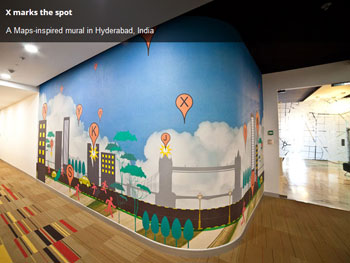
    A Google Maps-inspire Mural in the Hyderabad office. Photograph courtesy: Google.com

    It may not be the best of times to release a report like ‘The Best Companies to Work for’, given the low morale on the economy front and crunch in job opportunities prevailing in the marketplace. But there are companies that prefer to stand aloof from the depressing lot and would like to be counted as being amongst the best places to work for.


    The Economic Times in partnership withGreat PlaceTo Work have released ‘India’s Best Companies to Work for 2012′. The study throws up a diverse line-up of companies as favourites to work for.  Emerging the number one employer is Google India followed by Intel and NTPC at third. Further, five out of the top 10 companies are multinationals, pointing at the role played by global HR practices in stimulating employee satisfaction across workplaces in India.


    The study has been divided into the Top 50 and Top 25 best workplaces. When analysed further, only two out of the Top 25 Best Workplaces are companies which are new to the list of Best Workplaces, the rest having featured in the list in previous years. However, similar consistency is not seen in the Top 50 list in which there are 14 companies which have never featured in the list in India before.


    As for the standings, Gurgaon-based Makemytrip occupies the fourth spot, a drop from last year’s third rank. Amongst the media companies, HT Media Ltd is the only player to figure in the Top 25 list and is ranked 16th.


    Reacting to the win, Rajiv Verma, CEO, HT Media Limited, said: “This recognition is a testament to the strength and integrity of HT Media’s corporate culture. A few years ago, when we crafted a set of long-term goals for our company, we embraced the vision of being an ’employer of choice’. The recognition that we received from the study is a compelling sign that we have been moving in the right direction.”


    Other nominees include Cactus Communications that has been placed at number 20, Cleartrip Travel that is placed at 29th spot, Music Broadcast (operates radio channel Radio City) at number 41, Viacom18 placed at number 48 and Vodafone at number 49.


    In the category of Best in Class, Outdoor Advertising Professionals India Pvt. Ltd. achieves the top spot under Advertising & Marketing; Vodafone India Ltd. is number 2 under Telecommunications; Godrej Consumer Products Ltd., Procter & Gamble, Mars International India Pvt Ltd. and Mother Dairy Fruit & Vegetable Pvt. Ltd. are selected under FMCG; and Google India under IT.


    Some prominent companies that came up trumps across 22 sectors include: Vodafone India in Best Company in Large Organisations (more than 10,000 employees); Makemytrip, Cactus Communications & Cleartrip Travel Services under Professional Services, and HT Media Ltd and Viacom18 Media under Media.


    The study

    TheGreat Placeto Work® framework is based on over 27 years of research of the best workplaces across the globe from employees’ point of view. Some key trends spotted include: overall employee perception of their workplace culture has not changed significantly from 2011 – this is true for all companies, the Top 50, and Top 25 best workplaces in the Study. Thus, while individual companies may have done well or poorly in building trust with their employees, the workplace culture in India Inc., as perceived by their people, remains the same.


    Positive perceptions about their workplace culture continues to be high for senior management category compared to supervisory staff, with 7 per cent less supervisory staff giving positive feedback about their workplace culture. The study further reveals that 75 per cent of employees are below 35 years of age. While they are the majority in most organisations, their views about the workplace culture are significantly less positive than employees over 45 years in age. Only 20 per cent of employees, on an average, have worked in the same organisation for more than five years. There is a slow but gradual improvement in employee perception as one stays longer in an organisation, the study notes.


    As in the previous years, the Top 50 best workplaces are concentrated in Mumbai, NCR and Bangalore, but also have representation from Chennai, Pune, Hyderabad and Ahmedabad. 35 of the Top 50 have more than 1,000 employees, with 14 out of 50 having more than 5,000 employees. Only 7 of the Top 50 Best Workplaces saw employee increases of more than 30 per cent in the previous year, and 6 actually reduced their workforce.


    Also, the percentage of women continued to be low with only 5 of the Top 50 employing more than 40 per cent women employees. Women constitute less than 10 per cent of employees in seven of the top 50. Only three of the Top 50 have more than 30 per cent of their senior management as women. While 15 out of Top 50 best workplaces have employee attrition of over 20 per cent, however, in all major industries, attrition for the Top 50, on an average, is less by one-third to two-third of the industry average.


  • Eco Times launches The Power of Ideas 2012

    By A Correspondent


    The Economic Times brings back The Power of Ideas,India’s largest entrepreneurship development programme. It aims to encourage individuals with a business idea to come forward and connects them with relevant mentors and investors. The programme was first launched in 2009 when it received over 12,000 business ideas followed by over 16,000 the next year. This year, armed with a bigger corpus of funds, the initiative seeks to transform more business ideas into real businesses.


    Ravi Dhariwal, Chief Executive Officer – Bennett, Coleman & Co. Ltd said: “We at The Economic Times believe that the future of the Indian economy lies in the hands of young entrepreneurs. It is the energy and drive of these young people with an idea that will giveIndiaits next big leap. I am happy to say that The Power of Ideas initiative has provided critical impetus to many such ideas.”


    The programme is conducted by The Economic Times in partnership with the Department of Science & Technology (DST), Government of India. DST brings to the programme its expertise and relationships in the entrepreneurial space as well as a corpus of Rs6.2 crore of guaranteed funds. The funds are open to all those with genuine innovation on their mind, regardless of whether they have just an idea or a fully functional start-up.


    Working alongside ET and DST is IIM Ahmedabad’s Centre for Innovation Incubation and Entrepreneurship (CIIE).CIIE is a leader in the field of mentoring, guiding and making business ideas investor-ready.


    The greatest value CIIE will add to The Power of Ideas will be by way of their wide network of mentors and investors who will evaluate every single business idea received as part of the programme. The most deserving ideas will be given personalized mentoring. In the last phase, entrepreneurs who make it to the final cut-off will be taken through a nine-day period of intensive mentoring by CIIE, as a residential programme at IIM Ahmedabad. This unique public-private-academia partnership remains in place in 2012 to drive the programme to new heights.

  • Vipin Nair joins Head of Communications at Wipro

    By A Correspondent


    Vipin Nair has joined as the Head-Communications at Wipro. He will be handling the communication mandate for Wipro Technologies and the Corporate.


    Mr Nair brings with him diverse experience in the media and a rich experience of close to two decades. He has worked with print publications as well as international news wires. He has worked as the Executive Editor of Ticker Plant. Prior to that he has been with NewsWire 18 and CRISIL Marketwire. He has also worked with print publications including The Economic Times and Financial Express among others.


  • The King in troubled waters

    By Ranjona Banerji


    Whoever picked the guests for the Kingfisher segment of the Newshour last night, obviously did not gauge TimesNow editor Arnab Goswami’s mood right. More than half the panel spoke out in favour of the besieged airline while Goswami was adamant that no one owed Kingfisher anything for its bad management practices. Even worse, the people of India had been inconvenienced (or at least the flying public) and that was unacceptable.


    Vijay Mallya on TimesNow was quite a departure from his normal braggart self as he petulantly explained that he was dying to pay everyone but couldn’t since the income tax department had frozen all Kingfisher accounts. He did acknowledge that he did have some tax dues but…


    From all the par-for-the-course studio histrionics, one thing was clear – some urgent analysis of the aviation industry is required.


    Obviously, television cannot provide it…


    The first edit in The Economic Times seems to feel that a government intervention or bailout is unacceptable and Kingfisher has to sort out its own problems. It even calls for a suspension of licence. This is in keeping with Goswami’s line but does not follow that of Kingfisher’s well-wishers within the travel and aviation industry who keep bringing Air India into the picture. As ET points out, “The state of the industry and the fate of Air India should not be allowed to cloud the issue.”


    **


    The alleged rape of a woman in Kolkata gets curiouser and curiouser. The behaviour of West Bengal chief minister Mamata Banerjee and her minister Madan Mitra – blaming the victim and claiming a conspiracy to destablise the government – has been roundly criticised. Indeed, Mitra’s comments about the woman being out drinking deserve wider condemnation – he should surely be treated on par with the Andhra Pradesh police officer and Karnataka minister for making such sexist and dangerous remarks.


    **


    In The Indian Express, Abhijit V Banerjee, Ford Foundation International Professor of Economics at the Massachusetts Institute of Technology and director Abdul Latif Jameel Povery Action Lab makes an impassioned plea for allowing the British government’s Department for International Development continues its “good work” in India and for India not to get carried away by nationalism. This is a subject which needs to be debated more stringently in India. Do we still need foreign aid, does aid work and should not India manage its own problems. My instinct is not to agree with Banerjee and to side with the nationalists…


  • Soon you’ll be able to get your favourite Starbucks Espresso in India

    Starbucks Corp, the world’s largest coffee shop company, will open its first cafe in India in August through an equal joint venture with Tata Global Beverages, the two partners said on Monday.


    The venture, Tata Starbucks Ltd, will spend 400 crore initially and open 50 Starbucks cafe across the country by the end of the calendar year. The initial stores planned in Delhi and Mumbai in August. The move is part of the $10-billion-plus US firm’s strategy to focus on emerging markets such as India and China to drive future growth rates.


    “India is a unique market and we have gone through big transformation since the last four years,” said Mr John Culver, president at Starbucks China and Asia Pacific.


    While the core deal would be between Starbucks and Tata Global Beverages, it will work with other Tata Group firms such as Tata Coffee and Taj Catering. For instance, Tata plans to sell its mineral water brand Himalayan at Starbucks outlets in markets outside India. And the venture will leverage group firms’ properties for setting up Starbucks outlets.

    The deal comes a year after the Seattle-based firm signed an deal to buy green coffee beans from Tata Coffee’s Coorg facility and explore opening retail shops in the country. Starbucks manages over 17,000 stores in more than 57 countries and sells a wide variety of coffee and tea products along with food items, primarily through retail stores.

    The coffee cafe industry is on an expansion spree, led by market leader Cafe Coffee Day, to cash in on their increasing popularity among young consumers who have more disposable income than their previous generations.


    Source:The Economic Times

    Copyright © 2012, Bennett, Coleman & Co. Ltd. All Rights Reserved

  • It’s the economy, stupid

    By Ranjona Banerji


    Perhaps appropriately, the problems of the Indian economy have taken centre-stage. Some newspapers are concentrating on the falling rupee while others are concerned about the falling industrial growth rate. Both seem to be legitimate headlines. The general consensus seems to be lack of governance and the general drift of UPA II. Says The Times of India in its editorial on Wednesday, “If the political class needs a crisis to see that policy gridlock is strangling our economy, then that crisis is upon us… But the onus is also on the opposition to forego bloody-minded politics which makes the government’s job harder.”


    The Indian Express in its editorial concentrates on decline on the Index of Industrial Production and comments, “Unfortunately the slowdown has hit us at a time when real interest rates are negative.” However it cautions the Reserve Bank to wait and watch before “taking action”. It also brings up the valid point of many students coming out of management institutes being unable to find jobs if industrial and services growth on a downward spiral.


    The Deccan Chronicle in its editorial looks at how Indian companies are now looking abroad to invest their money, given the situation in India. “What India and the economy urgently needs to grow at this point is low inflation, low interest rates, immediate implementation of the new manufacturing and procurement policy, and a business-friendly transparent environment to unleash India’s unmatched entrepreneurial strengths.”


    The Economic Times carries a feature on the rupee crisis headlined “India Inc sends an SoS to RBI’. A Subba Rao of the GMR group is quoted as saying, “It’s like a natural calamity, like a tsunami… with the rupee falling so fast and so sharply, there is only so much you can do.”


    A discussion on Times Now on Tuesday had FICCI chairman Rajiv Kumar practically begging politicians to sort our their problems and prevent a further downslide in the economy. His predictions were dire unlike Union Finance Minister Pranab Mukherjee’s somewhat sanguine assurances that things were not so bad.


    **


    Given our current obsession with corruption, two stories in Wednesday’s newspapers deserve attention. The Telegraph, Calcutta, has a story on how the Jyoti Basu government handed the AMRI hospital land in the Dhakuria area of Kolkata between 1994 and 1998 at rates that will remain frozen till at least 2024. Unlike other such deals, there are apparently no provisions for revision of the rental rates. The state government has, according to the report, acquired the land in 1991 to provide affordable healthcare.


    The Indian Express’s flyer story looks at the various irregularities in the Noida farmhouse allotments, from which a key member of the Anna Hazare-Jan Lokpal movement also benefited – Shanti Bhushan and his son Jayant. The Express report provides details of various transgressions and concessions, many of which appear to be inexplicable.


    **


    Even as TV continues to be the chief champion of Anna Hazare and his campaign for his Jan Lokpal Bill, the print media conversely continues to question. The Economic Times in its second editorial on Wednesday says, ‘Anna Hazare has displaced the my-way-or-highway sort of undemocratic attitude reminiscent of authoritarianism and a vigilante-style notion of justice and that is part of the problem.” It cautions against actions which will lead to anarchy.


    eom

  • As the $ rises, pay more for FMCGs & white goods

    By A Correspondent


    The falling rupee is raising the heckles for consumers already grappling with rising food prices. Over the last few weeks several fast moving consumer goods companies and white goods makers have increased prices, citing the depreciating rupee. And, those left behind are also bracing for a hike.


    If you haven’t noticed it yet, telecom handset makers such as BlackBerry and HTC have already jacked up prices by around 5%. According to retailers, Nokia has also raised the prices by the same amount, but the company declined to comment. Godrej, LG Electronics and Whirlpool have increased prices by around 8%. Samsung is planning to raise smartphone prices by 3-5%, but when it comes to white goods, the Korean giants have already opted for a 2-5% increase for refrigerators, washing machines and microwave ovens. Godrej Consumer Products, Dabur, Panasonic will follow suit, company executives said.


    While demand is not rising significantly, most companies say they can no longer absorb the lower margins on account of higher commodity prices. Although metal prices have declined internationally in recent weeks, the falling rupee has eroded the gains. Since the beginning of August, when the rupee was a little short of the 45-mark against the dollar, the Indian currency fell to a low of 52.73, a decline of nearly 18%. On Monday, the rupee closed 51.42, but even this is 15% lower than the level seen four months ago.


    Source: The Economic Times

    Copyright © 2011, Bennett, Coleman & Co. Ltd. All Rights Reserved