OpenAI’s new generative Sora tool has sparked lively technology discussions over the past week, generating both enthusiasm and concern among fans and critics.
Sora is a text-to-video model that significantly advances the integration of deep learning, natural language processing and computer vision to transform textual prompts into detailed and coherent life-like video content.
In contrast to previous text-to-video technologies, like Meta’s Make-A-Video, Sora is able to overcome limitations related to the type of visual data it can interpret, video length and resolution.
From what OpenAI has demonstrated, Sora can generate videos of various lengths, from short clips to full-minute narratives, and in high definition, accommodating a wide range of creative needs.
Although no official release date has been announced, Sora will likely be available to the public in the coming months, judging by OpenAI’s typical pattern of public releases. For now, it’s only available to experts and a few artists and filmmakers.
How Sora works
At the heart of Sora’s innovation is a technique that transforms visual data into a format it can easily understand and manipulate, similar to how words are broken down into tokens for AI processing by text-based applications.
This process involves compressing video data into a more manageable form and breaking it down into patches or segments. These segments act like building blocks that Sora can rearrange to create new videos.
Sora uses a combination of deep learning, natural language processing and computer vision to achieve its capabilities.
Deep learning helps it understand and generate complex patterns in data, natural language processing interprets text prompts to create videos, and computer vision allows it to understand and generate visual content accurately.
By employing a diffusion model — a type of model that’s particularly good at generating high-quality images and videos — Sora can take noisy, incomplete data and transform it into clear, coherent video content.
Sora’s approach differs from CGI character creation, which requires extensive manual effort, and from traditional deepfake technologies, which often lack ethical safeguards, by offering a scalable and adaptable method for generating video content based on textual input.
What does this mean for businesses?
One of the most noteworthy aspects of Sora is its flexibility, as it supports various video formats and sizes, enhances framing and composition for a professional finish, and accepts text, images or videos as prompts for animating images or extending videos.
The emergence of Sora presents key opportunities for businesses across different sectors. In the near future, there are two key areas that may have significant applications.
The first area is in marketing and advertising. Just as ChatGPT has become a marketing and content creation tool, we can expect businesses to use Sora for similar reasons.
With the public release of Sora, brands and companies will be able to create highly engaging and visually appealing video content for marketing campaigns, social media and advertisements.
The ability to generate custom videos based on textual prompts will allow for greater creativity and personalisation, possibly helping brands stand out in a crowded market.
The second area Sora could impact is training and education. Companies could use Sora to develop educational and training videos that are tailored to specific topics or scenarios. This could enhance the learning experience for employees and customers, making complex information more accessible and engaging.
Other sectors, such as e-commerce, also hold promising potential for the future application of Sora. Retailers could create dynamic product demonstrations that effectively showcase products in a more engaging and interactive manner.
This would be especially beneficial for companies that want to highlight specific aspects of products that might not be easily conveyed through static images or text, or for advertising products that require a detailed explanation.
Sora could also significantly reduce the uncertainty associated with online shopping by facilitating virtual try-on experiences, allowing customers to visualize how a product, such as clothing or accessories, would look on them without the need for a physical fitting. This, in turn, could result in a better return on investment.
What are the key challenges ahead?
While there are key opportunities ahead, OpenAI, regulators and users need to carefully consider key factors that could pose challenges, including copyright issues, ethical concerns and the consequences of increased digital noise.
With Sora’s ability to generate lifelike video content, there’s a risk of inadvertently creating videos that infringe on existing copyrights. OpenAI has already been sued several times over copyright infringement and intellectual property issues.
OpenAI hasn’t disclosed where the data used to train Sora is from, but it did tell the New York Times it was training the system using videos that were publicly available and licensed from copyright holders.
The technology also raises ethical questions, particularly around the creation of deepfake videos or misleading content.
Establishing guidelines and safeguards to prevent misuse will be essential for maintaining trust in the technology. In a post on its website, OpenAI stated it was working with experts to test the model before releasing it to the public.
As more businesses and individuals gain access to Sora, there’s a potential for an increase in low-quality or irrelevant video content, leading to increased “digital noise” that could overwhelm users. Finding ways to filter and curate content will become increasingly important for businesses looking to maintain their edge.
Last, but certainly not least, is the question of how Sora will impact the job market for content creators. While Sora does have the potential to automate certain aspects of video production, like ChatGPT, it’s unlikely to replace human creativity and insight anytime soon.
Instead, Sora could serve as a tool that enhances the capabilities of content creators, allowing them to produce higher-quality content more efficiently. As with any technological advancement, the key will be for professionals to adapt and find ways to integrate Sora into their workflows, leveraging its strengths to complement their own skills and creativity.
Omar H. Fares is Lecturer in the Ted Rogers School of Retail Management, Toronto Metropolitan University. This article is republished from The Conversation under a Creative Commons license. Read the original article.
In 1954, the Guardian’s science correspondent reported on “electronic brains”, which had a form of memory that could let them retrieve information, like airline seat allocations, in a matter of seconds.
Nowadays the idea of computers storing information is so commonplace that we don’t even think about what words like “memory” really mean. Back in the 1950s, however, this language was new to most people, and the idea of an “electronic brain” was heavy with possibility.
In 2024, your microwave has more computing power than anything that was called a brain in the 1950s, but the world of artificial intelligence is posing fresh challenges for language – and lawyers. Last month, the New York Times newspaper filed a lawsuit against OpenAI and Microsoft, the owners of popular AI-based text-generation tool ChatGPT, over their alleged use of the Times’ articles in the data they use to train (improve) and test their systems.
They claim that OpenAI has infringed copyright by using their journalism as part of the process of creating ChatGPT. In doing so, the lawsuit claims, they have created a competing product that threatens their business. OpenAI’s response so far has been very cautious, but a key tenet outlined in a statement released by the company is that their use of online data falls under the principle known as “fair use”. This is because, OpenAI argues, they transform the work into something new in the process – the text generated by ChatGPT.
At the crux of this issue is the question of data use. What data do companies like OpenAI have a right to use, and what do concepts like “transform” really mean in these contexts? Questions like this, surrounding the data we train AI systems, or models, like ChatGPT on, remain a fierce academic battleground. The law often lags behind the behaviour of industry.
If you’ve used AI to answer emails or summarise work for you, you might see ChatGPT as an end justifying the means. However, it perhaps should worry us if the only way to achieve that is by exempting specific corporate entities from laws that apply to everyone else.
Not only could that change the nature of debate around copyright lawsuits like this one, but it has the potential to change the way societies structure their legal system.
Fundamental questions
Cases like this can throw up thorny questions about the future of legal systems, but they can also question the future of AI models themselves. The New York Times believes that ChatGPT threatens the long-term existence of the newspaper. On this point, OpenAI says in its statement that it is collaborating with news organisations to provide novel opportunities in journalism. It says the company’s goals are to “support a healthy news ecosystem” and to “be a good partner”.
Even if we believe that AI systems are a necessary part of the future for our society, it seems like a bad idea to destroy the sources of data that they were originally trained on. This is a concern shared by creative endeavours like the New York Times, authors like George R.R. Martin, and also the online encyclopedia Wikipedia.
Advocates of large-scale data collection – like that used to power Large Language Models (LLMs), the technology underlying AI chatbots such as ChatGPT – argue that AI systems “transform” the data they train on by “learning” from their datasets and then creating something new.
Effectively, what they mean is that researchers provide data written by people and ask these systems to guess the next words in the sentence, as they would when dealing with a real question from a user. By hiding and then revealing these answers, researchers can provide a binary “yes” or “no” answer that helps push AI systems towards accurate predictions. It’s for this reason that LLMs need vast reams of written texts.
If we were to copy the articles from the New York Times’ website and charge people for access, most people would agree this would be “systematic theft on a mass scale” (as the newspaper’s lawsuit puts it). But improving the accuracy of an AI by using data to guide it, as shown above, is more complicated than this.
Firms like OpenAI do not store their training data and so argue that the articles from the New York Times fed into the dataset are not actually being reused. A counter-argument to this defence of AI, though, is that there is evidence that systems such as ChatGPT can “leak” verbatim excerpts from their training data. OpenAI says this is a “rare bug”.
However, it suggests that these systems do store and memorise some of the data they are trained on – unintentionally – and can regurgitate it verbatim when prompted in specific ways. This would bypass any paywalls a for-profit publication may put in place to protect its intellectual property.
Language use
But what is likely to have a longer term impact on the way we approach legislation in cases such as these is our use of language. Most AI researchers will tell you that the word “learning” is a very weighty and inaccurate word to use to describe what AI is actually doing.
The question must be asked whether the law in its current form is sufficient to protect and support people as society experiences a massive shift into the AI age. Whether something builds on an existing copyrighted piece of work in a manner different from the original is referred to as “transformative use” and is a defence used by OpenAI.
However, these laws were designed to encourage people to remix, recombine and experiment with work already released into the outside world. The same laws were not really designed to protect multi-billion-dollar technology products that work at a speed and scale many orders of magnitude greater than any human writer could aspire to.
The problems with many of the defences of large-scale data collection and usage is that they rely on strange uses of the English language. We say that AI “learns”, that it “understands”, that it can “think”. However, these are analogies, not precise technical language.
Just like in 1954, when people looked at the modern equivalent of a broken calculator and called it a “brain”, we’re using old language to grapple with completely new concepts. No matter what we call it, systems like ChatGPT do not work like our brains, and AI systems don’t play the same role in society that people play.
Just as we had to develop new words and a new common understanding of technology to make sense of computers in the 1950s, we may need to develop new language and new laws to help protect our society in the 2020s.
Mike Cook is Senior Lecturer, Department of Informatics, King’s College London. This article is republished from The Conversation under a Creative Commons license. Read the original article.
Although this article talks about the status of magazines elsewhere in the world, some of the points made are relevant for India as well. In fact the fact that the Indian edition of Esquire is set to launch later this from the RP Sanjeev Goenka group, clearly magazines aren’t dead in India. Not yet.
By Julian Novitz
In the classic comedy Ghostbusters (1984), newly hired secretary Janice raises the subject of reading, while idly flipping through the pages of a magazine. The scientist Egon Spengler responds with a brusque dismissal: “print is dead.”
Egon’s words now seem prescient. The prevailing assumption of the past couple of decades is that print media is being slowly throttled by the rise of digital. Print magazines, in particular, are often perceived as being under threat.
While not nearly as popular as they once were, magazines haven’t died. New ones have started since the dire predictions began, while others continue to attract loyal readerships.
So what’s the enduring appeal of the print magazine? Why didn’t it die, as so many predicted?
Printed words in an online world
The word “magazine” derives from the term for a warehouse or storehouse. In its essence, it is any publication that collects different types of writing for readers. Each instalment includes a range of voices, subjects and perspectives.
Print magazine culture has certainly seen a decline since its heyday in the 20th century. Once-popular print magazines have moved entirely online or are largely sustained by growing digital subscriptions.
Elsewhere, internet media sites, of the type pioneered by Buzzfeed and its imitators, increasingly fulfil the need for diverse and distracting short-form writing.
The explosion of social media has also cut into the advertising market on which print magazines have traditionally depended.
Online audiences have come to expect new content daily or even hourly. Casual readers are less willing to wait for a weekly or monthly print magazine to arrive in the post or on a newsstand. The ready availability of free, or significantly cheaper, digital content may deter them from purchasing print subscriptions or individual issues.
Turning from screens to the page
And yet print magazines refuse to die. Established periodicals, such as the New Yorker and Vogue, stubbornly cling to a global readership in both print and digital formats.
New titles are emerging as well – 2021 saw the launch of 122 new print magazines in the United States alone. The number is smaller than some previous years, and this perhaps reflects the generally shrinking market for print media.
But given the accepted wisdom, it is remarkable there are any new periodicals at all.
In Australia, print magazines sales have risen 4.1% in 2023 and previously axed publications – such as Girlfriend – are now receiving one-off, nostalgic returns to print.
The market for print magazines isn’t exactly thriving. But they haven’t vanished as quickly as anticipated.
Some commentators have attributed the enduring appeal of print magazines to the physical experience of reading. We absorb information differently from the page than from the screen, perhaps in a less frantic and distractable way.
“Digital fatigue” from the years of the pandemic has arguably resulted in a small pivot back to print media. The revived interest in print magazines has also been attributed to the “analog” preferences of Gen Z readers.
As the writer Hope Corrigan has noted, there is also something appealing about the aesthetics of print magazines. The care taken with layout, images and copy can’t always be replicated on as screen. Indeed, magazines with a significant focus on photography and visual design – such as fashion and travel magazines – are enduring in print.
Magazine expert Samir Husni has observed that emerging independent print magazines are more focused on targeting a niche readership. Advances in printing technology have made smaller print runs more cost-effective. This allows new magazines to focus on quality over quantity.
The new wave of print magazines tend to have a higher cover price and standard of production. They are also published less frequently, with quarterly or biannual schedules becoming more common.
What was old is cool again?
This trend moves away from the idea of magazines as cheap and disposable. Rather, it reframes them as a luxury product.
Print magazines cannot compete with digital media in providing constantly up-to-date content to a mass audience. But they can potentially maintain a dedicated readership with a meaningful and aesthetically pleasing publication.
This means print magazines may be spared some of the turbulence suffered by media websites that are solely dependent on digital advertising revenue. The past few years have seen staffing upheavals, mass resignations and shutdowns at popular magazine-style websites such as Deadspin, the Onion AV Club, the Escapist and Jezebel (although the latter has since returned). The original vision and standards for these sites have arguably suffered from the constant drive to increase daily traffic and reduce costs.
Print magazines may also be seeing a revived interest from advertisers. Recent research indicates a strong preference for print advertising among consumers. Readers are far more likely to pay attention to a print advertisement and trust its content. By contrast, online advertising is more likely to be ignored or dismissed.
In a 2021 profile of magazine collector Steven Lomazow, Nathan Heller writes:
[…] what made magazines appealing in 1720 is the same thing that made them appealing in 1920 and in 2020: a blend of iconoclasm and authority, novelty and continuity, marketability and creativity, social engagement and personal voice.
While the circulation and influence of print magazines may have reduced, they are not necessarily dead or even dying. They can be seen as moving into a smaller, but sustainable, place in the media landscape.
Julian Novitz is Senior Lecturer, Writing, Department of Media and Communication, Swinburne University of Technology. This article is republished from The Conversation under a Creative Commons license. Read the original article.
ChatGPT was launched on Nov. 30, 2022, ushering in what many have called artificial intelligence’s breakout year. Within days of its release, ChatGPT went viral. Screenshots of conversations snowballed across social media, and the use of ChatGPT skyrocketed to an extent that seems to have surprised even its maker, OpenAI. By January, ChatGPT was seeing 13 million unique visitors each day, setting a record for the fastest-growing user base of a consumer application.
Throughout this breakout year, ChatGPT has revealed the power of a good interface and the perils of hype, and it has sown the seeds of a new set of human behaviors. As a researcher who studies technology and human information behaviour, I find that ChatGPT’s influence in society comes as much from how people view and use it as the technology itself.
Generative AI systems like ChatGPT are becoming pervasive. Since ChatGPT’s release, some mention of AI has seemed obligatory in presentations, conversations and articles. Today, OpenAI claims 100 million people use ChatGPT every week.
Besides people interacting with ChatGPT at home, employees at all levels up to the C-suite in businesses are using the AI chatbot. In tech, generative AI is being called the biggest platform since the iPhone, which debuted in 2007. All the major players are making AI bets, and venture funding in AI startups is booming.
Along the way, ChatGPT has raised numerous concerns, such as its implications for disinformation, fraud, intellectual property issues and discrimination. In my world of higher education, much of the discussion has surrounded cheating, which has become a focus of my own research this year.
Lessons from ChatGPT’s first year
The success of ChatGPT speaks foremost to the power of a good interface. AI has already been part of countless everyday products for well over a decade, from Spotify and Netflix to Facebook and Google Maps. The first version of GPT, the AI model that powers ChatGPT, dates back to 2018. And even OpenAI’s other products, such as DALL-E, did not make the waves that ChatGPT did immediately upon its release. It was the chat-based interface that set off AI’s breakout year.
There is something uniquely beguiling about chat. Humans are endowed with language, and conversation is a primary way people interact with each other and infer intelligence. A chat-based interface is a natural mode for interaction and a way for people to experience the “intelligence” of an AI system. The phenomenal success of ChatGPT shows again that user interfaces drive widespread adoption of technology, from the Macintosh to web browsers and the iPhone. Design makes the difference.
At the same time, one of the technology’s principal strengths – generating convincing language – makes it well suited for producing false or misleading information. ChatGPT and other generative AI systems make it easier for criminals and propagandists to prey on human vulnerabilities. The potential of the technology to boost fraud and misinformation is one of the key rationales for regulating AI.
Amid the real promises and perils of generative AI, the technology has also provided another case study in the power of hype. This year has brought no shortage of articles on how AI is going to transform every aspect of society and how the proliferation of the technology is inevitable.
ChatGPT is not the first technology to be hyped as “the next big thing,” but it is perhaps unique in simultaneously being hyped as an existential risk. Numerous tech titans and even some AI researchers have warned about the risk of superintelligent AI systems emerging and wiping out humanity, though I believe that these fears are far-fetched.
The media environment favors hype, and the current venture funding climate further fuels AI hype in particular. Playing to people’s hopes and fears is a recipe for anxiety with none of the ingredients for wise decision making.
What the future may hold
The AI floodgates opened in 2023, but the next year may bring a slowdown. AI development is likely to meet technical limitations and encounter infrastructural hurdles such as chip manufacturing and server capacity. Simultaneously, AI regulation is likely to be on the way.
This slowdown should give space for norms in human behavior to form, both in terms of etiquette, as in when and where using ChatGPT is socially acceptable, and effectiveness, like when and where ChatGPT is most useful.
ChatGPT and other generative AI systems will settle into people’s workflows, allowing workers to accomplish some tasks faster and with fewer errors. In the same way that people learned “to google” for information, humans will need to learn new practices for working with generative AI tools.
But the outlook for 2024 isn’t completely rosy. It is shaping up to be a historic year for elections around the world, and AI-generated content will almost certainly be used to influence public opinion and stoke division. Meta may have banned the use of generative AI in political advertising, but this isn’t likely to stop ChatGPT and similar tools from being used to create and spread false or misleading content.
Political misinformation spread across social media in 2016 as well as in 2020, and it is virtually certain that generative AI will be used to continue those efforts in 2024. Even outside social media, conversations with ChatGPT and similar products can be sources of misinformation on their own.
As a result, another lesson that everyone – users of ChatGPT or not – will have to learn in the blockbuster technology’s second year is to be vigilant when it comes to digital media of all kinds.
Tim Gorichanaz is Assistant Teaching Professor of Information Science, Drexel University. This article is republished from The Conversation under a Creative Commons license. Read the original article.
Elon Musk, the world’s richest man, has his fingers in many pies, none of them your standard Four and Twenty – space exploration, electric cars, AI and social media, among others.
He became a global leader in space exploration when NASA had virtually vacated the field, and his electric vehicle company Tesla, headquartered in the gas-guzzling United States, has by far the biggest market capitalisation of any car manufacturer in the world, yet he has few formal qualifications in either field.
Many see Musk as a 21st-century idiot savant. Others, watching him reduce an important social media platform – Twitter – to cyber-rubble, think of him simply as an idiot. Maybe both are true, or maybe other readings of his life are true. Aged 52, Musk certainly merits a good, searching biography.
Walter Isaacson seems well-credentialed for the task. He has written biographies of Henry Kissinger, Benjamin Franklin, Albert Einstein, Steve Jobs and Leonardo da Vinci that have won awards or become bestsellers, or both.
Isaacson began his working life as a journalist. He spent more than two decades at Time during the magazine’s heyday, rising to become editor in 1996. Since then, he has been chief executive of the CNN cable television network, headed the Aspen Institute (a longstanding non-profit think tank), become a professor of history at Tulane University, and done various jobs for both Republican and Democrat governments.
This year he was awarded the National Humanities Medal by US President Joe Biden.
Isaacson’s virtue as a biographer is his reporter’s ability to gather enormous amounts of material and quickly render it as a (generally) smooth and readable account of a life bursting with dramatic events. His project only began in 2021 and covers events up to Space X’s unsuccessful Starship rocket launch in April 2023.
Musk made himself available for numerous interviews. He gave Isaacson access to places and people at key moments, such as the purchase of Twitter (now known as X), and regularly emailed Isaacson at 3am with his thoughts – and thought bubbles.
Isaacson also interviewed 130 other people, and his labours have uncovered newsworthy information that has been widely reported – and, in one case, corrected – since the book’s publication.
For instance, Isaacson builds on earlier reporting by the Washington Post to reveal the extent to which Musk’s Starlink satellite network has been crucial to the Ukrainian military’s ability to fight Russia’s invasion, providing them with continued access to the internet on the battlefield after the Russians destroyed access to other internet services. He shows how Musk was persuaded by the Russians to temporarily cut off the Starlink access after he believed their entreaties that any further victories by Ukraine would provoke nuclear war.
The implications of these remarkable revelations have been examined by the ABC’s Matt Bevan in a recent episode of his If You’re Listening podcast. But even though Isaacson revealed this information, he does not pause to discuss it in any detail. That’s one of the shortcomings of this book.
Lord of the Flies on steroids
Perhaps seduced by Musk’s apparent candour or a publisher’s pressure to rush to print, Isaacson accepts his subject’s words without sufficient scepticism. For instance, Musk’s childhood experiences at a veldskool in 1970s South Africa read like Lord of the Flies on steroids. Bullying was the norm and children were encouraged to fight over meagre food rations. “Every few years, one of the kids would die,” writes Isaacson.
Really? Says who? Musk, apparently. No one from the school is listed in the source notes, to confirm or refute this account. Throughout the book, Musk comes off as a shameless self-dramatiser, but that doesn’t mean his biographer should succumb to it.
Isaacson is an adherent of the “grand man” school of history. He has written only one biography of a woman – the Nobel Prize-winning biochemist Jennifer Doudna. He is far less interested in, or comfortable with, the role structures and systems play in shaping events.
As Jill Lepore pointed out in the New Yorker, Isaacson also has “an executive’s affinity for the C-suite”, meaning he pays little attention to the people who work for Musk or the impact of his actions on their lives.
The core question driving the biography is: has Elon Musk had to be such an “asshole” (Isaacson’s term) to achieve what he has? Isaacson acknowledges it is much the same question he asked about Steve Jobs in his earlier biography of the Apple cofounder.
I lost count of the times the question, or a variation of it, was posed during the book’s 670 pages, but in classic Time-style both-sidesing, Isaacson keeps toggling between admonishing Musk for behaving like an “asshole” and admiring his ability to get results. He rarely if ever lifts his gaze beyond this binary, which means he ignores lessons learned from all those people, past and present, who have achieved things without treating people appallingly.
It also means achievements are seen solely through the prism of one person’s actions. In a perceptive article in Vox, Constance Grady reminds us that Musk’s determination to override safety concerns in Tesla factories has led to worker injury rates equivalent to those in a slaughterhouse.
Grady allows that Isaacson reports the increased injury rates, but notes his vagueness about exactly what kind of injuries occurred. Citing 2018 work by the Center for Investigative Reporting, she reveals Tesla workers were “sliced by machinery, crushed by forklifts, burned in electrical explosions, and sprayed with molten metal”.
She also notes Isaacson downplaying the company’s experience of COVID-19. Musk, a fervent libertarian allergic to any form of regulation, kept the factory running during the global pandemic. Isaacson says “the factory experienced no serious COVID outbreak”, but Grady reports there were 450 positive cases.
From Twitter to X
Musk has an immense work ethic and expects everyone working for him to share it. By relentlessly questioning all assumptions – “the laws of physics are unbreakable; everything else is a recommendation” – Musk and those working in his companies have indeed achieved a lot.
I am not really in any position to assess Musk’s contribution to space exploration, AI or car manufacturing. But I am willing to accept the evidence of Isaacson’s biography that they have been substantial – or, in the case of AI, promise to be.
I feel better able to assess Musk’s contribution to social media. Here, the evidence presented by Isaacson and many others is that Musk has damaged, perhaps irretrievably, Twitter – which he has renamed X, a letter of the alphabet to which he seems inordinately attached. Not only has he named one of his children X, he waves away the letter’s other connotations.
In 1999, Musk cofounded the online bank X.com. He soon learned there was another company aimed at revolutionising online transactions, PayPal, founded at around the same time by Peter Thiel, Max Levchin and Luke Nosek.
The companies merged in 2000, amid a classic Silicon Valley phallus-waving struggle over who had the idea first and who should take over whom. Levchin derided X.com as a “seedy site you would not talk about in polite company”. “If you want to take over the world’s financial system,” Musk rebutted, “then X is the better name.”
Musk lost the nomenclature war then, but realised his dream more than two decades later when he bought Twitter for US$44 billion and could call it whatever he liked.
Impulsive, determined, clueless
The picture of Musk that emerges in Isaacson’s book is of an impulsive, utterly determined person who is genuinely talented as a physicist and businessperson, and genuinely clueless when it comes to human relationships. He either doesn’t get people or doesn’t care about them – or, more likely, both.
He dotes on his children, especially X (I guess you need to do something to compensate for naming a child after a letter), yet he is capable of breathtaking callousness and rank sexism. He whispered in his first wife’s ear on their wedding night that he was the alpha male in the relationship.
In 2021, Musk’s third wife, Shivon Zilis, was pregnant with twins conceived with Musk by in-vitro fertilisation, and was in a hospital in Texas experiencing complications. At the same time, and in the same hospital, a woman serving as a surrogate for Musk and his ex-wife, Claire Boucher – better known as the Canadian-born musician Grimes – was also experiencing pregnancy complications.
Zilis and Boucher, not to mention the surrogate, did not know about the other’s pregnancy.
As Isaacson drolly comments elsewhere in the book:
Musk developed an aura that made him seem, at times, like an alien, as if his Mars mission were an aspiration to return home, and his desire to build humanoid robots were a quest for kinship.
Musk is on record saying humanity is in danger of not having enough smart people and it is his duty to populate the planet with as many of them as possible. To date, he has 11 children. If that notion sounds disturbingly like eugenics, it is not something Isaacson reflects on as he studiously documents Musk’s chaotic love life.
Nor does he delay his rat-a-tat-tat narration of every twist and turn in Musk’s dramatic life to question his subject’s burning desire to make humanity a “multi-planet civilisation” by colonising Mars. Musk is obsessed with this goal because he is worried about the prospect of our planet being destroyed by the accelerating consequences of climate change.
A laudable ambition, no doubt. But neither he nor his biographer stops to ask: if humanity fails so badly that it destroys this world, why would you think it could make life better on another, already inhospitable planet?
The surface of Mars. NASA/JPL, Public domain, via Wikimedia Commons
Startling achievements and childish petulance
It is easy and tempting to poke fun at Musk. Perhaps this is because his personality combines grandiose visions with arrested development, startling achievements with childish petulance. His idea of dieting is to get hold of the diabetes medication Ozempic – the dieter’s drug du jour – begin an intermittent fasting regime, then make his first meal of the day a bacon-and-cheese burger and sweet-potato fries topped with a cookie-dough ice-cream milkshake.
Or do you remember how Musk responded in 2018 to a mild rebuke of his frenetic desire to play the hero rescuing children trapped in a cave in Thailand with a purpose-built mini-craft? That’s right, by labelling one of the actual rescuers a “pedo guy”.
But it is dangerously easy. Social media plays an important role in modern society. Whatever its benefits, and they are many, the algorithms embedded in social media platforms – by their owners, let’s not forget – neatly sidestep nuance and reason in debate, turbo-charge conflict and emotion, and play a role in the spread of misinformation and disinformation.
Musk is now the owner of one such social media platform. But since buying Twitter last year, he has not been able to bend it to his will. His mistake – perhaps fatal, according to Isaacson – appears to be that he sees it as a technology company, something he understands, when it is really an “advertising medium based on human emotions and relationships”, something he does not understand.
Musk proclaims himself a free-speech advocate, but he has already displayed flagrant biases. He allowed Ye (formerly Kanye West) to tweet anti-Semitic remarks. He tweeted a florid conspiracy theory about the savage attack on Paul Pelosi, husband of the then speaker of the US House of Representatives, Nancy Pelosi. And he has asserted China’s repression of the Uyghurs was an issue that “had two sides” – perhaps because China was important to his car company, Tesla.
Musk has become obsessed by what he calls the “woke-mind virus”, which he believes is infecting social discourse. Whatever the excesses and blind spots of those on the progressive side of politics, Musk sees this virus almost everywhere.
A longtime devotee of comics and science fiction, he has increasingly given rein to his conspiratorial tendencies, as if he really thinks The Matrix trilogy was a documentary series. In one of his 3am tweets, Musk wrote: “My pronouns are Prosecute/Fauci”. As Isaacson trenchantly comments:
It made little sense, wasn’t funny, and managed, in just five words, to mock
transgender people, conjure up conspiracies about the 81-year-old public health
official Anthony Fauci, scare off more advertisers, and create a new handful of
enemies who would now never buy Tesla.
Nor does Musk’s belief in free speech extend to the social media postings of Twitter employees or their comments on internal Slack messaging. He trampled on the company’s internal culture of healthy dissent, peremptorily firing three dozen employees who had criticised the company.
His longstanding, largely successful mantra of getting things done cheaply and quickly, regardless of impediments, finally ran aground after he proposed cutting the company’s workforce by 75%.
Just before Christmas last year he decided it was imperative to move all the company’s servers from Sacramento to Oregon as a way of saving money. Remember how presidential aspirant Ron De Santis’ big live interview on X went horribly wrong earlier this year? That was because of problems with the servers, writes Isaacson.
More recently, the drastic cutting of the site’s moderators led to floods of misinformation following the attack on Israel by Hamas on October 7.
Musk has also begun to realise that advertising, which previously comprised 90% of Twitter’s revenue, is susceptible to public perceptions. It fell by more than half in the first six months of Musk’s ownership, according to Isaacson.
Geopolitical implications
As mentioned earlier, Musk has found himself playing a key role in a war with geopolitical implications.
Immediately before invading Ukraine in early 2022, Russia launched a malware attack that crippled the US satellite company providing internet service to Ukraine. Its deputy prime minister, Mykhailo Fedorov, reached out to Musk via Twitter, appealing for help.
Musk did, donating US$80 million worth of technology to Ukrainian forces, including Starlink’s solar and battery kits, which were able to defeat Russian efforts to jam them.
Musk’s intervention was widely praised, but in September 2022, when the Ukrainians planned to use Starlink to guide a drone attack on the Russian naval fleet at Sevastopol in Crimea, he refused to help. He had been listening to the Russian ambassador, who had reached out to him a few weeks before.
Russia had annexed Crimea in 2014 and the ambassador persuaded him not only of Russia’s inalienable right to Crimea, but of the prospect of nuclear war if the Ukrainians were allowed to try and retake it. He told Isaacson he had been studying foreign policy and military history: “Musk explained to me the details of Russian law and doctrine that decreed such a response.”
Has technology put an individual private citizen in such a position before?
Individual companies, such as the Krupp manufacturing company, notoriously played an important role in arming Nazi Germany. Individual media proprietors, such as Rupert Murdoch, have played a role in encouraging war, as when Murdoch’s media outlets overwhelmingly editorialised in favour of the United States invading Iraq in 2003.
The combination of new global communication technologies and decades of unwillingness by governments to find ways to regulate them adequately has now put one unelected citizen, as childishly impulsive as he is brilliant, in a rare position.
The question is not simply, is he equipped to make such decisions, but how and why has it come to this?
Matthew Ricketson, Professor of Communication, Deakin University. This article is republished from The Conversation under a Creative Commons license. Read the original article.
The X logo atop the company’s headquarters. From a tweet posted by CEO Linda Yaccarino
By Matthew Pittman
Twitter has swapped the fluffy bird that used to symbolise the social media platform for a spindly black X. Ditching the company’s well-known logo and changing its name to a letter often associated with danger, death and the unknown is only the latest user-aggravating step CEO Elon Musk has taken since he bought Twitter in October 2022 for US$44 billion.
But it’s the most visually jarring one.
The reaction has mainly been a mix of ambivalence, ridicule and scorn. For the most part, longtime Twitter users are unhappy at what they perceived as another unnecessary change that’s eroding their enthusiasm for the social media platform. It’s hard to find anybody praising the change so far, except perhaps some of Elon Musk’s most devoted fans. Twitter co-founder Jack Dorsey signaled that he was finding the uproar overblown.
I’m paying close attention to this corporate pivot because I’m a scholar of design who researches social media and brand campaigns. Logos and brand names change all the time and rarely cause this much commotion. But because these changes go deeper than most, I believe the risks of damage to the company are greater.
X’s clumsy design
X might strike you as a weird brand name, and the change may seem to have happened out of the blue, but Musk has long been smitten with the letter.
In 2000, the founders of PayPal ousted him as CEO for trying to change its name to “X,” his Tesla models are famously named S, 3, X and Y – which displayed together basically spell out the word “SEXY,” and one of his many children is named X on his birth certificate.
I would describe the new logo, submitted by a Twitter user, as a white-on-black, sans-serif X consisting of two strokes. It’s minimal and modern – and a stark departure from Twitter’s iconic blue-and-white bird. That shade of blue makes you feel calm and serene; black conveys sophistication and mystery.
And yet even people who know nothing about design are poking fun at the logo’s simplicity and unprofessional execution. To me, the logo looks suitable for a metaverse strip club or a dating app for robots.
Facebook’s Meta journey
Oddball branding is hardly unusual for a big tech company.
When Facebook rebranded itself as Meta in 2021, it was part of a comprehensive, strategic and long-term plan. The transformation signified the company’s aspiration to shift from a social media platform to an enterprise focused on the metaverse.
While the goal of a vibrant metaverse remains more theoretical than imminent, the rebranding still gave Meta some momentum as it now seeks to shift its focus to artificial intelligence.
Meta’s rebranding highlights the importance of staying relevant and embracing innovation. The company discerned the changing landscape and demonstrated a willingness to adapt in response to shifting consumer needs and preferences. When it realized the metaverse wasn’t materializing, the company focused elsewhere.
Perhaps that openness to trying new things explains why the rollout of Threads, Meta’s new competitor for the social media platform formerly known as Twitter, is apparently off to a strong start.
Tweet posted by Elon Musk. Also see: A pile of characters removed from a sign on the Twitter headquarters building seen in San Francisco on July 24, 2023. Photograph viewable at https://www.latimes.com/opinion/letters-to-the-editor/story/2023-07-30/twitter-x-elon-musk
From dunking to Dunkin’ and rebuilding Lego’s brand
When Dunkin’ Donuts trimmed its name to Dunkin’ in 2018, the reception was mostly positive. Its customers seemed to get that the company wanted to move away from being closely associated with donuts – a high-calorie pastry with little nutritional value – and toward becoming a “beverage-led, on-the-go brand.”
That rebrand succeeded, and the company has also stuck with the slogan it adopted a dozen years earlier: “America runs on Dunkin’.”
Lego had another rebranding effort that business school students learn about as a model.
Lego was profitable, popular and beloved for the entire 20th century, but around 2003 its sales began to wane. Presumably, kids had too many other toys and digital devices to play with and simply didn’t have the time or patience to assemble small, colorful, plastic blocks anymore.
Undeterred, Lego conducted extensive market, ethnographic and psychological research to better understand how people in general, and children in particular, play with its wares. The company’s management realized that Lego products can be tied to just about anything.
Lego blocks are used both in original ways – kids make their own creations – and derivative ways, whether it’s recreating a pirate ship or a dinosaur seen in a beloved movie.
So the company began to partner with “Star Wars,” Nintendo, “Jurassic Park” and other brands to market special Lego sets. It also released a movie in 2014 that grossed nearly $500 million – boosting Lego sales and profits.
The Dunkin’ brand name and logo no longer includes the word ‘donuts.’ Gary Hershorn/Getty Images
BP rebrand crashed and burned; American Airlines had low altitude
Many corporate rebrands either don’t work or don’t do much to help their companies.
In 2000, BP changed its branding from British Petroleum to Beyond Petroleum.
Despite efforts to reposition itself as an environmentally responsible company, its actions revealed a contradictory truth. While BP reportedly invested over $100 million in the rebranding effort, it continued to spend billions more on oil exploration than renewable energy initiatives. BP abandoned the campaign a few years after its massive 2010 oil spill in the Gulf of Mexico.
After merging with US Airways in 2013, American Airlines rebranded away from its iconic 1968 logo, which had blue and red letters and an eagle between them symbolizing American power and ingenuity, to a sleek red-and-blue stripe with an abstract eagle beak separating the company’s colors.
The company called the new logo a “flight symbol.” Some design experts dubbed it a travesty.
Despite the contention, the company retained the new look.
Ultimate fate of X
I doubt the X rebrand will succeed – and not just because I dislike the new name and logo.
There are some challenging legal issues with naming a major company a letter of the alphabet. The letter X’s use as a brand is already banned in certain countries because of its prevalence in pornography branding.
And the rollout has been messy on the company’s own website. Musk reportedly swiped the @x handle from its original user without offering any compensation.
What’s more, many users had already left the platform because of technical glitches and increased hate speech; the switch to X could make them less likely to come back and won’t make others more eager to stick around.
In Musk’s quest to create what he says will become an app that “does everything,” I believe that his X rebrand took Twitter one more step toward being good for hardly anything.
Matthew Pittman is Assistant Professor of Advertising and Public Relations, University of Tennessee. This article is republished from The Conversation under a Creative Commons licence. Read the original article. The views by the writer are personal.
Representative graphic. It doesn’t give the exact drop in engagement of ChatGPT and Threads
By Omar H. Fares and Seung Hwan (Mark) Lee
ChatGPT recently experienced a decline in user engagement for the first time since its launch in November 2022. From May to June, engagement dropped 9.7 per cent, with the largest decline — 10.3 per cent — occurring in the United States.
Meanwhile, Meta’s Threads platform experienced a significant drop in user numbers, going from more than 49 million users on July 7 to 23.6 million active users by July 14. In the same time frame, the average time users in the U.S. spent on the app dropped from a peak of 21 minutes in early July to just above six minutes.
In the tech world, companies are always racing to be the first ones to introduce new innovations, aiming for the “first mover’s advantage.” This refers to a firm’s ability to get a head start over competitors by being the first to enter a new product category or market.
However, being a trailblazer doesn’t guarantee an easy ride. While there are perceived benefits, there are also a plethora of challenges that arise.
A news story about what the drop in Meta Threads engagement means for the social media app.
The recent declines of Threads and ChatGPT attest to this reality, demonstrating that rapid and widespread acceptance doesn’t necessarily lead to long-term success.
There are a few reasons why a fast adoption isn’t necessarily the key to success including unsustainable growth, inadequate scaling infrastructure and a lack of user retention strategies.
Unsustainable growth
The idea of unsustainable growth stems from a platform’s inability to uphold or maintain the quality of the user experience while scaling up at a rapid pace.
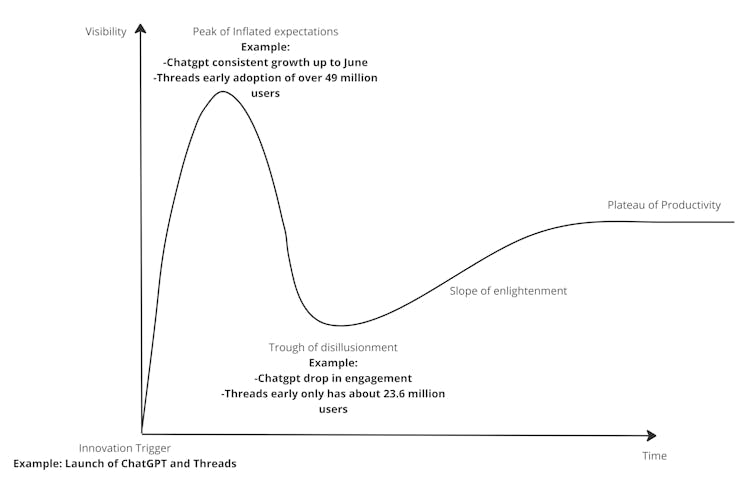
This is where the real challenge lies: being able to effectively scale up a product or service. It is precisely at this junction that the concept of unsustainable growth intersects with the Gartner Hype Cycle.
The Gartner Hype Cycle is a model that shows the stages of emerging technology adoption: from the initial hype and inflated expectations, through disillusionment and skepticism, to practical and mainstream productivity.
A graph illustrating how ChatGPT and Threads fit into the Gartner Hype Cycle. (Omar H. Fares and Seung Hwan Lee), Author provided
In the context of unsustainable growth, products like ChatGPT and Threads appear to have reached the stage known as “peak of inflated expectations,” where the publicity of a new product generates over-enthusiasm and unrealistic expectations. During this stage, users rapidly adopt the product due to its novelty and the hype surrounding it.
However, this stage often leads to the “trough of disillusionment.” During this stage, the product fails to meet users’ unrealistic expectations, causing a decline in their interest.
It indicates the product’s growth may have outpaced its ability to provide an excellent user experience. Without enhancing the product based on user feedback, declining user engagement will ensue.
This rise and fall underscores the challenge of achieving sustainable growth in the face of rapid adoption. The initial hype often attracts a massive influx of users, but without a clear, scalable strategy for maintaining quality and engagement, platforms can quickly lose their appeal.
Inadequate scaling infrastructure
When a platform’s user base expands at a rapid pace, the question of whether that platform’s infrastructure can scale to the demands of its users becomes critical.
The sudden influx of users that accompanies a successful product launch can be a double-edged sword; it brings a wealth of opportunities for data collection, user feedback and revenue, but also tests the scalability of the platform’s infrastructure.
If the underlying technology, support services or operational strategies are not built to scale, the product might suffer from slow loading times, frequent crashes or a lack of timely customer support — all of which are detrimental to the user experience and a product’s long-term success.
For instance, OpenAI, the company behind ChatGPT, had to limit ChatGPT-4 users to 25 messages every three hours due to infrastructure constraints — even for those with a paid membership. While this helps manage the infrastructure load, it presents a challenge from the user’s perspective.
Users who were accustomed to unlimited interactions with ChatGPT-3 now find themselves paying for a service with limitations. This may inadvertently dampen user engagement and drive some users away, underscoring the delicate balance between managing infrastructure and maintaining user satisfaction.
Lack of user retention strategies
One reason why tech businesses struggle to retain users is because they don’t prioritize user-centered design. By failing to incorporate user feedback in product development, businesses can end up offering a product that doesn’t meet user needs.
In addition, businesses must provide effective support for users. Insufficient or unclear onboarding may leave users feeling lost and overwhelmed, leading them to abandon the product. In the case of ChatGPT, OpenAI provides a basic explanation of platform usage, but users are primarily responsible for exploring it themselves.
Users experiment with prompts without a clear understanding of how to generate impactful responses, resulting in uncertainty and frustration. This lack of guidance may contribute to lower engagement rates, as observed in the recent decline.
Lastly, increasing concerns about security threats and privacy have raised questions about how new technologies are protecting their users. The conflict between the need for more personalized experiences and privacy can give rise to a phenomenon called the personalization-privacy paradox.
As individuals grow increasingly uneasy about how their personal information is stored, the lack of proper regulations can lead to a decline in the use of personalised services or technologies.
While rapid user adoption is a promising start, it doesn’t guarantee long-term success. Striking the right balance between growth and infrastructure scalability, adopting a user-centric approach, maintaining user trust and investing in continuous innovation are the cornerstones for enduring success in the competitive tech landscape.
Omar H. Fares is Lecturer in the Ted Rogers School of Retail Management, Toronto Metropolitan University and Seung Hwan (Mark) Lee is Professor and Associate Dean of Engagement & Inclusion, Ted Rogers School of Management, Toronto Metropolitan University. This article is republished from The Conversation under a Creative Commons licence. Read the original article.
When someone says social media, you probably don’t immediately think of LinkedIn. But there’s no denying that the business networking site has gone the distance: it is now 20 years since it was founded in Silicon Valley.
It was the brainchild of Reid Hoffman, a US entrepreneur who worked on an early social media platform for Apple before launching one of his own in 1997. SocialNet was a dating and professional connections site, but folded two years later after failing to find a big enough userbase in those early days of the web.
LinkedIn founder Reid Hoffman. Photograph credit: Marco Verch, CC BY-SA
Hoffman went on to become a senior manager at PayPal, and made a substantial amount of money when it was bought by eBay in 2002. This helped him to co-found LinkedIn on December 28 2002 with a team of former SocialNet colleagues, becoming its first chief executive and later executive chairman.
This was a period when everyone was realising the importance of individual interconnection and peer-to-peer interactions. LinkedIn launched in May 2003, just ahead of Myspace and Facebook. But where they and others like Friendster went after the consumer market, Hoffman’s venture was always focused on business.
How it grew
LinkedIn was originally set up as a place where users could share their CVs and establish a network of people who could recommend them. It took a while for the service to find its feet via innovations like allowing users to upload their contacts books (2004), as well as jobs listings (2005) and public profiles (2006).
LinkedIn went international in the late 2000s, opening an office first in the UK in 2008 and introducing Spanish and French language versions the same year. Jeff Weiner, formerly of Yahoo, took over as chief executive the following year as the company morphed into a proper business.
It made money from premium features that enable users to do things like messaging outside their network, send promotional emails and access analytics. It also sells advertising space and packages to help recruiters attract talent.
It floated on the stock market in 2011 with a valuation of US$9 billion. This helped to finance an acquisition spree that has gradually bolted new features onto the platform, such as posting articles (2015) and videos (2017).
The company was acquired by Microsoft in 2016 for US$26 billion (£21 billion). With Hoffman joining the Seattle giant’s board the following year and Weiner still LinkedIn’s chief executive today, Microsoft has taken a relatively hands-off approach to ownership.
Pandemic benefits
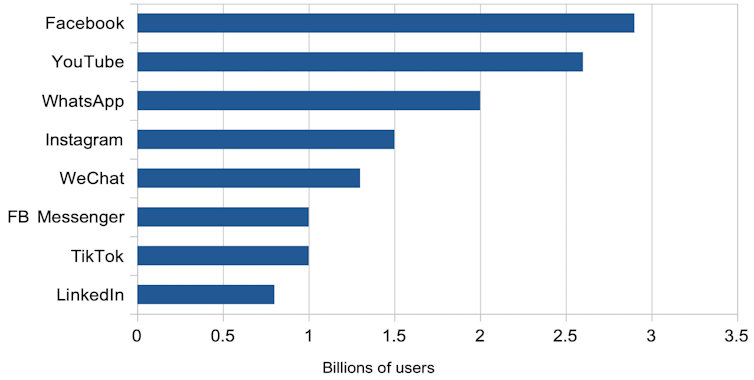
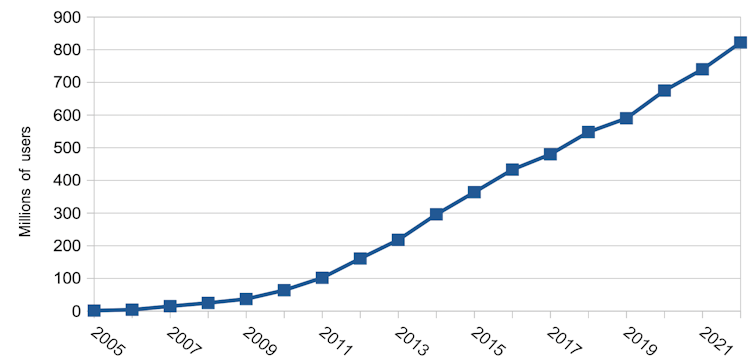
Today LinkedIn is arguably the seventh largest social network after Facebook/Messenger, YouTube, WhatsApp, Instagram, Twitter and Tik Tok. In 2021 it had nearly 824 million users across 200 countries and territories, of which 6% (49 million) are premium subscribers, paying a minimum of US$29.99 a month.
Not only does LinkedIn’s business focus attract an upmarket userbase, they are also youthful. The majority (59%) is made up of 25-34s, followed by 18-24s (20%) and 35-54s (18%). It generated revenues of over $10 billion in 2021.
World’s biggest social networks
All the data is monthly active users from January 2022, except LinkedIn, which just gives user numbers. Statista
LinkedIn had a “good” pandemic, with conversations on the platform rising 43% and content-sharing almost 30%. It benefited from a shift in how people networked, related to findings from numerous studies that it’s the “weak links” in our professional networks who are the most important for gleaning critical information that leads us into jobs we genuinely desire.
At a time when the usual barriers of time and space were less relevant and Zoom calls were ubiquitous, it became the perfect moment for reconnecting with these occasional contacts. Especially with so many people questioning their work situations, LinkedIn was the ideal place to see their posts and reach out to them.
This meant that LinkedIn played a key role in the great resignation, particularly since like the platform, this movement was dominated by millennials. Users posting about changing or quitting jobs would attract large numbers of likes and comments, inspiring others to do likewise. The fact that so many people were connected on LinkedIn multiplied the effects, making it both the main catalyst and the main solution for employers.
LinkedIn user growth over time
Various sources
Meet the ‘work-fluencer’
LinkedIn’s role as a lightning rod for work issues is also likely to determine how it develops, as a new category of social media influencer emerges – the “work-fluencer”. Companies are increasingly finding that employees’ LinkedIn profiles and postings can express the brand better than corporate accounts, allowing them to develop the corporate business network much more quickly and naturallyand naturally.
When this is done well, employee posts are usually much more authentic than corporate PR. Rather than just curating articles on professional milestones and triumphs, people have become more open and honest about day-to-day work life.
Over 13 million LinkedIn members have their profile set to “creator mode” to obtain higher exposure for their postings. Many use the hashtag #careertiktok to publish things like their wages and day-in-the-life vlogs about their professions, achieving over 1.5 billion views.
This new “online watercooler” represents a change in the amount of information people reveal about their work on the internet. Workers are raising formerly taboo concerns like pay transparency, discrimination and professional undermining. Some professionals like lawyers, entrepreneurs and HR experts, have leveraged their posts into new content-marketing businesses and other profitable side hustles.
Twenty years after LinkedIn was founded, this could enable the platform to enjoy the kind of trust and community growth that other social media networks would envy. Certainly it has challenges – fake accounts are an issue, for example. And LinkedIn inevitably attracts a lot of spam, which is probably one reason it doesn’t achieve the same amount of daily interactions as other social media.
On the other hand, it benefits from not having a single direct competitor of scale. The nearest big ones would be Facebook Groups or Reddit, but LinkedIn’s purely corporate focus is always likely to be a plus against such players. At a time when traditional platforms like Facebook and Twitter are experiencing difficulties, LinkedIn has a real opportunity to continue succeeding as the one dedicated platform of its size.
Theo Tzanidis is Senior Lecturer in Digital Marketing, University of the West of Scotland. This article is republished from The Conversation under a Creative Commons license. Read the original article.
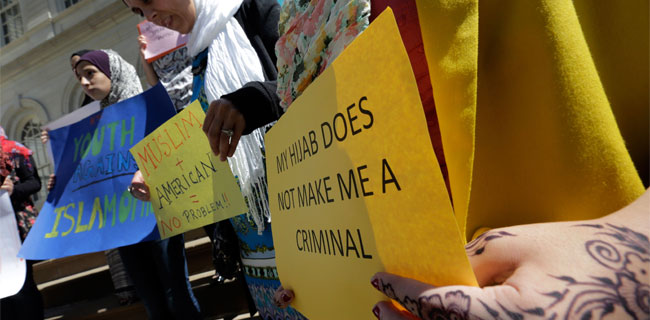
Students with the Muslim Consultative Network’s summer youth programme gather on the steps of New York’s City Hall on Aug. 14, 2013, to speak out against Islamophobia. AP Photo/Richard Drew
By Erik Bleich, Middlebury & A Maurits van de Veen, William & Mary
The warm welcome Americans and Europeans have given Ukrainians in 2022 contrasts sharply with the uneven – and frequently hostile – policies toward Syrian refugees in the mid-2010s.
Political scientist David Laitin has highlighted the role that religious identities play in this dynamic. As he pointed out in a recent interview, Syrian refugees were “mostly Muslim and faced higher degrees of discrimination than will the Ukrainians, who are largely of Christian heritage.”
The media provide information that shapes such attitudes toward Muslims. A 2007 Pew Research Center survey of Americans found that people’s negative opinions on Muslims were mostly influenced by what they heard and read in the media. Communications scholar Muniba Saleem and colleagues have demonstrated the link between media information and “stereotypic beliefs, negative emotions and support for harmful policies” toward Muslim Americans.
To better grasp the evolution of media portrayals of Muslims and Islam, our 2022 book, “Covering Muslims: American Newspapers in Comparative Perspective,” tracked the tone of hundreds of thousands of articles over decades.
We found overwhelmingly negative coverage, not only in the United States but also in the United Kingdom, Canada and Australia.
Negative coverage of Muslims
Previous research has identified widespread negative media representations of Muslims. An overview of studies undertaken from 2000 to 2015 by communications scholars Saifuddin Ahmed and Jörg Matthes concluded that Muslims were negatively framed in the media and that Islam was frequently cast as a violent religion.
But the studies they reviewed leave open two pressing questions that we address through our research.
First, do articles touching on Muslims and Islam include more negative representations than the average newspaper article? Second, are media portrayals of Muslims more negative than articles touching on other minority religions?
If stories about minority religious groups made it to the news only when they were involved in conflict in one way or another, then they may be negative for reasons that are not specific to Muslims.
What we found
To answer these questions, we used media databases such as LexisNexis, Nexis Uni, ProQuest and Factiva to download 256,963 articles mentioning Muslims or Islam – for which we use the shorthand “Muslim articles” – from 17 national, regional and tabloid newspapers in the United States over the 21-year period from Jan. 1, 1996, to Dec. 31, 2016.
We developed a reliable method for measuring the positivity or negativity of stories by comparing them to the tone of a random sample of 48,283 articles about topics drawn from a wide range of newspapers. A negative value on this scale means that a story is negative relative to the average newspaper article.
Crucially, this approach also provided a baseline for additional comparisons. We collected sets of articles from U.S. newspapers relating not only to Muslims, but also separately to Catholics, Jews and Hindus, three minority religious groups of varying size and status in the United States. We then assembled stories linked to Muslims from a broad array of newspapers in the U.K., Canada and Australia.
Our central finding is that the average article mentioning Muslims or Islam in the United States is more negative than 84% of articles in our random sample. This means that one would likely have to read six articles in U.S. newspapers to find even one that was as negative as the average article touching on Muslims.
To give a concrete sense of how negative typical Muslim articles are, consider the following sentence that has the tone of the average Muslim article: “The Russian was made to believe by undercover agents that the radioactive material was to be delivered to a Muslim organization.” This contains two highly negative words (“undercover” and “radioactive”) and implies that the “Muslim organization” has nefarious goals.
Articles that mentioned Muslims were also much more likely to be negative than stories touching on any other group we examined. For Catholics, Jews and Hindus, the proportion of positive and negative articles was close to 50-50. By contrast, 80% of all articles related to Muslims were negative.
The divergence is striking. Our work shows that the media are not prone to publishing negative stories when they write about other minority religions, but they are very likely to do so when they write about Muslims.
Beyond comparing coverage across groups, we were also interested in coverage across countries. Perhaps the United States is unique in its intensely negative coverage of Muslims. To find out, we collected 528,444 articles mentioning Muslims or Islam from the same time period from a range of newspapers in the U.K., Canada and Australia. We found that the proportion of negative to positive articles in these countries was almost exactly the same as that in the United States.
Implications of negative coverage
Multiple scholars have shown that negative stories generate less favorable attitudes toward Muslims. Other studies that looked at the impact of negative information about Muslims also found an increase in support for policies that harm Muslims, such as secret surveillance of Muslim Americans or the use of drone attacks in Muslim countries.
In addition, surveys of young American Muslims have found that negative media coverage resulted in weaker identification as American and in lower trust in the U.S. government.
We believe acknowledging and addressing the systemic negativity in media coverage of Muslims and Islam is vital for countering widespread stigmatisation. This may, in turn, create opportunities for more humane policies that are fair to everyone regardless of their faith.
Erik Bleich, Charles A. Dana Professor of Political Science, Middlebury and A. Maurits van der Veen, Associate Professor of Government, William & Mary.
This article is republished from The Conversation under a Creative Commons license. Read the original article.