By G Seetharaman
It could well have been just yesterday when you walked into your friendly neighbourhood kirana store and muttered to the shopkeeper the by-now-familiar line: “Kuch toh discount dijiye, main toh har baar idhar hi aata hoon.” The guy behind the counter perhaps wouldn’t be amused – particularly if he’s never seen you before – but he isn’t likely to show his irritation; instead he may well decide to reward you for your apparent loyalty by shaving a few rupees off your bill.
Consumers love a bargain – and marketers love to show that they’re giving one. There’s a fair bit of role-playing with the shopper trying hard to show her loyalty and the marketer trying even harder to reward it. Those efforts manifest themselves in wallets swelling with loyalty cards of retailers, airlines and hotels. But are the points that consumers stockpile in the hope of encashing them one fine day juicy enough carrots to keep them coming back for more? Perhaps not.
C Prabhakar, a Chennai-based company secretary, does not set much store by points-based loyalty programmes. “Rather than waiting for a really long time to earn enough points to redeem them for something I like, it makes more sense to just go ahead and buy it,” he says. Two years back, Mr Prabhakar became a member of the loyalty programme of the Landmark group, which has retail chains like Lifestyle and Home Centre. “Just because I have the loyalty card does not mean I’m going to go there again and again. If I happen to go there, I will use the card, that’s it,” he adds.
Customers like Mr Prabhakar are a marketer’s nightmare and defy what companies are trying to achieve through loyalty programmes. Siddharth S Singh, associate professor of marketing at the Indian School of Business (ISB) who has researched loyalty management in the US and India, is not surprised. “Companies here have tried to imitate the West. Sometimes loyalty management firms that devise programmes for companies are not experts. They are just IT vendors,” he says.
Not Very Loyal
While some retailers in India handle their own loyalty programmes, most of them hire loyalty management companies to do it for them. The loyalty programme market in India is pegged at about Rs 5,000 crore; retail accounts for two-thirds of that, and travel and financial services for 10% each. The rest comes from other sectors including hospitality and also channel loyalty initiatives.
Loyalty marketing research firm Colloquy estimates the number of loyalty programme members in India to be over 35 million. The points earned in a loyalty programme can be redeemed for discounts or other rewards like movie tickets, accessories and consumer durables. MS Ashok, chief operating officer of Accentiv India, a loyalty management company, says cost is a huge factor in the very limited nature of loyalty programmes.
“Companies are not able to move their marketing budgets from ATL [above the line] to BTL [below the line]. Loyalty programmes should be a big part of any company’s marketing budget,” he notes. While advertising falls under ATL activities, loyalty programmes are under BTL.
Bijaei Jayaraj, founder and chief executive of Accentiv’s peer Loylty Rewardz, says even globally loyalty programmes are not very evolved. “Loyalty programmes are much more than points. There are some associated things which companies do not do very well, like suggesting purchases based on a customer’s transaction history,” he notes.
Loylty Rewardz runs programmes for banks like Punjab National Bank, Bank of India and the State Bank group. Vijay Bobba, managing director and CEO, Payback India, says a good points-based loyalty programme should see a redemption of at least 50% of the points: “There are very few such loyalty programmes here and no programme crosses 70%.”
Not all brands need a loyalty programme. Those that are either truly aspirational or those that anyways provide total value for money for sure don’t. Mr Bobba gives the examples of Apple (aspirational) and Walmart (value-for money) that can afford to not have a loyalty programme.
“Apple provides the most premium customer experience and has a huge following. Walmart sells at the lowest price possible.” For others who fall between these two ends of the positioning spectrum, loyalty cards are a great way to identify customers, adds Mr Bobba. Payback India runs a unified loyalty programme for several brands including Future Group, ICICI Bank and travel portal MakeMyTrip.
Know Your Customer
Srikanth Chunduri, co-founder of Emart Solutions India, which devises loyalty programmes for companies, says the problem lies in not understanding customers. “It took the guy at the coffee shop I visit regularly six visits to know me. My kirana store owner knows me better. He doesn’t give me discounts for being a loyal customer but gives me convenience of free home delivery,” he observes.
Vinay Bhatia, vice-president, marketing and loyalty, Shoppers Stop, believes a piece of plastic does not create loyalty: “Points are just the transactional part of the programme. You have to go significantly beyond points.”
He also says it is better to charge customers for a loyalty card than to dole out freebies. “When a customer pays, he takes interest and asks so many questions about the rewards. That’s what we want,” he adds.
Shoppers Stop charges Rs 300 for a ‘First Citizen’ card. First Citizen along with Jet Airways’ ‘Jet Privilege’ is among the best known loyalty programmes in the country.
Over 70% of Shoppers Stop’s revenues come from its 2.8 million First Citizen customers. Marketing professional Tanaz Makujina concurs with Mr Bhatia on the benefits of retailers charging customers for loyalty cards. A First Citizen member, she used to redeem her points but now does not visit Shoppers Stop because she does not like their collection. “I’m not brand-loyal when it comes to retail stores. As I’m not one of those people who will go to a particular shop just to earn points, I won’t pay for a loyalty card again,” says Ms Makujina who owns eight loyalty cards.
Talking of the points she earns on her ICICI Bank debit card, she says that since she has to visit the Payback site to find out what her points will get her, she does not bother. According to a 2011 Cross-Cultural Loyalty Study by Colloquy, only 42% of shoppers surveyed in India belonged to a loyalty programme compared to 74% of Americans surveyed. Companies, expectedly, say points-based loyalty programmes are effective. “I don’t think there is disenchantment with the points system among customers. It works when you give significant value to your customers,” says Anil Ramachandran, who heads the credit cards business at IndusInd Bank.
Devendra Chawla, president of Future Group’s Food Bazaar, says the group’s Payback programme has 1.1 million members. “One loyalty card across formats and different merchant establishments certainly works better for customers as they get points on almost every item they buy, and more points get accumulated,” he adds. Parag Rao, business head, card payment products, HDFC Bank, claims the bank’s credit cardholders have displayed the “highest rewards redemption behaviour in the industry”.
HDFC Bank is the largest credit card issuer in the country, accounting for a third of the total outstanding cards. Kaushal Satam, head, Jet Privilege, says the relationship between accrual and redemption of points is a symbiotic one: “The ability to redeem points is as important as the opportunities to earn those and success in one area determines success in the other.”
Points are Not Everything
While marketers emphasise the need for points, they have also realised they have to think beyond points to get their customers to stick with them. Shoppers Stop, for instance, decided to expand its Durga Puja offers outside West Bengal last year and mined its First Citizen database for Bengalis in New Delhi, Mumbai and Bangalore and notified them about the offers.
“We saw an incremental turnover of Rs 1 crore,” says Mr Bhatia. Apparel brand Louis Philippe also offers sweeteners beyond points to its “Upper Crest” members. “Events like theatre, golf tournament invites and red carpet invites to stores for wine and cheese evenings with Louis Philippe designers and marketing teams have been very well received by members,” says Jacob John, brand head, Louis Philippe India.
Manisha Lath Gupta, chief marketing officer, Axis Bank, says points are a currency which should be used intelligently. She adds: “There should be different incentives for different customers. For instance, I could give people who have never swiped their debit card bonus points to get them to use their cards.” Axis Bank recently revamped its loyalty programme to make it a pan-bank loyalty programme which means customers can earn points not just on debit and credit cards but also on their savings accounts, internet and mobile banking. “Earlier, redemption of points was in lower single digits but now it is has gone up to 16-17%,” she says.
Mr Chunduri of Emart Solutions feels companies should think of innovative ways to reward customers. “An online bookstore could send out invites to a book reading,” he says. Companies in India do not know how to leverage their database, according to ISB’s Singh. “That’s what Tesco and BestBuy have done. They focus on their most valuable customers,” he notes.
Tesco and BestBuy are American and British multinational retailers respectively. Their loyalty programmes, along with that of Amazon’s, are considered among the best. With increasing options for customers for almost every product and service, retaining them is no walk in the park for companies. But such a scenario also provides them with an opportunity to make their loyalty programme stand out from their peers’. Only a handful have done that so far.
Source:The Economic Times
Copyright © 2013, Bennett, Coleman & Co. Ltd. All Rights Reserved
Licensed to republish

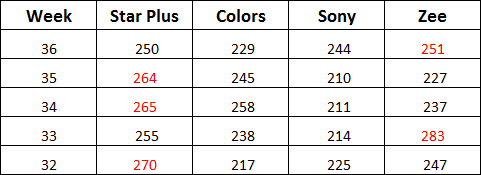 According to Anita Nayyar, CEO, India and Southeast Asia, Havas Media, in the GEC space there are four top channels – Star Plus, Sony, Zee and Colors – and their ratings keep fluctuating among themselves, which isn’t a recent phenomenon. “One week, one channel is peaking so the other week it’s another channel’s chance. Also, there isn’t much difference between their GRPs; it’s a matter of only a few numbers that they fall short of each other in the race. Therefore, it’s nothing alarming even for the clients who follow the GRPs to the T. However, we do keep in mind the trends and what gets the eyeballs to the channel. For instance, KBC taking Sony to number slot was expected. One needs to keep such issues in mind and plan accordingly.”