Tag: television

  • What TV viewers watched in 2011


    By A Correspondent


    Digital viewing of television grew a phenomenal 63 per cent in 2011, indicating the shape of things to come in 2012 and forthcoming years. This and various other results are part of TAM Media Research’s third annual report on television viewing patterns inIndia.


    Titled ‘Impatient Generation’, the report was launched by Union sports and youth affairs minister Ajay Maken at the Indian Merchant Chamber’s ‘Fusion 2012’ conference. Ms. Bhavna Doshi, President, Indian Merchant Chamber and Mr LV Krishnan, CEO, TAM, were also present on the occasion.


    “We conduct such a study every year. The study, ‘Impatient Generation 2011’, is a quick, reader-friendly compilation of TV viewing trends in 2011. It gives a patient update of the impatient world of audiences consuming TV content. This annual feature attempts to update all advertisers, marketers and other stakeholders on how to reach out to their target groups,” said Mr Krishnan.


    Here are some of the highlights of the report:


    The TV Viewing Universe

    • C&S at All India level is currently 126 million Households, Digital Households (42 mn) have grown at 63 per cent.
    • C&S and Digital grew by 5 per cent and 61 per cent respectively in TAM reported markets.


    Viewing trends in key genres


    • Hindi General Entertainment Channels (GECs)
      1. Viewership of Hindi GECs genre has seen a 6.5 per cent dip.
      2. Viewership share of Hindi GECs is 38 per cent of all TV viewing and Top 6 GECs account for 90 per cent of the audience shares gained by the genre.
      3. In 2011, Hindi GEC genre has shown a consistent growth in 1-hour special fiction episodes during Prime Time on Weekends.
      4. Delhi, Maharashtra, UP & Gujarat have been the Top performing markets for Hindi GECs genre across years and the viewership returns from Metros have seen a slight drop.


    • Hindi Movie Channels
      1. Hindi movie genre holds about 15 per cent of total TV viewing.
      2. Number of unique movies aired in 2011 has decreased by 10 per cent.
      3. Both airtime and viewership of South-dubbed movies has seen a clear growth in 2011.


    • Hindi General News
      1. Share of Hindi News genre has witnessed a 10 per cent growth in 2011 after decreasing in 2010.
      2. Returns from News Bulletins has witnessed an appreciable increase while viewing proportion from telecast of Review/Reports has witnessed a decline across years.


    • English Entertainment
      1. Overall GRPs have increased by almost 50 per cent with Reach & Time spent contributing to the gain.
      2. Digital penetration increasing in key Metro markets has led to greater access for the channels.
      3. The growth in Consumption led by Time Spent is showing a 15-20 per cent increase.


    • Kids Channels
      1. The overall genre with 18 per cent share seems to be on a growth path with new channel launches in 2011. Today, 14 channels constitute the genre.
      2. The Reach levels for 10-14 years age band has improved in 2011.
      3. With the increase in number of channels, Kids genre witnessed a continuous increase in viewership share since 2008.
      4. Homes with Kids are faster in adopting to Digital TV platforms with growth rate touching almost 60 per cent in 2011.


    • Sports Genre
      1. Sports genre witnessed 200 million unique viewers in year 2011.
      2. There has been 18 per cent rise in Sports content on TV during 2011.
      3. Live sports coverage continued to garner over 50 per cent of the viewing for any sports content.
      4. 2011 saw 35 per cent growth in advertising volumes, but 70 per cent of volumes continued to be garnered by cricket.


    Launch_of_Impatient_Generation_by_Mr.Ajay_Maken, Hon’ble Minister of State for Youth Affairs and Sports, Ms. Bhavna Doshi, President, Indian Merchant Chamber and Mr. LV Krishnan, CEO, TAM Media Research


    Viewing trends in select regional markets


    • Tamil Nadu
      1. Digital penetration increased by 17 per cent in Tamil Nadu market.
      2. Increase in viewership is because time spent levels increased by 3 per cent in Tamil Nadu market.
      3. Tamil GECs, Music and Sports also witnessed increase in viewership.


    • Andhra Pradesh
      1. Digital penetration has just touched 8 per cent in AP market.
      2. While overall Time Spent on TV is high (over 3 hours daily), its growth is just 1 per cent over 2010.


    • Karnataka
      1. Kannada GECs, News are primarily on a growth track in viewership.
      2. While serials provided almost 3 times ROI, the growth in viewing for this genre has continued to be excellent with an average of almost 20 per cent in 2011.


    • Kerala
      1. Fall in Time Spent by 6 per cent has resulted in overall TV viewing coming down in 2011 but the introduction of new channels has resulted in a growth in viewing again the last few weeks of 2011.
      2. Malayalam GECs dominate with a lion share of 50 per cent with news, movies and music following.
      3. Malayalam Kids Content pick viewing with launch of New channel – Kochu TV.


    • West Bengal
      1. Viewership of Bangla regional has witnessed a steady and fast growth from 5 per cent share in the year 2000 to 43 per cent as of 2011, eating into Hindi channels’ share.

    There has been a growth in ratings for regional movies and events as compared to Hindi movies and events.


    • Maharashtra
      1. Although total TV viewing remained steady, viewership of Marathi yegional has seen a growth over last year.
      2. The growth is seen maximum on Digital TV platforms (31 per cent), as compared to Analog set of viewers (13 per cent).
      3. Unlike 2010, the Marathi GEC genre had prioritized the airtime mostly for the higher ROI generating contents like fiction, movies and reality shows.
      4. Chat shows/ Interviews (on Marathi news channels) now constitute about 12 per cent of airtime, contributing about 14 per cent of total viewership.


    According to Mr Krishnan, the study provides a useful perspective to TV broadcasters and production houses of the where, when and how TV audiences are changing in their tastes and preferences, what content they are rejecting or accepting. “The dynamics that shape an average Indian household viewer’s relationship with TV each day starting from morning to evening is another block that this TAM feature attempts to throw light on,” he said.


    MxMIndia will bring you more viewership trends over the next week.

     

  • South African Tourism launches ‘Leave ordinary behind’ ad campaign

    By A Correspondent


    South African Tourism has kick-started its television, outdoor and cinema campaign in order to promote the destination inIndia. Post the launch of its cinema campaign recently, South African Tourism has now started the campaign on television and outdoor to popularise the destination among Indian travellers.


    The 20 and 30 seconds advertisement captures an Indian couple who share their mesmerizing experience of travelling toSouth Africa. The commercial captures the experience of adventure, nightlife, wildlife, luxury, wine route and beauty ofSouth Africa. With this advertisement, South African Tourism is reaching out to numerous travellers through various entertainment and news channels.


    Indian television has a lot of shows that have the potential to draw good viewership and South African Tourism is tapping this opportunity to draw more Indian tourists to the Rainbow Nation.


    Along with its television campaign, South African Tourism has also launched its outdoor campaign. Outdoor Advertising Professionals (OAP) has done the creatives and execution for the outdoor campaign. The upcoming campaign is spread across 16 types of media that comprises of 452 media units covering an outdoor space of approximately 1,90,000 sq ft across 22 markets. The various media chosen for the campaign are billboards, backlit walls, bus shelters, cantilevers, glass façades, flagpoles, gantries, glow cubes, king-long buses, metro signages, pole kiosks, subway panels, skywalks, standalones, malls and airport displays.


    Commenting on the campaigns, Hanneli Slabber, Country Manager, South African Tourism, said: “Given the fact that Indian television is one of the strongest consumer influencers, we wanted to leverage the medium with the launch of our television campaign. The commercial aims to demonstrateSouth Africa’s warmth and affability through the eyes of Indians who have experienced the country. They are real people telling their story in their own words and we hope that the Indian viewers can connect well with the ad. With these two campaigns we want to intrigue desire towards the destination and aid brand recall towardsSouth Africa. We are confident that the television, outdoor and cinema campaign will definitely tempt the Indian audience to consider a holiday inSouth Africa.”


    South Africahas grown to become one of the most popular destinations among Indian tourists. South African Tourism has witnessed an exceptional 29.9 per cent increase in Indian tourist arrivals between January-September 2011 in comparison to 2010.


  • Anil Thakraney: ‘Giving’ season for Bollywood & TV-land

    By Anil Thakraney


    It’s that season when many organizations will gave away many awards to many Bollywoodians. And the number of award givers is increasing with time, and I hope it stops right here. It would be a joke if in the year 2020 we have stars lining up for 30 events. Rather, I wish there were, at the most, two ceremonies, so that the awards are truly coveted and valued.


    Aside from numbers, there are many problems with these awards shows in the Indian context, and for their own credibility, the organizers must do their damndest to sort them out.


    For one, there must be absolute integrity in the judging process. Everyone and his father knows some winners get picked by non-jurists. Often either by the organizers themselves or by their sponsors or associates. And this gets amply proved when everyone who attends the show gets an award, and only the winners land up for the events. This is not the way it pans out either at the Oscars or the Golden Globes. And that’s the reason why Aamir Khan shuns these tamashas. Surely there is a way to deal with this continuing malaise. Maybe the will is lacking.
     

    Two, since all the moolah comes from television rights, these shows are tailor-made for the tube. Quite a few acts don’t happen on stage, they get inserted in later. This makes no sense. If the stars are going to perform on stage, then they must do so in real time, in front of the hundreds of people in the audience. Because capsules get inserted in later, the show looks pretty artificial and scripted. Again, nowhere does this happen in the world. Organizers must make it mandatory for performers to perform live. That’s the beauty of an event. If we wanted to watch recorded stuff, we’d watch the regular TV shows.


    And third, because these events get packaged as TV dramas, awards become the side show. ‘Extras’, in filmi lingo. In fact, awards for vernacular films and for the technical crew get done in a big rush, so that the entire time and energy goes into entertainment. Which is dance and thakela banter. Awards should be the big act, the rest of the stuff woven around them.


    Lots of issues to be dealt with, and I am not even talking of the shoddy camera work. Hope one day we can put out an awards show that the West will envy and emulate.


    * * *


    PS: If you haven’t watched ‘Shattered Glass’ already, you should quickly grab the DVD. Especially if you work in the media. It’s the story of a young reporter who cooks stories and quotes to quickly rise up the hierarchy. And also to deal with the intense pressure in the newsroom. This can so easily happen to any young journo. A warning for everyone.


  • [LOOKBACK 2011] The Year for GECs

    By Ritu Midha


    One-upmanship among the General Entertainment Channels (GECs) continues. While the top slot, for now, seems to be reserved for Star Plus, number 2 slot is now occupied by Sony. The tough fight between the channels has definitely benefited the viewer, who gets to see differentiated content now.  It is appointment viewing all the way – with viewers happily surfing from channel to channel, depending on the shows being shown at a specific time slot.  With a number of new shows hitting television at the same time – multiple show viewing at the same time (sampling) too is quite common – which is likely to reduce once the programme loyalty sets in.


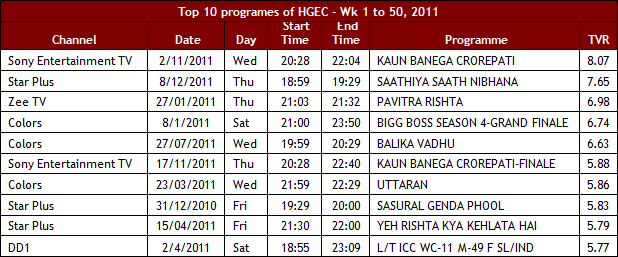
    The top 10 shows in GECs include three reality shows (including the top slot). And the 10th slot is occupied by Cricket (Doordarshan). This effectively indicates that only six of the top ten shows for 2011 (first 11 months) were fiction shows.

    Source: TAM Media Research
    TG: CS 4+yrs
    Market: HSM
    Channels : Hindi GEC
    Period : Wk 1 to 50,2011


    Perhaps, the picture would be bit different if one looked at the entire year, with quite a few new shows like Kuch to Log Kahenge,  Diya Aur Baati Hum, Hitler didi and Bade Acche Lagte Haen settling down.  Interestingly – none of the four is a classic saas bahu drama.

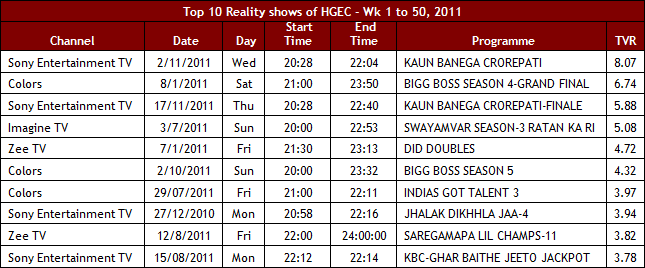
    As for the reality shows, only KBC and Big Boss (Finale) could find a place in top 10 – however others too brought in reasonable numbers for the channel. A quick look at them is here:

    Source: TAM Media Research
    TG: CS 4+yrs
    Market: HSM
    Channels : Hindi GEC
    Period : Wk 1 to 50,2011


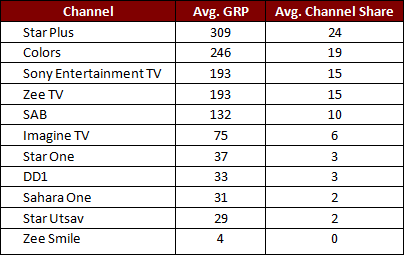
    Now a look at the average TVR of the channels -If one looks at GEC viewership for the first 11 months, Star Plus rules as numero uno, with Colors at number two and ZEE and Sony rubbing shoulders at number 3:

    Source : TAM Media Research

    Period : Jan – Nov 2011

    TG : CS4+
    Market : HSM
    Period : Wk 1 to 50,2011


    However, if one breaks the data by month, it becomes the story of Sony’s steady climb through the year. The channel got it right post KBC. Its numbers did not dip as was being anticipated – but the new shows it brought in have, in fact, consolidated its positions as the number two GEC.  Multi Screen Media with two channels in top 5 GEC, and MAX too going strong is doing well for itself. It would be interesting to watch if Star One in it its new avatar – Life OK proves to be a threat.

  • [LOOKBACK 2011] The Year for News TV

    By Ritu Midha


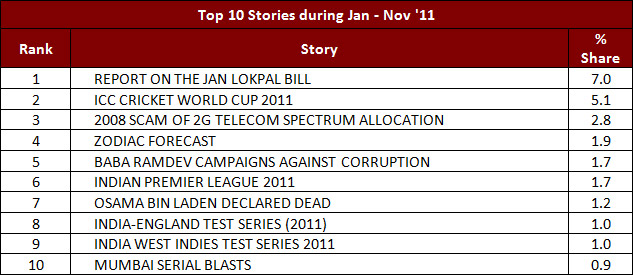
    Anna Hazare got the largest percentage share as far as the news channels go. The other top stories of the year 2011 were Cricket World Cup 2011, 2GScam. Interestingly post these comes Zodiac Forecast, which is two rungs above IPL coverage. Here is a list of top 10 new stories by percentage share:

    Source: Source: News Content Track – A service of TAM Media Research Pvt. Ltd

    Channels: Aaj Tak, CNN IBN, Headlines Today, IBN 7, India TV, NDTV 24/7, NDTV India, Star News, Times Now, News 24 & Zee News
    Period: Jan – Nov, 2011

    Note : Analysis is based on the Telecast duration


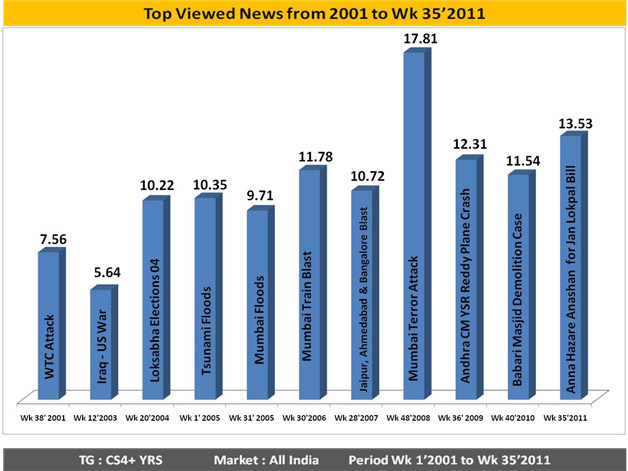
    If one looks at data from 2001, the Lokpal Bill at its peak was the second most watched news in 11 years – second only to the Mumbai Terror Attacks:


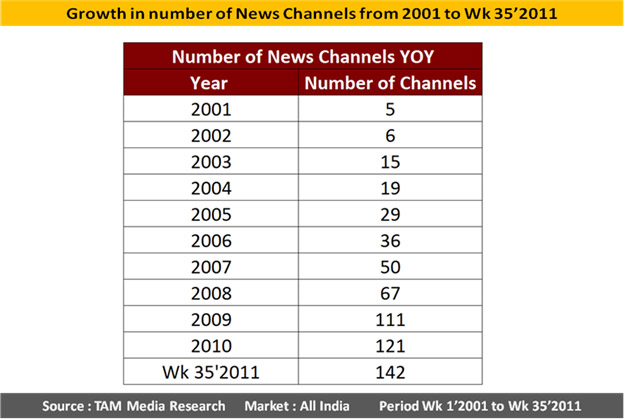
    News, interestingly is the fastest expanding genre with eight new news channels being launched (excluding regional languages) till week 50, 2011: 7 in Hindi and 1 in English.

    Even if on e looks at year on year growth – news is one of the fastest growing genres:

    With the first quarter of 2012 seeing assembly elections including heavyweights like Uttar Pradesh and Punjab – and Lokpal Bill still in the eye of the storm – the share of news channels is expected to grow.

  • Much ado over 3D?

    By Akash Raha

    Even as High Definition (HD) television channels are entering the Indian market, blogs and social networks are already abuzz with talk of 3D channels coming soon, and how that will revolutionize the entire TV-viewing experience. MxMIndia took a closer look at these claims, to find out whether such a time is actually anywhere close at hand.

    According to Ms Anamika Mehta, COO, Lodestar UM, “India is already an underleveraged and fragmented market and such innovations will definitely add to the monetary burden.  Indian consumers are yet to fully embrace HD, and 3D in that context is still years away. While some manufacturers have launched 3D products, we still do not have ample content. 3D content would mean significant investment in content cost and advertisers and viewers alike are unlikely to pay in the short run for the experience. Secondly, perhaps barring live sports there isn’t any genre that could see demand for 3D broadcasting. The other genre could be movies in theatres for an experience… Lastly, you need high quality content which lends to 3D viewing and strapped for budgets, very few production houses will bite.”

    But all said and done, the success of Mr James Cameron’s film Avatar in Indian theatres is enough proof that when you offer visually appealing content in 3D, people will flock to see it. Even so, such a number still remains way short of expectations for a market such as India to actually implement a 3D plan. If media analysts are to be believed, making 3D content for television is a very difficult job and the cost is too high to bear. Even today, many media houses use age-old technology for programming and non-35 mm cameras.

    Interestingly, in the US a $14-billion, eight-year deal by ESPN with the National Football League (NFL) includes international rights and distribution of 3D content. This is despite the earlier reports that they might give up on 3D technology altogether. Several other broadcasting plans, internationally, for 3D broadcast of live baseball and basketball games are also on the anvil. MxMIndia’s efforts to reach ESPN-Star in India for their take on the issue failed to elicit any response.

    Mr Dinesh Vyas, Business Head, MEC said that any talks of 3D technology coming into India in the current scheme of things is certainly a gimmick. He said, “HD and 3D televisions are already available in the market, but people are still apprehensive about it, especially, 3D. People get headaches when they see 3D content for extended periods. Such a technology is not going to take off any time soon in India. The Indian market is not very receptive to technology and it takes a long time to appropriate it… Cost of technology too is very high – and currently no advertiser will be interested in it, which implies that even media owners will have to drop any major 3D plan. However, there will always be small news here and there about 3D which might get everyone excited.”

    So is it a good idea for affluent Indians and the upcoming middle class to splash out on 3D television – which is touted as the technology of tomorrow? The answer is a plain simple – no. Or at least, not yet… After all, what use is a large sprawling 3D television in your living room without any 3D content to support it with? That is excluding a handful of 3D movie DVDs and Blu-Ray discs.

    However, not all media planners are pessimistic towards the technology and some still see hope, however dim, for it. Mr Premjeet Sodhi, President, The Collaborative, Lintas Media Group, said, “High value, premium or luxury goods and services are not new to the India market and like any other such goods and services the 3D TV sector is also amenable to adoption and success. However, I don’t think I am qualified to comment on which consumer technology will be successfully adopted. Whether 3D TV will be adopted and when and whether it will be a viable business is something for the custodians of these businesses to dwell upon and work towards. But, as and when the penetration of the technology reaches a critical mass, I am sure the media and advertising services will equip themselves to support the technology.”

    There may well be a time in future when 3D channels and television will be in vogue, but apparently that time is not near. If analysts are to be believed, it will be a long while before demand meets technological advancements. However, India still remains an unpredictable market. It is the same country which discarded pager technology and yet usurped the mobile. To write off 3D technology’s viability in India could be presumptuous.

  • The Anchor: 7 ways to keep a viewer glued to your channel

    By Sunder Aaron


    #1 Assortment: A channel needs to offer a variety of content to viewers to keep them coming back.


    #2 Thematic: It is important to be a part of local festivals and important historic days which makes the viewers feel closer to the channel – for example Diwali or Independence Day.


    #3 Original: A viewer today is bombarded with numerous communications all the time – it is more important than ever create a clear differentiation amongst the category to enjoy top-of-mind status with the viewers.


    #4 Young and fresh: Any viewer, young or middle-aged, would like to watch a film which excites him/ her. The best way to this is to keep the appearance of the channel vibrant and fresh.


    #5 Beyond the television screen: Gone are the days when television channels just aired promos and hoped to keep viewers glued – the need of the hour is to create brand extension programs.


    #6 Avoid repetition: Repetition could result into losing a fair amount of eyeballs since there is a sense of disappointment if the viewer has already watched the content.


    #7 Surprise element: Surprise your viewer! Exceed your promise by delivering more than you promise.


    Sunder Aaron is Business Head, PIX.

  • History launches with innovations blitz

    By Dhara Salla

    The History Channel launched its India edition on October 9 as part of a joint venture between TV18 and A+E Networks. The launch is a significant milestone in the Indian media space as it marks an alliance between dynamic television media conglomerate TV18 and factual entertainment biggie A&E Networks.

    Mr Raghav Bahl, Founder and Editor, TV18 said on the occasion of the launch, “We have always believed in making a difference in the domain that we work in and we believe that factual entertainment will emerge as one of the mainstays of the Indian television space.”

    Mr Haresh Chawla, Group CEO, Network18 said, “We believe that the Indian market is ripe for alternative formats and that is one of the reasons for us to bring in channels like History into this market. Factual entertainment is emerging as the new preferred choice across the world and the genre has the potential to become mainstream in India as well.”

    Ms Sangeetha Aiyer, General Manager Marketing, History, told MXM India, “By far this is one of the biggest media launches in the year and most definitely the biggest in the factual entertainment genre, in terms of impact, visibility, engagement, etc across traditional and new media.”

    As a channel, History has transformed itself by using very innovative formats that move away from the traditional concept of History being about dates, B&W footage, World War II etc. That DNA of innovation is being replicated everywhere including the marketing campaign. According to media reports, the marketing spend would be between Rs 150-170 million.

    The string of innovations began with the channel announcing its association with Bollywood star Salman Khan to be the face of the channel in an attempt to broad-base the appeal of History and the factual entertainment genre.

    In terms of Outdoor or Out of Home, innovative formats where the content seems to come alive and appear real will give passersby a first-hand taste of what History is all about. Some examples of engaging outdoor innovations are the Ice Road Trucker bridge replicated on a foot overbridge, Sliced where the anchor actually seems to ‘slice’ the hoarding, Swamp People, which has a brilliant life like cut-out of a crocodile/alligator, and Top Shot where smoke actually comes out of a gun which is part of the hoarding.

    On the programming and the content front, History channel has found out that Indian viewers across demographics are interested in experimenting with alternative forms of content, as far as the entertainment quotient is not compromised upon. The channel is being launched with universal themes that use the premise of history.

    Ms Aiyer said, “It will also announce a few big-ticket local productions that match international scale, very shortly.” The major chunk of the content is currently from the History US catalogue, with an appeal to viewer preferences in India. However, the channel is also experimenting with local production possibilities.

    How would this channel differ from the existing ones in this genre? Ms Aiyer said, “Firstly there is no other History channel in the country. History Made Everyday, the channel’s new positioning, encompasses the breadth of content and themes that History brings to Indian audiences. History here is not just about the past, it’s as much about people making History today.”

    AETN and Network 18 have come together as AETN 18 where Network 18 group holds 51 percent share and AETN holds 49 percent.

  • UEFA media rights announced

    By A Correspondent

    UEFA has announced the award of 2012-15 UEFA Champions League and UEFA Europa League media rights to various territories in Asia.

    Malaysia and Brunei: Pay television operator Astro has been awarded exclusive media rights for the 2012-15 UEFA Champions League and UEFA Europa League. Football fans in Malaysia and Brunei will be able to see live at least six UEFA Champions League and at least four UEFA Europa League matches per matchweek, as well as highlights and delayed match coverage for both competitions each week. Astro will exploit the rights across its Astro SuperSport pay platform throughout the territories. UEFA would like to thank long-time partner, incumbent UEFA Champions League rights holder ESPN Star Sports for its valued contribution to the competition.

    Indian Subcontinent: Ten Sports, operated by Taj TV, has renewed its exclusive rights for the 2012-15 UEFA Champions League and UEFA Europa League. Ten Sports will broadcast live at least four matches per matchweek, as well as delayed coverage and highlights for both club competitions. Live and delayed broadcasts of the matches will be available on Ten Sports and Ten Action+, with highlights being broadcast on Ten Sports. Ten Sports has acquired the rights across all broadcast platforms which shall enable it to reach significant audiences throughout India, Pakistan, Sri Lanka, Maldives, Nepal, Bhutan, Afghanistan and Bangladesh.

    Myanmar: S Media has been granted all rights to the 2012-15 UEFA Champions League and the UEFA Europa League. S Media will broadcast live at least six matches per matchweek on its pay television channels, as well as highlights and delayed coverage, in respect of both the UEFA Champions League and the UEFA Europa League.

    All rights have been granted on a platform-neutral basis, so all broadcast partners will exploit the rights via television, internet and mobile.

    Commenting on the award of these media rights in Asia, UEFA said:

    “The media rights sales process is successfully continuing in Asia, reflecting the growing interest for UEFA’s club football competitions in the region. UEFA is happy to announce these deals as they will enable football fans throughout the respective territories to enjoy increased levels of match choice and coverage of both the UEFA Champions League and UEFA Europa League”

    Meanwhile, Ten Sports has been signed as the national broadcast partner for the I-League 2011-2012 season by IMG Reliance.

    Known for its global coverage of football, cricket and motor sport, Ten Sports’ portfolio of channels includes Ten Sports, Ten Cricket, Ten Action+. For the 2011-2012 I-League season Ten Sports, will broadcast 75 league games live on Ten Action+.

    Speaking on the initiative a spokesperson from IMG Reliance, commented, “We are happy to confirm Ten Sports as the National Broadcaster for the 2011-12 season of I-League as part of our ongoing efforts to develop the following of the sport in India. We are committed to pursuing various initiatives as part of our strategic plan to enhance the level of competition as also harness the domestic football talent in the country. Ten Sports shares our vision for the sport in India and we are delighted to partner with them in bringing football into the homes of fans across the nation.”

    Mr Atul Pande, CEO, Ten Sports, said, “We are delighted to be associated with IMG Reliance, to telecast the I-League , India’s premier’s football tournament.”  He further added, “We are committed to bringing the   best sports action to our viewers, and this new agreement with the IMG Reliance reaffirms our commitment to grow the sports business and consolidate our position as the leading sports broadcaster. Zee and Ten have been supporters of Indian football for many years and we continue committed to our vision of enhancing and adding value to the sport “

    AIFF General Secretary Mr Kushal Das expressed great satisfaction to have Ten Action+ as  the national broadcast partner of the I-League for 2011-12. He added “Ten Action + is a niche football channel and I am sure the visibility and on air promotional activities of the channel will go a long way in enhancing the profile of the I-League . Our partners IMG RIL deserve all credit for forging this significant partnership.”

    The I-League kicks off on October 22, 2011 and runs until the end of April 2012. Fourteen teams participate in the League which comprises 182 matches across 26 rounds. Started in 2007, the I-League replaced the National Football League, which ran for 11 seasons. The winner of the I-League qualifies for the AFC Champions League qualifying round.

  • The Anchor: Abraham Alapatt on 7 reasons a marketer prefers television to other media

    #1 Reach

    IRS media figures show a 17.9 percent compound annual growth rate (CAGR) in the spread of cable and satellite TV across India. The figures, for the first quarter of 2011, show that the total reach of cable and satellite TV is now 416.51 million, up from 403.51 million registered in the fourth quarter of 2010, and just under 383.61 million homes a year ago. Television – including terrestrial transmission – is now available in 522.44 million Indian homes, up 5 percent on the 516.41 million figure at the end of 2010, and the 509.86 million recorded in the first quarter of 2010.

    In fact, the only sections of the survey which registered a dip in the IRS figures were radio and cinema penetration. Cinema’s reach fell by minus 5.4 percent CAGR, from 81.66 million at the end of 2010 to 79.71 million in Q1 2011. The total reach of radio fell from 163.91 million to 161.48 million in the same period: a drop of 8.3 percent negative CAGR.

    #2 Family consumption

    In markets like the US or the UK – small families, working parents and typically “more than one TV homes” is the norm. In India on the other hand, TV viewing is a social “family” gathering where Indian families (often larger/joint families) gather around the single television in the living room of the home. This means that, with approximately four people viewing per TV set in India (during prime time) the reach is not just significantly larger than the numbers suggest, but also more involved and animated as a family unit. This aids marketers across segments and target groups. This group consumption of TV as opposed to radio, print or internet (which are usually consumed alone) makes it very powerful and unique.


    #3 Nature of media

    The versatility of the media – combining audio and visual elements and allowing stories, humour, glamour and imagery to be combined, makes it a potent tool for marketers to project their message/brand in the most attractive manner possible.


    #4 Segmentation based on viewer profile

    Based on time of day, nature of programme etc, marketers are able to target the right segment better than other traditional media such as print and radio.


    #5 Planned consumption

    TV viewing, in extension to being a social/family event, is consumed to a specific time pattern/lifestyle and is therefore fairly dependable from a marketers’ point to view to reach prospects.


    #6 Consumption by habit

    An extension of the social and planned aspects is “force of habit” – viewers of a particular program/channel tend to consume it almost by habit, unless the content fails to deliver or something more attractive comes up on another channel during the same time band. Women viewers of soap operas, teens watching MTV or lifestyle channels, men watching cricket/sports/news are cases in point.


    #7 Ads themselves as content

    With ads getting more creative, slick and entertaining, TV ads have themselves become subjects of discussion and aid brand consumption – Vodafone’s ZooZoos, Airtel’s new jingle “Har ek friend…” etc are just some very popular recent examples. This is, for obvious reasons, a marketer’s dream come true.


    Abraham Alapatt is Head – Brand & Corporate Communication, Future Generali India Life Insurance Company Limited.

  • The Anchor: Sanjay Reddy on 7 reasons why regional GECs should be treated differently

    #1 Ethnicity and Culture: India is a multi-cultural society, where every state has its own culture and language. Shows that do well in Hindi Speaking Markets (HSM) might not do so well in Tamil Nadu or even Andhra Pradesh. The GECs of the market need to show content that is in tandem with the culture of the masses.


    #2 Identification & Familiarity: Viewers like to feel associated with content that they can identify with and which feels familiar. Any major shift from this safe zone can sometimes (not always) lead to the viewer leaving the show. Most of these regional markets have their own movie Industries, showcasing their need for differentiation and attraction to what seems familiar.


    #3 Targeted Advertising: Most retailers look for the most cost-effective way to reach their target audience. If the TG is based only in Maharashtra, it does not make sense to advertise on a Hindi channel as the spillover would be tremendous. Thanks to the presence of Marathi channels in the region, the ROI is high and the spillover is limited. Having a strong GEC with content targeted at the regional market makes it a more appealing and value-for-money proposition for the advertiser.


    #4 Continued Experiments with Programming: Regional GECs speak to a smaller audience compared to the Hindi GECs. Hindi GEC need to provide content that caters across HSM giving it the chance to experiment with content and create shows that might not appeal to masses in small towns but might end up doing well in metros and big cities. In case of Regional TV GECs, yes sure here also people can experiment but anything too over the top might not go well will the audience and as most brands look at regional TV for targeted advertising, there are only a few mistakes that a channel can make, a typical chicken and egg situation.


    #5 Relationships in South and North GECs: When it comes to relationships, North and South India have a few differences. In AP a man can get married to his sister’s daughter – something that is totally unheard of in the north, similarly a marriage between a man and his bhabhi is an accepted fact, something that won’t be taken well in AP. This was just a small example but surely both GECs need to have different treatment in story structure and relationships.


    #6 Production Costs: Given the kind of advertising spends a regional channel sees, compared to a national Hindi GEC, it would be unfair to compare the two. Sets from the top Hindi shows are too high-maintenance for regional channels. There are regional channels that have spent a lot on their sets and shows but there can be only one show in the channel that can get such lavish budgets.


    #7 Influence of Western Culture: HSMs are more prone to western cultural influences, something that can be seen with successful shows like Indian Idol, India’s Got Talent, KBC, Big Boss, Masterchef India etc, which are remakes of popular international shows. Shows with a contemporary packaging haven’t done too well in regional markets.


    Sanjay Reddy is EVP – South Cluster, Zee Entertainment Enterprises Limited

  • MTV’s Roadies is a game to wait and watch for

    By Dhara Salla


    Nine years down the line, the Roadies fever can still grip the way it always does. This is probably India’s only reality show format to be adopted internationally.  MXM tracks down the complete journey masala of Roadies.

    MTV Roadies has caught on among the youth to the extent that it has been termed a cult. Not only was audience interest intact throughout, it geared up in its fourth and fifth season. Mr Raghu Ram, the producer of the show, had commented in a media report back in 2005 itself that the popularity of the show has increased to 2500 per cent than what it was in the first season.

    According to the TAM data, Target Audience, CS-15+ in the HSM, for the opening episodes in 2003, the first season of Roadies opened with just 0.14 TVR. Later in the second season in 2004 it ascended to 0.27 TVR and in 2005 to 0.3. It really picked up in the fourth season and one of the reasons of this credit goes to Gurbani, known as VJ Bani, with whom the TVR touched 0.31 in 2006. This was followed by 0.34, 0.34, 0.42 and 0.29 TVR in 2007, 2008, 2009 and 2011.There has been a consistent upward trend except for 2011.

    In 2009, Roadie Palak aka Gurmeet Kaur claimed to Times of India that Roadies is scripted and all those youth who consider to be a part of this show should re-think. But according to the TVR it did not touch the popularity quotient.


    Success Mantra

    Then what could be the success mantra? According to Ormax study in the month of August, it said VJ and Actor Rannvijay is the most popular personality among the youth followed by Mr Raghu Ram. Does the popularity of the faces make this show so successful or is it the concept? Mr Aditya Swamy, Channel Head MTV, answers this, “Every year we try to set a different standard for the show. It is a cult, Rannvijay came in because of Roadies and now Roadies is associated with his face, and Raghu is the brain behind this concept. Everything together gives a complete package of success. We always need two hands to clap.”

    According to Mr Swamy, its not only about the TV show but also the off-TV engagement that they have created, like on Orkut Roadies where the community has more than 3 lakh members. The Roadies Page on Facebook is the fifth most engaged page in the world, and the Roadies Battleground contest that happens online encourages youth to participate by giving them tasks online and uploading their videos.


    This year’s Roadies

    MTV Hero Roadies 9 this year travels to USA with the new theme, “Everything or Nothing.” Mr Swamy explains, “The Roadies contestants will be given two choices at every turn and they will have to choose one which will lead to either everything or nothing.” He further adds, “As this year we are going to USA the tasks will be according to that, for example in Las Vegas the tasks will be about gambling.”

    The auditions have already started but Mumbai is not in the list of cities for auditions. On this Swamy reveals that, “Roadies has its diehard fans in the cities like Pune and Hyderabad so we chose to go there and get the right people.”

    The title sponsor is Hero (earlier known as Hero Honda) and the associate sponsors are Mountain Dew, Lava mobiles, Spraymint, Ceat, Steelbird, Denver. Cafe partner is CCD, Radio Partners are Radio Mirchi in Pune, Kolkata, Delhi and Hyderabad and Big FM in Chandigarh, and Multiplex Partners are Inox in Pune and Kolkata and PVR Cinemas in Delhi, Chandigarh and Hyderabad.


    What’s In Store

    Mr Swamy said, “We have MTV Unplugged with 10 episodes, second season of Crunch which is a multi platform reality show, F1 Rocks, Vodafone Race to Fame and Roadies will be on air by the end of the year.”

    MTV is a channel that originally started as music television, then moved on to be a youth reality channel and now it is a mixed bag of youth channel and music. Whether Roadies, MTV’s hottest property, will live up to expectations and continue to rule the charts, remains to be seen.