Tag: Telegraph

  • ABP, Telegraph & Cadbury get together for Season 3 of Folk Music edition

    By Our Staff


    Cadbury Dairy Milk, in association with Anandabazar Patrika and The Telegraph is back with the third season of Cadbury Dairy Milk Gaane Mishti that highlights folk fusion songs sung by the leading artists of Bengal.

    Notes a communique: “In an initiative to recognise their efforts, the platform will be also seen appreciating the karigars (creators) of the mishtis under the coinage – Humans of Mishti. Working with passion for years, these karigars and their family members have been instrumental in the process of creation of a variety of mishtis. Humans of Mishti will recognise their contribution to the trade and award them with a token of appreciation. The six-week  programme will culminate with a two-day Mishti Mela (Carnival) around the first weekend of April where the artists associated with the campaign will perform live for the audiences on both days. Along with the performances, the consumers would also get a chance to indulge in savouring mishtis from the participating brands.”


  • No Vaccine against Media Stupidity


    By Ranjona Banerji


    Ranjona BanerjiOn June 7, 2021, at 5 pm, Prime Minister Narendra Modi addressed the nation. After several self-congratulatory statements, he then announced that his government was now going to reverse his early COVId19 vaccination policy of letting the states fend for themselves and begin a centralised policy. Not from today, June 8, 2021 but from June 21, International Yoga Day.
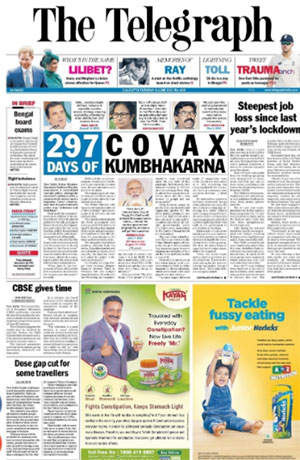


    This is The Telegraph, Kolkata, front page, June 8, 2021:

    “Prime Minister Narendra Modi on Monday announced a centralised vaccine policy, taking the corrective measure after a countrywide outcry and a Supreme Court observation that the government’s policy was “arbitrary and irrational”.

    https://epaper.telegraphindia.com/imageview_363137_163320780_4_71_08-06-2021_1_i_1_sf.html
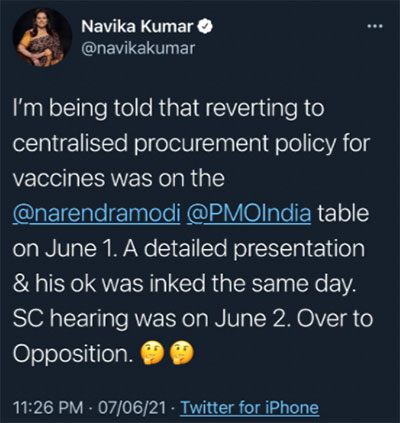


    Then there’s Navika Kumar of Times Now, in a tweet sent out at 11.26 pm on June 7, 2021, which she has since deleted. The tweet claimed: “I’m being told that reverting to centralised procurement policy for vaccines was on the @narendramodi @PMOIndia table on June 1. A detailed presentation & his ok was inked on the same day. SC hearing was on June 2. Over to the Opposition.”


    You can be kind and say she was misinformed. Or you can be real and know that Kumar is one of the leaders of the “pro-Modi at any cost” brigade. She is correct to the extent that the Supreme Court did call the Centre’s vaccine policy for 18 to 44 year olds “arbitrary and irrational” on June 2, 2021.


    However, it is also true that on May 31, 2021, while the hearing on the Centre’s vaccine policy was on in the Supreme Court, Justice Dy Chandrachud said to the Solicitor General of India Tushar Mehta, “I was reading the Constitution. Article 1 says that Bharat is a Union of States. When the Constitution says that, then we follow the federal rule. The Government of India has to procure the vaccines and distribute it. Individual states are left in a lurch.”


    There is no ambivalence here.


    Only the equivocation of Modi’s pets in media who cannot for the life of them question this government on anything. Even when the lives of so many Indians are at stake.


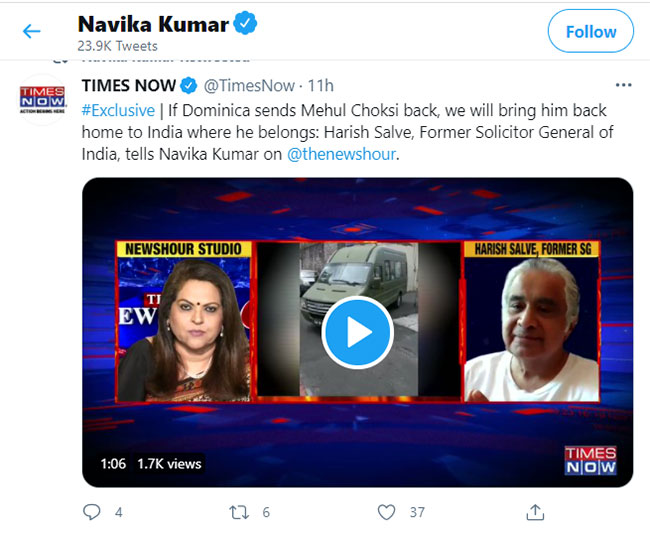
    Navika Kumar’s programme on the night of June 7, 2021 was about absconding jeweller Mehul Choksi and how the Modi government was going to get him back to India, rah-rah!


    Who can blame her?


    How about the venerable Hindu?


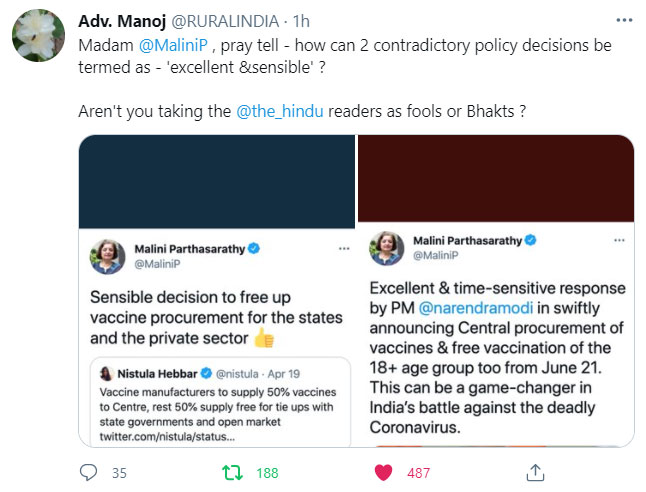
    Malini Parthasarathy, member of the owning family, sometime editor and currently Chairperson of the Hindu group, tweeted that she felt that the Prime Minister’s decision for a centralised vaccine policy was “excellent and time-sensitive”. As it turns out, the Twitter handle @RURALINDIA, revealed to us that Parthasarathy had also called the Centre’s decision to leave vaccine procurement to the states “sensible”.
    Meanwhile, while we understand that Parthasarathy believes that whatever the prime minister does is sensible even when his actions are directly contradictory, The Hindu published a fact check, which found that, to put it bluntly, Narendra Modi’s several claims on India’s vaccination history in his 5 pm address to the nation on June 7, 2021 was riddled with lies.


    “Prime Minister Narendra Modi’s speech on Friday presented a view of India’s vaccination history that is at odds with the facts. “If you look at the history of vaccinations in India, whether it was a vaccine for smallpox, hepatitis B or polio, you will see that India would have to wait decades for procuring vaccines from abroad. When vaccination programmes ended in other countries, it wouldn’t have even begun in our country,” claimed Mr. Modi in his address.


    “India, even before Independence, was among the countries that indigenously manufactured vaccines almost years within they were discovered, historical records suggest.


    “While there have been several challenges to the uptake of vaccines, their availability was the least of the problems.”

    https://www.thehindu.com/news/national/news-analysis-history-shows-india-did-not-lack-access-to-vaccines-as-claimed-by-pm-modi/article34758021.ece


    I have still to find a cogent explanation from India’s brave media on why Modi’s great policy – does anyone remember the Tika Utsav minus any tikas from a few weeks ago? – has to begin on June 21, 2021.


    I know the answer from reading between the lines. We do not have sufficient vaccines to start today.


    However, this analysis in The Wire lays bare several of the contradictions and lies in Modi’s new policy:

    https://thewire.in/government/modi-forced-to-change-tack-but-new-vaccine-policy-still-promotes-inequity-and-inefficiency


    That so many influential sections of India’s media will still allow Modi to get away with lies and prefer to roll in the muck, shows us the extent to which we have sunk. India’s current COVID19 figures may be not as bad as they were two weeks ago but we have still lost too many, and too many still struggle. As the Supreme Court, the Opposition, members of the public have all pointed out, the current mess is on the Centre and it has not gone away.


    This article from the BBC revisits the suffering in UP.

    https://www.bbc.com/news/av/world-asia-india-57383131


    The next few days will tell us which members of the Modi Bhakt Media are on their toes with the Modi Government’s vaccine procurement policies. Don’t hold your breath!


    Ranjona Banerji is a senior journalist and commentator. She writes on MxMIndia every Tuesday and Friday. Her views here are personal.


  • Ranjona Banerji: Indian journalism exposed by ‘one year’ coverage


    By Ranjona Banerji


    The great gaps in Indian journalism have been exposed by the coverage of one year of the Narendra Modi government at the Centre. And also, the great divide within.


    The media, print, television and digital (if only we could add radio to this list), have embarked on a first anniversary analysis of the government’s performance. This includes report cards, which former prime minister Manmohan Singh used to do with his Cabinet.


    However, who do you find to both praise and critique the government’s performance and appear to be objective? Commentators and analysts have been very sharply divided between pro-Modi and anti-Modi since the nation kicked into election mode in 2014. The supporters are usually either BJP members or open admirers. The anti-brigade are the usual suspects and somewhat larger in number because they include academics and activists.


    The only recourse therefore to “balanced” coverage is to ask members of the BJP itself and BJP-appointed members of organisations or pro-BJP corporate to assess the government’s performance. Obviously there is no balance there at all but perhaps there is no option.


    So that’s as far as columnists and analysts go. What about bog-standard newspaper coverage? Here we see, more or less, straight outright hero worship. The Times of India’s Mumbai edition gives the Modi government over 77 per cent on May 26, the anniversary of the swearing-in or anointment as TV anchors preferred to gush. Oddly a survey for May 16, the first anniversary of the election results, in the same newspaper, showed many Indians, especially those living in Mumbai, not quite so happy with the government’s performance. Perhaps something dramatic happened in the last 10 days that the rest of us are unaware of?


    The Economic Times outdid its sibling paper with its 20 or more days of coverage and analysis of the first year. The paper on May 26 led with the headline “Lage Raho Narendrabhai”, a salute to the successful Lage Raho Munnabhai movies about the life and times of a lovable petty gangster. Not sure if the editors saw the irony there or had not seen the movies… Judging by the gush and mush, I would reckon they thought they were just being super-clever.


    The Hindustan Times, Hindu, Telegraph, Indian Express and so on follow the model but with comparatively less hero worship… but am not sure that that’s saying a lot… TV is so idiotically breathlessly ra-ra that analysis is sometimes not possible. The websites have managed to be better sources of opinion than newspapers but is that because they depend not as much on advertising revenue?


    **


    Rather than speaking to so many “experts”, how would it have worked if newspaper reporters or maybe editors themselves, actually ventured out to the streets to speak to the general public. After all, they are the ones who vote and who wanted “achche din” after four years of stagnation. Had these people understood that the promises made were dismissed as “jumla” or that the promised good days were not supposed to arrive for the next 60 years?


    It might have been interesting to know how editors would spin the word on the street. Surveys are so much easier and so what if they’re not always right? You can always increase the margin of error to plus-minus 15 per cent, no?


    The foreign media, perhaps most interested in India because of Modi, has been more balanced in their assessment. This is actually a scathing indictment of the Indian media as a whole because it means that too many managements and editors put business interests ahead of truth… Hmm, what’s new, eh?


    **


    Meanwhile, some Hindi newspapers reported that chairs were broken by crowds angry with Modi’s one-year celebration speech in Mathura on Sunday. Did any English newspaper or TV channel report this?


    Ranjona Banerji is a senior journalist and commentator. She is also Consulting Editor, MxMIndia. The views expressed here are her own. She can be reached via Twitter at @ranjona


  • HT, Hindu & ABP groups get together to offer single-platform reach to advertisers

    By A Correspondent


    Six leading publications of the country – Hindustan Times, Hindustan, The Hindu, The Hindu Tamil, The Telegraph and Ananda Bazar Patrika have come together and formed the OneIndia group as a platform to facilitate reach to the largest print audience with a single advertisement.


    OneIndia, available by invitation to select display advertisers only, offers the unique benefit of a single-platform reach comparable and incremental to television, along with the many clear benefits of print, such as immediacy, impact, comprehension, credibility, and a clutter-free environment, to name a few.


    Talking about the key idea behind this alliance, Benoy Roychowdhury, Executive Director, HT Media Ltd., said, “The idea behind OneIndia is to provide an unduplicated reach like never before, along with a single-window service, in order to invite non-print and infrequent print advertisers to experience and profit from the significant benefits of print advertising.”


    Apart from the fact that print media readership is significantly more upmarket than television, several research studies globally have also demonstrated that print plus TV has driven more than 20 per cent incremental push-through in brand equity compared to TV alone. Further, some recent media multiplier research studies by leading international research agencies have demonstrated that print advertising in Asia-Pacific indexes three times more than TV on RoI, and five times more on brand impact.


  • Puja with The Telegraph in Bengal

    By Akash Raha

    Durga Puja, by far the biggest festival in West Bengal, is the event of the year. Festivities touch dizzy heights in Kolkata where more than 2,000 pujas take place in neighbourhoods, not counting pujas in apartment complexes/RWAs, which touch about 500.

    West Bengal’s top English daily The Telegraph is all set to activate three big initiatives during this period so as to enable its readers to make the most of this festive season. It also partners with clients to set up meaningful interaction opportunities with relevant target audiences and help create a special bond through the festive route.

    Speaking about the initiatives Mr Dhruba Mukherjee, Associate Vice President, The Telegraph said, “Durga Puja is the most important festival of Bengal and being Bengal’s favourite English daily, we wanted to do something for the city. Our activities, even though fun, take up a social cause and exemplify our responsibility towards the city.”


    True Spirit Puja

    More than 300 neighbourhood pujas participate in this initiative, the objective of which is to make the Puja experience safe, happy and meaningful. Organizing committees are judged on the basis of their display of civic consciousness, social contribution and safety measures. After a preliminary judging round a panel of celebrities visit the shortlisted pujas to rate them. Based on the ratings the pujas are accorded stars from five stars to one star. Thereafter one puja is given the model puja status.

    Each star rated puja is given a fund to undertake a development project in their locality. This initiative is now in its ninth year and is co-partnered from the beginning by Calcutta Electric Supply Corporation (CESC) of the RP Sanjiv Goenka Group. It is also supported by Kolkata Police, Kolkata Municipal Corporation, West Bengal Fires Services and NGO – The Bengal.  It is extensively promoted editorially in the pages of The Telegraph.

    Hand in Hand

    Here, The Telegraph ties up with 100 SEC A apartment complexes/RWAs, each with a minimum of 100 flats. Overall about 20,000 flats participate in this initiative. During the five days of festivities The Telegraph helps the societies to organize various cultural programmes and fun activities for residents, and also arranges for prizes. Some of the activities organized are antakshari, sit and draw, dhunuchi dance, recipe contest and so on. The Telegraph through this also creates an engagement opportunity for various other interested clients to interact with the target audience through the Hand in Hand pavilion it sets up within societies. This activity is in its seventh year and is the centre of puja celebrations for apartment blocks in Kolkata. The entire proceeding is amplified in a big way using the pages of The Telegraph as well as TV, radio and web. This year the event is being presented by Lewis Berger and associate partners are Bajaj Almond Hair Oil and Reliance 3G.

    Festival of Joy

    This initiative, in its second year, is modelled on the ‘True Spirit Puja’ concept and is executed only for apartment societies/RWAs. The idea is to promote civic, social and safety consciousness among residents of these societies. This in turn ensures that their cause of celebration does not become a cause of concern to the environment around. In its second year this is rapidly gaining ground and has already seen participation from about 50 apartment societies/RWAs this year. A panel of celebrity judges visits the shortlisted apartments and accords ratings. Each rated apartment is given a funding for a development project in their locality. The whole activation is supported editorially in The Telegraph to amplify the just cause it intends to promote. This year the event is being presented by the Eureka Forbes group.