Tag: Telecom Regulatory Authority of India

  • Broadcasters slam TRAI notification to limit ads

    By A Correspondent


    Broadcasters and advertisers have slammed Telecom Regulatory Authority of India (Trai) move to limit the duration of television advertisements to 12 minutes in an hour, and accused the regulator of exceeding its brief.


    A new notification issued by the regulator on Monday limited the amount of advertising on TV channels and disallowed any shortfall in a particular hour to be carried over. According to industry estimates, this could impact advertising revenues of broadcasters by 15-40 per cent.


    “Trai has no jurisdiction in the subject. Advertising is governed by the Cable and Satellite Act and the appropriate authority is the ministry of information and broadcasting,” said Uday Shankar, president of the Indian Broadcasting Foundation, and the chief executive officer of Star India. “The regulator is overstepping its brief,” he added.


    According to Mr Shankar, the low revenues from subscriptions give broadcasters no option but to rely on advertising inventory and revenues to survive.


    An Indian Broadcasting Foundation official said an earlier government guideline stipulated that Trai could issue an advisory with regard to advertising but not a notification.


    Sunil Lulla, managing director and chief executive officer of Times Television Network, which runs Times Now, ET Now and Movies Now channels, too criticised Trai’s decision. “This move is completely ridiculous. Self regulation is the best regulation,” he said.


    “This move will have an immediate impact because right now there is no other big source of revenue for broadcasters,” said Rohit Gupta, president of Multi Screen Media, the company which runs Sony Entertainment Television. The IBF will appeal against this new regulation, he added.


    Barun Das, chief executive officer of Zee News, questioned the timing of the regulation at a time when the entire broadcasting industry was going digital. “We have a limit mentioned in the Cable Act. If at all there is a need for regulating duration of advertising, it possibly could have waited some more time for the digitisation process to settle down.” he said.


    Mr Das said his channel had voluntarily cut its advertising inventory by 30per cent earlier this year. “We realise that too much advertising is a deterrent to viewership. We were not driven by regulations, rather we were driven by market forces,” he said.


    Mr Das said the viewers had choices not only of channels but also of media platforms. “I am not sure if advertising volume needs to be regulated. I would tend to believe that too much advertising would anyway drive away viewers,” he added.


    Sale of television rights have become an important source of income for sports bodies such as BCCI but the restriction on advertising will adversely impact the ability of broadcasters to recoup their investments, forcing them to scale down their bids.


    Source: The Economic Times
    Copyright © 2012, Bennett, Coleman & Co. Ltd. All Rights Reserved


  • Address consumer complaints within 8 hrs: TRAI

    By A Correspondent


    The Telecom Regulatory Authority of India (TRAI) issued the Regulations on the Quality of Service and Consumer Complaint Redressal Mechanism for the Digital Addressable Cable TV Systems (DAS) on May 14.


    Under the new order, every multi-system operator (MSO) or his linked local cable operator (LCO) will have to establish a complaint centre in his service area, for redressal of complaints and for addressing service requests of his consumers before providing the digital addressable cable TV services.


    Every complaint centre will be accessible to the consumers from 8am in the morning to midnight on all days of the week. The complaint centre will have facilities for the local language of the area in addition to Hindi and English. Every MSO or his linked LCO will deploy sufficient number of employees at his complaint centre to meet the Quality of Service (QoS) parameters, as may be specified by the Authority from time to time.


    The MSO or linked LCO will have to ensure that the complaints centre is accessible and has a toll-free number which will be widely publicized. In the new regulations, TRAI has also issued details of how an Interactive Voice Response System (IVRS) should function, and how consumers should be made aware of the existence of the centre.


    Every MSO or linked LCO will have to establish a web-based complaint monitoring system to enable the consumers to monitor the status of their complaints. Every MSO or his linked LCO will also have to designate a one or more nodal officers in every state in which it is providing its services. In case the consumer is not satisfied with the redressal of his complaints through Complaints Centre, he can approach the nodal officer of the operator.


    MSOs or their linked LCOs have to publish a consumer’s charter for DAS providing all necessary details with respect to the services being provided by them.


    Under the Quality of Service (QoS) Regulations, a standard application form will be devised giving all details to be used for providing services such as connection, disconnection, shifting and return of set top box (STB).


    The consumer will have to be given a prior notice of a minimum of 15 days for disconnection of services. Similarly, the consumer will have to give a prior notice of minimum 15 days for making a request for disconnection.


    No charges other than rentals for STB will be charged in case the connection is suspended on the request of the consumer for a period of minimum one month to maximum three months.


    Operators will publish a manual of practice and provide it to the consumer at the time of enrolment. The manual of practice, apart from Hindi and English, should be in the language of the state where the cable services are provided.


    Every MSO will offer cable TV services on both pre-paid and post-paid payment options to the subscriber and will be responsible for generation of bills for the subscribers. It will be open to the subscriber to choose either the pre-paid or post-paid option.


    Operators will have to offer three schemes for STBs to the consumers, and these are outright purchase, hire purchase and rental. Operators will have to provide a minimum warranty of one year for STBs acquired by the consumer under outright purchase scheme.


    The security deposit of the STBs has to be refunded within seven days of surrender of the STB by the consumer.


    All MSOs and cable TV operators will conduct public awareness campaign about the salient provisions of these regulations.


    Meanwhile, TRAI has issued amendments to the Interconnection Regulations issued on April 30 under which the MSOs have been barred from charging any placement fee from broadcasters.


    Giving in to a collective demand of broadcasters, the Telecom Regulatory Authority of India (TRAI) has barred Multi System Operators from charging a placement fee from channels in lieu of placing them in select slots.


    TRAI has issued amendments to the Interconnection Regulations which were earlier issued on April 30. The interconnection regulations are applicable to all digital addressable cable TV systems (DAS).


    As per the amendments, TRAI states, “Multi System Operators are not to demand any placement fee from broadcaster.” In a move to make the system more transparent, TRAI has specified, “Tthe Reference Interconnect Offer of a multi-system operator submitted to the Authority to contain the basis on which the carriage fee payable by the broadcaster has been determined.”


    TRAI also mandates every MSO to display in his Electronic Programme Guide, all the channels offered by him, in the same genre in which a particular channel has been indicated by the broadcaster and one channel shall appear in only one genre.


    Under the new regulations, broadcasters will also have to declare the genre of their channels which may be either News and Current Affairs or Infotainment or Sports or Kids or Music or Lifestyle or Movies or religious/Devotional pr General Entertainment (Hindi) or General Entertainment (English) or General Entertainment (regional language).


  • Nearly 10 lakh STBs ready for Kolkata

    By A Correspondent


    The Cable Television Networks (Regulation) Amendment Act, 2011 has made it mandatory for switch-over of the existing analogue Cable TV networks to Digital Addressable System (DAS) by December 2014, in a phased manner. In respect of four metros of Delhi, Mumbai, Kolkata and Chennai, the digital switch-over is to be completed by June 30.


    The ministry is very closely monitoring all the activities for the timely implementation and the quality of the Digital Cable TV service. During the high level review meetings by the Ministry, it was revealed that in the case of Kolkata, out of total requirement of about 35 lakhs STBs, over 5 lakhs STBs have already been installed, about 4 lakhs STBs are available in the stock which are being installed and the orders have already been issued for the balance requirements of STBs.


    Further it came to the notice that all the MSOs already have digital head ends and the existing channel capacity in each of the case is over 200, which is the mandatory requirement as per the Telecommunication (Broadcasting and Cable Services) Interconnection Regulation, 2012. The channel capacity is being augmented by the MSOs.


  • Digitization is going to be the biggest reform in broadcast sector: Ambika Soni

    By Shruti Pushkarna


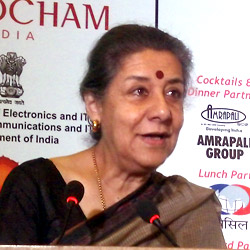
    High drama ensued at the Assocham event inNew Delhias local cable operators (LCOs) flagged black ribbons at the Minister for Information and Broadcasting, Mrs Ambika Soni. The Minister was attending the 6th Annual Summit on Entertainment and Media organized by Assocham, Focus 2012: Digitization for Inclusive Growth. As the theme suggests, one of the primary issues discussed at the event was Digitization of Cable television.


    The LCOs were protesting against the recent tariff order issued by the Telecom Regulatory Authority of India (TRAI), which they claim is an unfair order against all small operators. Following the heated arguments between cable operators present at the event venue and the Minister, one of the cable operators, Sandeep Mcgee who is based inEast Delhithreatened to commit suicide in front of the Minister. Mrs Soni, however, tried to pacify the operators’ fraternity and asked them to file a formal letter with all their grievances against the tariff order and the regulator. She also promised to address their concerns and, if need be, raise the same with the regulator.


    Addressing the concerns of broadcasters on the carriage fee mentioned in the same order, Mrs Soni said that the government will consult all stakeholders before taking a final call on the regulations decided by TRAI under which the Multi System Operators (MSOs) are allowed to charge a carriage fee from broadcasters.


    Earlier, in her inaugural address, the Minister emphasized the importance of digitization for the entire industry and all stakeholders: “Digitization is going to be the biggest reform in broadcast sector and enable operators to expand their revenue sources by providing more choice and variety to customers. Digitization is imperative to tabulate subscriber base and reduce carriage fee. Digitization will also help reduce all human error in the process.”


    Defending the tariff order issued by TRAI recently, she said that the government indulged in exhaustive consultations with all stakeholders on all issues including the carriage fee, and the main aim of the new regulations had been to benefit the consumer. Mrs Soni said: “The TRAI tariff order makes the viewer the most important beneficiary; the choice will be with the viewer.” As for the broadcasters, she said digitization would help reduce the dependence on TRPs and bring in transparency where every broadcaster would be in a position to identify exactly how many people are subscribing to the channel.


    On the issue of media regulation, Mrs Soni said: “Let’s not condemn self-regulation per se because even though self regulation is a slower way of correcting things, it is still a surer way as it involves converting minds and hearts in the process.” She added that in the whole race to growth, the provisions of the Cable Television Regulatory Act were overlooked and it was a fault in the functioning of the government that the act had been ignored.


    On the issue of Paid News, she said that while it was the worst phenomenon that existed, it’s not as easy to detect paid news. She was responding to scathing criticism of the media by the Chairman of Press Council of India, Justice Markandey Katju in his keynote address at the same event.


  • IBF welcomes Tariff Order, seeks clarity on Carriage

    By A Correspondent


    The Indian Broadcasting Foundation (IBF) has welcomed the initiatives taken by the I & B Ministry and TRAI in bringing about much needed reforms in the cable sector.


    The Tariff amendments and the new Interconnect regulations for Digital Addressable Cable brought about by the Telecom Regulatory Authority of India (TRAI) will inject necessary transparency across the value chain. With a slew of consumer friendly measures – namely choice of packages and introduction of Basic Service Tier, TRAI has ensured that all subscribers of varied socio economic background are duly taken care of and provided for. IBF also welcomes the mandate to enhance the channel carrying capacity to a minimum of 200 channels wef July 1, 2012 and 500 channels wef January 1, 2013.


    The new interconnect regulations have brought within its wake the much awaited specifications for digital addressability while at the same time laying down the eligibility criteria for availing signals. The reporting requirements will help the government in plugging leakages while the provisions on disconnection of signals will ensure that all stakeholders are aware of their rights and obligations.


    Overall the Tariff Order and the Interconnect Regulations read with the amended Cable TV Act and Rules are steps in the right direction and will help the country to make the digital transition.


    However, a big area of concern for Broadcasters is Carriage Fee. The Broadcasters have taken up this issue in various discussions with the TRAI and the Government in the past. Carriage Fee has crippled various broadcasters, especially the smaller sized companies, and it has restricted a broadcaster’s ability to invest in content and other activities of a channel. Therefore, there is an urgent need to revisit this issue and IBF will seek clarity on this matter from TRAI.


    India is on the threshold of a digital makeover and IBF trusts that this will, over a period of time, make way for more freedom to stakeholders as digitalization acquires critical mass and the country gains more confidence in bridging the digital divide.


  • 58 Days to D-Day | Analysis: TRAI’s Tariff Order will make channels bleed more

    By A Correspondent


    In another major blow for TV channels, the Telecom Regulatory Authority of India’s (Trai) recent tariff order for digitization has a loophole that allows distributors to surreptitiously charge ransom-like placement fees from broadcasters. While this would be true for all tiers, it would be especially compounded in the Basic Service Tier (BST) where around 80 private free-to-air (FTA) channels are to be offered at Rs100 a month.


    This makes for a crippling double whammy for TV channels and makes the “must carry” proviso meaningless as Trai has also legitimized the usurious carriage fee racket which has turned multiple system operators(MSOs) and cable companies into the most profitable part of the Indian TV industry, even as it has bled nine-tenths of the TV channels into sickness.


    Over and above their other costs, TV channels annually pay over Rs3,500 crore as carriage fees alone, but collectively receive around Rs4,000 crore only of the approximately Rs20,000 crore paid by India’s viewers to cable companies and distributors.


    Trai’s own report had said that there was evidence of tax evasion in the cable industry while independent industry estimates have routinely put under-declaration by this cash-rich industry at a whopping four-fifths of its subscriber base – all of which allows for thousands of crores to be denied to the exchequer every year.


    According to an estimate, the government had lost around Rs5,950 crore in 2006-2011 in service tax alone due to under-declaration even as it posited the income tax evasion during this period at Rs17,413 crore, besides the loss of entertainment tax by states.


    In this situation, industry sources said, Trai’s move to force TV channels to pay carriage fees to distributors, ostensibly to enable them digitize their systems, was totally unacceptable. “There is no justification for robbing the already impoverished TV channels to pay the rich distributors, as they have had a favourable business model for years, and in any case, would reap the rewards of digitisation far more than any other segment of the TV business,” said an industry source.


    Adding that there was no justification for making the broadcasters pay for upgrading the infrastructure of the MSOs, they pointed out that upgradation was a one-time investment, but the carriage fees would continue to be an annual recurrence for broadcasters who, in any event, could not be suddenly made the medium to fund distributors.


    Broadcasters are especially aghast by this move as the prices of their channels are regulated and have been frozen for years, even as distribution costs have been allowed to rise unchecked in the garb of scarcity of bandwidth – problems which were supposed to have been addressed by digitization.


    Industry sources told ET that while they welcomed the Rs100 BST for 100 channels as being in consumer interest, there was a hidden minefield in the Trai tariff order that had come as a further shock. They said that the new order had no rules banning placement fees for channels in any tier, including the BST, and hence, this would again allow cable companies and distributors to fleece TV channels by demanding huge sums of money.


    Distributors already demand placement fee for placing the channel in a particular slot – by a process known as Electronic Programme Guide management. However, they had hoped digitization to end this malpractice.


    This problem is especially compounded, with the BST having only a restricted number of private free-to-air channels in its basket of 100 channels, compared to the large number of channels in the market place. As per the rule, at least five channels are to be carried in each of the following genres: movie, general entertainment, children’s content, news and current affairs and sports. This would allow distributors to cherry pick the minimum five channels in each genre and demand a huge placement fee to carry them since there are many more channels in each genre, language or market. In addition to carriage fees, this would be a crippling double whammy for broadcasters, sources specified.


    The solution, sources said, would be to increase the numbers of channels and also ensure an equitable, but not equal, split between genres, since there is a larger proportion of news channels to, say, sports channels.


    They also said that there was another burden in store for TV channels that Trai did not appear to have foreseen: Since every broadcaster would like to place its channel in the BST, the distributor could potentially subvert the letter and spirit of the Trai digitization order by fixing the carriage fee of the BST much higher than the carriage fee of its platform.

    CARRIAGE FEE

    Earlier, the News Broadcasters’ Association had slammed the Trai move to legitimize the ransom-like carriage fees charged by distributors, which have now been made a mandatory payment by all the broadcasters to the MSOs. Under this order, the MSO will not be bound to carry the channel of a broadcaster unless it pays carriage fees – which means that the broadcaster would have to pay carriage fees to the MSO to be carried on its platform – which would be decided solely by the MSO and would differ from MSO to MSO even in the same geography.


    Industry sources said legitimizing carriage fees could sound the death knell for small broadcasters, particularly the regional channels. The Trai move also goes against the concerns showed by the government for small regional channels. Information and broadcasting minister Ambika Soni, in a Parliamentary motion to discuss the Cable Television Networks (Regulation) Amendment Bill, 2011, had said: “This process of digitalization, I feel, would have a major impact on regional channels. They do not get on to national carriages. They cannot pay the high (carriage) fee. There are small channels catering to different states…”


    MUST CARRY

    However, the nub of the matter was that the evil of carriage fee would be abolished only if the capacity constraint was adequately addressed by mandating MSOs to increase their capacity to 999 channels instead of just 500 channels.


    India currently has around 800 registered channels available in the market and more are lined up for approval in the information and broadcasting ministry.


    Despite this, surprisingly, Trai has put the minimum number of channel at 200 for small distributors and 500 channels for large distributors, which frustrates the purpose of “must carry” as outlined in the regulation. “Assuming for a moment that every broadcaster is willing to pay the carriage fee declared by the MSO in its RIO, how is the MSO going to carry all the channels on its platform if it has no capacity to carry all the channels,” sources asked.


    They feared that the end result would be increased litigation between the broadcasters and distributors, thus potentially adversely affecting the smooth rollout of digitization. They said the situation can be salvaged only if Trai increases the numbers of “must carry” channels to atleast 500 channels by June 30 and 999 channels by January 1, 2013.


    Industry sources also pointed to other major systemic issues which the Trai order had failed to address.


    First, MSOs have been given the unfettered rights to decide the maximum retail price of the channels they carry- a move that would adversely affect both consumers and broadcasters as the MRP of the same channel could be different at the platform of every MSO. This would not only create confusion among the consumers, but would also increase the number of disputes apart from potentially allowing distribution platforms having their own channels a distinct advantage to manipulate for their own benefit. Sources said the solution to the peculiar situation was in allowing the broadcaster to have a say in fixing the MRP as is the right of manufacturers in all other sectors.


    Second, the freeze on the price of a TV channel – which had been introduced as a temporary measure – had not been lifted even after eight years. This has seriously affected broadcasters as many have not been able to recover their basic cost of operation. Given that there are more than 800 channels, with more in the pipeline, market forces should be allowed to play out.


    Source: The Economic Times
    Copyright © 2012, Bennett, Coleman & Co. Ltd. All Rights Reserved
     

  • [60 Days to D-Day] All stakeholders need to work together: Neeraj Sanan

    The Telecom Regulatory Authority of India (TRAI) issued new rules refurbishing the regulatory structure of the broadcasting, cable and DTH industry ahead of the digitization switch over in four metros, Delhi, Mumbai, Kolkata and Chennai from July 1. The order deals with issues such as channel availability, channel pricing, carriage fee and revenue sharing.

     

    Digitization is being seen as the game changer for the Indian TV industry, expected to bring a sea change for viewers, broadcasters and cable operators. The broadcasting industry is expected to see a growth in subscription revenue post digitization, as opposed to the present model where they depend largely on advertising revenue.


    As per the new guidelines, ‘The Broadcaster would enjoy ‘must carry’ provision from 1.1.2013 or 1.4.2013 as the case may be, for Hindi, English and channels in the regional language of the concerned area.’  In the order, TRAI has also addressed the much debated issue of carriage fee. The order states, “Keeping in view the fact that substantial investment for implementation of Digital Addressable Cable TV Systems is made by the MSO and the cost involved in carriage of channels, the Authority has decided that every MSO may fix the Carriage Fee. However, it should be published in the Reference Interconnect Offer and applied in a uniform, non-discriminatory and transparent manner. The Carriage Fee cannot be revised upward for a minimum of 2 years. The Authority would intervene in case it is felt that the Carriage Fee is unreasonable.”


    The regulatory has also prescribed the MSOs to increase their channel carrying capacity, stating that every MSO should have a minimum capacity to carry 200 channels by July 1, 2012.


    MxMIndia’s Shruti Pushkarna spoke to Mr Neeraj Sanan, EVP- Marketing and Distribution, MCCS to get his response on the Tariff Order and Interconnection Regulations for the Digital Addressable Cable TV Systems issued by TRAI.


    What’s your first response to the Tariff Order? Specifically the MCCS position?

    It is a reaffirmation of the government’s stated position and something that TRAI has been working towards for a long time.


    The TRAI observes that the Order will help profitability of channels. But carriage fee exists. Do you think your bottomline will be impacted in a positive way with this?

    The TRAI’s order will help all stakeholders move to a position of working in a structured manner. A well-run business can hope to get its deserved profit.


    Do you see the implementation happening in the four metros before July 1?

    I understand that a lot of intelligent people in well-run MSO and LCO organizations are working round the clock to make it happen. A key factor here will be for the government to continue to do what it has been saying. We shall all have to brace ourselves to a large surge in operational logistics at the last minute, but yes all this is surmountable.


    What are the marketing initiatives you are undertaking to ensure that you retain viewers?

    This is a challenge more for a distributor.


    Do you think the government is doing enough to promote the switch to digitization and explain the benefits to consumers?

    There is always something better we could do, but yes, government has been consistent in it’s thought. Now it is for all stakeholders, including all state governments to realize the prudence of digitization and work together to make it happen.


    Are there any areas of worry in the run-up to digitization (given that we have just 60 days to go)?

    No constructive business happens without risk and yes there are a lot of things that could go awry but if all players remain aligned, this is achievable. We should all realize that it is history being written everyday for distribution and we need to carefully tread this path.


  • [60 Days to D-Day] Digitization good for industry: Sahil Gupta, PWC

    The Telecom Regulatory Authority of India (TRAI) issued the Tariff Order and Interconnection Regulations for the Digital Addressable Cable TV Systems on April 30.

     

    Aimed at providing the viewers with a better viewing experience and maximum choice, digitization is being seen as the biggest change broadcast and cable industry in the country is set to witness. Television viewers will get to choose a minimum of hundred Free to Air (FTA) channels at a maximum retail price of Rs100, as per new tariff rules for Cable TV announced by TRAI.


    The order states: “The basic purpose of digitization is to ensure ample choice to the consumer as well as to enable him to budget his subscription according to his paying capacity. Accordingly, the Authority has mandated MSOs to carry a minimum of 500 channels from January 1, 2013. However, keeping in view that the smaller MSOs having less than 25000 subscribers may need some additional time for building the capacity, they have been given time up to April 1, 2013. Besides, to ensure that the consumer is not adversely affected, the Authority has prescribed that every MSO should have a minimum capacity to carry 200 channels from July 1.”


    In the new guidelines issues, TRAI has also addressed issues pertaining to revenue sharing between MSOs and LCOs, carriage fee paid by broadcasters, channel pricing and so on.


    Mr Sahil Gupta, Senior Manager, Tax and Regulatory Services, PwCIndia shared his analysis of the recent order with MxMIndia’s Shruti Pushkarna and how he sees digitization as a win-win for all.


    What is your view on TRAI’s Tariff Order? 

    It’s a pro-consumer directive. Consumers can now pay for what they want to see, unlike in today’s time when they purchase a bouquet which has unwanted channels as well. Hence a la carte selection works more cost-efficient for consumers.


    So do you see digitization as a win-win for all?

    Digitization per se is good for the industry – consumers get better quality reception, broadcasters can know their exact consumer base, which will help them realise full value from MSOscable operators (which gets under-reported in current times based on what subscription base the intermediaries disclose to broadcasters). Moreover, it helps in bringing addressability in the system.


    Do you think the government is serious about the July 1 deadline?

    The government is taking a lot of initiatives to push digitization – it has a stakeholders’ meeting every week or two weeks and is helping stakeholders migrate to the new system. They are thus doing their bit for helping meet the deadline of July 1.


    But on the ground we hear that there is much to be achieved?

    The infrastructure is what is taking time. The digital/upgraded set top boxes need to be procured and be ready for installation at the consumer’s end. Some MSOs/cable operators are looking at funding mechanisms for meeting these procurement needs, while others are working towards building a right procurement strategy for the same. All in all, the industry is gearing up for it and all stakeholders doing their bit.


    Your view on the guidelines for carriage fees in the Order?

    Carriage fee is what MSOs charge broadcasters for carrying their channels to viewers. Some element of arbitrariness gets reduced from this Order as it needs to be uniform and non-discriminatory across all broadcasters. The TRAI will step in if it’s unreasonable and this will help.


    And on pricing of channels?

    The limits on pricing mentioned in the order is aimed mainly at ensuring that channels, especially popular ones, are not priced high.


    There’s also a mention on the revenue sharing between MSOs and cable operators…

    There seems to have been certain disputes between MSOs and cable operators in regard to sharing of distribution revenues. Prescribing the revenue sharing formula, in absence of an agreement between them, will help and bring in transparency…


  • [60 Days to D-Day] Digitization in 4 metros will not happen by July 1: JS Kohli

    Late Monday night, Telecom Regulatory Authority of India (TRAI) announced the new tariff structure for digital cable TV services. Under the new rules, all cable operators will have to mandatorily offer a Basic Service Tier (BST) to viewers which would consist of 100 free to air channels, including 18 mandatory Doordarshan channels, as well as the Lok Sabha channel. The tariff order states that apart from the mandatory channels in the BST, cable operators and Multi System Operators (MSOs) will have to provide customers a minimum of five channels of different genres.
     

    The authority also stated that MSOs will have to increase their channel carrying capacity. TRAI stated: “The Authority has mandated MSOs to carry a minimum of 500 channels from January 1, 2013. However, keeping in view that smaller MSOs having less than 25,000 subscribers may need some additional time for building capacity, they have been given time up to April 1, 2013.” The TRAI has prescribed that every MSO should have a minimum capacity to carry 200 channels by July 1.


    TRAI has also established new guidelines for revenue sharing between Multi System Operators (MSOs) and Local Cable Operators (LCOs).


    MxMIndia’s Shruti Pushkarna spoke to Mr Jagjit Singh Kohli, a veteran of the cable industry and CEO of cable distribution firm Digicable, on his reading of the latest order issued by TRAI and if he thinks the sunset date of June 30 is still achievable.


    What’s your first response to the Tariff Order?

    Well, the order is on expected lines, no big surprises there. Given the circumstances, I am happy with it, in the sense that we know the regulatory has been operating under tremendous pressure from various stakeholders, so given that situation, I am actually happy with the order.


    TRAI has observed that the Order will help profitability of channels. But carriage fee exists. Do you think the bottom line will be impacted for both broadcasters and the cable trade?

    The channel capacity is increasing to 500 channels, so automatically the pressure on carriage will reduce. So, although the carriage fee remains but the channel capacity itself is increasing so much that the price per channel will come down.


    Given the status as of today, do you see the implementation happening in the four metros before July 1?

    Now, that I don’t think will happen. We will need a postponement of at least three to four months. The tariff order has just come; there are so many other issues such as DAS licenses being not issued till date. To meet the deadline the industry needs to deploy atleast 150,000 boxes every day, only then will we be able to meet that deadline, and that’s impossible.


    What about the availability of set-top boxes?

    Even that is an issue. But even if set top boxes were to be made available, it would be very difficult to meet the deadline.


    Do you think the government is doing enough to promote the switch to digitization and explain the benefits to consumers?

    Yes, you can’t blame them on this. They have been quite aggressive on the timelines and in their campaigns.


    Are there any areas of worry in the run-up to digitization (given that we have just 60 days to go)?

    The only area of worry is that we will need some more time to meet the deadline, otherwise everything is fine.


    Photograph: Fotocorp


  • TRAI issues tariff order for cable TV

    By A Correspondent


    The Telecom Regulatory Authority of India issued the Tariff Order and Interconnection Regulations for the Digital Addressable Cable TV Systems late yesterday.


    While the Tariff Order has been issued as an amendment to the existing Tariff Order for addressable systems, the Interconnection Regulation is comprehensive one for the Digital Addressable Cable TV Systems.


    As per the communiqué, here are the salient features:


    1. All channels (pay and free-to air) to be offered on a-la-carte basis to subscribers.


    2. There will be a Basic Service Tier (BST) consisting of a minimum of 100 free-to air (FTA) channels comprising at least 5 channels of each genre namely news and current affairs, infotainment, sports, kids, music, lifestyle, movies and general entertainment in Hindi, English and regional language of the concerned region. 18 channels of Public Broadcaster and Lok Sabha channel will also form the part of the BST. While Multi-system Operator (MSO) has to offer the Basic Service Tier, it is not obligatory for subscriber to subscribe to the BST. Instead subscriber can form his own package of a maximum of 100 FTA channels.

    In either case the MSO cannot charge the subscriber more than Rs100 per month.


    3. It shall be open to the subscriber to subscribe to the BST or one or more FTA channels or one or more Pay channels or bouquets offered by MSO or any combination of these.


    4. In case subscriber chooses Pay channel(s) with or without FTA channel(s) the MSO can fix a minimum monthly subscription not exceeding Rs150. If the total value of the channels/ bouquets opted by the subscriber exceeds Rs150 then actual subscription charges has to be paid.


    5. The basic purpose of digitisation is to ensure ample choice to the consumer as well as to enable him to budget his subscription according to his paying capacity. Accordingly, the Authority has mandated MSOs to carry a minimum of 500 channels from 1.1.2013. However, keeping in view that the smaller MSOs having less than 25000 subscribers may need some additional time for building the capacity, they have been given time up to 1.4.2013. Besides, to ensure that the consumer is not adversely affected, the Authority has prescribed that every MSO should have a minimum capacity to carry 200 channels from July 1, 2012. Authority expects that all the MSOs operating in areas of Phase-II onwards to take suitable measures to enhance the channel carrying capacity to 500 channels.


    6. Only those MSOs that have the requisite capacity, as mentioned above, can invoke ‘must provide’ clause. The broadcasters shall not provide their channels to MSOs who have channel carrying capacity of less than 200 channels immediately and less than 500 channels from 1.1.2013 or 1.4.2013 in case of smaller MSOs.


    7. The Broadcaster would enjoy ‘must carry’ provision from 1.1.2013 or 1.4.2013 as the case may be, for Hindi, English and channels in the regional language of the concerned area.


    8. The provision relating to amount charged by broadcaster to MSO remains unchanged. They can charge a maximum of 42 per cent of the rate, they charge in the non-addressable systems.


    9. The Authority has addressed the issue relating to the Carriage Fee. Keeping in view the fact that substantial investment for implementation of Digital Addressable Cable TV Systems is made by the MSO and the cost involved in carriage of channels, the Authority has decided that every MSO may fix the Carriage Fee. However, it should be published in the Reference Interconnect Offer and applied in a uniform, non-discriminatory and transparent manner. The Carriage Fee cannot be revised upward for a minimum of 2 years. The Authority would intervene in case it is felt that the Carriage Fee is unreasonable.


    10. The MSOs can fix the retail tariff and also package and price offerings. However, the sum of the a-la-carte rates of channels, forming part of a bouquet, shall not exceed 1.5 times the rate of the bouquet. Further, the a-la-carte rate of any channel shall not exceed 3 times the average channel rate of the bouquet.


    11. The July 2010 Tariff Order provides that the revenue share between the MSO and LCO shall be based on mutual negotiations. The Authority has now prescribed that in case the mutual negotiations fail, the revenue share shall be in the ratio of 55:45 (MSO: LCO) for BST or FTA channels. The revenue share for Pay channels or bouquet of Pay channels with or without FTA channels shall be in the ratio of 65:35 (MSO: LCO).


    12. Implementation of Digital Addressable Cable TV Systems will lead to better choice to consumers, variety and quality of content, adequate revenue to stakeholders and healthy environment for the industry in addition to bringing in transparency in the business transactions and subscriber base. It would also ensure that the Government receives the due revenue.


    Details of the Interconnection Regulations and Tariff Order are available on TRAI website: www.trai.gov.in.


  • TRAI invites views on ads policy for broadcasters

    By A Correspondent


    It was bound to happen, only its timing – soon after the not-very-exciting Budget and the uncertainties thrown up by digitization staring in its face – could’ve been unfriendlier. On Day 3 of FICCI-Frames, Big brother Telecom Regulatory Authority of India (TRAI) released a consultation paper titled “Issues Related to Advertisements in TV Channels”.


    First some background, in TRAI’s words: “The advertisement revenue has been a substantial portion of the overall television industry revenues. Perhaps, this has led to the tendency of pushing more and more advertisements in the television programmes in both pay and FTA channels. The increasing duration and distracting formats of advertisements has, however, adversely affected the consumers’ viewing experience. This has been reflected in numerous consumer complaints and opinions being expressed at various fora.”


    The TRAI is hence reviewing the existing regulations on duration of ads and how they should be presented given complaints that these are not being followed. Here goes:


    1. The limits for the duration of the advertisements shall be regulated on a clock hour basis i.e. the prescribed limits shall be enforced on clock hour basis.

    2. No FTA channel shall carry advertisements exceeding 12 minutes in a clock hour. For pay channels, this limit shall be 6 minutes.

    3. The 12 minutes of advertisements will not be in more than 4 sessions in one hour. In other words, there will be continuous airing of the TV show for at least 12 minutes each. Not more than three advertisement breaks shall be allowed during telecast of a movie with the minimum gap of 30 minutes between consecutive advertisement breaks.

    4. In case of sporting events being telecast live, the advertisements shall only be carried during the interruptions in the sporting action i.e. half time in football or hockey match, lunch/ drinks break in cricket matches, game/set change in case of lawn tennis and so on.

    5. There shall only be full screen advertisements. Part screen advertisements will not be permitted. Drop down advertisements will also not be permitted.

    6. In so far as News and Current Affairs channels are concerned, they are allowed to run not more than two scrolls at the bottom of the screen and occupying not more than 10 per cent of the screen space for carrying non-commercial scrolls, tickers etc.

    7. The audio level of the advertisements shall not be higher than the audio level of the programme.


    The text of the Consultation Paper is available on TRAI’s website (http://www.trai.gov.in/WriteReadData/trai/upload/ConsultationPapers/289/ cp_aproved_Authority.pdf). Written comments on the issues raised in the Paper are invited from the stakeholders by March 27, 2012, and counter-comments by April 2.


  • Digital, growth mantras to drive agenda


    By A Correspondent


    Asia’s largest convention in the business of entertainment, FICCI Frames 2012, will be held at The Renaissance, Powai in Mumbai from March 14 to 16. In its 13th year, Frames is a three-day global convention covering the entire gamut of media and entertainment ranging from films to broadcast, which includes television and radio, to digital entertainment, animation, gaming and visual effects.


    The Summitwill be inaugurated by Government of India’s Information & Broadcasting Secretary, Mr Uday Kumar Varma. Senator Chris Dodd, Chairman, Motion Picture Association of America will deliver the keynote address at the inaugural session. Japanis the partner country at FICCI Frames 2012 and will be present with a high-powered delegation comprising key stakeholders from the Japanese media and entertainment industry.


    Frames 2012 will present opportunities for business networking, lobbying, and creative and financial collaboration and partnerships. There will also be a series of workshops and master-classes that will be conducted by venerated global gurus who will be busy highlighting the way forward to the assembled delegates. Nearly 2,000 Indian and 800 foreign delegates are expected to attend the event.


    The Who’s Who of the Indian media and entertainment industry will join hands with the global industry leaders and experts to discuss and debate and to announce new initiatives at FICCI Frames 2012. Mark Hollinger, CEO, Discovery, Carolyn Everson, VP-Global Marketing Solutions, Facebook, Cameron Bailey, Co-Director Toronto International Film Festival, Bruce Beresford, Director of Oscar-winning movie Driving Miss Daisy, Silas Hickey, Regional Creative Director for Animation at Cartoon Network, Max Howard, Global Animation Consultant and Lecturer on Producing Independent Animated Feature Films for the International Markets, Oscar-winner Harvey Lowry, Hollywood’s Special Effects Guru, and John Bashford, Vice Principal, LAMDA (The London Academy of Music & Dramatic Arts) are some of the globally well-known names who will be delivering keynote addresses, conducting workshops and master classes, and joining the panel discussions in various sessions at Frames.


    Other eminent speakers from the world of television, radio and print that would be present include television czarina Ekta Kapoor, Barkha Dutt and Vikram Chandra of NDTV, Sunil Lulla of Times TV, and Puneet Goenka of ZEEL. Print will be represented by Shekhar Gupta, Editor-in-Chief of the Indian Express Group and T.N. Ninan, Editor of Business Standard.


    Bollywood too would be adequately represented through eminent faces such as Yash Chopra, Karan Johar, Vidya Balan, Kamal Haasan, Imtiaz Ali, Anurag Kashyap, Farah Khan and Zoya Akhtar.


    The theme of this year’s event is ‘Embracing the Digital World’. Dr J S Sarma, Chairman, Telecom Regulatory Authority of India (TRAI) and Mr Uday K Varma, Secretary, Ministry of Information & Broadcasting, will identify and address immediate areas for successful implementation of the digital switchover and also on what’s next in the regulatory and market framework to enable and sustain the transition.


    The move to embrace digitization in Cable and Satellite TV services has become imperative as such services have grown exponentially inIndiain the last 17 years. A separate session at FICCI Frames 2012 will deliberate on ways to maximize the power of digital distribution. Industry leaders will share their experiences with Frames delegates, their perspectives on how funding challenges have been overcome in other jurisdictions and the takeaways forIndia. The panelists include Vivek Couto, Founder, Media Partners Asia; Anshuman Mishra, MD, Turner International India; Vikram Chandra, CEO, NDTV; Jagi Mangat Panda, CEO, Ortel; Prof Jonathan Askin, Professor of Law, Brooklyn School of Law, Former Senior Legal Advisor, FCC; Anita Wallgren, US Department of Commerce.


    The FICCI-KPMG study on Indian Media & Entertainment for 2012 will also be released on the occasion. Strong growth in tier 2 cities, the continued march of regional media and the rapidly expanding new media business helped the media and entertainment industry log a 12 per cent increase in revenues to Rs729 billion in a troublesome 2011, according to the report. Overall, the industry is expected to grow at a compounded annual growth rate (CAGR) of 15 per cent to Rs.1,457 billion by 2015.


    Further details on the event will be available at: http://ficci-frames.com/