Tag: Tata Global Beverages

  • Tetley unveils new campaign featuring Sourav Ganguly

    By A Correspondent


    Featuring the former captain of the Indian cricket team, Tata Global Beverages has introduced the all-new Tetley Super Greenwith its latest light-hearted ad film. The campaign highlights the super human expectations each of us face every day.With this campaign, Tetley Super Green introduces vitamin enhanced green teas for the first time in India.The Tetley Super Green range consists of Tetley Super Green Boost – a combination of lime and mint green tea with vitamin B6 to help reduce tiredness and fatigue and Tetley Super Green Immune – which is a combination of citrus and honey green tea with Vitamin C, to help support the immune system.


    After a series of ad campaigns, this new campaign from Tata Global Beverages highlights the product’s USP of being a super green tea in a creative manner. The film truly brings alive the positioning of Tetley Super Green as the superhero of green teas. It was backed by the insight that even real, everyday people, are constantly faced with super human expectations, and need a little extra from the products they consume to live up to them.


    The ad opens with a woman asking Ganguly’s wife why she needed Tetley Super Green. To which she replies that people still treat her husband like the ‘Prince of Kolkata’, while the camera pans to Sourav Ganguly. The film then continues to display a series of situations where Ganguly is still expected to ‘be the person he once was’. The film ends with Ganguly sipping Tetley Super Green while the voiceover reiterates that a person with super human expectations requires a super green tea.


    Speaking about his association with Tetley Super Green, Sourav Ganguly, Brand Ambassador – Tetley says, “I feel extremely honored to be associated with an international brand like Tetley that works tirelessly to give their consumers the best products possible.  Tetley Super Green tea, as the brand name suggests, truly believes that ordinary people are capable of doing super things. Tetley Super Green Boost and Immune contain Vitamin B6 and Vitamin C, whichenhance the functionality of green tea to help us deliver on Superhuman expectations every day. “


    Remarking on the campaign, Rishi Chadha, Head – Tea Marketing, Tata Global Beverages says, “At Tata Global Beverages, we are driven by consumer centricity and constant innovation, to cater to the evolving needs of our consumers. Our constant endeavour is to leverage our strong global expertise and learnings to introduce differentiated and value-added offerings to delight our consumers. We pioneered the green tea wave in India and are now introducing a first-of-its-kind vitamin enhanced super green tea as the latest addition to our green tea portfolio. We believe that Tetley Super Green tea is a compelling reason for new consumers to come into the green tea category.  Our new brand film explains this beautifully in a light-hearted and relatable manner. Sourav Ganguly has done a fantastic job of capturing the essence of ‘Everyday Super Humans’ and we are very excited to have him as the new face of Tetley in India.”


    Commenting on the campaign, Shriram Iyer, National Creative Director, Mullen Lintas says, “Super Green as a product is about upping health benefits of Green Tea. To bring this alive, the planning and account team on the brand in Bangalore arrived at the insight that sports celebs are faced with a unique challenge. People always expect from them the same superhuman feat that they once performed on the field, no matter what life stage they are in now. This ‘superhuman expectation’ became our creative plank to deliver the message. The script crafted by Santosh Ramakrishnan and directed by Abhinav Pratiman lands the idea gracefully. Sourav Ganguly hits it out of the park. Personally, I think this is Sourav Ganguly’s best onscreen performance, off the field!”


  • Sanchayeeta Verma is Ad Club Bangalore President

    By A Correspondent


    Sanchayeeta Verma

    The Advertising Club, Bangalore has elected Sanchayeeta Verma, Managing Partner, Maxus South India & South Asia, as President of the Club. Verma has taken over the mantle from Malavika Harita of Saatchi & Saatchi Focus Network.


    Speaking about her plans for the Club, Verma said, “Bengaluru has a perfect balance of seasoned thought-leaders with an increasing number of dynamic, young and fresh talent which I would like to capitalise through our new initiatives at the club. We are gearing up for our biggest annual award night – The Big Bang awards which recognizes the creative excellence in media and communications. We also plan to introduce events which will go beyond work into play and collaborate all our members. Some of the initiatives in the pipeline are incentivizing Ad Club members to bring in some leading rock bands for members-only nights and a gaming event to bring out the gamer in every one of us.”


    Commenting on the appointment, Arvind Kumar, Executive Director, Ad Club Bangalore said: “The Ad Club will benefit from the vast experience and exposure Sanchayeeta has in her role as Managing Partner of South India and South Asia for Maxus Group. Her enthusiasm and energy to increase the Ad Club activities and enhance its image and make it more contemporary, will help in making Bangalore Ad Club into a very active body in South.”


    The Ad Club Bangalore holds a variety of events right from Sports tournaments to Advertising and Creative Quiz, panel discussions amongst others to engage a larger audience at the Club.


    Sonia Serrao from Tata Global Beverages, Akshar Peerbhoy of Maa Communications and Nidhi Lall of Saatchi Focus Network are the new additions to the Managing Committee of the Club, according to a communiqué.


  • Maxus leans on ‘Narinku Dhanyabad’ for Tata Tea Premium

    By A Correspondent


    Maxus ESP, the entertainment, sports and content arm of global communications consultancy firm Maxus, has weaved a thought-provoking campaign for the women called ‘Narinku Dhanyabad’ for Tata Tea Premium in the Odisha market. The campaign which means “Thank the Women” is a call to the men of Odisha to thank the women and remember their silent contribution in shaping their lives.


    Tata Tea Premium, a market leader in Odisha, wanted to stay locally relevant to their consumer, the women and build conversations keeping them at the heart of it. Their Odiya TVC is based on a very powerful insight from the market. A research study showed that a patriarchal setup in Odisha made women feel supressed and be taken for granted.


    Using content as a route, the brand wanted to create conversations about local reality. They had to engage in multiple, continuous conversations with the men of Odisha. This gave birth to the “Narinku Dhanyabad” campaign. The campaign is targeted to the men of Odisha to awaken them and get them to acknowledge the importance of women in their lives.


    Maxus collaborated with Odiya TV network Tarang as the broadcast partner. The faces of the campaign were a few popular stars of Odiya films including Anubhav Mohanty, actor Mihir Das and Buddhaditya Mohanty. They came together to lead the change in Odiya society. They urged men to thank the women in their lives respectively for their immense contribution. The men were also targetted through campaign-centric content on OTV, Odisha’s most watched news channel.


    The 3 stars through their individual vignettes urged the men of Odisha to give a missed call to thank that important woman in their lives. Once the men shared the mobile number of the special woman, the woman got a call back with a heart-felt thank you message which acknowledged and respected her contribution. The voices of the stars was used to communicate with both sender and receiver.


    “It is extremely heartening to see the response to this campaign. We have gone live only 15 days back and already got 61% of the estimated response. This vision has been brought to life by the collaborative power of GroupM’s House of Media. We would like to thank Tata Tea Premium for taking this up and supporting such a unique yet relevant message! The marriage between the message and the medium has been successful and we hope to supercede in our expectations with this social initiative!” said Pooja Verma, Head, Maxus ESP.


    Informing about the integration, Rishi Chadha, Head – Tea Marketing, Tata Global Beverages said, “Tata Tea Premium has been a brand loved and respected by the people of Odisha for over thirty years, making it the market leader in tea category in the state. We at Tata Global Beverages, have always been instrumental in creating a positive social impact. Building further on our iconic Jaago Re property which stands for social awakening, ‘Narinku Dhanyabad’ campaign was conceived in partnership with Maxus ESP to enable the men of Odisha thank the most important women in their lives. At TGB, we strive effortlessly to be increasingly relevant to women whom we consider to be the most integral section of our consumer group and this is our way of giving something back to all of them who truly form the backbone of the society. For the first time, a brand has embarked upon a mega 360 degree activation in the state to truly engage with the people of Odisha. Maxus ESP has spearheaded this campaign from conception to execution, bringing the most important media partners and celebrities on board, making it a roaring success. We now have a sustainable media property to engage with our consumers in Odisha.”


  • The Granny has her way in new communication for Tata Coffee Grand

    By A Correspondent


    Tata Global Beverages has launched a new marketing campaign for the launch of Tata Coffee Grand, a new instant coffee mix. The company recently launched ‘Grand’ in a competitive environment, at a time when coffee consumption has started growing in non-southern markets in India.


    Keeping with a core theme of innovation and disruption (from the product and packaging to communication), the brand campaign includes a marketing mix consisting of:

    – A 360 degree virtual reality tour of Tata Coffee Plantations in South India – viewed on social media or on Google Cardboard via mobile

    – A series of disruptive web films that launch a mission to ‘kill bad coffee’

    – An edgy and disruptive television commercial

    – Digital activation across social media platforms

    – Media and PR integration and activations


    Says Sushant Dash, Regional President – India, Tata Global Beverages, “We are excited to launch Tata Coffee Grand at a time when coffee consumption is poised to grow significantly in the country. We are launching an innovative product and in keeping with this, we decided on a marketing mix that is different and disruptive. This is a refreshing take using compelling storytelling that speaks to both existing coffee drinkers, as well as young, curious prospective consumers who are looking for a new beverage of choice. With this campaign, TGBL looks to challenge the category codes in a way that is uniquely Tata Coffee Grand.”


    The new television commercial for this campaign is fun and quirky. It features The Granny dressed in a mix of traditional south Indian attire and western hip-hop apparel. With her sunglasses and bling, she takes on a bunch of youngsters in a style no less than that of a showstopper. In her signature style she raps about ‘coffee, the way it should be’. Conceptualized by Mullen Lintas, the campaign will be supported by an extensive social media plan and media integrations. The advertisement will be aired in Hindi, Tamil and other languages.


    Shriram Iyer, National Creative Director, Mullen Lintas said, “With the launch of a new product in one of the oldest categories in the country but one that’s just beginning to see a surge in growth, came along an opportunity to do something really unique and interesting. We’ve tried to break away from the monotony of conventional advertising on coffee by enlisting the help of a South Indian grandmother who’s anything but traditional. Decked in hip hop gear and bling, through an integrated 360 degree campaign, she teaches consumers on what it takes to make great coffee and to stop drinking what has now begin to pass for coffee, by rapping it.”


  • Global, going local


    By Moinak Mitra


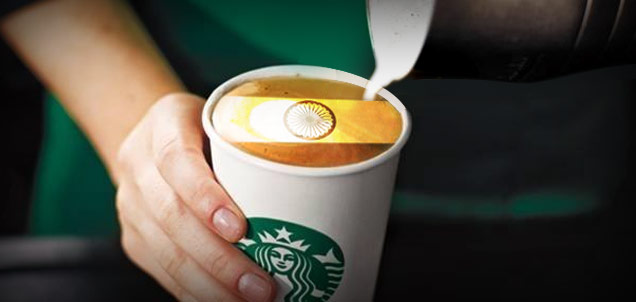
    In January 2011, when Starbucks chairman and CEO Howard Schultz made his maiden India visit to sign the 50:50 JV with Tata Global Beverages, hopping over to Asia’s largest coffee maker Tata Coffee’s 8,258 sq feet roasting facility at Kushalnagar near Coorg made perfect sense. After witnessing the plant first hand, his team pointed out that the coffee at the roasting facility matched the global espresso blend that Starbucks prides itself on.


    So for the first time ever in Starbucks’ history, the company pinned its faith on a partner-owned roasting facility, outside the five plants it owns across the world, including one at Amsterdam. Local coffee, global taste.


    WHAT’S IN STORE

    That set the ball rolling for a slew of localization initiatives which the JV kickstarted from October 2012, as it launched its very first outlet in Mumbai. The store in Horniman Circle, which can accommodate 120 people, has hand-carved wooden screens, tables of solid Indian teak, painted vintage trunks and old leather-bound books, harking back at Mumbai’s mercantile past.


    As for the grub, there’s Konkani Twist or a Reshmi Kebab Roll, jostling for mouth-share with the standard Blueberry Muffin or the Classic Breakfast Chicken Sandwich-all coming from the Tata-owned TajSATS, India’s largest provider of meals to domestic and international airlines. While the coffee variants are largely untouched, the beans and espresso blend at the heart of the coffee are locally sourced. Even the Tata Tazo tea range throws up a spice-infused Chai Tea Latte-distinctly Indian. Similarly, when Starbucks opened shop in Delhi’s Connaught Place in February 2013, the ropework design of the store stood out as a local theme, along with food offerings, such as Murg Kathi Wrap and Murg Tikka Panini.


    The Pune store, on the other hand, honours the rich copper culture of the city through copper artifacts and even has a traditional Indian swing for customers to sway. While certain elements in its food kitty are customized to suit local taste-buds, things are no different when Starbucks launched its 50th store in the country at Chennai earlier this month, which is the only outlet vending a ‘pour-over set’ single brew serving merchandise, typical of the filter coffee culture down south.


    Procurement, store décor, F&B, merchandise- across locations , Tata Starbucks has set out to garner neighbourhood connect, to create what its CEO Avani Davda claims as the “third place” between the office and home. Unlike rival Café Coffee Day, which operates across multiple formats on a franchisee model, Tata Starbucks prefers operating the third place on its own, with an average covered floor area of 1,000-1,200 square feet. Much of that is governed by homegrown research that points to a more leisurely café culture in India than the west, where it is an on-the-go, grab-a-bite, kiosk-led approach with tiny outlets located near workplaces. That explains why Starbucks gets about a fourth of its revenue here from food as against 20% globally.


    Though Ms Davda’s cuppa of choice is Sumatra or a vanilla latte in the morning, she would any day welcome the growing consumption of Chai Tea Lattes from her stores. Unlike in most countries, Starbucks realized that India is largely a tea-drinking nation and has now solidified that beverage selection on its menu. It has also launched the India Estates Blend – a country-specific blend developed with Tata Coffee, and the India Espresso Roast, which is sourced locally through the coffee sourcing and roasting agreement with Tata Coffee.


    LATE, YET RELEVANT

    As the local theme gains momentum, Starbucks’ late entry into the country’ Rs 1,200 crore coffee chain market must not be overlooked. When it finally entered in 2012 after a botched entry in 2007 with Future Group’s Kishore Biyani , the domestic market was nearing saturation, with quite a few players snapping up prime properties in the top ten cities.


    Though the JV never compromised on real estate, Starbucks President, China and Asia, John Culver said forging a sense of community will be key, while inaugurating the Horniman Circle outlet. Surely, the $14.89 billion Starbucks has also drawn lessons from the localization bids of other food retail chains, particularly KFC and McDonald’s. While the former ranks Paneer Zinger and Veg Twister as its top-sellers, McDonald’s McAloo Tikki and Masala Grill scorch the tables.


    But since such chains operate across multiple formats, some of them even resort to differential pricing across different formats or locations, to cater to a broader consumer base. But Starbucks is clear about its premium pricing and aware of its international brand following.


    “We now have an average customer who is very well-informed, and has exposure to international brands and experiences… although price and convenience play a part in their spending decisions, they are also more and more influenced by a brand’s values,” says Manmeet Vohra, Director-Marketing & Category, Tata Starbucks.


    THE NAYSAYERS

    The Indianizing influence, particularly from a brand like Starbucks, has its own share of sceptics though. “People line up outside Starbucks for a global gourmet coffee experience with knowledgeable staff (partners) and baristas who can toss up the Starbucks experience…. unfortunately, the company has adopted a cookie-cutter approach (in India)….it’s like Zara saying it’ll sell salwar-kameez in India,” observes Harminder Sahni, Founder and MD, Wazir Advisors.


    As a counter, Ms Davda claims that a career at Starbucks starts with learning about coffee, often through coffee-tasting and roasting events. “Our baristas are trained for specific periods by certified baristas, and each partner undergoes the training before undertaking their respective roles,” she says. Keeping the debate alive, former VPMarketing of Tata Coffee and brand consultant Harish Bijoor observes that Starbucks must not dilute its international flavour in order to grow in India.


    “It must not become an Indian cafeteria from an American café,” says Mr Bijoor, adding that strong brands are often inflexible. Even marketing guru Jagdish Sheth dismisses the ‘think global, act local’ approach of Starbucks, pointing out the new trend as ‘think local, act global’, with a slew of examples, such as Haldiram’s, Dabur and Pathak Pickles from India now riding high overseas with very ethnic offerings.


    BANKING ON THE HOOD

    But Tata executives, like Davda and Vohra, remain steadfast in their commitment to serve local communities and grow the business case around regions and neighbourhoods. It goes to explain why each outlet supports the surrounding ecosystem.


    In Mumbai’s Horniman Circle store, for instance, Starbucks maintains the adjoining heritage park while in Gurgaon’s HUDA Metro Station store, partners take time out for regular cleanliness drives. Pradeep, one such partner, works the counter in Delhi’s Hamilton House branch at Connaught Place and keeps watch as the outlet’s assistant manager. Amid rope chandeliers and the surrounding wood, steel and concrete surfaces that resonates the character of the Lutyen’s-era building, Pradeep helps fellow partners with orders, calling out names of consumers alongside the order on delivery.


    Right next to where he stands, about one-fifth of the food section has local offerings-“Chatpata Paratha Wraps and Tandoori Paneer Rolls are the highest selling food items in this outlet,” claims Pradeep. Though Davda will be happy to see local grub flying off the tables, for Tata Starbucks, food accounts for just 25% of its Rs 16 crore revenue. It is the core beverage category that Ms Davda will be watching closely after ensuring that the beans at least are sourced and brewed in India.


    Source:The Economic Times

    Copyright © 2014, Bennett, Coleman & Co. Ltd. All Rights Reserved

    Licensed to republish

     

  • Brands show the way – in or out – this election season

    By Shobhana Nair


    The ongoing election fever has certainly caught the attention of everyone concerned including individuals and companies alike. This year especially is one where a host of brands have joined the opinion bandwagon and have gone on to express their hopes or angst against a host of political parties and their candidates. Recent examples include Fevicol that has joined the group with its recent ad campaign that humorously reflects the current election scenario in India and also Maruti’s Wagon R that has released a campaign around elections.


    Harish Bijoor

    Explaining the approach being taken by brands, Harish Bijoor, Brand Expert & CEO, Harish Bijoor, Consults Inc said, “Politics is a very important part of the fabric of societal life. Every being is essentially a social being first and then a political. To that extent politics touches every one of us. Since it does, marketers salivate at the prospect of using politics and election time is a great time to piggy back on the one big event that gets the eyeballs: Indian elections.”


    That may sound like a great marketing strategy and that’s why brands like Tata Tea has been a clear favourite amongst both the experts and the aam junta in throwing light on issues that need attention. This time around, Power of 49 had the backing of popular TV faces and the response received has been phenomenal. The brand has received over 1.7 million responses till date with a majority of these responses coming in from the states of Uttar Pradesh, Madhya Pradesh, Maharashtra, Bihar and Rajasthan. Of the 1.7 million calls, more than 0.6 million have voiced specific issues that concern women.


    Vikram Grover, VP – Marketing, India and South Asia, Tata Global Beverages said, “What is noteworthy is that not just women, but men too have participated in a major way. With such phenomenal participation from the general public and an increasing focus on women in political discourse, we hope that the reach of our campaign could play a small but a significant part in paving the way for women’s empowerment and hence aiding the nation’s progress.”


    This isn’t the first time that Tata Tea has taken up a social cause. One is aware about their Jaago Re campaign which was established in 2007 to awaken and empower citizens to ‘be the change they wished to see’. A well-planned and tactical communication strategy surely helps in winning a few brownie points along with building goodwill in the market.

    Another tea brand Wagh Bakri had released a campaign ‘Sahi Chuno’ in November 2013. Spending around Rs 3 crores on this campaign alone, the brand managed to create higher customer awareness in newer markets with a mix media plan comprising of TV, Radio & Outdoor. Parag Desai, Executive Director, Wagh Bakri Tea believes that tea plays the role of a catalyst in bringing people together in India. “When people come together and have tea they establish a relation. Our TVC went one step beyond and said that do not just vote but ‘Sahi Chuno (choose wisely), be it a tea brand or your candidate.”


    In fact, even a global brand like Google couldn’t resist from contributing towards the election fever. It released a 3 minute video ‘Pledge to Vote with Shyam Negi’ inspiring millions of Indian digitally to come out and get inked. That’s exactly what brands needs to do – inspire and encourage.


  • With $160 mn fresh funding, Flipkart’s $1.5-bn valuation comparable to P&G India, Tata Global Beverages

    By A Correspondent


    Continuing its capital-raising successes, online retailer Flipkart.com has mopped up a further $160 million ( Rs 976 crore) from mostly new investors, taking the total in the fifth round to $360 million ( Rs 2,196 crore).


    The latest funding values Flipkart, considered the Amazon of India, at over $1.6 billion, or Rs 9,760 crore. This is similar to its valuation in July, when it raised $200 million. Incidentally, Flipkart is worth more than the total market cap of all 15 listed retail companies, including Future Retail, Shoppers Stop etc. Among brand-led firms, Flipkart’s valuation is comparable with heavyweights such as P&G India and Tata Global Beverages (Tata Global Beverages owns Tata Tea, Tetley and Himalayan). It is also more valuable than 28 banks, including the likes of IDBI Bank, Union Bank, Central Bank of India, etc.


    Investment advisory firm Dragoneer Investment, investment bank Morgan Stanley Investment Management, private equity firm Sofina and Vulcan Capital participated in the latest round. Tiger Global – one of the first backers of the Bangalore-based company – also invested.


    “It’s the quality of the asset that is attracting investors,” said Raja Lahiri, partner at advisory firm Grant Thornton India. “E-commerce is a cash-intensive business. The top four-five players in this space will keep attracting investments in the next few years.”


    Experts point out that the latest fund-raising by Flipkart is an indicator of the growth potential of the Rs 10,000-crore online retailing industry, which is expanding at 54% annually, according to Internet and Mobile Association of India. E-commerce is expected to grow to $200 billion ( Rs 1.2 lakh crore) in India by 2020.


    Besides Flipkart, online marketplace Snapdeal has so far raised about $50 million ( Rs 305 crore) while fashion e-tailer Myntra received about $25 million ( Rs 152 crore) in risk capital.


    “These new investors are willing to participate again if required like Naspers, Accel, and Tiger. Investor alignment with our strategy is very important,” said Sachin Bansal, 32, co-founder of Flipkart.


    Started as primarily an online book store in 2007 by two former Amazon India employees – Sachin Bansal and Binny Bansal – Flipkart has till date raised $541 million (Rs 3,300 crore). In the first phase of this round, Flipkart raised $200 million from South African Internet company Naspers, venture fund Accel Partners, and investment firms Tiger Global and Iconiq Capital.


    The company has ventured into payment gateway solutions this year by launching PayZippy. Flipkart, which employs close to 3,000 people, has close to 10 lakh visitors on its website every day.


    The company’s revenues were Rs 217 crore in 2011-12, according to a filing with the ministry of corporate affairs. But in 2012-13, it soared to an estimated Rs 2,000 crore.


    “Flipkart has got its timing, investments and vertical business strategy right,” said Rajesh Sawhney, angel investor and founder of GSF Superangels. “It will be difficult to replicate Flipkart’s success again, as that phase of scale is already over. New entrepreneurs will have to mine newer verticals.”


    The company changed its model from being inventory led to that of an online marketplace earlier this year.


    As per India’s current FDI rules, foreign investors are not permitted to invest in branded online retail business. Some experts feel that the change in model is also attracting foreign capital.


    The participation by San Francisco-based Dragoneer Investment Group ratifies Flipkart’s success globally. A long-term investor, Dragoneer, has backed companies such as Facebook, Alibaba and 360Buy in the past.


    “All our investors think long term; this is patient capital,” said Mr Bansal. “Dragoneer also brings a network that is really helpful.”


    With inputs from Ramkrishna Kashelkar


    Source:The Economic Times
    Copyright © 2013, Bennett, Coleman & Co. Ltd. All Rights Reserved
    Licensed to republish

     

  • AdStrat: Tata Tea – Duties Big & Small

    Vikram Grover, Head, Marketing, Tata Global Beverages


    Name of the Campaign: Tata Tea’s Jaago Re


    The Brief:  To emphasize the importance of both big and small duties with the new Jaago Re campaign.  The TVC to bring alive the perfect blend of ‘Chhoti and Badi patti’ in the context of the ‘Jaago Re’ philosophy.


    [youtube width=”400″ height=”220″]http://www.youtube.com/watch?v=hAEV1K8JuV4[/youtube]

    Research insights:  Tata Tea’s award-winning Jaago Re campaigns have time and again awakened individuals and inspired them to be the change they wish to see around them. Making its debut in 2007, the campaign began with a television commercial (TVC) which showed a young man enquiring about the credentials and credibility of a local politician campaigning for votes before offering him a cup of tea. Striking a chord with the youth, the campaign launched a series of advertisements over the last four years that wove in the themes of awakening, enlightening and civic consciousness.


    The creative process behind:  Tata Tea’s flagship brand Tata Tea Premium in its latest TVC touches upon the importance of fulfilling ones duties, however big or small they may be. Inspired by the Jaago Re! philosophy, the TVC plays up the fact that to make a serious impact, it is not enough to do only the ‘big important’ things like voting and fighting corruption, but that it is crucial to do what are often considered minor tasks like following traffic rules, that are equal in importance and impact.


    The film plays out at a typical Indian home where the husband returns on a motorbike with two of his friends. The wife teasingly asks the husband if he is done with his day’s share of whiling time away. The husband replies with great pride that he just cast his vote and has thus fulfilled his ‘big’ duty. His wife, on hearing this, starts to prepare tea made merely of big tea leaves. On being questioned by her husband she explains that just the way the perfect cup of tea has a blend of ‘chhoti’ and ‘badi’ patti (big and small leaves), it is equally important that one gives importance to a blend of all duties, however big or small they may be.


    Media Vehicle:  TVC led with 360 degree approach


    Does the treatment do justice to the brief? Yes, taking the route of common man’s attempt to bring a change, the treatment does justice with natural performance which strikes a chord with the masses.


    What is the differentiating factor of the ad? Lowe which has been working on the Tata Tea ads scores with perfect casting coup with people who resemble average Indians who inhabit many of our homes thus making the point of big and small duties much more relatable. Plus the fact that it’s a perfect match of social awakening that goes well with a cup of tea that somewhere is also akin to waking up peoples senses when they consume it.


    Client feedback:  Our insight from recent events has been that while we as a country are getting deeply engaged with the larger issues that the nation is facing, we sometimes forget the small duties that we are expected to perform as citizens. The film builds on giving due importance to issues, big or small. The commercial draws from Jaago Re’s philosophy and blends perfectly with the product differentiator of Tata Tea premium which has a perfect blend of small and big tea leaves (chhoti and badi patti) required to make a perfect cup of tea.


  • Soon you’ll be able to get your favourite Starbucks Espresso in India

    Starbucks Corp, the world’s largest coffee shop company, will open its first cafe in India in August through an equal joint venture with Tata Global Beverages, the two partners said on Monday.


    The venture, Tata Starbucks Ltd, will spend 400 crore initially and open 50 Starbucks cafe across the country by the end of the calendar year. The initial stores planned in Delhi and Mumbai in August. The move is part of the $10-billion-plus US firm’s strategy to focus on emerging markets such as India and China to drive future growth rates.


    “India is a unique market and we have gone through big transformation since the last four years,” said Mr John Culver, president at Starbucks China and Asia Pacific.


    While the core deal would be between Starbucks and Tata Global Beverages, it will work with other Tata Group firms such as Tata Coffee and Taj Catering. For instance, Tata plans to sell its mineral water brand Himalayan at Starbucks outlets in markets outside India. And the venture will leverage group firms’ properties for setting up Starbucks outlets.

    The deal comes a year after the Seattle-based firm signed an deal to buy green coffee beans from Tata Coffee’s Coorg facility and explore opening retail shops in the country. Starbucks manages over 17,000 stores in more than 57 countries and sells a wide variety of coffee and tea products along with food items, primarily through retail stores.

    The coffee cafe industry is on an expansion spree, led by market leader Cafe Coffee Day, to cash in on their increasing popularity among young consumers who have more disposable income than their previous generations.


    Source:The Economic Times

    Copyright © 2012, Bennett, Coleman & Co. Ltd. All Rights Reserved