The Harvey Weinstein sexual assault/harassment scandal in Hollywood has had a cascading domino effect across the world. Women enthusiastically joined the “#MeToo†campaign across social media either to show solidarity with those who had been raped, assaulted, groped, harassed, humiliated or to say that they had gone through the same thing, one way or another.
The conversation has moved on from the film and glamour industries. Academia has been exposed and now a former US president, George Bush Sr, has had to apologise for his behaviour. The media has reported on these aspects and accusations of sexual harassment most conscientiously. Various opinions have been put forth – some in support of the women who are “naming and shaming†predatory men, some pointing out that “naming and shaming†is a sort of an unjust hit and run tactic, men have tried to say they are sorry or that they are not all bad.
A particular list of Indian academics who have preyed on women has been made public. Author and Pakistan expert C Christine Fair wrote a detailed and painful account of how she has been abused and harassed through her life, which Huffington Post published and then took down from its site, although it is available on her own blog. US-based academic and activist Raya Sarkar who put up a list of abusive Indian academics has created an enormous controversy which has roiled people tremendously. Her Facebook profile was even suspended, although it has since been restored.
A list of “Shitty Media Men†in the US has created its own problems, with same accusations of justice and unsubstantiated allegations.
And this is where we reach the crux of our own media problem: the media itself. Across the world, regardless of the number of women who now work in the media, the story of predatory men is largely left unspoken and “toleratedâ€. Men who are greatly “admired†for the journalism often have a horrific reputation of targeting and abusing women who report to them. The Tarun Tejpal case is a rarity, where a young journalist had the courage to actually make him accountable and demand a court case. You will recall the amount of support that poured in for Tejpal from his colleagues – some female – and one notably dangerous piece written by a man from the point of view of the elevator where the abuse happened.
Although we write about gender abuse elsewhere, we in the media would rather not tackle it. This is in spite of any number of instances which are reported within media organisations. The whole debate over Visakha guidelines has died down now. The stories continue. Although the Indian media has more women in leadership positions than its counterparts elsewhere, the top job is still most likely to go to a man. The old prejudices of “features†for women continues, although much less. Verbal abuse is tolerated as “banterâ€.
Some older women, who identify as feminists and have fought for the cause, however have been acclimatised over the years to try and “be fair†and also see the “man’s point of viewâ€. In a sense, without knowing it, they have been co-opted into old patriarchal systems. Like those cliched women who will swear their daughters-in-law’s main roles are to produce male children and make round chapathis.
The argument also gets lost into the “not all men are bad†territory which in fact is nothing but a diversion to let the men who do get away with murder, off the hook.
It is heartening to see that today’s younger feminists are breaking some old rules and shibboleths and becoming more aggressive. I would argue that although their actions are neither “fair†nor “justâ€, they speak to the decades of change that have not happened. Perhaps in fighting to ensure that women get plum assignments or are allowed to work the night shift, some harassment was brushed under the carpet, or this battle was chosen over that.
It looks like we have reached another crossroads. If “name and shame†is unfair, the media has to find some other effective method to deal with the demons within. If not, all these exposes and follow-ups are nothing but a hypocritical sham.
​Ranjona Banerji is a senior journalist and commentator. She is also Consulting Editor, MxMIndia. The views here are her own.
This column has to be dedicated to the power of Twitter. Or, as Bachi Karkaria, well-known journalist, columnist and noted punster would put it, “extraneous noiseâ€.
The Times Literary Carnival invited Tarun Tejpal as a panellist on the subject of the “Tyranny of power†in the first week of December. Manu Joseph, journalist, was to be the moderator, with journalist, editor, writer and now scriptwriter Basharat Peer and politician Mani Shankar Aiyar as the other participants.
Is there anyone here who has forgotten the Tejpal story from last November? The apology letter from the founder-editor-owner of Tehelka, the “recusing†of himself from the job and the “penance of lacerationâ€, the determination of the young colleague to expose his assault on her, the escalation of events from an admission of sexual harassment (hence the penance blah blah), the private mails made public, the police action on a rape case, the filing of charges?
It did not stop there either. Tejpal evaded arrest, was taken dramatically to Goa and put in jail. Once the lawyers entered the picture, the apology mails were retracted and his accuser was blamed for, well, the usual defence in such cases, asking for it. Collateral damage in all this was the reputation of Tehelka’s managing editor Shoma Chaudhury and Tehelka itself. Certainly one of Indian journalism’s most sordid scandals, except that we have such short memory spans.
Not that it ended there of course. Once Tejpal’s defence was settled on “the victim asked for it†or “why was she in a short dress†or “why did she get into a lift with meâ€, some attempt at rehabilitation was in order. It began with articles on video footage of the corridor outside the lift where the assault happened. Reams of high flown text on the corridor in defence of Tejpal from Manu Joseph, yes indeed, the man picked as the moderator.
It was apparently Swapan Dasgupta, columnist and good friend and defender of the BJP, who first set Twitter off by pulling out publicly from the “carnivalâ€. The outrage and protests grew on social media. Some people felt that the principles of free speech and presumption of innocence could be applied to the decision to invite Tejpal. Others felt this was just a way to rehabilitate him as a public figure and public “thinkerâ€. And the overwhelming feeling was one of anger that such an attempt was being made at all.
The problem with the presumption of innocence argument is that Tejpal himself apologised, publicly and privately before the matter became a police case. This was not a forced police confession to be retracted in front of a magistrate pleading torture or coercion or seen as inadmissible in law. Add to that the largely unaddressed issue of sexual harassment in media offices – for all our posturing and pointing fingers at other industries – and the problem is magnified.
One assumes therefore that the Times Literary Carnival knew what it was doing when it invited Tejpal as a panellist. And yet it found itself unable to come up with an adequate defence against the anger on Twitter. So Bachi Karkaria, organiser of the literary festival, announced on Twitter that Tejpal had been asked not to attend because the festival did not want “extraneous noiseâ€.
I have discussed the notion of extraneous noise in a piece for the opinion website, DailyO, and will not repeat that here. Instead, let us salute extraneous noise and the power of public opinion on social media, which can make a behemoth notice a pesky ant and change direction. Not a retraction, not a “recusalâ€, not a “penance that lacerates†but at the very least, a shift in “adamantine resolveâ€.
It’s Tarun Tejpal, right? I cannot think of a bigger media story of 2013. The outrages before that had been layoffs, ill-treatment by employers, closing down of publications. Network 18 and Outlook group were most talked about on those issues.
We even had a few high-profile sackings. The Hindu suddenly decided that it no longer wanted the services of editor-in-chief Siddharth Vardarajan. This was a bit of a surprise since Vardarajan had been appointed the year before with much drama: highlighting the immense family feud which is the Hindu board, where N Ram had overridden everyone else. Ram had then claimed that the newspaper had to employ professional journalists for the top posts and not keep it all in the family. However, along the way he changed his mind, and some of the siblings joined forces, ousted Vardarajan and took control of the paper again. It should be noted that some family members disagreed with this decision and against Ram’s claiming two votes for himself.
Hartosh Singh Bal, political editor of Open magazine, was also “let go”, he said because the owner (Sanjiv Goenka) didn’t like his political leanings. Goenka said he didn’t and never had liked Bal. Manu Joseph said he had protected Bal as long as he could but could not do so any more. Bal said he was going to sue Open because for too long had owners taken journalists for a ride.
Forbes magazine saw the exit of its top editorial staff as well as its CEO, seen by many as part of Network 18’s downsizing drive. The senior staff also said they would take legal action against the group.
Television saw many sackings but few of them were high profile. Hundreds of nameless and faceless video journalists and support staff were not interviewed by top television anchors and who knows if they have exercised the option of a judicial solution.
The stomach-wrenching gangrape of a young photojournalist out on assignment in Mumbai brought the issue of women’s safety in public places back to the front pages. The young woman was accompanied by a male colleague, it was still daylight and although they were in a deserted mill, it was situated in a crowded part of the city. The nation mourned at one more heinous assault and marvelled at the courage of one more woman.
And then there was Tehelka. The story about editor-in-chief and founder Tarun Tejpal and his “alleged” assault on a young reporter who worked for him broke suddenly and each passing day provided new shocking material. The assaults happened in Goa, during the ‘Thinkfest’ which is some sort of a Tehelka subsidiary. The reporter complained to Tehelka managing editor Shoma Chaudhury that Tejpal had assaulted her 10 days before and then within days, the Tehelka story was over, nothing was secret or hidden and Tejpal was in judicial custody.
The lessons for the media seem pretty clear. For one, there is no protection for journalists any more, especially from fellow journalists. Public pressure if nothing else will make cover-ups difficult, if the supposed transgression causes enough outrage. For another, the internet has busted everyone and it is in control in its own crazy haphazard way. The way information spreads (or even misinformation for that matter) and the way the sender can be anonymous, you cannot be surprised that the word given to it is “viral”.
So Tarun Tejpal and Shoma Chaudhury became “victims” of this new world where little can remain secret. And set a message to the media that while it must highlight everyone else’s misdemeanours, it cannot ignore its own. How effectively we take that into the future remains to be seen… my bets are on more mistakes before better sense hits people on the head.
Ranjona Banerji is a senior journalist and commentator based in Mumbai. She is also Contributing Editor, MxMIndia. She can be reached via Twitter at @ranjona. The views here are her own
Is there a trial by media in the Tehelka case? Has the media conducted a witch hunt against Tarun Tejpal and Shoma Chaudhury after allegations of sexual assault bordering on rape were made public? As many in the media know and have pointed out, there are innumerable instances of sexual harassment within the media and in most cases justice has not been done to the victim. The Vishakha guidelines which everyone now quotes so freely are followed in only a few media offices.
Looking back, coverage of this case hinged on a few key points. The first was the verbose bombast of Tejpal’s various letters of apology. The second was the release of the victim’s email which detailed the very serious charges against Tejpal. The third was Chaudhury’s aggressive posturing in front of reporters, especially her comment, “Are you the aggrieved partyâ€.
The gauntlet had now been thrown down to the rest of the media. And yes, as has been said before, the media is the aggrieved party. Everyone is the aggrieved party. For a journalist to ask this of another, shows how easily we forget our professional compulsions when matters become personal.
There is another less savoury aspect to the reaction of the media. For all the sterling work that Tehelka did, many journalists were uncomfortable with sting operation journalism as well as with Tehelka’s very self-righteous approach. If there is anyone who knows that being self-righteous in the media is a sham, it is a journalist. We have to live on cynical pragmatism while following an idealistic principle. Being judge and jury is not our calling. Being the mirror is. To be sure, it’s a tightrope walk. So it is possible that many of us found Tehelka’s sanctimonious front a bid galling and that made this case a bit more intriguing.
However, at the bottom of it all, lies some unacceptable behaviour and that has nothing to do with the feelings of the viewer. The change of stance by Tejpal, the stonewalling by Shoma Chaudhury, the tenacity of the victim who did not let go and did not capitulate all increased the interest in the event.
And then came Tejpal’s bail application. Even if it was drafted by his lawyers, it contained every bit of misogynistic patriarchy that Tehelka itself has been fighting against. It blamed the victim, it questioned her behaviour after the alleged assault and it claimed that Tejpal was forced to write letters of apology by Chaudhury.
Given all this, it is hardly surprising that the media has been following this case so closely. Add to that the political sideshow with Tejpal somehow blaming the BJP for his predicament and you have a story that no media outlet would miss.
One could also argue that the level of media interest in gender stories has also increased since the December 2012 gangrape in Delhi. Also, while many are questioning why senior journalists are going after Tejpal and not protecting their own it is worth remembering that the victim is also one of our own.
**
The Tehelka case forced me to watch prime time news TV slugfests after almost six months. Most channels and anchors managed a few stimulating discussions on the subject mainly because they avoided inviting politicians: Karan Thapar (CNN-IBN), Nidhi Razdan (NDTV), Sagorika Ghose (CNN-IBN), Arnab Goswami (Times Now), Rajdeep Sardesai (CNN-IBN), various anchors on Headlines Today and NewsX.
Once the politicians entered the scene, it all went downhill of course. And once politicians start behaving badly, all the other guests apparently believe that open season for lack of etiquette has begun. Interrupting, shouting over each other, refusing to answer the question asked – all the fine elements of a “debate†on English news channels in India. And Arnab Goswami I see has only grown in stature and now his whole show is unashamedly about his own opinions. My advice: dump the guests and have a nightly chat with the nation about what needs to be done.
**
Wags on social media have been pointing out that Tarun Tejpal has achieved what the might of the Congress party could not: knocked Narendra Modi off national television. Having said that, Tehelka will peter out sooner rather than later and the Gujarat surveillance case will be back.
**
And Cobrapost and Gulail have now informed the rest of us how politicians – and anyone else – use trickery and cheating to manipulate the social media. Expect some more on that.
Ranjona Banerji is a senior journalist and commentator based in Mumbai. She is also Contributing Editor, MxMIndia. She can be reached via Twitter at @ranjona. The views here are her own
There’s been a lot spoken and written about the young journalist being subjected to sexual assault (rape as per the law). Many mails have been leaked, some officially released. Many statements have been made. And there’s been the resignation later from managing editor Shoma Chaudhury earlier today (Nov 28).
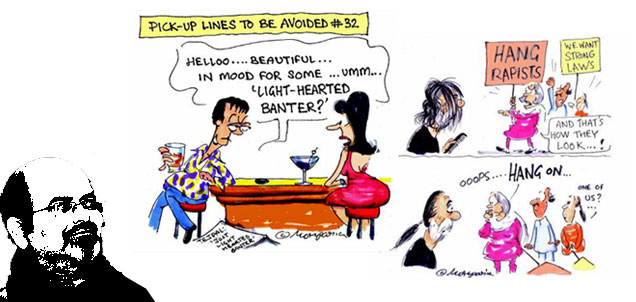
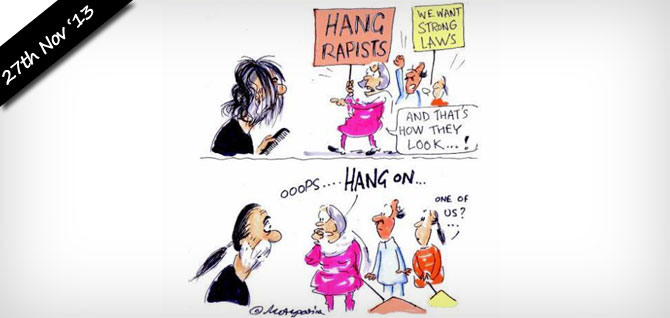
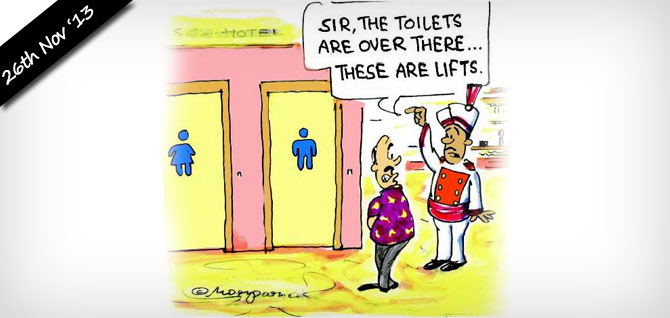
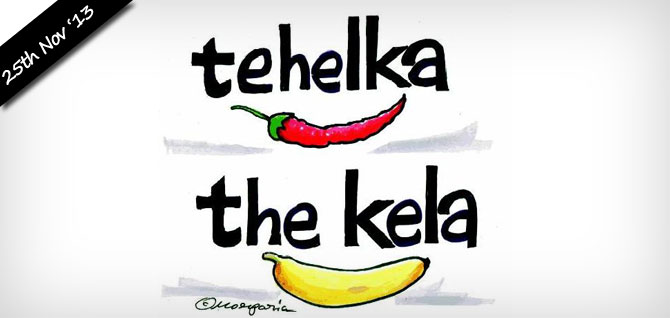
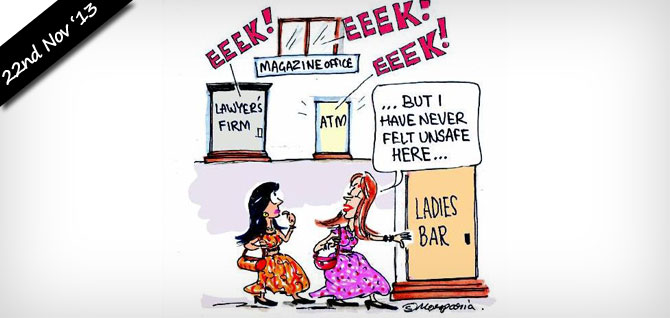
We present here five cartoons by Hemant Morparia, one of India’s best known editorial cartoonists, who draws a daily pocket cartoon for Mumbai Mirror and group publications. These, according to us, tell give us a view that’s sharper and thought-provoking than a lot that we’ve heard and read so far.
There’s also a Jaldi 5 Q&A with him alongside the toons.
Jaldi 5 with Hemant Morparia: The seedy is not necessarily as Sleazy as the Mainstream can be
Hemant Morparia is one of India’s best known editorial cartoonists. Other than a daily pocket for Mumbai Mirror, he toons for various Indian and international publications. When he not drawing, he’s into photography, travelling, archery and assorted reading. He’s also a radiologist and sonologist at Mumbai’s Breach Candy Hospital.
01. They’re funny, but given the nature of the event, you can’t really laugh on viewing the five toons you have drawn thus far on the Tarun Tejpal episode. The one on the ladies bar is perhaps the most telling comment on the state of safety.
That is my favourite of the lot. Sort of speaks my view that the seedy is not necessarily as sleazy as the mainstream can be. It’s hypocrisy that makes one think so.
02. What happened to the young journalist is reprehensible. But what made things worse was that the assailant was allegedly her boss, someone who has been revered in journalistic and activist circles. From the point of view of an observer of news events, do you think this possibly rates as one of the worst acts of the powerful in our country in recent times?
That jobs and promotions could be linked to ‘giving in’ is equivalent to trafficking by the perpetrator. One is making an employee a whore, by force – so it’s a grave crime. I have no problems with consensual encounters without professional inducement or threat.
03. Would you now see people doubting all the rich, powerful and famous. As in when you meet Editor X and Y, will you now be asking yourself whether he (or even she) could be in indulging in such acts?
This is as old as time. Nothing shocking here. All humans are potentially capable of depravity anyway imho.
04. Many well-known cartoonists and commentators have been muted in their response on this episode. Possibly because they know him? Didn’t you feel the same? No more invites to Thinkfests? If you had been drawing for Tehelka, would you have done the same?
The test for any commentator is how he sticks to his point of view honestly, without fear or favour. Personal equations colouring views will be the beginning of the end for him.
4a. You attended the first Thinkfest. Regret having attended that? If invited, and if organized by the same set of people, will you attend it?
There’s no reason to regret. I won’t attend in future. Probably won’t exist in future, anyway.
05. On a lighter note, Do you really think there could be a day in India when we’ll have separate elevators for men and women?
Ha ha! Someone commented on Twitter that such already exist in Saudi Arabia. Well, it would be safer for both sexes you know. The decent male, due to the pervading issues connected to some bad apples of his gender, is a beleaguered creature today. In this charged atmosphere, false accusations could rise too.
Reproduced here with permission from Hemant Morparia. All cartoons published in Mumbai Mirror on dates mentioned along with the cartoons.Â
Inexcusable as it is, Tarun Tejpal was not the only person who made a shocking ‘error of judgement’. Clearly, the other really major error of judgement in responding to the sexual harassment charge by a young journalist during the magazine’s Thinkfest in Goa recently must lie with the Managing Editor of the magazine, Shoma Chaudhary.
In his email, Tejpal referred to what he termed a bad lapse of judgement and an awful misreading of a situation. He offered an unconditional apology and recused himself from the editorship of the magazine for six months. In her email to the staff, Chaudhury appears to accept both the apology as well as Tejpal’s decision to step down for six months:
“We have also believed that when there is a mistake or lapse of any kind, one can only respond with right thought and action. In keeping with this stated principle, and the collective values we live by, Tarun will be stepping down for the period mentioned”.
Unfortunately, this is simply not enough. And the outrage that followed on social media sites by journalists and editors is only some indication that the Tehelka management has fouled up in tackling what is a pretty straightforward issue.
When any complaint is lodged on a charge of sexual harassment, the law binds the management of a company to institute an inquiry with an independent member on a complaints committee. The Vishakha guidelines are clear on this.
Moreover, the Sexual Harassment of Women at Workplace (Prevention, Prohibition and Redressal) Act, passed by both houses of Parliament in 2012, was gazette in April 2013. Rules under the Act are currently being enacted but the Vishakha guidelines are clear and, as a statement of the Network of Women in Media, India, said, “compliance with the Supreme Court’s guidelines is the very least that mediawomen expect of the media which are, after all, supposed to be the watchdogs of society.”
It is highly unlikely that the editor of Tehekla was unaware of these guidelines. Reports in various websites even attribute quotes to the aggrevied journalist seeking an inquiry under these guidelines. Was this done? Who constituted the committee? Was there an independent member as required by law? When were the hearings held?
In any complaint, an independent inquiry is important and crucial. Due process of law must be followed so that justice must not only be done, but seen to be done.
In the present instance, a major aspect of the complaint: that of the guilt of the accused, is already established. Tejpal has not only not denied the charge, but tendered an unconditional apology. It’s possible that, given incontrovertible evidence and/or the admission of guilt, an independent inquiry would have arrived at the same conclusion – that the charge was proven.
The next step is the delivery of justice. Tejpal’s offer to recuse himself from editorship is all very well, but is this what the aggrieved journalist wanted or sought? What exactly did the journalist seek in terms of justice for the wrong done to her?
For Tejpal, the ‘punishment’ for his act, couched in vaguely religious terms of atonement, laceration or penance, is that of stepping down from a post he occupies. How does Tejpal’s self-imposed, self-denial of his position, that too for a limited period, make any difference to the charge? To whom will it make a difference, if at all?
But, while it may be part of a larger response of a man in a position of power and influence, it may not provide any succour to the individual concerned.
The determination of the relief that the journalist will seek – whatever it may be – can only be done in a transparent manner, with full accountability and clarity. Whatever decision is then taken in terms of dealing with a clearly criminal act – must be done with the consent of the journalist concerned. Only then can a complaint like this move towards closure.
The NIMBY phenomenon
Despite numerous articles, the media is simply unwilling to address sexual harassment when it happens in its own backyard. Media houses need to come clean and publicise whether they have instituted sexual harassment committees in the work place and whether any complaints have been lodged before these committees.
To date, the record of existing instances of sexual harassment in media houses is pathetic. The well-known instance of sexual harassment in Statesman, filed by journalist Rina Mukherjee in Kolkata, resulted in her dismissal in 2002, an order against which came in February 2013, a good 11 years later!
In March 2013, a journalist filed a sexual harassment case against a senior editor in Sun TV, and was again suspended from service. A complaints committee instituted by Sun TV did not follow the procedures as laid down by law and did not uphold her charge. In another instance in India Today, a complaints committee was set up but the independent committee member is yet to be appointed!
Geeta Seshu is a senior journalist and writes on free speech, women and representation and media ethics. She is Consulting Editor of the media watch site, The Hoot. She can be reached at @geetaseshu
Photograph:Â Department of Communication and Journalism, Mumbai University
At the recently held Think festival organized by Tehelka magazine, there was a session where rape survivors recounted their stories. The title of the session: The Beast in Our Midst.
As it has now emerged, even when the various delegates and ‘thinkers’ were deliberating on the ways of the world at the Goa event, there was a beastly act on elsewhere. Tarun Tejpal, Tehelka founder, celebrity journalist, author, mentor to budding writers and a beacon for those against all things wrong in the country, had indulged in what has until the time of writing been described as an act of molestation.
Mr Tejpal has confessed to his crime. Ah, well, remember he’s a writer. So the words he has used in a letter that appears at various places on the internet (including our favourite blog Sans Serif at http://wearethebest.wordpress.com/) to describe his acts is that it was a “bad lapse of judgment” and “an awful misreading of the situation”.
We weren’t present in the 2011 edition of the Thinkfest, but Mr Tejpal is reported to have made this controversial statement: “You’re in Goa, so eat, drink, make merry and sleep with whoever you want.” The writer-journalist has ostensibly taken his own words seriously.
The victim has said she’s a friend of his daughter. That her father and he were once colleagues. She tried to stop him from what he was doing. Not once, but twice over, over two days.
Mr Tejpal’s books (coincidentally titled ‘The Alchemy of Desire’ and ‘The Story of My Assassins’) have received rave reviews. “I have always held that Tehelka the institution, and its work, have always been infinitely more important than any of us individuals. It is tragic, therefore, that in a lapse of judgment I have hurt our own high principles,” he wrote to managing editor Shoma Chaudhury who will now be incharge of the magazine. The letter described “pompous in tenor” by the Mumbai Mirror diarist does appear to be pretentious. “I feel atonement cannot be just words. I must do the penance that lacerates me. I am therefore offering to recuse myself from the editorship of Tehelka, and from the Tehelka office, for the next six months.”
In a letter to the Tehelka staff, Ms Chaudhury has forwarded Mr Tejpal’s letter and said: “This is a hard time for all of us, and I hope all of you will stand by the institution” She is quoted to have to have told an Indian Express journalist that the journalist has not filed a criminal complaint and that she (the victim) and other staffers were satisfied with the action taken. “It is an internal problem and we are not setting up any enquiry into the matter,” Ms Chaudhary told Business Standard. “The matter was taken up internally, and has been addressed and redressed,” she told the Express. However, a confidante of the victim told NDTV that the victim was not satisfied with the action taken.
Is a six-month ‘penance’ of being away from the top job at Tehelka enough? Is staying at home, in the hills for half a year enough?
In many ways what Tarun Tejpal is being subjected to on Twitter and Facebook is worse than a dozen lashings in the Middle East? He’s being ridiculed, humiliated and mocked at so much that even some of the most universally lampooned Indians on Twitter – N D Tiwari would appear to have done nothing wrong.
But the law is clear on the subject. Sexual harassment cases need to be handled in a certain way, and this one could be called an assault. According to a set of Twitter messages, the victim is said to have written the following to Ms Chaudhury: “As of Saturday evening, he sent me text messages insinuating that I misconstrued “a drunken banter”. That is not what happened. Banter does not involve forcing yourself on someone, trying to disrobe them, and penetrate them with your fingers despite them pleading for you to stop.” Note: this is an unverified version. MxMIndia has in its possession a copy of the letter the victim is said to have written.
The victim we are told has retained copies of Mr Tejpal’s text messages and it is said that the video footage from the elevators is also available as proof of Mr Tejpal’s acts.
Journalists and activists believe the apology offered by Tarun Tejpal is half-baked and the case should be handled in a legally tenable way.
In many ways, Tarun Tejpal’s act is a blow to the world of news media. Especially when we have an assortment of law-makers and influencers wanting tighter controls on the craft. The question now is: will the law-enforcers from Delhi or Goa act against the editor?
Hardly had the news of the acquisition of English news channel NewsX by ITV Media Group and Hindi news channel Live India by Prosperity Agro filterd in, there were murmurs on whether it was vital for the government to impose entry barriers for the news media. ITV of course has been in the news for around five years and Live India already had a sizeable stake by a property developer HDIL.
As part of MxM Mondays, we spoke to a cross-section of news media practitioners to offer their views on the issue.
This issue of media ownership has been debated on in the past, and more so recently, because of the entry of corporate groups into the news media. Earlier this year we saw two big corporates enter the media domain, when Reliance Industries bought a stake in Raghav Behl-led Network18 and Aditya Birla Group invested in the Aroon Purie-led Living Media India.
While big business owning media is not a new phenomenon, there are numerous instance of politicians owning and controlling sections of the media, especially in Southern India.
Hence the question arises: Is it a cause for worry when people with non-media interests start owning the mass news media?
Here are a cross-section of views from captains of the industry (in alphabetical order of their last names):
Tariq Ansari, Chairman and Managing Director, Next Mediaworks Ltd
Tariq Ansari
The worry is not around who owns the media but whether they act in a way that is consistent with journalistic standards of integrity and fair play. We seem to have forgotten simple journalistic conventions like a declaration of interest from the owner of the publication/channel on stories in which there is a substantial commercial interest.
Media, much like steel or fertilisers or communications, will eventually belong to those who have the means and desire to invest in it. The point about it being the preserve of a few is inexplicable. Nobody is stopping anyone from raising the capital to start a newspaper/magazine/TV station/radio station/website. We live in a free country. Anyone who has the ability to own media should be able to do so, without limitation. Clearly my preference would be that criminals or those with clear vested interest should not own media, but I am not sure if the law of the land can prevent this from happening.
Vinod Mehta
Vinod Mehta, Former Editor-in-Chief, Outlook magazine
I am worried. Media diversity is very important for freedom of the press. I don’t want Media in the hands of a few owners. It should be open to all.
And here’s what MxMIndia’s regular columnists say:
Ranjona Banerji, senior journalist, columnist and Contributing Editor, MxMIndia
Media ownership is a worry to the extent that journalists are not able to withstand corporate pressure. For instance, the Birlas started Hindustan Times and the Tatas has a stake in The Statesman (to name just two) and the battle between marketing and editorial is as old as the profession. The problem comes when senior editors capitulate and reader interest is surrendered or sacrificed. I would turn the spotlight back on journalists: are we fighting the good fight?
Many years back when I asked a leading industrialist why he was keen on starting a news channel he replied with the famed Deewar dialogue (some alcohol in the system did the trick): Aaj mere paas buildingey hai, gaadi hai, bank balance hai, but even then these guys owning newspapers and channels are ruling the world. We were in the late 1990s, and journalists and news media owners were indeed much sought after. That may have waned over the years, but the desire to own news media stays. What hasn’t changed is that the intent of owning the news media goes far beyond returns on investments.
When the British ruled India, it was the desire to mobilize public opinion that led to several national leaders and even businessmen to embrace news. Post-Independence, with the birth of a new economy, it was a mix of nationalistic sentiment and also to use it as an ally in a tightly controlled business environment. The ’60s and ’70s saw the media taking off with magazines like the Illustrated Weekly of India, later India Today and several others in regional languages. The imposition of the Emergency got people to realize the importance of the news media as the liberalization of the economy and and the airwaves ensured that there is no looking back.
Being a democracy, there are no entry barriers to the media. And rightly so. However, when a few years back a few real estate and assorted players jumped into news television there were representations to the information and broadcasting ministry that there ought to be tighter controls.
The current murmurs are being heard because NewsX has been acquired by businessman Kartikeya Sharma. ITV, his media company, also runs the newspaper Aaj Samaj and regional and Hindi news network India News. And the reason for the concern: it was feared that being the brother of Manu Sharma who has been convicted in the Jessica Lallmurder case, he could misuse his position to influence the executive and the judiciary. Well, the Supreme Court upheld its sentence of life imprisonment in 2010, so evidently he didn’t achieve much. To be fair to Sharma, a senior editorial and business executive who has worked with him, told me that he saw no interference on content, especially on the Manu Sharma front.
Clearly, the money power of rich businessmen and politicians cannot bring in readers or viewers, as the case may be or make a success of the media enterprise. In the late’80s, the Ambanis acquired Commerce Weekly and converted it into a business daily. They also acquired The Sunday Observer that was once edited by Vinod Mehta and was exceedingly popular.  The Ambani indulgence in the media failed despite hiring top journalists and publishing executives. They could only use the papers to fight a few minor battles, and even those without much success.
Mehta worked and fell out with industrialists Vijaypat Singhani and L M Thapar as both found news too hot to handle and counter-productive to their primary businesses (and revenues). One had assumed he would meet the same fate when Rajan Raheja, a then-emerging industrialist with some interests in real estate, set up the Outlook magazine group. Mehta has led many battles with the mighty and powerful in his magazine and both Raheja and Mehta have survived each other.
Save the Outlook example which is a good indicator of business interests and independent journalism co-existing, clearly big money is not enough to drive consumption of news media. My worry though lies elsewhere:
1. Lack of transparency in the ownership of media.
2. Creation of a monopolistic scenario with business groups investing in multiple and similar vehicles
3. Level playing field for competition in case of vertical and/or horizontal cross-ownership, and
4. Diversification of media companies into entities beyond news
1 & 2. Transparency requirements in media ownership are critical. When the government announced recently that a certain conglomerate doesn’t not have interests in the media, is it really the case, or is that what is on paper and hence deemed correct? While doubts have been raised about how the acquisition of a sizeable chunk of Network 18 via an independent trust would impact the editorial independence of the group, the real worry is the rumoured interests of the group in other media ventures too.
Could we have a situation that a genre of channels or newspapers or the media entities in particular region of the country be owned – directly or indirectly – by one group? How do we tackle a monopolistic scenario such as this?
3. The PR head of a radio station in Delhi once complained that she could never hope to get her press release into the two main English dailies in the city because both had their own FM stations. So, while the most inane event from the group’s radio station gets covered, the lady’s FM frequency never got a mention even for a big activity. So rampant is this blacking out of a rival group’s activities that it’s now considered standard practice. In many countries there are strict rules for horizontal and vertical cross-ownership. While the TRAI has suggested restrictions in vertical ownership (a TV channel can’t fully own a DTH or cable platform etc), horizontal ownership is fine (so a TV channel can also run a newspaper, radio station etc).
4. The last of my worry areas can be a bigger concern, and, if misused, even graver than big business or a political party getting into the media. Many news media groups have invested in sectors outside of news and doubts have been expressed if there is any connect between the relationships with governments via the news media and the winning of such contracts.
Even though the government at the Centre is weak, and we can be sure it will flex its muscles often enough in the run-up to various elections until 2014, I don’t see any immediate solution to the problem. But what can play a deterrent for those who abuse the media will be public opinion via social media.
Sevanti Ninan, Editor, thehoot.org and Columnist, Mint
Sevanti Ninan
Yes, it is a cause for worry when people with vested interests start owning the mass media because political ownership of the media is increasing, and there are no transparency requirements on media ownership.
Readers and viewers are unable to discern ownership-related biases. There is also a renewed trend of corporate investment in media increasing. Media companies are supposed to file ownership details with the registrar of companies, but one, it is not properly done, and two it is very difficult for lay people to access the correct and latest data.
On the issue of media being a preserve of only a certain groups, even now it is fairly widely owned.
Maheshwar Peri, Chairman, Pathfinder Publishing India Pvt ltd
Maheshwar Peri
In my opinion there is no cause for worry. I think, increasingly, the cause for worry comes from a few industrialists who’ve gotten into media. But if you go back to the flag bearers of Indian journalism in the 1980s, Indian Express was owned by RNG, an industrial group. So, to say that ownership by industrialists would hurt media is a slightly wrong way of looking at it.
There is definitely a cause for worry when people get into media for reasons other than running it as a professional empire. If you look at some of the politicians who’ve come into media or political parties that are launching their own channels, that’s a cause for worry because they have a reason to dish out news which suit their needs and opinions.
So there is a problem when people in public office get into media, but it’s not so much of a problem if industrialists or venture capitalists or any others moneybag get into it because they want to make it a commercially viable operation. And they know they can make it commercially viable only when the reader/viewer respects them. In case of politicians, they are not interested in making it commercially viable; they just want to ensure that their point of view finds a space in the public domain.
I think unless a reader or consumer respects you, you won’t be able to sell beyond a point. So all of us, whether or not owned by corporates, are always trying to ensure that we give unbiased and credible information so that the reader continues to respect us as well as the advertiser continues to invest in us.
And what makes one think that they have a better opinion about media than a fruit vendor? I don’t think there can be a classification of who has a better opinion about certain things in this country – we are a democracy. So the worse thing is to say that ‘these’ kind of people can get into media and ‘those’ kind cannot.
Tarun Tejpal, Editor-in-Chief, Tehelka magazine
Tarun Tejpal
To some extent, there is cause to worry about media ownership. We have to air, discuss and examine issues of monopolies, cross media ownerships, and of cross business ownerships. And to try and build in some structural safeguards that both help ensure the financial viability of honest, robust media, and deter media owners from using their media instruments for unfair advantage in their other businesses.
Theoretically, it (media) should be open to all. But we must build in safeguards that minimize the misuse of public discourse and public instruments of media. This is not easy, but a discussion must start on this issue at all levels.
Paranjoy Guha Thakurta, Senior Journalist
Paranjoy Guha Thakurta
The growing corporatization of the Indian media is manifest in the manner in which large industrial conglomerates are acquiring direct and indirect interest in media groups. There is also a growing convergence between creators/producers of media content and those who distribute/disseminate the content.
In India’s unique ‘mediascape’, it is often contended that the proliferation of publications, radio stations, television channels, and internet websites is a sure-fire guarantor for plurality, diversity, and consumer choice. There were over 82,000 publications registered with the Registrar of Newspapers. There are over 250 FM radio stations in the country. Despite these impressive numbers of publications, radio stations and television channels, the mass media in India is possibly dominated by less than a hundred large groups or conglomerates, which exercise considerable influence on what is read, heard, and watched.
One example will illustrate this contention. Delhi is the only urban area in the world with 16 English daily newspapers; the top three publications, the Times of India, the Hindustan Times, and the Economic Times, would account for over three-fourths of the total market for all English dailies.
However, what is unacceptable is media barons using news outlets as tools to further their business interests. In this country, as in the world over, large media corporations are clearly playing a bigger role in the political economy that they report on. Though a free media is fundamental to the existence of a liberal democracy, concerns about the accountability and transparency of media companies remain. For instance, the RIL deal has enabled Network 18, Eenadu, and the merged group to expand its offerings to benefit its stakeholders and its advertising target audiences. What remains to be seen is whether clear boundaries can be etched between the boardroom and the newsroom.
There’s absolutely no doubt about the fact that if it’s truly going to be a responsive media, then the media should reflect the views, the interests, the aspirations of a larger section of population as possible. The problem with much of our media is that they are too busy trying to ‘reach’ consumers to potential advertisers than providing information to citizens.
Next Week:
Why do we all like to damn TAM?
The Sectoral Innovation Council recommendations last week said that there was need for an alternative to TAM, short for the media research company formed by a jv of two international research biggies: Nielsen and Kantar. This is a view that has been expressed several times over the years.
One of the main peeves against TAM is the number of Peoplemeter boxes present to collect data. Can 8000+ boxes effectively poll a populace of 1.2 billion, is what many broadcasters keep asking in public. In private though, not many are ready to pay up by increasing their subscription fee to enable the installation of more boxes across the country.
Also, what’s happening to BARC, the joint industry body that was to provide an alternative?
MxMIndia will speak to a cross-section of the industry to get answers. Meanwhile, if you have a view, email it to us at editor@mxmindia.com with the subject ‘MxM Mondays #2’
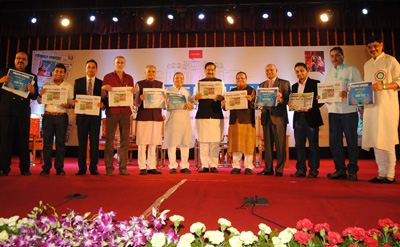
Maharashtra’s Chief Minister Prithviraj Chavan launched the sixth edition of the popular Hindi daily, Lokmat Samachar in Pune. Also present on the occasion were Minister of State for Education Rajendra Darda along with media luminaries Balbir Punj (senior columnist and RS MP from Rajasthan), Prabhu Chawla (Editor-in-Chief – The New Indian Express), Tarun Tejpal (Editor-in-Chief, Tehelka.com) and Vijay Darda, Rajya Sabha MP and Chairman of Lokmat Media Pvt Ltd.
“Lokmat Samachar will enhance the quality of life in Pune and will make it more cosmopolitan,” said Chief Minister Chavan at the launch ceremony.
A panel discussion on “The Relationship between Media and Politicians” was organized to mark the launch. “A journalist is also a politician. Not only should the media help in shaping public opinion, it should also play a critical part in the development of the political process,” the CM observed.
Senior journalists and editors Mr Chawla, Mr Tejpal and Mr Punj highlighted the increasing complexities of the media world, and the need to maintain a balance in giving coverage and direction.
“Media is a fish that lives in the vast ocean of democracy,” said Mr Punj. “Hence strengthening the media will result in the strengthening of democracy.”
Highlighting the sharp difference between the cover prices of newspapers in India and abroad, Mr Tejpal pointed out that the readers India are not willing to pay enough money to run these institutions. “This is the structural flaw due to which quality deteriorates,” he said.
Mr Chawla decried the increasing incidences of ‘paid news’ inserted by politicians, due to which media is facing a credibility crisis. “Media has become a victim of this phenomenon,” he maintained.
Speaking about the Pune edition of Lokmat Samachar Rishi Darda, Joint Managing Director – Lokmat Media Pvt Ltd, said: “The Hindi-speaking population of Pune, which has emerged as an education hub and IT city, was in need of a national daily. Since Hindi is our national language and therefore connects people throughout the country, Lokmat Samachar would definitely fill the gap.”
The newspaper offering consists of the main paper of 12 pages along with a 4 pager Apna Pune that will detail the local civic issues and also leisure options for the Puneites. For You for the young, Sakhi for Women and Lokarang Sunday supplement will accompany the paper on 3 different days in a week.
This is the sixth edition of the popular newspaper which first appeared in 1989 in Nagpur, and was thereafter launched in Aurangabad, Akola, Kolhapur and Jalgaon in that order. Lokmat Samachar has 13.56 lakh readers as per IRS 2012 Q1 AIR
Its Pune edition has a cover price of Rs3 plus an attractive subscription scheme.
Very good sting operation by Tehelka. Totally in public interest, and their findings are pretty frightening. They have carried out a sting on some Delhi cops to find their sensitivity (or the lack of it, as it turns out) to rape victims. And as we all might have suspected, yes, the stung cops’ attitude is medieval. They do believe women often ‘ask for it’. And this in turn leads to lackadaisical investigation process.
This particular sting operation reminds me of the kickass way Tarun Tejpal started out his Tehelka. It used to a bomb factory, the sensational website carried out many stinging exposes, and each one shook the nation. Subsequently the portal faced the wrath of the then government and went through horrible financial difficulties. All this is well documented and discussed so I shan’t go into the sordid details.
However, some years down the line Tehelka was relaunched as a rather serious magazine. Tarun seems to have left the edit room, and now the stings are few and far between. I don’t know the mag’s exact readership figures, but am quite certain they aren’t earth shattering. And that’s because the brand has lost its edge, its USP; it shut down the bomb factory.
The latest expose on the cops is a reminder that Tehelka must do many more sting operations. They can continue to do the intellectual stuff, but what will get them serious readership is if the bombs get dropped on a regular basis. And the team doesn’t need to worry anymore. The Indian media has grown real mighty in the last decade, and if Tehelka were to get persecuted by the government circa 2012, the entire Indian media’s weight will fall on the ruling party like a tonne of bricks. Surely Tehelka needs to forget about the past. It will never repeat itself.
And most importantly, I do believe that with the sort of mess that goes around in this nation in all walks of life, there is an urgent need for many intelligently done sting operations. Obviously those that serve a larger public purpose, like their sting on cops. And Tehelka is good at this game, no one does it as smartly as they have been known to do.
 By ​Ranjona Banerji​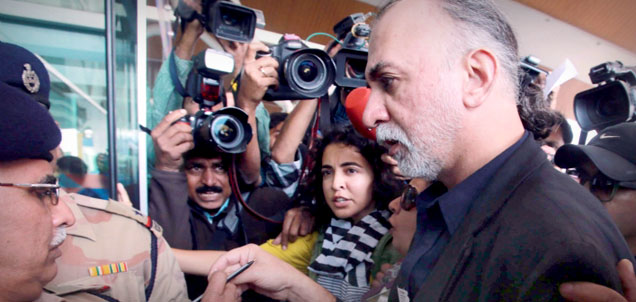
 Hemant Morparia is one of India’s best known editorial cartoonists. Other than a daily pocket for Mumbai Mirror, he toons for various Indian and international publications. When he not drawing, he’s into photography, travelling, archery and assorted reading. He’s also a radiologist and sonologist at Mumbai’s Breach Candy Hospital.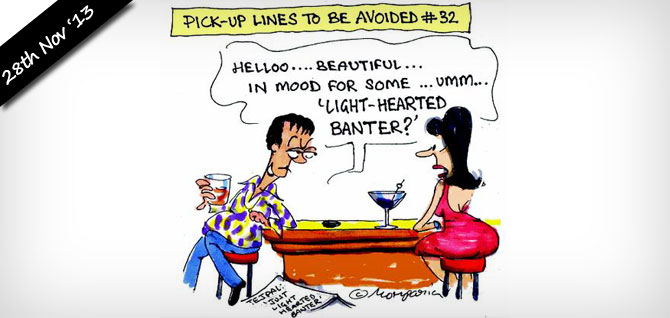
 By Geeta Seshu


 Media ownership is a worry to the extent that journalists are not able to withstand corporate pressure. For instance, the Birlas started Hindustan Times and the Tatas has a stake in The Statesman (to name just two) and the battle between marketing and editorial is as old as the profession. The problem comes when senior editors capitulate and reader interest is surrendered or sacrificed. I would turn the spotlight back on journalists: are we fighting the good fight?
 Many years back when I asked a leading industrialist why he was keen on starting a news channel he replied with the famed Deewar dialogue (some alcohol in the system did the trick): Aaj mere paas buildingey hai, gaadi hai, bank balance hai, but even then these guys owning newspapers and channels are ruling the world. We were in the late 1990s, and journalists and news media owners were indeed much sought after. That may have waned over the years, but the desire to own news media stays. What hasn’t changed is that the intent of owning the news media goes far beyond returns on investments.




 By Anil Thakraney