
Tag: TAM Media

  • TAM launches CRISP to track consumer reviews & influencer sentiments for brands

    By A Correspondent


    TAM Media Research has announced the launch of CRISP, an analytics tool to help decode consumer sentiments in the Indian marketplace. CRISP is short for Consumer Reviews & Influencer Sentiments for Brand Performance. The product is specially crafted for marketers to gauge and understand the actual consumer reviews/ sentiments and augment the consumer product connect, notes a communique. TAM has partnered with Revuze, a global product experience management specialist.


    Speaking on the launch, L V.Krishnan, CEO, TAM Media Research: “Today’s evolved Indian consumer is not just pragmatic about the products they purchase but extremely vocal and quick to give reviews. For a Marketer, these customer feedbacks can help realign product and communication strategy effectively. Hence, it is crucial for Marketers to constantly keep track, understand and re-connect while managing consumer sentiments towards Brands. TAM has partnered with Revuze to bring a new age, robust, data analytics tool – CRISP, for Marketers to decode the realms of unstructured feedback data from consumers and retrace it back into defining sharper rrand strategies. In a fast-paced evolving environment, it can be a crucial weapon for marketers to win additional brand sales and market shares. CRISP will help build the much-needed superior analytical prowess within the marketers business and help analyse product usage, identify areas of product/service improvement based on feedbacks so as to take quick footed decisions.”


    Added Shai Etzion, CRO, Revuze: After showing significant success in the USA, Revuze is entering the Indian market partnering with TAM Media, a natural choice being our mutual Nielsen family relationship and their 20+ years’ experience in deep understanding of the Indian media landscape. It will be a compelling product and a gamechanger for India to understand consumer sentiments and reviews.


  • Panel-based measurement is better: LV Krishnan


    Last week, the Kantar Media-Nielsen jv TAM Media and Kantar-owned IMRB announced the TeleWeb ratings for an integrated study of viewership on television screens and the internet – desktop/laptops as well as on devices. We caught up TAM CEO LV Krishnan to understand the finer details of the offering…


    You had spoken about the multiscreen measurement earlier. But do you think it could’ve come in a year or two earlier?

    Well, it required a lot of work to put it together because one is a non-linear medium and the is a linear one. To bring together both into the same database and be able to tell an advertiser that using a combined medium maybe better than using one medium etc requires work. We did a lot of groundwork. If only publishing numbers in terms of saying which sites were getting hits and which sites were getting what kind of profile of audiences. it could’ve been easy. It could’ve happened much before than now. Probably about 4-5 months back. But to integrate both, this is the earliest we could’ve got to.


    Given that there is an MoU with BARC on meters the merger move is work in progress, what happens after the merger happens?

    We’ll see it at that time.


    BARC is also doing something similar, it is also looking at multiple screen measurement.

    From our perspective we are looking at the present moment of time. We’ve done almost a year-and-a-half of work into this exercise. Obviously, since we are still running the television panel, the idea was to launch it and help the industry use it. What will happen a couple of months down the road is something we haven’t thought about at all. From our perspective, the work on TAM BARC integration is going well at a high speed level. That’ll continue.


    Since IMRB’s digital measurement exercise has been on for some five years now, couldn’t this have happened earlier?

    Two important things. Before we launched something like the integrated data we also needed to ensure the fact that the two panels are stable. TV was completely stable. The online one was a new one launched around 2011-2012. So it took time for that panel to settle down and get used on a regular basis because at that time if you look at it the advertising online was hardly around 2-3% of the advertising that was going over there. So, even if we had launched at that particular moment of time, the integrated quotient, the usage could’ve been very low. The demands coming in from the advertisers that we need do it the integrated way. Only in the last one year, in the beginning of 2014, when we were interacting with advertisers that there was a huge push going towards digital. Probably also because of the fact that most of the advertisers were MNCs were also being pushed by the global directors saying that let’s get starting investing on digital because globally digital was picking up strongly.


    What we previewed at the press conference last week was about English channels and the Hindi news channels. But I’m sure the difference is significant with English GECs.

    English GECs are basically international sites. So, we need to see what you want to track within that and how much of it is with the Indian audience largely. So, probably with time we’ll look at English entertainment also as a next step.


    Do you see a lot of viewing happening online in the case of all GECs?

    There is dailymotion.com, Hotstar, Sonyliv, Ditto, all of them are coming in the Top 50 sites. Platforms like Hotstar are among the Top 5.


    Now a channel like Colors has ‘Comedy Nights With Kapil’ which is among the most watched as per your numbers, but a channel like Colors which targets urban audiences is not in top channels list in tele-web, vis-à-vis Zee which is on the list?

    That’s because of Ditto TV. Ditto is the push for Zee. It has certainly got some audience in the metro markets. Colors is yet to have a platform that could be visible and for which audiences are walking in.


    So, will you say OTT is playing a big role?

    Yeah, certainly.


    What is the kind of response that you’ve seen from the advertising community, from the advertising agencies and media agencies?

    We don’t know yet the response because we just launched today but we’ve been working with the advertisers on this for almost a year now. We connected with them and we realised what they are looking for. So, therefore from that perspective this is exactly matching up to what their expectation was from a feasibility perspective of trying to alleviate a campaign on a multimedia level.


    There is no joint industry body to contend with the way you work. There is no industry association as such…

    No, there is no industry association involved in this. We are on our own and like any other research we are marketing it on our own for users to take their independent decisions whether they want to buy it or not or use it or not.


    There have been views on the entire element of panels. In the case of television, the cost of set-top boxes ensured that the sample size of panel homes couldn’t grow. But no such thing exists for the internet, so why only 6-8000 sample size? Do you think it can be browser-driven so that anyone can download and install?

    There are two different kinds of measurements that happen across all media. One is measurement based on universe and second one is measurement based on panels and specific sub-groups of profiles. The problem comes in when the universe study is when you don’t know who the individual is, who is responding to a particular viewing. So, most of the dynamics related to the universe measurement is already available with the publishers themselves like a Google or a Facebook knows about their customers largely and to that extent Facebook I could say knows it even better because age and gender is something they capture apart from the geographic location which is universally available to them. So, therefore, from a universe perspective, limitation is a fact that while you’ve a larger base you don’t know who that base is, who that individual is in terms of profile. So when you are targeting it, you are targeting more based on the behaviour pattern of the respondent rather than on the basis of demographics. In a panel0based exercise you are able to measure demographics as well as in terms of behaviour patterns together. So you know individually what the profile of the guy is, what profile of home he comes from, what are the numbers in the home, what are the platforms they have in the home that can be access point or a competitive perspective, a competitive touchpoint. So, all this kind of information is available on a panel-based exercise. Therefore, we are able to integrate between two mediums very effectively in this kind of a panel-based exercise. In a universe level it’ll be very difficult to integrate two measurement systems. So, largely speaking, for an understanding of a consumer behaviour and trying to monitor it on the basis of his behaviour, a panel makes sense actually. But in the longer run, we could actually do it the way it happens in television where the set top box data and the panel data work together. To therefore use a panel data is to optimize the set top box data. Similarly here too the panel-based data can be worked on to the universe data. You could mine better data at smaller discreet levels. These things will happen in future.


    How much of the TAM sample are you looking here?

    Six metros put together will be about 10,000 individuals actually, which is close to 2500 paneled homes.


    On a lighter note, had the news on NDTV scoring so high on TeleWeb come in earlier, things would’ve been much nicer for TAM?

    No, we take it as it comes. For us the most important thing is to indicate what is happening in the behaviour front. Business decisions are taken by users.


  • India-SL Test series helps Sony Six: TAM data

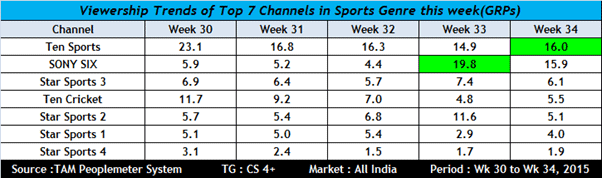
    Cricket rules, you can ask any Kabaddi captain this, and he or she would rue that despite all of the promotional efforts, cricket scores the highest. Thus, Sony Six has put up a noteworthy performance thanks to the airing of the India-Sri Lanka Test series, as per an analysis of TAM Media’s analytical arm – the S Group


    As is evident in the above table, Sony Six saw a sharp rise in its viewership in Week 33 leading the channel to gain the leadership position in the genre. The major reason for the leadership was airing of the India-Sri Lanka Test from  August 12 to 15. Week 34 saw the channel drop to a close second position in the sports genre as data for only three days of the second Test was available.


    The viewership from match airing alone contributes to more than 60% of the viewing on the channel with a GRP of 12 and 10 in Week 33 and Week 34, respectively.


    Overall the match was able to reach out to 8.05% & 6.98% of audience in Week 33 and Week 34, respectively.


  • TAM’s AdEx to certify ad spots for Amagi

    By A Correspondent


    Amagi has announced that its ad spots will be certified by AdEx India, a division of TAM Media Research. AdEx India is the country’s most prominent advertising monitoring and information unit. This arrangement has come into effect from 1st, February, 2015.


    The certification adds a new dimension to Amagi’s offering of geo-targeted advertisements on television. An endorsement of Amagi’s ad-spot reporting mechanisms, the certification will include proof of execution and time of delivery, which will be included in the company’s post-campaign report. The certification is currently specific to Zee TV ad-inventory purchased through Amagi.


    Speaking about the development, Amagi business head, LS Krishnan said, “The TAM-AdEx certification adds value and integrity to the reporting of our ad campaigns. This partnership will add not only add credibility but also ensure transparency to the ad play-out process, a realignment which media planners have been waiting eagerly for. A first-of-its-kind certification for India’s geo-targeted TV advertising industry, this will help accelerate the adoption of geo-targeting by advertisers. This substantiates our commitment to a value-driven and effective advertising service. As a pioneer in this industry, we see it as our responsibility to grow the world of targeted advertising in India and this is a big step in that direction.”


    Amagi’s geo-targeting will help media planners, marketers and advertisers across the country plan their budgets more effectively. It also gives agencies the opportunity to offer specific, result-oriented campaigns to their clients across sectors.  Furthermore, the TAM-AdEx certification ensures that media planners can now be absolutely certain about their reporting for geo-targeted ad campaigns.


  • Rebranded Eikona to offer solutions for Earned Media management

    By a correspondent


    After having set many proactive PR measurement and audit benchmarks for the industry, a vibrant and freshly rebranded Eikona is all set to aid the brand custodians (client organization and its agencies), with end to end solutions on brand management through Earned Media. The objective is to play an intrinsic role in helping clients and agencies at every step of their brand communications planning, execution and review process.


     

    Eikona shall offer holistic, neutral, one stop research and data solutions for Earned Media management. Eikona’s service span will include helping brand custodians listen to the mood of the market, set communications targets, monitor execution, audit & advisory and finally, establish Earned Media’s impact on brand reputation.


    LV Krishnan

    LV Krishnan, CEO, TAM Media Research, commenting on this initiative, said, “Our organization is very uniquely placed. While through TAM & RAM we help the industry understand the TV & Radio consumption patterns & dynamics of Indian consumers, what makes us come a full circle is our ability to not only monitor & correlate a brand’s Paid Media initiatives through ADEX and but also the Earned Media initiatives through Eikona. These data sets help industry scientifically understand and correlate brand’s Visibility as well as its Reputation.”


    Siddhartha Mukherjee

    Explaining Eikona’s focus on Earned Media management, Siddhartha Mukherjee, Sr. VP, Eikona, said, “We are living in a Reputation Economy. Here is where, Earned Media is fast moving towards the centre stage of any Brand Building or Sustenance exercise.  While the need to manage this space has become quintessential, it is the methodology of managing & leveraging Earned Media that is becoming a complicated combination of art & science. Eikona will focus its energies in helping Brand Custodians with step by step, end to end solutions starting with Communications Planning, Execution checks, Audits & Advisory, and finally, helping establish Earned Media’s impact on Brand Reputation scores.”


  • Pradeep Hejmadi to be Business Head, Zee TV

    By A Correspondent


    Pradeep Hejmadi, Senior Vice President at TAM Media, is set to join Zee Entertainment as Business Head of the flagship channel, Zee TV.


    While his decade-odd stint at TAM – especially the S group which was engaged in the consulting operations of the measurement company – will ensure that he steers Zee TV to the top of the heap of general entertainment channels, Mr Hejmadi or Praddy, as he is known in the trade, is no newbie in broadcast. He has held key portfolios at Discovery, Nickelodeon and Turner Broadcasting.


    At TAM, he reported to LV Krishnan. He is likely to take charge at Zee by mid-June, 2014


  • Star Plus stays #1, Colors and Zee at #2 and #3.

    By A Correspondent


    The GVTs of Week #46 of the calendar year 2013, according to TAM, show Star Plus leading in the Hindi General Entertainment category. Star Plus scores 529193 GVTs, a little below the previous week’s 536270. Colors and Zee were placed second and third as per the GVTs.


    The following are the ratings of the leading Hindi GECs. Figures in brackets are those for Week 45.


    Star Plus         529193            (536270)

    Colors              479010            (486423

    Zee TV             440447            (428610)

    Life OK            340200            (344624)

    SAB                 315637            (310534)

    Sony                297801            (341054)


    Please note that the information has not been supplied and verified by TAM Media. However our source is reasonably reliable.


  • Star Plus reign continues as LC1 data makes debut

    By A Correspondent


    The ratings numbers from TAM Media including LC1 markets are out.


    Here is the data for Week 5 of 2013 for Hindi GECs. Figures in brackets include Week 4 and Week 1-3 Average.


    Star Plus 281(233) (258)

    Zee TV 214 (245) (214)

    Colors  210 (195) (219)

    Sony 159 (186) (174)

    SAB  134 (145) (145)

    Life OK 121 (114) (115)

    Star Utsav  52(53) (53)

    Sahara One 24 (25) (26)


    Please note that TAM Media Research does not share weekly ratings data with the news media, as it would early last year. While the data above has been sourced from a reasonably reliable source, we would urge readers to verify these.


  • Hindi GEC yo-yo continues. Star leads in Week 51

    By A Correspondent


    According to Week 51 GRPs of the Hindi General Entertainment Channels, Star Plus is steady at 231 points and manages to take a lead over Zee and Colors. Zee stands at 226 GRPs, up from 191 in Week 50. After reigning the GRP chart with 239 GRPs last week, Colors was now placed with 223 GRPs.


    Sony also lost a few GRPs in Week 51 as it secured 192 GRPs from 201 in Week 50 even as Life OK overtook SAB by a point at 144 GRPs. However, SAB rose three points to 143 GRPs from 140. Sahara gained a point (23 in Week 50) and stands at 24 GRPs in Week 51.


    Please note that the information has not been supplied and verified by TAM Media. However our source is reasonably reliable.


  • RAMcheck: Most popular FM stations heard out of home

    By A Correspondent


    Unlike our regular RAMcheck reports which didn’t differentiate between any places of listening, this time MxMIndia decided to concentrate exclusively on radio channels’ out of home (OOH) listenership. According to RAM (Radio Audience Measurement), the OOH listeners include listenership in cars, at work and other out of home places. TAM Media’s Radio Audience Measurement from week 40-43, 2011 to week 52- 3, 2012 reveals the most popular FM radio station out of home. RAM is currently present in four metros – Mumbai, Delhi, Bengaluru and Kolkata.


    Mumbai:

    According to the RAM data for OOH listenership, the top five FM stations for Mumbaikars are Radio Mirchi, Big FM, Radio City, Fever FM and Red FM, excluding the government-owned AIR FM2 Gold. The radio stations, from week 40- 43, 2011 to week 52 to 3, 2012, have not seen much variation in their channel shares.


    Delhi:

    In Delhi AIR FM2 Gold is the most popular FM station followed by Fever FM, a strong number two in OOH listenership share. While the number one and two slots have a clear position in OOH listenership, there is no clear winner for the number three position. There is a close fight for number three position between Radio Mirchi, Radio City and Red FM. However in Wk 52′ 2011 to Wk 3′ 2012, both Radio Mirchi and Red FM received 12.4 per cent station share whereas Radio City received a station share of 11.1 per cent. The other FM stations in the Delhi market include Big FM, Radio One, Oye!FM, Hit FM, AIR FM1 Rainbow, Vividh Bharati and Akashavani Delhi.


    Bengaluru:

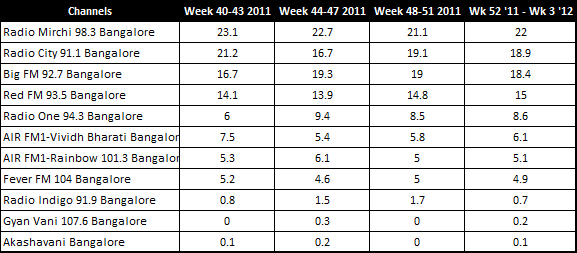
    Radio Mirchi is the number one FM station in Bengaluru followed by Radio City, Big FM, Red FM and Radio One. Between Wk 40- 43, 2011 to Wk 52, 2011-Wk 3, 2012 the radio channel share for Radio Mirchi was at its peak in Wk 40 -43, 2011 with a share of 23.1 per cent. Radio City, the second most popular FM station in OOH listenership, was also at its peak in wk 40 – 43, 2011 with 21.2 per cent share. However in week 52, 2011 – Week 3, 2012 the station share for Radio Mirchi dropped to 22 per cent whereas Radio City’s share was 18.9 per cent. The other clusters of FM stations in Bengaluru are Fever FM, Radio Indigo, AIR FM1, Vividh Bharati, AIR FM1 Rainbow, Gyan Vani and Akashavani Bengaluru.


    Kolkata:

    Kolkata has a clear number one and number two FM stations in Friends FM and Radio Mirchi. Ranked third is Red FM. The gap between the top three FM stations is significant. While Friends FM received a market share of 23.4 per cent in Wk 52, 2011 – Wk 3, 2012, the same week saw Radio Mirchi receive just 18.3 per cent market share and Red FM receive 12.4 per cent share. The other clusters of FM stations in Kolkata are Fever FM, Aamar FM, Air FM2 Gold, Oye! FM, AIR FM1, Rainbow, Radio One, Power FM, Akashavani and Vividh Bharati Kolkata.