Tag: Taj Hotels

  • Customer satisfaction dips for Indian brands


    By Our Staff


    Havas CX, the Havas Group’s global customer experience network, has launched the X Index Report 2022. The report indicates that trust, inclusivity, always being of service, and going above and beyond are now major factors in creating the most meaningful customer experience.


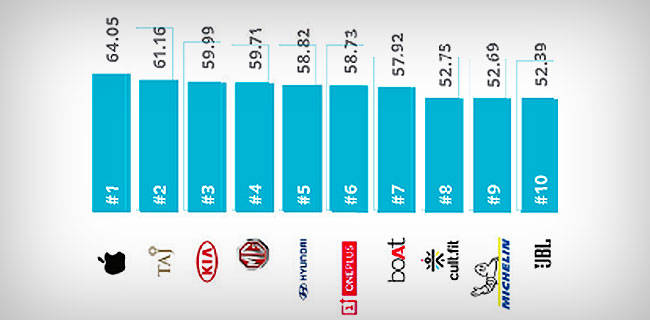
    According to the X Index India report parameters, the #1 brand is Apple followed by Taj Hotels, KIA, MG, Hyundai, OnePlus, Boat, Cult.fit, Michelin and JBL.


    Fifty leading brands across 13 categories including retail, fashion, financial services, automotive, entertainment, hospitality, beauty, health, and more were studied from India for the recent study. What’s interesting is that among the six countries also surveyed a year earlier, only India registered a lower overall score in 2021 compared with 2020. The higher scores in the other five markets (China, France, Portugal, UK, and the US) point to rising satisfaction with the customer experience. What this means is that while most geographies were able to leverage the new normal to cement their CX and deliver on consumers’ rising expectations, Indian brands were not as agile to keep up with the rising expectations. This makes it even more critical for Indian brands to now recognise that customer experience is synonymous with brand experience.


    For the second consecutive year, brand image has emerged as the strongest competitor to the X Index, representing 46% of India’s score. This hints at the fact that while ecosystems and the touchpoints were expanded during this new normal, brands also need to maintain continuous engagement to reinforce their image while also making it part of their CX.


    Despite heavy customer experience investments by brands, there’s still room for improvement with only a global average of 40% of consumers thinking the brands they interact with are “cantered on their needs as a customer.” This year’s research reveals that increased consumer expectations around trust, sustainability, and inclusivity are now impacting the evaluation of customer experience, with brands being assessed on the concrete actions they deliver to create a welcoming experience for all – shifting the traditional idea of customer experience to citizen experience.


    Said Prashant Tekwani, EVP & Business Head, Havas CX India & Havas Worldwide, West: “The pandemic has brought about a sea-change in consumer shopping behaviour. Brands now need to evolve their thinking from customer experience to citizen experience by making seamlessness and inclusivity their priority. According to the latest X Index report, India is the only country to register a lower overall score in 2021 in comparison to 2020. There is a gap that needs addressing for brands in India to score high in the CX journey. This shows how the understanding of the evolving expectation of the consumers is critical to maintaining the health of CX, growth and brand imagery. While meeting functional criteria around seamlessness, simplicity, and efficient customer service, brands must also go the extra mile to make a lasting impression in their customers’ minds.”


    Added Sumeer Mathur, National Strategy Head & Managing Partner, Havas Worldwide India: “Interestingly, out of all the parameters that we measure to arrive at a final score, the Brand image has emerged as the strongest contributor to the X Index, representing 46% of India’s score. This hints at the fact that while ecosystems and the touchpoints were expanded during this new normal, brands also need to maintain continuous engagement to reinforce their image while also making it part of their CX. Conversely, it could also mean that Indian brands are under leveraging other parameters and relying too heavily on the brand image alone to determine the customer experience.”


    The X Index identified four key principles to create a best-in-class citizen experience:


    Trust comes first: Brand trust is the most powerful denominator around the globe in the customer journey. Brands build trust by keeping their commitments to customers and being there in times of crisis. For example, brands that optimized their shopping experience during the COVID-19 pandemic saw better results; these optimizations included moving many traditionally in-person services online (consultations, etc.), and taking advantage of new platforms to integrate community building and social components. Brands also build trust with transparent business practices and by making commitments to social causes.


    Build an all-inclusive experience: For customer experience to become a citizen experience, brands must be inclusive. According to the X Index, consumers evaluate brands at every step of the journey, including the way they treat their frontline employees, foster inclusivity and break taboos in representation and marketing. Inclusivity also means enabling customers to participate in a community, with some brands introducing forums, clubs, and apps for customers to connect and interact with each other.


    Always be of service: Customer service is now defined by the speed of reaction to customer demands. It is one of the key discriminating factors. In addition, when it comes to staff and salespeople, consumers not only expect them to be efficient but also knowledgeable.


    Provide for the age of extra: When it comes to satisfying customers, going the extra mile is of paramount importance for brands. A key part of going above and beyond in making sure the experience feels extra personal.


  • Starbucks for festive season flag off in Mumbai

    By Arun Kumar & Rasul Bailay


    Starbucks Coffee Co and its Indian joint venture partner Tata Group have plans to open around 40 stores by December, half of those in hotels and the rest in high-street malls, a person with the direct knowledge of the plans said.


    The person said the 50:50 joint venture, Tata Starbucks, has so far lined up 14 properties in malls and high streets in the New Delhi capital region, Mumbai, Bangalore and Chennai and will make its India debut in September or October from the commercial capital, Mumbai.


    The firm will adopt a cluster approach to simultaneously open three to four outlets in each city they initially go to. Mumbai will be followed by the National Capital Region, Bangalore and Chennai. The properties finalised in hotels include the Ambassador and President hotels under the Vivanta by Taj label, a contemporary luxury chain just notch below the super luxury Taj brand of the Tata group.


    “We are looking at both Tata properties as well as non-Tata properties and will focus on how we can become part of the local community where we do business,” a Starbucks spokesperson said in an e-mail reply. The alliance is also in talks with non-Tata hotel chains such as Marriott Hotels to open their outlets.


    The joint venture will invest Rs100-150 crore this year alone and has a total budget of $100 million (around Rs 550 crore) to invest in India in the next two to three years, the person familiar with the plan said.


    He added that the Seattle-based coffee chain – the largest in the world – will manage the business and source many of its staff from the Tata-owned Taj Hotels. All the stores in the initial stage will have a combination of the lounge as well as takeaway facilities, he said.


    Starbucks operates more than 17,000 stores in almost 60 countries. The coffee titan has been exploring possibilities to enter India for many years. Earlier it had made an abortive attempt to foray into India before it called off a joint venture involving its Indonesian franchise and Kishore Biyani of the Future Group. In 2007, the joint venture withdrew its foreign investment proposal with the Indian government without citing any reason.


    Now, Starbucks is back with a new partner and is bullish on India, a country with one of the lowest rate of coffee per capita consumption in the world.


    Local chain Cafe Coffee Day and global chains such as Barista Lavazza, Costa Coffee and Gloria Jeans are among others currently operating around 2,000 outlets in the country.


    Industry estimates that the Rs 1,000 crore coffee-through branded outlets sector is growing at an annual rate of 20 per cent. “I don’t see Starbucks as a competition… I see them as a player who will make drinking coffee through outlets a routine business,” said Virag Joshi, chief executive of Devyani International, which operates more than 100 Costa Coffee stores in India.


    The company plans to invest Rs400 crore to add 400 more outlets in the next five years. “The market will keep evolving and will keep growing over the years,” he added.


    Source: The Economic Times

    Copyright © 2012, Bennett, Coleman & Co. Ltd. All Rights Reserved


  • Tata group firms to launch common loyalty plan

    By Sagar Malviya


    Tata Group’s consumer-centric firms including Taj Hotels, Croma and Westside will soon initiate cross-marketing activities such as promotions and campaigns by sharing customer database and insights.


    “What we plan to do is leverage different databases and provide more value to the customers,” says Akash Sahai, managing director, AIMIA India, a joint venture between Tata Capital and Canadian firm AIMIA (formerly Groupe Aeroplan) that will launch a common loyalty card for clients within and outside Tata Group.


    “For instance, we are using the database of Taj Hotels to give its customers additional promotions at Tata’s department store Westside,” he says. “Similarly, consumers could use Tata Capital card at Westside and Croma for added benefits and finance schemes.” Most Tata Group companies have been working together in legal, real estate sourcing and IT services among other administrative work, but the conglomerate so far did not have a common customer relationship management (CRM) programme for its half a dozen consumer-centric companies spanning retail, consumer goods, hospitality, financial services and telecom segments.


    AIMIA has started managing Taj Group’s customer relationships and will soon include other consumer firms of the group to create a unified CRM programme.


    Customer service is clearly emerging as a differentiator for consumer-centric companies as competition increases and consumers become more empowered.


    Several global multi-partner loyalty operators have set their sights on the Indian market, valued roughly around $1 billion.


    While Tatas roped in AIMIA last year, another Canadian firm, LoyaltyOne, has acquired a stake in local firm Directions. Kishore Biyani’s Future Group, the country’s largest retailer, is partnering German loyalty management firm Payback.


    Penetration of loyalty cards in India is just 42% of organized retail consumers with an average of 2.8 cards for each person compared to 74% penetration at an average of 3.8 cards for each consumer in the US.


    LoyaltyOne Chief Marketing Officer Rathin Lahiri says loyalty programmes will help marketers leverage consumer insights for developing customised programs. “That will not just impact the way that consumers respond to their brands, but also in the long term will shape their buying patterns,” he says.


    AIMIA will launch its multi-party loyalty card later this year. Apart from Tata Group firms, it is in talks with several non-competing brands in the aviation, petrol retailing and financial services space to launch a loyalty card to be used across companies.


    Source:The Economic Times

    Copyright © 2012, Bennett, Coleman & Co. Ltd. All Rights Reserved