Tag: SVOD

  • Not at all Quiet on the OTT Front


    By Shailesh Kapoor


    Shailesh KapoorOver the last three years, it became abundantly clear that streaming (or OTT, as it’s called in India) is the medium of the future in this country, even as other media will continue to co-exist. Linear television always had the numbers. But thanks to a mix of factors, ranging from the pandemic, to ever-reducing data costs, to a nosey TRAI, linear television has barely managed to stay afloat. Pressure on revenues has been felt across the board, and that’s never a good sign.


    Streaming itself is trying to find its sweet spot. Is it a premium paid (SVOD) medium, as all the promotions of well-mounted web-series suggest? Or is it a medium for the ‘masses’, where free (AVOD) content is going to dictate the future? The jury has been out. And the last few weeks have seen their share of action on this front.


    Perhaps the biggest shift in the dynamic has been around the IPL. The 16th edition of the league, which starts March 31, will stream free on JioCinema. That’s a polar opposite to how it was thus far: IPL was a subscription (and hence, revenue) driver for Disney+ Hotstar, not just in India but at a global level too.


    Then, there’s the talk of the largest AVOD player in India outside of YouTube, i.e., MX Player, being up for sale. The content side is going through its continuous evolution. For example, price points for acquiring streaming licences to theatrical releases have not stabilised yet.


    All these are healthy signs, one would think. A growing category is bound to see new ideas, new strategies, and new alignments. And some of these may shape the future of the category. For example, there is little doubt in my mind that IPL’s streaming viewership will outnumber that on linear television this year.


    How did linear television find itself in this situation is a matter of another debate. But it should not have, because it’s still the staple, go-to medium for millions of Indian families every night. But the only way you can fight technology is by building a precise and relevant narrative. The linear TV industry has failed to do that for itself.


    Amidst all the positive action, the talk of censorship of streaming content has started again. This week, the I&B minister advocated censoring “vulgarity”. The genesis of this not-so-veiled threat lies in a Delhi High Court judgment will handling a complaint on TVF’s show College Romance. The state and the judiciary playing moral police can be a major irritant in a category that’s otherwise amid a period of high activity and growth.


    All eyes, hence, are on India’s streaming story, in its second phase, where the category seeks stabilization and re-alignments. And the upcoming IPL will set the ball rolling on that front.


  • Farzi: The Real Thing


    By Shailesh Kapoor


    Shailesh KapoorIt’s not a major talking point yet, but the OTT Hindi fiction space may just have entered its second innings. Farzi, Amazon Prime Video’s recent launch, has amassed huge viewership numbers, and is almost certain to become the most-watched SVOD show in India across platforms by the end of next week, based on Ormax Media’s viewership estimates for OTT originals in India.


    The success of Farzi marks the end of a lean period that started in mid-2022. The first half of that year saw a good mix of launches: Panchayat S2 proved to be a worthy successor to the delightful first season; Rudra received mixed audience response, but went on to get huge viewership, thanks to Disney+Hotstar’s sizeable subscription base and Ajay Devgn’s star value; Rocket Boys received immense appreciation, and was Sony LIV’s tentpole property for the year; Gehraiyaan delivered some solid numbers in the first week despite mixed to negative audience feedback; starting off as a low-profile film, A Thursday went on to become the most-watched direct-to-OTT film of the year; Human, The Great Indian Murder, Gullak S3 and Mai were fairly successful as well, especially for shows of their scale.


    But then started a drought of sorts. The second half of 2022 just didn’t have enough firepower. Criminal Justice: Adhura Sach managed to build good viewership, perhaps aided by a staggered episode drop, but scored below the show’s previous (second) season on audience likeability. The same can be said for Delhi Crime S2, which lacked the relevance of the first season that focused on the landmark Nirbhaya case. Films like Monica, O My Darling and Darlings good positive reception, but the viewership levels were only moderate.


    The lull continued till the launch of Farzi on Feb 9 this year. The show recorded a peak ‘Buzz’ of 45% on Ormax Stream Track, the highest since The Family Man S2 in June 2021, incidentally another show by Raj-DK, the creators of Farzi.


    There were more than 150 SVOD originals that launched in Hindi in 2022. But clutter generally comes with its share of issues. In a year where the conversation moved back to theatrical content, the absence of truly marquee shows on streaming made one wonder if the honeymoon period that the streamers enjoyed, especially during the two pandemic year, is over.


    Farzi can be called the start of a new phase in the Indian OTT originals market. The category is more mature and stable now, and one hopes that, like theatrical, it finds its equivalent of an “event film”. Six-eight “event shows” in a year will keep the category running strong. Farzi is 2023’s first, and one hopes the next one is round the corner.


  • Ormax Media releases study to size OTT audience

    By Our Staff


    Media consulting firm Ormax Media has released an audience research to size the OTT universe in India, titled The Ormax OTT Audience Sizing Report 2022. The research, based on a sample size of 13,500 across urban and rural India, was conducted from July to September 2022.


    Ormax Media released select findings of the report, which reveal that the Indian OTT audience universe is currently at 423.8 Million (or 42.38 Crore) people. This translated into a penetration of 30%, which means that 3 out of 10 Indians watched online videos at least once in the last one month. The report breaks this universe by gender, age, NCCS, pop strata, states and cities.


    Speaking about the need for the report, Shailesh Kapoor, Founder & CEO – Ormax Media, said: “India’s OTT audience universe has grown rapidly since 2018, with a boost during the pandemic years of 2020 and 2021. Now that we are in a more settled, post-pandemic period, this annual report is an important reckoner for the OTT industry to understand how their audience base is growing, and where this growth is coming from. Unlike other reports that rely on desk research, this report is based on primary audience research across India.”


    The report also reveals that there are currently 119 Million active paid OTT subscriptions in India, across 49 Million paying (SVOD) audiences, i.e., an average of 2.4 subscriptions per paying audience member. 65% of these paid subscriptions are with male audience. The top 6 metros contribute only 10% to India’s OTT universe but 33% to total paid subscriptions in India. Mumbai, Delhi and Bengaluru, Delhi and Mumbai are the top 3, with more than 8.5 Million active paid subscriptions each.


    Speaking about the findings, Kapoor said: “A large share of the 20% growth in audience base has come from rural India and small towns. The metro cities have reached saturation levels, with more than 79% OTT penetration. Platforms will have to rely on the smaller markets for the next phase of growth. From an SVOD perspective, the most significant finding has been that the average number of subscriptions have remained static at 2.4 per paying user. This data point holds immense strategic value, as it suggests that subscriptions growth will come from more people paying for subscriptions, than the same people paying for more subscriptions”.


  • Samsung Ads & Verve table survey on response to ads on TV

    By Our Staff


    Samsung Ads India, the advertising division of Samsung Electronics, partnered with global market research agency Verve to survey a panel of 700 Smart TV users in India.  The research aimed to uncover advertising engagement across various TV platforms, including linear TV (cable) advertising supported video on demand (AVOD) and subscription based video on demand (SVOD) that are set to introduce ads as part of some subscription tiers.


    Said Prabhvir Sahmey, Senior Director, Samsung Ads India & South East Asia, of the report: “The Indian market demonstrates a high degree of receptiveness to ads shown to them on their TV screens. To maintain this momentum, it’s important for advertisers to understand the dynamic TV landscape and how audiences respond to differing  platforms so that ads can be delivered to the most appropriate audiences at the right moments. To keep high degrees of engagement, a data-driven approach to advertising will be critical so that brands continue to  reach the right audience with the most relevant message at the best time. ”


    According to the survey, 81% of Indian consumers are happy to watch ads on their TV screens in return for free content, according to a new study commissioned by Samsung Ads India.


    :: Relevancy of ads

    In addition to the vast majority of respondents who are willing to watch ads in exchange for free content, a similar amount (80%) claimed to be happy to watch ads if they featured content relevant to them.

    Respondents considered AVOD and SVOD services to be the best at delivering relevant ads with 63% and 64% of respondents agreeing, respectively. More than a third of Indians (38%) [LB1] who watch ads in full on AVOD find them to be engaging due to their length and relevance. The ads are perceived as shorter and therefore less disruptive to the viewing experience.


    :: Emotional response

    According to the research, over half of respondents in India demonstrated a positive emotional response to ads across all platforms. Both SVOD and AVOD generated the most positive emotions amongst audiences.

    SVOD prompted 63% of respondents to feel excited, whereas AVOD prompted 60% of respondents to feel the same emotion. Similarly, 64% of respondents thought SVOD ads were enjoyable and 62% considered AVOD ads to be enjoyable.

    These positive reactions help to explain why Indian respondents said they were more likely to take action in response to advertising on AVOD (64%), followed by SVOD (62%).

    This reflects how effectively streaming services have been at delivering ads to Indian audiences in OTT settings. Unlike in other markets, Indian audiences demonstrate little distinction between these services, with some SVOD services already offering an ad-supported tier. Whilst SVOD is a strong performer in India, there is consumer frustration that ads are being shown on paid subscription-based channels. Whereas in other markets, the introduction of ads to the streaming giants is still very much in its infancy.


    :: Trustworthiness of ads

    Just under two thirds (62%) of Indian respondents were likely to take action in response to an ad shown to them across all three platform types (AVOD, SVOD, and linear). This is likely a reflection of how highly this market trusts the ads which are delivered to them.

    More than 60% of respondents in the survey considered ads across platforms to be trustworthy. This is highest in an SVOD setting where two thirds (66%) of respondents trusted the ads. Similarly, 64% of Indians trust the ads they are shown in AVOD.


  • Smalltown India is the future for SVOD


    By Indrani Sen


    Indrani SenOrmax Media, a specialised Insights consultancy firm, was established in 2008. In its own words: “Over the last 13 years we have pioneered the usage of various testing, tracking and forecasting-based tools, designed to achieve higher profitability in films, television, streaming, print, radio and other categories in the Indian media industry… We are constantly innovating to introduce new tools and build knowledge that can help the Indian media & entertainment industry use consumer insights and data analytics to create businesses, brands, shows, films and campaigns that are both consumer-centric and profitable.”


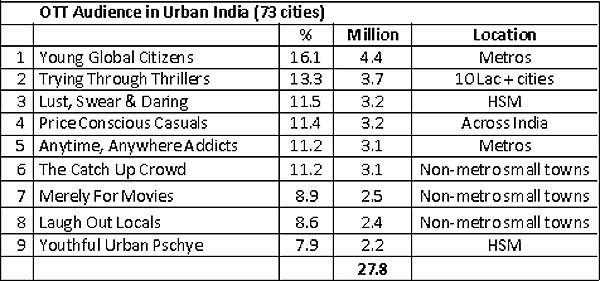
    Ormax Media launched the first edition of its Ormax OTT Audience Report 2019 with a promise to conduct similar reports year on year. In its first report, Ormax analysed the viewing behavior by preference of content watched and divided the urban OTT audience into interesting segments of nine different types.


    Source: OTT_AudienceSegments_OrmaxMedia__1_.pdf


    The onslaught of Covid-19 and the national lockdown forced them to miss the opportunity of conducting field research in 2020. But Ormax was back in 2021 with the 2021 report based on a 12,000 sample size across urban and rural India. As per that report, OTT audience universe in India in 2021 stood at 353.2 million (35.32 Crore) people. In other words, the penetration of OTT viewing was of 25.3% of the population, “which means that one in four Indians watched online videos at least once in the last one month”. The report was aligned to other syndicated media research and presented analysis of the universe by gender, age, NCCS, pop strata, states and cities.  This second report elevated OTT from a niche medium to a mass medium with huge prospect for further growth. It was possible to calculate reach of the OTT medium in different target audiences for the first time. The report also revealed that in 2021 there were 353 million OTT users in India of which 40.7 million were paying (SVOD) audiences accounting for 96 million active OTT subscriptions. In other words, each unduplicated paying audience member was subscribing to 2.4 OTT subscriptions on an average. This SOVD audience were dominated by male members who constituted 66% of 40.7 million.


    Last month, Ormax Media released The Ormax OTT Audience Report 2022, which has some interesting insights related to viewing habits of OTT audiences including content watched in different languages. The latest report is based on a sample size of 6,000 SVOD and AVOD audiences in urban India, and is probably India’s largest profiling study of the streaming /OTT audience.


    The report has revealed that Indian SVOD viewers use the dubbing and subtitling options on their OTT platforms and watch content in four to five languages on an average, while AVOD viewers watch in at least two languages, primarily due to less content options available to them. AVOD viewers watch a lot of content on YouTube where no dubbed content available.


    Content in the four South Indian languages have a large audience outside their home states, 88 per cent Malayalam SOVD content viewers and 82 per cent Tamil SOVD content viewers are respectively from outside Kerala and Tamil Nadu.


    This research also has highlighted the difference in preferences for content between SOVD and AOVD audiences.  The latter do not prefer to use web series instead they want more of shorter formats, like comedy scenes, songs, knowledge videos, including recipes, education and health, and films.


    The research has predicted that the next level of growth of SOVD viewers would come from small towns as 60-70 per cent of the top six metros’ population has already converted to SVOD audience, making the metros a near-saturated market. The male domination of the SOVD audience segment continues which may be due to other socio-cultural reasons and not just financial independence of women.


    On the whole, The Ormax OTT Audience Report 2022 has opened up a new vista of opportunities for content strategy and content creation for the Indian OTT platforms. It is interesting to note that Ormax media so far has not repeated any research on OTT audience in India, but has looked at a new concept for research every year to provide the users in the industry with either better estimates or in-depth insights.


  • Voot Kids brings home Pokemon

    By Our Staff


    Voot Kids, the content platform for children from Viacom18, has added the popular anime franchise Pokémon to its library. On offer: 21 movies and over 10,000+ minutes of Pokémon Anime series episodic content.


    Speaking on the initiative, Ferzad Palia, Head – SVOD (Voot Select, Voot Kids) & International Business at Viacom18, said: “At Voot Kids we aim at creating a wholesome experience for our young viewers to enjoy and fun learn from their favourite characters in a 100 per cent kid-safe environment. This endeavour of ours has received significant impetus through last year with the kid’s fun learn category witnessing exponential demand growth. The addition of the vast Pokémon slate to our content repertoire will allow us to further widen our audience base and continue to be category leaders.”


    Added Ashutosh Parekh, Head of Content – Voot Kids: “At Voot Kids, we continue to build a roster of compelling stories fronted by top global and local characters. With the consumer at the heart for every initiative on the platform, this was the perfect opportunity to build on the fandom Pokémon holds in India, propelled by kids and those who are kids at heart. Undeniably, this evergreen anime franchise with multiple extensions has evolved to be very relevant to the today’s digital natives, with superlative story arcs and well etched characters that unify action – adventure with humour.”


  • Zee5 partners TVF

    By Our Staff


    OTT platform Zee5 has inked a content partnership with leading content creator TVF (The Viral Fever). The partnership includes the launch of originals and subsequently, new seasons of iconic TVF shows on its SVOD platform, along with popular cult favourites that will be accessible to all, on its AVOD platform.


    With this, Zee5 will have shows such as Pitchers Season 2, Tripling Season 3, Humorously Yours Season 3, and other titles like Engineering Girls Season 2 and The Aam Aadmi Family Season 4. In addition to the existing seasons of the said shows above, older titles like Permanent Roommates, Tech Conversations with Dad, Awkward Conversations, PA-Gals, Inmates, Weekends, The Insiders, Zeroes will also be accessible on Zee5.


    Said Manish Kalra, Chief Business Officer, Zee5 India: “Our focus for this year is ‘Entertainment Inclusion’, to ensure everybody, irrespective of the demographic and language preference, has access to purposeful entertainment on Zee5. The first step to this has been to further bolster our content offering followed by ensuring we are able to take that content to the right user. Our association with TVF is in that direction. Over 60% of our audience comes from Hindi-speaking markets and TVF caters perfectly to that group. Being a customer-obsessed platform, we are delighted to bring these much-loved and iconic TVF shows to our platform to further enhance our extensive library of purposeful, multilingual, and diverse titles. Going forward, we will continue to satiate viewer’s appetite for entertainment by offering them a robust slate of differentiated stories in the language of their choice and at their fingertips, reinforcing our positing as the Multilingual Storyteller for millions of entertainment seekers.”


    Commenting on this, Punit Misra, President, Content & International Markets, Zee Entertainment Enterprises Ltd, said, “Consumer obsession is the cornerstone of our content design thinking on Zee5. Our partnership with TVF is driven by that same obsession, as we seek the love and advocacy of both the OTT native youth audience as well as family audiences. Bringing in a mix of iconic shows and characters on one hand, and heart-warming new shows on the other, we hope to truly delight our viewers. We see a convergence of thinking about content design when working with TVF, driven as it is with our belief of the power of the cycle of observation to insight to finally, the creation of great characters and stories that touch our hearts and truly inspire. Our true reward is to have our viewers move from just being consumers of our high-quality content, to becoming cheerleaders and champions for the Zee5 platform.”


    Added Arunabh Kumar, Founder, TVF:  “It gives us immense pleasure to join hands with the team at Zee led by Mr Punit Misra. We are always trying to push the boundaries with our characters and stories, and we are confident that with the power of the Zee5 platform, our teams and stories will win the hearts of millions of new viewers across the country and the world over. With this collaboration, we are looking forward to creating real magic, not just bringing the best of TVF on the platform but also creating memorable new seasons and shows that our viewers and fans can thoroughly enjoy.”


    And this is what Nimisha Pandey, Head Hindi Originals, Zee5 India, said in a statement: “We are excited to team up with TVF, the creators who put streaming content on the map in this country. Their stories inspire an instant connect as their slice-of-life shows closely mirror the viewers’ lives, with charming ensemble of characters having relatable quirks brought alive by some very talented actors. The iconic TVF shows finding a home on Zee5 is just the beginning, and together we will be bringing our viewers shows that will surely win their hearts and put a smile on their faces. With new seasons of all-time favourites such as ‘Pitchers S2’, ‘Tripling S3’, ‘Humorously Yours S3’, ‘Aam Aadmi Family S4’, and ‘Engineering Girls S2’ along with some new shows for viewers to look forward to through the year!”


  • State of the Trade Media: Pre-Crisis Alert


    By Shailesh Kapoor


    Shailesh KapoorNews about government guidelines on content regulation and ‘censorship’ in the digital space, including social media and the OTT platforms, has been dominating the trade media over the last week. This topic has been in the discussion for a while, and continues to get written about extensively in business newspapers and online trade websites.

    But it is not as if the trade media covers digital content only when there are regulatory developments. There has been extensive reporting on content itself, including show launches, slate launches, content analysis, the works. For years, the trade media was largely focused on linear television as its primary industry of analysis, and print got its share of coverage as a secondary medium. But now, digital media is right up there, ahead of television, in terms of its visibility on top media websites in India.

    From an advertising perspective, free platforms like social media, YouTube and AVOD offerings of OTT players form an important domain to report on. Digital advertising is growing, and is shaping the future of how advertising may look like in a future. But SVOD platforms do not interest advertisers as such. And yet, they are being covered extensively. A platform like Netflix India gets more trade coverage than big TV channels whose daily viewership is 20 times Netflix’s India subscriber base.

    Evidently, it seems the digital story is an exciting one, especially because it’s evolving, and everyone, including the platforms, are learning on the go. Consumer tastes are still shaping up, and data is not easily accessible, which opens up the topic for explorations in various directions.

    While the extensive coverage given to digital media makes a lot of sense, the contrast between how digital media is being covered far more meaningfully in the trade than traditional media has been a pet peeve for me for a couple of years now. Search the internet for pieces on Indian television or print industry, and you will largely get press releases, or interviews that look more like plugs than actual interviews. As a student of media, if you looked towards the internet for some knowledge, you will get ample to read on the digital front, but very little insights coming your way on television or print. There is hardly any content analysis or marketing stories on TV or print brands, for example.

    The situation has been worse for the other traditional industry, i.e., films. Reporting on theatrical content has been limited to a few box-office and film trade sites. The latter are more promotional platforms than knowledge hubs. For the longest time, I thought this was the case because the theatrical medium is not ad-driven, and hence doesn’t interest the trade media. But with so much coverage on SVOD content, that argument is not valid either.

    Even at an overall level, trade websites have generally been reduced to being information disseminators than thought drivers. Very few like MxMIndia have regular guest columns from industry experts. Views, and not news, shape up the thinking of a human being. Young executives entering the industry can definitely do with more of them.

    Because of my work, I often get to speak to media trade journalists. If I were to make a list of those who truly understand the medium, the audience and the business, the list will come to less than a dozen.

    We may not realise it yet, but the Indian media industry is running into a crisis of poor reporting around it. This problem may even be linked to the larger issue of falling levels of journalism across domains. But B2B journalism doesn’t even have the excuse that it needs to cater to the lowest common denominator!

    Let’s hope that this growing industry gets a more nuanced B2B media ecosystem in the coming years. It surely deserves better.

  • Adspend is now forecast to shrink 7.5% in 2020, compared to July’s 9.1% forecast: Zenith

    By A Correspondent


    The global ad market has recovered more rapidly than expected from the severe slump in Q2 caused by the coronavirus pandemic and is now forecast to shrink by 7.5% to US$587bn across 2020 as a whole, according to Zenith’s Advertising Expenditure Forecasts, published today. This is a marked improvement on Zenith’s forecast of a 9.1% decline in July.


    Zenith predicts that global adspend will grow by 5.6% to US$620bn in 2021, boosted by the favourable comparison with 2020, as well as the delayed Summer Olympics and UEFA Euro football tournament. Despite this bump, spending will remain below the US$634bn spent in 2019. In 2022, adspend will grow by 5.2% to reach US$652bn, exceeding 2019 by US$18bn, though it will be about US$70bn lower than it would have been if it had remained on its pre-pandemic track.


    These forecasts assume that the global economy will start a sustained recovery as Covid-19 vaccines are introduced in 2021, and are subject to the wide uncertainty over how rapid this recovery will be.


    Zenith predicts that global digital adspend will rise 1.4% in 2020, and increase its share of total adspend to 52%, up from 48% in 2019. The pandemic has forced brands to step up their digital transformation, as ecommerce has proved a vital tool for maintaining relationships with existing customers, mitigating the loss of in-store sales, and even finding new customers. Euromonitor International forecasts that ecommerce sales will increase 25% this year, while in-store sales drop by 5%. Brands have increased their spending on digital media to promote and drive traffic to their own ecommerce operations and to retailer partners. Search and social media, up 8% and 14% respectively, have proved particularly useful for these purposes.


    The growth of ecommerce is not expected to reverse once the world starts to recover from the coronavirus pandemic. Now that brands have proved the value of digital transformation under stress, they are likely to press ahead with it enthusiastically, devoting even more of their budgets to digital advertising. Zenith forecasts that digital advertising will account for 58% of global adspend by 2023.


    Advertising on connected TV is compensating for the rise of SVOD: Consumers’ viewing habits have been evolving for years, but 2020 saw a real step change as online video platforms benefited from a long-term boost to awareness and demand. Forced to spend much more time at home, consumers flocked to existing SVOD platforms like Netflix, which added 25 million new subscribers in the first half of the year, and new ones like Disney+, which achieved its five-year growth target in just nine months.


    Importantly for advertisers, who are locked out of SVOD platforms, demand for ad-funded video on demand (AVOD) has been even stronger, especially on connected TV sets. Between January and April 2020, the reach of SVOD services on connected TV in the US rose by 5%, but the reach of AVOD services rose by 9% to 58.5 million households, or 48% of the total1.


    AVOD combines the premium viewing environment of television with the data-fuelled targeting capabilities of digital advertising. It offers high ad recall, and high reach among young audiences that are hard to find on traditional TV. As it continues to grow over the next few years it will counterbalance the loss of audiences to SVOD and help fuel an average of 8.4% annual growth in online video adspend between 2020 and 2023.


    “Now that it offers mass reach in key markets, it’s the right time for brands to invest in connected TV,” said Christian Lee, Global Managing Director at Zenith. “Brands should use connected TV for both branding and performance, exploiting its high ad recall and full targeting and tracking capabilities to drive awareness and sales conversions at the same time.”


    Retailer media is diverting commercial budgets to advertising: The spike in ecommerce this year fuelled rapid growth in demand for retailer media – display or search ads that appear on retailer platforms and direct users to products available for purchase there. This is a well-established channel in China but is relatively new elsewhere. By promoting products at the point of purchase, it acts more like in-store displays than traditional above-the-line advertising, and brands commonly pay for it from commercial budgets set aside for negotiating with retailers, rather than from marketing budgets. It can therefore grow without cannibalising existing ad expenditure. Amazon is the main supplier of retailer media outside China, and its revenues grew by more than 40% year-on-year every quarter in 2020.


    Retailer media has huge potential for growth globally, given that its market share outside China (3%) was less than a sixth of its market share in China (19%) last year. Zenith estimates advertisers spent US$35bn on retailer media in 2019, and will spend US$51bn in 2020, up 46% year on year.


    “Retail platforms are powering their growth by putting pressure on brand margins. Their focus on bottom out price wars, and enhanced consumer experiences, benefit consumers while brands bear the cost,” said Ali Nehme, Global Chief Commerce Officer, Publicis Groupe. “In this scenario, brands must flex their own power, by selecting retailer partners who offer demonstrable value through transparent data and measurement, as well as the ability to deliver the consumers who will drive much needed category growth.”


    Asia Pacific and Central & Eastern Europe to lead recovery: Adspend is forecast to bounce back to 2019 levels in 2021 in both Asia Pacific and Central & Eastern Europe. The successful containment of Covid-19 infections in many Asia Pacific markets has limited the economic damage and prepared the region for rapid recovery in 2021. Countries in Central & Eastern Europe have generally suffered more, but their ad markets are less developed – accounting for 0.4% of GDP compared to 0.7% in Asia Pacific – and they have a faster underlying growth rate. Zenith forecasts adspend in both regions to shrink by 6% in 2020 and grow by 7% in 2021.


    North America has fared better than any other region this year and is forecast to shrink by just 5.3% in 2020, but that’s partly owing to very heavy political spending in the run-up to the US Presidential election. The absence of political adspend will make the comparison look tougher for 2021, when Zenith forecasts just 3.3% growth. Adspend will then grow by 4.5% in 2022, which is when North America will return to pre-pandemic levels of spending.


    Western Europe, Latin America and the Middle East & North Africa (MENA) are all forecast to shrink by 12.3%, 13.8% and 20.0% respectively this year. Of these, Zenith expects the quickest recovery from Latin America, another underdeveloped advertising region with the fastest long-term growth rate of the three, which will overtake 2019 spending levels in 2022. Mature Western Europe will not return to 2019 levels of spending until 2023. MENA has been shrinking for years as a result of conflict, political instability and volatile oil prices, which the pandemic has only exacerbated. Zenith forecasts that adspend in MENA will still be 4.1% lower in 2023 than it was in 2019.


    “The global ad market has been recovering from its Q2 nadir throughout the rest of this year,” added Jonathan Barnard, Zenith’s Head of Forecasting. “The prospect of multiple effective vaccines gives us confidence that adspend growth will continue in 2021 and beyond, returning the market to 2019 levels in 2022.”


  • Indian Streaming Content: Boom or Bubble?


    By Shailesh Kapoor


    Shailesh Kapoor

    In a tough year for businesses in general, the growth of the streaming business in India has stood out as the big story of 2020. Last week, Disney+ reported that out of its 73.7 million paid subscribers worldwide, 18.3 million are from their Indian service Disney+ Hotstar. Even if one assumes that a fraction of this number will unsubscribe now that IPL is over, this is a staggering number, nonetheless. India is a market known for its reluctance to pay for content.

    The current SVOD (Subscription Video on Demand) consumer base is India is estimated at about 30-35 million people, and the average number of services subscribed to at about two, leading to an estimate of 60-70 million active paid subscriptions. Considering that every subscription is used by about three people on an average, that’s about 200 million (20 crore) SVOD consumers in India, a healthy number by any yardstick.

    An equally big growth story is emerging on the AVOD (Advertising Video on Demand) front. Catch-up television has been at the forefront of AVOD consumption in India for a few years now. But this year has seen original content springing up too, with MX Player, the leading AVOD platform, clocking huge numbers for its shows, especially Aashram, two seasons of which were released within a short period of time.

    And then, there’s film content too, which has got a major surge because of an extended period of theatres being closed and no major new releases announced even after they have re-opened. If we just consider national content (Hindi and Made-in-India English shows or films), the number of shows and films launched in 2020 have been upward of 200 already. The year may end at a number close to 250. If production had not been halted because of the lockdown, we may have seen a triple century being hit. And this does not include many low-profile YouTube shows that form a secondary content ecosystem online. In the streaming category, International content gets sizeable traction too. Add to that the activity at the regional front (Bangla platform Hoichoi and Telugu platform Aha have done very well), and it’s a buzzing category indeed.

    Now that’s a lot of content! In comparison, the Hindi GEC category launches about 80-100 new shows every year, and about a similar number of Hindi films release theatrically with at least some marketing push behind them.

    But how many of these 200 shows and films have actually done well? India does not have organised viewership measurement on the streaming category yet, and it may take some time before that happens. Platforms, understandably, are reluctant to share figures. We, at Ormax, are working on statistical estimate models to estimate viewership of shows (and a Top 5 list is released every week on Film Companion since September). But while we wait for that data to be built over a year, another yardstick for which more data is available is the likeability of the content itself. Of those who watched the show or the film, how many liked it enough to recommend it to someone they know?

    This data has been built at Ormax since the start of the streaming originals in 2015. Measured on a percentage (0-100) scale, Advocacy (likeability) of 60% of more suggests a positive response, while that of 70% or more indicates that the content has truly broken out. Only 27% of shows or films launched in 2020 met the 60+ benchmark. And only 12% crossed 70. These numbers are at par with TV and films content in India over the last 2-3 years.

    But the difference is when you can calculate the absolute number of shows or films that were “not liked” (below 60). That’s 150! Yes, let that sink in. 150 Indian streaming originals and films launched in 2020, in Hindi or English, received response that ranged to lukewarm acceptance to outright rejection.

    Production houses are enjoying this phase, when there is a lot of demand for content from the streaming platforms, and a lot of work is being commissioned. But the question that should be asked sooner than later is: Are the streaming platforms becoming a dumping ground for mediocre content? Content that would not have found its way in any other medium, such as television or theatrical?

    For every Scam 1992 or Mirzapur, there are half a dozen other shows that just don’t get any traction. All streaming platforms, without exception, take pride in the data that they own, and guard it jealously too. Why, then, should the success rate be a paltry 27% only?

    It is certain that 2021 will see a further surge in content production for the streaming category, especially because more films will be made with the intent of releasing directly on OTT. One hopes the strike rate improves too. Because content quality is as much a measure of success as anything else, especially if one has an eye on the long-term sustainable growth, which is needed to ensure 2020 doesn’t become just a bubble year.


  • The Year Ahead for TV


    Published from the GroupM TYNY Report


    Globally, we estimate that television ad revenue declined by -3.6% in 2019, excluding U.S. political advertising (or -5.5% including it).


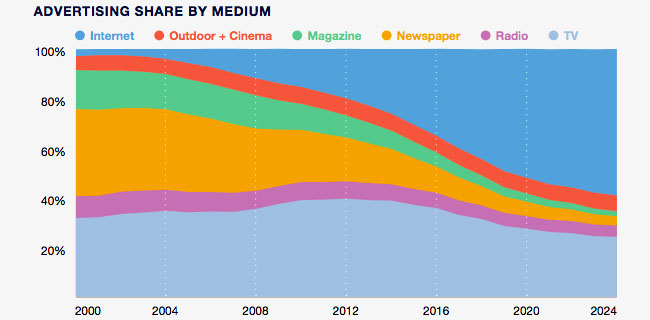
    Despite the inclusion of digital extensions associated with TV in some markets (including the U.S. and U.K.) and various other advancements, TV is unlikely to grow in the future on an underlying basis, and we expect just under $170 billion in annual ad revenue each year through 2024. New forms of TV—or premium video advertising— will likely lead to a shift in spending within the medium going forward. Although television arguably remains most effective in helping marketers build their brands, the relative effectiveness of television has likely fallen, at least incrementally. And, the share of budgets allocated toward TV have generally diminished incrementally with each passing year. This has occurred as some advertisers shifted some budgets out of TV and into digital, and other advertisers shrank in size and reduced media spending, including TV. Television now commonly represents around 40% of a typical large brand’s media budget, or 27% on average across all advertisers as reflected here for 2020. Interestingly, the median growth rate in 2019 was +0.1% and should be +1.8% in 2020, illustrating that there are many countries where TV advertising is still growing. The median country should see growth of between +1–2% each year through 2024.


    Top of mind for many marketers using television as a key part of their media mix is the impact of new SVOD services, especially the U.S.-based media giants. In a mature market such as the U.S., we can see the impact of the availability of streaming alternatives prior to the launch of Disney+: Cord-cutting and cord-shaving are accelerating to record levels, with total Pay TV subscribers now falling annually by low single digits, and the median network losing mid-single-digit percentages of subscribers on a similar basis.


    Traditional TV viewing across all audiences and all forms is down only slightly, but this masks the growth of streaming-related activity. Concurrently, consumption of television using internet-connected devices accounts for nearly 15% of TV-related activity, and is growing by around +30% year over year. A majority of this internet-connected-device viewing is directed to SVOD services.


    The leading driver of this behaviour is Netflix, of course, with 158 million subscribers in total, including approximately 61 million U.S. subscribers (50% of all U.S. TV households), 12 million in the U.K. (41% of all households there), 10 million in Brazil (close to 20%), six million in France (nearly 25%), and six million in Canada (nearly half). The competitive offering from Amazon’s Prime Video is nearly as widely subscribed, while other services primarily operating in single countries—including Baidu’s iQiyi, Alibaba’s Youku Tudou, and Tencent Video (all in China); Hotstar and Hulu (in India and the U.S., respectively, and both owned by Disney)—have also emerged. In addition, a growing range of specialist and niche services and streaming replacements for traditional TV networks is now widely available. And of course, much more is set to come in the year ahead following the 2019 launch of Disney+ and Apple TV, with pending launches of new services from Comcast/ NBCUniversal’s Peacock and AT&T/WarnerMedia’s HBO Max.


    For these new SVOD services to have a meaningful impact in the U.S. or elsewhere, meaningful investments will still be required—and the media owners making those investments will face hard financial choices. Some of the new SVOD services are launched by traditional TV owners, and accelerating investment in SVOD content will partially depend on overcoming the friction tied to cannibalising existing revenue streams. These are hard decisions. Taking risks and making investments will help futureproof their businesses, but not every company will do all they need to in the short term in order to ensure long-term health.

    Consider the scale of investment required to be competitive:

    • In the U.S. alone, Netflix is on track to spend around $3.5 billion this year on an accrual basis, or probably closer to $5 billion in cash terms (assuming one-third of the global $15 billion in expected spending this year is attributable to the U.S.). This amounts to around 5% of the ~$75–80 billion spent by all MVPDs and streaming services in the U.S. This spending is arguably reasonable, considering how much viewing Netflix generates: The company accounts for 37% of all streaming consumption on televisions in the U.S., and streaming accounts for around 14% of TV consumption, according to Nielsen data. From this data we can calculate that Netflix has a 5% share of viewing, roughly the same as their percentage of spending on content. Over the next several years, costs will undoubtedly rise as Netflix looks to maintain its audience share, and so it is not unreasonable to think in terms of $5 billion in spending on an accrual basis (or more than $6 billion on a cash basis) by 2024.


    • Disney expects to spend $5 billion annually on content for Disney+ by 2024, with one-third of subscribers inside the U.S., and presumably a proportional amount of spending on content assigned to their U.S. content expenses. This will be paired with spending on Hulu, which last year amounted to around $2.5 billion, and which will presumably rise significantly. Even backing out costs associated with Hulu’s vMVPD service, we could expect a $4+ billion streaming content bill for Disney’s domestic operations in 2024.
    • Similarly, AT&T has indicated that by 2024 it will be spending an incremental $3 billion on domestic programming for its HBO Max service, above and beyond what it already spends on HBO today.
    • According to the Financial Times, Apple has committed $6 billion to spending on original shows and movies for its TV service, presumably globally, over an unclear time horizon.

    If each of these services aims for viewing parity, it is not hard to imagine their spending $4 billion per year, on average. Additional services will also undoubtedly be significant buyers of content, including Comcast’s Peacock and ViacomCBS, which will presumably invest more heavily in their initiatives as the two companies formally come together. The total amount of annual spending in the U.S. alone would likely amount to around $30 billion if all of this plays out.

    All of this new spending would be consistent with recent increases in industry-wide programming costs. If the non-streaming world were able to hold the line on its content spending at around $70 billion, the $30 billion referenced above would represent an incremental $20 billion on spending (as streaming services currently spend around $10 billion on content annually). Over the next five years, this would equate to a roughly +5% increase in annual spending on programming by the services consumers receive in the U.S., a lower figure than the +7% increase in spending on programming we saw from cable and satellite operators over the past five years between 2013 and 2018.

    However, the economics of streaming services are very different than those of the traditional MVPD business. They are less favorable on a stand-alone basis and usually need to be considered in the context of other services with which they are bundled. Assuming that advertising attributable to streaming services will not be incremental to the industry, direct revenues probably won’t fully offset costs by much, if at all, leading to margin erosion.

    There will only be so much money to go around for subscription fees. If consumers continue to increase their spending on all forms of video (which amounted to $140 billion last year for video services, cinema and DVDs) at historical rates through 2024, there will only be an incremental $20 billion in consumer spending available for new services. This is roughly equal to the amount of new spending on content that we estimate above. And, unfortunately, advertising is not likely to be incremental for the industry (as there is only a limited relationship between changes in supply or improvements in targeting and changes in total spending in the advertising industry, unless new advertiser segments are brought into the medium).  This suggests that financial contributions from these new services will not be net positive anytime soon.

    Favourably for Disney, Comcast, AT&T and Netflix, at least, what money is available will mostly go to these companies, as Amazon and Apple appear to primarily look at streaming services as a value-added product and are not likely to attempt to recoup all of their costs directly. The overall economics of these services can be viewed more favorably if we consider their contribution to other business, including reduced churn or pricing premia for services with which they are bundled.

    For the media industry, the question is what media owners’ tolerance for margin erosion will be. This will drive the pace of change in the years ahead. Some owners of streaming services will be more tolerant than others and position themselves more favourably for the future. But it’s also possible that every one of them agrees that this kind of business reinvention ultimately leads to better business in the long run. For consumers, this world arguably looks quite favorable as it offers up better-quality content with the opportunity to purchase content packages more granularly, as needed, even if costs per hour of content purchased rises. For advertisers, some elements of television will worsen because ad inventory is likely scarcer, and reach is likely harder to come by. On the other hand, where advertising does exist in this new world—and many streaming services will embrace advertising as an element of their financial models—it will likely reach more engaged consumers, in potentially more valuable environments than those that have come before.

    Toward these ends, many advertisers want to prepare for such an eventuality. For those who believe it is prudent to make such plans, what should advertisers do? It bears repeating that ad-supported TV in its broadest definition—including streaming equivalents—remains strong in absolute terms and generally maintains superior reach relative to alternatives for most audiences. Of course, there are significant challenges to be overcome in managing campaigns optimised for reach and frequency, given the manner in which those campaigns must be run across different sellers of advertising and different devices, and given the limitations of existing measurement systems.

    If ad-supported TV declines relative to alternatives, different approaches to media planning may be considered. Beyond premium video, many advertisers may run video across environments that include other digital content or on digital out-of-home in an effort to sustain broad reach, albeit without the borrowing of content’s brand equity. Another alternative includes optimizing reach across a wider range of media, with a focus on using each medium to drive awareness as best as each can. Other marketers might find that a focus on outcomes as opposed to proxies for long-term outcomes (which brand awareness is arguably best at) rather than reach is a preferred approach.

    A future with less premium video advertising should present an opportunity to take a fresh look at how marketing is budgeted. If the insights and ideas supporting brands will be more impactful than any individual media execution, processes should focus more on investing in those insights and ideas. Investing in a broader notion of a consumer’s potential life cycle with a brand—ranging from brand ideas to media exposures, brand experiences and word of mouth (including all of the data and marketing technologies that support them)—will probably be impactful as well.

    We are mindful that U.S. trends may occur in other countries, but probably not everywhere—at least not in the same ways over similar periods of time. We see cord-cutting in some other countries, like Brazil, where we see mid- to high-single-digit annual declines in pay-TV subscribers. However, in many other places, the concept of cord-cutting is not meaningful yet, especially in countries where digital terrestrial TV makes it possible for consumers to access what Americans might think of as “basic cable” with a simple antenna, or through a free set-top box provided by an internet service provider. Viewing trends will also be impacted by the fact that pay-TV penetration has often been low to begin with in many countries. This would limit the hours consumers have historically spent with TV, at least relative to the U.S. Where that has been true, it is possible that the wider availability of SVOD services (and the premium content they offer) could lead to an expansion in viewing of the medium in its broader definition. More viewing, especially of high-quality TV content, should lead to more engaged viewers—all things being equal—and should prove to be positive for advertisers.


    TOMORROW: THE YEAR AHEAD FOR THE INTERNET


  • The Fifth Billion is the Hardest in SVOD


    By Brian Wieser


    Apple’s TV streaming service has launched and this week Disney will launch Disney+ in the US, Canada and The Netherlands.   AT&T has also now announced details of its new HBO Max SVOD service.  While expanding SVOD services will increase consumers’ choices, , the already negative trajectory of traditional television will not necessarily accelerate. In the short-term, the constraint is probably not consumers’ willingness to access these services. Subsidies such as Disney’s arrangement with Verizon give subscribers on its unlimited wireless plan access for free for the first year. Apple’s bundling of access for its hardware consumers will help ensure that subscriber numbers are high from the start. Instead, limitations of their impact on traditional TV will be a function of the pace at which SVOD services increase spending on programming.

    Some of the new SVOD services are launched by traditional TV owners, so accelerating investment in SVOD content will partially depend on overcoming the friction tied to cannibalizing their existing revenue streams. These are hard decisions. Taking risks and making investments will help future-proof their businesses, but not every company will do all they need to in the short-term in order to ensure long-term health.

    Within several years, SVOD owners could spend $30 billion on exclusive streaming content in the US alone – and multiples of this figure globally – if each one seeks parity with the current largest players in the space.  Consider the following:

    :: Domestically, Netflix is spending around $3.5 billion this year on an accrual basis, or probably closer to $5 billion in cash terms (assuming one third of the global $15 billion in expected spending this year is attributable to the US). This amounts to around 5% of the ~$75-80 billion spent by all MVPDs and streaming services in the US. This spending is arguably reasonable considering how much viewing Netflix generates. The company accounted for 37% of all streaming consumption on televisions in the US, and streaming accounts for around 14% of TV consumption, according to our analysis of Nielsen data. Their spending share is roughly in proportion to the share of consumer time their platform.  Over the next several years, costs will undoubtedly rise as Netflix looks to maintain its audience share, and so it is not unreasonable to think in terms of $5 billion in spending on an accrual basis or more than $6 billion on a cash basis by 2024.

    :: Disney expects to be spending $5 billion annually on content by 2024, with one third of subscribers inside of the US, and presumably a proportional amount of spending on content assigned to their US content expenses. Paired with spending on Hulu which last year amounted to around $2.5 billion and which will presumably rise. Even backing out costs associated with Hulu’s vMVPD service, we could expect a $4+ billion streaming content bill for Disney’s domestic operations in 2024.

    :: Similarly, AT&T has indicated that by 2024 it will be spending an incremental $3 billion on domestic programming for its HBO Max service, above and beyond what it already spends on HBO today.

    :: According to the Financial Times, Apple has committed $6 billion to spending on original shows and movies for its TV service, presumably globally, over an unclear time horizon.

    :: Comcast’s spending plans for Peacock, set to launch around the same time as HBO Max, have not yet been disclosed.


    Assuming each of these services aim for viewing parity, it is not hard to imagine each of the six services spending $4 billion per year, on average.   Additional services will also undoubtedly be significant buyers of content, especially CBS and Viacom which will presumably invest more heavily in their initiatives after the two companies formally come together.

    All of this new spending would be consistent with recent increases in industry-wide programming costs. If the non-streaming world were able to hold the line on their content spending at around $70 billion, the $30 billion referenced above would represent an incremental $20 billion on spending (as streaming services spend around $10 billion on content annually at the present time).  This would equate to a roughly 5% increase in spending annually over the next five years on programming by the services consumers receive in the US, a lower figure than the +7% increase in spending on programming we saw from cable and satellite operators over the past five years, between 2013 and 2018.

    However, the economics of streaming services are very different than the traditional MVPD business. They are less favorable on a stand-alone basis and usually need to be considered in context of other services with which they are bundled. Assuming that advertising attributable to streaming services will not be incremental (only a limited relationship between changes in supply or improvements in targeting and changes in total spending), direct revenues probably won’t fully offset costs by much, if at all.  If consumers continue to increase their spending on all forms of video (services, cinema, and DVDs: $140 billion last year) through to 2024, there would only be an incremental $20 billion in consumer spending available for new services. This is roughly equal to the amount of new spending on content we estimate above. This suggests there is no positive financial contribution to the industry from new services, even if we only considered content costs.   Favorably for Disney, Comcast, AT&T and Netflix, the money will mostly go to these companies as Amazon and Apple appear to primarily look at streaming services as a value-added product and are not likely to attempt to recoup all of their costs directly. The overall economics of these services can be viewed more favorably if we consider their contribution to other business, including reduced churn reduction or pricing premia for services they are bundled with.

    Of course, content spending is only one cost item for SVOD services.  Other costs can be substantial as well.  For example, AT&T has indicated it will spend around $1 billion per year on what it is categorizing as customer acquisition. Netflix is currently spending around $1 billion annually on marketing expenses domestically (and more than double that figure internationally), which is likely the most similar comparable expense. Altogether, each SVOD service could very well spend incremental billions on advertising every year. Partnerships with hardware companies, call centers and subscriber management, streaming delivery and other costs will add billions more. And then there are the costs of cannibalization. New services may cause cord-cutting to accelerate or cause consumers to actually reduce what they are spending on video services. For example, greater numbers of consumers might decide that traditional free-to-air broadcast channels paired with a collection of SVOD services are a more than sufficient replacement for traditional cable, at a much lower cost. With all of these new costs, profit margins across the industry likely fall.

    For the media industry, the question is what their tolerance for margin erosion will be? This will drive the pace of change in the years ahead.  Some owners of streaming services will be more tolerant than others and position themselves more favorably for the future than others.  But it’s also possible that every one of them agrees this kind of business reinvention ultimately leads to a better business in the long-run.  For consumers this world arguably looks more favorable: more industry-wide spending on content and the opportunity to purchase content packages more granularly. For advertisers, some elements of television will worsen because ad inventory is likely scarcer and reach is likely harder to come by. On the other hand, where advertising does exist in this new world – and many streaming services will embrace it – it will likely reach more engaged consumers, in potentially more valuable environments than those which have come before.

    Brian Wieser is Global President, Business Intelligence GroupM. This article was first published at https://www.groupm.com/news/svod-services-fifth-billion-hardest