By A Correspondent
The year 2014 is turning out to be a turnaround year for political parties who are turning to the digital world to reach out to the masses. While their popularity with the masses on the medium is questionable, what is noteworthy is that it has managed to play the role of a catalyst in disseminating information to the people at large. But it is not as smooth for most politicians who are looking at the medium as an intrusion into their public life.
These and many more aspects concerning the digital world were discussed in detail at the session ‘Internet and Democracy: Interloper or Catalyst?’ The panelists at the session included Chetan Krishnaswamy, Head, Public Policy and Govt Relations, Google India; Suparna Singh, Director of Strategy, NDTV, and Managing Editor, NDTV.com; Ronak Samantray, Founder, NowFloats.com; Mike Best, Berkman Center for Internet & Society, Harvard University and Roger Fisk, PR Expert, President Obama’s Campaign. Jon Sopel, Senior Anchorperson, BBC Global News was the moderator at the session.
Chetan Krishnaswamy of Google began by warming up the audience on the spectacular growth story being put up by the medium of digital. “From what it was around a decade ago, internet has grown by 600 per cent to a $2.5bn industry today. In fact over the next six years, the country would have about half a billion users accessing the internet, easily surpassing countries like US and being a close second to China.” Krishnaswamy went on to add that much of the growth on digital was coming from the mobile platform with over 4 million users using the medium to access content. “What is interesting is the growth that is being reported from non-English websites or language websites that have grown by more than 56 per cent whereas the English websites have grown by just 11 per cent. All these are indications that the internet can only make the democracy better and act as a catalyst.”
According to Suparna Singh, what social media, in addition with players like facebook, twitter can do is become an apparatus of change. “What is being witnessed right now is that such platforms are becoming more opinion oriented and not informational; it needs to shed its baby weight and become more mature. There needs to be more dialogues and exchange of ideas and information on these websites,” reiterated Singh.
Highlighting the action that was being witnessed on the medium with the general elections around the corner, Singh said that though there has been an invasion from the political parties on these platforms, it is still in its infancy. “But that will change in the next general elections where a lot more political parties will take a liking to the medium and will be reaching out to the masses in a much profound manner,” affirmed Singh.
Highlighting the work done by his firm, Ronak Somantray said that the objective of his firm was to get businesses online and promote them largely through the medium of messaging (SMS). There is a lot of response that we have generated in the marketplace and are hopeful of making a big impact in the future as well, he said.
According to Mike Best, the role of social media is not being comprehended in a manner that it should. “If you see the impact that social media websites created on countries like Iran and Syria during the turmoil, it was quite an extraordinary effort.” Best bought up the example of Nigeria where his company had helped the country in the run-up to the elections by providing insights and data on the trends that were being spotted. This, he said, prepared the people to either vote for change or be ready for the worst. Highlighting his objective in 2015, Best said that his company will be monitor social media as well as well as observer missions at the same time when the elections take place again in Nigeria.
The panelists went on to discuss the intricacies surrounding privacy on the internet and how the process had to be simplified so that the owners do not face a harrowing time answering questions from the consumers’ end.
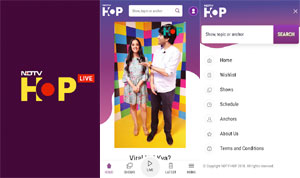 NDTV and Airtel announced the launch of NDTV Hop, billed as the world’s first live channel for smartphones available entirely in portrait (vertical) mode with exclusive content for Airtel TV users.