Tag: Suhel Seth

  • Republic conducts social media summit

    By Our Staff


    Republic Media Network has conducted its first ‘Social Media Summit’ to discuss issues around social media regulation, tech developments and promotional possibilities. Interestingly, the Summit also had a session on fake news.


    The Summit started with a one-on-one that Editor-in-chief Arnab Goswami had with Ajit Mohan, Vice President and Managing Director, Facebook India.


    Said  Goswami on the summit: “Over the last six months to a year there has been an incredible amount of conversation about social media, its regulations & responsibility. These conversations are not in isolation but linked to the fact that internet penetration, usage, accessibility has grown dramatically over the last decade. When things change, it garners interest across corporate, social and political platforms. When we conceived the idea of Social Media Summit, it was to ensure that we take two steps back away from our roles as stakeholders and users, and look at it as something in which the future of the country is vested in”.


    The fake news session was moderated by Suhel Seth, Managing Partner, Counselage India Pvt. Ltd, the panel featured Dr Ratan Sharda, Author, Mohandas Pai, Chairman, Aarin Capital Partners, Harish Bijoor, Brand-Guru, and Gaurav Pachnanda, Senior Advocate, Supreme Court of India. There were other sessions featuring Anand Ranganathan, Scientist & Author, N.S. Nappinai, Supreme Court Advocate & Founder, Cyber Saathi, Lizzie O’Shea, Digital Rights Activist, Human Rights Lawyer & Writer and Kanchan Gupta, Senior Advisor, Ministry of I&B, Government of India. Another session had Rujuta Diwekar, Nutritionist for celebrities and one more was  moderated by Karthikeya Tanna, U.S. Immigration Attorney and Political Commentator where the panel featured Dr Siddhant Bhargava, Co-Founder, Food Darzee, Anshoo Sharma, Co-Founder & CEO, magicpin, Garima Khandelwal, Chief Creative Officer, Mullen Lintas and A S Rajgopal, Founder & CEO, MYn. There were other panels with Smita Prakash, Editor, ANI, Madhoo, Indian Actor, Sinan Aral, Actor- David Austin Professor, MIT/ Director, MIT IDE/ Founding Partner, Manifest Capital, Author- The Hype Machine, Shefali Vaidya, Author, Speaker, Fellow-Ananta Leadership Program, Major Gaurav Arya, Consulting Editor, Defence and Strategic Analyst, Aprameya Radhakrishna, Co-Founder & CEO, Koo, Niranjan Narayanaswamy, Executive Editor-News, Republic Media Network, Pulkit Agarwal, CEO & Co-Founder, Trell, Ashish Bhasin, CEO APAC & Chariman India, Dentsu, Umang Bedi, Co-Founder, Verse Innovation (Josh & Dailyhunt) and Dr. Pawan Duggal, Advocate – Supreme Court of India.


    The Summit will air on Republic TV over the weekend and can be accessed on the RepublicWorld website.


     

  • Utterly Butterly Amulicious


    Over the last 50 years, the Gujarat Cooperation Milk Marketing Federation (GCMMF) which owns the brand name Amul, has been presenting some memorable advertising in the form of topical hoardings. These have turned markers of contemporary issues and events.  A few years back, daCunha Communications and DYWorks came up with a book titled ‘Amul’s India’ capturing the best of the outdoor creatives. Last week, a revised and updated edition was released celebrating the topicals with comments from Amitabh Bachchan, Alyque Padamsee, Harsha Bhogle, Rahul daCunha, Rahul Dravid, Rajdeep Sardesai, Sania Mirza, Santosh Desai, Siddharth Kak, Shobhaa De, Shyam Benegal, Suhel Seth and Sylvester daCunha.


    Meanwhile, Amul has also launched a new app “Amul World” which has all the Amul topicals created over the last 50 years. This app will soon be available for download on Android and Apple devices.


    At the release last week, R. S. Sodhi, Managing Director, Gujarat Cooperative Milk Marketing Federation (GCMMF) said, that “We had promised to release the updated edition at the time of launch of the first edition. It is an honour for us to have published the revised and updated edition of this book after the phenomenal print run of 1.2 lakh copies of the first edition. The Amul topical advertising campaign and our consistent advertising strategy has played a very pivotal role in the growth of brand Amul and we shall endeavor to continue our efforts.”


    Give us this day our daily ad!


    By Rahul daCunha


    Every day is a new day in the life of the Amul hoarding (or meme as it is now referred to on social media). My job is two-fold — to shepherd the brand, and to spoof the many events that emerge from this Pandora’s Box called India. Seven thousand billboards and twenty-one years later, I have never been tired of saluting and spoofing the numerous facets and faces of our colourful country.


    For 50 years, our little Amul moppet, or the Amul girl with her polka-dotted dress and bow, has commented on all things amusing, annoying, absurd and alarming. And unfailingly, India waits for what she has to say with expectation and excitement.


    The human race, certainly the Indian human race, has a newly-acquired, collective case of Attention Deficit Disorder. What holds good as a piece of news one day, is irrelevant the next morning. Plus everything is chatworthy news today – take male chauvinist politicians, mass hysteria Bollywood, multi-crore scams, messy scandals, Mamata Banerjee’s diatribes or M.S. Dhoni’s decisions, both follicular and on-field.


    In the ’60s and ’70s, daCunha Associates created one hoarding a month. By the ’90s, it had increased to one a week. This year, we went daily.


    One new Amul ‘topical’ goes online and outdoor every day. Every morning my creative team — comprising Manish Jhaveri, Jayant Rane and I, connect on what’s on the Amul menu for the day. Is it an upmarket issue that will tickle the fancy of snot-nosed south Bombay? Or a Bollywoodised titbit that will satisfy celebrity-obsessed north Bombay? Or is it a Laloo Prasad witticism that will amuse the Hindi belt? Or has Rajnikanth’s new movie galvanised the south of India? Or has TV show Game of Thrones thunderstruck the Twitter generation?


    There are five Indias today – Mumbai, the Hindi belt, the East, the South and social media. Mumbai is a country by itself. The East is passionate about Durga Puja, Dada, Mishti Doi and Didi. The North is political and paparazzi-obsessed. The Hindi belt is focused on Yadav Senior and Junior’s shenanigans. And Facebookers and Twitterers are just obsessed with the flavour of the moment.


    In the 21 years that I’ve been campaign custodian, we’ve poked fun and parodied, but never viciously. Our spoofs and satirical messages have been welcomed sportingly by both politicians and popular figures, actors and anarchists. Just occasionally, lampooning has led us to the doorstep of the legal process.


    Rahul daCunha is Managing Director and Creative Head of da Cunha Communications, the ad agency that creates the Amul outdoor billboards.


    A For Awesome


    By Suhel Seth


    Very few brands across the world speak a borderless,  timeless and ageless language. Amul is one of them. Very few brands across the world create both a sense of entitlement and waiting. Amul is one of them. Very few brands touch the soul of consumers in an enduringly consistent manner: reflecting the pathos of an evolving society: Amul is one of them.


    The history of India can be told in a three-part voluminous tome or can be absorbed simply by going over the advertising that Amul has created. It is however, as much the history of Amul. Just like the India we see today, ever-evolving; ever brushing aside challenges which may seem insurmountable and yet holding a place of pride in the comity of nations, Amul too has had a story of inspirational zeal. One which is more than about a brand that delights us on dining tables. It is a brand that we never seem detached from.


    Over the years, Amul has represented not just innate quality and the vision and coming together of millions of dairy farmers but equally, through its advertising, Amul as a brand has both been a chronicler and a mirror to each one of us. In our lives of drudgery, Amul helps us smile; it helps us laugh away the worries and at times it helps us celebrate the enormity of Indian achievement. It also, at times, very poignantly shows us the way.


    For me personally, Brand Amul has been a part of my growing up: not in terms of chronology but equally in an insightful way, capturing the trials and tribulations of a nation that India is. It has always been something that I have looked up to. The advertising that Amul has unleashed over decades is not something that is designed to sell butter. It is indeed designed to help reflect on who we are. I have always believed that Amul’s advertising is not about selling more butter or more milk: it is about helping the young and the old understand the India we are creating: either wilfully or as mere spectators. I have often said to those who care to listen: the biggest civilian honour one can hope to attain in India is to be on an Amul hoarding or in an Amul press advertisement.


    Because in a strange way, Amul speaks for every Indian. Amul is infact, many a time, the voice of a multitude of voiceless Indians and herein lies its eternal charm and its enduring appeal. The reason is not because of what it says. But equally about how and why it says it. There are moments in time when silence is not a virtue. That is when Amul’s advertising speaks for millions. There are equally times when in the din we fail to separate the good from the not-so-good. It is at that time that the advertising of Amul helps us set the right course.


    Amul’s advertising is a barometer for what India has been, what India is and what India is likely to be. Which is why Amul the brand has morphed into Amul the being.


    Suhel Seth is a former Amul baby and now the Managing Partner of Counselage India


    Footnote:

    Excerpted with permission of the authors from:

    Amul’s India

    Based on 50 Years of Amul Advertising

    by daCunha Communications

    (Revised & Updated Edition)

    HarperCollins India

    Rs 299


  • ET Edge hosts ‘The ET Best Brands 2014’

    By A Correspondent


    Times Conferences Ltd. functional under the brand name ET Edge in collaboration with Nielsen held the first edition of ‘The Economic Times Best Brands 2014’. The platform is an endeavour to recognize the efforts of the most admired brands that are redefining the Indian marketplace in the contemporary times.


    India as a country stores immense potential in the form of a colossal population providing global brands with a massive ground to play and explore respective targets. ET Best Brands, through this platform aims to highlight India’s supreme brands which have displayed leadership in market cap, innovations, services, referral and recall value among all strata of consumers.


    With the theme of “Celebrating Brand Excellence”, the platform aimed to bring together visionaries, industry influencers, strategy planners and implementers on a single platform to discuss and comprehend modern brands and branding strategies. The summit also brought forth Indian and global industry barons and visionaries on one platform to share their knowledge and experience of brands and consumer relationships. The ET Best Brands and Nielson study was focussed to gain deeper insights into the role of new age branding and brand association with consumer preference. This effort recognises 250 of the best and the most admired brands in India based on how they have reshaped the way our markets operate.


    Speaking on the occasion, Deepak Lamba, President, Times Conferences Limited – BCCL said, “It is a matter of great pride for all of us at The Economic Times to introduce you to one of our biggest research based initiatives; The ET Best brands 2014. The platform recognizes the excellence of best brands that have set a benchmark across various parameters like Innovation, Brand Value, Brand Recall, consumer satisfaction, service & quality. We are celebrating brand excellence and are proud to present the top brands that have created a lasting impression in the minds of consumers.”


    The keynote address was given by Suhel Seth, Author & Marketing Maven and the special address was given by Amish Tripathi, Noted Author, Shiva Trilogy. A special session on making of an iconic brand was given by Sunil Vysyaprat, Executive Creative Director, Wieden+kennedy. An armchair interview of Parminder Singh, Managing Director SEA, India & MENA, Twitter was also an interesting session in the summit. The summit also focused on various panel discussions on topics such as: 5 steps to build lasting connect with the consumers, Making of an iconic brand, Brands in a virtual globe: Talking to 24×7 connected consumers & Indian brands taking it Global – Challenges & Opportunity.


  • Facebook posts get Suhel Seth to give up Rai doctorate

    By A Correspondent


    He is one of India’s best known faces on television panel discussions. Suhel Seth, ad man-turned-communications consultant and managing director of Counselage, was awarded an honorary doctorate by the Rai University last week.


    But  a Facebook post by Maheshwer Peri, Careers360 CEO-promoter and may we call him an ethical education activist, got him to give it up as there was outrage over Mr Seth’s accepting the recognition from a university which, as Mr Peri put it, “is most likely to abuse it to reach out to ignorant students”. “How I wish our celebrities acted a bit responsibly and did their homework,” Mr Peri’s post on Facebook added.


    There was much outrage after this initial post on Facebook with many people casting aspersions on Mr Sethi’s credibility. Almost an hour after the initial post by Mr Peri, Mr Seth reacted with:  “I had no clue…will return this immediately” and later added: “In fact even at the damn convocation I said this was a fraudulent event…I was told that this was a legit university and so on… but I agree… it is a fraud and I will have nothing to do with it…”


    After Mr Seth’s pronouncement, there was an expression of delight at the decision. “Bravo Suhel Seth,” exclaimed one post.


  • Headlines Today scores on 2G

    By Ranjona Banerji


    The fault is mine: I got to the television two hours late on Thursday – after the Supreme Court ruling on the 2G licences. The punishment was purgatory: I knew something had happened but I had no idea what. Every TV news channel showed a press conference addressed by the BJP’s Arun Jaitley reacting to the court ruling but no one told us what the ruling was. I travelled up and down the channels that my cablewallah allows me and learnt nothing. Jaitley could have been ranting or talking sense but since I had no context I could not fully appreciate or understand him.


    After 10 minutes of fruitless frustration I did the sensible thing: got online and read the latest updates by print journalists. Till Thursday evening, the whole thing was only about “reaction” on television, sometimes from small-time party functionaries and sometimes by bigwigs like Kapil Sibal who had to counter Jaitley with his own spin. One poor reporter even ran after the judge AK Ganguly as he retired and asked him how he felt. The honourable judge ran away as fast as he could. All through the day they broadcast a reaction from some telecom honcho but never told us who he was.


    It says something about the way television journalists operate that they cannot explain events or interpret them for viewers themselves. Something as important as this 2G ruling requires reporters and anchors to get all the facts themselves and tell the viewers exactly what has happened before playing the “reaction” game. Also, instead of telecasting every single press conference live in its entirety, they could edit or cut back to studio to explain what was happening mid-way.


    Business channels were, sadly, no better since they are all obsessed with the stock market and cannot consider implications beyond that. But one would imagine that the cancelling of 122 licences would have huge impact on their constituencies. I guess one imagines wrong.


    The most sensible TV debate on the subject was a surprise – it was not at prime time and it was on Headlines Today. Thanks largely to Paranjoy Guha Thakurta as well as to Sandeep Bamzai, we got a clear idea of the economic and political implications of the judgment.


    The rest of debates seem to have the usual suspects who talk about everything – Chandan Mitra, Ravi Shankar Prasad, Mahesh Jethamalani, Nirmala Seetharaman, Renuka Chowdhury and perhaps Suhel Seth was there somewhere but I didn’t catch him.


    Niira Radia and Ratan Tata were not there.


    * * *


    This round once again goes to newspapers who explained the matter in every detail from the political implications for the UPA government to the business implications for the telcos to the fortunes of A Raja and P Chidambaram and so on. However, while every newspaper and TV channel said it was 122 licences, The Times of India decided on 121. No idea why.


    Most newspaper editorials did raise the question of the unfairness meted out to telcos which were being punished for following government laws. This is a tricky one. It would be interesting to see whether there’s more discussion about the dangers of corporate lobbying and the role played by journalists in getting A Raja the ministry of his choice.


    I’m not holding my breath, actually.


  • Social media hits back at Sibal

    By Ranjona Banerji


     The might of social media came straight down on Union minister Kapil Sibal on Tuesday after he tried to control, contain and coerce the internet into submission. Not only did the websites he spoke to refuse to screen content before it goes online, internet users also spewed venom at him. Those who tried to defend the minister’s position also felt the wrath of the people – former minister Shashi Tharoor and cricket commentator Harsha Bhogle for instance.


    Sibal said that after “offensive” comments and pictures on the net were brought to his notice, he got in touch with some websites and asked them to screen such content before it goes online. He pointed out that the cultural sensitivities of India had to be protected.


    Does the minister have a point? The problem for him though is that the internet is notoriously (and gloriously) indifferent to regulation. Its users guard their freedom very effectively and the effort to control them would be time-consuming, expensive and largely futile.


    TV on Tuesday night was bristling with rage – though I should clarify that. Times Now and CNNIBN bristled, NDTV was bothered about surrogacy (more publicity for Aamir Khan) and after that, showed We The People Again.


    For the first time since I have seen Suhel Seth on television (I confess here that he and I went to the same school for some years in Calcutta, at the same time), he did a commendable job yesterday. As Chandan Mitra was extolling the virtues of a tolerant India and the importance of freedom of speech, at the same time likening the Congress Party to the devil, Seth reminded Mitra that December 6 was the anniversary of the demolition of the Babri Masjid, which does not say much for Indian tolerance. He also asked Mitra to reveal what he felt about freedom of speech and expression in the context of MF Husain and the controversy over the late artist’s depiction of Hindu deities. Mitra promptly changed his tune and was not quite so much in favour of freedom of expression. This is fact brought him closer to the song which Sibal is singing? Goswami, to his credit, pointed out to Mitra that he had changed his position. Anyway, Seth and Mitra got into spat and that ended what anyone else had to say.


    As a result, like all TV debates, there was more bombast that substance. It took today’s newspapers to tell us that the government is considering fines for offensive material and is formulating a code of conduct.


    Twitter and Facebook however continued their anger into Wednesday. India was likened to China (which is infamously terrified of freedom), the Emergency was harked back to, Sibal was compared to a Taliban cleric and the defining word – used in defiance of course – for Sibal was “idiot”.


    Not a nice day in the office for the minister!


    **


    The amount of publicity given to Aamir Khan’s baby via IVF and surrogacy has raised this cynic’s suspicions. Is there some sort of a publicity campaign going on for IVF clinics? Having done a number of stories on the procedure in my youth, I am surprised to see that the downside of IVF – high cost and low success rate to name two – is hardly being discussed.


    Surrogacy however has had some discussion on it.


    **


    V Gangadhar’s satirical piece on the edit page of The Hindustan Times is worth a read for a chuckle. He’s had a little gentle fun with the tributes to the late actor Dev Anand, which have been written by the unlikeliest of people.


  • Anil Thakraney: Adland blues – where the ‘uncles’ don’t understand digital & ‘dudes’ don’t know Real India

    By Anil Thakraney


    One subject that keeps popping up when I meet senior creative directors from the ad world is the challenge posed by new media. And it’s a bit of a worry for everyone because India, unlike developed nations, is placed on a very interesting media matrix.


    On the one hand, we have the so-called old-world creative directors (most of them also chairmen of agencies) who have been weaned on TV commercials. Their entire focus and creativity is concentrated on the tube, they can only think TV (not even print!). And they will continue to thrive for many more years because unlike in the western nations, TV isn’t about to die in a hurry in this country. However, these TV hero ‘uncles’ are zeroes when it comes to using the digital media for their clients, and that’s obviously a big weakness. Their understanding of the opportunities offered by the social media space, for example, is very poor. In fact, both Balki and Piyush haven’t even registered for either Twitter or Facebook, that should give you an idea of their disinterest.


    Which is why they rely on the ‘young geeks’ in their offices to figure out the use of the digital media for their clients. The twenty-somethings who live their lives purely in the virtual world. The problem with these nerds, on the other hand, is that they don’t understand the traditional media at all. In fact, drowned in their comps/pads/mobiles 24X7, these techno-wizards are disconnected from reality. Therefore incapable of coming up with ideas that are born out of the nation’s culture and beliefs.


    For a Kolaveri sort of viral magic to happen for brands, this twain shall have to meet. Either the senior CDs make sure they spend energies to understand and bond with the digital space. Or, they ensure the bachchas in their agencies spend at least half their waking hours getting to know Real India. There is no third way out.


    This chasm is no good for the health of the brands they handle.


    ***


    PS: A review of Suhel Seth’s book has got the author all worked up. And the feisty man has been busy dissing the article writer, calling him a ‘loser’, ‘unemployed economist’, ‘a lowdown’, etc. Apparently, Seth later deleted the sweet tweets. Here’s the link to the said review. Must-read stuff.


    http://www.caravanmagazine.in/Story.aspx?Storyid=1189&StoryStyle=FullStory

  • Vinod Mehta: When I became an editor, I started to learn (Video Report)


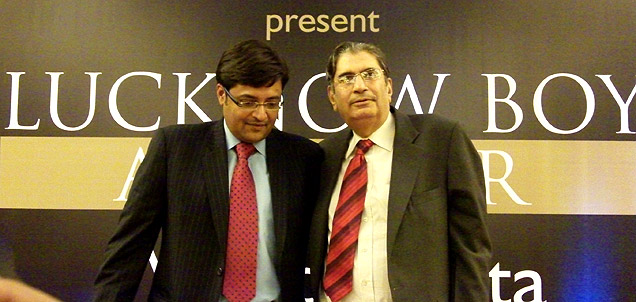
    In our tribute package to Vinod Mehta, we thought we should replay a video report of the launch of ‘Lucknow Boy’ where the late editor answered questions posed by Arnab Goswami. Read on… 


    By Shruti Pushkarna


    I used to be terrified at my ignorance, I knew absolutely nothing… when I became an editor, I started to learn.”

    It was as candid as it could get. Addressing an elite gathering of politicians, journalists, close friends and family, Vinod Mehta, Editor-in-Chief, Outlook, was at his ‘truthful’ best, as he shared his life experiences and views. It was at the release of his memoirs, ‘Lucknow Boy’ in New Delhi yesterday that Mr Mehta confessed, “We journalists have the best seats in the tournament, but some of us, editors particularly, think that we are players. “

    The book launch ceremony began with Mr Suhel Seth, Managing Partner of Counselage India, reading a few excerpts to an eager audience.


    Editor-in-Chief of Times Now, Mr Arnab Goswami was then invited to moderate a short discussion with the author. Mr Goswami admitted that to him, Mr Mehta was like, ‘the god of journalism, whom I admire the most.” Adding further, he related an incident from the previous night when he posed two choices to Mr Mehta, asking him which work out of the two was he more proud of, Debonair centrespread or the last page of Outlook. The reply, said Mr Goswami was in line with his habit of being upfront when very easily he chose the last page of Outlook, his own work.


    What followed was a candid one-on-one between the ‘king of television news’ as Suhel Seth billed Mr Goswami him, and one of the most ‘Independent’ editors of our times. Ranging from the reasons behind writing this book, to the greatest risks undertaken, to why a journalist and a politician can never be friends, Mr Mehta answered all questions posed by Mr Goswami. When asked if he were 35, would he do television, Mr Mehta, without mincing words, said, ‘Television does not interest me”.


    On why he wrote his memoirs
    [youtube width=”450″ height=”250″]http://www.youtube.com/watch?v=srM-E8i6wKI[/youtube]
    On why he doesn’t want to do Television
    [youtube width=”450″ height=”250″]http://www.youtube.com/watch?v=p2gxTDo_eFE[/youtube]
    On the need for editors to be able to ‘smell’ the news
    [youtube width=”450″ height=”250″]http://www.youtube.com/watch?v=RvuDgAPjIIQ[/youtube]
    On why politicians and journalists can never be friends
    [youtube width=”450″ height=”250″]http://www.youtube.com/watch?v=aZOKWWHH6uw[/youtube]
    On how does it feel to look back
    [youtube width=”450″ height=”250″]http://www.youtube.com/watch?v=ftm_IeG-zds[/youtube]
    On the best thing that has happened in journalism in the last 40 years
    [youtube width=”450″ height=”250″]http://www.youtube.com/watch?v=sBb7OzUOL8s[/youtube]
    And a reasonably fair attendance from the political world did not deter him from admitting that the one thing that he has hated all his life is to ask a politician a favour. Mr Mehta is of the strong opinion that politicians and journalists can never be friends. He said, “We follow two different vocations. Politicians are in the business of embellishment, spin, emphasis when emphasis is not necessary and sometimes they are in the business of telling lies. We as journalists on the other hand, with all our imperfections, are in the business of trying to get at the truth.”


    On a lighter note, Mr Mehta also shared some bits of his journey as an editor, as a student and above all, as a person.


    To recount some faces present at the gathering, first up politicians: MoS for Commerce & Industry Jyotiraditya Scindia, Union Urban Development Minister Kamal Nath, Union Petroleum Minister Jaipal Reddy, BJP MP Tarun Vijay, Chief Election Commissioner SY Qureshi, CPI National Secretary D Raja, Lok Sabha MP Jay Panda, MP and Chairman of IPL Governing Council, Rajiv Shukla and Former Minister of External Affairs, Natwar Singh. The media was represented by senior editors Tarun Tejpal, Saeed Naqvi and Paranjoy Guha Thakurta. Also, author Gurcharan Das and Indrajit Hazra of Hindustan Times, and of course the Outlook team.