Tag: Sucheta Dalal

  • ASCI unveils ‘Swachh Ads Abhiyan’ on National Consumers Day

    By A Correspondent


    Observing  National Consumer’s Day on December 24, the Advertising Standard Council of India (ASCI) launched a ‘Swachh Ads Abhiyan’ campaign with the purpose of combating misleading ads. This follows the government’s Department of Consumers Affairs asking ASCI to come up with an initiative to create awareness amongst consumers to action for misleading content. The campaign was initiated across various social platforms like Facebook, Twitter, LinkedIn and YouTube.


    Said Narendra Ambwani, Chairman, of the advertising self-regulator: “It’s really important that consumers don’t blindly believe in advertisements and understand unethical and misleading claims. ASCI engaged with consumers through social media activities on Twitter, Facebook LinkedIn and YouTube which have massively driven consumer attention towards the campaign. We hope this initiative from ASCI will empower and encourage consumers to make the right decisions.”


    Added Sucheta Dalal – ASCI’s Consumer Complaints Council Member: “As a member of the consumer complaints committee (CCC) I have seen the big leap in ASCI’s effort to track misleading advertisements across different media and languages on a nationwide basis. ASCI has also made it easy to file and track complaints online or engage with it through social media. All we need now is better consumer awareness and action by concerned citizens to keep ASCI on its toes by filing complaints and making themselves heard on the evolving issue of misleading advertisements”.


  • Are we really ‘free’ at work in Indian media?


    By Tuhina Anand and Meghna Sharma


    As India gets ready to celebrate her 66th Independence Day, one wonders how much freedom one really has to express oneself – specifically those who are in the creative business. While one has to be responsible when communicating with the masses – be it journalists, or planners for content that is shown on the various channels or the creative agencies that work on various communication strategies for different brands – but there are deterrents to this key element of freedom that the fraternity craves for to express freely.


    Keeping these factors in mind, MxMIndia spoke to cross-section of people from the industry to get an understanding on their Freedom Fundas.


    Bobby Pawar

    Bobby Pawar, Chief Creative Officer and Managing Partner at JWT India is clear that there is no unfettered creativity that exists and that is probably best for a creative agency. He explained: “Our job is to come up with brilliant communication solutions for our clients, hence there is a purpose to achieve. So what we follow is creativity within a box where it is harnessed to achieve maximum result. We partner with various people to come up with this solution and hence we have to listen to various opinions. I do not profess complete freedom for the creative industry.”


    However, Mr Pawar would like to have more control over the shape that an idea finally takes and how it gets executed. Also he definitely would like to have more control over the research that is handed to them and definitely over the way an allocated budget on a brand is being invested.


    Research seems to be the bane of the creative frat. Rahul Sengupta, NCD at TBWA India too would want freedom from research. He feels that if one wants to do anything that’s trendsetting, often research acts as an impediment to take it forward. As for clients’ demands, Mr Sengupta said: “The client is the one sponsoring the idea, so definitely one would not want freedom from them! I have met clients who are hazards to creativity as well as those who are best guardians of an idea.”


    He added pragmatically: “Of course, there are frustrations and there is lack of freedom but if I would rather have freedom from research than clients as latter can be worked amicably to enhance the client-agency relationship.”


    We also spoke to people at mid level like Auro Chattopadhyay, who quit Ogilvy recently, who also wanted freedom from research. He said: “Often research might not help in the brand story, but insistence to stick to it hinders creativity.”


    A creative hand at JWT pointed that conflict happen when there is no match with one’s creativity and that of one’s higher up. Fortunately, this has never happened with him. He feels that the creative industry gives him much freedom to use his ideas as opposed to many other professions.


    However, another stated that hierarchy means towing the line of ideas that the higher in authority believe in. Freedom of creativity in such cases often refers to agreeing to somebody else’s vision.


    The case, however, is different in the new medium such as digital where there is largely freedom to execute an idea. Carlton D’Silva, CCO, Hungama Digital, said: “Right now, digital is like the last three slide of a presentation- very much an afterthought. Hence, spend on the medium is miniscule. There is a fair amount of freedom to explore creativity. However, one would like freedom from data as often clients demand for it but in digital especially, when suggesting some new technology and a unique idea to take shape, there is no data available.”


    Prosenjit Datta
    Courtesy BusinessWorld

    We also spoke to people from the print and broadcast industry to give us an understanding of freedom they enjoy at work. Cyrus Oshidar, Creative Director at Bawa Broadcasting is credited with creating some unique content at MTV and even pushing the boundaries. His view: “If one only wants creative freedom then one should be an artist. If you are producing or making a show for which a client is paying, then there will definitely be some constraints. Ratings do matter in our business and sometimes might even alter one’s choice rather than giving the freedom to do something which one really wants to. Also, one needs to be politically correct in this country. Even the government which is supposed to protect people’s freedom sometimes backtracks from its duties. One needs to be careful about how they approach an issue without offending or hurting feeling of any section of the society. Honestly speaking, we have too many restrictions which are created by us. There is no true democracy in this country.” Mr Oshidar clearly pointed that freedom in creative business is a myth.


    Sucheta Dalal

    Prosenjit Datta, Editor, Businessworld, giving his take on the print industry, said: “Every magazine or a newspaper has a certain set of audience and purpose. For instance, a business magazine like ours won’t focus so much on political stories as political or general magazine would do. So, what stories they choose and how they analyse will be different from genre to genre. Hence, it would be unfair to say that there isn’t creative freedom or if media is ‘restricted’. We don’t have any management policy which will hamper or obstruct our editorial approach. A lot depends on the editors too as they enjoy full freedom to how to go about an issue.”


    Pointing out the restriction that comes with the economics of business, Sucheta Dalal, senior journalist, commentator and consulting editor, Moneylife said: “With so many newspapers, magazines and news channels making losses, it is hard to say or believe that they are not dictated by marketers. Today, we can even see head of various companies writing with their bylines which wasn’t the case earlier. I don’t know how things are right now as I’m not working with any newspaper at the moment, but when I was with Times and Express, the pressure from the advertisers was quite evident.”


    Sunil Lulla

    And how is it in television? Said Sunil Lulla, CEO and MD, Times Global Broadcasting: “Over the past decade or so, the television industry has evolved. There is greater sense of self-regulation and discipline as well as maturity on entertainment and news channels. Though there are guides and policies set by regulatory bodies like IBF, industry enjoys the freedom to operate freely. Besides, there is greater acceptance of TV now which enjoys sense of confidence and responsibility. So, there is culture of freedom in media.”


    Sudhir Sharma

    Said Sudhir Sharma, Producer, Sunshine Productions: “TV as a medium is for the masses and targets everyone from kids to adults to old folks. We make TV shows to entertain. We do follow certain guidelines and censorship which is surely a necessity. By and large we surely have the freedom to make the content we want to show. Creative freedom parameters may vary from producer to producer. Compared to films, TV censorship guidelines are surely stricter keeping in mind that television is accessible on the press of a remote button. In my opinion, we have enough creative freedom and we as makers are progressing and so are the maturity level of audiences.”


    Freedom, limited freedom, no freedom… we received no clear answers to our question. However, the fact remains that despite the current slowdown, the fraternity is still managing to survive and thrive in the prevailing system.


    Image: Rafiq


  • Apology + Rs 500cr: Is Indian Express right in sending Open a legal notice?


    By Pradyuman Maheshwari and Shruti Pushkarna


    Shekhar Gupta

    It was the most read story on MxMIndia yesterday. As the news of the legal notice served by a lawyer representing Indian Express, Shekhar Gupta and three others filtered in, there were heated discussions in newsrooms on whether the Express and its legal eagles were right in serving a legal notice to Vinod Mehta, Open and its senior staffers.


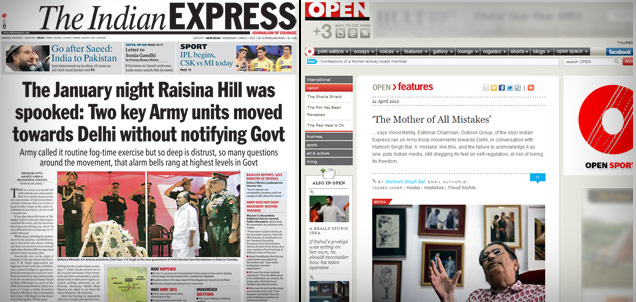
    First some background. On April 4, The Indian Express carried a story by editor-in-chief Shekhar Gupta with Ritu Sarin and Pranab Dhal Samanta on two key army units moving towards New Delhi without informing the government. Ajmer Singh contributed to the report.


    Vital Links
    The Indian Express report (April 4, epaper)
    The Open interview (April 21)
    The ‘notice’ (May 15, note: source unverified and unknown)

    There was outrage and denials issued by all and sundry in the government and armed forces. However, save the outbursts, it wasn’t proven that the Express story was incorrect.


    Meanwhile, ever since the report appeared, The Indian Express – while still respected as a no-nonsense, credible newspaper – was the butt of ridicule by commentators and on social networks. Those in print may have been a lot more gentle, but a few television discussions were indeed scathing.


    And then came this interview with Outlook’s editorial adviser (and former editor-in-chief) Vinod Mehta in newsmag Open on the issue. The headline of the interview said it all: The Mother of All Mistakes (issue dated April 21, 2012). In his inimitable style, Mr Mehta suggested that Mr Gupta was taken in by a story that was planted on the Express.


    While a magazine has a limited readership, since the article was freely available on the internet and it carried a very pointed allegation by one high profile editor on another, the interview viralled in the media fraternity a great deal.


    This legal notice by a lawyer representing The Indian Express and the four writers of the story – Shekhar Gupta, Ritu Sarin, Pranab Dhal Samanta and Ajmer Singh – came less than a month of the publication of the interview.


    One would’ve let the notice be, but its contents make for interesting reading. So while Mr Mehta may be suggesting in the interview (and he also said  amidst some cheer at the Press Club Bombay awards recently) that he quit the Independent owning moral responsibility of an incorrect story, the notice points out that in his memoirs (Lucknow Boy), he projects that he was compelled to do so. “Till now, I am unsure why I had to quit.”


    The notice asks for an apology and pulling the story off Open’s internet edition openthemagazine.com. At the time of filing this report, Open hasn’t done either and two senior staffers told MxMIndia that the magazine does not intend to do either.


    The notice also demands damages of Rs 100 crore each to the lawyer’s clients. That’s five of them – the Indian Express, Shekhar Gupta, Ritu Sarin, Pranab Dhal Samanta and Ajmer Singh. The Rs 500 crore damages have to be paid regardless of the apology.


    MxMIndia asked a few senior editors for their views on the issue. While many of them did not want to be drawn into the controversy, there were a few who told us that they didn’t know enough of the matter to be able to comment.


    Our questions were: Is the media too sensitive to criticism? Just as the Express, Shekhar Gupta & Co sent a legal notice to Open and Vinod Mehta, can governments, politicians, businesspersons and even film-makers who are critiqued by the media also send notices and ask for crores as damages?


    Here are reactions from four veteran commentators:

    Dileep Padgaonkar

    Dileep Padgaonkar, former editor-in-chief, The Times of India:

    Of course it is… the media is sensitive to criticism. The media thinks it is fit to criticise everyone but the minute everyone points a finger at the media, the media bristles. I think media should take criticism directed against it in its stride, this is part and parcel of democracy. And I don’t think one should be too prickly in these matters unless of course there is a clear case of personal attack, defamation… in that case legal course is available but otherwise one should ignore these things and go on.


    As it is, the censorship of cartoons was a dismal warning of the sensitivity of the political establishment. Now if media is going to go at another section of media, there is going to be a free-for-all and the big casualty out here would be good, decent, honest journalism.


    Sevanti Ninan

    Sevanti Ninan, editor, The Hoot, columnist and media-watcher:

    Criticism is not an accurate word for what Vinod Mehta called The Indian Express story. He essentially said it was a planted story and it was a huge mistake to carry it. Considering that the first byline on the story was that of the chief editor, that is quite statement to make. You are saying the chief editor and his colleague are susceptible to plants, thereby seriously questioning their credibility. So I guess the Express could hardly ignore it. IE did come in for a lot of criticism on the import of the story and the display given, including a critical editorial in the Hindu but nothing quite as damning as Mehta’s statements.


    This is the 3rd 100 crore notice involving the media over the past year, in any case. So it is becoming more common.


    Paranjoy Guha Thakurta

    Paranjoy Guha Thakurta, independent journalist and commentator:

    I think The Indian Express has over reacted. I think it’s gone a little over the top. They may disagree with what Vinod Mehta has said… my personal view is that it’s a point of view which obviously the Express doesn’t agree with but I don’t think that what Mr Mehta has said can be construed to be criminally defamatory. And the kind of damages sought are excessive. They are as excessive as the damages that Justice Sawant has sought from Times Now and what Times Now has sought from TheHoot. I mean these are ridiculous sums of money.


    I think we’ve become an extremely intolerant society. I think people talk about freedom of expression being a fundamental right but I don’t think people are really believing in Article 19(1)A of the Constitution of India. Like so many sections of Indian society, including our political leadership which is very upset about these political cartoons that have appeared in textbooks, I think even sections of the media are becoming extremely intolerant of criticism. If you are in a democracy, you have to give the right to everybody to disagree with you.


    Sucheta Dalal

    Sucheta Dalal, senior journalist and commentator, consulting editor, Moneylife:

    Well, not the media, but The Indian Express is too sensitive to critcism… It’s an interesting thing, it’s the first time it is happening and we should see where this goes, whether they follow through by actually filing a case. It’s the first time that somebody in the media is suing another person in the media, we need to look at how it goes… as I said everybody else is sensitive, everybody else does send defamation notices but I don’t know how many of those notices actually get converted into legal action. So we have to wait and watch.


    Otherwise the notice is also a way of making a point, it’s a way of putting pressure. It’s not just Vinod Mehta, if he looks at what was said about that story on the social media, then there are a lot more people that they would probably need to sue. So maybe he is making a case out of Vinod Mehta and Open magazine, we need to see whether they follow through. I would say that the test is not in the legal notice, the test is in seeing whether they are actually going to follow through, stand in court and argue it out.