Tag: Subhash Kamath

  • ASCI releases guidelines on gender stereotypes

    By Our Staff


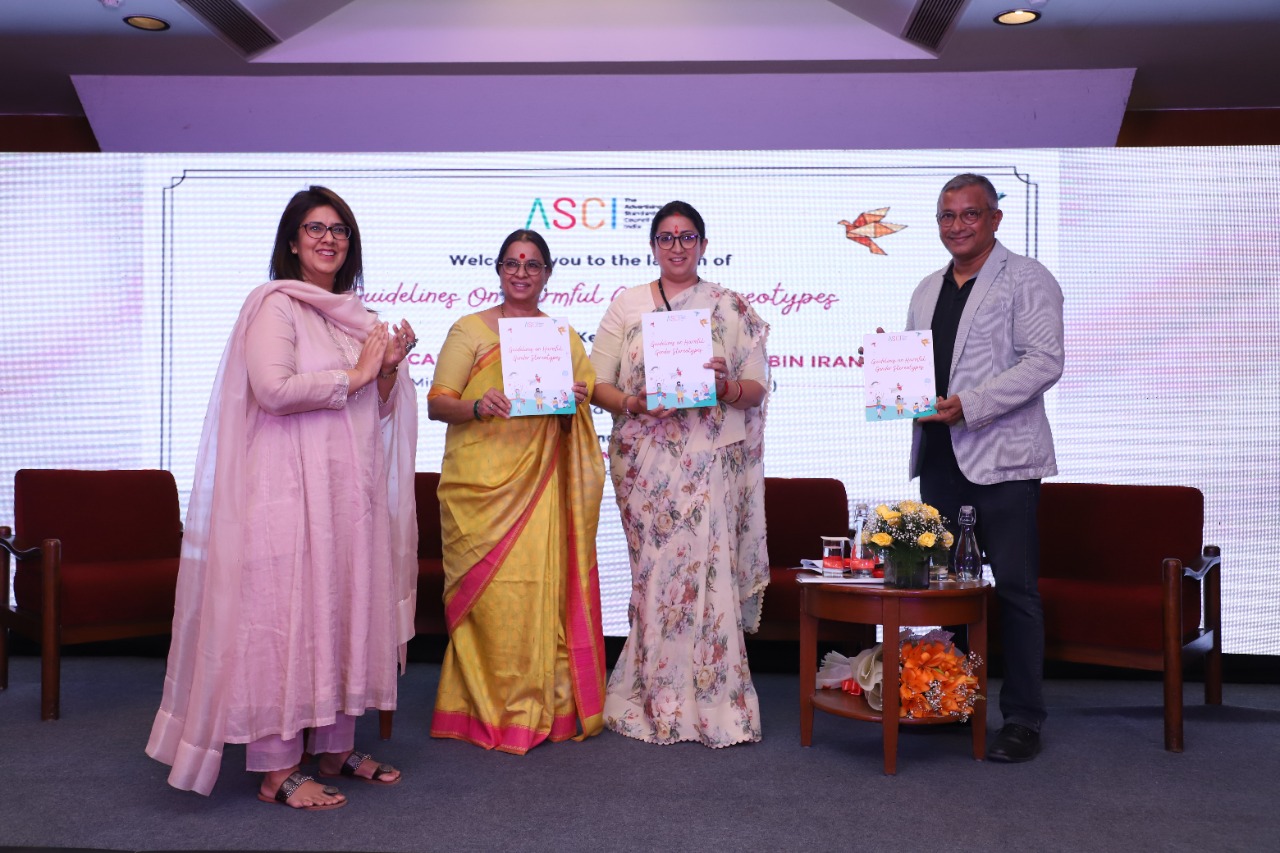
    The Advertising Standards Council of India (ASCI) has followed up the launch of its GenderNext report in October 2021, a study by ASCI and Futurebrands, with the release of guidelines that guard against harmful gender stereotypes. The guidelines were released at an event held in Delhi presided over by Union Minister for Women and Child Development Smriti Irani.


    While the guidelines focus on women, they also provide pointers for depiction of other genders.


    The guidelines, encourage advertisers and creators to deploy the SEA (Self-esteemed – Empowered – Allied) framework that guides stakeholders in imagining as well as evaluating portrayals of gender in their advertising by building empathy and aiding evaluation, as well as the 3S framework, which provides a checklist to guard against tropes and implicit stereotypes that creep into advertising.


    These frameworks can prove to be extremely useful for marketing and advertising professionals to improve their advertising ROIs.


    Speaking at the launch of the guidelines on harmful gender stereotypes, Irani said: “While there are women who are happy with the incremental change that has been made in the advertising industry, women of my generation are a bit more impatient. It is time not only for the men but also for the women in the advertising industry to step up. This is a very important move, and I believe that there is a long journey to be undertaken to turn the thinking but it’s required now. Work in this area must move with more and more speed and organisations like ASCI should lead this, the action beginning with its member base.”


    Added Subhash Kamath, Chairman, ASCI: “The new guidelines were created after extensive consultation with many partners- both from industry, as well as civil society organisations, including the Unstereotype Alliance and UNICEF. These guidelines are a big step forward in strengthening ASCI’s agenda to shape a more responsible and progressive narrative. We are grateful to the government and Shrimati Smriti Irani for supporting these guidelines, and to the many partners who have been with us on this journey.”


    ASCI’s Guidelines on Harmful Gender Stereotypes in advertising:

    Note:

    1. ASCI will consider an ad’s likely impact when taken as a whole and in context.

    2. ASCI will consider stereotypes from the perspective of the group of individuals being stereotyped.

    3. The use of humour or banter is not likely to overcome the underlying issue of such harmful stereotypes.

    4. The guidelines do not intend to prevent ads from featuring:

    5. glamorous, attractive, successful, aspirational or healthy people or lifestyles;

    6. one gender only, including in advertisements for products developed for and aimed at a particular gender;

    7. gender stereotypes as a means to challenge their harmful effects.


    Advertisements must not include gender stereotypes that are likely to cause harm or serious or widespread offence.

    1. While advertisements may feature people undertaking gender-stereotypical roles e.g., a woman cleaning the house or a man going to an office, or displaying gender-stereotypical characteristics, for e.g., a man being assertive or a woman being sensitive to others’ needs, they must not suggest that stereotypical roles or characteristics are:

    :: always uniquely associated with a particular gender;

    :: the only options available to a particular gender; or

    :: never carried out or displayed by another gender(s).

    1.1 Advertisements that are aimed at / depict children may target and feature a specific gender but should not convey that a particular children’s product, pursuit, behaviour, or activity, including choice of play or career, is inappropriate for one or another gender(s). For example, ads suggesting that a boy’s stereotypical personality should be “daring” or that a girl’s stereotypical personality should be “caring”, or someone chiding a boy playing with dolls or girls from jumping around because it is not the typical activity associated with the gender, are likely to be problematic.


    2. While advertisements may feature glamorous and attractive people, they must not suggest that an individual’s happiness or emotional wellbeing depends on conforming to these idealised gender-stereotypical body shapes or physical features.


    3. Advertisements should not mock people for not conforming to gender stereotypes, their sexual orientation or gender identity, including in a context that is intended to be humorous, hyperbolic or exaggerated. For example, an ad may not belittle a man for carrying out stereotypically female roles or tasks or make fun of a same-sex relationship.


    4. Advertisements should not reinforce unrealistic and undesirable gender ideals or expectations. For example, an advertisement must not depict a man with his feet up and family members creating a mess around a home, while a woman is solely responsible for cleaning up the mess, or a woman overly grateful for the man helping her in everyday chores. Similarly, a woman returning from work may not be shown as solely responsible for doing household duties while others around her are at leisure.


    5. An advertisement may not suggest that a person fails to achieve a task specifically because of their gender e.g., a man’s inability to change nappies; or a woman’s inability to park a car.  In categories that usually target a particular gender, care must be taken to not depict condescension towards any other gender or show them as incapable of understanding the product or unable to make decisions. This does not prevent the advertisement from showing these stereotypes as a means to challenge them.


    6. Where an advertisement features a person with a physique or physical characteristics that do not match an ideal stereotype associated with their gender, the advertisement should not imply that their physique or physical characteristics are a significant reason for them not being successful, for example in their romantic, social or professional lives. For example, an ad may not suggest that a man who is short, a woman who is dark, or any individual who is overweight has difficulty finding a job or a partner due to this aspect of their physique.


    7.. Advertisements should not indulge in the sexual objectification of characters of any gender or depict people in a sexualised and objectified way for the purposes of titillating viewers. This would include the use of language or visual treatments in contexts wholly irrelevant to the product.  For example, an online takeaway service featuring an image of a woman wearing lingerie lying back in a provocative pose behind various fast-food items would be considered problematic.  Even though the image may not be sexually explicit, by using a suggestive image of a woman that bears no relevance to the advertised product, the ad would be considered objectifying women by presenting them as sexual objects, and therefore is a gender stereotype that is likely to cause harm.


    8. No gender should be encouraged to exert domination or authority over the other(s) by means of overt or implied threats, actual force or through the use of demeaning language or tone. Advertisements cannot provoke or trivialise violence (physical or emotional), unlawful or anti-social behaviour based on gender. Additionally, advertisements should not encourage or normalise voyeurism, eve-teasing, stalking, emotional or physical harassment or any similar offences. This does not prevent the advertisement from showing these depictions as a means to challenge them.


  • Subhash Kamath moves to advisory role. Dheeraj Sinha will also be Chairman of BBH, Russell Barrett is CEO & CCO

    By Our Staff


    Publicis Groupe India announced that it has appointed Dheeraj Sinha as the Chairman of BBH India in addition to his existing mandate as CEO & CSO, Leo Burnett, South Asia. Partnering Sinha will be Russell Barrett, as CEO & Chief Creative officer, BBH India. Subhash Kamath moves into an advisory role for the group on other strategic initiatives.


    Said Anupriya Acharya, CEO, Publicis Groupe South Asia: “I would like to thank Subhash for his leadership and contributions on BBH. Today BBH India is synonymous with truly world-class advertising. With Russell as CEO and CCO of BBH India and Dheeraj taking additional charge as Chairman, BBH India, we will further accelerate the agency’s spectrum of capabilities and creative product to deliver unmatched value to clients. Dheeraj comes with an impeccable track-record on growth, and this is also a testament of the strong leadership talent we have”


    Added Kamath: “It’s been a fantastic journey of 13 years, having founded this agency from scratch in India. It’s an agency built on a very strong people’s culture with creative excellence & strategic thinking at its very core. But I’ve been doing this for a very long time and as I enter the twilight of my 35-year career in advertising, I believe it’s time to hand over the baton to the next generation of leadership as I transition into an advisory role for Publicis Groupe. I’ve known Dheeraj for many years, and I know his passion for strategy & creativity. Along with Russell and Sanjay and many of the talented ‘black sheep’ in the organisation, I know I’ll be leaving BBH in very safe hands.”


    Said Sinha: “BBH is a dream brand amongst creative agencies. The brand has always believed in great work powered by sharp thinking. I have been a great admirer of its philosophy and the work that BBH has done globally. I am very excited with this opportunity. We have some great work, clients, and teams at BBH. Our goal will be to be one of the topmost agencies in the BBH network globally, creating work for our clients that brings them growth and glory.”


    Added Barrett: “BBH is an amazing brand, and this is an exciting new chapter in the exceptional story that has been scripted so far. I’ve enjoyed an enriching partnership with Subhash, Sanjay and Arvind, as we’ve done some proper black sheep work together. I now look forward to partnering with Dheeraj, who I’ve worked with before, and I can say from experience, that he brings a lot of energy and dynamism to every interaction and piece of work he touches.”


  • ASCI launches Endorser Due Diligence service

    By Our Staff


    The Advertising Standards Council of India (ASCI) has launched an Endorser Due Diligence service to help endorsers avoid making misleading claims in advertisements. Service will provide guidance from highly-qualified specialists from over 20 disciplines.


    ASCI has established a panel of experts, from over 20 disciplines, ranging from advertising regulation and legal, ayurveda, microbiology, electronics, market research, nutrition, dentistry, product formulations, financial services, and so on. The panel will assess the representations, statements, and claims in the advertisement from a consumer and technical perspective, examine the evidence in support of the claim where necessary, and thereby help the endorser conduct their due diligence. The advertisements can be sent to ASCI at any stage, including pre-production. This ensures that the endorser can do their independent due diligence before the advertisement is produced.


    Said Subhash Kamath, Chairman, ASCI: “Endorsers, particularly celebrities have a huge fan following and they enjoy the trust of millions of consumers. There is therefore a direct moral and now, legal responsibility that they bear to ensure that they do not make representations in ads that could be considered misleading. ASCI has always required celebrities to be mindful of what they endorse in advertisements, and now the law too, requires them to do due diligence in this regard.”


    Adds a communique: “Similar to the Advertising Advice service offered by ASCI, Endorser Due Diligence will be confidential and non-binding and will be issued in the name of the endorser.”


    Added Manisha Kapoor, Secretary-General ASCI: “Endorsers may not always be experts when it comes to the products they push and the claims they make. The law makes endorsers liable for the advertisements they appear in, hence Endorser Due Diligence becomes a critical need. ASCI’s service that is speedy, confidential, and based on the assessment of a multi-disciplinary panel can help endorsers do their due diligence in a timely and comprehensive manner, ensuring that consumers are not misled and that the endorser too, fulfills their legal obligations.


  • ASCI frames guidelines for virtual digital assets & services


    By Our Staff


    The Advertising Standards Council of India (ASCI) has announced guidelines for virtual digital asset advertising.


    The guidelines will be applicable to all advertisements released or published on or after the April 1, 2022. Advertisers and media owners must also ensure that all earlier advertisements must not appear in the public domain unless they comply with the guidelines, post the April 15.


    Subhash Kamath
    Subhash Kamath

    Said Subhash Kamath, Chairman of ASCI: “We had several rounds of discussion with the government, finance sector regulators, and industry stakeholders before framing these guidelines. Advertising of virtual digital assets and services needs specific guidance, considering that this is a new and as yet an emerging way of investing. Hence, there is a need to make consumers aware of the risks and ask them to proceed with caution”.


    These guidelines interpret, for virtual digital assets, Chapter 1 of the ASCI code, particularly clauses 1.1, 1.4 and 1.5. that require ads to be truthful, and not mislead consumers by implication, ambiguity, exaggeration or omission, and are not framed in a way that abuses their trust or exploits their lack of knowledge.


    It is important to note that these guidelines do not amount to any legal recognition or endorsement of the industry or the sector, as that is a matter of government policy. ASCI only provides self-regulation for content of ads that are permitted by law.


    Manisha Kapoor
    Manisha Kapoor

    Added Manisha Kapoor, Secretary General, ASCI: “We have seen a spate of advertising for virtual digital assets which could compromise consumer interest in the absence of some guardrails. Use of celebrities and high decibel advertising would attract consumers to these offerings, without full disclosure of the risks. Given that this is, as of now, an unregulated space, it is even more important for advertising to be upfront regarding the risks associated with these products. Globally, this is an emerging technology and products in the virtual digital asset industry have seen significant volatility.  We believe with these guidelines, advertisements would be fairer and more transparent.


    All advertising for virtual digital assets and services needs to follow the following guidelines:

    (1.1) All ads for VDA products and VDA exchanges, or featuring VDAs, must carry the following disclaimer.

    “Crypto products and NFTs are unregulated and can be highly risky. There may be no regulatory recourse for any loss from such transactions.”

    Such a disclaimer must be made in the following manner so that it is PROMINENT and UNMISSABLE by an average consumer:


    (a) In print or static, equal to at least 1/5th of the advertising space at the bottom of the advertisement in an easy-to-read font, against a plain background, and to the maximum font size afforded by the space.

    (b) In video, the disclaimer should be placed at the end of the advertisement against a plain background.  A voice over must accompany the disclaimer in text. The voiceover should be at a normal speaking pace and must not be hurried. In the case of long format video of over two minutes, the said disclaimer should be repeated at the beginning and at the end of the video. The disclaimer must remain on screen for a minimum of five seconds.

    (c) In audio, the disclaimer must be spoken at the end of the advertisement. The voiceover should be at a normal speaking pace and must not be hurried.  In the case of long format audio of over 90 seconds, the said disclaimer should be repeated at the beginning and at the end of the audio.

    (d) In social media posts, such a disclaimer must be carried in both-  the caption as well as any picture or video attachments. The disclaimer within the caption must be placed upfront at the beginning of the post. Where social media posts. or advertisements  have restrictions on text in the static picture, the disclaimer must be carried upfront in the caption before the fold.

    (e) In disappearing stories or posts unaccompanied by text, the said disclaimer will need to be voiced at the end of the story in the manner laid out in points (a) or (b) above. If the video is 15 seconds or lesser, then the disclaimer may be carried in a prominent and visible manner as an overlay.

    (f) In formats where there is a limit on characters, the following shortened disclaimer must be used “Crypto products and NFTs are unregulated and risky” followed by a link to the full disclaimer.

    (g) The disclaimer must be made in the dominant language of the advertisement

    (h) In addition to the above, all disclaimers must meet the minimum requirements laid down in the ASCI guidelines for disclaimers.


    (2) The words “currency”, “securities”, “custodian” and “depositories” may not be used in advertisements of VDA products or services as consumers associate these terms with regulated products.


    (3) The information contained in advertisements shall not contradict the information or warnings that the regulated entities provide to customers in the marketing of VDA products from time to time.


    (4) Advertisements that provide information on the cost or profitability of VDA products shall contain clear, accurate, sufficient and updated information. For example, “zero cost” will need to include all costs that the consumer might reasonably associate with the offer or transaction.


    (5) Information on past performance shall not be provided in any partial or biased manner. Returns for periods of less than 12 months shall not be included.


    (6) Every advertisement for VDA products must clearly give out the name of the advertiser and provide an easy way to contact them (phone number or email). This information should be presented in a manner that is easily understood by the average consumer.


    (7) No advertisement for VDA products or exchanges may show a minor, or someone who appears to be a minor, directly dealing with the product, or talking about the product


    (8) No advertisement may show that VDA products or VDA trading could be a solution to money problems, personality problems or other such drawbacks.


    (9) No advertisement shall contain statements that promise or guarantee future increase in profits.


    (10) No advertisement may show that understanding VDA products is so easy that consumers do not have to think twice about investing.  Nothing in the ad should downplay the risks associated with the category.


    (11) VDA products may not be compared to any other asset class which is regulated.


    (12) Since this is a risky category, celebrities or prominent personalities who appear in VDA advertisements must take special care to ensure that they have done their due diligence about the statements and claims made in the advertisement, so as not to mislead consumers.


  • 6 key patterns in ads that India finds offensive


    The Advertising Standards Council of India, the self-regulator body set up advertisers, advertising agencies, media companies and others in media ecosystem, has come up with a report titled ‘What India Takes Offence To’.


    Based on 1,759 complaints against 488 advertisements over the past three years, ASCI undertook a deep dive to identify trends in such complaints in order to deconstruct not only the messaging that was found objectionable, but also the articulation of the complaint along with desired action asked for.


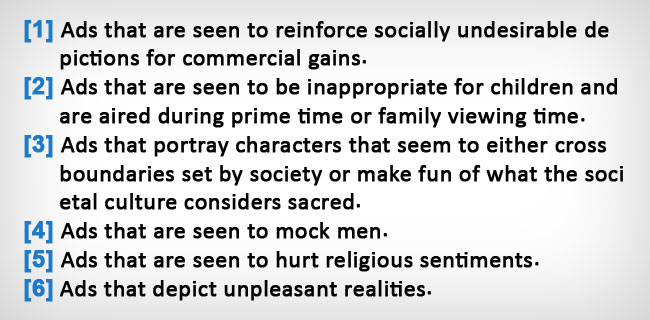
    There are six broad patterns of triggers:

    Socially undesirable depictions for commercial gains: Some ads were seen to reinforce depictions of society that perpetuated unhealthy practices or beliefs for the sole purpose of commercial gains. For example, ads that promote stereotypes such as fair skin, certain body shapes or ads that create undue pressure on parents and kids in the field of education.


    Inappropriate for children: This category had ads, mostly viewed at prime-time, that seemingly provoked children’s interest in ‘adult life’, particularly in the idea of sexuality and physical intimacy. The complainants were largely embarrassed or concerned parents.


    Ads where people seemingly crossed cultural boundaries: Depiction in these ads seemed to cross boundaries set by society or to make fun of what was considered sacred in our culture. Individualist depictions, particularly of youth and women, were key triggers. Many ads that showed intergenerational dynamics in non-traditional ways were also considered problematic by some people.


    Advertising mocking men: Ads where men were depicted in a negative or poor light, even in humorous or introspective ways, were considered offensive by some.


    Hurting religious sentiments: Ads portraying mixed religious narratives, depictions of new interpretations of traditions or the use of religious and cultural motifs in a humorous manner became a trigger point. Complainants questioned the intent of the ads and felt the need to guard against ‘conspiracies’.


    Depicting unpleasant realities: Everyday realities, when depicted in an in-your-face manner, triggered complaints from consumers who preferred a more sheltered and ‘civilised’ version of realities. Showcasing death, raw meat or blood tended to raise the hackles of these complainants.


    Said Manisha Kapoor, Secretary General, ASCI: “Being in direct touch with the complainants gives ASCI a unique vantage point to understand what people find offensive in advertising. We are sharing these insights with our stakeholders to help advertisers plan campaigns better and be more cognizant of  consumer sentiment.”


    Added Subhash Kamath, Chairman ASCI said “At ASCI, we believe our role is not just to police the narrative but to also constantly add value to the industry by guiding our members towards more responsible advertising. These kinds of reports, along with initiatives like our ‘Advertising Advice’ service will help the industry a lot in that direction.”


    The report can be accessed at https://ascionline.in/.


  • Starting next month, Subhash Kamath can work in Paris/ US/ wherever for 6 weeks

    By Our Staff


    Subhash Kamath
    Subhash Kamath

    Publicis Groupe has announced ‘Work Your World’, a policy that combines flexibility, opportunity and growth for all talent. Launching in January, with health and safety at the core, the programme will allow every Publicis Groupe employee to work from any accessible country where the Groupe is present, for up to six weeks a year. Hence Subhash Kamath, CEO, Publicis Worldwide and BBH, India and every Publicis Group employee in India can spend a month-and-a-half in the 100-odd group offices across the world.


    Said Arthur Sadoun, global Chairman and CEO of Publicis Groupe: “We have been working hard on how to turn the hybrid world into new opportunities for everyone at Publicis, and make the future of work more creative and more daring. We know the pandemic isn’t over, and we know that the world could close again at any time. But that’s not a reason to close our horizons and perspectives. We will continue to move forward, because one day this crisis will come to an end and because we owe it to our people to make their professional and personal experience at Publicis truly unique”


    Added Carla Serrano, global CSO of Publicis Groupe: “Our people have been incredibly resourceful despite the limitations of the pandemic. They deserve to work for a company as resourceful as they are. Work Your World can help every Publicis employee “work their world” in a bigger, better and brighter way thanks to our scale, diversity and Marcel.”


    So if you want to be going places – literally, you know which CEO/HR head to write to pronto.


  • Subhash Kamath re-elected ASCI chairman

    By Our Staff


    The Advertising Standards Council of India’s (ASCI’s) Board has elected Subhash Kamath for a second consecutive term as Chairman. NS Rajan, Director, August One Partners LLP, was re-elected Vice Chairman of the Board.


    Said Kamath: “I thank the Board for its support and trust. We have flagged off important initiatives in the digital space, such as the influencer guidelines and the monitoring of promotional content. We are becoming future-ready in this ever-changing marketing and media landscape. The second term will allow me to push further with these initiatives, which are showing immense promise. As we expand our presence, we are engaging more with consumers as well to increase awareness of their rights.”


  • So, what’s the view on Depiction of Women in Advertising


    By A Correspondent


    The Advertising Standards Council of India (ASCI) and Futurebrands, have unveiled the GenderNext study to study the representation of women in advertising. GenderNext, notes a communique, covers patterns of portrayals across multiple categories, such as personal care, fashion, beauty, home and hearth, gadgets and wheels, money and education. The study also touches upon how advertising portrays women versus how they see themselves and want to be seen.


    According to Lipika Kumaran, the lead author of GenderNext, the study reveals that while there are some positive moves, mainstream advertising still heavily borrows from an inventory of overused, and sometimes harmful stereotypical tropes. A detailed study of over six hundred advertisements revealed several problematic tropes- such as sensualising the act of eating by women, showing women as spenders in financial advertising, women running around the house while others lounge around, male gaze acceptance in beauty ads,, showing women as lower down in tech-hierarchy in gadget ads, male celebrities challenging and instructing women,among others. A detailed list of such depictions across categories are captured in Annexure A.


    Women interviewed across different life stages and town classes pointed out that it is not them but others in their sphere who lag behind them, and they are the ones in need of empowerment. They feel that advertising can be their ally in this journey. The study found that for young unmarried women, common stereotypes used in advertising such as women joyfully undertaking the drudgery of work was not aspirational at all. Typical women’s day ads that show women emerge victorious after significant struggle were not considered particularly empowering. Women are tired of ads showing young women being bestowed with freedoms only after putting up a fight.


    The study proposes a category agnostic framework “The SEA (Self-esteemed – Empowered – Allied) Framework” that aims to guide stakeholders in imagining as well as evaluating portrayals of women in their advertising by building empathy and aiding evaluation


    The study also proposes a 3S screener for scripts/storyboards, casting, styling to identify stereotype red flags. The screener looks at aspects of a) Subordination b) Service and c) Standardisation (. More details of the SEA framework and 3S screener can be found in Annexure B


    Said Subhash Kamath, Chairman, ASCI: “GenderNext acts as a guide for stakeholders – brand owners, marketers, advertising professionals – to aid the creation of more progressive depictions of women in advertising. The deep insights on women, and what they feel about advertising is a fantastic input into advertising creation, and we hope that brands and advertisers will be motivated by the findings to depict women in more progressive ways. We also intend to set up a task force to evaluate advertising guidelines on harmful stereotypes”


    Added Santosh Desai, MD, Futurebrands Consulting: “As an influential form of popular culture, advertising has historically been a significant source for the propagation of gender stereotypes. While things are changing, what this study, initiated by ASCI and carried out by Futurebrands uncovers, is that gender continues to be represented in a skewed and discriminatory manner. Some obvious ways of stereotypes are less visible, but there are many other ways, both subtle and not-so- subtle, in which gender portrayals continue to be skewed. The GenderNext study has identified some common patterns of discrimination and has also created a framework that enables marketers to identify and eliminate such undesirable representations.”


    The report, said Manisha Kapoor, Secretary-General, ASCI: “ is only the first of the many initiatives ASCI will put together in this space. This is a continuing conversation.”


    For the study, the primary research involved ad clinics with 160 respondents and 20 focus group discussions across 10 centres, in addition to tapping into Futurebrand’s proprietary study Bharat Darshan. More than 300 people were spoken to via social media. All stakeholders such as national and regional advertisers, agency and creative heads. Gender domain experts, policy makers and advocacy groups were consulted as part of the study enquiry.


  • ASCI launches ‘Advertising Advice’ service to help brands determine if ads violate ASCI code

    By Our Staff


    The Advertising Standards Council of India (ASCI) has launched a paid ‘Advertising Advice’ service. This service is open to all members and non-members of ASCI and will point out to advertisers and marketers, at the campaign planning stage, if their claims could potentially violate any ASCI code or guideline. This will help them to take corrective action at the pre-production phase and will guide them to substantiate the claim and align the creative basis the ASCI code.


    While the service existed in a smaller form earlier, now the Advertising Advice panel also includes technical experts in different specialties who can examine the claim and evidence for technical claim support.


    ASCI has clarified that it will process any complaints they receive against such ads as per its normal process. The advisory panel for Advertising Advice service is completely different from the complaints process to avoid any potential conflicts.


    Said Subhash Kamath, Chairman, ASCI: “As ASCI steps into its next phase, the Advertising Advice service will be a crucial element in the cause of self-regulation. The service gives brands a chance to better prepare their campaigns and mitigate reputational risks. While there is no guarantee that consumers will not raise a claim against a brand, the advisory does help brands take steps to ensure that their campaigns don’t violate any norms formulated to protect consumer interest. We believe that this advisory service will provide the necessary support to the advertising ecosystem to create more responsible ads without affecting creativity.”


    Added Manisha Kapoor, Secretary-General, ASCI: “The advisory can be used by brands to great effect while planning their campaigns. Brands wish to be competitive and push the boundaries of claims. With this service, we can support advertisers to make strong claims while not crossing the all-important lines of honesty, decency, fairness and safety. An external scrutiny by experts at the pre-production stage can add tremendous value to campaign development. Post release of the campaign, any stoppage can cause significant disruption and cost for an organisation. But by making this a part of the way advertisers think of campaigns at an early stage, such risks can be mitigated. We see this as a win-win for advertisers and consumers, who then get exposed to fewer problematic ads.”


  • Google, Facebook to strengthen ASCI board

    By Our Staff


    The Advertising Standards Council of India (ASCI) has announced two new appointments to add to its digital expertise as part of its vision for the future. Aditya Swamy, Director of Google India, has been appointed to the board of governors of ASCI, while Sandeep Bhushan, Head of India Global Marketing Solutions at Facebook has been appointed as special invitee to the board. The appointments also mark ASCI’s fast-widening focus on digital advertising and platforms, which began last year with a partnership with TAM to monitor 3,000 digital platforms for misleading marketing claims, as well as the launch of the Influencer guidelines and influencer monitoring through an AI platform.


    Said Subhash Kamath, Chairman, ASCI: “‘I’m delighted to welcome both Aditya and Sandeep to the board, this is a landmark moment. As we strengthen our roots in the digital space and streamline its functioning, it is extremely important that we collaborate with and learn from the leaders. Google and Facebook are the biggest digital players. We look forward to them helping us become a better conscience keeper of the industry.”


    Added Manisha Kapoor, Secretary-General, ASCI: “Having Google and Facebook on our board is a great start to the new journey ASCI is embarking upon. It is vital for us to have a keen understanding of digital operations. We will benefit greatly from the expertise that both these companies bring with them.”


  • ASCI refreshes ‘future-facing’ brand identity

    By Our Staff


    New ASCI logo
    The refreshed identity

    The Advertising Standards Council of India (ASCI) has unveiled a new brand identity to reflect, as its communique points out,  the “agenda of becoming future-facing and more inclusive”. The refresh comes close on the heels of new initiatives such as the guidelines for influencer marketing and online real money gaming and asci.social. Adds a communique: “ASCI has always been the conscience-keeper of the Indian advertising industry, and in this new phase, it aims to expand its offerings and services that will help advertisers balance creativity and responsibility.”

    Subhash Kamath
    Subhash Kamath

    Said Subhash Kamath, Chairman, ASCI: “ASCI has stepped into the next phase of challenges that impact the interests of consumers in new ways. With new-age challenges posed by the digital age, it is imperative for ASCI to take a leap into becoming a contemporary thought leader and add greater value to consumers, industry and all our stakeholders. The new logo represents this very interesting phase of ASCI’s journey, and the vibrant and optimistic outlook of responsible advertising. Our ideology and aim remain unchanged; however, we are now on the path to becoming a more dynamic and future facing organization.”

    KV 'Pops' Sridhar
    KV ‘Pops’ Sridhar

    Added KV Sridhar, Chief Creative Officer (Global), Nihilent Ltd, the company which designed the refreshed logo: “The colourful logo palette denotes the vibrancy of advertising and communication itself, as well as the diversity of ASCI’s stakeholders who have taken the oath to self-regulate and create ads with responsibility. The idea of creativity with responsibility is central to ASCI. The logo also reflects the dynamic nature of media platforms and the newer interesting ways in which communication is being created and consumed today. The elegant and inclusive font reflects an organization opening up to newer kinds of stakeholders, an organization that is collaborative and demonstrates leadership in bringing together the needs of different stakeholders. It signals that ASCI is gearing up towards this fast evolving and dynamic environment of consumers and advertising.

    Roger CB Pereira
    Roger CB Pereira

    Said marketing services veteran Roger C B Pereira, Founder Member, ASCI: The world today is remarkably different from when we started ASCI in 1985. However, what is noteworthy is that the twin principles of consumer protection and fostering creativity remain unchanged.


  • ASCI, FSSAI join hands to curb misleading claims in F&B ads

    By Our Staff


    The Advertising Standards Council of India (ASCI) has signed an agreement with the Food Safety and Standards Authority of India (FSSAI) to safeguard consumers against misleading claims in food and beverage (F&B) advertisements. The agreement was signed in the presence of Arun Singhal, CEO, FSSAI, and Bejon Misra, Adviser, Public Affairs, ASCI, on July 1.


    As per the agreement, ASCI will identify advertisements which prima facie violate provisions of Food Safety And Standards (Advertising And Claims) Regulations, 2018, and FSSAI would further investigate these. Under the agreement, ASCI will set up a three-member expert panel to evaluate F&B advertising identified by the ASCI monitoring team.


    Said Manisha Kapoor, Secretary-General, ASCI: “With this agreement, ASCI will intensify its scrutiny of the F&B sector. We will tap our National Advertising Monitoring Service, which monitors over 900 TV channels and publications, and over 3,000 websites. Besides national brands, we will examine regional and local ones. Our experts, with decades of experience in the F&B sector, will shortlist those advertisements that require further scrutiny by FSSAI.”
    Added Subhash Kamath, Chairman, ASCI: “This is a significant collaboration. The common goal of consumer protection drives us all to share skills, expertise and resources in the most effective way to curb the menace of misleading advertising.”