Tag: Stratagem

  • Mitron, the Nation wants to Know…


    Call it the News Channel Dangal or whatever, here’s an analysis by Stratagem Media on how the English news channels fared post-demonetisation and Arnab Goswami’s exit

    Background :

    The economic and political scenario in the country over the last two months has been fodder for the news business – mainly with the announcement and unfolding of the demonetization drama, followed by the demise of Tamil Nadu Chief Minister, J Jayalalithaa. But for all of us in the marketing and media fraternity, something equally dramatic happened about the same time.

    On November 2, the media fraternity witnessed a piece of truly “breaking news” –Arnab Goswami, the editor-in-chief and star NewsHour anchor of Times Now channel had resigned. Well of course, he was still on air, for the next few days, when on November 8, even as everyone was trying to predict the after-effect of his departure from the TV screen, the shock-n-awe of demonetisation happened.

    Speculation about Goswami’s departure from the TV screen, and his plan thereafter,has been rife, ever since.

    Objective of the study:

    At Stratagem Media Pvt. Ltd, we were equally eager to understand the effect of these developments on the viewership of news channels. Our friends (mitrons) and fellow professionals in the media and marketing fields (by and large, our ‘nation’), would be keen to understand

    – whether news viewership has risen post-demonetisation

    – whether there is a difference between the after-math of demonetization on English and Hindi news channels?

    – Or has Mr Goswami’s absence from the TV screen, had any effect on channel viewership and if so, how much?

    But we felt it would be prudent to resist the temptation of jumping to conclusions and not rush through the analysis. So, we waited for the scenario to stabilise, till viewership data for at least a few weeks had trickled in.

    Here’s a study of viewership,both pre- and post-demonetisation, which happened to also coincide with ArnabGoswami’s last week on the screen. Naturally, the questions that have been addressed are whether the viewership of English and Hindi News channels was affected in any way, post that week, and what was the effect on the viewership of specific channels.


    Methodology:

    A simple viewership comparison was undertaken for a period of 10 weeks i.e. five weeks pre- and five weeks post demonetisation/ Mr Goswami’s departure from the screen.

    This study was focused on the ‘9 pm to 11 pm’ time slot on the weekdays, (which historically contributes to a major proportion of viewership). This analysis was done for three relevant geographical units (the 1mn+ cities across the country, Mumbai+Delhiand Mumbai+Delhi+Bengaluru), as well as for a relevant and sufficiently wide target group comprising of Males,above the age of 22 years belonging to the top two segments of affluence (i.e.NCCS AB)Although not all of it is published here, the analysis was also undertaken simultaneously, but separately, for the entire genre of Hindi News channels and English News channels (including English business channels).

    Two viewership parameters were examined – gross impressions and relative channel share (for the English and Hindi channel genres).

    The source of all data was the BARC viewership ratings.

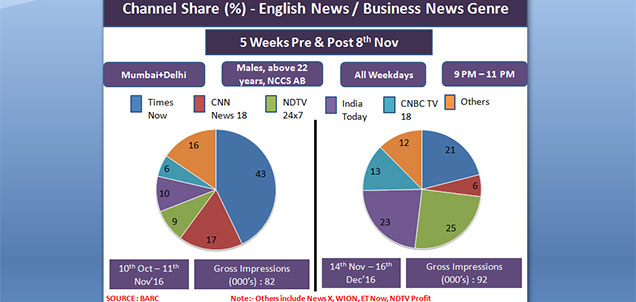
    Conclusions (English channels):- (Refer slides above)

    From the above analyses,in the five weeks post-demonetisation,it is evident that (within the specific TG of Men, above the age of 22, from the top 2 affluence classes – NCCS A&B), in the prime time slot of 9 pm to 11 pm,

    – The viewership of English News channels in all main cities in India, in fact declined by 1 %, in the 5 weeks post demonetization. But it increased by about 11 % to 12 % in the 2–3 main metros. In other words, as expected, the viewership pie of English news genre as a whole has only managed to increase in the main cities (Mumbai, Bengaluru, Delhi) where the English news channels get most of their eyeballs.

    – While Times Now continues to lead the pack in the English News genre, the decline in its viewership, ranged from – 29 % to  -45 % in these 3 market units. In fact, even CNN News18 declined by about 27 %, to 61 %,whereas the gain in viewership of other channels such as NDTV 24×7 and India Today TV, was considerable, ranging between 99 % to 230 % for either of them, over the same period. However these channels grew from a relatively much smaller base.

    – Consequently, in the main cities of the country as a unit, the decline in the relative share of viewership for Times Now was from 55 % to 40 %, whereas NDTV 24×7’s relative share grew from 8 % to 17 %, and India Today TV’s relative share grew from 12 % to 19 %.

    – The corresponding changes in viewership shares, in the main metros for these channels were even more pronounced, as evident from the graphs.

    – And yet, without doubt, Times Now still stands head-n-shoulders above the other English News channels.


    Conclusions (Hindi News channels)

    From the analyses, it was also evident that in the 5 weeks post demonetisation, (and within the specific TG of Men, above the age of 22, from the top 2 affluence classes – NCCS A&B), in the prime time slot of 9 pm to 11 pm

    – The viewership of Hindi News channels increased by as much as 29 % in the 1 mn + cities, with some channels registering gains of more than 50 %

     – In terms of relative channel shares, the biggest gainers were News18 India, Zee News and AajTak.

    So, on an apple-to-apple comparison, Hindi channels seem to have grown in the post-demonetisation phase, in the cities, whereas English channels have in fact, marginally declined. So, could this perhaps be a case of missed opportunity.

    This does however give rise to another pertinent question. What constitutes brand identity for a media house – be it a newspaper title, a TV channel, an FM station or a website? They say ‘Content is King’, but is it just content, or the values that the brand is perceived to stand for, or production quality, or just the sheer the persona of the anchors/ RJs.

    To validate some of the quantitative findings of this analysis, we asked senior media professionals about their individual opinions and experiences. This is what they had to say :

    Sandip Tarkas

    Sandeep Tarkas, CEO (Sports, Media & Special Projects), Future Group, states that “I think Arnab was the person I missed the most during the entire demonetisation debate. After initially watching a lot more of news for about a week, I have almost stopped watching news TV, and that’s where I missed Arnab. He would have brought the right issues to the fore even if one didn’t agree with his take on the issue”.


    Karthik Mani

    Kartik Mani, Founder, Chief Insurgent – Merry Men, says that although he has never been a fan of Arnab Goswami, but Arnab’s absence has made watching Times Now, a lot less compelling.



    Munnish Puri

    Munnish Puri, media expert & Founder, Indian Financial Advisors, has this to say:”Beyond doubt, Arnab and Times Now were a highly impactful combination. Viewers tuned-in to get real ‘inside information’ of the news that mattered. Even global audiences took a strong liking to Arnab. Looking at the recent viewership data, it is not surprising that the Times Now viewership has been impacted. The Newshour is certainly not as engaging without Arnab!’



    Bharat Kapadia

    Bharat Kapadia, veteran media expert, confesses that he gets put off when news channels become noise channels, and that leads to reduced exposure. But he adds that Arnab always had the last & loudest word which at times made it interesting. And that he has hardly watched Times Now after Arnab quit. Bharatbhai also adds that his time spent watching news channels post demonetisation had increased, but he was disappointed about the way the topic was covered by all channels in general. There was no depth in the content, just opinionated angles and gimmicky presentation. He feels that it is entirely possible for face value to outweigh brand value of a media house, just as it happens in the film industry.

     

    Sumit Roy

    For Sumit Roy, Founder Director Univbrands, Times Now was not the preferred channel. He sums it up by saying: “Times Now isn’t any better now, without Arnab. As a policy I switch channels when any Anchor speaks over the Panelist and cannot control panelists speaking over each other. Some other anchors seem to have gone that route as well.As a result my preferred news channels are India Today, NDTV and BBC World. In that order. I stay with whichever (of these) has the more interesting story at the time of watching.”


    Nevertheless, as evident from the above analyses, it’s not just content, or the values of a news channel, or production quality, that builds a TV brand. Viewership also seems to be obviously sensitive to changes in brand persona.All in all, with state elections around the corner, we can be sure that the News Channel ‘Dangal’ is far from over.

     

    Sundeep Nagpal

    This report has been conceived and produced by Stratagem Media Pvt Ltd., an independent media specialist company, headed by its Founder–Director, Sundeep Nagpal

     

  • 25 years of Stratagem


    By Anuka Roy


    The first thing that gets your attention about Stratagem Media is its logo. It is a chameleon. And if you are wondering the reason behind this, it’s simple. A chameleon does not change colour, it merely blends in with as per the need of the hour. So, the belief as mentioned in the company website is, “In fact to a chameleon, stratagem is inherent! Its adaptation of colours is its natural stratagem. Similarly, at Stratagem Media, we believe that we reflect the colours of our client and adapt to their ever-changing requirement from time to time.”


    Founded in mid-1991, by media services veteran Sundeep Nagpal, Stratagem operates in the fields of media buying, planning and consulting. Currently, the company is celebrating its silver jubilee year. On this occasion, we caught up with Nagpal to know more about his journey, the current trends in the industry and more.


    The beginning

    There is no answer to why I began. I was young and it was an impulsive decision to be on my own. I began by just actually offering whatever I thought I knew to anybody who I thought could use my services. So, I had been lucky that I had worked on some of the best brands in the country by that time. I decided to offer my services to media professionals, initially to those agencies that did not have in-house media planners. Thankfully, there were maybe half a dozen of them who said that we do not want somebody full-time and were looking for somebody part-time. That is exactly what I wanted, so I said I can give you part media planning service and I will operate out of my office but I will also come here and take briefs whenever it is required. There were three or four such agencies who tied up with me later in the sense that they became clients. And, that is how we started.


    Then and now – the difference in media planning

    Now, the service of media planning, first of all has not only become very large in scope because the media players have increased so much but also it is more easily available. There are individuals, agencies who have enough of expertise now. In those days, there were a very few of us and we were somehow a rare breed those days. Obviously, now, one has to think about how to stay afloat.


    There are many brands who now know what media is planning, they understand it, and they get some of the nuances, even the Indian entrepreneurs they know about it. Now, I do not have to explain to people what I do. Earlier, I had to explain to them in great detail that this is what I do but now I do not have to explain so much.


    Milestones

    Somewhere in the mid-90s, my company was asked to start a new kind of an initiative with seven medium-sized agencies, which was a media buying initiative on behalf of all those seven media agencies combined. That was a milestone because nobody had done it before, we did not know how to go about it and we went and did it. Whatever time it lasted, it did not last for more than two and a half years but whatever it was, it was perfectly natural. There was no worry about why it was not working. Everybody understood these were the pitfalls and therefore we may not be able to push it forward. But that was a fantastic time because for me it was a great moment as I had done this.


    In 25 years, there have three or four milestones. Again, somewhere in the mid-90s we started working for brands who not only wanted to use media planning but media companies such as newspaper groups and television channels wanted to understand how to increase their advertising revenues. So, we started consulting with them. We used the same knowledge and background to help them to earn more advertising revenue, again something nobody had done before. I was very happy that I am to do this and continue to do that even today.


    Then, the third milestone was in the late-90s where we stopped working with agencies because the entire industry changed because these agencies either they were absorbed by other larger agencies or they lost their main clients or for whatever reasons.  So, I reinvented the whole process and was working directly with brands, with advertisers. That was another milestone for us.


    We did a couple of other things which were very unique. One was, we worked with a large financial investment company on a three months project where they wanted to understand the strengths and weaknesses of a particular television network in the current competitive scenario. That was a humongous exercise which we never realised that we would be capable enough to do it but we did it.


    Now, of course, we are looking towards a few new things as well in the area of digital perhaps.


    The evolution of clients

    They have had to learn how to separate the wheat from the chaff- this is good and this is not and this is what is going to work for me. Earlier, they did not bother and left it for the agency to bother. Secondly, despite the fact that they have learned something, unfortunately or as a parallel the number of options has grown hugely. They are still grappling and they are still not consistent with what they want to try. See, as a final result of any particular communication exercise there could be many things that could have gone wrong. Very few people understand how to identify what has exactly gone wrong in the communication exercise which is an overall thing or let us say in the brand’s bottom line or top line. There could be 100 reasons but you should not give up what you have started on. Try it consistently, identify the problems and move on. Plug the loopholes, most people do not want to plug the loopholes. That is probably the wrong attitude.


    Surviving the obstacles

    Any business goes through ups and downs because of the market. Initially, like I said, I was quite content providing my services to the ad agencies but the mid-sized agencies I was working with were either absorbed by larger agencies or they lost their main clients, the big pitfall that happened for me was that I was not ready for it. I did not even expect it. And, it happened almost overnight. I was forced to stand up on my own again. So, that challenge happens anywhere. Now, for example, if I was to look for challenges, how do I keep pace with changes that are happening in the media sector and I do not want to call it just digital because within digital there are so many options. And, I do not want to necessarily say I am an expert in all of them. But I must know how to judge one from the other. Once I know that, I need to know how I execute it for a client. We have a very small set of clients and thankfully some of them are very happy with us in the sense that within the realm of whatever they require we have delivering well enough which is now nothing to feel very happy about but the next thing is how do I get some growth for them as well and for me as well.


    Looking forward

    The future is a mix of some trepidation in my mind along with some amount of excitement. There is excitement about doing something new but at the same time there is a concern that will I get it right.


  • By Invitation: Sundeep Nagpal | Will Satyamev Jayate work for advertisers?

    By Sundeep Nagpal


    Much has been said already about this latest attempt at garnering mindshare (no, not that one …. please notice, the ‘m’ is not in caps !). And most of it is reasonably credible and justifiable. For instance, there’s little doubt that the show is a brave attempt by an entertainment channel to create some degree of social transformation, as much as being almost a challenge to its sponsors to leverage its equity for their brand.


    There’s also little doubt that both, the anchor of the show and its production values are as superlative as they could be.


    But the question is: Will it work?. What are the benchmarks of performance? Should they be just the ratings? And if not, are there any other – for example: any NGOs which can monitor changes in behaviour, attitude, etc. towards the social issues that the programme addresses.


    However, until such time that any social transformation becomes evident, here are some thoughts that still intrigue media professionals (especially after seeing the first episode). (Lesser mortals such as us can only look at this prism, in the light of the advertising / media business).


    – By any stretch of imagination, and despite being broadly classified under the genre of reality, SJ is far from being an entertainment show (no argument that even KBC was entertaining to some degree, despite basically, being a general knowledge quiz). So, will it work even half as well as KBC?

    – With the backdrop of socially-oriented programs like Aap Ki Kacheri, what can be expected from SJ? Can the host / treatment of this show make it a commercial viability for the channel?

    – In a season where the popularity of the country’s largest entertainment spectacle (the IPL) seems to be on the wane, what can be expected by an advertiser from a social talk show?

    – To what extent could the marketing muscle behind the show have bolstered the ratings of the first episode? (and of course, what, if anything would sustain its popularity?)

    – While there is no doubt that the host/ anchor, production values and the promotional strategy (including the suspense created), have been very favourable for the show, are the time slot, program duration and basic content, favourable enough to create a block buster?

    So, this article is not a shot at ‘philosophical gyaan’. In fact, it is an attempt to understand audience perception as well as an attempt to predict the popularity of the show (yes in terms what the opening ratings are likely to be).


    To address the former issue, we at Stratagem Media, undertook a dipstick study of a cross-section of more than a 100 people who had watched the show, in Mumbai only, (needless to say that dipsticks are only meant to be indicative of any patterns that may exist and not necessarily statistically accurate).


    Also, we did look at the ratings of a variety of other reality shows quite closely, just to be able to arrive at an educated judgement on what its opening TVR would be on Star Plus (for an All India, CS, 4 + audience).


    Here are some of our observations.

    –  To begin with about 25 % of people approached for the dipstick survey had not seen the show (but that’s not surprising, after all people do other stuff on Sunday mornings), and males formed a larger component of the non-viewing audience.

    – 18 % watched for less than 15 minutes, while 27% watched for more than an hour (albeit, not for a statistically valid sample).

    – A majority of male viewers did not even know the duration of the programme, (even after having watched it).

    – Two-thirds of viewers watched the original airing and almost everyone who saw it, did so on Star Plus (in Mumbai).

    – A majority of Males watched primarily because of the host/anchor, while about a third of them were curious about the content. Whereas a much larger proportion of women watched for the content.

    – More than two-thirds of viewers rated content and credibility of the show very highly.

    – In fact, the majority seemed to find nothing wrong with the time slot and expressed a desire to watch it again.


    And lastly, while the media fraternity waits with baited breath for this, and purely based on judgment, the opening original episode of Satyamev Jayate on Star Plus, ought to garner a rating of between 3.2 to 3.7 for an All India, C&S, 4 years-plus audience.


    However, as has been said before, for advertisers/ sponsors, this programme is not about ratings alone – it’s about an opportunity to build brand equity, which can be invaluable. In fact, it could be about diverting your CSR budget to Television !


    So, All the best, Aamir & All the best, Star!


    Sundeep Nagpal is director of Stratagem Media Pvt. Ltd, a Mumbai based media agency!


  • Life OK’s gr8 start with 87 GRPs (report + analysis by Stratagem)

    By Rishi Vora


    While it may be still early days to declare Star India’s new channel Life OK as a success story in the Hindi GEC market, there is no doubt that it has delivered on the network’s goal No 1, which was to make an impact on the industry.


    The primary objective, as cited by a few industry observers, is to compete with the Sony and SAB TV combo, so that Star as a network could have a commanding position in a market which is now seen as hyper-competitive.


    So Life OK has clocked 87 GRPs in its first week, surpassing Colors’ 81 GRP launch back in July 2008. It may be recalled that Colors had left no stone unturned for the launch. The strategy was to start with the big-ticket show Khatron Ke Khiladi (with film star Akshay Kumar in a way giving a solid push to the channel), aggressive marketing, fiction shows, mythology, so on and so forth.


    One may argue that Colors was launched as the flagship channel of a joint venture company of two broadcast majors – Viacom and Network 18. Life OK in that sense is Star India’s second offering in the Hindi GEC sector. But, that has very little to do with what the channel has achieved in the first week as Star officials say that the idea is to compete with every channel in the market, it doesn’t matter if it means competing with elder sibling and No 1 channel Star Plus.


    An interesting observation: Imagine and 9x were launched in the same year (2008) and registered 55 and 21 GRPs respectively. Both the channels gradually grew in GRP terms, but as the market became competitive, the going for both channels became tough. While Imagine is still around (currently placed at No 7 with 67 GRPs), 9x may be on air, but even though it has been acquired by Zee, it has failed to create an impact . Of course there are several reasons attached to why the channel tasted early success and witnessed one of the most dramatic and talked-about downfalls.


    As for Life OK, its success at this stage can be attributed to the following: A sensible approach to launch the channel with a unique philosophy, marketing blitzkrieg (it is reported that Star India made an investment upwards of Rs 700 crore to launch the channel. The campaign, which is in full swing now, saw a three-day roadblock across Star India’s network, an outdoor plan reaching 100 towns, a week-long digital engagement programme which included an eight-hour-long concert, and of course getting Madhuri Dixit as the Sutradhar (storyteller). Plus, the fact that the channel did not bank on one particular show to deliver, and rather offered viewers a package of differentiated programming, the strategy to cut down on advertising inventory – all these factors put together have produced rich dividends.


    Official comments from the senior members of Star India and Life OK could not be obtained at the time of this report. However, industry observers believe that Life OK has what it takes to be a serious contender in the Hindi GEC market.


    Ashish Bhasin, Chairman India and CEO South East Asia, Aegis Media, observed, “Life OK as a channel has great potential.  However, the true test of a channel is after it has settled down for a few months. It is sometimes easy to get content for a short period but sustaining it on an on-going basis becomes a challenge. Ultimately, in my view, content drives the fate of any channel. If Life OK is able to sustain good quality content on an on-going basis for two or three years, it can definitely become a serious player. On the other hand, if the quality of the content starts to drop after the initial launch, then it’ll have a struggle ahead for itself.”


    Havas Media CEO – India and South Asia Anita Nayyar said, “With the kind of marketing backup and hype, the opening seems good and certainly a hike from the Star One deliveries. However, two-three weeks of sampling will continue and the actual stability will start setting in after a few weeks. Coming from the Star Network, the programming quality is very good.”


    On whether it will pose a challenge to the top players – Star Plus, Sony, Colors and Zee, she said, “It will be a strong competition in the GEC category for the No 3, 4 and 5 slots. Not sure about whether it will be another success story as big as Colors, as it had the advantage of differentiated content on the social platform when it launched. The content is interesting and should help stabilise around 60-70 GRPs from here.”


    In an earlier interview to MxM India, Star India COO Sanjay Gupta had mentioned that the No 4 position in the GEC line-up (currently held by Zee) would be a first good milestone to look at. In week 52, Zee is at 208 GRPs. Though he did not put a timeframe, going by what experts have to say, the channel will need to pick up on its early momentum and get there by bringing differentiated content – something Colors did very successfully.


    While Imagine has slipped to No 7 position and SAB is at No 5 with 122 GRPs, it looks like a serious battle from here on.


    An analysis by Stratagem Media Pvt Ltd on the launch of Life OK.Background 

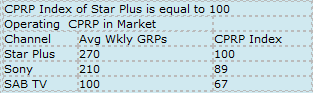
    It is a jungle out there in the media business. If you win the battle, you still have to worry about losing the war. Recently the Star Network launched another GEC called Life OK. Probably in the wake of competition from the Sony and SAB TV combo.The table 1, below depicts that the Sony and SAB combo was just about edging out Star Plus from the top GEC position, especially if it came at a more attractive rate (CPRP), as estimated in the table below.So, the not-so-hidden agenda of the Star network for Life OK would be to combine it with Star Plus and thereby fend against the Sony + SAB offensive, but without devaluing their trump card (i.e. Star Plus itself). Therefore, how would the new channel Life OK have to price itself, to overcome the Sony + SAB threat?


    Stratagem Media has undertaken a simple exercise to answer this question, for different levels of performance of Life OK.


    Objective of the exercise: To derive the CPRP Index of Life Ok @ different level of GRPs, if the CPRP of Star Plus is 100?


    Methodology: If the CPRP of Star Plus is 100, then what should the CPRP of Life OK be, if they have to match the CPRP of the Sony + SAB combo at different GRP ratios between the 2 channels.


    In the exercise below, the ratio of GRPs purchased between Life OK and Star Plus is assumed to improve in favour of Life OK, as its performance improves.


    *At these CPRPs, the Star Plus and Life OK combo will be as cost-effective as SET and SAB combo.


  • Industry veterans to train @ Stratagem Media’s Media Rhythm 4

    By A Correspondent


    Stratagem Media, an independent media services company led by Mr Sundeep Nagpal, has been fairly active in the field of media training – an area which Mr Nagpal has, for many years, specialised in. The latest in the company’s list of training programmes is the Media RHYTHM series, which he started a couple of years back. The idea was to provide hands-on training to media professionals in the area of sales and help them overcome severe impediments in today’s media selling environment.

    RHYTHM is an acronym for Realising Higher Yields through Talent Harvesting in Media. The company has so far done three rounds of Media RHYTHM; and the previous ones have had Chairman of Madison World Mr Sam Balsara and former Zee CEO Mr Pradeep Guha flagging off the events.

    The fourth round is all set to take place on December 2-3, 2011 in Mumbai, and MxMIndia is the web partner for the event which has five modules – Print, TV, Radio, Digital and Outdoor.

    The list of speakers includes media veterans such as Mr Bharat Kapadia, Mr Suresh Balakrishnan, Mr Madan Sanglikar, Mr Jairaj Padmanabhan and Mr Nagpal himself. Topics that will be covered are: ‘Adding relevance to Value’ by Mr Kapadia, ‘Customising business solutions to meet business objectives’ by Mr Balakrishnan, Does Digital really work’ by Mr Sanglikar, and Strategising before, during and after every move in a media sale by Mr Padmanabhan. Mr Nagpal will talk on ‘When, how and how much to use the science behind media decision making’.

    Mr Nagpal is optimistic of putting up a good show. Talking to MxM India he said, “Stratagem Media has always believed in giving hands-on training to media professionals. There is so much that youngsters can learn, on how they can develop their skills and also how to start thinking and implementing effective selling strategies. ”

    Mr Nagpal further said that the workshop will give participants insights on things like how to close deals in the least possible time and how to understand the thought process of a media planner better. He feels such interactive workshops provide an opportunity for media companies to harvest talent of a select few ad sales personnel which they think are the future.

    Mr Kapadia said “Media RHYTHM is not like the regular seminars. It is more like the closed-room sessions, where participants get a chance to interact more and participate, unlike large forums and industry gatherings. The hands-on approach towards training is what makes the whole experience better.”