

Tag: Stratagem Media Pvt. Ltd

  • Comment: The Suspension of News Ratings


    By Sundeep Nagpal


    At the outset, let me state that this piece is not meant to comment on whether or not there have been any malpractices in the TRP measurement process. Nor is it designed to be an opinion on whether any channel is guilty of abetting such unscrupulous practices or not. It is not my role to comment on this aspect. That’s the job of the law-enforcers and the fact that there is an FIR on this, certainly suggests that there could be a serious problem. Most importantly, given that some skeletons may still tumble out of the cupboard, as we are seeing in the course of the daily investigations, it’s too early for anyone to pronounce judgment.


    So, what is this article about? It’s meant to lend a perspective on various aspects of the issue at hand. And it is being written purely on the basis of my experience as a media professional, who not only uses data to allocate brand advertising budgets to channels, but also as someone who has worshiped data, trained no less than a thousand individuals on its utilisation and strongly propagated its application in the decision making process, even to advertisers, for over three decades now.


    For a media professional, all it would take is a keen sense of observation and some common sense to read between the lines, to understand the reality.


    So, here are the aspects that are being addressed in this piece.


    Aspect No 1: The Suspension of News channel ratings, for upto 12 weeks, apparently for them to clean up the mess?


    Aspect No 2: Did someone say, that this a scam, and that too of the order of Rs. 30,000 crore… seriously?


    Let’s talk about the First Aspect:  The suspension of the News channel ratings, for upto 12 weeks, ostensibly to clean up the field issues in data collection.


    There could be three possible reasons for this:

    1. As claimed by a faction of news channels, there have been frequent and inexplicable fluctuations in the ratings of some news channels, and that ought to be examined and corrected, in case there are measurement flaws (In fact, in this context, readers would recall, that recently, the sudden growth in viewership of a wild card Hindi news channel, had become a big bone of contention, and this was vehemently debated by both sides, without any significant outcome. By now, perhaps the ratings have stabilised – as evident from the graphs). So, viewership fluctuations have been a way of life for media planners to contend with.

    2. Secondly, given the dust storm that has risen on news channels, another unstated consideration for this temporary suspension, could possibly be to let the dust settle on this matter, and until such time, to adopt some interim measure to avoid any further controversies, and mitigate the risk.

    3. This tussle between the state machinery on the one hand, versus the controversial network on the other, is only likely to bolster the network’s viewership, (yes, let’s not forget that the majority of viewers, regardless of how they’re inclined, just tend to get excited about such developments), and that may actually happen at the cost of some of the network’s competitors.


    So, one faction of news channels (called the NBA – which comprises mainly of the said network’s competitors), has been very vocal about supporting this move of temporary ratings suspension. Whereas the other faction, called the NBF – which comprises of he said network and several other regional networks, is dead against this temporary embargo. In fact, last Thursday, NBF released a statement to the effect that ratings agency, BARC has been unfair by singling out the news genre, for an overhaul, and that it was done without any consultation with its member channels and that other genres are equally fraught with anomalies, and hence are also in need of an overhaul, and therefore implying that all ratings should be re-examined, etc. etc. etc.


    So, the fact that BARC has suspended the news ratings, even temporarily, can actually be due to any one or more of the above reasons, but this embargo in itself, can be looked upon as an admission of a systemic problem.


    Now let’s talk about the Second Aspect: Rs 30,000 crore? Really?  Where did this number come from? Has any industry professional provided this figure or verified it? Can anyone substantiate and explain how it has been arrived at? Has BARC even hinted at such a large figure? Let’s understand, that Rs 30,000 crore is (probably less than the profit of Reliance Industries, but it is), still humongous, for anything to do with the advertising/ media business.


    So, again, where did this number come from? Or is it that, after the various ‘Bad Boy Billionaire’ scams, the yardstick for any issue to be labelled as a scam, has suddenly increased to a few thousand crores, by default? Just so that it is taken seriously !


    Hence the question here is not just as to what the general public is being told, but what lay persons end up believing !


    There can only be two reasons for such a headline – it’s either a desperate attempt to grab audience attention (sensationalise) or it reflects the ignorance of the claim maker, about the reality of the BARC system, or perhaps, both !


    As media/ marketing professionals, we must try to understand this: even if there is some malpractice about households (HHs) being paid to keep certain channels on, then how many such HH’s can make a significant difference to the viewership of the allegedly rogue channels? How much can some HHs in a single city, affect the national ratings of that channel? How much money would have to change hands to make a significant difference to the channel? And even if the viewership did rise, how much additional advertising could the channel in question attract, in return for this unscrupulous investment?


    Moreover, if the viewership number did not rise sufficiently enough, would that channel retain the loyalty of its existing advertisers? In other words, do advertisers select every channel only on the basis of viewership? Or do other intangible factors, like content synergy and audience profile also have an important role to play, in the decision making process?


    The answers to these questions are obvious.


    Incidentally, the number of channels that are included/ covered by the system, are in excess of 400.


    Also, the total amount of advertising revenue generated, annually, by all channels put together could be somewhere in the region of Rs 30,000 crore. (the exact number is not necessary here when we are only trying to understand the bigger picture)


    So, by logical extension, any such claim that alleges a scam of Rs 30,000 crores, must necessarily imply that all (approx.. 400+) channels, have been indulging in this fraudulent and illegal practice, of artificially boosting their viewership ratings, by paying some amount of money to sample households (HHs), right through the last 12 months !


    Now, for the mathematically inclined, here’s a small extension of this theory. Of the 44,000 sample HHs in the country, only about 2000 of them are in Mumbai. It’s impossible that all of these HHs could ever be paid off, in the above manner. So, as a ratio of the sample HHs all over the country, where viewership is being measured, to what extent can the viewership of these channels stand to gain, from this small allegedly rigged sample? In other words, how much can the TRP go up, even if the viewership in these few sample HH’s is artificially boosted?


    So, the claim that this is scam of the order of 30000 crores, seems preposterous, given that so far, just three channels have been alleged to have indulged in it.


    So, firstly the “scam”, if there is one, is probably not worthy of the magnitude of the hue-n-cry/ attention that it has generated so far. In my opinion, the newsworthiness of this entire ‘so-called scam’ (and I’m being objective, here), comes from other reasons, such as the controversial nature of the channel being implicated.


    Another reason for this, is that this is really not the first time ever that such a malpractice has come to light. There were at least two similar instances in the distant past, which were curtailed and rectified in a short time. And so, hopefully, so would this.


    Further, consider this. Do advertisers, media planners, marketing professionals rely only on TRP data for their decision-making? Don’t they understand the limitations of the data collection methodology? Surely there’s got to be some way in which their experience and first-hand feel/ non-data related expertise, come into play?


    It is also my humble opinion that any media analyst, worth his salt, understands when and where not to apply the data, in the decision-making process, and how to make the decision on other, less tangible/ non-tangible factors.


    It is my strong belief and contention that niche/ special interest channels, from genres such as English Entertainment/ English News/ Lifestyle/ Infotainment or even the Children’s channel genre, mostly do not attract advertising based on their viewership estimates. These channels are chosen by advertisers primarily based on their content and profile, which need not deploy the use of any data.


    This aspect can further reduce the intensity of the issue at hand, (for whatever has unfolded up to this point in time, unless more skeletons come out from the cupboard later).


    So, given the above two aspects – the question that arises is, why such a brouhaha over ratings? If there’s even a shadow of doubt on the field practices, then just correct those, why suspend the release of the ratings in the public domain, …. unless of course, there is enough evidence that the disease has reached pandemic levels.


    Ultimately, I believe, that no matter how superficial audiences may be, w.r.t their understanding of somewhat technical issues, they are not idiots. Their ability to connect the dots and come to their own conclusions, about the underlying causes of this issue, must not be undermined.


    Because, obviously, these developments are more than what meets the eye. It’s not just a question of news channel ratings, but it’s a no-holds barred business warfare between channels, and the Kurukshetra (battlefield) is not just the TV news arena, but in fact, a larger political arena as well.


    Some media professionals must believe that this entire TRP saga makes about as much difference to their jobs, as a drop of cyanide in the Atlantic (whereas it is being made out to disrupt marine ecology). All the same, true professionals (journalists or media planners), ought to be more concerned about how to retain and enhance the credibility of our own role / effort. But are we doing any better than the lay viewer ? We’re only being a little more than innocent bystanders, coz, we’re also basically just watching the drama unfold.


    Satyameva Jayate !


    Sundeep Nagpal is a veteran media profession and Director, Stratagem Media Pvt Ltd,  an independent media specialist firm, in the business for nearly three decades. His views here are personal

  • ‘If you’re not ready for digital, your company is’: Media Rhythm 4


    By A Correspondent


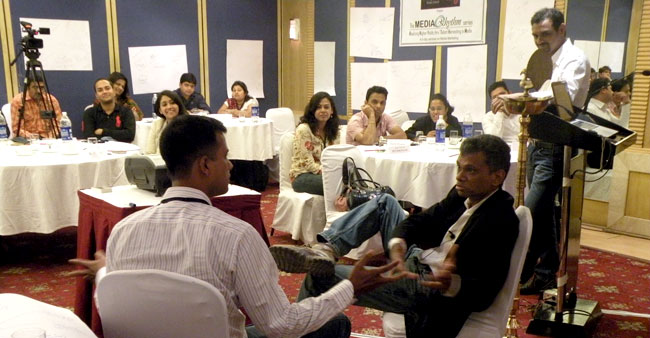
    Stratagem Media Pvt. Ltd, an independent media services company, held its fourth training program called ‘ReveNEW Concepts – The Media Rhythm series and Ideas’ on July 21 in Mumbai. The workshop saw participants from The Times of India, The Hindu, Malayala Manorama, Eenadu, Amar Ujala, MY FM and other media companies.


    Among the speakers were Mr Sundeep Nagpal, Founder Director at Stratagem Media Pvt. Ltd; Mr Suresh Balakrishna, CEO, Brand Programming Network; Mr Bharat Kapadia, Chairman, Whatuwant Solutions and Mr Madan Sanglikar, a digital media expert and CEO, AD2C.


    About bending backwards with ease:

    Mr Nagpal, the first speaker of the day, delved on ‘Bending back with ease’ wherein he asked the participants to first know what they are selling. He said that instead of selling many things at one time, there has to be some clarity and certainty of what is being sold and only then the expectations of the clients can be met. Mr Nagpal also spoke about the importance of reminding the consumers about the brand even after awareness is created: “A consumer needs to see the ad frequently. Time and again we have been able to convince clients that in a crowded market, playing one advertisement is not enough. Therefore a reminder is very important.”


    He also said that even though there is awareness, reminder and high impact, the brand may not sell as the problem could be because the competition is making more noise. “At times when everything is good, there is no recall because competition is making more noise. Response measurement is very tricky and must be done in a scientific way. Low response could be because of the lack of good features, price and distribution issues,” he said.


    Mr Nagpal also pointed out that it is very important to know the client’s business or product: “If you are managing client expectations, you must also know the client’s needs. When you do consultative selling, you can reduce the discount selling.”


    He also spoke about the two ways a brand can grow. First, get new consumers and second get the same old consumers to consume the brand more frequently. Some other ‘home truths’ Mr Nagpal shared were: remove discount, adopt differential and value based pricing.


    He said it is important to know the competition as is important to calculate, permute and innovate and that you can always refuse a business instead of selling lower than what you deserve.


    Customising media usage for brand communication:

    Mr Suresh Balakrishna kick-started his session by playing a one minute trailer of the film ‘Rocket Singh, Salesman of the Year’ as an example of how one should and can sell his brand to the consumer. He spoke about going beyond media objectives and looking at communication objectives, quickly pointing out that the media objective is only a channel; the client however wants a communication objective. “You need to create a connect between communication objective and media solution. It is important to understand the communication objective of the client, his needs and aspirations as well. You must, therefore, involve your clients and listen more to what your client wants.”


    Mr Balakrishan presented three case studies – Union Bank of India, Vodafone, and Cadbury Dairy Milk Shubh Arambh. He split the participants in different groups and asked them to do various exercises on the case studies presented. He gave the participants various challenges and asked them to come up with solutions to those challenges: how they would have connected with the consumers; how they would have amplified a particular campaign in the media or solved a certain problem in a different way.


    On Motivation and Innovision:

    Mr Bharat Kapadia spoke about the importance of motivation in an individual and the need for ‘innovision’- a combination of innovation and vision. “Everyone cannot have wrong card, what is important is how you play your cards. Unless ‘You’ believe that nothing is impossible, nobody will be able to help you out. Whenever you are given a tough task, don’t see it as impossible, but instead attempt it to raise the bar for yourself.”


    On the need for innovation, Mr Kapadia stated that even innovation needs to have a vision. He said that one needs to innovate, to not only stay ahead of the competition, but also to create a new experience or even to solve a problem which at first looked quite challenging.


    Mr Kapadia shared four crucial points for innovation: Uniqueness, Impact, Achieving the goal and Sustainability. He was quick to state that ideas and creations are nobody’s monopoly as each one is capable of generating ideas. Therefore, one needs to start thinking without any baggage.


    He also stressed that an idea needs nurturing, which could be achieved with the help of family, friends and colleagues. He asked the participants to mentor the ideas of their juniors, so that they would come up with better ideas. But he was also quick to stress that the real test lies in the execution of the idea. One must always think of the end objective of their idea, and the hurdles they might have to cross.


    Mr Kapadia also warned the participants about the dangers of an idea: “Be careful that your idea is not gimmicky and irrelevant, the idea must fit into the objective of the brand. A good idea becomes a great idea if it is implemented well.”


    He also told the participants not to be afraid of mistakes and failures, but to learn from them. Mr Kapadia shared his experience about how he managed to successfully execute the Bru Coffee aroma campaign on The Hindu and the challenges he have to overcome to execute the campaign successfully.


    Mr Kapadia also gave participants some practical or exercise work during his session. He asked them to come up with an innovation for any media vehicle for any brand, whether existing one or a fictitious one. He asked them to exploit the strength of that medium. The teams were split into five groups.


    While concluding his session, Mr Kapadia reiterated that an idea is no one’s monopoly. It must however be relevant, feasible and beneficial to the client. He concluded: “There is no dearth of money in the market because it is all about a good idea. If you come up with a good idea, then the client will also shell out the money required for that idea. A good idea can even bring new advertisers.”


    Teleporting to 2015:

    Mr Madan Sanglikar shared nine concepts on digital, emphasising the growth of digital and the implication of that growth to other medium and the brands. He spoke about the future of print, television, gaming, mobile, social media, e-commerce, data visualization and eco-system transition, pointing out the need to think digital, that innovations are also happening on digital, and the fact that digital media is the fastest growing medium in the country.


    He said that the growth of digital will see more advertising categories increasing their spends on digital. He also said that digital will reduce the urban- rural gap. On the future of print media: “Print will be the biggest beneficial from the digital growth among the media categories. Dailies and magazines will get a new lease of life and static and AV (Audio Visual) formats of content and ads will co-exist.”


    On the future of television, Mr Sanglikar said that television experience will get better, a lot of which will be gesture controlled. Online video format will merge with television; it will create an explosion of online and on-demand videos.


    Talking about the gaming market, he stated that it is expected to grow to Rs3,100 crore by 2015 and there is a shift of gaming from bedroom to living room, wherein it becomes a family entertainment medium.


    Mr Sanglikar gave the example of a bakery in London who used Twitter to attract customers to his bakery as an example of how social media can be used for enhancing the business. He said that very soon there will be no emails as corporate social network will see huge growth.


    On the e-commerce front, Mr Sanglikar stated: “E-commerce market is also growing tremendously. Online shopping is getting more interactive with more pay options available and newer shopping categories soon catching up.”


    Mr Sanglikar also explained the difference between paid media, owned media and earned media and how today we are witnessing owned media and earned media share growing. He concluded: “Digital is like another medium and not imbibing the medium will not work. If you are not thinking about digital, your companies are certainly thinking about it.”


    What the participants say:

    At the sidelines of Media Rhythm 4, MxMIndia spoke to some of the participants for their views on the daylong event. According to Mr Subin Thomas from MY FM: “It was very interesting and fun too. Mr Suresh Balakrishna’s session was especially very good. There has been lot of learning, especially about innovation and communication objective.


    Ms Zeenat from Eenadu said: “The workshop was definitely helpful for us as it helps us with new ideas. After being in the industry for a long time, you tend to get a rigid mindset but, when we attend such forums where so many different issues are discussed, it refreshes our thoughts and allows us to think differently. The session on digital will probably help us in our work in digital.”


    A Times of India participant said: “It was a good way of looking at certain things and even on media selling. All in all it was a good and interactive sessions. There have been some good learning and takeaways too. I would also be taking some of the takeaways from these sessions to my clients.”


    Mr Soham Khimani from Malayala Manorama said: “The sessions were really wonderful and the speakers too were good. There was lot of creativity in the session which is very important in media sales today.”


  • Stratagem’s 1-day training for media sellers


    By A Correspondent


    Stratagem Media Pvt. Ltd, led by Mr. Sundeep Nagpal, began as a media planning hub for medium-sized ad agencies in the early 90s and somewhere along the middle of the last decade, it morphed into a media services company.


    The ‘Media RHYTHM’ series is a recent initiative by the company to enable participants channelize the thought processes that govern modern day practices in media selling.


    The initiative engages experts from the industry who jointly conceive and design such programs over hours of discussion to make them as relevant as possible. RHYTHM is an acronym for Realizing Higher Yields thru’ Talent Harvesting in Media. At another level, the programme also serves to orient the thought process in a particular direction and thereby condition the mind.


    Mr. Nagpal believes that such open programs are useful for companies which wish to develop talent and knowledge base of select personnel in their sales departments.


    The forthcoming program, to be held on July 21, has been conceived as a single-day workshop titled “ReveNEW Concepts and Ideas”. The modules will focus on concepts that are integral to the media business – media evaluation & utilitarian concepts, as well as the subjective aspects that can be used effectively by sellers.


    Facilitators like Madan Sanglikar will administer a module on the applicability of new media for new brand and how media houses can build on it. Bharat Kapadia will stimulate participating sellers to think creatively by involving them with certain exercises.


    Suresh Balakrishna will engage participating sellers on how to translate the basic tenets of a brand communication into a media-led solution.