Tag: Soumya Mohanty

  • Google, Tata Motors, Amazon, Jio & Apple Most Inclusive Brands in India

    Google, Tata Motors, Amazon, Jio & Apple Most Inclusive Brands in India

    Leading marketing data and analytics firm Kantar has launched its Brand Inclusion Index (BII), a global study which reveals that 75% of consumers say that a brand’s diversity and inclusion reputation influences their purchase decisions.


    A staggering 68% Indians claim to have been discriminated against, and in majority of cases in commercial places and brand touchpoints, which is substantially higher than the global figure which stands at 46%. The study also showcases that DEI is important for an overwhelming majority of Indians, both in life and while making brand choices, with 86% of respondents.


    The first edition of India Brand Inclusion Index study explores skincare, banking, automotive and Technology categories. In its Index of the world’s most inclusive brands, Kantar ranked Google, Amazon, Nike, Dove and McDonald’s in its global top five while in India, it is Google, Tata Motors, Amazon, Jio and Apple. The brands were recognised by consumers for setting a positive example by demonstrating a genuine commitment to diversity, equity, and inclusion (DE&I).


    The study identifies that inclusive marketing is a significant opportunity to drive brand growth. It is clear that brands who fail to address discrimination, risk alienating a significant portion of their customer base. Despite progress made by some brands, the Brand Inclusion Index 2024 reveals a significant inclusion gap that businesses must address. This gap is the difference between the proportion of people in a market who have experienced discrimination and the percentage who believe in the importance and influence of diversity and inclusion.


    Kantar’s Brand Inclusion Index 2024 is a survey of more than 23,000 people in 18 countries, the India leg comprises 1000-plus respondents with an inclusive demographic which is gender expansive, disability, socio-economic class, religion etc.


    The findings of the Brand Inclusion Index sit in the context of preliminary research from the Unstereotype Alliance with Oxford University’s Saïd Business School, using data from Alliance members including Kantar. This study has found that progressive, inclusive advertising drives a significant sales uplift of over 16% when compared with less progressive ad content and has a significant impact on consumer loyalty, buying intentions and a brand’s pricing power. Respondents assess brands on different dimensions – brave brand DEI strategy, diversity, equity, and inclusion – from the absence of negative actions, to the presence of positive initiatives.


    Key findings:

    • There’s an urgent need for brands to address DE&I failures: A staggering, 68% Indians claim to have been discriminated against, and in majority of cases in commercial places and brand touchpoints, which is substantially higher than the global figure which stands at 46%. The study also showcases that DEI is important for an overwhelming majority of Indians, both in life and while making brand choices with 86% respondents
    • Consumer expectations are high, globally: 75% of consumers globally say that diversity and inclusion – or a lack thereof – influence their purchase decisions
    • DEI is yet to make its mark on Indian advertising:
      • More women are seen in Indian ads than global average but they remain bound by traditional roles of homemakers and mothers (7% women are featured in non-traditional roles)
      • Fairness of skin may have transitioned to glow but skin colourism continues to exist in creatives
      • Sizes remain slim and small. (7% diverse body shapes)
      • Ageism dominates with 40+ women represented in less than one out of five ads (15% in India vs 26% globally)
    • Underrepresented groups are most vulnerable: Ad protagonists and characters in India are painted in broad strokes of what they, their homes, beliefs and lifestyles look like, ignoring ethnic minorities, LGBTQ
    • Ads that successfully portray people positively provide greater predicted ROI for advertising investment. There has been growth in the industry in positive portrayal of Males over the last year, but a drop in Female portrayal since last 2 years
    • Globally, people with disabilities and LGBTQ+ individuals report the highest rates of discrimination (81% and 62% respectively), emphasising the need for targeted efforts to create more inclusive environments and content
    • Google, recognised as most inclusive brand in India as well as globally. It emerges as a beacon of hope, ranked by Kantar as the most inclusive brand globally. Consumers, particularly in marginalised communities, praised Google for its unwavering commitment to DE&I in its internal policies, products and marketing, its authentic representation of people from all walks of life and its leading-edge innovation for inclusion
    • Alongside Google, Tata Motors, Amazon, Jio and Apple emerged in the top five winners in India. Category wise, the India top Brand Inclusion Index scorers are – Google (Technology), Tata Motors (Automotive), SBI (Banking), Dove (Skincare).


    Said Valeria Piaggio, global head of diversity, equity and inclusion at Kantar: “It’s a myth that inclusion marketing is about marketing to minorities. Inclusion marketing is expansive marketing. One of the fundamental ways to grow your brand is to predispose more people to it. Yet when brands exclude consumers – whether that’s because people don’t feel welcomed when shopping in stores or their advertising doesn’t reflect diverse communities – it’s an easy miss.


    “Millennials and Gen Z prioritise diversity and inclusion even more than other groups, and as these populations grow in size and buying power these issues will carry more weight. Brands will be rewarded if they stand by their values – especially in the face of vocal communities which stoke the culture wars by pitting minority groups against one another.”


    Said Soumya Mohanty, Managing Director & Chief Client Officer- South Asia, Insights Division, Kantar: “In a country of India’s size, the term under-represented groups can be misleading for brands to use as a guiding light. Minorities can translate into millions of people who may choose or not choose to buy your brand, based on how well they feel seen, heard and voiced in your brands. It is a business imperative for brands to prove that they are serious and committed about DEI. The Brand Inclusion Index – our breakthrough study on brand inclusion – gives clear indications of how to achieve the inclusivity imperative. Our analysis of what’s behind the most inclusive brands is that they all have three things: a well-thought-out DEI strategy that stems from company actions and is committed long-term, impeccable creative execution, and bravery. The element of bravery will be increasingly important. As in other moments in history, when there’s significant social change, there are groups of society that seek to maintain the status quo, feel threatened, and as a result, react loudly,” adding: “To avoid backlash, brands today need to be extra careful. Full inclusion needs to work at both ends of the spectrum: reaching out to underrepresented populations and making them count, while avoiding negative reactions from people who are used to seeing themselves well-represented by brands and don’t want to be left behind. This study brings understanding of how people perceive brands based on their DEI efforts, focusing on populations that tend to be excluded, underserved, or misrepresented. The Brand Inclusion Index gives marketers clear benchmarks for brand inclusion and inspiration from brave brands that are seen as diverse, fair, and inclusive.”

  • TCS is India’s Most Valuable Brand


    By Our Staff


    Tata Consultancy Services (US$45.5 billion) is the new number one most valuable Indian brand, claiming the top spot from HDFC Bank (no.2, $32.7bn) which had held the position since the first ranking was unveiled in 2014. TCS’s brand value has been accelerated by global demand for automation and digital transformation following the pandemic.


    The Top 10 Most Valuable Indian Brands together contribute just over half of the ranking’s total value. There has been significant movement at the top, in addition to the two most valuable brands switching positions. There are two new entrants – Infosys ($29.2bn) which has rocketed up to no.3 from 12th position, and ICICI Bank ($11bn) which has climbed two places to no.9. State Bank of India ($13.6bn) has also risen four places to no.6.


    There are brands from 23 different categories in the 2022 Indian Top 75. There are a total of 14 newcomers , from 11 categories – including online gaming, education, apparel and real estate, reflecting the diversity and dynamism of the Indian economy.


    India’s strongest brands have bounced back from the pandemic to increase their brand value by a massive 35% CAGR since 2020, when COVID-19 hit the country. India’s top 75 brands are worth a combined $393 billion, equivalent to 11% of India’s national GDP.


    Technology and Banking brands account for over half of the total value. Six B2B Tech brands and 11 Consumer Tech brands contribute 35% to the total value of the ranking, reflecting the rise of Tech India. Overall, B2B brands (tech, payments) are on average almost three times as valuable as B2C brands, reflecting the fact that many of the B2B brands play on the global stage while B2C are more focused on the domestic market. Six banking brands deliver 19% of the total value. Also notable for their performance are Insurance brands, which have performed well as the pandemic increased consumers’ focus on protection of life and health and Telecom Providers, led by Airtel (No.4; $17.4bn) and Jio (No.10; $10.7bn), which took full advantage of growth opportunities as everything moved online, from education to work to parties.


    Key newcomers to the ranking include Vi (No.15; $6.5bn); formed from a merger between Vodafone and Idea, Byju’s (No.19: $5.5bn), the educational technology brand that has become India’s most valuable education brand, and Adani Gas (No.21; $4,5bn).


    Said Deepender Rana, Executive Managing Director- South Asia, Insights Division, Kantar: “India’s leading brands have grown at an exceptional rate, despite global economic headwinds, putting the disruption from COVID-19 behind them. Indeed, they have both driven and benefited from the transformation in consumer and business behaviour as a result of COVID-19, especially where it relates to the use of technology. The challenge now is to sustain momentum as inflation bites worldwide and consumers and businesses adjust to the new normal. Brand owners will need to work harder to identify and build on what makes worth paying for and ensure ROI on their marketing expenditure to avoid a margins squeeze.”


    Kantar BrandZ has identified Four Fundamentals responsible for powering brand growth: Function, Convenience, Experience and Exposure. India differs from other markets around the world, however, in that a brand’s sustainability credentials and purpose matter more.


    Overall, 65% of Indians feel anxious about climate change, and 64% believe businesses must play their part. The highest-ranking brands in the Top 75 are clear on purpose and have a relevant sustainability agenda. These include services platform Zomato (No.30; $3.1bn), which offsets the carbon footprint of its deliveries and packaging. Swiggy (No.20; $4.8bn) elevates consumers’ quality of life with speedy delivery of meals, groceries and healthy items, as does Flipkart (No.12; $8.9bn), while also helping smaller local brands to connect with consumers via its platform.


    Added Soumya Mohanty, Managing Director, Insights Division, Kantar: “Purposeful and sustainable brands are rewarded. Indian consumers look further than the brand attributes that affect them personally – they want brands to improve people’s lives and have a positive impact on wider society. They vote with their wallets, choosing brands they see as ‘doing the right thing’. Indian brands should have a clear view of their purpose, connect strongly with it by embedding it in their culture, talk about it in creative and powerful ways, and deliver on it – without fail.”


    Salience – the ability of brands to spring quickly to mind when a consumer has a need – is also vitally important. India’s Top 10 brands are far more salient than their counterparts in most other countries. However, for growth to be supercharged, brands must also have strong meaning as well. They should have functional meaning – doing a good job of fulfilling a need – but also a layer of emotional meaning. The Kantar BrandZ India Top 75 far exceed other Indian brands on all these of these vital predictors of success.


    Other key highlights from the analysis include:

    :: 57 of the brands in the 2022 Top 75 have been in the ranking since 2018, while 19 have moved up the league table.

    :: The share prices of companies behind strong brands are protected in a ‘bear’ market and recover more quickly. Between August 2014 and June 2022, the SENSEX India Index gained 63.8%, while a portfolio of the most valuable Indian brands rose 81.8%.


    There are eleven consumer tech brands in the Top 75, reflecting the increasingly digital way Indian consumers live, which is 11% of the total brand value. The four most valuable brands in this category are Flipkart (No. 12; $8.9bn), Byju’s (No. 19; $5.5 bn), Swiggy (No. 20; $4.8bn) and Nykaa (No. 25; $3.7bn).


  • Ukraine, cost-of-living & climate changes concern areas for India


    By Our Staff


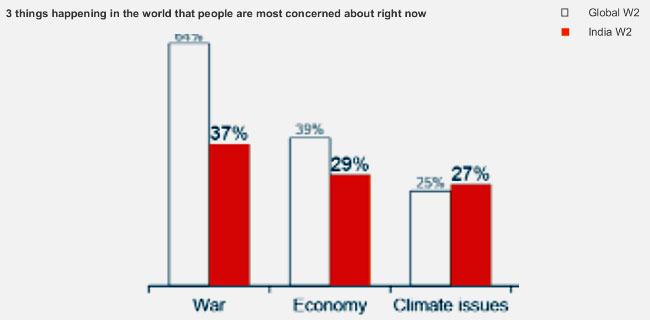
    Kantar’s Global Issues Barometer has found that the invasion of Ukraine remains the #1 concern of people in India followed by economic worries and the cost-of-living crisis. Asked to share their concerns, 37% of people mentioned the war, followed by 29% mentioning economic issues, as their top concerns currently. Climate and environmental issues have also emerged among Top 3 concerns. Covid-19 is no longer seen as a pressing issue like rest of the world, except in China where lockdowns are just lifting.


    Kantar’s Global Issues Barometer study is a detailed analysis of 800 people’s attitudes in India contrasted to 11,000 people across 19 countries (representing 68% of global GDP. The study asked open-ended questions to understand peoples’ real opinions and used Kantar’s TextAI technology to understand and analyse the responses.


    The war in Ukraine

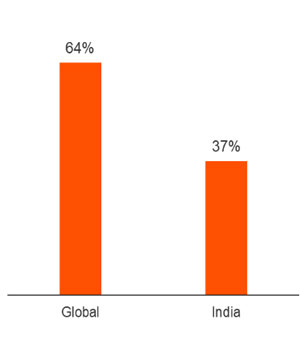
    The war in Ukraine is currently the biggest concern in India like every geographic region surveyed. As expected, the concern is much lower than the European counterparts. There is a high correlation between concern and proximity. 64% of people across the Globe mentioned the war as a concern while only one in three of India’s (37%).


    Figure 1: % Mentions of War


    The cost-of-living crisis

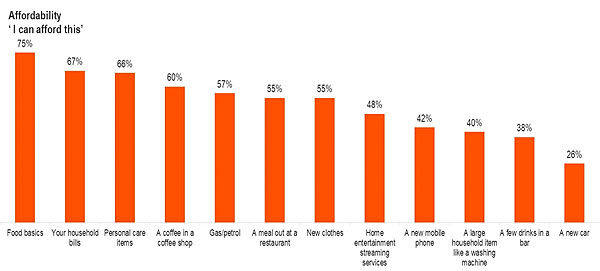
    The cost-of-living crisis is #2 on people’s minds. Price increases in fuel, food & drink and household bills have been noticed the most. Compared to the world, Indians feel the pinch of price increase on white goods more.


    While 35% of the population report their household financial situation is deteriorating, 46% believe the general economic outlook of their country is negative right now. People are struggling to meet their living costs, with 32% of households experiencing difficulties meeting their monthly outgoings and 11% unable to meet their commitments. The problem looks set to continue, a further 71% of people believe inflation will continue to rise even further.


    But there is sliver of hope as two-third of people in India feel secure in their jobs and expect pay rise that will match inflation.


    Figure 2: Affordability


    Eco-anxiety

    Climate inaction is causing remarkably high levels of distress with more than half of people experiencing eco-anxiety.


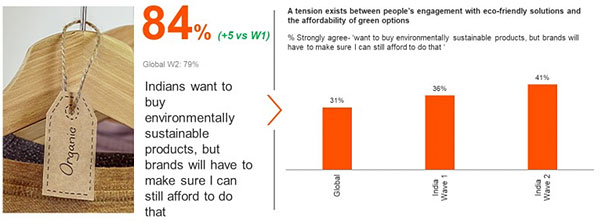
    Two-thirds of the population believe businesses have a responsibility to solve the climate crisis, while 84% of consumers want to buy environmentally sustainable products but need brands to do more work on affordability.


    Figure 3: Eco-anxiety


    Discussing the findings, Soumya Mohanty, Managing Director, South Asia, Insights Division, Kantar, observed: “The current tempest of global events is affecting long-term plans as well as short-term behaviour of Indians. Beyond making cutbacks on general expenditure, people are rationalizing their future savings and working harder.


    Luxury goods, entertainment and holidays look likely to be the sectors to suffer next. Almost half of households (41%) are considering economizing subscriptions to entertainment subscriptions- one industry that did well during the pandemic. Longer-term, almost three fourth of people say the current turmoil is impacting their big life plans; saving for big future life events (47%), children’s education (27%) and retirement plans (24%). So, the impact of this crisis lies in the future as much as in the present and can influence not just financial but also emotional well-being. Brands must therefore recognize what matters in people’s lives and examine brand’s relevance in supporting people overcome these challenges”


    Added Deepender Rana, Executive Managing Director, South Asia, Insights Division, Kantar: “Brands that can offer Green Affordable Solutions are likely to be favoured and become mainstream. With inflation rocketing, in their daily lives, consumers are considering solutions that can help reduce energy and fuel expenditure. They expect brands to do the same and be more efficient, while simultaneously raising the bar on ethical production. If anything, the cost-of-living crisis has reminded people that green products/services shouldn’t come at a premium. Insights from Kantar’s Global Issues Barometer can help brands and businesses understand how to navigate during these uncertain and fast changing times”.


    More on the study at https://www.kantar.com/campaigns/global-issues-barometer 


  • Kantar launches 2nd edition of  Creative Effectiveness Awards

    By Our Staff


    Kantar, the marketing data and analytics company, has announced winners of the second edition of its now annual Creative Effectiveness Awards. The firm tested more than 13,000 creatives for clients around the world. Around 10% (1300+) of those creatives were tested in India alone. The India report shortlisted over 350 ads, tested across categories, markets, TG’s and media channels.


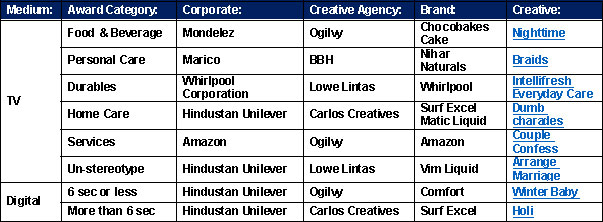
    Across television ads tested in India, Kantar has awarded standout performers in five product categories- Food & Beverage, Personal Care, Durables, Home Care & Services. Kantar has also included a special segment on social causes and this edition spotlights


    ‘Un-stereotype’ which all about celebrating gender progressive advertising.


    Here are the Kantar Creative Effectiveness Awards 2022 India Winners:


    Commenting on this year’s winners, Soumya Mohanty, Managing Director and Chief Client Officer, Insights Division, Kantar said, “The spread of ads that consumers have perceived to be both creative and effective is an affirmation of the fact that the space for creativity even in context of marketing ROI is infinite. While there is no magic formula for creating such ads, we can start with the right ingredients and refine them by testing them out with consumers. Kantar is pleased to share the learnings that we have had in the area while working with the leading marketeers in India.”


    Key highlights from this year’s report:


    >> Kantar’s Strategic Sparks identified for effective and creative TV advertising:


    1. Indians love to ride fulfilling story arcs: Stories create room for empathy, engagement, and vivid memories through which one could influence the way in which consumers think & feel about the brands.

    2. Touch of drama helps: Just the right kind and quantity of spice delivered through creative storytelling and filmmaking,  elevates even the repetitive themes, to make them more personal, relevant and aspirational.

    3. License to be extravagant in visualization: Indians are open to suspending their disbelief for the well visualised film

    4. Layer in emotional meaningfulness: Emotive contexts have the potential to make the consumers warm up to even the dry functional categories.

    5. Show, not tell: Integrating brand payoffs as an organic plot event in the script is a timeless approach toward creating vivid and persuasive memories.


    >> Kantar’s Strategic Sparks for effective and creative digital advertising:

    1. Customized and integrated content yields significantly higher ROI​: Carrying forward creative stories and elements from other media amplify the impact of digital assets.

    2. Shoot for instant meaning: Given the attention poor consumers and short window available, it pays to ensure that the consumers are not called to do any additional work for decoding what they are supposed to think and feel about the brand

    3. Ride the moment: Embrace the topical issues and trends, to engage and be relevant

    4. Strike an emotive chord: Well told stories open up consumers for longer format videos

    5. Hook them early:  Promise of a fulfilling story arc, emotive journey and humor help in ensuring that consumers stay invested beyond 6 seconds.


    >> Unstereotyping: Time to mainstream progressive gender portrayal


    Kantar’s collaboration with the Unstereotype Alliance has led to the development of the Unstereotype metric (UM) which Kantar now includes as a measure of gender portrayal in advertising as an integral part of its Link™ communication pretesting solution. Thus, setting a foundation for marketers to review the potential of their creative executions on this dimension to monitor progress over time.


    Unstereotype metric* (UM) in the long term provides learning and context for gender progressive advertisements. UM is now measured for 14,000+ ads across 70 countries, 3,300+ brands and 251 categories.


    :: Unstereotyping in advertisements is predicted to unlock higher marketing ROI. It signifies strong brand equity and is likely to impact short term sales as well. This impact is not only true for women, but progressive male role models also impact business outcomes across categories.

    :: Progressive ads are more effective and trigger positive engagement. They are in general seen to be more enjoyable, relevant, different and even pleasantly surprising.

    :: Unstereotyping affects various aspects of the brand- power, meaningfulness, difference and saliency especially seen in food & beverage, household and personal care categories.

    :: There are clear and present rewards for brands that seek to be at the forefront of embedding progressive gender roles


  • Kantar Marketplace expands to Creative and Media effectiveness solutions

    By Our Staff


    Launched in 2020 in India, Kantar Marketplace, notes a communique, is a market research platform that empowers insights professionals, marketers and agencies to build meaningfully different brands with speed and agility. It is the only market research platform with solutions that have been independently validated to predict sales and brand growth.


    Said Soumya Mohanty, MD – Client & Quantitative, India, Insights Division at Kantar, “Marketing spends are shifting online and so is the need to get a better assessment of ROI and creative impact, beyond the standard engagement metrics. In this always on digital world where content is getting generated continuously, we need a holistic understanding of the interplay of story, context, placement, format and channel. Kantar offers a synergistic suite of Creative and Media solutions, now available on Kantar Marketplace, which gives you insights at speed but also with the precision that the Kantar frameworks offer.”


  • Kantar unveils Creative Effectiveness Awards

    By Our Staff


    Kantar, the insights and consulting company, has unveiled the ads that were most effective and creative in India across 2020. At Kantar’s Creative Effectiveness Awards, consumers were the jury. The India report included over 150 ads tested across categories, markets, TGs and media channels which were potential contenders. Kantar tested more than 10,000 creatives for clients around the world. 1000+ of those creatives were tested in India alone.


    Across the television ads that were tested in India, Kantar called out the standout performers/ winners in four key categories.


    Commenting on this year’s winners, Soumya Mohanty, Managing Director- Client and Quantitative, Insights Division at Kantar said: “We are happy to extend this global property to India. The winners are from a diverse range of industries and products. Like our global report, in India too brands that have won have a penchant for achieving creative excellence and their brand promise is delivered through performance, consistently”.


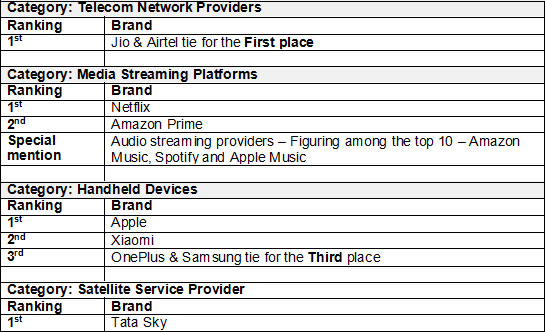
  • Jio,Airtel,Netflix,Apple,Tata Sky top Kantar CX+ 2020 TMT

    By A Correspondent


    Jio, Airtel, Netflix, Apple, Tata Sky have topped the Kantar CX+ 2020 for TMT. The Kantar CX+ report evaluates the CX performance of companies in the Telecom, Media and Technology sectors, using the Kantar’s CX+ index. CX+ is a sector-specific index to look at brands in the context of their category. It uses customer centricity as its core to evaluate CX performance of a company.


    As per a communique, the basic premise of CX+ is that brand and customer experience have become synonymous, in this increasingly connected environment.


    The roadmap to delivering a holistic experience is based on five key CX success factors:

    1. Clarity of brand promise

    2. Empowered employees

    3. Empowered customers

    4. Creating lasting memories

    5. Reinforcement of brand choice


    Additionally, the study also identifies each brand’s Experience Gap – which quantifies the difference between the Brand Promise and the actual customer experience delivered.


    The CX+ index for each brand is derived based on a combination of the CX Performance and the Experience Gap.


    The TMT study covered Telecom Network Providers, Media Streaming Platforms and Handheld Devices. In this study conducted in early 2020, clear winners emerged in each of the sectors.


    Commenting on the launch of the CX+ TMT report findings, Sushmita Balasubramaniam, Domain Lead for CX and Commerce – South Asia, Insights Division, Kantar said: “The landscape across the TMT sectors has changed drastically over the last one year. Consumers’ adoption of and dependence on digital, whether for basic everyday living, working, studying or entertainment has presented enormous challenges to companies in these sectors. And, the changes in usage of products and services will also mean that customer priorities on the kind of experience they are seeking will be different from the pre-Covid era.”


    Added Soumya Mohanty, Chief Client Officer, South Asia, Insights Division, Kantar: “In the current scenario, with tech convergence and emerging global media giants, the world will see vigorous competition in the TMT sector. This is an arena where tech credentials will become increasingly hygiene, CX will be critical. As network services providers, handheld device brands and streaming media providers, all will leverage customer data to build personalised journeys, CX and owning the relationship with the end user will become increasingly important.”


    Kantar CX+ 2020: Leaders in the TMT sector in India


    The Kantar CX+ TMT 2020 study analysed 6,000+ customers drawn from users across the sectors in India and was conducted in early 2020.


  • Value and innovation: Finding growth in the post-pandemic recession


    By A Correspondent


    Persistent safety concerns, financial pressures and sticky new behaviours mean consumers will not return to pre-pandemic behaviour any time soon. Marketers will need to pivot to finding growth in recession; delivering increasing value in the short-term to address growing economic concerns while innovating their way to sustained relevancy as behaviours and priorities change long-term. These are the findings from the fifth wave of Kantar’s Covid-19 Barometer, a global study tracking people’s attitudes, behaviours and expectations across more than 50 markets.


    Post-pandemic recovery delayed

    Only one third of people (37%) expect to return to non-essential consumer behaviour before 2-3 months. Even as many countries relax lockdown laws and commercial businesses reopen, across the world 66% of people say they will continue to avoid busy places, meaning a drag on physical retail environments. Beyond mandated hygiene and social distancing measures, 50% of people want regular testing for all and 43% want mandatory facemasks, led by demand in Asia, but more reluctance in western markets.

    Nearly everyone is experiencing increased anxiety over money. 56% of households across the world have now experienced a loss of income due to COVID-19. In India, the impact is even more acute, with 74% of households having experienced a loss of income due to COVID-19. This rises to 68% of the Millennial generation and 65% of GenZ. A further 19% expect an impact on their income in the future.


    In the short-term, brands and retailers need to prove their value

    As the financial impact of the crisis becomes increasingly apparent, across the world consumers consistently speak of a sense of pride in finding value, making smart decisions, and quietly enabling their own long-term success. 53% of consumers are paying more attention to products on sale (vs 36% in wave1). Offering discounts and promotions is now the third highest expectation of brands, (vs 5th in wave 2). 69% of consumers say a shopping list is more important now globally as well as in India.

    Beyond pricing strategies, consumers expect brands to keep advertising and acknowledge the crisis; three in four (74%) are happy with the volume of advertising, and only 14% want to see pre-pandemic ‘normal’ advertising. Two thirds of consumers are looking for help and advice – for themselves (64%) and their communities (65%) in the adverts they see and in actual brand behaviour. In India too, more than half of consumers would like to see lot more of advertising which shows what brands are doing to help the community (57%) and the people themselves (54%).

    Grocery stores are recognised as delivering value in the short term. 40% of consumers globally and 60% in India perceive their grocery store experience to be more positive while 69% perceive employees to be friendly and helpful and grocery stores to be acting on their promises; both metrics significantly outperforming CX benchmarks. Ecommerce usage continues to soar. 40% (vs 33% in wave 3) of consumers now say they have increased or significantly increased their online purchasing, rising to 48% for households with children and millennial households. India too shows a positive trend for Ecommerce usage (45% vs 40%) in Wave 3). Low pricing and promotions rank as the biggest reasons.


    Innovate to align with the new rhythms of life

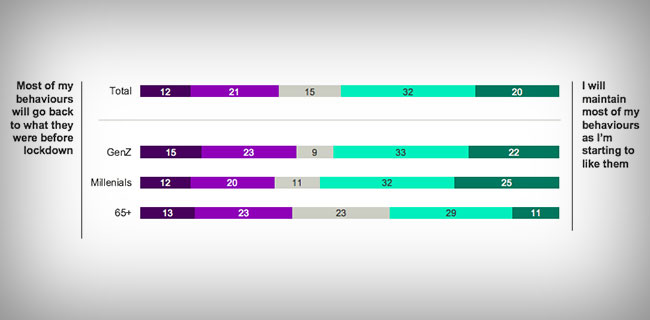
    People have started to like their lockdown habits. More than half (52%, 57% Millennial, 55% GenZ believe they will maintain lockdown behaviours post-pandemic. In India too, (53%, 56% Millennial, 61% – 35+ year olds) likely to maintain behaviours adopted during the pandemic. Increased hygiene, healthier eating, spending time with the family and personal development are most likely to be maintained. More than half the world (51%) now claim to be trying to exercise more. These changes all lead to different needs and spending patterns, and with more than half the world also feeling financial pressure, brands need to ensure their products make the cut in being considered vital in the new rhythms of life. This is amplified by the increase in willingness to switch. 45% (rising to 50%+ of households with kids) of consumers say they are prepared to keep using products and online stores they found while in lockdown.

    Said Soumya Mohanty, Chief Client Officer, South Asia, Insights Division, Kantar: “Indians are still in the phase between a lockdown and unlock. Some habits are starting to stick – eating healthy, hygiene while new ones around social distancing are emerging. The way we shop and interact will change but in an emerging, aspirational market the meaning of sustainability and responsible consumption differs. Brands will need to move from emotional succour and social solidarity to fundamentals of value, functionality, innovative delivery and simple mental availability. Simplicity could well be the new mantra as we navigate an uncertain world.”

    Commenting on the findings, Rosie Hawkins, Chief Innovation Officer, Kantar observed, “Adapting to life post pandemic, we’ve started to appreciate, and want to maintain our newly formed healthy behaviours, our more considered and purposeful personal connections and our online shopping habits. Brands and companies first and foremost need to ensure that their goods and services are safe to use and that precautions have been taken to guarantee this. As lockdown restrictions lift, consumers’ lives will continue to change and so brands will need to reassert their relevance in these new environments.”