Tag: social networking

  • S is for social, the Vijay Mukhi way


    By Johnson Napier


    In the era when the internet was new in India, and computer users were so limited that they even had their own club with branches all over the country, there were a few names one instantly associated with the digital revolution. Vijay Mukhi was one.


    A pioneer of information technology in India, Mr Mukhi has a host of credits to his name. Having served as a Director of Bombay Stock Exchange Limited, Mr Mukhi ran his own computer training centre as well as provides corporate training to companies in latest technologies. He has written over 80 books ranging from C, C++ to Networking and Java. He is also advises governments and the police on how to maintain a safe cyberspace and is Chairman of the IT Committee at FICCI and Indian Merchants’ Chamber.


    India has come a long way from the days of the dial-up internet gateway. Now, anyone with a mobile phone can be a member of the Twitterati, can post his/her thoughts on a daily, nay, minute-by-minute basis, can be a viral star (and not in the medical sense). It’s a communication jungle in the digital world, and social networking is the fuel and fertilizer that is making it flourish.


    In a bid to make sense of what gets played out on social networking websites, Vijay Mukhi has launched his portal with the URL www.vijaymukhis.com.


    Elaborating on the need and thought-process behind engaging in such an initiative, Mr Mukhi said, “The URL name is www.vijaymukhis.com with the ‘s’ connoting social. The though process stemmed from the fact that social media is growing by leaps and bounds but nobody in India has data about what Indians are doing on social networking websites. For example in politics, if you want to know whether Narendra Modi is a stronger weight on the social web over Shashi Tharoor, etc, there is no real data available for one to compare such analysis.”


    Adding further he said, “Also, the other thing was that which tweets or what Facebook posts are more successful or is liked more by people on the social web… like which of Amitabh Bachchan’s tweets were more successful, nobody knows – even Amitabh himself doesn’t know it. To add further, nowadays a lot of profanities are used in tweets and Facebook posts – so who are the people who use such language. Then in the ongoing IPL, how many tweets have geo-locations on them and from which parts of the world do these tweets come from…? Basically a lot of questions that need answers and nobody has the answers to provide for them. So the whole idea behind this portal was to answer questions such as these.”


    Notch above the others

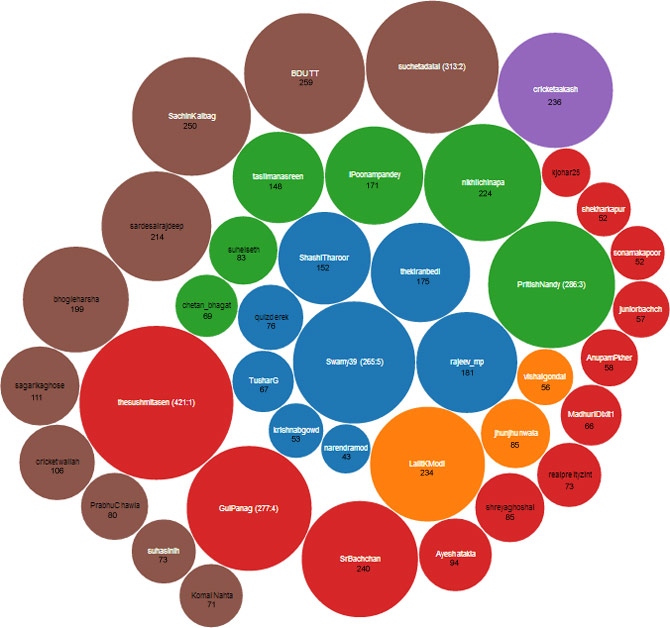
    Explaining the concept, Mr Mukhi said, “In the month of February, Pritish Nandy was India’s top tweeter. Similarly, in the month of March one tweet of Abhishek Bachchan got re-tweeted about 37,000 times while in the month of April, one tweet of Barkha Dutt got retweeted 72,000 times. Now we are already in May and a tweet of Omar Abdullah has been re-tweeted about 20,000 times. So the point is that unless we do not have 4-5 months data you won’t be able to analyze anything.”


    Elucidating further on what makes his venture stand out, Mr Mukhi said “People do not know that when Mr Bachchan tweets, the tweet is owned by Twitter and not by him. So if tomorrow someone wanted to set up the same data that I am putting up you will have to hire a programmer and download the data. But the fun part is how you display the data in innovative ways. That’s what will separate me from everyone else. There are specialized agencies like Radian, which is one large player to whom Indian companies would go to for the social media demands like Twitter, Facebook etc. But my website has more data and charts than others do and is more believable.”


    “The other thing is that because I have data that nobody else has and that one likes doing comparisons like a Shah Rukh versus Salman Khan…so the minute you make it commercial then people will say you are doing it for making money. That is usually what happens when you do stories around celebrities. The most important thing that I have done is put at the bottom of the page all the data that I have sourced so that no one can accuse me of fudging numbers” reasoned Mr Mukhi.


    While the data that gets displayed is sourced from Twitter and Facebook itself, the larger issue, according to Mr Mukhi, is how one displays this data so that one is able to make sense out of it. “I gather around 50,000 tweets from Twitter every day. How do we present those many tweets is the bigger challenge facing my portal.”


    Sharing a few trends, Mr Mukhi said that some interesting facts have come up which include the fact that Shah Rukh Khan and Aamir Khan don’t tweet and yet you find them in the top three. “Such data is something that shocked me too. Also, I was pretty surprised that Narendra Modi is very close to the celebrities. He is a film star of cyberspace, in a sense. If one were to monitor closely, the guys who have real followers on social media are the filmstars. They are way ahead of even the cricketers. The data suggests what the Indian social web is all about.”


    119 & counting…

    While it’s been three months since the venture was floated, the portal has managed to analyze data of about 119 prominent people so far. These include people from all walks of life namely politicians, celebrities and sportspersons. But that was not the TG that he originally intended to focus around. “Actually the idea germinated after a meeting with a friend who suggested the need to start ranking journalists on the social media platform. So from a single person in February today I have managed to present data of more than 119 celebrities that include journalists, politicians, filmstars etc.”


    On his immediate plans with the portal, Mr Mukhi shared, “My plan is that in the next general election I believe that Facebook and Twitter would be the largest vote bank for political parties. Also, there are a lot of questions that I would like to answer. Like when a movie is about to be launched – can I take every tweet and facebook post of that movie and compare it with the success or failure of the movie? Also the hotel industry, I am sure the Leela Group of Hotels would like to know what people think about them on the social web compared to let’s say The Taj. With the hotel industry whatever reviews get written are mostly answered by the top managers, which implies that they take the social web very seriously. So everybody wants to know what people are saying about them on the social web. My website will tell them about what is available and what you should hence be doing with the data. So there are many such exercises that we could engage in and there will never be a time when it will be complete. New ideas will keep on evolving from my end.”


    Taking the NGO route

    While people today queue up to get their hands on data that explains concepts and trends, Mr Mukhi prefers it to offer free for the users. In fact he has taken the non-commercial approach and would like to keep it that way. “Anybody can download the data from the website and use it for their own benefit. But I would like to bring more interactivity which will provide more options for one to see the same data. Also, I would like this venture to remain non-commercial; I would rather set standards for all to emulate.”


    Explaining the rationale for not charging for the data, Mr Mukhi affirmed, “What people do not realize is that I don’t necessarily have to do this in India where I have to spends several lakh of rupees to buy a sever, lease line etc. My entire server is in the cloud which enables me to do my work from any corner of the world. So it’s not really an expensive venture and therefore I am not considering investors for the project. Once I collect three months of real data that is when I could start talking to people and making sure it gets more high-profile. The more data you are able to churn out the better it will be for me in the future.”


    In fact money aside, Mr Mukhi has a unique plan that he would want to implement in the future. “Where the future is concerned, I would rather like NGOs to use my data,” asserted Mr Mukhi. “Today the scenario is such that NGOs have a lot of data with them but they do not know how to display that data. Over a period of time I will be reaching out to the NGOs and helping them in displaying their data better. I think my time will be spent better with the NGOs then with the corporates.” In fact he will also be using his resources to boost young entrepreneurs. “My data could help them present their case in a better format with charts, tables and the like. That’s what technology enables one to do today.”


    Total Number of Tweets for the Month of May


  • Jaldi 5 with Sanjay Mehta: 1 billion users strong, Facebook can influence elections

    Sanjay Mehta

    When Facebook gently proclaimed that it now had touched the magical one billion users figure, most of us just dismissed it as a milestone. But it’s an accomplishment that cannot be ignored by not just individual users – but also marketers, sociologists, governments and all those who need to reach out to the masses.


    We asked Sanjay Mehta, Joint CEO, Social Wavelength some very fundamental questions on this achievement including whether there is any reason to fear the platform being abused of destabilizing nations.


    1 Would it be right to say that a good reason for the Facebook users reaching 1 billion would be thanks to the growth in recent years in India?

    LOL… no. We cannot take too much credit considering the Indian userbase, at this time, being a nominal 50 mn in FB’s total of 1 bn. So while the Indian user base has contributed to the overall numbers, it has been a nominal percentage.


    Would you say that Facebook is the single biggest marketing development of the 2000s?

    Well, I would say Social Media is the single-biggest marketing development. And Facebook is a key player in that social media space. Also though, I would also not claim this to be the greatest development of 2000s. That is a long period, and we have had other key developments including search engine advertising, which have been impactful. But in the last 2-3 years, it has been a clear emergence of social media as a marketing platform, and Facebook is its most significant component!


    With one billion users, Facebook users constitute the single largest community of individuals after China and India? Do you think it’s right for it to be seen like that?

    Well, yes, sure. So let’s take that analogy ahead.  What does a single group – be it citizens or China or India, or registered users of Facebook – mean?  That they do share some characteristics (citizenship in case of countries, Facebook in the latter case), but there are enough differences amongst them too. All citizens are not the same kind of people, nor are all registered users of Facebook. Likewise, there is no easy way for a marketer to reach “all Indian citizens” (wouldn’t THAT be a dream?!), and so also, there is no easy way to reach the billion Facebook users.


    Except perhaps, for the governments and for Facebook!! But the citizens and Facebook users do constitute a ‘group of sorts’ and there are opportunities built in there, for marketers.


    2 Do you think marketing in the present day can be done without a Facebook strategy in the media plan?

    All marketing plans may not need Facebook. So there IS a possibility for a few marketing campaigns to not include Facebook However, Facebook is making constant changes to become interesting for more and more brands and perhaps over time, most campaigns will have a Facebook extension! Or a Facebook core!


    But is there a lot of abuse of Facebook – fake likes, fictitious users and various strategies adopted to alter perception by marketers. Is there reason for skepticism when people refer to success thanks to ‘Facebook marketing’?

    The scepticism is with a few people only, and it is also misplaced. The number of fake accounts or fake likes is a small percentage again, and the matter has been exaggerated. There is also an extent of click fraud in Google ads. But due to good algorithms, this is controlled to a small level. Same is the case with fake profiles and fake likes. It is a small percentage. Facebook does not like these. Recently it identified about 80+ mn fake accounts and went about deleting those.


    Can Twitter be put in the same basket as Facebook for marketers?

    Well, it depends on what you’d call the basket. So yes, it is also part of the social media space, and in a sense, the marketer will reach the social media active user, via Facebook or Twitter. But within that framework, there is a difference between the two platforms. Not just that, within Facebook or Twitter usage also, there are different patterns of usage and user profiles. So marketers cannot just “go to Facebook or Twitter”. There is a further science in terms of what they want to achieve, whom they want to reach, etc., and based on which campaigns are planned and executed.


    3 Just as Orkut was a rage once upon a time and faded out eventually, do you think Facebook could see the same eventuality soon? What do you think is the next big idea?

    If I have learned something in the last 10-15 years observing the tech space, it is that, ‘nothing is permanent’ or ‘no platform / brand / service remains on the top for very long’. Facebook could be the exception to this rule, or it could also fall out of favor in sometime.


    However, at the present moment, stock price apart, Facebook is extremely well-entrenched as a powerful leader in the space.


    If something or someone can displace it from its position, I do not have the crystal ball to gaze into and tell you, what that may be! It could be a platform that is currently present and becomes larger, or it could be something that is being developed in some garage or lab in some part of Silicon Valley or Israel or even Mumbai or Bangalore!


    Let’s keep watching the space and discover when it happens!!


    4 Do you see social media like Facebook being used by politicians to influence public opinion?

    Absolutely! Politicians are also brands that need to be sold, no disrespect meant here! So like any other brand that uses the medium to influence its target market, a politician also needs to do the same, for their communication messaging.


    Whether social media will impact an election result or not, just yet, it hard to say. But it will definitely influence few votes!


    5 Can there ever be a fear of Facebook being misused to destabilize countries… just as there is a fear of various media vehicles?

    We live in interesting times. Many of us are logged into our Gmail accounts all day. There is a decent amount of our web behavior that Google knows about.


    We use applications like Whatspp or Truecaller, and we share our contact lists with these applications. And a lot of us do so, and the applications then, know a lot of our cross connections and relationships.  Likewise we use Facebook, where we share our relationships, we talk about our vacations, put our photos and videos, and let people know our political preferences or movies that we like.


    There is truly a lot of information about us, out there.  And this is with a variety of sources, whom we consciously trust, or sometimes do not realize, but end up giving our trust!  Just as data stored and flowing through electronic pipes is always susceptible to leaks like Wikileaks, so also our personal data is always susceptible to being abused.  Either by means of hackers exploiting some holes, or worse, if the sources that we trust, turn rogue!


    We live in hope that these guys don’t turn rogue, and there is no major abuse of our privacy. Each morning, along with the prayers for your health, wealth and prosperity, you must also pray that Google, Facebook, Whatsapp and other such applications do not turn rogue ever!!


  • The Anchor: Ruby Bana on 6 reasons FMCGs need to look beyond TV

    By Ruby Bana


    For years I hear again and again from FMCG clients that 90 per cent of our budget goes into TV first, we need to handle that well. Sure we DO! TVCs are what helps us stay in place (unless a brand is a new entrant). TVCs help us maintain SOV, and hence market share by helping remind consumers close to purchase that we are still there. But TV is such a passive medium and consumers are becoming active. They are educated, demanding and skeptical…. So to complete our communication we need to look beyond TVCs


    1. Tell the whole story: Nothing does it better than magazines.


    2. Immerse the consumers in the brand experience: Nothing does that better than the events.


    3. Interact and engage them: Nothing does that better than online website or social networking and consumer forums.


    4. Win credibility: Nothing does that better than Socially Responsible Marketing.


    5. Become local: Nothing does it better than newspaper or radio.


    6. Become part of lifestyle: Nothing does it better than ambient media.


    All of these add competitive advantage to our brands and help us get noticed, remembered and enrich our interaction with our consumers. The older and better established a FMCG brand becomes, the lesser and lesser must it rely on TV. It’s a fundamental truth… the strategies/tactics that get us to the top are not necessarily those that keep us there OR help us evolve to the next level.


    Ruby Bana is Chief Strategy Officer, Madison


  • Bandh a ‘partial success’, no effect on petrol prices

    Ranjona Banerji

    By Ranjona Banerji


    Tracking Thursday’s Bharat Bandh protesting against the petrol price hike on TV led to a bit of confusion – was it a success or not. As it turned out, the Opposition-led bandh was what is known as a “partial success” so if you’re a half-glass pessimist, that’s the same as a “partial failure”. For Mumbai, TV showed us a bus in Mulund being attacked by a man in a BJP T-shirt – who either did not have the good sense or was just to brazen to hide his face from the camera. But social networking sites seemed to suggest that people did go to work. The morning papers said 60 per cent turn out in private offices and slightly more in government offices (really!). The commercial loss, said The Times of India, was Rs1,000 crore while Mid-Day pegged it at a more conservative Rs300 crore. Of course maybe with current rupee-dollar rate, both figures mean the same thing?


    There is also the other question about the loss caused by damage to property by “bandh” enforcers which as every newspaper painstakingly informed us, we the people would have to pay for.


    Across the country, the bandh fared better in some parts than others and apparently had no effect in Kerala at all.


    Petrol prices, by the way, had not come down by Friday morning at least.


    * * *


    As the TV news day progressed however, the bandh was sidelined first by BJP veteran LK Advani who announced in his blog that the BJP had made too many bad decisions recently and used the party’s favourite word “introspection”. This kind of took the wind out of the BJP’s sails as the main “bandh” caller. Immediate speculation began about a rift in the party – something political commentators have long known about. http://blog.lkadvani.in/blog-in-english/bjp-a-hub-of-hope


    Arnab Goswami interviewed Ram Jethamalani who had said similar things in a letter to Nitin Gadkari and Jethamalani was a hoot as always, even as he lost his ear pieces for a while and Goswami watched precious air time and money dribbling away.


    Jethamalani told Goswami he was a clever man who was trying to get Jethmalani round to Goswami’s opinion. Goswami said he had no opinion.


    No comment from me either.


    * * *


    The other big bandh spoiler was the Indian economy and the fall in GDP growth to 5.3 per cent, the lowest in nine years. Our TV newswallahs who usually shy away from the economy – possibly because they know so little about it – were forced to sit up and take notice and so gave us some uninformed guff, interspersed with a lot of dramatic music and stuff.


    Since the economic recession in the West in 2008, international TV newswallahs have become experts at this economy stuff and our TV people could learn from them how to use jargon effectively and impressively. Or, they could hire some journalists with a background in business and the economy. This would be particularly useful for the Sensex channels.


    Amartya Sen on NDTV sort of turned the argument on its head by saying that this obsession with GDP was misplaced. He started talking about inclusive growth and stuff which usually makes business people and economists turn faint from boredom as they cannot understand what that means.


    * * *


    At prime time, Headlines Today was still worried about cricket and Rahul Kanwal was in “hot pursuit” of Gautam Gambhir. Arnab Goswami asked why we need such bandhs at all and then proceeded to have a quarrel with Ravi Shankar Prasad about the NDA’s petrol policies.


    Mohandas Pai formerly of Infosys came up with a novel solution to bandhs – he said all bandh-callers should sit around statues of Mahatma Gandhi and hold hunger strikes. BJP people looked bewildered having never heard of this man nor seen statues of him anywhere in India.


    * * *


    Chief Election Commissioner SY Quraishi in Thursday’s Indian Express said, “Serious thought needs to be given to the ‘paid news’ that is threatening to erode the value and pride of the press and is starting to shake the foundations of democracy. A voluntary code would be the effective answer”.


    He was speaking at the annual convocation of the Express Institute of Media Studies.


  • Airtel & Hungama announce mobile music premiere of Gangs of Wasseypur

    By A Correspondent


    Music from Anurag Kashyap’s most-awaited movie ‘Gangs of Wasseypur’ became the first soundtrack in India to premiere on the mobile platform, prior to the album’s physical music release thanks to a tie-up between Airtel  and Hungama Mobile. The music is now available exclusively for Airtel mobile customers till May 26 via Hello Tunes and Airtel Radio.


    Commenting on this, N Rajaram, CMO – Consumer Business, Bharti Airtel said: “The music premier of ‘Gangs of Wasseypur’ on the mobile platform speaks volumes of the changing consumption pattern among customers today. Be it music, movies, gaming, social networking or emailing – the discerning Indian customer is increasingly relying on the mobile phone for accessing content. As more and more customers prefer listening to music on their mobile phones, we expect to see mobile music launches as a fast emerging trend towards catering to the preferences of India’s expanding base of mobile music listeners. We are delighted to join hands with Hungama to announce this industry first and exclusive for Airtel mobile customers”.


    Albert Almeida, COO, Hungama Mobile, said: “The mobile ecosystem is evolving and with a staggering number of consumers wanting to consume music and movies directly on their phones, we are happy to satiate their appetite. Airtel has been at the forefront of marketing and distributing entertainment and music content via mobile devices and through this initiative together we will make a compelling offer to music lovers yet again.”


    What makes this tie-up special is that ‘Gangs of Wasseypur’ has been selected for the prestigious “Directors’ Fortnight” at the 65th Festival De Cannes and has already garnered unprecedented buzz from international media and critics.


  • Info explosion has made India smarter: ‘New Realities 3.0’ study

    By Robin Thomas

    The Interpublic  Group (IPG), one of the world’s premier advertising and marketing services companies, has come out with its global ‘New Realities 3.0’ study that provides a unique window into how the Indian consumer is coping with information overload. The study provides insights on the decision-making process of the consumer in today’s era of information explosion. The study also aims to answer the unanswered queries of marketers on whether the information explosion has made consumers smarter or confused, the role of social media in a making consumers more informed, the role of brand advocates and much more.


    The study covered five countries namely, India, China, Brazil, America (US) and Germany. The India leg of the interview was conducted by Draftfcb Ulka’s independent consulting agency, Cogito Consulting. Over 600 online interviews were conducted in each of the five countries between October 26 and November 10, 2011. Some of the findings from the ‘New Realities 3.0’ study reveal that most Indian consumers feel they have grown smarter with the available product information, which is higher than the other countries. Further, the study notes that consumers in India rated a reasonable 7.3/10 when asked whether the available product information made them feel smarter compared to China that showed a rating of just 3.9/10, the US at 6.8/10, Brazil at 6.4/10 and Germany reporting 7.0/10.


    Interestingly, despite consumers in India claiming to feel smarter and not confused or frustrated with the product information available to them, they do not trust the information they see on brands, especially from the manufacturers end. Further, 32 per cent of Indian consumers say they do not trust most of the information they see on brands, whereas 31 per cent say they do not trust information from manufacturers or providers.


    The trust deficit that brands have among Indian consumers is higher than the other four countries, for instance only 11 per cent of Germans say they do not trust any information from brands whereas 22 per cent say they do not trust information from manufacturers or providers. Even Chinese consumers seem to trust information from brands and manufactures as compared to the Indian consumers. 19 per cent of Chinese say they do not trust information from brands whereas 24 per cent Chinese do not trust information from manufacturers or providers. 16 per cent of those interviewed in the US say they do not trust information from brands whereas 15 per cent do not trust information from manufacturers.


    Another interesting finding is that with the exception of Germany, the remaining four countries interviewed – India, China, Brazil and United States have said that product learning is a source of joy and fulfillment. 54 per cent of Indians have said that they enjoy researching the information for buying decision whereas 52 per cent of them say they find the information on brands fulfilling.


    Terry D. Peigh

    The findings have also revealed that most Indians learn product information to build an expertise about a certain product and brand as well as because it helps them stand out in their social circle. 53 per cent of Indians said that the reason they stay informed about certain products is because ‘people value me and my knowledge about certain products’, whereas 52 per cent of them said it helps them enhance their self-esteem.


    In addition to these, the study also revealed that consumers in India and China are most likely to turn into brand advocates and become a media channel and that in India, Brazil and China, especially, social networking sites are a good source for word of mouth information on brand experience.


    As vague and unique as it sounds, MxM India’s Robin Thomas got Mr Terry D. Peigh, Managing Director and Senior Vice President, IPG to relay more outcomes from the study, the role of social networking sites in decision-making capabilities and much more.


    New Realities… is an online study across multiple countries, including India. What is the sample size that was chosen for this study? Who are the respondents i.e. the TG for this study?

    We interviewed 600 people in each country i.e. in India, China, Brazil, United States and Germany. Out of the 600 people sampled, one-third were Gen X, one-third were Gen Y and one-third were boomers. 50 per cent of those polled were men and 50 per cent women.


    What was the key objective of the study? What, according to you, are the learnings for the Indian market, as well as the global market?

    The key objective was to better understand how the consumer has changed because of the new media. We came across the idea years ago as we noticed that the number of information sources available to consumers today has grown exponentially. So we found out if people were confused, frustrated, overwhelmed, and how are consumers viewing the overall experience of absorbing product information and using that information.


    We learnt that consumers have evolved over the years and hence they are not confused or frustrated with the information explosion. Consumers have not only learnt to easily filter or absorb the information but, they have also learnt how to manoeuvre their way through all the multiple choices of product information available to them.


    We have also learnt that surprising number of consumers, especially from India, are now very open, willing and eager to learn about product information as they find a lot of joy and satisfaction in learning about product information. In fact, our research also shows that people in India are most likely to really enjoy research and product information.


    One of the reasons why many in India are willing or open to product information is because they find it of social value as it allows them to have an expertise in certain products. We have also learnt that consumers are aggressively willing to become advocates of brand. Our research also shows that they are now interested in continuing to learn about a product even after they have purchased a product as they want to learn more about the product and advance their knowledge about that product.


    What this reveals is that communication should not stop at the time of sale and that marketers must continue to talk to their consumers even after they have purchased the product. As a result marketers may convert their consumers to brand advocates.


    The study reveals that Information explosion in India has led consumers to become smarter and helped them beat the system – much higher than what the other countries have reported. What are some of the factors that influence the consumer’s decision-making process around a product?

    We see a dominant role of family and friends in a consumers’ decision-making process. Although social media is still small, its role as a channel is growing, but too often social networking sites are limited to ‘likes’ or number of friends which is wrong. It’s too easy to get someone to push the like button or accept a friend request, even though they may really not like the brand or want to be their friend. A research from Australia finds that less than one per cent of friends are actively engaged and want to be truly engaged to the brand. So we keep encouraging our clients to go beyond ‘friends’ or ‘likes’ on a social networking page but, instead seek true engagement.


    As India becomes more tech-savvy, do you anticipate further information explosion to come about that could lead to further increase or decline in consumers who are confused or frustrated with the information?

    We were, in fact, surprised that the confusion or frustration numbers were not higher. My projection, however, is that it (frustration and confusion) will not go up as consumers have learnt the role of technology very quickly. Technology is fast reaching to the lowest common denominator very quickly so, I think people are learning to process information very quickly.


    Will there be a Phase II of the ‘New Realities 3.0’ study?

    Yes. We will soon be out with the second phase of the study in another 18 or 20 months, which will help us understand more trends. In China, for instance, during Phase I and II we have seen dramatic changes in over 18 months. We found that the Chinese were much more inclined to use the internet for product research. In China, the internet was used primarily for entertainment purposes, now it’s used for product information.


    Not surprisingly, consumers in India do not trust brand information especially from the manufacturers. This is not so with other countries, particularly Germany, US and China. How would you explain this? What must brands / marketers in India do to build the trust deficit among their consumers?

    I believe it is because of the newness of the consumer culture in India. In the US, for instance, there has been a mass market of consumer culture for 100 years and the same in Western Europe. I think consumers need to develop trust for their products. Brands must not be afraid to enter into the world of social media and hearing negative comments about one’s brand. There is probably no quicker way to gain trust with the consumer than to actually legitimately and honestly respond to criticism and fix the problem. This, I believe, is one way for brands to gain trust of the consumers.


    With the exception of Germany all other countries seem to enjoy product learning. What makes the consumers in Germany not really enjoy product learning?

    Yes, German people usually do not associate joy from product information. The Germans usually get their joy from music and food


    How has social media changed consumers’ decision-making across the globe? What role do you see social networking sites play in the near future in India?

    The role of social networking sites as a tool for brand advocates will increase. One thing we have noticed in the western world is that the number of people visiting brand pages on social networking sites is on a decline in Europe. This is not the case in India. In the western world a lot of consumers say that they do not visit Facebook for brands, but for friends therefore, it will be interesting to see if it will be any different in the developing economies. Nevertheless brands like Coca-Cola have leveraged social media well by finding ways to reach out to the consumers by engaging in a good conversation and get them to participate in brand activities. Right now the data shows consumers are willing and eager to visit social media to learn about products or brands.


    Even though broadband penetration is still low in India as compared to the US, why are consumers in the US and Germany reluctant in using social media for product research?

    This may be because brands that first started using the social media didn’t do a good job in engaging the consumers. The consumers may have clicked ‘like’ or may have become friends but, the brand may not have received anything else. Brands must, therefore, learn to go beyond the ‘likes’ and adding of friends to adding value in a consumer’s life as the consumer is not accessing social networking sites for brands but for something else. Therefore, in order to leverage the social media, brands need to operate in a different way. Increasingly, many brands are beginning to use social media effectively to engage with their consumers.


    How do you plan to reach the brands or marketers with the study? What can brands or marketers expect from the study?

    This study is important for clients because it is consumer based, is fresh, is in-depth, is broad, it looks at many different segments by product category, by demographic and it is the consumer telling us what he or she is thinking about.


  • In your Facebook, in your brand?


    By Ritu Midha


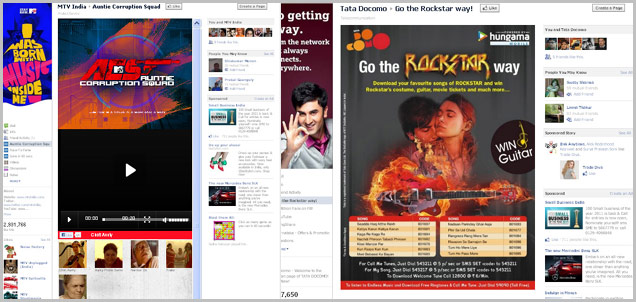
    Though there have been, and are other social networking sites, none match Facebook – whose growth has been phenomenal – in terms of usage and the buzz around it. Brands, keen to be where their target audience is, seek it out and in spite of issues like low internet penetration, power cuts and low literacy levels, social media and more specifically Facebook is seeing exponential growth in India.

    A study by Experian India released in September 2011 indicates that Facebook, YouTube and Orkut are the top three social networking websites in the country.

    As per the study, search engines continue to be number one in terms of visit share in the month of August 2011 with 17.25 percent visit share, while social networking and forums are at number two with 13.99 percent.

    The study also indicates that social networking sites are amongst the top three sources of traffic for these industry categories: Automotive, Community, Computers & Internet, Education, Entertainment, Food & Beverages, Health & Medical, Lifestyle, Music, News & Media, Shopping & Classifieds, Sports and Travel.

    When it comes to specific social media sites Facebook is at number one with a 52.47 percent visits share, while YouTube is a distant second with 20.34 percent share (July 2011). And when one looks at percentage change this August vis-a-vis August 2010, Facebook has seen a whopping 88.46 percent growth from 27.85 percent to 52.49 percent.

    And as per a global Cisco study, within certain countries, including India, updating Facebook was ranked as the highest priority, even more than hanging out with friends. Of all the countries surveyed in the study India ranked highest in the frequency of Facebook interaction, with 92 percent of students and 98 percent of employees checking it daily.


    Facebook, thus, has arrived in India, and if the growth rate is any indication it is not a storm in the frying pan. However, one wonders if Indian brands have really begun to value the impact of social media, or is being on social media just a feel-good factor for them? Says Mr Ashok Lalla, President – Digital, Euro RSCG, “There certainly is a lot of enthusiasm among Indian brands to get onto the social media bandwagon. Unfortunately, most get on thinking that a fan page, or an app or a Twitter handle is all that it takes to crack the social media code. However, we are also seeing some brands take a more mature view of social media, and these also better integrate social marketing with the rest of the marketing and communications mix.”

    Mr Alok Kejriwal, CEO and Co-Founder, Games2win, too agrees that brands are at different stages of evolution as far as social media goes. He remarked, “Some of them use social media well, some of them are learning and some of them are completely ignorant. The brands who get it are those who have young CEOs and managers rather than the ‘Silver Foxes’ who run the companies that run the brands who live on the dark side of the moon. Think Vodafone vs Air India.”

    Talking specifically of Facebook, where most of the consumer action is at the moment, while a few brands are working on specific Facebook strategies, others just want to fit it in. Mr Lalla said, “I’m not sure if brands have reworked their overall communication strategies, but they certainly have recast and extended them to include social media. Facebook clearly is the first and most popular part of most social media plans. That’s not surprising, since it’s got the largest number of social media-active people in India.”

    Interestingly, one notices that brands look at gaining as many ‘likes’ as possible – a ‘like’ on a page can get a fan Rs 1,000 off on a luxury cosmetics brand – while a few others believe that the ultimate is to make the customers win a contest, and give away an expensive handset. These mostly work as tactics for the moment. As soon as the contests and discounts are over – so is the people’s interest in that specific page.

    What, then, would be an ideal Facebook strategy for a brand? Kejriwal explains, “Listening and not marketing. Brands and their decision-makers need to listen to the whispers on social media – their ears should be on the railway tracks picking up tremors and the train before it arrives in their face. Facebook is a reactive and conversational media for brands rather than a pro-active and defensive media.”

    It effectively means that ‘likes’ are not a good enough benchmark for a brand page on Facebook. Mr Kejriwal declared, “No way! Likes are silly. It’s like saying that the number of units sold of a sachet is the sign of the success of a brand! Less Is More on Facebook for a brand. The quality of conversation – not the quantity – is important.”

    “The real impact comes when brands look at ‘Life beyond the Like’. And focus on identifying and nurturing the ‘fans’ that have real brand love, and the potential to turn into brand advocates,” added Mr Lalla.

    Social media, and more specifically Facebook, opens doors for two-way communication between the brand and its audiences – and it is that conversation that brings the biggest value to a brand. Mr Lalla elucidates, “Today a brand is no longer about what marketers tell consumers it is, but it is what consumers tell other consumers it is. In this context, it makes immense sense for a brand to be receptive and responsive to its audience. That’s where a two-way communication (conversation) helps.”
    It is largely youth brands looking at a presence of Facebook – an effect of the perception that it is largely young and happening who spend time of Facebook. However as per Mr Lalla, the fastest growing demographic on Facebook worldwide is the over-50s. So, used right, social marketing via Facebook can make a difference for more than just youth brands. Brands, perhaps, are waiting, to witness a few big success stories before taking Facebook more seriously. In times to come it will become even more intrinsic to marketing, and brands will gradually learn to appreciate the influence it can create on their audiences.

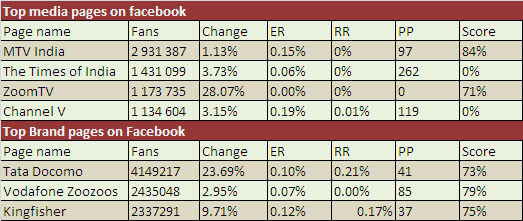
    ER = Engagement Rate, average number of total interactions to the pages posts divided by the number of fans in the last 30 days
    RR = Response Rate, the pages response rate to the user questions posted on the wall in the last 30 days
    PP = Page Posts, the number of the posts by the page in the last 30 days
    Score = The score of the Facebook page, a Socialbakers only metric that we create out of 30 different parameters

    Source:

    http://www.socialbakers.com/facebook-pages/brands/india/
    http://www.socialbakers.com/facebook-pages/media/india/