Tag: slowdown

  • Implications of Economic Deceleration for Advertisers


    By Brian Wieser


    Key takeaways:
    :: Economic growth is decelerating in most countries
    :: Advertising growth is also looking neutral to negative vs. last year’s levels, with recent trends likely to continue
    :: Marketers can prepare for opportunities which can emerge in a downturn

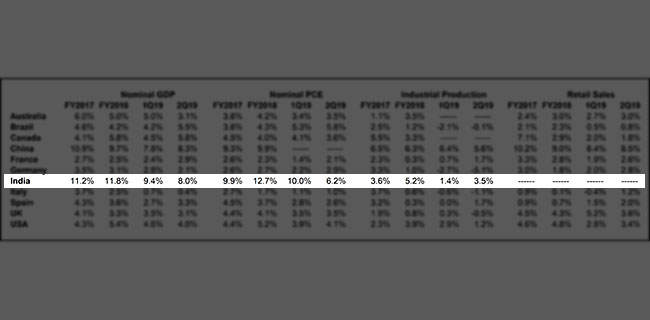
    Fragile global economy shows mild fractures. Concerns have risen around the health of the global economy since we published the mid-year update to our global advertising forecasts at the beginning of June. At the time, we referenced the OECD’s then-recent assessment of the global economy as “fragile,” acknowledging economic growth alongside increasing risks that we might begin to see meaningful deceleration. Since then, most of the world’s major economies have published estimates of economic growth for the second quarter. Along with GDP (the broadest measure of economic growth in a country), we have also wanted to look at current trends in personal consumption expenditures (PCE, usually the majority of a country’s GDP, and often more tightly correlated with advertising than GDP), retail sales and industrial production (each of which can correlate more highly with advertising than either GDP or PCE). All metrics have been tracked here in current/nominal terms, meaning not discounted for inflation, and on a non-seasonally adjusted basis when available.


    Year-over-year growth trends for some key economic variables so far in 2019 are generally negative. For the countries we looked at in recent weeks, if we compare second quarter conditions with those for all of 2018, we see GDP and PCE trends that are generally the same or negative. That is to indicate that we still see growth, but growth which is generally slower than previously observed. However, retail sales and industrial production appear more unambiguously negative versus last year’s levels. Again, these variables tend to be more tightly correlated with advertising because marketers spend on advertising in alignment with the pace at which they make things or sell things.

    Source: GroupM analysis of data from individual country economic bureaus, Refinitiv

    Source: GroupM analysis of data from individual country economic bureaus, Refinitiv


    Advertising growth is looking neutral to negative versus last year, with recent trends likely to continue.  This data is consistent with expectations of neutral to negative trends for advertising around the world.   While the U.S. saw accelerated advertising growth in the second quarter, this followed a relatively weaker first quarter. In many other countries, deceleration appears to be more pronounced, as indicated in the table above.  Further deterioration is likely given the pressures of trade wars – which are likely to persist – alongside Brexit uncertainties impacting both the UK and Europe.  All of this says that marketers need to be prepared for a downturn.


    Marketers can still look for opportunities in a downturn. In a full economic downturn, advertising growth will generally decline, but not necessarily in every country nor in every medium. This can present opportunities. As we have written previously, global markers with flexibility to shift marketing budgets across countries may find opportunities to redeploy resources from countries with weak economies and strong media markets to those with relatively stronger economies and weaker media markets, as marketing dollars may go further in those instances. More generally, as we can anticipate that most marketers will cut their spending, marketers with the flexibility to do so could benefit from maintaining or increasing spending given the relatively inexpensive opportunities to raise “share-of-voice” that would exist under these circumstances. An economic downturn environment may, in fact, provide marketers and opportunity to grab greater share.


    Consumer behaviours could change in response to economic weakness and, as always, require ongoing monitoring. In some instances, we will see shifts in consumer behaviours, but the direction may be hard to anticipate. For example, SVOD services might appear to be discretionary choices that consumers could eliminate in belt tightening.  But on the other hand, the relative value of these services versus more expensive entertainment options like theatrical movies, concerts, and more could actually reinforce consumer interest in SVOD which, could be viewed favourably versus the cost of traditional pay TV services.   There is no history to point to in terms of predicting how new platforms will fare in a downturn, and so close monitoring of consumer adoption will be increasingly important.


    Marketing messages need to maintain relevance. There are, of course, brand-related considerations to consider as well. Marketing messages may need to be adapted in many instances – for example, emphasising a product’s value or how it helps a consumer avoid incurring other costs. In other instances, marketers may find totally new business opportunities as consumers reassess their spending patterns and product preferences.


    “Never let a crisis go to waste.” Choices made under severe economic pressure have the potential to lead to better marketing choices. With the budget cuts that can follow if a company’s revenues fall, some marketers may find themselves forced to be creative in how they deploy resources. If they aren’t doing so already, they should be prepared to assess their mix of spending across marketing services, software and media. For example, some will find investments in marketing technology or other brand experiences prove more effective uses of budgets versus media, especially if they help deepen consumer engagement, enhance “share of wallet,” or reduce customer churn.

    Everyone would rather see sustainable growth for their businesses and the economies in which they operate. However, to assume this may occur uninterrupted over the next couple of years requires excessive optimism. Hoping for the best but preparing for the worst will help you survive and thrive over quarters and years to come.


    Brian Wieser is Global President, Business Intelligence GroupM. This post first appeared on the GroupM website at https://www.groupm.com/news/implications-economic-deceleration-advertisers

  • Govt policies anti-small radio stations: Goyal

    Tarun Goyal is the Founder, Director of Radio Chaska, a radio station which was founded in 2006 by the Goyal family. In conversation with MxMIndia’s Robin Thomas, Mr Goyal speaks about the challenges facing the station in achieving break even, the issues that need to be resolved before the phase III rollout, on their plans to revamp their official website and whether the radio industry has been hit by slowdown?

     

    Founded in 2006, when you look back, how would you say the journey has been for Radio Chaska?

    The journey since 2006 has been a different one. We started a radio station in Gwalior, thinking that FM radio will catch the fancies of the people, and it did. Over the years there has also been a shift in the advertiser perspective about the medium. However it is the support from the government that we are lacking today, they are spending very less on radio. On a positive note, despite odd challenges, radio has managed to grow tremendously over the last many years, and has also contributed to the development of the city as well.


    What is the Gwalior market like for radio?

    Well, it certainly is very different from the metros. People invGwaliorvhave an altogether different taste for radio itself.  The advertising category on radio is mostly retail. We mainly play music all the time – mostly latest Hindi or Bollywood hits.


    Apart from advertising, what are the other sources of revenue generation for Radio Chaska?

    We do generate some revenues from activations, a good pie of our revenues also come from Radio Mirchi (ENIL), with whom we are instant partners for sales and then we rely on our local revenues. Although activations help increase our revenues, the profits generated are low, mainly because of the high costs in activation. Thereby, we primarily have to concentrate more on advertisements because that’s where a good portion of our revenues comes from. Nonetheless, more number of activation definitely helps us increase our brand value in the city, which in turn, helps us get more local advertisers.


    So, has the strategic sales alliance model worked? How does it benefit both Radio Chaska and Radio Mirchi?

    Since we are a single station owner in Gwalior, this partnership has been a strategic move for both Radio Chaska and Radio Mirchi. Since Radio Mirchi is present across Chhattisgarh and Madhya Pradesh except inGwaliorand Radio Chaska is present in Gwalior, therefore Radio Mirchi (ENIL), in strategic sales alliance with Radio Chaska, has created a space for itself in Gwalior as well. It is quite hard to sell a single station and keep track of various campaigns coming from different parts of the country. This strategic alliance with ENIL gives Radio Chaska an edge in reaching out to other parts of the country and the state. Thus we have had an extremely good partnership with ENIL ever since the inception of Radio Chaska.


    What are your break-even plans? When do you see Radio Chaska achieve break-even?

    I don’t know when we would be achieving break-even as the costs are escalating and hence we are unable to increase the revenues as anticipated. Unless we have some good policies from the government, small stations will never achieve break-even. Government policies, I believe have gone against the small radio broadcasters and, besides, there are other small issues which if resolved would help small stations achieve break-even.


    Music royalty is one of the issues that are yet to be resolved. The escalating fuel cost is another worry because it is adversely affecting the industry. A company’s five to seven per cent cost is always burnt in fuel because the government is unable to provide electricity. These may be small issues but nevertheless they are vital in helping the business sustain in the market.


    The MIB (Ministry of Information and Broadcasting) has already given its nod to news on private radio stations, multiple licenses are allowed, FDI limit has been marginally increased. How does Radio Chaska view these developments? Will these benefit smaller stations?

    We welcome this move, but issues like music royalty need to be sorted out first and only then I believe FM radio stations can probably flourish in the long run. Right now challenges for smaller stations, in particular, are many and only time will tell how FM phase III will benefit the industry. Nonetheless we welcome the policy and we too would try and be part of the phase III policy.


    So, will you approach phase III more cautiously? Will you expand to other markets? What are your phase III plans?

    We are eyeing for expansion in parts of Madhya Pradesh as well as in other markets, but yes, our approach will be a little cautious. We will not hype up the prices and bid unnecessarily. If we find the scenario viable only then we will bid, otherwise we will stay away.


    How significant a role does the website play for a radio station? Do you plan to add new features or redesign your website someday?

    Yes, we will be upgrading our website very soon, probably in next two months. Official websites have also become a medium for radio stations to interact with their listeners. Our RJs regularly interact with listeners on social networking sites and today official websites have also become an integral part of a radio station.


    It is said that the radio industry being hit by the economic slowdown. Do you agree?

    Yes, I do agree that the radio industry too has been hit by the economic slowdown. The telecom industry, for instance, was one of the highest spenders on radio and in the last three or four months we have not received any business from the telecom sector. So, yes there is a slowdown and radio has been affected by it, but nevertheless radio is surviving the slowdown.


  • Focus on increasing number of formats: Govind Shrikhande, Shopper’s Stop

    As was predicted of the sector, retail did take a beating at the hands of slowdown, especially the second half of FY 2011-12 where growth was difficult to come by. But the downturn is not as bad as it seems and good tidings are being predicted for the medium for 2012-13. Much will depend on how the large players will be geared to tackle this difficult phase including undertaking risky yet calculative decisions that will either see them in the red or see them walk away with pots of money.


    Govind Shrikhande, Customer Care Associate & Managing Director, Shopper’s Stop Ltd is all set to take his company to new heights and feels that expanding its product offerings across the country could work in favour of the company as there are always new markets and consumers who are waiting to savour variety. Mr Shrikhande opened up to Johnson Napier of MxM India on the sidelines of Mindshare-Brand Equity Compass 2012 on how his company is geared to tackle the challenges of the future and what the retail industry needs to do to overcome the downfall scare that’s had everyone on tenterhooks.


    Q: It’s been a shaky 2011-12 for the retail industry in India. How is Shopper’s Stop handling the slowdown conundrum?

    2011 has been a mixed year for us – the first half went pretty well, but Q3 which is the biggest quarter for the retail sector witnessed a slowdown. We expect some recovery to take place in the second half of 2012-13 while the first half of 2012-13 will be a little slow.


    Q: How have you grown organically across the multiple formats that you are present in?

    We have grown very fast in the last one year. We added around 13 stores in the main format; overall we added more than 20 stores in all the big formats that we have. So it’s been a very fast-paced expansion drive for us. Going ahead, we plan to add atleast eight stores every year. I’d like to state here that the opportunity for retail community in the future is big, so it’s important that you expand today. Though there could be some short-term difficulties of sales growth not being as high as one expected it would be but if one prepares oneself so well that the model is good, the consumer traction is strong and the assortment is very good then one can be in a good position to perform well and really be ready to face challenges of the future.


    Q: Are you contemplating expanding your product offerings apart from the staple departmental and hypercity formats that you currently cater to?

    We have enough formats today like Shopper’s Stop in the department store format, Hyper-City in the hyper-market format, Crossword in the books store format…so we have enough formats currently by which we can expand and we are doing that.


    Q: What do you derive from the changing FDI stance between the government and the retail industry?

    I think FDI is getting a new meaning every season now. The Indian government did announce FDI in multi-brand retail and took it back. Also, the concept of cash-and-carry has been around for some time but now it’s getting into a different kind of a situation. I think the industry as such is waiting for the government to come up with some concrete plans around FDI but yes, once it does come in it will definitely help the whole retail industry to expand faster than what it has been able to do right now.


    Q: What is the impact that digital will cast on the retail sector? A lot of brands are taking the e-tailing route to increase product traction…

    Digital will help drive growth of retail because it is has been found that globally, a lot of consumers first check details on the internet and then go to a shop to buy stuff. It plays a support role where shopping is concerned. The fact is that almost 30-40 per cent of shopping that happens in a physical store has already been researched about before by people on the digital platform. So I do not see it posing any competition or threat; it would be self-supporting.


    We too have started our own websites for Shopper’s Stop and Crossword which will further ensure that a customer will get a multi-channel delivery whether through physical store or a digital store.


    Q: Apart from talent, what is the other big challenge facing the retail industry as of today?

    Apart from people, the other big challenge for the retail sector is the availability of quality space and rental. This in fact is a bigger challenge than people. As for the people challenge that we face, we are trying to overcome that by building new programs like Fashion Associates, which should help us to face this crisis in a much bigger way. But availability of quality retail space at reasonable rent is still a big challenge.


    Q: As you move forward, what would be your main objective for 2012?

    We have enough happening in the company right now. The key driver would be expanding into more cities and growing the total number of formats rather than getting into new formats.


  • So will media spends grow at 12 or 8%?


    By Johnson Napier


    A lot could be said about how the year 2011 has shaped up for the media industry in India. From a growth perspective, it possibly has shaped up the way brand marketers and industry observers had predicted it to be – a mixed year with its usual set of highs and lows. But despite the rise and fall, the enthusiastic performance displayed by the industry year-on-year is giving players from the space, as also research bodies, enough scope to track down this domain exclusively and come up with studies that predict the trajectory and also crystal-gaze into its performance for the forthcoming year.


    In pace with its observations on the growth witnessed by the media industry in India, a couple of media (agency) firms have rolled out reports citing healthy growth numbers for 2011 and a cautious-yet-optimistic trend for next year. After Mindshare India released its annual report titled ‘This Year, Next Year: Indian Media Forecast’, it was the turn of Pitch-Madison to reveal its report last week. Joining the above two reports was another finding from research firm Media Partners Asia that unveiled its study tracking the performance of media in 2011-12. (Disclosure: MxMIndia partnered with Mindshare to publish the report digitally and in print form as ‘The Mindshare Indian Media Forecast 2012’)


    2011 (cr) 2012 (cr) YOY % growth
    Mindshare 33,388 37,397 12
    Pitch-Madison 25,594 28,013 9
    Media Partners Asia 31,400 34,100 8.7


    While most studies have predicted a healthy growth trend what is noteworthy is the optimism in numbers that have been expressed through the various reports which range from a modest 8 per cent to a high of 13 per cent. This translates into adspend monies ranging from Rs 25,594 crore to Rs 33,388 crore approximately. As part of the ‘Mindshare Indian Media Forecast 2012’ published by MxMIndia, Ravi Rao, Leader, South Asia, Mindshare had expressed how predicting adspends has become more complex now than ever was. “The economic outlook is something that one can never get the handle right, with most studies not agreeing on one number. But this is what makes it exciting to look and estimate the Adex growth in India. Group M does yeoman’s service of providing some startling numbers based on science rather than gut, even though India tends to buck the trend away from global predictions.”


    When analysed further, the Mindshare study predicts an AdEx growth of 12.8 per cent in 2011 with net revenue totalling INR 33,388 crore. This was driven largely by the medium of television that contributed 18 per cent to the growth followed by Print at 7 per cent and Digital at 30 per cent. In fact for 2012, Mindshare predicts an overall growth rate of 12 per cent that will be led by spends on television – 15 per cent, print – 8 per cent and digital – 30 per cent.


    As for the insights by MPA, ad revenues in India for 2012 are expected to clock a growth rate of 8.7 per cent. According to MPA, this growth will be primarily driven by MNCs investing in India and stronger MCG sector, and if there are revisions carried out in 2H 2012. As for the advertising growth across key categories, MPA expects robust growth from the FMCG sector, which is the largest advertising category, contributing 30-35 per cent to total ad spend. The study predicts that MNCs are expected to report robust numbers while a few large MNC accounts are looking to increase spends by 50-70 per cent for the coming year. The other sectors that will see heightened activity include Auto – while traditional companies such as Maruti and Hyundai have reduced spends, global car manufacturers investing in India are driving the overall growth for the sector, Telecom and Life Insurance.


    On its part, the Pitch-Madison study (published by Pitch magazine, conducted by Madison) predicts a sluggish growth rate of 8 per cent due to slowdown worries in the second half of 2011. It predicts a cautious trend for 2012 which is expected to pick momentum only in the second half. It predicts a growth a 9 per cent with revenues totalling Rs 28,013 crore.


    The industry, on its part, seems undeterred with the varying figures being thrown up and appear comfortable with the current state of affairs so far. Divya Gupta, CEO, Dentsu Media India said, “The estimated adspend growth according to us stands at approx 9 per cent. Also, the growth trajectory may have slowed down versus what was reported in the last few years, but it is still very healthy!”


    According to Shubha George, Chief Operating Officer, South Asia – MEC, “Our estimate of 2011 closing numbers is close to 13 per cent. When analysed further, the mediums of TV, Digital and Cinema have outperformed vis-a-vis the overall 13 per cent whereas Print and Radio have been below par. As for 2012, our estimates are a percent lower than 2011 at 12 per cent.”


    Admitting that the so-called slowdown may have cast its effect on the growth of the industry, Anita Nayyar, Chief Executive Officer – India and South Asia, Havas Media said that “the actual rate that was predicted was in the range of 11-12 per cent but given the slowdown scare and also the volatility that was witnessed in the markets, the rate was revised to be in the region of 9-10 per cent.” Going forward, Nayyar feels that marketers will tread with a cautious approach as they are yet to see signs of recovery – a phenomenon that will start taking place in the second half of 2012. “Large clients like P&G and other FMCG units have announced a slash in the adspend rates. This indicates a cautious approach that’s being taken by the marketers. Even category-wise, sectors like FMCG, finance etc that used to spend heavily have taken a backseat for the moment. But what is surprising is the marketing drive that has been taken out by sectors such as education, real estate and to certain extent even auto, which are continuing to hike their adspend budgets.”


    Presenting a rather comprehensive outlook, S Yesudas, Managing Director – Indian sub-continent, Vizeum India stated that while the industry will grow at 10 per cent, growth will come in largely from three areas. “At a broad level it will come from investments in newer markets with the definition of India changing for many categories and consequent expansions. Share of voice reduction by certain categories will be balanced with increase by certain others which will include new launches particularly in the financial, automobile, IT and healthcare segment. Growth will also come from increased investments in the digital as well as out-of-home space and will be further boosted by changes in the audience buying-selling structure of traditional TV medium,” he asserted.


    While some clients may have decided to plug the unwarranted spends in advertising there are others who are jumping into the bandwagon to explore opportunities not found before. But slowdown or no slowdown, the industry appears to be keeping pace with its growth story the way it has been since the past few years and would continue to focus on ensuring that clients get maximum ROI for the monies spent.


  • PR must look up to advertising: N S Rajan

    By Johnson Napier


    With foreign players taking a keen liking to India, the PR industry is poised for a quantum leap. Not the one to miss out on the race, Ketchum Sampark is doing everything right to stay on track and be counted as a contender worth the deal. In conversation with Johnson Napier of MxM India, N S Rajan, Managing Director of Ketchum Sampark outlines his agency’s plans to be counted amongst the best and why quality, and not numbers, will be the differentiator in the race to win and retain more clients. Excerpts:


    Q: It’s been some 7-8 months since the much-hyped tie-up with Ketchum. How would you analyze your journey post the acquisition?

    There has been no change as such at the ground level but yes, processes have changed, reporting has changed – it is now more in terms of financial and MIS reporting and not so much in operations. Also, what probably has changed and helped us is the access to information, access to best practices, access to case studies… so it is a win-win situation for us while we continue to work the way we are.


    Q: Could you elaborate on your choice of shortlisting Ketchum as your foreign partner?

    We have been working with Ketchum for more than three years now so this tie-up is actually a formalization of our relationship. We have been very comfortable with the cultural match. I think philosophically, Ketchum and Sampark have always had the same focus in terms of client deliveries, choice of clients, etc so there were a lot of similarities between us.


    Q: Come to think of it, the venture looks like Omnicom’s reply to making its presence felt in India – just the way Publicis did with Hanmer. Your thoughts?

    I think this is something like a process of evolution. We have been working with them for 3-4 years, and it just happened that the timing is now. It did take time for us to tie the knot as there had to be a comfort level on both sides. We probably got into a JV at the opportune time as the media is opening up and India remains a good market for bringing a foreign partner where we are able to service global clients in India and also open up our offices and network for Indian clients wanting to go abroad.


    Q: On the growth perspective, how would you analyse the year 2011 for your agency?

    I think we have done well. We have grown by 25 per cent and this has come on the back of 30 per cent growth that we recorded last year. Also, we signed on a lot of good clients. This apart, we just recently announced Ketchum Sampark Digital and also set up specialised verticals in healthcare and infrastructure. We believe this tie-up will take us to the next orbit in terms of skill-sets, information flow, etc. More importantly, what we have learnt from this venture is best practices. We have to understand that the market dynamics are changing and people are looking for specialised services in each of the areas. I think there is a lot of comfort at the client level if you are able to bring in value in each of the domains. That’s because clients are also looking at core focus, specialisation, skill levels, agency background, etc. So to that extent healthcare and infrastructure remains our focus areas because a huge growth is predicted in these areas. Another important area for us is crisis communications; we believe a separate vertical would be good to go with for crisis.


    As for our agency, we are divided into four verticals – brand, corporate, technology and financial services. Healthcare and infrastructure would continue to be separate verticals but could probably be clubbed under corporate. This apart, sports is another area that is huge for us. We have handled some very big marquee properties across India ranging from cricket, golf, football, etc. So that would continue to remain a focus area for us. We also engage in organising festivals like the Jaipur Literary Festival which witnessed the gathering of more than 400 authors and many media professionals from around the world.


    Q: How according to you will digital change the way PR functions, say, in a few months from now?

    According to me, the game changer in 2012 for the PR industry will be digital, as its significance and importance will be largely felt. The traditional way of communicating today will probably go direct-to-consumer with the help of digital. Also, with digital, there is a lot of opportunity for content, for social media, for gathering traffic to your site, to build conversations around content and also monitor them, etc. With Ketchum being one of the global leaders in digital I think we have a huge advantage in terms of assimilating knowledge much faster, so we will be able to scale up very quickly.


    Q: You’ve mentioned a growth rate of 25 percent plus; does that translate to occupying a fair market share as well?

    While we figure amongst the top 5-6 agencies in India, our emphasis has always been on quality. We would probably be happy if we were perceived as an agency known for its quality. I may not be the No 1 in terms of size, but I certainly will be No 1 in terms of quality. We would love to earn the respect, trust and long-term partnership from our clients. Also, we would like our employees to be happy. If in the process of doing all this we improve our ranking, we’ll be happy with that.


    Q: Despite the low-warning signs, how are you warming up to the current economic situation being tagged as ‘tough’?

    While on the slowdown, let me tell you that during the 2008-09 recession, when most agencies lost business, we were the only agency that grew that year – even if the growth was single digit. So there will always be some amount of hardship so long as clients believe that you will be able to deliver value to them. In our experience, our clients have retained us during the tough times as well. The challenge for any business is to see through the bad phase and that is possible when you are focused on quality, people and such attributes. But if you are chasing to be the No 1 player then there are chances of you losing out.


    Q: Do you plan to scale up operations across other centres in India?

    We are currently present in seven cities and we do have aspirations to roll each of the practices in each of the regions. We just hired a senior person to handle our office in the South so we are taking all steps necessary to grow all our offices. Also, we have an SBU concept where we encourage and handhold all our businesses to be profitable and contribute to the growth. So that process is happening. Finally at the end of the day, it is important for each SBU to contribute to the overall growth of the agency.


    Q: Where the industry is concerned, what can be done to make it more organised than the state it is in now?

    I think it should begin with individual agencies taking the onus and coming on a common platform to address the woes of the industry. It is important for the PR industry to look up to the advertising industry which, despite having its share of problems, is much more organised. Today, one is not even sure what is the exact size of the industry. If you put the top 10 PR agencies together I think they would be estimated to be around Rs 300-400 crore whereas the unorganised industry would be around Rs 150-200 crore. So the total industry size could be anywhere between Rs 500-600 crore. Also, the problem is compounded by the fact that compared to other markets, our fees are a little lower. Our fees are 30-40 percent lower than even that of China. There are too many players in India leading to the fees being compromised. But having said that there are clients who are willing to pay a premium if they are convinced about the quality of the service being offered.


    Q: What is the way forward then?

    I think in the long term a lot of agencies would opt for the consolidation route. What is happening is that companies here are also realising that they need networks that will lead them to get more organised, have access to better offices, skill sets, etc. All this is possible with a larger network. While pop-and-mom stores will continue to exist they too will increasingly take the consolidation route.


    Q: Any other attributes that need to be paid greater attention to?

    One attribute I think needs more attention is people. I think we don’t have too many qualified people. Also, the good PR professionals are not adept at running a business – a lacuna that needs to be bridged. This is possible with effective training programmes. We have our own in-house training programmes and we hope to train our colleagues on this front as well. Also, we plan to have a fixed number of hours for training our staff. At the end of the day, being in the services industry skills and people are important attributes that one needs to pay adequate heed to.

  • Be cautious in slow market: Rana Barua

    By Robin Thomas


    The government has enhanced the foreign investment limit in FM radio to 26 percent from the earlier 20 percent. E-auction for FM phase III is reported to have received a nod from the Union Cabinet. Multiple frequencies if allowed will bring different genres of FM station in the same city, the overall media spends and advertising revenue in radio will see humongous growth. FM stations will soon be allowed to air news although not independent of the government owned AIR (All India Radio), nonetheless it seems good times are ahead for the Indian radio industry.


    While the FM phase III rollout has moved a little closer to reality, there is always something to learn from past experiences, even for the Indian radio industry. MxMIndia tries to find out one of the critical learning for the radio industry in FM phase III from the earlier phase I and II. In conversation with MxMIndia, Mr Rana Barua, COO Red FM observed, “One of the critical learning that a lot of us had in phase I and II is not to overestimate the potential of the market. The biggest challenge that lies for all of us is knowing that uncertainty has become such a huge thing today, therefore I think a cautious approach is going to be extremely critical.”


    “We should be completely taking cognizance of the fact that there is definitely a slowdown, the clients, advertisers and everybody else is extremely careful about the money they are investing in any form of medium. Taking things for granted and creating business plans for the next two three years seems like a passé now. It is more like making a business model and reviewing it every month” he added.


    Mr Barua also shed some light on how Red FM is gearing up for FM phase III. He spoke about Red FMs cautious approach and its keen interest in participating in FM phase III. “We are still weighing the pros and cons but, yes we will be seriously involved in phase III. We are very clear that we would like to be in most of the markets which will have some kind of ROI but, we will weigh the pros and cons, we will see the costs and we will be extremely cautious about the approach. We are looking at towns where we are not available and which are important for the advertiser. So we are definitely looking at this as one of our strategies” explained Mr Barua.