Tag: Siddhartha Mukherjee

  • Siddhartha Mukherjee: Brand Reputation Management = ORM + ORM

    By Siddhartha Mukherjee


    Social, Digital, Online, Web, Internet…Wow! Many jargons. Special conferences, seminars, workshops… so many industry gatherings on this subject…Nice to know! Agencies setting up digital/social teams for their clients and naming themselves as Online Reputation Managers… Good start!


    This is a great development, no doubt. However, I do hope that Brand Custodians – clients and their agencies – collectively, do not lose out on the larger plot. Brand Management had shifted from buy me to why me; from I said to they said.. Which is why the fad for online/ digital communication should not make one oblivious to the reality and effectiveness of offline or conventional communication via print, TV, radio and other primary touchpoints.


    India, known for its heterogeneity, emotions and its demand and supply story across a diverse range of product categories is still more offline than online. Which is why, a Brand’s PR reputation management has to be an intelligent mix of Online + Offline Reputation Management…every time, right through the communication calendar. For the larger part of India’s economy and the product categories, offline will continue to rule the roost, at least for the next decade.


    Tackling brand reputation in India needs much more than Online Reputation Management machinery. It needs primary support from offline – TV, print, radio as well as primary touchpoints like experiences at the points of transaction – for example, pre-sales queries, during sales and post/ after sales. Which is why, whenever we discuss online/ digital/ social, we should do that amidst the surround sound of offline! In fact, this should lead to the dependency of a single point agency/ desk that will plan and manage everything end to end… rather than depending on multiple communications agencies.


    Some quick pointers to keep in mind:

    :: Tackling Heterogeneity: India is known for its heterogeneity. It is known the types of crisis it creates and solves for itself, languages and dictions, accessibility of mediums -and media titles, socio-economic classification, time spent across print/TV/online, Ad Vs news avoidance, relevance of  online and offline mediums for the hundreds of product categories our economy is known for and many more.

    :: Impact of Offline on Online: Online/ digital/ social is still reactionary! The trigger for which comes from offline – print, TV, radio and other primary/ experiential touchpoints. In fact, as per a study done by Eikona, close to 70% of all brand conversations online are triggered through offline – Print & TV.

    :: Uniqueness of Online – To position itself as brand launcher or a brand maker, online/ digital media still needs a lot of time. It can certainly play the role of brand sustainers, but mind you, as one of the many IMC initiatives, not standalone. For some more time to come, it will continue to be good for MarCom not as much for Corp Comm. For certain product categories and customer profile, it is a good CRM tool. Nowadays, increasing evidences of it acting as a sales channel is also emerging for many product categories like BFSI, Fashion, FMCG etc.

    :: Brands and Consumers are all about (Multiple) Touchpoints: Media plans to create brand touchpoints across ATL, BTL and primary experiences will get a new meaning if we understand the definition of brand reputation and its management. How a reputation is made and sustained is actually a net/ average of multiple brand exposures and experiences (sentiments) across online and offline. This principle is applicable for every single product category across every single industry vertical. Online/ digital media is one of the components or wheels which make the Brand wagon run smoothly.

    :: ORM Team: Based on the above, why should a brand create a separate and isolated Online Reputation Management (ORM) team? Irrespective of whether it is internal or outsourced, why shouldn’t there be a single point reputation management team that takes stock of and manages all forms of online and offline brand exposures and experiences.

    :: Single Agency, Master of All: I see no reason why digital PR should be done by Desk/ Agency A, CRM by Aesk/ Agency B and digital ad by Desk/ Agency C. What if one single agency showcases specialisation for all. Given that communication is all about story telling and perception management of a brand, a single point agency doing proactive and reactive activities makes life much simpler for the client.

    :: PR Agency’s Role: Sky is the limit! The PR agency has enough opportunity to extend its services beyond just the creation of FB pages, Twitter handles and inserting some conversations for activations. The PR agency can take up the central and holistic role of the Brand’s story telling. Which means listening, planning the IMC mix along with print and TV, and usage of tools across Ad, PR, CRM et al! Yes, but this will require patience.


    Currently, we are at stage where the definition of mediums is taking a new shape and meaning. Marketers and their agencies’ perception about mediums are also changing. Perception-wise, Online is chic, dynamic and quite a lifestyle statement for a marketing and communications professional. All good! But let us not get carried away from the Big Picture reality of offline.


    Siddhartha Mukherjee is a senior PR industry professional and currently Senior Vice President, Eikona – Earned Media Planning, Audit and Advisory. The views expressed here are his own.
  • Siddhartha Mukherjee: PR Agency v/s Consultancy…. Any difference?

    By Siddhartha Mukherjee


    I have always believed that the PR service providers will be the catalysts of PR’s growth story in India. Towards this, while the initiative to transform a PR Agency to a Consultancy started many years ago, not sure the conversion has been a 100 percent success story. In fact, the claim of “We are a PR Consultancy and not an Agency” all the more confuses me.


    The advertising industry is what it is today – size- and quality-wise – largely because of its agencies. They have shaped themselves and positioned the tool of advertising on a platform that has made it so intrinsic to every brand-building story for every client.


    Somehow, I have found very few PR firms who are genuinely taking efforts to create that differentiator both in their thinking and action. Some PR firms make that claim of being a consultancy for the style quotient… some to momentarily hide their insecurities… but to be fair to some, they have no qualms or inhibitions about who they are. They think and act exactly like a PR Agency and not a Consultancy. They are the implementers, the coordinators, event managers… the jugaad guys. Mind you, our market, currently and for the next few years, will have more potential for PR Agency work than Consultancies.


    Without generalising, I have seen cases where multinational, large PR firms continue to act and think like agencies. At the same time, there have been very humble and quiet Indian PR Firms who are doing amazing consultancy work.


    For the moment, I am intrigued to visualize what possibly could be some of the key differentiators between a PR Agency and PR Consultancy:

    a. Quantity Vs Quality of Clients: I do not believe that a PR service provider’s turnover or its number of clients qualifies it to be called as a Consultancy. I would much rather give weightage to the quality of clients or the kind of work the service provider is rendering for the clients on an ongoing basis. Imagine a scenario where any and every form of media relations services is no longer the mainstay but becomes the default backend output of the service provider and for the client. Noticeably, the focus of work shifts from media coverage to brand building – Recall, Disposition and Conversion!


    b. Quality Vs Quantity of Team Members: Many clients, many people to service, many offices! Great story! For me, size does not matter. Quality matters. I see a stark difference between an average team member of a PR Agency vs that of a Consultancy. Well, to summarise it quickly, it is all about their Audio & Visual. I do not want to spend time on the visual part. On the audio part, well, let me go straight to the PR Consultancy person. This person is humble with a constructive energy. He/she is all the good permutations and combinations of a Learner, Manager, Thinker, Researcher, Statistician, Strategist, Sociologist, Anthropologist, Soothsayer, Journalist, Economist, Brand-builder, Writer,…culminating into a wonderful storywriter and narrator.


    c. Services being offered: Well, a Consultancy becomes one when it talks and only talks brands… not media coverage! Media relations or media coverage services become the default, as and when needed, backend output for the PR Consultancy. A Consultancy is only working on and for a client’s brand reputation. This means, every single service associated with the client’s corporate and marketing communication requirements, across stakeholders, are taken care of. This also shapes the type of people/desks within client organisations you are interacting with. Let’s do a check – do we interact/discuss/debate with CXOs on Brands? If so, how often? Or is our interaction largely restricted to Corporate Communications and media coverage volumes?


    d. Simple Client Servicing Etiquettes: A quality Consultancy or brand-builder will have some of the basic traits:

    :: Client Servicing Executives believe in punctuality – arrive at meetings before time. Not on time…forget about being late! Punctual on calls, sending documents and other logistics.
    :: The kind of the questions they will ask the clients will not only charm them but force them to think.
    :: They know more about client’s competition than the client himself/herself.
    :: They work towards Possible “Business As Usual” or “Business Not As Usual” scenarios for their Clients and the required Fall Back solutions.
    :: They will base their arguments basis research and numbers!
    :: They will be the document creators for clients for every situation.
    :: Their plans/proposals will focus on input, output and outcome


    e. Evaluation Parameters: A PR Consultancy will never agree to be evaluated on the count of media coverage or advertising equivalent. The Consultancy will talk on the lines of output and outcome for the client’s business.


    f. Presence of a Holistic Research Desk:  Like I said, there are genuine attempts being made by a few to transition into a Consultancy. One such genuine effort is by setting up a dedicated research desk/team. This team is responsible towards answering or creating information for all corporate and marketing communication needs. It is a desk that works not towards the end output of media coverage but towards a practical and effective outcome of brand exposure, engagement and the final conversion for every stakeholder. It is a specialist in generating data, collating and fusing multiple data sets and analytics – all of which go towards new business wins and client sustenance.


    Does not matter which side of the bridge the PR service provider is in. To cross over to the Consultancy side, some habits, traits and behaviour have to change. This change is for the PR industry’s growth. Moolah, image and added longevity are some immediate benefits.


  • Siddhartha Mukherjee: Avoid divorcing your PR Agency!

    By  Siddhartha Mukherjee


    The entire dynamics of hiring and firing of one’s PR Agency remains to be a mystery for me.


    In today’s day, when Brand Storytelling requires domain and client knowledge along with customised skillsets which evolve over a period of time, I wonder if there is really a genuine need for corporates/clients to change their PR agency so frequently.


    There was a time when the average numbers of years, a client-agency relationship would stay for, would be five years or more. Today, not only are the separation rates high, but, I am quite sure, that this industry average is nowhere above three years. Personally, I feel it is not a good sign at all. In fact, it smacks of contradiction.


    Some random questions pop up in my mind:

    a) Why do we hire/marry a PR agency? How do we position the PR agency within our organisation’s internal ecosystem?: The mix of reasons why a Client hires a PR agency ranges anywhere from weird to those that can be justified:

    :: Competition has one, so we must too!

    :: We need people for “Media Relations”! Postman job being one of them!

    :: We need someone who can avoid/ manage negative media coverage crisis!

    :: We need an event management and postman service!

    :: We need a Brand Building Partner!

    :: Inhouse team doesn’t have the bandwidth. Client’s in-house team will plan, PR agency  will execute


    As for how we position the incumbent agency within our client organisation, well, the more meaningful the answer to the above question is, the more the CXOs and organization’s internal ecosystem will believe in corporate communications and its PR agency.


    b) How do we hire?: An entrance exam sets the tone of the organization or a corporate you are planning to be a part of. What kind of filtration process a corporate/brand deploys to hire a PR agency speaks volumes about what its intentions are. The people involved, the type of quantitative and qualitative processes involved, the evaluation parameters etc. can go a long way in deciding how soon or late you may have to ask it to go.


    c) Is our PR Agency a life partner or mere vendor:  How we treat and position our PR agency internally is very critical – especially, when it comes to our procurement department. They have a task of treating every service provider one as a “Vendor”! Their job is to look at the most sasta, not tikau (cheapest, not durable) available vendor option… does not matter what type of constructive role the service provider plays for our organisation. It is a rarity where procurement teams demonstrate immense domain knowledge and weigh the service providers not just in terms of pricing but more importantly in terms of merit and what they can deliver for the organisation. Given the role that PR plays for CEOs, CMOs and other CXOs, I hope that soon, there will be a day when the procurement teams will have clear internal mandate of differentiating  their procurement processes between likes of raw material/stationery/furniture vendors and those who are knowledge partners and build brands.


    d) What are the possible reasons why we think of changing our PR agency?: Well, it is not that only PR agencies that let things slip away. Yes, instances of what they promise versus what gets delivered still has huge gap across industry corridors. While there are many quantitative and qualitative parameters to show to evaluate them, to our surprise, however, there have been cases where PR agencies have actually done a great job in some specific quantitative and qualitative parameters.


    Clients too, have to reciprocate, supplement and compliment the relationship. They need to very clearly state:

    :: Client’s objectives and expectations from the PR agency. Both monthly and annual.

    o Objectives which can be very scientifically quantified and qualified

    :: Both its business as well as the communication plans. Very rarely are these shared.

    :: The information sets that will and will not be shared with the PR agency

    :: Who are the spokespersons that the PR agency will be given access to:

    o Regularly and in special cases

    o Also, the guarantee that they will ensure spokespersons availability when needed

    :: Historic as well as futuristic details of all critical/sensitive details that the company has encountered or may experience in the future

    :: Lastly, and very importantly:

    o Who will evaluate the PR agency’s performance? Will it only be corporate communication’s sole decision or a mix from CEO, CMO and other CXOs.

    o How frequently will the evaluations be done?

    o What are the clear quantity and quality parameters that will be used to appraise the agency?


    It can well be that the PR agency is not clear in one or more of these above areas.


    e) How do we strengthen our relationship with the PR agency?:

    :: Mindset: This is first and foremost. There has to be a complete clarity amongst corporate communications staff and all CXOs on why a PR agency needs to be hired. Is it tactical? For media relations and postman’s job or are they going to be our life partners for brand building? Looking at long-term associations will ensure savings of costs that goes towards hiring a fresh agency, its orientation, et al.


    :: Make your hiring process robust: Make the PR agency hiring process a comprehensive and exhaustive exercise that involves the CXOs and all the relevant departmental corridors of your organisation. Please remember, starting with this, you are telling others whether the PR agency is a vendor or a partner.


    :: Enable the usage of quick and intelligent data: Between the client’s corporate communications desk and its PR agency, there should be regular and intelligent use of data – both for Research and Measurability/ Accountability purposes.  Giving your PR agency access to research data, competition moves, benchmarking techniques, planning techniques, audit methodologies etc. will go a long way towards fortifying the client-agency marriage. On-going/regular discussions between client and agency will be based on a common language, scientific expectations, measurable deliveries and mutually respecting parameters. Encourage your PR agency to place their argument with numbers.


    On the whole, I see some great advantages if we sustain our marriage with our PR agencies:

    a. Clients will need to give serious thoughts on creating a scientific, exhaustive and inclusive process of hiring a PR agency

    b. This will force clients to think whether they want a vendor a partner

    c. This will ensure that clients and PR agencies are mutually accountable to each other. Accountability with the spirit of partnership

    d. This will further ensure that PR agencies deliver, the best stay and the weak or the incompetent ones ship out

    e. This will result is more transparent, closer, regular and scientific dialogue between PR agency and clients

    f. With industry consolidation, the ARPU per PR Agency will only rise.


    Don’t let them go! Cherish and groom your relationship with your PR agency!


  • Siddhartha Mukherjee: Get PR scientifically measured… Show our customers PR works!

    By Siddhartha Mukherjee


    During the last decade especially, Public Relations, previously perceived to be all about the Art of Jugaad, has been complemented with a crying need for Science – both in planning and implementation. CXOs are now getting this tool under their respective scanners of ‘ROI and Accountability’.


    So far so good! Our industry has definitely come a long way. However, there are some questions which still remain unanswered:

    a. What is the definition of PR Industry growth? Is it just a year-on-year quantitative growth. Even if that be, is there scope for improvement of that growth rate?


    b. Can there be qualitative growth as well? Growth that reflects rise of stature of PR outside its industry, addition of glamour quotient, a permanent place in board room, and so on…


    I am sure many will agree that in the case of second one above, it is difficult to give an emphatic affirmation. The core reason for this is that the Industry has not been able think and do things which are out-of-the-box.  One of the key reasons for this, in turn, is the lack of funds. Our PR Industry needs Funds. Lots and lots of it. Funds are needed to:

    • Attract and sustain a different quality of talent. Quantity of talent is not an issue. In fact poor quantity has been a key cause of our bleeding bottomlines.
    • Produce richer products and services:

    o    Deliver much beyond just media relations

    o    Think and conduct like a client’s band custodian

    o    Add richness in ideas and deliveries through data and insights

    • Market itself to brand custodians within India Inc. (PR for PR):

    o    Add glamour quotient, market itself by conducting well planned and regular industry events and initiatives.


    To my surprise, almost every single Indian and international Conference on PR/Corporate Communications, for more than a decade now, has been repetitively discussing and grieving about why this tool, this Industry and this function is not growing or getting acknowledged at a pace we would like it to be.


    The core answer to all this is to give a serious thought on how we can Measure PR and showcase its effectiveness to the outside world. Measurement is the only way that will help PR Firms showcase PR/Earned Media’s effectiveness to corporate communications. Corporate Communications can use it to demonstrate PR prowess to its internal customers of CXOs. Show brand custodians within corporate/client organisations that PR works, it brings recall, creates engagement and aids towards conversion. The moment this starts happening, they will start loosening their purse strings! It is this money that will allow the PR industry stakeholders – comprising clients (corporate communications departments) and PR firms – to think and do things differently.


    Yes, in this chicken-and-egg situation, measurement and ROI route is the only tangential thought process to get the industry out of the quagmire. Only with this, will our PR industry’s internal constituents be able to command higher fees for every unit of service!


    One of the core roadblocks, I feel, that the industry – clients and PR firms – have not been able to come out of is the lack of clarity between PR Tracking and PR Measurement & Audit. Generic PR (news) tracking and analysis will never be able to deliver or showcase what PR can deliver to a brand. It can only satisfy and give a sense of security to the PR firms and corporate communications desk. Our focus has to be on the customers of PR and Corporate Communications. With this, wealth will automatically follow! Clients/Investors look for effective ideas and their scientific measurability.


    The internal customers of PR desk want proof that PR works, that it can be measured.  Brand custodians want to see that PR is partnering the process of exposure, engagement and conversion. While we are talking of futuristic principles of measurement, the ground reality remains that even after more than two decades, in large parts of the industry, we are still yet to weed out the elementary and cancerous evaluation/ measurement systems like that of EAVs. The industry needs organic growth which is possible only if: a) We do our PR b) For this, use self devised scientific metrics…not those that have been copy-pasted from advertising!


    Let us no longer boast of high annual industry growth rates on small denominators. Industry needs to think and do things differently. Funds are essential for this. Scientific PR Measurement, if implemented well, will give us better growth rate, higher influx of funds and qualitative push to our stature. No doubt, at the initial stages, certain corridors will raise lots of questions, objections, contradictions, bust a lot of years old myths and disrupt a lot of comfort zones. It will force the two stakeholders – Clients and PR Consultancies – to question, disagree, counter and introspect. However, that will be a good sign as they are common and basic catalysts for any “Change”! The question, however, is – do we dare to question, do we dare to disagree…do we dare to dare!


  • Siddhartha Mukherjee: PR = Jugaad + X + Y + Z…; X = Media Planning

    By Siddhartha Mukherjee


    It is not just Algebra. I believe this is a matter of bringing the “X Factor” into the Indian PR Industry.


    Our Public Relations Industry started and has been thriving on Jugaad. This silent army of PR professionals, certainly for the last two decades, has been quietly helping organisations and brands get “Exposure” in the news space across newspapers, magazines, TV channels, websites and social media. Their ‘Jugaad’ as relationship managers with journalists has actually helped many corporate entities enter India, settle well, understand the market and more importantly trigger the interplay of demand and supply.


    There is certainly no denying that Jugaad is a must! The economy and society that we belong to make it mandatory. However, in the last few years, this standalone art of Jugaad has been fortified with a crying need of science of planning and management of Public Relations.


    The good news is that PR is now getting equated with ROIs. ROIs are with reference to targets. Targets, in turn, have to be supported with Media Planning. In short, PR efforts are a waste if constructed without Media Planning. Whosoever’s objective it might be – the CEO’s set of ROIs, the CMO’s set of ROIs, that of HR, CFOs etc. – these can be achieved only when there is a clear plan, brief and media planning support.


    Why is Media Planning needed?

    – The cancer called EAV/AVE continues to kill and decay the industry. With more than two decades in use, this unit of measurement has not, in any way, been able to upgrade the stature of PR Agencies in the Client minds. Neither has it been able to pull funds for the service providers.

    – PR, like any other tool of Brand Communication, goes through the normal process of:

    o Input

    o Output  (ROI- 1)

    §  Exposure of your Brand and messaging in Media

    o Outcome

    §  Engagement of your Brand and messaging (ROI – 2)

    §  Conversion of your Brand within your Target Audience (ROI – 3)


    – CEO, CMOs and other Function Heads want us to speak the above language


    – Clients have started looking at us as Media Advisors and Partners. No Longer as Postmen or Liaison Officers. They want us to speak the language of Media Planning.


    Who should take charge of this?

    I have always believed that agencies are the catalysts to any change within the industry and especially, in a client’s mindset. At least that is what I have seen with the advertising industry and its agencies.


    Here, I must acknowledge that many of the PR agencies that I am in touch with, have already started this implementation. They are walking the talk! Owners, top management and their team members are, slowly though, imbibing the science of media planning.


    Are there symptoms of Change at the Ground Level?

    – PR Agency employees are moving beyond the Chakravyuh of databases like Publication List, Journalist and Editor List, Ad rate List, etc.


    – They are not only incorporating the topics of readership and circulation but also trying to understand how they are calculated.


    – They are trying to avoid the yardstick of EAV/AVEs


    – PR agencies are asking for smarter briefs stating clear and measurable expectations. PR agencies are working out even smarter deliverables in the client service contracts.


    PR agencies and our industry at large need the X factor. The definition of X factor, well, can be many. For the moment, media planning capabilities will add to or modify our industry’s existing personality.


    PR Agencies have the resource, bandwidth and very importantly, the proximity with the clients. Many have started this movement.


    The question is that when will they make it a viral, Industry wide movement?


    Siddhartha Mukherjee is a senior PR industry professional and currently Senior Vice President, Eikona – Earned Media Planning, Audit and Advisory. The views expressed here are his own.


  • Siddhartha Mukherjee: Indian standalone PR Firms are fighting back!

    By Siddhartha Mukherjee


    There was a time when the advent of multinational PR firms into India was seen as bullish and a fresh breath of air! Clients became happy expecting “international standards”, “western learnings”, “professionalism”, “customisation”, “strategic inputs instead of tactical, table and chair management services” and so on. Which is why, paying a premium service fee did not receive too much of a resistance.


    As for the employee base, they expected better work environment, training and development, a respectable employee identity and fatter pay package.


    Well, the dust is settling down now. The air is clearing up! The reality on the ground is becoming kind-of visible. Basis the feedback I have received from various corporates and industry captains, who have worked with/for both multinational and Indian PR firms, it seems the desi players are fighting back and setting their own innovative standards.


    An eventual conclusion can also be that, if this trend continues, the core business advantage of deep pockets (allowing wait-and-watch patience), that multinational firms have been known to leverage upon, may not be a potent gamechanger any longer.


    Let us look at what the Indian PR firms are doing to fight this battle:

    a. “Dil Dhadakne Do” Zeal: In one of my previous articles, I had spoken about “It is time for India Principles”. Well, this is an interesting beginning! The very fact that Indian PR Firms have realised that “Zindagi Na Milegi Dobara” so “Dil Dhadakne Do” means a lot towards creating a mark in the global arena! The fact that Indian PR firms have started setting up international offices, getting invited to juries of international advertising and PR award functions is a wonderful pat on our back! The fact that they want to LIVE is by itself a great change! Indian PR Firms are wanting to relive life and set the Dhadkan!


    b. Transition of Management Philosophy: The sole proprietorship or mom-n-pop shop approach is dead! Phew! The core postman job of delivering press release copies from publication door to door is fast becoming a small fraction of PR Agency KRAs. Agency top management is no longer just the founder or owner but an array of thinktanks. They are expected to face, answer, guide and counsel the client top management with strategy and direction. Thinktanks from outside the industry – management consultants, auditors, economists, researchers, statisticians, etc – are being enrolled into the thinktank panels. Indian PR Firms have put on the thinking caps!


    c. Professionalism is taking a U-turn, towards Good: Before we take it otherwise, let me clarify that by professionalism, I simply mean basic hygiene factors like punctuality, quality of language (written and spoken), planning skills, creating client briefs, delivering on the expectations, reviews and appraisals and so on. Well, I am happy to see things changing… for the good. To start with, PR firm client servicing teams are reaching for meetings on time! Second, they come much better prepared. Third, they are well-read and have some perspective beyond just “news coverage”, “publication name”, “edition name” and “journalist name”. They have started talking about brand building – and it makes me excited as I write this) – and they are talking about matching their efforts with outputs and outcome. Indian PR firms are professing professionalism!


    d. Strategy & Customisation outweighing Template Culture: Clients are being treated with unexpected yet welcome pleasantries in the form of getting much more increased amount of customised strategic inputs which typically, at least perception-wise, has been the bastion of the multinational firms. Indian PR firms are setting high levels of innovative and out-of-the-box expectations within a client’s mind on what an ideal PR firm should do and deliver. It is no longer about tactical media relations skills. Clients have started realising that Indian PR firms have the inherent advantage of local ground knowledge. Second, Indian firms are (still) not bound by templates that many of the multinational firms are forced to follow because of diktats from the western headquarters. The Indian firms have had the advantage of fighting heterogeneous market situations for decades where templates were no remedy. This gives Indian PR firm thinktanks immense advantage setting expectations and delivering to them. India teaches you the art of living through instant improvisation! It seems, Indian PR Firms are faster and nimble footed!


    The decision is not final yet. The quarters and semis are being played currently. Who the winner will, probably, get decided in the next few years. Going by the trend, it is for sure that a client’s imagination about an ideal agency is set to undergo a sea change! The tide is taking a turn. Top-of-mind recall levels are drifting back – slowly though – towards Indian PR Firms.


    Siddhartha Mukherjee is a senior PR industry professional and currently Senior Vice President, Eikona – Earned Media Planning, Audit and Advisory. The views expressed here are his own.


  • Siddhartha Mukherjee: It is time for India PRinciples!

    By Siddhartha Mukherjee


    Our fixation with ‘Phoren Maal – Videshi Samaan’ continues even now. It took our PM Narendra Modi to convince us to “Make in India”. India Inc’s marketing and communications machinery has, very successfully, convinced us Indians that definition of words like lifestyle and  aspirations by and large only end with aping the west. Short and simple, Reference = West, copy-paste the West, listen to the West. However, many ground checks are emerging to prove that it is finally those who think local and act global who are emerging as the Dark Horse!


    Let’s talk about our own home turf – the Indian Public Relations Industry. The majority part of our industry has come under the influence of “International” or “Western” ideologies and principles. While the entry and successful establishment of multinational PR firms and associated services in India has been one of the constructive aspects of our industry, my personal view, however, is that the template that we have been applying to plan, execute and measure needs to reflect the personality of India! Western thoughts and principles just do not apply and match up to India! It is a wastage of time for the service provider and wastage of money for the client. It is time for locally customised and centrally localised India PRinciples.


    More so, it is time for the world to know about and learn from India PRinciples. The Indian market, its ground realities, challenges and unique cultural personality makes every stakeholder of the Indian PR/Earned Media Industry – PR firms, evaluation and measurement services and clients – uniquely placed to profess and share learnings with the marketing and brand building community of the world.  It is time we project ourselves inward out. It is time we take centrestage of the world can learn from Indian industry, its adept professionals and the market. It is time India is on the stage…not ‘phoren’ personalities!


    Before I get into some quick thoughts on how we could look at taking this forward, I wanted to share a key reason towards why India should take centrestage in the global arena…Why India principles should be the base of drafting marketing and brand communication syllabus for the western world. A very simple yet key reason is that for decades, the western market enjoyed the advantages of being a homogenous market. Marketing challenges – controllable and uncontrollable, Media Mix and Planning, Targeting, Evaluation etc have been far more smoother and homogenous. Compared to the complex web of heterogeneity of Indian markets, those in the west have been a marketers’ bliss.


    However, now, the same markets have started developing the genetics of heterogeneity. Marketing and communications dynamics have started to convolute. Psychographics and demographics have started to twist and turn. Media and its revolution has been a key trigger towards this change.


    Which is precisely why, our Indian communications industry should start projecting itself as the partner!


    Some quick thoughts on this:

    a. First up, is the belief that India’s PR Industry can take on the world. It can teach and spread its prophecies. While we have had self-created occasions to feel low or belittled, I see no reason as to why we can’t bounce back in the global arena of corporate brand communication and reputation management.


    b. The PR Industry Body (PRCAI) can consider taking up the ownership of authoring the India PRinciples and representing India in the Global arena


    c. Creating India’s PRinciples should include creation of a charter and assigning a character to India’s PR Industry!


    d. The India PRinciples should certainly constitute of principles across key blocks of PR Communication Planning, Execution and Measurement/Evaluation.


    e. While the PR Firms/Consultancies should lead this, it should have healthy representation of Users (Clients) and a Neutral & Holistic Measurement & Audit mechanism.


    f. Communicate (Do PR for) India’s PR capabilities as a Thought Leader in the Global Arena.


    g. Add science of measurement and data authentication to corroborate that why India is one of the benchmark/reference markets to learn from and convert those into Case Studies for Global reference.


    h. Maintain and retain the end objective of INDIA on the Stage, World in the Audience.


    Not just as an Indian, but going by the work PR Firms based in India are doing along with their clients, delivering tangible results despite the ground challenges India offers, I firmly believe that we should not leave any stones unturned to position ourselves in the driver’s seat and on the global stage. It will be a matter of pride and milestone if India and her PRinciples are on stage and the world in the audience.


  • PReamble by Siddhartha Mukherjee: The Shift from “BUY ME” to “WHY ME”

    By Siddhartha Mukherjee


    Talking about “Brand Reputation” and “Reputation Economy” in the Corporate world is becoming a fad. When you come to think of it, well, there’s nothing wrong about it! Compared to our (India Inc.’s and its Agency Machinery’s) state of awareness a decade back, a good start I would say. However, when you look at the reality in terms what we are actually doing towards very crucial dynamics of creating and maintaining Brand Reputation, it very clearly smacks of understanding or seriousness. Very simply put, CEOs, CMOs and all other CXOs need to understand the ground-level implications of what Reputation Economy means. The consumer, our revenue contributor, is no longer agreeing to buy our products/services just because of the Product/Brand’s recall, price promotions, packaging or convenience of place. He/She is no longer getting impressed by our communication push that focuses on “BUY ME”. The consumer has started to flip the product packaging and check who the manufacturer is. Does he/she believe him? The consumer wants to very clearly hear an honest “WHY ME”. They want to focus on the Corporate Brand!


    If one were to look at the total annual Indian advertising spends, advertisers do not spend more than 3-5% of the total on  orporate image. In other words, more than 95% is pure marcom (marketing communication) push. It is a “BUY ME” push. The “WHY ME” part has been missing. By “WHY ME”, I mean information about the maker of the product/service, its philosophy, its business ethics, its culture, its vision & mission, its approach towards the social ecosystem, its governance, quality controls, its commitment to employees, investors, government, society at large, vendors and so on and so forth.


    Corp Comm (Corporate Communications) has to emerge as the frontrunner. CEOs need to be aware that all CXOs, not just the CMOs alone, need to have a say in the brand building process. The long standing excessive weightage on Marcom has to shift and move to Corp Comm! The P/L, toplines and bottomlines simply cannot be the guiding and driving force of an organization’s business and communications planning process. For an organisation/ corporate brand, to put in place a robust reputation management machinery, and further aligning it to a singular reputation building agenda internally is paramount. While CMOs mandate is to obviously focus on BUY ME, the CEO should not do the blunder of losing sight of WHY ME? The onus is on him. In the sense that when the consumer flips the packaging/cover of the product to check on the owner or manufacturer of the product, the consumer should not take much time to recall and thereafter, convinced, place it in his/her shopping cart.


    The potential and deliveries that advertising brought to a brand custodian as a standalone communications tool has lost its firmness. Today, brand custodians need integrated help through earned media. While advertising or paid media, for its own inherent challenges is unable to deliver, earned media/ public relations can well be the custodian of both corporate and product brand reputation going forward. Earned Media/PR can well be the conveyor/spokesperson of not just the brand’s “BUY ME” bit, but more importantly, the WHY ME block.


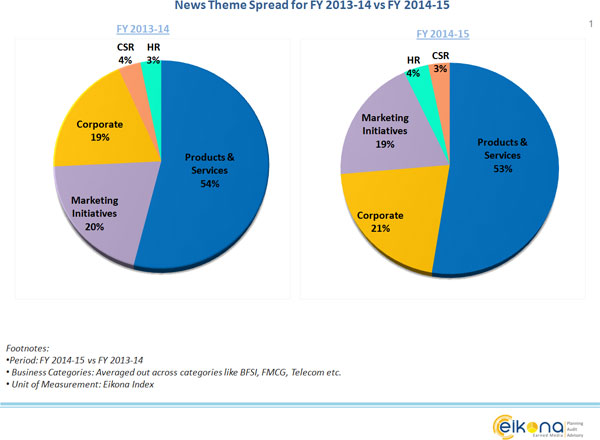
    The Eikona chart, above, gives a sense of what some of the key sectors (averaged out) like Telecom, FMCG, BFSI etc. have focused on. Have they focused on WHY ME or does it continue to be the same story of major focus largely on BUY ME? The following takeaways can be concluded upon:


    a) Things have improved, but Brand ka dil mange more: The above data sets are for the financial year 2013-14 and 2014-15. The above chart splits the total News Push or News Presence of companies across industry sectors and splits them by themes such as corporate image, human resource, marketing initiatives, product and Services etc. If you were to total up product and services and marketing initiatives-related news push, the figure is hovering around a humungous 74%. Which means that a large part of what creates and sustains a corporate brand is missing! However, a silver lining, however, is that these periods are seemingly better when compared with 2011-12 and 2012-13 (not in the chart above). They  used to smack at around 85%. Good news is that the emphasis or push on the “WHY ME” part, comprising Corporate Image, Vision and Strategy, Business Ethics, CSR, Human Resource etc., has increased/improved  as compared to 3-4 years back.


    Further, like I said before, these are averages of some key industry categories. If one were to look at individual sectors, reality in some specific sectors will be harder and much more rude. The message is clear – long-term success is all about corporate brand and not product brand alone! For this, corp Comm has to be in the driver’s seat.


    b) CXOs need to be aware of consumer’s purchase dynamics: Consumer’s purchase dynamics are no longer about Brand Track TOM scores. It is now shifting towards Disposition. It is shifting towards dynamics of strong sustained Messaging which gives away the WHY ME part loud and clear. Any product or service purchase, does’txt matter whether from B2B or B2C category, is about investigating and pivoting the purchase decision on WHY ME. Brand Track survey mechanisms will need drastic revamp. Some of the current ones are archaic and is far from taking care of BTL communication push. Also, the disposition studies will need more robustness.


    c) Why does Earned Media/PR score over Paid/Ad route?: First, the paid/ad route has long lost its credibility. Data sets like ad avoidance, falling Brand Track scores are terrific endorsers of that. Second, the Paid tool is too pricey (let me clarify – I mean money wise! Doesnot justify the ROIs). Third, Ad layout formats doesnot allow me the logistics of laying down details or even relevant snippets of WHY ME. Earned Media scores on ALL!


    d) Can it be measured?: The best part of all this is that Earned Media can be measured neutrally, holistically and continuously and be equated with Corporate and Product Brand Reputation scores.


    Call it Living Company, Loved Company, Successful Company, Lambi Race Ka Ghoda…well, it is time to change. “WHY ME” is the magic wand of long term Business Brand building. CEOs will need to take charge and make amends in the Organizational structure. Communication KRAs and KPIs will need to be recreated with & for all CXOs. Very importantly, they will need to be linked with the Business Objective!


    Siddhartha Mukherjee is a senior PR industry professional and currently Senior Vice President, Eikona – Earned Media Planning, Audit and Advisory. The views expressed here are his own.


  • Introducing a new fortnightly column on PR insights – PReamble by Siddhartha Mukherjee

    By Siddhartha Mukherjee


    Advertising is BIG in Size, even BIGGER in Stature. Tracing back many years, one will observe that towards the foundation and gradual development of our Advertising Industry, both in size and aura, the intrinsic role of Public Relations cannot be ignored.


    What has Public Relations got to do with the SIZE of the Indian Advertising Industry?

    Our Indian Advertising Industry would not have been half as rich as it is today had it not been for the Public Relations Industry’s decades of effort to get the multinationals enter the Indian economy smoothly, help them settle and start their operations. I believe that Public Relations has played a key role in transforming our India’s erstwhile Swadeshi Market to today’s India Inc. It is the Public Relations machinery that has worked tirelessly with the media and foreign Investment corridors to ensure the smooth entry of Multinational Organizations before it fell into the lap of the Advertising Industry as prospective Client Revenues.


    Why talk about Multinationals alone? Even the India-based Corporates and Organizations have made a fair use of Public Relations before jumping on the Advertising band wagon. Mergers and Acquisitions, Brand Crisis, Investor Relations/IPOs, CSR, Employee and Trade Relations, Regulatory dynamics, well, many such other dynamics were tackled through Public Relations before those Corporate and Product Brands started using the Advertising tool.


    Ask any PR/Communication professional, especially veterans, and they will have amazing facts to narrate which reiterate the role of Public Relations in creating and stabilizing a brand. PR Consultancy Heads or its Senior Management, Corporate Communication Heads, CXOs, etc., will have an amazingly rich archive of actual, real life PR Effectiveness & Success Case Studies to share – some of which that they themselves ideated or implemented. It is a different story though, that no one has bothered to document these decades of initiatives. All that was needed to be done is to approach the right Industry professionals and Thought Leaders. Case studies will come pouring from various management corridors – Corporate, Human Resource, Marketing, Finance, Manufacturing etc. Function head will have interesting anecdotes to share on how Public Relations helped them in their respective spheres whether it was Business As Usual or Business Not As Usual scenarios.  It really doesnot matter if the case study pertains to a National or Multi-national organization. The important thing here is that every industry vertical will have many case studies buried deep within the wisdom of both veterans & visionary Corporate Business Leaders and Communicators. Each of those stories will somewhere, very humbly, highlight the underlying message of how it helped contribute towards the growing revenues and size of the Advertising Industry.


    Today, if the Indian Advertising revenue size is touching close to 1% of our GDP, well, you know who or rather which Industry to acknowledge!


    How did Public Relations build Advertising Stature?

    My 10-year-old son’s school curriculum has capsules and questions on Advertising, Copy writing, Medium, Slogan etc. It made me wonder & trace back as to what could have been the trigger of all this? Why was my son not being taught about news, news writing, etc. Like advertising, why isn’t he getting the exposure to the world of Journalism as one of the facets of Public Relations?


    Advertising Industry and its Celebrities (well, names like Alyque Padamsee, Sylvester da Cunha, Prem Mehta, Piyush Pandey, Prasoon Joshi, Balki, Vikram Sakhuja, Sam Balsara, Shashi Sinha,…well, it is a long list) have become household names. Parents of employees working in the Industry, their friends and family, social ecosystem, clients, have all acknowledged the  Advertising Industry as a respectable employer, a brand partner and sustainers of brands.


    Well, mind you, this did not happen overnight. This has happened after years of regular use of PR of the Advertising Industry and its Industry Captains.


    Day on day, week on week, Advertising Industry’s credentials, its achievements, plans and yes of course, the Celebrity quotient have an had ominous presence in Newspapers, TV News Channels and Online Networks.


    No wonder then, most of the Management Institutes still continue to believe that when it comes to preparing or revising their marketing course curriculum, Advertising is the nucleus of Brand Communications and Management.


    If anyone doubts on the scientific impact of PR, well, the example is live and all around us. It is one of the best examples to give to establish that PR works, it moves the cheese and how!


    Hopefully! one day, in a similar fashion, PR will have a lot do with PR!


    Siddhartha Mukherjee is a senior PR industry professional and currently Senior Vice President, Eikona – Earned Media Planning, Audit and Advisory. The views expressed here are his own.


  • Cadbury turns focus to ‘glow moments’ in life with new product launch

    By A Correspondent


    Mondelez India Foods has announced the launch of its luxury chocolate gift offering Cadbury Glow. Cadbury Glow is the new luxury gifting brand from MondelÄ“z International and is being introduced for the first time in India. To support the launch, the company has introduced a new television commercial. The TVC, through its unique storyline, strives to convey the brand promise of creating ‘glow moments’ – acts of thoughtfulness and imagination which show those who matter to you that they really do.


    The TVC created by Ogilvy & Mather opens with the scene of a young couple stuck mid-air on a Ferris wheel during their date. While the wife is enamored by the beautiful night sky filled with stars, the husband seems irritated with this idea. The wife then surprises him with a pack of the new Cadbury Glow, whilst wishing him a happy anniversary. The husband opens the pack of Cadbury Glow revealing the treasure box-like pack to viewers. As the couple enjoys the rich taste of the pralines under the starlit sky, the wife urges him to wave a scarf. As the Ferris wheel suddenly starts moving, the husband realizes how his wife had planned their ‘glow’ moment under the stars. The TVC features celebrities Rajkummar Rao & Aditi Rao Hydari as husband and wife.


    Speaking on the launch of the new Cadbury Glow campaign, Siddhartha Mukherjee, Director, Chocolate Category & Media, MondelÄ“z India Foods Limited, said, “Cadbury Glow is an all-year round luxury gifting praline inspired by insight that ‘there is no greater joy than seeing your loved one’s glow when they receive a gift’. The TVC beautifully captures this emotion – as Cadbury Glow along with the thoughtfulness of the wife, creates a moment which the husband cherishes and which brings a warm glow on his face.”


    Cadbury Glow is aimed at those who look for a finer, holistic gifting experience and truly cherish the same. The pralines which are specially crafted in Europe are filled with little details that are symbolic of the care that went into creating it. The Cadbury Glow gift boxes are available across metros in pack sizes of 16 pieces (160 g) for INR 400 and 24 pieces (240 g) for INR 600.


  • Cadbury emphasizes on ‘eat state’ with new 5Star variant

    By a correspondent


    Cadbury India, part of Mondelez International, has unveiled a new TVC to announce the launch of Cadbury 5Star Chomp. A new entrant under the Cadbury 5Star umbrella, Cadbury 5Star Chomp will offer consumers an irresistible combination of chocolate, caramel and nougat of Cadbury 5Star, along with the crunchiness of peanuts.


    Targeted at chocolate-loving enthusiasts across the country, Cadbury 5Star Chomp’s new campaign emphasises on the ‘eat state’ as its core message. The campaign is designed to encourage consumers to enjoy the caramel, chocolate, nougat and peanut bar with inhibited gusto. The TVC seeks to celebrate the manner of consumption of the product and give the consumer a very engrossing eat experience.


    Speaking on the launch of Cadbury 5Star Chomp, Siddhartha Mukherjee, Director – Chocolate Category & Media, Cadbury India, said, “As category leaders we see a market making opportunity with Cadbury 5Star Chomp. The product has been developed keeping in mind the evolving consumer palette. Cadbury 5Star Chomp will introduce consumers to a completely new eat experience. Moreover, this launch is an important milestone in the journey of Cadbury 5Star and is expected to widen the brand’s play in the category. We therefore see the launch of Cadbury 5Star Chomp expanding the repertoire of Cadbury 5Star.”


    Conceptualized by Ogilvy & Mather, the 42 second commercial is a conversation between a human and a ghost to highlight the heavy engrossing eat. The high-voltage launch rolls out across the country, through a combination of commercials across TV, digital and social media platforms to drive awareness and encourage consumers to bite into the goodness of Cadbury 5Star Chomp.


  • Say Cheers! Madison predicts 16.8% adspend growth in 2014


    By Johnson Napier


    With so much being reported and analysed about how the oncoming Lok Sabha elections would benefit or harm the prospects of the economy, there is one section of the trade for whom the election year indeed holds good stead. Going by the growth projections that the election season are expected to bring in 2014, the media advertising business in India is in for a big surprise if numbers revealed in a recent report are anything to go by.


    According to growth projections released by the Pitch Madison Media Advertising Outlook 2014 report in Mumbai yesterday, the advertising revenues are expected to grow by a robust 16.8 per cent in 2014 at Rs 37,216 crores. This is a sharp rise from the healthy 11.1 per cent that was reported by the industry in 2013. In fact the growth in 2013 is much more then the benchmarked figure of 7.4 per cent that was initially predicted by the report.


    Presenting the numbers to the fraternity in Mumbai, Sam Balsara, Chairman and Managing Director, of leading media services conglomerate Madison World said that the time to be cautious – which was the state that the industry was in for much of 2013 – was almost over and that the year ahead would be even more fulfilling with growth projected in the range of 16.8 per cent.  The report was presented by Madison World in conjunction with the exchange4media group’s Pitch magazine.


    “It is great to be clocking a growth rate in double digits, which has come as a boon to the industry that was stuck in clouds of uncertainty given the economic downturn that was witnessed for much of last year,” affirmed Mr Balsara. “Compared to 2012 that registered revenues to the tune of Rs 28,694 crore, the year 2013 reported numbers equalling Rs 31,877 crore, growing by 11.1 per cent. In fact 2014 would outperform the previous year and would register an estimated growth of 16.8 per cent, with revenues totalling Rs 37,216 crore,” said Mr Balsara, beaming.


    According to Mr Balsara, the core factor that would bring in the growth for the industry would be the Lok Sabha and the state Assembly elections scheduled for 2014. This would also include spendings by individual political candidates that would be investing money in reaching out to the masses.


    Presenting a medium-wise break-up to the gathering, Mr Balsara said that like last year, this year too belonged to Print that emerged as the numero uno medium. Advertisers took a liking to the medium as it reported a growth of 10 per cent with revenues equalling Rs 13,167 crore. This was largely due to increased advertising by sectors such as FMCG that contributed by 12.3 per cent to the overall ad pie (replacing Auto from the top spot) and Auto that contributed around 11.7 per cent. Education though saw a decline to 9.71 per cent versus 10.6 per cent share registered last year.


    When asked by MxMIndia to share his observations on the projections for the medium of Print, Varghese Chandy, Chief General Manager, Marketing, Advertising Sales, Malayala Manorama said that the growth was indeed a bullish one for the sector. “I am excited by the numbers that we have managed to throw up as a medium. The fact that we have still got the advertisers attention by being the number one medium of choice is a big thing.” Sharing further on what will drive the sector in 2014, he said that the Lok Sabha elections and the assembly elections that will take place in 2014 will bring in the necessary revenue growth that the medium is known for. But he had a word of caution for the magazine sector as he said that it would still be a task for magazines to contribute as much growth as newspapers too. “While niche and regional magazines will continue to deliver good growth, overall the magazine industry will still be challenged on the growth front.”


    Following the medium print closely was Television that recorded a growth of 8.2 per cent with revenues totalling Rs 12,410 crores. This was in sharp contrast to 2012 where the medium registered a zero per cent growth. Where sectoral contribution was concerned, Media, Retail, Alcoholic Beverages and Corporates registered a negative growth with only FMCG registering a positive growth for the medium. The medium is further expected to grow by 15 per cent in 2014.


    The next medium to vow the advertisers was Digital that has now become the third-most preferred medium for advertisers on a consistent basis. With revenues totalling Rs 3,050 crore the medium grew by a good 32.4 per cent and is expected to grow by 29.5 per cent in 2014 as well. Of this, display advertising will continue to have an upper hand compared to search with revenue numbers totalling to Rs 2,150 crore.


    Siddhartha Mukherjee, Category Director, Chocolate and Media, Cadbury India, Mondelez International was optimistic of the returns that the medium would deliver in 2014. Affirming to this writer, he said, “Going by the projections that were presented today and by the points bought up by panellists, there is no doubt that digital will continue to remain a go-to medium for many advertisers. That is what would be of importance to us too.”


    The mediums of Radio, Outdoor and Cinema combined accounted for the remainder 12-13 per cent of the ad chart with Radio accounting for revenues totalling Rs 1,097 crore (18 per cent growth), Outdoor clocking a growth of 6.2 per cent at Rs 1,977 crore and Cinema registering a growth of 10.4 per cent at Rs 167 crore.


    The evening also witnessed keynote addresses being delivered by dignitaries including Adi Godrej, Chairman of the Godrej Group, Uday Shankar, CEO of Star India, and Girish Agarwal, Director, Dainik Bhaskar Group who presented a roadmap that the industry could adopt to change their business fortunes and also derive positive growth for the several mediums under Media.