Tag: Shri Bimal Julka

  • #FF14 Day 1: Frames takes transformational route in 15th year


    By a correspondent


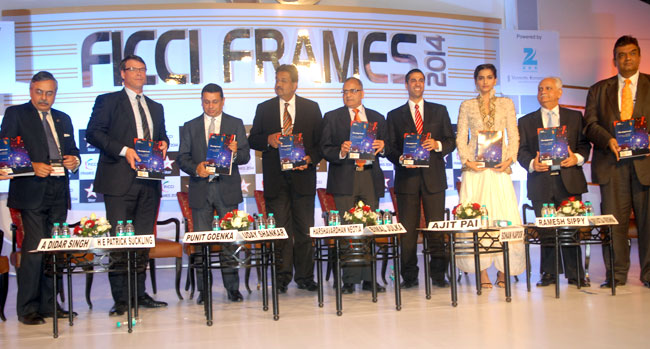
    The 15th edition of the much anticipated annual event of the Media & Entertainment industry – FICCI Frames 2014, got off to a captivating start in Mumbai on March 12, 2014. The event began with an inaugural session that saw the big guns from the media and allied sectors including the I&B Ministry delve on the theme of the conclave – Transforming Lives – while also highlighting the current state of the M&E sector and its scope for the future.


    The lineup of the dignitaries for the inaugural session included Harshavardhan Neotia, Vice President, FICCI; Uday Shankar, Chairman, FICCI Media and Entertainment Committee, and CEO, Star India; Punit Goenka, CEO & MD, Zee Entertainment Enterprises Ltd; Shri Bimal Julka, Secretary, Ministry of Information & Broadcasting, Government of India; Shri Srivatsa Krishna, Secretary, Department of IT, BT & ST, Government of Karnataka; H.E. Patrick Suckling, Australian High Commissioner to India and Ajit Pai, Commissioner, FCC, USA.


    Highlighting the state of the M&E industry in 2013, Uday Shankar said that while there was much talk about doom and gloom in the economy it was not the case for the M&E industry that grew by almost 12 per cent. But he cautioned that the goal of attaining the $100 billion landmark was a distant dream as yet. Mr Uday went on to highlight the role that the government could essay in simplifying several issues facing the industry and how it could work in tandem with the industry in resolving them.


    Echoing a similar point of view, ZEEL’s Punit Goenka too laid the pitch for a collaborative effort as he said that the M&E sector has played a key role in enhancing the prospects of the economy, especially on the jobs front. “The M&E industry has been a shining example of how an industry could work towards achieving a common goal of inclusive growth and being a facilitator to all concerned. It is a matter of pride for the sector to be employing more than 6 million people with the scope of providing employment to many more in time to come.”


    Mr. Goenka further highlighted the role that digitization has played in the year gone by, and how it would alter the broadcast landscape in the future. He affirmed to the audience that it was time to give back to the industry for whatever it has given us and that the same should be done by unleashing innovation and creativity as the core. In fact the collective aim should be to transform the lives of the global community and not just India, asserted Goenka.


    Having been introduced to the various loopholes and issues facing the industry at the introductory session, Shri Bimal Julka, Secretary, Ministry of Information & Broadcasting was vocal when he said that it was not just the government but the industry that should take responsibility in finding a solution to the problems at hand. “The role of the government is that of a facilitator, it would be great if the industry takes a collective stand on issues themselves and come to us if at all they face any hurdles.”


    Highlighting the several initiatives undertaken by the I&B ministry, Mr Julka said that the first two phases of digitization have met with reasonable success in about 42 cities and it could be credited as being the smoothest and fastest such initiative of its kind. The focus now would be on Phase 3 & 4 of the drive where an additional 110 million STBs are scheduled to be rolled out. “While there are a few issues concerning the digitization exercise, we are taking efforts to sort them out including at the level of broadcasters, MSOs, LCOs etc. But the good thing is that digitization has managed to bring in transparency in the broadcast sector, which was the main goal of the whole exercise.”


    Mr Julka said that the I&B ministry was also concerned about the content that was being shown to the viewers and urged the broadcasters to practice self-regulation. With 800 channels already existing and a further 250 plus awaiting clearances, it was important for broadcast companies to figure out how to dish out content that is accepted by the viewer.


    Mr Julka also touched upon the challenges facing the industry including control on monopoly & cross-media ownership, content monitoring, transponder capacity problem facing DTH players etc.


    The session proceeded to an engaging perspective on the US broadcast market that was provided by Ajit Pai, Commissioner, FCC, USA and also a keynote address by Shri Srivatsa Krishna, Secretary, Department of IT, BT & ST, Government of Karnataka.


  • Corporate ownership of media is an inescapable reality as is surrogate political ownership: Manish Tewari

    (Text has been edited for style at some places. Some bold formatting and capitalizing of text has been retained)


    Honourable Vice President of India Hamid Ansari Sahib, Chairperson of the Press Council of India Justice Katju, Secretary I&B Shri Bimal Julka, Ladies and Gentleman.


    Allow me to commence by congratulating the Media fraternity on this auspicious occasion. The National Press Day always provides a unique opportunity to reflect on the state and the role of media in the current milieu.


    In the last two decades the media landscape has undergone an exponential transformation. This epochal change has been facilitated by the emergence of the World Wide Web. Starting life in the Defense Advanced Projects Laboratory of the Pentagon it has truly revolutionized the way we live and conduct our interactions.


    As I have stated on numerous earlier occasions:

    a) The internet is the largest experiment involving anarchy in history-and it has succeeded. (The last four words are mine).

    b) It represents the largest ungoverned space on planet earth.

    c) Never before in history have so many people from so many places had so much power on their fingertips.

    d) Every two days more digital content is created than from the dawn of civilization until 2003.

    e) What is evolving is a tale of two civilizations; one physical that has evolved over the millennia and one virtual that is still very much in formation.

    f) The New Media rides on the back of this World Wide Web.


    What still has not been analyzed in depth and detail is-how this democratization of news creation, aggregation and dissemination a bottoms up process – sans editorialization is impacting both print and broadcasting newsrooms in addition to transforming the contours of the media space.


    There are some other pertinent questions that the first generation of the digital age should address with some measure of dispatch to ensure that the process of defining agreed global rules of engagement commences in right earnest in the virtual civilization, for example – at what point does a personal “tweet” essentially a digital freedom of expression – turn into a “mass broadcast” – a telecommunications business, in effect one that has to be held to certain standards of accountability?


    Allow me to turn to the other hard question of our times and the subject of our deliberations today, i.e. media and public interest.


    Public interest has but myriad subjective connotations. It can and may mean various things to various people but what public interest certainly cannot mean is the promotion propagation and proclamation of private Interest in any area of human endeavor.


    Speaking in the Rajya Sabha in 1974, Late Shri R K Mishra an eminent journalist himself, made an incisive though a very blunt and some may term even a provocative observation about the Media and Private interest. An articulation that raises hackles in certain very influential quarters in our country whenever it is reiterated. He stated and with your permission quote;


    Now where is the freedom of the Press? What do we have? In India we have the freedom of the newspaper owner; In India we have the freedom of the newspaper proprietor and in some cases the delegated freedom which is enjoyed by the newspaper managers ……and the working journalists will continue to be paid employees doing whatever the newspaper proprietor wants him to do.”


    Pungent but profound words that have proven to be almost prophetic in their import. Though obviously this adage does not have universal application even in the Indian context but a few would seriously contest that selectively it is a non-sequitur. Rather than react with the usual display of indignation perhaps the media industry would be better served if stakeholders were to calmly and dispassionately consider evolving the means and measures of putting Chinese walls cast in concrete between commercial considerations and editorial autonomy. Recently in influential publications very eminent editors have voluntarily relinquished their managerial responsibilities. This is indeed laudable and an example that inspires emulation by one and all.


    On the occasion of the National Press Day we must rededicate ourselves to the cause of empowering the working journalist as well as creating the necessary wherewithal that supports truly Independent Media initiatives.

    Corporate ownership of the Media is an inescapable reality as is surrogate political ownership as well as government ownership in the public broadcaster format. While one can possibly argue about the pros and cons of each of these paradigms but life is circumscribed by the given reality and not the utopia of Shangri-las. The moot point being that there are diverse interests always at play in the media space. The challenge therefore is to always try and find the elusive golden mean so that Public Interest does not become a permanent casualty at the altar of competing and contradictory private interests. In the UK this dilemma was articulated cogently in 1995 by the then Conservative government’s White Paper on media ownership: The paper stated and I quote-


    A free and diverse media are an indispensable part of the democratic process. They provide the multiplicity of voices and opinions that informs the public, influences opinion, and engenders political debate. They promote the culture of dissent which any healthy democracy must have…. If one voice becomes too powerful, this process is placed in jeopardy and democracy is damaged.”

    That is perhaps why post The Lord Leveson enquiry the British government with broad Multi Partisan support promulgated the Royal Charter on Media Regulation recently despite opposition by powerful interests in the British Media Industry. Unfortunately this development has not found resonance in the otherwise vacuous realm of public polemics in our country.


    In both the Indian and even the global context certain structural paradoxes have emerged which require the focus of concerned, conscientious and committed stakeholders of the public discourse.


    THESE ARE:

    (a) PARADOX OF THE SHORT FUSE-INCREASED INFORMATION DISSEMINATION MECHANISMS QUA INCREASED INTOLERANCE OF THE OTHERS POINT OF VIEW.

    (b) PARADOX OF FLAWED REVENUE MODELS QUA QUESTIONABLE REVENUE GENERATION PRACTICES

    (c) PARADOX OF TRPsS QUA THE TRUTH

    (d) SENSATIONAL MEDIA TRIALS QUA A FAIR JUDICIAL TRAIL GUARANTEED BY ARTICLE 21 OF THE CONSTITUTION.

    (e) ANONYMITY MASQUERADING AS PRIVACY IN THE NEW MEDIA SPACE-THE SPECTRE OF THE ‘HIDDEN’ PEOPLE AND THE DARK NET.

    (f) NON EMERGENCE OF GLOBAL RULES OF ENGAGEMENT IN THE VIRTUAL CIVILIZATION.

    (g) LAST MILE NEUTRALITY AMONG CARRIGE PROVIDERS SO THAT CONTENT PROVIDERS GET A LEVEL PLAYING FIELD AND ARE ABLE TO REAP THE BENEFITS OF CONVERGENCE.

    AND THE QUINTESSENTIAL DILEMMA

    (h) SELF-REGULATION QUA A STATUTORY REMIT.


    If I were to liberate my thoughts from the seemingly vexed issues that bedevil the media remit and ask a very simple question as to what is the Fundamental Public Interest of our times? The answer can perhaps be articulated in one simple sentence- upholding the constitutional values which define the very idea of India. As we go about our everyday chores dark clouds of fascism loom ominously over the horizon- a great evil stalks our land. The first casualty of this specter would be the constriction of liberal spaces, curtailment of creativity and circumscribing the right to challenge the conventional and think off the beaten path. If the alleged expose about state sponsored stalking is correct I would be worried not as a woman but as a civil libertarian about the Orwellian state that some “esteemed” gentleman seek to construct.


    William Shakespeare in his epic Julius Caesar wrote

    “There is a tide in the affairs of men

    Which taken at the flood leads to fortune
    Omitted, all the voyage of their life
    Is bound in shallows and in Miseries
    On such a full sea are we now afloat
    And we must take the current when it serves
    Or lose our ventures.”


    History bears testimony to the harsh reality that evil has always triumphed when good men have chosen to keep quiet and do nothing. When the immediate has taken precedence over imperative! When like Lord Neville Chamberlain we have been naive enough to believe that compromising with the forces of fascism, right reaction and national subversion can buy us the peace of our times.


    At such a crossroads ladies and gentlemen do we today stand!