 By Shishir Joshi
This is not in defence of the media. As you read along, you may realize it. In fact, it is quite to the contrary.
Foremost, let me lay down some of the allegations against the media and some of the prevailing perceptions;
That the media is a king-maker. That it is corrupt. That it is far away from the realities impacting the society. And that it thrives on sensationalism.
Partly, it is the media, itself, which is to blame. For the corruption. (Bhrasht-aachar; read, corrupt behaviour.) And for the perception.
Let’s start with the most recent one. Media as the king-maker. Allegations which have shattered the holier than thou image. And as eminent journalist Arun Shourie put it in a TV show, “Time and again instances have come up where journalists themselves have been responsible for the betrayal.â€
Many, largely unrelated to media, strongly believe media is corrupt. Unfortunately, what they mean by ‘Media’, could really be a handful, but, those who get branded, are just any and everyone who is associated with ‘media’.
So, to begin with, here’s a dekko to clarify some prevailing misconceptions.
Very few people really know and understand how a news organization operates. In the fifty-odd people who work, in what is seen by the outside world as the ‘powerful’ editorial of any news organization, a little less than half, say twenty or so, are what everyone knows as Reporters (working Journalists in the real sense).
They are the ones who have a contact with the ‘outside’ world. Or, that, the outside world really knows about. (The other non-reporter face known to the high and mighty could be the editor, but, increasingly, it is the CEO or the Marketing /sales head who is a far more ‘popular’ face.
Within those twenty reporters, barely four or five such Journalists deal/interact with those in High places; by this, I mean, with Political heavyweights (by Reporters covering the political beat) film stars (mind you, not any film start, but only the big five of Hindi cinema) and Sports, again, here not just any sport or any sports heavyweight, but Cricket an d the mighty Sachin, no less.
So now, of an approximate 50 odd, we have come down to the top five in any Editorial, who have the opportunity to rub shoulders with the Rajas (not to be mistaken with Spectrum Raja. And within that, on a rare occasion will one odd Journalist really mis-use his seat or position.
All this also depends on the reach and impact that the Media house commands, in circulation or readership. (NDTV among policy makers and Hindustan Times in Delhi do count for being heavy weights…umm… what a coincidence). Needless to say, a fancy designation helps.
So if a Managing Editor of one among many many many media organizations is found to step into grey area or is caught on tape, mediating or promising solutions, this could be just ONE he or she caught in the act isn’t it? Is it then fair to brand all of media as corrupt?
It may be unfair. But the guilty, is the media itself. And some of these journos in power. And the perception that they have created.
How often have we seen PRESS stickers adorning two wheelers and cars of media persons. Any self respecting journalist who holds a valid identity card from his organization will tell you that these stickers are not required. Not required unless you are using them to ensure the traffic cop does not stop you.
Maybe those using these stickers do not know this, but the ‘public’ and the traffic police surely believe this is the reason.
To say press stickers are by themselves to blame, would be highly unfair.
We also have a mushrooming number of ‘king-maker’ journalists. Who throw names, host parties and ensure that the bigwigs attend their private dos.
Rarely does the ‘King’ , either a big-ticket politician or a film star, not oblige. Graciously, he ensures that the journalist is addressed by his first name, and a few back slaps later, the powerful man is back in his den.
Only a handful would cringe at the thought of a powerful and popular name walk into your living room and back-slap you, chat up your family and share a chai with you. What the action leaves behind is you, the journo beaming from ear to ear, like a fat cat having stolen a bowlful of cream, with the rest of your family, friends and neighbours in a daze.
Mind you, there is nothing wrong in the high and mighty visiting you.
But, where the hacks go wrong, is when they start believing that powerful are in love with you the person and not you the Journalist. I promise you, it can’t be further away from the truth, in most cases.
And as you bathe in the halo of the big one calling you by your first name and your family and some friends gazing at you with renewed affection and respect, you fail to see the rest of the neighborhood, who see you as an ass-licker. That is perception, as it gets created.
You, in fact are an ass with a big bloated ego, refusing to see the writing on the wall. “You are so dear to me,†says the politician and you glean with pride. What you don’t read between that line is he muttering under his breath that “I accept you only with your designation and organization.â€
The power of a journalist, in today’s age (unless his good deeds speak volumes) is like the hair on the head, the tooth in your gums and the nail on your fingers. It is valued only when it is in its place. Worthless when chopped.
There was a time when Journalists wielded the power of the pen. The power, by what they wrote. Based on facts and fair play. That was power. Real power laced with absolute respect.
Today, the power has corrupted. Absolute power (based on a belief that he is the king maker) has corrupted absolutely.
The far and few, but absolutely corrupt journalist is powerful not by what he is capable of writing, but his ability to WITHHOLD information. The power to conceal a story, often at the cost of a favour, or as seems in the case of the Radia tapes, through an alleged TRADE-OFF makes the corrupt journalist in the lot nothing less than a white-collared extortionist.
But you hate them, you call them names and yet, you do not speak out against them. What is it that scares people when it comes to speaking up? Or speaking out? Unless it is in hushed tones? Politicians have been hurling abuses at each other, taking names, in the spectrum scam. But no one has dared name the journalist(s) or media houses at all. Only after social media (and later a few magazines) began talking about it, have names begun cropping up. The role of the journalists is beginning to get scrutinized.
While social media has been active in this case, mainstream media has been largely mute. Be kind to thy comrades for they may one day come and lord over us. Is that the reason why?
But what stops the rest of the world from talking about these names in public? Two reasonings come to my mind.
One, Industry captains do not wish to rub India’s much watched English channel(s) and powerful newspapers the wrong way. “I am seen on it, quoted by them and would continue wanting to be seen there†is what they believe. Any rubbishing of the network, or its key stake holders would mean, being blacked out.
The second, and more real fear is of an unwarranted backlash. I call it the Dolly Bindra effect. Nobody wants to rub Media big-wigs the wrong way. However wrong they may be. They may be paper tigers, but tigers no doubt. Their byte is more poisonous than the (non existent) bite. They have a habit of bouncing back and, like the boxing cushion, slamming right into your nose.
So, however much you dislike them, hate their guts, have evidence of their alleged wrongs or have taped conversations of political coziness, you would rather shut up and lead your life.
After all, we all know what happened to Shweta Tiwari and Samir Soni on BiGG Boss season four when they took on Dolly Bindra, right? Shweta was stung in the face, Samir was ousted. And the one who got maximum press, was Dolly, who returned to the BiGG BOSS house with a bang.
PS: Remaining quiet has never been a solution. Mute spectators to a crime too, are as much guilty as those perpetrating the crime.
It is time you speak up against those, whom you believe are corrupt under the garb of being honest. It is important too. For others, Citizen Journalism, or social media, is a solution.
For, isn’t it a commoner like you and me who exposed the Adarsh scam or the CWG or the initial lid of the various scams in recent times?
Shishir Joshi is the co-founder of Journalism Mentor, and till recently was the Group Editorial Director of the Mid-Day group of publications.
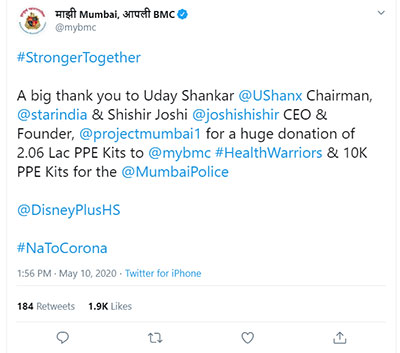 In an effort to support the Covid-19 outbreak response, Star India and Disney+ Hotstar have partnered with the former journalist Shishir Joshi-spearheaded Project Mumbai to provide over 200,000 Personal Protection Equipment (PPE) kits to health workers at BMC and an additional 10,000 khakhi-coloured kits for the Mumbai Police.