Tag: Shashidhar Nanjundaiah

  • Shashidhar Nanjundaiah: The Real Year of Fakeness

    By Shashidhar Nanjundaiah


    The usual reviews of the Hindi OTT show Criminal Justice: Behind Closed Doors were relatively tepid. Relative to my own expectations, and relative to what should have been. “Not a great show, but an efficient one” (what on earth is an efficient show?), “Laboured narration dilutes a relevant story”, “Relevant but flawed” are some headlines or introductions to the show. In my humble opinion, they’re all missing the pie while looking for crumbs.


    Criminal Justice is multifaceted. Its focus is on how it is the victim who feels shame at being wronged. But it is equally about how we live a “media life” and how it of course breaks traditional societies by disrupting the very factor that binds them. Our society seems finally “woke” enough to be willing to accept critiques of gender injustice—thanks to mediated campaigns and the social media where we must put on our best behaviour while calling out others’ worst.


    BJP’s youth leader Abhimanyu Tripathi is now even more famous. He posted on Twitter an image that went viral, with the text: “And then Nazeer Mohd became a Sikh farmer by wearing a turban. The truth is that this is not a farmer’s movement, but Khal’ist’ani propaganda? These are the people who were also involved in anti-CAA Protests and Shaheen Bagh.”


    Because Khalistan is allegedly a Pakistan-sponsored demand, its false equivalence with a Muslim man made perfect sense to the senseless. The usual online media portals conducted fact-checks and, unsurprisingly, found the claim to be false. But the damage, as always, was done. Who followed up with Nazeer to find out how fake news affected him? How is he doing?


    Media Life is a term powerfully used by Mark Deuze, author of a book by the same title. That description should fit Criminal Justice like a glove. Deuze says (and names a chapter) “We’re all f***g zombies!” In the show, the characters could have chosen to be the zombies that Deuze describes us as-dangerously tacit, damagingly pliable. But it’s a show, and they are not. They take action, counter the perception war through counter-perception, and hope to win the war.


    That’s not reality. Media life has enveloped our tacit, pliable, (because) voyeuristic side, because it has worked to everybody’s advantage. Who doesn’t like a bit of gossip about a target?


    Especially when you don’t know the person, so you can target them away without guilt or carefulness?


    Especially in a year when OTT fiction protagonists (Shrikant Bashir) identify their Muslim partner as miyan perhaps in an attempt to mimic the Prime Minister, and shame their religious practice?


    Especially in a year when our so-called news channels identify their prey (Rhea Chakraborty) and go after her with full force, and when the police find her innocent, discredit the cops?


    Especially in a year when our government and its agencies used the media to politicise the pandemic and emphasise the recovery rate rather the death rate, to spread superstition, and to turn people’s distress into their opportunity? (In May, a health briefing by ministry spokesperson Rajesh Bhushan said, “The biggest news this week is that India has tested two crore tests.”)


    Every such phenomenon goes through a cycle. The cycle of misinformation through leaflets and the propaganda machinery in the 1910s soon lost out, as people understood the ploy. The fake anti-intellectualism in the 1950s in the United States, too, lost the battle out in a couple of years.


    Lost to media literacy, of all things.


    Earlier instances of how misinformation caused damage to societies were at least somewhat localised, albeit with global impacts. This time around, though, the phenomenon itself is global, with local interpretations, and seemingly never-ending.


    A phenomenon with such a massive and widespread torque will continue on its journey for a while. Optimists including this writer have seen the phenomenon as temporary. Inadvertently or deliberately, we have fuelled and perpetuated the cycle of disinformation and misinformation. In conventional definitions, those two terms are distinguished thus: the first is supposedly less deliberate that the second, but after long and grave thought, I’ve decided those terms are not all that different, after all. Think of the effects—they are equally devastating.


    There are perceptible isobars between societies—new forms of expression of communal hatred are running rife in India, Europe, and North America, for example. Yet the expressions may be different. For example, they gave up lynching a while ago elsewhere—we’re just picking it up.


    In its organic ways, media literacy is in perpetual motion. Individuals and societies (and I recognise that those would be variables in two different academic research topics) are constantly learning, and media-learning is no different. That is a combination of learning from the media and learning about the media. What the media tells us is our first form of absorption. Our understanding of what goes behind is the next, deeper level of our involvement with the media—who the sources are, what the modes of production are, and why no truth is objective.


    Even so, it seems our learning curve around fake news, misinformation, disinformation, and what WHO called “infodemic” has not been steep, because we seem to have lost the inclination to learn. Like Instagram photos, in 2020, we seemed to be happy ensconced in our fake media life. To paraphrase Martin Broadwell’s terms, there is unconscious ignorance, conscious ignorance, conscious awareness, and unconscious awareness. I argue that unconscious awareness can be the most insidious.


    Above all, behind literacy lies the will to learn. Let us hope 2021 sees an uptick in the learning curve. Happy New Year to my two (or was it three?) readers, and to everybody else who didn’t read this.


    As the founder of BeingResponsible, Shashidhar Nanjundaiah author is attempting to build media awareness among school- and college-goers via Responsible Media Literacy. Prof Nanjundaiah has led media institutes to positions of repute and leadership. And, yes, he’s an editor. You can reach him at shashi.nanjundaiah@hotmail.com.

  • Shashidhar Nanjundaiah: Objective and balanced-not!

    By Shashidhar Nanjundaiah


    Last week, I was chatting with a friend who owns a modest but surprisingly well-funded group of publications with a social-right slant. Pardon this compulsive hyphenation. I have started using economic-right and social-right because too many jargony terms are thrown around these days, and they all either overlap or confuse. To me, a social-right indicates a relativistic campaign for a community, that is, a campaign that sees a community as pitted against another.


    An interesting point my friend brought to the table was the idea that objectivity is often mistaken by many editors for balance, but in reality, they are different. One distinction could be that objectivity is all about sticking to the observable facts without bias, while balance is to fairly provide all sides an equal value without bias.


    That means you can be objective, provide all facts, and still be biased, because you set an agenda to tell the whole truth that lies on one side of the fence. That should be fair if you define your readership well. Political parties bring out their house publications with that agenda. But if someone claims balance, it sets off alarm bells in my mind.


    Reporter bias is not only allowed by good editors, it is often encouraged. While covering an alleged gangrape in Boolgarhi, Hathras, reporters led the campaign, convinced by what they saw and heard around them—take or leave any possible, institutional agenda to comment on the state’s political supremo. Reportage often includes voices from both sides (at least once a story has developed enough), gladly lapping up available sources.


    On the other side, the current government has set the agenda for the nation through mediated messages not so much by armtwisting as by simply making a welter of stories available to the media, ready, formatted, and ripe for picking. 


    Balance needs replacing. The concept of balance needs to be replaced in the media, and in much of the practice, it has been replaced. In the absence of something that is readily available waiting to be adopted, it has been often replaced by campaigns and representation, replete with nudges bordering on social engineering.


    But shouldn’t we fight and strive for objectivity and more importantly, for balance?


    No sirreebob. Why? Because like objectivity, there is no limit to balance—you can never bring enough stories of all hues to constitute ideal balance. Both Doordarshan and Republic TV can rightly claim to be objective. Doordarshan and NDTV would probably claim balance, but is often called out for that supposed claim as hypocritical (although I am not sure I see that claim in as many words–being the media, they have a way with nuanced wording!). My point about the hypocrisy of balance is that it is often a cognitive illusion whose realisation needs someone else to call it out–some externalisation, if you will.


    Audiences are ever-evolving as media literates, but often they are only catching up with technology. In India, channels’ new claim to represent their audience seeks, speciously, to situate media platform in the comfort zone of yay-sayers and fan clubs. It eliminates the naysayers, dividing the audiences not on traditional lines of age, gender, income levels, geography and psychographics, but on the lines of partisanship.


    For that kind of strategy, as an audience, I prefer the messaging in uncensored fiction—or dramatised—shows on OTT like Undekhi or Aashram. Wrapped in the rapture of a thriller, the messages are nevertheless unmistakable. But when the message is sponsored, it looks forced. That is the case both with some forgettable films post-2014—and with today’s television news.


    I also see the so-called hypocrisy as a brave, quaint and naive effort. The concept of “news story” has changed with live coverage and live reportage. But this gravitation in this decade towards providing limited sides and versions of news is interesting. The same editorial discretion that media has always used to justify the selective pickings is now more out in the open. So as news media matures (if we can call it that), the ambiguity that the right-wing calls hypocrisy is also morphing.


    Post-maturity. Tomorrow’s post-mature (like postmodern, get it?) media organisations will recognise the need—demand, for those who understand the word—for eclectic views. In an age of channel-surfing, surfing is the democratic choice, not balance. I call organisations mature in the sense that they have evolved with trends. The hope is that in the end, the perspectives somehow arithmetically cancel themselves out, resulting in this zero-value of objectivity.


    Doesn’t that sound almost silly because there is no way arithmetic could solve that problem, so to speak? The next intellectualised demand could be the right not to surf—the demand of an algorithmic generation that may be more accustomed to staying put while stuff comes to them. One English-language channel employs anchors with different and well-known partisan dispositions. (The Hindi channel doesn’t offer quite the same luxury of choice,) That’s perhaps the most fair we can get within the matrix of “modern” news media.


    The concept of balance is as unrealistic as the concept of objectivity. But while objectivity has long been challenged by the postmodernists, the concept of balance continues to brazen it out.


    As the founder of BeingResponsible, Shashidhar Nanjundaiahis attempting to build media awareness among school- and college-goers via Responsible Media Literacy. Prof Nanjundaiah has led media institutes to positions of repute and leadership. And fair disclosure—he’s been an editor. You can reach him at shashi.nanjundaiah@hotmail.com.

  • Shashidhar Nanjundaiah: Sudden Impact & Small Nudges

    [We incorrectly published an earlier column by Prof Nanjundaiah… apologies – Ed]


    By Shashidhar Nanjundaiah


    Amidst the din and excitement of US election last week, most of us missed out on Philanise White and Theresa Raborn, two Republican candidates from the Midwestern state of Illinois for the 1st and 2nd Congressional District. These women were never going to win, given they were contesting two incumbents in the largely African-American neighbourhoods of southside Chicago.


    White and Raborn are conspiracy theorists, and that is what sets this little-reported news story apart. They are both followers of QAnon, a bizarre-sounding theory that could be unsettling to many faithful believers in innate goodness of American values. As many of us may be aware, QAnon is a conspiracy theory whose followers believe that Washington is infiltrated by members of a “deep state” and that Trump is waging a secret battle against Satan-worshipping paedophiles who run a global child sex-trafficking ring.


    But in contrast to the two Democrats’ easy win in southside Chicago is the opposite phenomenon in Georgia, where Republican Marjorie Taylor Greene, who spoke favourably of QAnon, won her US House of Representatives race. As the Chicago Tribune put it, a conspiracy theory has found its way to the corridors of Washington. This should worry Americans, but I know we are already, in our minds, comparing it with the Indian context.


    When I asked someone in the US over the long counting-and-recounting process over the weekend whether they were following the election results, they retorted, “No. It’s all rigged.”


    This year, I find that more Indians on social media than ever before are invested in the American election. This could be a combination of factors. One, it is the nature of the social media to globalise. Two, an Indian-Jamaican-American is poised to be the Vice President of the most powerful country in the world, and our chests have swelled in ethnic pride. Three, it is vicarious: one section of the social media finds it suitable to assume that somehow, the whole process makes America look worse than us. The other section is laughing at the abject failure of the well-documented refrain from Modi at Houston, Abki baar Trump sarkaar (Lame translation: “This time, it will be Trump administration”).


    Just how invested Indians are in the US election has been a revelation to me as another acquaintance in India told me that it’s all a conspiracy and basically the US is run by the Rothschilds and the Fords, so it’s all a big fraud.


    Donald Trump’s claim of “large-scale voter fraud” is neither new nor limited to his Republican party. Both Democrats and Republicans have made similar claims when the truth is inconvenient. But founded on Q-Anon-promoted theories, the story of a deep, nefarious force that is puppeteering our world actually made sense to a large proportion of his core constituents. A Republican commentator mentioned on television that the legal action his party was taking to recount and “stop the counting” was largely to complete the loop of the theory they themselves had spun, taking the story to its logical conclusion—perhaps that the courts wouldn’t allow it, so hey, what were we telling you earlier about the whole world being against us Republicans!


    Perhaps the observation that a conspiracy theory can be effectively tied to anecdotes and fake news to create a public movement. Someone actually took photographs of UFOs, and seeing is believing. So the theory around that undisputable news story works great. As a simulation of news, fake news has immediate anecdotal impact, while a conspiracy theory takes time, patience and elaboration. But because most conspiracy theories are based in some fact, the fake news work beautifully to embroider the narrative into chewable spin. So fake news creates an immediate impact but leaves the question “why” unanswered, and that’s when the theory takes over, telling us “why”.


    The widely publicised story that Tablighi Jamaat congregated in India to spread jihadi bio-terror through the coronavirus. Its “twin” is the conspiracy Hindu khatre mein hai (Hindus are in existential danger).  The “news” that Pakistani MPs chanted “Modi Modi” in their parliament finds a similar twin. Many fake news items have a backstory—a theory. It is the theory that sinks in deeper with the spread of individual stories. If I spread the theory is that many ordinary Muslims are actually terrorists, people may laugh at me. If I concocted a news story, though, the theory sinks in much faster. That is why we have conspiracy theorists like Kapil Mishra or Akbaruddin Owaisi who openly call for violence against a community, while fake news stories all around the theory help to justify the anger.


    The combination of the sudden-impact stories founded on the bedrock of Chinese Whispers and nudging of the actual theory we want to promote has a long-term effect, and one that won’t go away because, like all theories, it can neither be conclusively proved nor conclusively disproved. We have all grown up with conspiracy theories, and what’s scary, most have some basis in truth. How corporate America runs that country is no longer a secret; the presence of UFOs, long laughed at, is suddenly a declassified topic of public interest even among the sceptics. How much we believe of one theory while ignoring the opposite or converse theory perhaps defines our level of absorbing conflicting theories and stories that defy common observation.


    So the US election 2020 was a sort of a referendum on how influential fake news and conspiracy theories are. The answer is too influential, obviously. It was not enough to keep a dangerous hatemonger in office—but only just.


    As the founder of BeingResponsible, Shashidhar Nanjundaiah is attempting to build media awareness among school- and college-goers via Responsible Media Literacy. Prof Nanjundaiah has led media institutes to positions of repute and leadership. You can reach him at shashi.nanjundaiah@hotmail.com. His views here are personal.


  • Shashidhar Nanjundaiah: What the US elections can tell us about ourselves

    By Shashidhar Nanjundaiah


    This fortnight, I will succumb to the temptation to veer off just a little bit and hold the media-centredness in my column at the periphery of this piece. Well-known columnist and TV show host Fareed Zakaria said this week that he had predicted the US election wrongly in 2016, but he will go ahead and stick his neck out again this year. Zakaria said the maverick Donald Trump, who currently has the lowest-ever rating for a US President, is an aberration and an honest mistake wrought by a combination of demagoguery and Electoral College technicalities.


    Zakaria’s personal reminiscence took me back a few years. Like Zakaria, I went to the US as a student, but unlike him, I returned after my education and went back temporarily later to work. My first exposure to the country was 1992 Texas, my mind filled with Indian gossip and Hollywood images about racism, mugging, constantly swearing rude people, great lifestyle and cars. Over the next few months, I found that most historical facts I had heard turned out true, while most spotlighted rumours about blatant racism turned out false. While rural Texans were still suspicious of outsiders, our twin college towns were friendly, the enforcement gentle but firm, and people in general were extremely helpful, accommodating and inclusive (as my many invited visits to crazy parties evidenced!). The media was not very differently organised from the way it is today—a combination of national television, national and local newspapers, and local and syndicated radio shows.


    I would cringe at sporadic remarks at college parties or private conversations about Gandhi and poverty, but as I would later realise that my reactions were typical defence mechanisms of a fresh-off-the-boat immigrant. George HW Bush, after whom our university’s library was named, would soon lose to an aggressive Bill Clinton—through unethical means, some of my Texan friends would claim. It was an easy country to blend into. Indeed, my Indian friends and I would often take undue advantage of small acts of trust and generosity embedded in good business practices—such as returnable items, unknown to us at that time in India. When we returned a keyboard instrument on Monday for reasons of “Didn’t like product”, the clerk at Wal-Mart probably knew we had bought it merely to jam over the weekend. Yet she would oblige with a smile, no questions asked. Over time, we integrated better, recognising the social value of those business actions rather than treating them as loopholes, as we were compulsively wont to.


    It was, of course, a divided society: I would be constantly surprised at the existence of radio and television stations specifically aimed at the Black community. It was way worse, of course, in rural America: one of my classmates told me she could never tell her parents she was dating a Black guy, much less take him home to meet them. But overall, it was a society making honest efforts to emerge out of its horrendous racial history and yet proudly capitalising on the vast infrastructural improvements of the 1940s and 1950s.


    Back to take a job in the mid-2000s to a psychologically scarred nation—albeit to the vastly different society of New York—things had changed. There was some anger against outsiders, but that was for economic reasons. Outsourcing backend work to countries like India and South East Asia meant loss of jobs to locals, and some people I met made no bones of it. Others brought it up in conversations. Later, in 2016, when Trump emerged victorious, I was as taken aback as most of my ’90s friends were.


    The Black Lives Matter movement had led to Blue Lives Matter and All Lives Matter—it had seemed racial tensions were back. Still, after all the seeming regression and pent-up anger gave rise to Trump and QAnon, I do not believe it will make Americans vote for Trump again. I do not believe that it was a routine election in 2016 for someone like Trump to win an election. I trust Americans to use their better judgment this time because Trump is an antithesis of their society, of their cultivated inclusiveness, of America itself. This vote will be a vote for balance and not vendetta.


    Cut to India. We live in an India where social media platforms (rather than social media itself, which is value-agnostic technology dependent on clever human coding) have divided the society and enabled the venting of anger and the rise of ultra-right politics along with sharp rhetoric and stentorian claims. Perfunctory noises are being made to fool us into believing that Facebook and Google will somehow be reined in and everything will be all right again. Our mainstream media’s Mixed Model has long been replaced by an unknown model—one that pretends to be pro-commercial and pro-development, but in fact conveniently blames commercialism for its opportunistic self-centredness.


    The definition of inclusiveness has changed. We are willing to embrace the LGBTIA community while practising the fractures of caste and religion. Our logic, too, has changed. National pride must be equated with hatred for Pakistan, if you believe many of our politicians and our media anchors. If some of us are dreaming that our society damaged by media and social media provocations will somehow be repaired in a hurry, it is unlikely. We live in an India where the majority has been convinced that it is the victim, and should not feel responsible for its past. So it is happy to pretend to itself that a divided society is a fair society.


    A society is like history and a river—you can’t step into the same one twice. While we must look west to American election next week to understand how societies learn to sew themselves up, we must also recognise that in India, a change-back is a long way off because Narendra Modi was never the aberration. He is mainstream to a majority that feels empowered to decide how much to progress technologically into the future, and how much to regress socially into divisiveness. Literally all our institutions, including our media industry, have reorganised themselves to a normal where balance and fairness are not equated. The reason for that reorganisation is that there is no change visible on the horizon.


    As founder of BeingResponsible, Shashidhar Nanjundaiah is attempting to build media awareness among school- and college-goers via Responsible Media Literacy. Prof Nanjundaiah has led media institutes to positions of repute and leadership. He can be reached at shashi.nanjundaiah@hotmail.com.


  • Shashidhar Nanjundaiah: The competitive face of truth

    By Shashidhar Nanjundaiah


    The media is not what it used to be. Competition has traditionally been about influence. How many copies did we sell? But behind the controversial coverage of Sushant Singh Rajput’s death and the death of the 19-year-old young lady in Boolgarhi, Hathras, is the motif of narrative, not the concept of justice. Underlying that narrative is, beyond the ratings rat race, the qualitative war of post-truth news television.


    When people accustomed to old-fashioned journalism decry the supposed invasion of Marketing on the editorial floors, it seems like a tug-of-war that the muscle of marketing can easily win. Easy access to what’s presumed to be a tangible feel of what’s popular, thanks to the social media, makes the editorial job seem somehow measurable.


    But journalists did not study to be SEO (search engine optimisation) content managers. Many of them aspire to join the most popular channels and newspapers. Some of my journalism students, after being industry-oriented enough through various kinds of exposure to the trade, were eager to make a difference, joined some of the most popular channels, only to quit in exasperation within the next couple of years after they discovered some harsh realities.


    Very few journalists would themselves agree with what’s going on. Media trials with sensational claims have taken over from good old investigative journalism; debates from sanity. Some unseen hand seems to stymie journalistic independence. The answer cannot be more vociferous competition, but a different kind of competition. We are seeing the cringeworthy fruits of the former phenomenon. There are too many, albeit reluctant, wannabes on air, too much artificial anger.


    If anything, the mimicking of what is presumed to be public anger is specious. The anchor creates a momentum of emotion in a discussion, often discrediting a guest who dares to raise a voice of disagreement. It’s like a microcosm of our nation, a quashing of dissent through brute force. The problem is that instead of decrying that channel, other anchors try to adopt the same style strategy. Bear in mind that nearly every channel articulately claims that theirs and theirs alone is the “news, not the noise”. (The remaining are less hypocritical.) By doing so, they not only offer themselves up for the same criticism as the original, but also wind themselves up in knots trying to defend ethical journalism.


    Traditional news is low-involvement, but it has grown in appeal and intensity over the past two decades. That would, of course, be a good thing were it not for the fact that it is also a form of validation. People’s response to the noisy journalism is that of attention and synchrony. It’s a tango of sorts, involving the viewer into the debate, raising and then legitimising arguments delightfully. So news has morphed from a source of information into a source of debate.


    Surely, there’s nothing wrong with that—so long as the points of the debate are legitimate. That’s the point of departure among channels. While each channel claims to be kosher, sometimes the difference could be in the veracity of what guests on a panel say. Most of the guests have some vested interest or the other. This is also where channels can differentiate themselves, and more importantly, call out the rotten fish so that we avoid consuming it.


    So how does healthy competition look? We are blessed to have such a diversity of views on our channels, and a large proportion of our journalists are well-meaning. But here is the window of opportunity for those good intentions: Contribute to the competitiveness of the channel by doing what journalists do best—questioning what is wrong. Competition needs to be both qualitative and quantitative. The business leaders concern themselves with the numbers, so it’s an easy guess who should be in charge of qualitative competitiveness. Is a channel calling people anti-national for having a dissenting voice? Is an anchor drawing false equivalences while citing figures or facts? Are the headline graphics asking questions that sound rhetorical, thereby misleading the viewer?


    A true journalist would object to all of these. Yet we see at best exasperated murmurs from the fraternity. The media is the story today, yet the media still lives within the old-fashioned idea of not preferring to look inward. If the media doesn’t, someone else is filling the gap, and that’s where the trouble lies. By not exposing the obvious within the media, we are exposing a less media-literate viewer towards false inferences.


    As the founder of BeingResponsible, Shashidhar Nanjundaiah is attempting to build media awareness among school- and college-goers via Responsible Media Literacy. Prof Nanjundaiah has led media institutes of repute to positions of leadership and can be reached at shashi.nanjundaiah@hotmail.com. His views here are personal.


  • Shashidhar Nanjundaiah: Mediated pandemic

    By Shashidhar Nanjundaiah


    “So it seems we are okay now. Right?” said my mother, sounding a little tentative. This was her effort at confirming what she inferred from media stories around the Covid-19 pandemic.


    Let us look at media coverage of the pandemic from a general and broad functional approach. Has it conveyed important and useful information? Has it provided valuable analyses and scientific perspectives? Has it woven the pandemic as a part of the fabric of its normal discourse? (ie has the pandemic been used in the usual programmes on entertainment using influencers, or on its technology shows where it has introduced us to new technology of working, etc., or on business shows where it has debated and discussed the economic fallouts of the pandemic?)


    The answer to all these must be a resounding “yes, but…” Unlike in 1918, when the world suffered the last pandemic, this time around, we know so much about Covid-19, thanks to our media. In a pandemic situation, the media behaves differently from the usual. It goes about its business, but exercises more than usual dependence on official sources, on verification, and scientific analyses. This is a reluctant and easily manipulated dependence while the media takes on the responsibility of providing immediate, usable news.


    The Union Ministry of Health’s briefings started promptly after the pandemic broke out. Then the migrant worker crisis happened. The briefings abruptly stopped in mid-May with no explanation. Perhaps the ministry was unable to offer credible justifications on the migrant worker crisis and other unexpected incidents that left the government stranded like a deer in headlights. Media reports suggest that the Ministry huddled after the crisis and restrategised their communication. Since then, briefings sound like desperate attempts to defend government initiatives and responses, swaying between confusing statistics and government narrative.


    “Our recovery rate is more than 50 per cent!” a news anchor pronounced. “Our mortality rate is still lower than most countries’!”

    “But what does that mean to me?” asked nobody.


    When the briefings came back, there was an even more emphatic stress on a political narrative in the garb of needless nationalism, wrangling positive stories out of statistics, downplaying India’s dubious Covid position, even telling us how the industry has turned the pandemic into an opportunity.


    “Look how India’s industrialists and India’s innovators has successfully established a homegrown ventilator industry,” Ministry spokesperson Rajesh Bhushan beamed proudly in a tone and manner as though he were telling a story to a bunch of toddlers. “The biggest news this week is that India has tested two crore tests.” As a channel aired the briefing live, the text graphics ironically showed that Covid cases crossed 18.50 lakh that day.


    Let us bear in mind that positivity is important for mental health in a lockdown. But in an age when every other person seems to be a dubiously qualified expert on mental health, we are faced with a very real-looking confusion between helping people stay positive amidst a deadly virus outbreak and withholding the truth and releasing information that is all positive.


    In doing so, several anchors with an obvious political slant appear rather disingenuous. Perfunctory noises are made to maintain old-fashioned journalistic balance. But more often, puerile efforts (including wearing khakis to the anchor set) are rife. But this is all a camouflage but par for the course. While we are attentive to what is being said, we are cleverly diverted by what is not.


    For example, why is the Indian Covid-19 graph so steady that it’s almost predictable? Other countries, too, have had lockdowns, but the media would have us believe that our government has done a better job than other countries have. A proper correlation between population, testing, cases, and deaths still largely eludes us—although some channels are doing a better job of breaking down all the numbers, not just those that our government would like us to consume.


    That kind of obfuscating communication conveys the message to the public that the government is well-prepared with strategic communication when an incident is planned, but unexpected events can easily topple the carefully constructed sandcastle.


    Add to that the convenient distractions that do nearly everybody good. The Narcotics Control Bureau (NCB) has also turned storyteller, debriefing the media about how Deepika Padukone “broke down” during the interrogation. Nobody is complaining except Deepika, and she isn’t talking to the media. The problem with this communication model is that even as our brave couch-soldiers give clarion calls on social media to “boycott everything Chinese”, we are starting to adopt the Chinese model of communication.


    The Indian media is as diverse as its population, and that is where we will remain different from China, whom we both want to emulate and now want to reject. The government may bury its face in the sand in the face of adverse situations, but the media cannot afford to follow suit. In these irreversible times of global communication, there is only a thin shadow that a narrative can hide behind.


    Meanwhile, my mother remains suspicious of my denial of her “all is well, right?” claim.


    This is an adapted extract from a recent address by the author. As the founder of BeingResponsible, the author is building media awareness among school- and college-goers via Responsible Media Literacy. Prof Nanjundaiah has led media institutes of repute to positions of leadership. You can reach him at shashi.nanjundaiah@hotmail.com.


  • Shashidhar Nanjundaiah: First Step to Reclaiming Trust

    By Shashidhar Nanjundaiah


    The Supreme Court’s ruling on hate speech this week, staying the airing of a controversial show on a news channel, stops short of landmark, but leaves it parked with immense scope for a larger churning.


    Let us not forget the historical precedent of this case. When the 15-year-old Sudarshan TV channel—repeatedly accused over the past few years of spreading fake news and religious hate-mongering—claimed that there is jihad aimed at UPSC recruitment, it didn’t sit well with a section of people. After considering public complaints, the Ministry of Information and Broadcasting allowed the telecast of the same programme, which claims that there was a jihad (Islamic holy war) infiltrating the Union Public Services examinations. The law does not allow pre-censorship or prior restraint of news, and surely the ministry knows that, so the whole procedure seems a little perfunctory. We can expect political interest in a ministry’s decisions, so the decision not to stop it is hardly surprising, given that a jihad claim promotes the Hindutva narrative in however warped a way.


    That is when the Supreme Court got into the act.


    The term ‘news platform’ has for long included opinions. In fact, opinions have occupied centrestage as nearly all primetime news shows are actually opinion shows. Certainly, this is like the editorial page of a newspaper, where content ranges from critical analysis to policy advice. Showing political slant in airing opinions has always been considered par for the course in this space (or time). The less observed slant, though, lies in one of the final stages of gatekeeping—the step of selecting which news stories will be disseminated in what order of importance.


    TRUST VS BELIEF

    Public trust in the media is founded in the very process of news production—newsgathering using news sources, both official and independent, followed by layers of gatekeeping. In public and legal interest, the gatekeepers (input and output editors or someone upstairs) can verify the authenticity of these sources. The authenticity of the source determines how the media keeps our trust.


    This trust is a chain. Whether a source is official or independent, an entire news story can be a mere claim if the chain of trust is broken at any joint—source, gatekeeping, or dissemination. The trust-deficit theory ignores the question, if trust is the bedrock of news consumption, how come television news is still so addictive? When we keep hearing that public trust in the media is eroding, we must remember that it may have given way to another psychological clutch—belief.


    Both trust and belief are subjective. The distinction is that while trust may be the result of hard-earned reputation, belief is the result of a choice, whether personal and conscious or through sociological indoctrination. A recent theoretical construct called the “Belief Gap” builds on its predecessor, Knowledge Gap. Knowledge gap pits knowledge as a competitive element in our psyche to keep up with the Joneses. On the other hand, the concept of belief gap posits that we will gravitate towards information that provides confirmation to our existing beliefs. It is possible to extend this concept to propose that there is a snowball effect to beliefs—that new beliefs may be formed as a result of content we receive. So we may see trustworthiness as an attribute of the disseminator, and belief as an audience attribute.


    WHY OWNERSHIP MATTERS

    If channels are operating on the springboard of belief, they continue to place the red herring of trust. Most if not all media platforms will also claim the words that one news group’s social media page uses to describe itself: “without fear or favour …[in] an ethos of editorial excellence and credibility”. If we must bring back trust, we must reorder gatekeeping, and that means a form of regulation that people can trust. Among the Supreme Court’s observations about the conduct of news channels, the most significant are about ratings and ownership. The observation states that the ultimate objective in problematic messaging is ratings. Second, there is a need to make ownership transparent.


    These observations are significant and a great first step in putting the legal spotlight on the media. The problem is really a combination of economics (ratings), politics (affiliation and backing of parties, but also owners’, producers’ and anchors’ individual affiliations), and religion (or, in general, owners’ ideological affiliation). By making media ownership more transparent, we would be triangulating trust and belief. Whether I trust that platform or not would depend on whether the owner’s belief systems are attractive to me.


    Let us begin a possible reengineering of a new churn by admitting that self-regulation of news television, for all its brave and relentless attempts, has failed the test of trust. Pre-censorship of live content is never going to be possible nor is prior scrutiny an option under our Constitution. But like any industry’s albatross, trust and social responsibility are integral to the media industry. Eminent lawyers on a news channel suggested this week that independent regulation is the answer, rather like a tribunal that can operate under the legal rather than legislative or executive system. This recommendation looks feasible insofar as placing the burden of reclaiming trust on the producer and not on the consumer.


    As the founder of Being Responsible, Shashidhar Nanjundaiah is building and delivering new curricula at schools and colleges in a brave attempt to instil Responsible Media Literacy. Prof Nanjundaiah has led media institutes of repute to positions of leadership. His views here are personal You can reach him at shashi.nanjundaiah@hotmail.com.


  • Shashidhar Nanjundaiah: Clearing the Earth Around Media Literacy

    By Shashidhar Nanjundaiah


    Last week, I was invited to a panel to evaluate scholarly papers at a conference on media literacy, conducted online by a prestigious university. My most lasting takeaway from it was the pressing need to clear the earth around what media literacy actually means and intends to do. Paper after paper either linked the term media literacy to concepts that are conventionally outside its purview or described it as an exercise in decoding fake news. Recommendations in the papers included using eclectic media archives in the classroom to ethical journalism.


    Some conflicting understanding of media literacy as technology training for trainers and media literacy as public awareness persists, and this is becoming an institutionalised confusion. A part of the problem is in the understanding of media literacy as an effort to train teachers, for example, in the use of media technology in the classroom. Even some public programmes are reported to have attempted to do so.


    On the other hand, efforts by departments within media organisations and independent practitioners have started making efforts at fact-checking and aiming at infusing better information literacy. The problem is that media literacy is both and these functions are joined at the hip.


    UNIDENTICAL TWINS

    This duality puts in jeopardy the definition of media literacy as the ability to decode and encode media messages. As a fledgling subject in India, this problem must be resolved sooner than later. The need to define and conceptualise media literacy as a subject is urgent because it should be considered integral to education at various levels was not lost on anyone.

    Some scholars have situated media literacy as an element with other forms of literacy such as digital, information and visual literacy. In the broadest terms, media literacy should be defined as a two-pronged exercise: Building an understanding of media functions and practice, and inculcating the ability to practise constructing and disseminating messages rightfully and responsibly. It is not the same as media education, which I delineate from the former as learning to be media professionals.

    The difference between literacy and education is that while literacy is a fundamental awareness and understanding, education is deeper and more elaborate. Literacy is also more toolsy and practice-driven. Language literacy is an example. Literacy is about the how. Education provides a much broader and deeper understanding of the history, values and predictions. We could argue that literacy is heuristic (dealing with strategies to solve problems), while education is hermeneutic (explanatory and interpretive).


    STRATEGIC DELIGHT

    Firstly, media literacy is instructive. Like any other form of literacy, it should be seen as the ability to construct and deconstruct language and context. Among media audiences, media literacy is a continuum and a constantly evolving process. These days, it seems the media itself is news, so many people at large understand the production and economics—and thereby the motivation—behind media messages. This is an evolving phenomenon, but when intervened by instruction in media literacy, it is possible to accelerate the awareness. That is why an increasing number of practitioners and scholars—including this author—have campaigned for a systematic approach to building that awareness as a citizen’s right to know.

    Secondly, it is important to understand that media literacy is a state to be achieved. Perhaps it is idealistic and tricky because of changing goal posts. The consumer can never really catch up with the producer, and that’s strategically delightful. Media literacy itself is not the practice of anything. While it should lead to responsible practice, it is really the construct from which various practices can ensue. Examples of such practices are detecting fake news, deep-reading news stories, constructing mediated messages while being aware of its consumptional consequences, and sharing or relaying others’ mediated messages with the responsibility of that awareness. These forms of practices are broad and sufficient enough to build themselves as the contours of media literacy practice.

    The National Association for Media Literacy Education (NAMLE), USA, defines the purpose of media literacy as helping “individuals of all ages develop the habits of inquiry and skills of expression that they need to be critical thinkers, effective communicators and active citizens in today’s world”. The National Council of Teachers of English, NCTE/IRA Standards for the English Language Arts, USA, defines media literacy as “being active, critical, and creative users not only of print and spoken language but also of the visual language of film and television, commercial and political advertising, photography, and more”. Those two definitions, in combination, are perhaps the definitions closest to my understanding of media literacy and to the design of a curriculum.

    To a reader steeped in media strategy and media practice, building transparency and awareness in their audience should not come as strategically perilous and operationally challenging. On the contrary, such deeper understanding can only add to more meaningful media audience engagement. Media corporations must meet media literacy not merely by the noble act of establishing fact-check desks, but by strategically demystifying why they do what they do.


    This episode of the column on media literacy was triggered from an online conference on Media Literacy, where the author was asked to evaluate papers and presentations. As founder of BeingResponsible, Shashidhar Nanjundaiah is building and delivering new curricula at schools and colleges in a brave attempt to instil Responsible Media Literacy. Earlier, Prof Nanjundaiah has led media institutes of repute to positions of leadership. You can reach him at shashi.nanjundaiah@hotmail.com. This column appears every other Thursday on MxMIndia. His views here are personal


  • Shashidhar Nanjundaiah: Liberal doses of media

    By Shashidhar Nanjundaiah


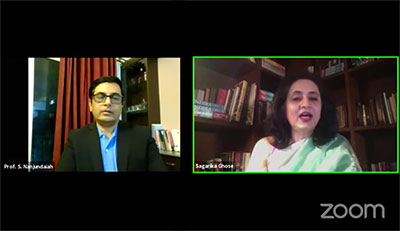
    Earlier this week, I had the opportunity to have a fireside chat with journalist-author Sagarika Ghose on liberalism. It is the theme in her latest book, but we decided the chat would not be strictly based on her book alone but on the need to understand the term better.


    It is undeniable that the history of liberalism is chequered or at least confusing. Although liberalism has been around in some form right since the Ancient Greek era, it was John Locke in the late 17th century who formalised it as a theory, and today many people say that’s all it is. A theory. But it has been co-opted in eclectic and sometimes self-contradictory ways—from John Stuart Mill’s individualistic utilitarian concepts to Keynesian economics that involves state intervention.

     

    But that’s the point of liberal values—not to be stuck but to move forward, inclusive and humanistic, individualistic and practical. Modern liberalism has stood by social reform. It has seemed to remain among elites and hasn’t really trickled down all the way to the last mile. Is it too esoteric? Or is it hard to practise? Or does it plain go against the grain of the Indian society? Why is it that liberalism has become a “cult” (as one questioner asked at the fest), bracketed as merely the protector of fringes? The right wing’s critique of liberalism the world over is that it’s devoid of moral values and is too driven by market economics and materialism.


    So, if we take a dipstick of what liberalism stands for today, it claims to represent free markets, free trade, limited government, individual rights (including civil rights and human rights), capitalism, democracy, secularism, gender equality, racial equality, internationalism, freedom of speech, freedom of the press and freedom of religion. Paradoxically, it seems to stand for so many things that it seems idealistic. But what’s a social philosophy without idealism?


    Let’s look at the practice of the media. Is it not idealistic? Democracy as an assumption with different interpretations. One looks at individual rights, another at community rights, and another egalitarian in general. Which of these does the media uphold?


    The media tries its best to be a champion of liberal values, but this representation gets distorted when a channel or a portal or a print publication leans politically one way or another. That affiliation colours liberalism because the values could conflict. The popular coverage of the Shaheen Bagh protests or the more recent Bengaluru riots are examples of which side our channels tilted.


    That largely works on both ways of the spectrum and is partly responsible for the perception that unless a media platform is fully supportive of the Modi government without as much as a word of critique, it will be branded with that dreaded label “liberal”. Congress’s Rahul Gandhi makes an accusation against the government, but most news portals choose to accord it coverage only after they obtain BJP Minister Ravi Shankar Prasad’s retort to juxtapose. I don’t see that same effort and anxiety to balance when the reverse situation occurs. That is not fair representation.


    There is a public opinion that the Indian media is so consumed by ratings that it has turned into a lapdog. On the other hand, public opinion also says that the news media must be faithful to development as defined by official sources. That is where the next liberalism paradox occurs. If liberalism stands for free market, ratings-driven, competitive media economics shouldn’t be a bother. I’m afraid a free market does include marketable content, not just some corporate strategy. Does that make it right that channel after news channel plays lapdog using the pretext of a ridiculously low sample to vie for the same pie. This is a construct of convenience for advertisers. But then, this is a convenience that suits everybody.


    Our electronic media started out as a Mixed Model during the public broadcaster-only days, focusing equally on development through education, information, and entertainment. But today, it seems like a mixed-up model, a drifter model, if you will. On the other hand, the social media is less hypocritical, producing snackable content that is mass produced and mass consumed. More than the mainstream media, and as problematic as it is, it is social media that is therefore generating critical thinking among consumers.


    As founder of BeingResponsible, the author, Shashidhar Nanjundaiah, is trying—really hard—to instil Responsible Media Literacy among younger citizens through 20-hour courses at schools and colleges. Earlier, he has led media institutes of repute to positions of leadership. Portions of this essay are derived from a conversation at the ongoing, virtually conducted Mysuru Literature Festival 2020. His views here are personal. Prof Nanjundaiah at shashi.nanjundaiah [at] hotmail.com.

  • He said, She said


    By Shashidhar Nanjundaiah


    The new National Education Policy (NEP) has stirred up a hornet’s nest among columnists who are busy parsing what it says more than what it doesn’t. The NEP is progressive, aiming to nurture independence of thought and decision. (I stress on “aiming to” because it was submitted by an eminent team of scientific tempered people, but in implementation, our government does have a suspected habit of appropriating institutions.) However, the NEP does little to instil specific forms of responsibility among young citizens. The responsibility towards gender mainstreaming is one such.


    When I was invited last week to speak at a small but important webinar for a young, woke and socially conscious audience on gender discrimination against men, I spoke about why we need a balance that must be initiated by the media and other influential institutions. The media, in particular, is important because it is the very custodian of public communication. This institutional leadership is also needed to distinguish the media more exemplarily from the social media, whose users are largely less trained and so have a long way to go in communicating responsibly.


    MEDIA’S BIAS

    Our television anchors and reporters appear to be angry activists, as they sometimes should. But they either choose their activism selectively, or their inherent biases creep in periodically. Our media routinely says “protect our women” and “women’s empowerment” in the same breath. Consider when an anchor asked his guest, a famous sportswoman, “What are your marriage plans?” When she objected, he apologised, quickly realising the archetypal bias that we all suffer from.


    Even where gender should not be an issue is an issue with our media, and so headlines such as “Woman techie caught for speeding in Audi car” (not a real headline) continue. Women achievers seem to be such an aberration to our media that in order to stay on course, it seems a hypercorrection is needed. Consider an angry-sounding anchor: “We need to believe harassment took place because she’s saying so. No woman would lie about such a thing.”


    I blame this on media education, or lack thereof. Stereotypes are the most ironic form of gender illiteracy. And because mediapersons have largely been teaching themselves gender literacy from experience and informal discussions, there will be gaps. As broadcasters of not just information but of opinion, mediapersons have a special obligation, and there is a special need for their education in particularly tricky subjects such as gender education. The media must constantly bear in mind pressures of ratings. But in the process, content corners are cut into chewables. One of those corners is journalistic ethics—including gender mainstreaming.


    CREATING LITERACY 

    Now, a lifelong student of mediated communication like me winces each time this happens, because we are trained to scrutinise the usage of terms and place them in sociological frameworks. But that’s just a handful of us, and mainstreaming the practice of gender-responsible communication in the media will also routinise its practice in society.


    This would mean the media must take responsibility for media literacy among its readership and audiences in ways that do not impact their numbers game and yet manage to address their apparent guilt: For some reason, all but one or two channels claim that they are “news, not noise”. That’s guilty conscience talking.


    Geert Hofstede’s seminal work in 1974 on cultural differences across the world found that much of South Asia scores very high on gender distance at workplaces.  Anecdotally, we will observe that post-MeToo communication between genders is more guarded and distant. Media coverage of the MeToo movement has made many women aware and conscious of their rights at the workplace better, and that counts for something. But it has left male professionals scared and confused. Although the new law against harassment is highly gender-biased, many right-minded companies have implemented a much more tempered and gender-neutral version of it.


    Good education in gender communication would do the trick. It is disappointing that the NEP does not consider the new forms of literacy that students must be educated on. It would make people more conscious but also more responsible while exercising their natural gender biases. Nevertheless, independent efforts can scale the gap from conscious to responsible communication. In short, education will generate consciousness, while viewed practice by the media will make us more responsible communicators. 


    Portions of this piece are adapted from the author’s address while chairing the UNESCO-SWAN working group on setting guidelines in gender balance in education and training.


    As founder of Being Responsible, the author Shashidhar Nanjundaiah is trying—really hard—to instil Responsible Media Literacy among younger citizens through courses at schools and colleges. The 20-hour courses are a combination of awareness, deep-reading media exercises, and basic rules-of-thumb forensics to recognise fakeness. Earlier, he has led media institutes of repute to positions of leadership. Prof Nanjundaiah can be reached shashi.nanjundaiah@hotmail.com. His views here are personal.


  • New Emotions for Old


    By Shashidhar Nanjundaiah


    Unusually, the hashtag #Nonsense_Modi topped the Twitter trending list in the country for several hours earlier this week after a primetime debate, where a spokesperson of the Opposition repeatedly used the term “nonsense” to question the government’s apparent stance that any question around the Ladakh standoff was against the nation’s interests. Although the ruling party’s spokesperson tried to defend that charge, the opposition was loud and relentless. Under the hashtag, which emerged from behind and beat #Nonsense_Rahul to the top, went well beyond the Ladakh statement, tagging eclectic national issues from job losses to Covid-19 to GST.


    To a student of media communication, this is a sign. The nature of media audiences is that they look for new emotions to massage themselves with. You have to start to wonder–and fear–what lies next in BJP’s media-agenda armoury. Is the narrative using the same old emotive messages while the media users are hankering for new emotions? Fear, hatred, nationalism have played their part. What next? The popular media-alarm “Massive controversy erupts” may still evoke volcanic mnemonics in us, shaking us out of our bot-like social-media existence. But emotional appeals must evolve, it seems.


    GOING PARASOCIAL

    For, after all, emotions drive today’s audiovisual news more than ever before. The surprise lies in how late news got into the act, decades after motion pictures and non-news television—and the all-inclusive digital media—recognised the clear market for emotive messaging. Viewers play with the television screen in a “parasocial engagement”, according to media psychology scholars Horton and Wohl. Until the social media swept the audience attention, the audiovisual media continued to rely on rational appeal. Today, stung but clever enough to co-opt its competition, news television knows better.


    But that’s the nature of immersiveness. It is high-involvement but temporary. Emotions around issues, with the exception of long-term investments in emotional attachments, are often transient. “When India’s onboard [demonetisation], why isn’t the opposition?” asked a channel, more or less summing up the implied nationalistic emotion. Considering the trouble it caused on ground, that political detail would seem a sadly ironic emotion, in conflict with what people felt. The more recent “#ChinaGoBack” call, too, tied itself to narratives aimed at nationalistic emotions. 


    EMOTIONAL TRANSIENCE

    But are media houses running out of emotions? News editors’ stated role has been to set the agenda of what we must think about. But their new role is in setting an agenda of individual emotions that add up and galvanise themselves on social media to become public emotions. We can call this emotional agenda-setting. In a binary context, this role would be set against a traditional, editorialised form of agenda-setting.


    Aristotle had said that man is either a political animal or an outcast like a “bird which flies alone”. Individuals have personal, social and cultural needs that must be fulfilled through associations. The welter of social media messaging gives the individual a false sense of being the agenda-setter: One that must indulge, take sides, react. Some scholars have used a somewhat awkward term, masspersonal, to describe our current state of social media usership. The more conventional media routinely use the social media mores and norms to boost their own viewership, borrowing trending posts to create news. So it won’t be amiss to use this masspersonal nature of consumption to news television, which mobilises mass emotions by hashtagging personal emotions.


    News language’s new role is visual, drawing us in. The news media is there to help us construct our truths. One way is drawing our attention to ‘massive controversies’ erupting everywhere. To draw inferences that are more detached, we must feel a need to be media-literate in the new digital age. And as history will tell you, media literacy follows media technology and techniques. Regrettably, we can never really catch up or the game would be up.


    So sure, emotions are here to stay. But how to juggle those emotions periodically will determine how strategically a marketing head and editor can jointly manipulate public sentiment.


    As founder of BeingResponsible, the author Shashidhar Nanjundaiah is trying—really hard—to instil Responsible Media Literacy among younger citizens through courses at schools and colleges. The 20-hour courses are a combination of awareness, deep-reading media exercises, and basic rules-of-thumb forensics to recognise fakeness. Earlier, he has led media institutes of repute to positions of leadership. Prof Nanjundaiah can be reached shashi.nanjundaiah@hotmail.com. His views here are personal.


  • Shashidhar Nanjundaiah: What ails our communication education

    By Shashidhar Nanjundaiah


    The Indian media and entertainment industry is growing by leaps and bounds—the annual FICCI-EY report this year estimates that the $22.75 billion industry (2017) grew by 18.55% since 2011. Although it is beginning to stabilise to around 12%, it will still be an impressive $37.5 billion industry by 2021. Television leads, but in terms of growth, predictably, the digital segment is growing the fastest. Growing at 26%, digital already enjoys 10% of the advertising expenditure. According to independent estimates, there are about 1,300 colleges in India offering media courses. Well over 50,000 students with media and communication degrees graduate in an average year in India. Employment issues in the industry are compounded by the fact that notwithstanding its high growth, much of the film and television industry relies on independent crew, and a large proportion of employment in production houses is project-based. It is therefore the strategy jobs in the M&E industry that are mostly available to media graduates.

    On their part, independent colleges have the leeway to develop, seek approval and deliver curricula that they believe is better than the “model” curricula recommended by the University Grants Commission (UGC), the overarching regulatory body for much of our higher education system. There is a 30% leeway to operate with independent thought, and we can see how different universities have adopted subjects with nomenclatures that seem different on the surface. But arguably, it is the prescribed format and structure of the curricula that do the most damage, because many colleges do not venture beyond the UGC-mandated structures. Even when they do, it is debatable whether the results match industry expectations.The most well-oiled machines are in independent filmmaking courses. With the usual exceptions of a handful of specialised institutes, graduates do not prepare to enter the industry. They prepare to graduate.

    WYSIWYG. Among aspirants, communication is one of the least understood disciplines, and predictably, this ignorance is far more pronounced in non-metros. (In metros, too, the understanding is incrementally more largely because of the exposure to the environment, not because the school system or any form of intervention creates any awareness.) The average applicant walks in seeking to “do something in” advertising or filmmaking.Because the media and entertainment (M&E) industries afford partial visibility, this parasocial exposure to what appears glamorous and attractive gladly occupies the aspirational mind.The results, too, are accidental. How many communication graduates can claim to have started and ended with the same focus?

    Neither the partially visible nature of our communication industries nor entering communication education on a clean slate is a bad thing. Just the contrary. But in reality, the slate is hardly ever clean. The visible parts of our industries occupy the clean slate. In institutes I have been involved with, I make it a point to create an unlearning atmosphere at pre-admission and post-admission levels, and make efforts to help students do so before they start learning their disciplines. This helps students take the directionbest suited to their aspiration, aptitude and life goals. But in recent times, competitiveness among communication educators has created another business imperative of sorts. As colleges go corporate, with large marketing departments in place, counselling is less about creating awareness and choice, and more about convincing. Everything goes well when a student comes in with that tabula rasa. Because a large proportion of communication jobs are usually hardnosed strategy roles, and “getting a job” in the creative industries often entails financial risks, students and parents are often put off. After all, they came in search of a communication school exactly because they didn’t want a business degree. Isn’t communication a way to make money by using the art of free expression? They want to know. Further complicating these issues is the fact that working in these industries often does not mean creating anything—it entails managing and understanding creativity.

    Wrong reasons. As the discipline matures, there is a slowly changing comprehension of what it takes—with the huge diversity in academic orientations ranging from the arts to statistics, creativity to business strategy. Students often choose their disciplines within communication because i) they want to enter a particular industry, whatever the role, or ii) the discipline seems familiar enough to grasp, or iii) they are clear what they want to do. The last of the three is a dream for a college, but that is because colleges themselves often do precious little to educate students what is at the other end of the journey. This means students choose with a certain amount of randomness. Being an educator should also mean helping students discover the intersections between natural inclinations, aspirations, and aptitudes.

    Then there is the familiar matter of keeping up with industry trends. While there are principles, schools and concepts in all communication disciplines, anda good communication college often does a fair job of grounding students in them, the curricula continue to live in history. The problem is not with the curricula. As I mentioned in last week’s piece about media education, the problem is how we create repeated practice out of existing curricula.

    This problem is usually more prominent in the more conventional disciplines such as film and advertising. With public relations, for example, the experience may be different. As a newer subject, it affords nimblefootedness in approach simply because of a drawback—not enough traditional literature exists. With advertising, students go through the usual motions of learning the features of copywriting. The strategic practice of copywriting remains obscure, because it is seemingly too much driven by individual talent.

    Digital communication—education hasn’t caught up. Among all the gaping gaps we see in communication education, though, is the chasm between the emergence of digitisation of practice and its learning at college levels. Take, for example, satellite-based distribution systems of creative products and the emergence of film marketing. Only a couple of colleges with roots in the industry have even paid attention to these new trends. The practice of digital communication has taken a quantum leap, attracting fresh talent like a black hole. But few students are systematically prepared for the digital industries, entailing the art, science and commerce of storytelling, content creation and the strategies to market and distribute them. For the PR industry, this brings in a whole new function of content aggregation beyond the traditional media functions.

    As much as digital communication is the medium of the youth, recruiters continue to be disappointed at the numbers and quality of graduating students who are experts at digital communication (notwithstanding a handful of good institutes teaching digital marketing). The larger picture with the frenetic growth of digitisation and of digital media platforms is that it has been creating new ecosystems. I have, somewhat in a Marshall McLuhan-esque way, regarded the digital as a new paradigm, not merely a new medium. Digitisation surrounds us through its three new dimensions: New tools (mobile, computer-based) and technology, revised concepts and ideologies, and an increasing role of digital professionals in professions and societies.

    Digital media literacy itself is a huge opportunity that ironically remains undisturbed among academic circles. Digitisation has added a research and analysis dimension to our practice, but again, it is largely being ignored at preparatory levels.Storytelling and (and through) gamification are potential specialisations within media colleges, being new forms that will occupy a big space in Indian mediated communication. The low-cost advantage to digital should have also sounded the opportunity bugle for digital entrepreneurship as part of the curricula. (Fewer communication students than ever before in my experience are interested in entering the workforce through day jobs.)The “new media” course among colleges does not do justice to the rapid evolution of digital as a new ecosystem. We badly need a digital-first approach specifically training students in digital communication practice.

    Digital media vs digital ecosystem. Learning digital media is never going to be enough unless understanding digital practice is embedded while learning any media-related practice.Many media colleges claim to cover much of what is needed. The important difference, though, is for how long and with how much focus do students absorb these subjects? A guest lecture or even a daylong workshop in gamification ain’tgonna cut it. It is even possible to embed many of these subjects within the existing curricular structure. I argue that all this is not the root cause of the mismatch between a student’s learning and her practice upon entering an industry. UGC mandates a large number of subjects, regardless of which discipline within communication you are specialising in. It does not pay enough attention to strategy and business—perhaps because the regulator does not see the practice of communication as a strategic-enough science. There is an array of diverse subjects that are great for general learning, but in a time-limited programme, some are redundant. Students themselves recognise the impracticality of some input. But in the end, it is all about how a college and its faculty approach specific subjects, what pedagogy they adopt, whether students get enough practice on ideas, technology, strategy and their tools. Believe it or not, communication skills—let alone writing—do not form a core part of a typical media student’s curriculum.

    It is impossible to generalise the issues of communication education, as much as it is impossible to club the problems in the practice of all communication industries. Such is the vast diversity in M&E. That brings to a final point: We need a radical change in the way we approach communication education. A distinction between communication arts and communication strategy is the real difference. Calling it “Advertising”, for example, is misleading both in the way its practice hasgrown and in the fact that its practice entails many divisions with completely different aptitudes and approaches. Similarly, subjects are created with a focus on their marketability with aspiring students. Teaching the concepts and practice of advertising or corporate communication may not occupy more than a semester of weekly input. But taking the student through the understanding of various client industries, through practical application of communication strategy, and developing independent projects is important to effective learning. As in journalism, project- and practice-based learning has no substitute. But the key lies in repeated practice.

    The industry is more active than before in participating in curricular delivery and sometimes in building syllabi. This is commendable, yet more embedding is needed because industry-trained faculty are far and few between. A recommendation I have been making since 2013 is that corporate social responsibility (CSR) must necessarily contribute to creating talent at colleges in their respective domains.MNCs are already building labs and imparting training in engineering and, lately, in journalism colleges. Surely more can be done in the digital, film, advertising, media research and PR industries in alignment with the Companies Act’s CSR clause?

    In conclusion, it must be noted that more corporations than ever before are hiring communication graduates, as are the best advertising agencies. That trend is a good acknowledgment of more acceptable communication education.

    Shashidhar Nanjundaiah has led leading media institutes in India, as  Director of Symbiosis Institute of Media & Communication, founding Director of Indira School of Communication, and first Dean of India Today Media Institute. He pioneered research on the socio-economics of a newly liberalised Indian media marketplace. Currently, he observes how India’s media industry is shaping itself in this decade. He has also edited newspapers and magazines in India and the US. The views here are his own.