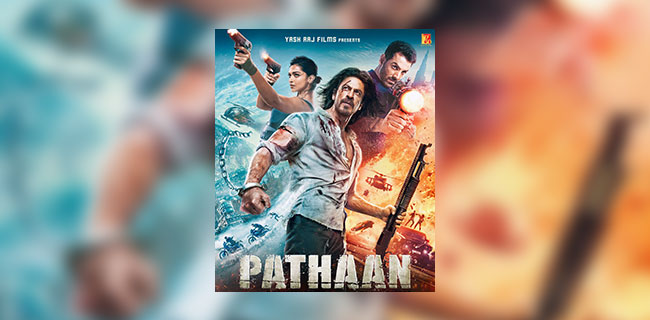
Tag: Shah Rukh Khan

  • Pathaan: Cinema over Politics


    By Shailesh Kapoor


    Shailesh KapoorTill about three weeks ago, there seemed imminent danger that Yash Raj Films’ Shah Rukh Khan starrer Pathaan, which released on Jan 25 this year, will have to face headwinds from several right wing affiliated groups. There were threats to disrupt the film’s release, over ‘issues’ that can best be described as manufactured. Our news channels did their job in blowing up these trivial issues (the orange dress objection is outrageously amusing), and it seemed that the film may struggle to get a proper release in some of the states.


    Today, on the 10th day of the film’s release, it has gone on to break every possible box-office record in India, ad remains in contention to be the highest Hindi film grosser of all time. It has revived the overseas box-office of Hindi films, and ushered in the SRK 2.0 era. The protests have disappeared, as have the pro-right news channel debates. A comment from the Prime Minister, urging his party workers to stay away from talking about films, was a command too direct to ignore.


    There’s a lot to learn from the unfolding of events over the last two weeks. Boycott campaigns targeting Hindi films had been normalised in 2022, and when a film failed, a large part of the failure was attributed to these campaigns. In many cases, those involved with the film (actor, director, producer, etc.) fueled this narrative themselves, as if to exonerate themselves of the responsibility of having failed to make an audience-friendly film.


    With Pathaan, the theory that politically-motivated campaigns can impact the fate of a film at the box-office have been laid to rest. As long as a film can release, in a way that it’s safe to visit a theatre, the audience will embrace it on merit. Which is not to say that the audience’s political leanings will not impact their movie choices. In an analysis published on the Ormax Media website in 2021, films that propagate nationalist ideas, such as Uri: The Surgical Strike and Tanhaji: The Unsung Warrior, showed stronger audience traction among those supporting the ruling party (BJP).


    But these films wore their politics on their sleeve. In Pathaan’s case, there is little in the content that’s overtly political. Taking a simplistic and safe approach, the film packages its ideas of secularism and ‘nation over religion’ in a way that’s largely apolitical, and never sermonic or ideological. The origin story of the protagonist, Pathaan, has a distinctly secular ring to it. But it’s never used as a messaging device. The film, primarily a crowd-pleasing entertainer, makes its political points, but leaves it to the audience to interpret them, through their own political lens.


    The audiences are smart enough to tell a real controversy from a fake one. That Shah Rukh Khan is a Muslim is not an argument this country will buy, to not watch a film. Ironically, this may have propelled some of his fans, who belong to all religions and political ideologies, to support the film even more. As if to make the point that even though cinema can tell political stories, it is not a medium for politicians to play their murky games.


    SRK’s Amar Akbar Anthony comment at a recent press conference, held to celebrate the film’s success, is the only authentic political message in or around Pathaan. In a way, that comment sums up why the inane controversy around the film fizzled out. Because unlike the film, it did not appeal to its target audience.

     

  • SRK: The Last Superstar Standing


    By Shailesh Kapoor


    Shailesh KapoorFive days hence, Shah Rukh Khan’s Pathaan will release worldwide. The film marks the return of SRK to the cinemas after an unusually long gap of more than four years since his last release Zero in December 2018. During this period, the actor has featured in some cameos, most recently in Laal Singh Chaddha and Brahamstra. But it’s been quite some wait to see him in a lead role again.


    The wait seems even longer because his last few releases have ranged from being unremarkable to disappointing. The search for an SRK film that did well at the box-office and found audience appreciation too would take us back to 2013, when Chennai Express released, and then further back to 2008 and 2007, when Rab Na Bana Di Jodi and Om Shanti Om released, respectively.


    It’s been a decade, then, since we saw SRK deliver a film worthy of his superstar status. But 2023 is the year where he seems to be in a hurry to correct that. Pathaan will be followed by Atlee’s Jawan and Rajkumar Hirani’s Dunki. All three films have an anticipatory vibe to them. Pathaan is set to open huge, on the right side of Rs 40 crore, and its second day is likely to cross the 50 cr mark, with the Republic Day national holiday push.


    How SRK has managed to maintain his stardom, despite no box-office presence of note for almost a decade can be a mystery to many. But it’s also a case study in what true superstardom is, and how it manifests itself.


    The tag ‘superstar’ is used so loosely by the media today, that it has lost its real meaning. When I was growing up in the 80s, Amitabh Bachchan was the only reigning superstar. None of the other stars of the time, such as Mithun Chakraborty, Rishi Kapoor and Anil Kapoor, carried that tag. Only in the early 90s did Shah Rukh Khan get associated with that word. Sunny Deol, who had some huge box-office successes in the 90s, was not called a superstar either. In fact, Madhuri Dixit was the only other star in the first half of the 90s to enjoy that status.


    Somewhere from the mid-90s, the media started using the word more liberally. Today, it is used almost interchangeably with the lesser version “star”, which itself is used to describe almost every other actor, including those who do not carry any box office pull at all.


    SRK’s stardom was built in the 90s, through a spate of successful love stories, some conventional and others experimental for their time. His romantic persona continues to be his dominant pop culture imagery, a tribute to which is the one of the brighter spots in Laal Singh Chaddha. But the actor has been keener on exploring the action genre in recent years, because of his age and also his personal preference for it. But he’s still looking for a big action blockbuster that gets the box office going beyond just the opening weekend. Pathaan hopes to be that film.


    In an era of excessive content and media options, including OTT, short videos and social media, building a superstar persona seems next to impossible. The aura of superstardom came with an idea of inaccessibility and scarcity, which today’s media ecosystem does not support. It’s safe to say that we have already seen the last of our true-blue superstars. And Shah Rukh Khan could be the last man standing from that list, if 2023 is any indication.


  • SRK launches new brand campaign of A23 Games

    By Our Staff


    A23 Games, a multi-gaming online platform owned and operated by Head Digital Works Private Limited has announced the launch of its new brand campaign with its brand ambassador, Shah Rukh Khan. Through these films, the brand aims to promote the importance of “responsible gaming”.


    Speaking about the campaign, Deepak Gullapalli, Founder and CEO, Head Digital Works said: “We have received a lot of love and acceptance from the audience on our platform over our journey and this would not have been possible without the way we positioned our brand. Today, as flag bearers of skill-based gaming in India, we believe it is imperative to reiterate the importance of responsible gaming from time to time to ensure that players are mindful of the amount of time and money they spend on our platform. This new set of advertisements is yet another step towards re-enforcing our brand’s message.”


  • Shah Rukh Khan umveils Godrej bodywash

    By Our Staff


    Godrej Consumer Products Limited (GCPL) has unveiled Godrej Magic Bodywash, a ready-to-mix bodywash at Rs 45. Actor Shah Rukh Khan has been roped in as brand ambassador for Godrej Magic Bodywash and will feature in a mass awareness campaign.


    Commenting on this launch, Sudhir Sitapati, Managing Director and CEO, Godrej Consumer Products Ltd (GCPL), said: “Sustainability is core to our strategy. In doing so, we are committed to make amazing quality products at accessible price points… We are pleased to announce Shah Rukh Khan as the face of Godrej Magic Bodywash. We roped in a celebrity for this product to ensure we create awareness around plastic, carbon footprint and upgrade bathing experience of soap users.”


  • Dhoni abandons his ‘Dream’?!


    By Vikas Mehta


    Vikas MehtaSo, it’s been a very usual and unusual IPL so far. Usual, because Mumbai Indians (MI) have lost the first two matches. But the MI captain Rohit Sharma felt it was business as usual in his post-match interview. Unusual, as Chennai Super Kings have also lost the first three matches on a trot, albeit after years. Unusual also for CSK as Dhoni, after relinquishing his captaincy seems to have taken it back and is also scoring runs as in his heydays.

     

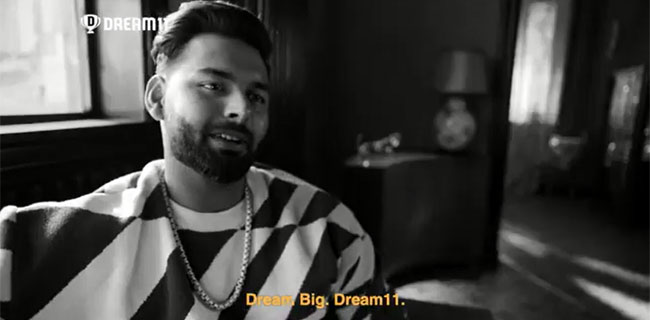
    And as usual, Dream 11 continues its dream run at IPL. The idea of “Dream Big” has seen many new frontiers. The series of various players like Shikhar Dhawan, Rishabh Pant, Rohit Sharma, Jasprit Bumrah and Hardik Patel reminiscing their struggles but not giving up on their big dream has two new creatives so far. One, with Pant and the other with Sharma. And this time, they pay tribute to some behind the scene people like the groundsman or even a stranger helping Pant at a gurudwara. The thought of one is never alone if one’s big dreams fits seamlessly into the Dream Big theme of Dream 11. Whew! Too many dreams here.


    https://youtu.be/3JazfubLOgI


    Dream big is also following a classical strategy of thematic and tactical ads. For the uninitiated, when advertising was the be-all and end-all of all communications, brand ads were created for brand equity, may be once a year, extolling the virtues of a brand and its personality. These were called thematic ads. Interspersed through the year were tactical ads which by nature would drive sales. These were by nature about inducements or sale pointers. Personally, I think this was more of a jargon-spitting marketer’s delight, as for the end-consumer. every communication is a message and she or he does not delve into it with a separate compartment of thematic and tactical in her or his mind. The ads with Dhawan, the Pandya brothers, Ashwin and even Pant in a metro asking people to try the Dream 11 seems to be in the genre of the tactical ads of yore.


    https://youtu.be/Dn7ixMGB_dM


    But one dream seems to be missing from Dream 11. Dhoni has disappeared from all communications and has now appeared for Winzo. Another gaming app. Winzo is not about a fantasy league. It’s about skill and social gaming and I presume it’s clear of any controversy related to “gambling” as Dream 11 is. Maybe that’s why Dhoni moved away from Dream 11. In the ad, Dhoni cheekily starts by saying that he is called gamechanger so he is changing his game from today. Very unusual but typically clever from Dhoni.


    Quite unusually, I am seeing Byju’s ads without Shah Rukh Khan. And these are good. Emphasising on understanding the concept rather than memorising for an exam. ‘Samjho seekho jeeto’ encapsulates the idea well. As a parent, these resonate with me more than the Shah Rukh ads which seemed more gimmicky. I also think Shah Rukh’s personality does not gel with that of Byju’s and made the brand more flippant.


    There has been a lot of buzz about the new Spotify ads. I like them because they amplify the generation gap between Gen Z and the millennials as also Gen X. While Gen X and the millennials are passionate about politics or shopping offline or any discussion and are more social, GenZ is more reclusive and more digitally social. So, Spotify is their ‘kavach’ or protective armour from these indulgences of the older generations. Unusual, yet simple.


    I also think that the Meesho ads capture a similar trait of Gen Z. The features of photo search or free delivery are neither new nor unique but they capture the essence of Gen Z. While millennials or Gen X prefer offline shopping and want to see all options, Gen Z is not only used to online but also wants trendy or happening products. So, these features serve them well.


    Does Aamir Khan have a triple role in his next film? The series of Netmed ads make me think so. Or, wait! Was it Pharmeasy? Or 1mg? At least Pankaj Tripathi was not about triple or double role. Not only are the names confusing but so are the generic benefits. From a consumer perspective, when I fall sick, I need medicines, fast. Not in a day or in a few hours, but in minutes. So, except for long-term medications like for diabetes or cholesterol, I am not sure how these medicine aggregators can help. What do the investors and these start-ups know that we don’t?


    And just when I was about to sign off, I saw two similar ads from PepsiCo company. For Pepsi and for Slice. It seems the company has taken competitive stance as a corporate paradigm. But then what’s the fun if unusual things don’t happen. More on the two ads next week.


    Vikas Mehta, a senior advertising professional, is now a strategy consultant and educator based in Dehradun. He has a considered, often contrarian view that we enjoy consuming (and contesting) on most things around him: cinema, cricket, advertising, politics and life in general. AdsOnIPL is a series of reviews of the ads aired around IPL programming. The column is in its second season. His views here are personal.


  • It’s not funny! Mocking one’s disability for another’s hilarity


    By Shruti Pushkarna


    Shruti PushkarnaLaughter, they say, is the best medicine. Humour is also an equaliser of sorts, the jester can ridicule the prince and the pauper alike. Often what can’t be uttered directly, is passed off easily, garbed in satire. We see that a lot these days, in the form of standup comedy, where political powers or specific groups are targeted in jokes. Gaining popularity in both online and offline avatars, standup comedy is increasingly becoming a respectable career choice for many.


     

    But what happens when the joke is directed at someone vulnerable or marginalised?

    The other day, I came across a video clip in which an Indian comic, Abhishek Upmanyu incites laughter by mentioning physical disability. The joke is not only in bad taste, it makes no sense. I’m sure there is a larger context to his gig, but nothing justifies the sheer insensitivity.


    What is funny to someone, can be extremely hurtful to another. Growing up, I used to wear thick spectacles to school. That’s when we didn’t have the luxury of ordering high index (thin) glasses to meet one’s cosmetic needs. I was mercilessly derided by peers who called me ‘chaukhi’ which loosely translates to ‘four-eyed girl’. Some kids even hid my glasses, and rejoiced seeing me bump into furniture, trying to find my way around.


    While their laughter filled up the classroom and the corridors, it wasn’t funny for me.


    Because of intrinsic stereotyping in literature, cinema, television, advertisements et cetera, the business of ‘othering’ is assumed to be acceptable. It comes naturally to people, young kids included.


    It has been normalised to such an extent, that we use phrases and words without worrying about the implications. Common utterances include, ‘That joke is so lame’, ‘Why are you acting bipolar’, ‘Are you retarded’, ‘Can you dumb it down’ and so on.


    Another comedian, Neville Shah was slammed online for ridiculing persons with disabilities. Incidentally, this artist features on a popular OTT platform. In this particular clip, Shah mocks disability and reservation for the underprivileged sections of society.


    https://twitter.com/riteshjyotii/status/1393945614946164746?ref_src=twsrc%5Etfw%7Ctwcamp%5Etweetembed%7Ctwterm%5E1393945614946164746%7Ctwgr%5E%7Ctwcon%5Es1_&ref_url=https%3A%2F%2Fwww.idiva.com%2Fnews-opinion%2Fnews%2Fcomedian-neville-shah-criticised-for-casteist-remarks%2F18020195


    How can apathy towards a sizeable section of the population result in comic relief?


    Bollywood also has a history of portraying disabled people as farcical, oafish or villainous. Their physical disability is accompanied with a character distinction that puts them apart from the rest of the cast. Premnath plays the powerful villain, Sir Judas in the film Karz who is speech impaired. Shah Rukh Khan plays young Rahul in the film Darr, chasing Juhi Chawla with an abnormal passion. His unhealthy obsession is attributed to mental instability. Vivek Oberoi plays the villain, Kaal in Krrish 3 who is paralysed neck down.


    Buffoonery and disability also go hand in hand in Indian cinema. Tushar Kapoor is characterised by speech disability in the famous Golmaal series. The weird noises made by his character have made him all the more endearing to the audience. Three lead actors, Akshay Kumar, Riteish Deshmukh and Abhishek Bachchan pretend to be disabled, in the slapstick comedy Housefull 3. One character plays a wheelchair-bound cripple, another pretends to be blind, and the third dons the garb of a mute man, only to generate some silly laughs.


    However, mocking disability is not limited to the Indian subcontinent. Several comedians across the world have indulged in thoughtless mirth at the expense of persons with disability.


    A Canadian comedian, Mike Ward mocked a disabled singer, Jeremy Gabriel who became a celebrity as a young boy. Known as ‘Petit Jeremy’, Gabriel has Treacher Collins Syndrome, a genetic disorder that affects facial bone structure. In his case it caused severe deafness. His family filed a human rights complaint, which was challenged and won by Ward on grounds of free speech.


    In 2018, advocacy groups, individuals and parents of children with Down Syndrome vociferously condemned comedian Tom Segura’s repeated usage of ‘retarded’ in the Netflix special ‘Disgraceful’.


    In the American sitcom ‘Big Bang Theory’, Stuart Bloom who is the owner of a comic bookstore, struggles with physical as well as mental health issues. He is made the butt of jokes, used for cheap comedy and easy one-liners.


    In the process of entertaining a majority, comedians and writers indulge in ‘otherising’ a minority and reinforcing prejudices in the societal mindset. Should the media be perpetuating such stereotypes?


    Shruti Pushkarna is a former journalist who now works as a programmes and media specialist for the inclusion of persons with disabilities. Shruti was part of the founding team of MxMIndia and now writes for MxMIndia every other Thursday. Her views here are personal. She can be reached via Twitter at @shrutipushkarna


  • Shah Rukh Khan enters partnership with Thums Up

    By Our Staff


    To all those who thought that dimple-cheeked Shah Rukh Khan Thums Up can never really be looked as an action hero, Thums Up (and agency Ogilvy) have got the actor perform stunts on the top of a train. And more.


    Commenting on the new campaign Sumeli Chatterjee, Head – Integrated Marketing Experiences (IMX), Coca-Cola India & Southwest Asia said: “Thums Up is a 45-year young brand that has always inspired millions to stay committed to their dreams. When we launched #PalatDe last year, the upside-down bottle of Thums Up became symbolic of the #PalatDe spirit – turning down every naysayer who cast a doubt on your ability. Building on this platform, we are thrilled to team up with Mr. Shah Rukh Khan to tell the story of the #ThumsUpStrong spirit. The strong unique taste of the brand is naturally weaved into strength as an emotion, that urges the drinkers to stay strong and believe in their dreams.”


    Btw, Salman Khan endorses Pepsi. The Khans aren’t foes, but the colas don’t have any love for each other.


  • Shah Rukh Khan to promote A23 online gaming

    By Our Staff


    Head Digital Works, an online skill gaming company, has roped in Shah Rukh Khan as the Brand Ambassador for its online multi-gaming platform – A23 (www.a23.com). Khan will feature in A23’s ‘Chalo Saath Khele’ campaign which includes various games of skill such as rummy, fantasy sports, carom and pool, with more to come.


    Said Deepak Gullapalli, Founder & CEO, Head Digital Works:  “It is a privilege to have the nation’s biggest superstar to be associated with A23. We truly believe that Shah Rukh Khan represents what our platform stands for both in terms of our brand and our players ― self-made champions who display a high degree of professionalism and skill in their game. As a global superstar, who has always connected well with all segments of the audience and society, we believe that Shah Rukh will help elevate our brand and win the hearts of millions of Indians who relate to using their skills to win. The Chalo Saath Khele campaign brings to life the narrative of various types of gamers on A23 through the magic of Shah Rukh Khan that promises to enthral fans of King Khan and make A23 a house-hold name in India.”


  • SRK in new TVC for Byju’s

    By Our Staff


    Byju’s, the edtech company, unveiled its new ad campaign featuring actor Shah Rukh Khan to highlight the launch of Byju’s Classes with ‘Two Teacher Advantage’. The TVC has been conceptualised and created by Springworks.


    Talking about the new ad campaign, Mrinal Mohit, Chief Operating Officer, Byju’s said: “Byju’s has always aimed to provide an engaging and interactive experience for students to make them fall in love with learning. The TVC aims to present the one-of-its-kind ‘ ‘Two Teacher Advantage’’ that makes the after-school learning experience very dynamic and redefines the classrooms of tomorrow. We want to further convey that Byju’s Classes is the future of tuition and will help students learn better. With Shahrukh Khan being a household name, we are confident that we will be able to bolster our connection with the students.”


  • Mental Health & A&M


    By Sanjeev Kotnala


    Sanjeev KotnalaAt the end of May 2021, women’s tennis star Naomi Osaka withdrew from the French Open to preserve her mental health. As if taking a cue, many athletes in recent times have been vocal on the subject. Fortunately, now it is receiving the desired focus. We, at least for the celebrity and sports personalities, are now agreeing, ‘It is OK to be not OK.’ And celebrating their courage to be open about it.
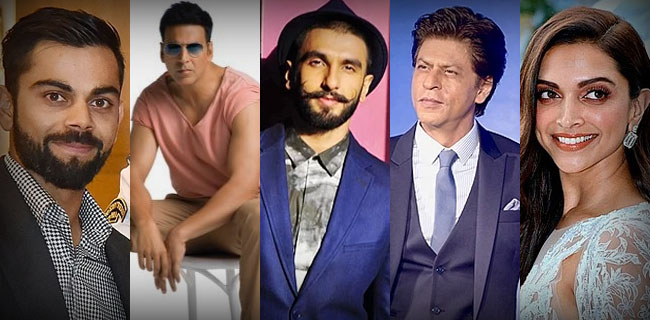
     

    In the Indian context, we have read about the mental health issues of Deepika Padukone, Virat Kohli, Abhinav Bindra, Tiger Shroff, Amitabh Bachchan, Sanjay Dutt, Shah Rukh Khan and many others. Many may say that it is easier for them to be open about mental health than an average person.


    Mental illness, also called mental health disorders, refers to a wide range of mental health conditions – disorders that can affect your mood, thinking and behaviour in personal and professional life. Mental illness includes depression, anxiety disorders, schizophrenia, eating disorders and addictive behaviours.


    Reports suggest elite athletes experience mental ill-health at a rate comparable to the general population in anxiety, depression, post-traumatic stress and sleep disorders. We now acknowledge these superhumans – high-performance humans are also vulnerable to mental health issues.


    Which makes me look inwards in the Marketing Advertising community. Just like #MeToo opened up flood gates. People shared their experiences.


    Are we going to see people from Marketing and advertising now coming out with their experiences and issues? Personally, I doubt.


    The industry has all the environment that could lead to mental health issues. It is high performance led. There is subjectivity. There is a swinging of fortunes in approval, appreciation, rejection and dejection. There are creative blocks that make people question their abilities. Then some push confidently even when they are way behind their benchmarks. Loss of business, shifting fortunes, impossibility to predict and control outcomes. The growth. The layoffs. The repeating iterations. The questions about capabilities, abilities and capacity of someone understanding the problem. Long working hours, no control on timelines and expected to be working beyond office hours add to the problem.


    Like me, many of you must have seen cases of people that we never rightly labelled as mental health issues. Because no one wanted to accept such a problem. Theek ho jayega. You will overcome it. Let’s drink to it. ‘Come on. Burn out. Recharge. Are some of the stock solutions offered by colleagues.


    I am not a doctor but, like every advertising marketing professional, an observer of life. And that makes me sure that sooner or later, we will be able to question behaviour and have a place for the proper counselling. Maybe the HR and the stakeholders in the industry could initiate a debate on it and think of possible policies to address it.


    Campaign did a research survey on the subject. Which told us 71% feel that their organisations haven’t taken any concrete steps towards actively reducing workplace stress. Employees claim they haven’t been receiving considerate timelines and are even unable to sign off for the day post 6 or 7 PM. Additionally, they are dealing with the pressures of coming to the office and are expected to be available over weekends.  Exchange4media did a story that told us that as an industry, we are opening up to it. Times Network-initiated #ActNow to spread awareness, normalise conversations around the issue and sensitise people to be responsive to the mental health needs of others. The business insider did a story on World Mental Health Day: How to address the challenges of overworking in an ad agency. Not enough. And we know the reality.


    I may have spoken about the Marketing and Advertising Industry as I am a part of it. But I will not be surprised that it is an omnipresent problem. Police, sales, Manufacturing, Bureaucracy, and students are included in the list.


    We need an ecosystem that does not treat it as a taboo subject. Time we are a lot more open and inclusive in our reaction and acceptance of the possibilities. Remember, It is OK, Not to be OK.


  • Virat stays India’s No 1 Celeb


    By A Correspondent


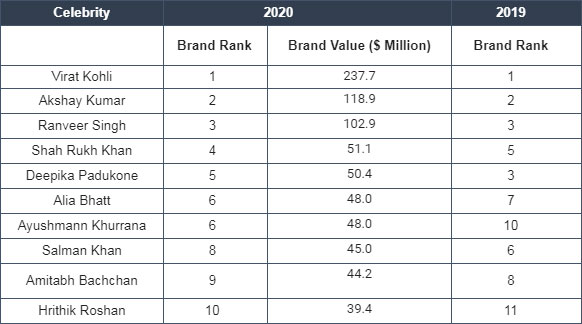
    Consulting firm Duff & Phelps, the world’s premier provider of governance, risk and transparency solutions, has  released key findings from the sixth edition of its Celebrity Brand Valuation Study 2020: “Embracing the New Normal.” The study provides a ranking of India’s most powerful celebrity brands based on brand values derived from their product endorsement portfolio and relative social media presence. It examines the impact of the pandemic on both brand value rankings and the celebrity endorsement space.


    Said Aviral Jain, Managing Director, Duff & Phelps: “While established celebrities continue to dominate our rankings, notable millennials with a strong social media presence continue to climb the ladder. Ayushmann Khurrana, Tiger Shroff and Rohit Sharma all jumped a few spots to grab the No. 6, No. 15 and No. 17 spots, respectively. Further, Kartik Aaryan debuts on our list at No. 20. These rising millennial celebrities were in greater demand during the pandemic owing to their popularity among the youth,” adding: “This year, the media and entertainment (“M&E”) sector took a hit and witnessed significant slowdown in advertising spends as traditional media and outdoor entertainment were severely impacted by the pandemic. Digital marginally overtook print to become the second largest segment in the advertisement space, and it continues to witness traction among brands. The pandemic has also reinforced the fact that a strong social media presence is no longer a ‘good to have,’ but rather a ‘must have’ for celebrity endorsers. With celebrity-brand engagements becoming more digitally oriented, brands and celebrity endorsers are discussing innovative ways of collaboration,” Jain added.


    Commenting on how the pandemic redefined the M&E sector, Varun Gupta, Managing Director and Asia Pacific Leader for Valuation Services at Duff & Phelps, added: “2020 saw a boost in digital advertising, with celebrities leveraging their authentic and personal experiences for endorsements. In fact, many OTT stars and influencers are currently sharing the spotlight for digital ads, which is a new trend observed this year.”

  • Dubai Tourism highlights unexplored destinations in latest campaign

    By A Correspondent


    Dubai’s Department of Tourism and Commerce Marketing (Dubai Tourism) announced the launch of a new collaboration with Hollywood actors Gwyneth Paltrow, Kate Hudson and Zoe Saldana. The campaign film titled ‘A Story Takes Flight’, features the actresses embarking on three journeys of exploration through Dubai, filled with inspiration, discovery, and human connections. This new global campaign resolves the mystery of the last edition of Dubai’s popular #BeMyGuest series, when Shah Rukh Khan bumped into Paltrow on a beach in the last video.


    Sharing his views on the recent campaign, Issam Kazim, CEO, Dubai Corporation for Tourism and Commerce Marketing (DCTCM) said: Inspired by His Highness Sheikh Mohammed bin Rashid Al Maktoum, the Vice President and Prime Minister of the United Arab Emirates, and Ruler of Dubai’s aspirational leadership, the people of Dubai reflect the city’s underlying spirit, where the pursuit of excellence has no finish line. ‘A Story Takes Flight’ is unlike any other film in that it speaks to this defining character of our city. It is a story of each person’s discovery through their interaction with Dubai. Regardless of who you are or where you are from, your journey with us also has no finish line – and the paths to explore are endless. As a city, we were thrilled to have the opportunity to host Gwyneth, Zoe and Kate, and work with such an incredible director, which Reed is. Through the eyes of the actresses we see the values, connections, and experiences that are engrained in the fabric of Dubai. This is what we represent. We are proud to be a city home to over 200 nationalities and we welcome visitors to write the next chapter of their story here.”