‘The Real Beast’ is the headline this Tuesday, February 25, 2020 of The Telegraph, Calcutta. Across India’s national capital, while the State Machinery was “busy” with US President Donald Trump’s visit to India, the state machinery was busy stoking violence. State BJP leader Kapil Mishra led a rally through North East Delhi and verbally attacked anti-CAA protestors. Soon after, the attacks became physical.
To quote the Telegraph: “protected thugs roam parts of Delhi; 4 killed as cops remain spectators.” The toll has since gone up.
This is the story of every riot in India. And most cases, barring some notable exceptions, it is the Hindu rightwing which starts these riots. As academics like Paul Brass have carefully researched and made plain, no riot can be successful without state help. Anyone who has been caught in or observed a riot in India knows that most help rioters receive is from the police.
They stand back, they watch or they actively take part. Members of the media who has reported on riots or been in the newsroom coordinating coverage or making pages or programmes knows this. Some of India’s best known TV personalities became “famous” and household names because they covered riots. Today, they are often enablers of rioters, of government excuses and police excesses by remaining silent or looking for false equivalences.
These two first-hand reports, by a Times of India photojournalist and a Times of India reporter, makes the ground situation clear. It reiterates who the perpetrators and who the aggressors were. Members of the Hindu Sena getting aggressive, forcing tilaks on people, wanting to check if the man is circumcised or not (as in, are you a Hindu or a Muslim), breaking locks on shops with Muslim names vandalising property.
The link below is from The Hindu. It continues with the old custom of “majority” and “minority” communities, but the story is the same: Hindus bashing Muslims.
I have chosen these first-person reports because if you read through the news reports of what actually happened in Delhi on Monday, or at least, whatever details are currently available, all you get is confusion. There is plenty of chatter about a gunman who apparently fired in the air and has since been detained and his name revealed as “Shahrukh”. However, this “gunman” did not injure anyone. Initial screen scrolls suggested that a police constable was killed by a gunshot wound. Now it seems the constable was killed in the storm of stones being exchanged. Before information of what the gunman did or did not do was revealed, we had senior journalists asking for the “terrorist” to be arrested and so on.
Meanwhile, members of the Hindu Sena and Hindu rightwing and Sangh Parivar and Hindutva proponents are presented as “misguided youth”. The narrative in India now follows the American pattern and this has nothing to do with Trump’s visit. All Hindu violence is a result of provocation, youth, misguided and such. All non-Hindu violence is a result of terrorist training. The hypocrisy and lies are no longer shocking. It is part of our mainstream.
When the media reports on the ground reality and media commentators twist or ignore ground reports to either facilitate the State and its agenda or at any rate try not to upset the State, you know how embedded the rot is. This is in spite of the fact that across media houses, reporters and photojournalists at the sites of violence faced threats from the Hindu rightwing, from organisations associated with the government, and saw the police standing by or actively encouraging violence.
India’s media has lost its conscience and whatever ethics it had in this desire to appear “objective”. If it no longer realises that it is not really being objective, then it is stupid. And if it continues with this fake objectivity then it is the acid that is eating into our society. I use this sweeping generalisation because the few voices that counter this sponsored news presentation are too small and too weak to make a difference.
The Narendra Modi government at the Centre has an endgame in mind: it is the Hindu Rashtra dream of the RSS. Instead of the largescale Gujarat anti-Muslim pogrom of 2002 which earned Modi and the BJP widespread international attention and opprobrium, the new strategy is small wars of attrition and a constant stream of violence. There will be attempts to now isolate and blame BJP leader Kapil Mishra for instigating the violence and excuses will be made for Modi and Union Home Minister Amit Shah.
Modi we have been repeatedly told by the media and others is a strong leader with a firm grip on his government. Shah is India’s home minister and the Delhi police is part of the Union home ministry. If these two do not know what’s happening in their party and their government, then they are but puppets in the hands of their RSS masters. If they do know what is going on, then they are part of it.
But every journalist and most Indians with their eyes open know what is going on. And if people do not know, and do not like what is happening, they need to educate themselves. The media and journalists can no longer help because too many of them are part of the problem.
Veteran media commentator Sevanti Ninan says “India deserves better media”. Never have truer or sadder words been spoken.
Hardly had the news of the acquisition of English news channel NewsX by ITV Media Group and Hindi news channel Live India by Prosperity Agro filterd in, there were murmurs on whether it was vital for the government to impose entry barriers for the news media. ITV of course has been in the news for around five years and Live India already had a sizeable stake by a property developer HDIL.
As part of MxM Mondays, we spoke to a cross-section of news media practitioners to offer their views on the issue.
This issue of media ownership has been debated on in the past, and more so recently, because of the entry of corporate groups into the news media. Earlier this year we saw two big corporates enter the media domain, when Reliance Industries bought a stake in Raghav Behl-led Network18 and Aditya Birla Group invested in the Aroon Purie-led Living Media India.
While big business owning media is not a new phenomenon, there are numerous instance of politicians owning and controlling sections of the media, especially in Southern India.
Hence the question arises: Is it a cause for worry when people with non-media interests start owning the mass news media?
Here are a cross-section of views from captains of the industry (in alphabetical order of their last names):
Tariq Ansari, Chairman and Managing Director, Next Mediaworks Ltd
Tariq Ansari
The worry is not around who owns the media but whether they act in a way that is consistent with journalistic standards of integrity and fair play. We seem to have forgotten simple journalistic conventions like a declaration of interest from the owner of the publication/channel on stories in which there is a substantial commercial interest.
Media, much like steel or fertilisers or communications, will eventually belong to those who have the means and desire to invest in it. The point about it being the preserve of a few is inexplicable. Nobody is stopping anyone from raising the capital to start a newspaper/magazine/TV station/radio station/website. We live in a free country. Anyone who has the ability to own media should be able to do so, without limitation. Clearly my preference would be that criminals or those with clear vested interest should not own media, but I am not sure if the law of the land can prevent this from happening.
Vinod Mehta
Vinod Mehta, Former Editor-in-Chief, Outlook magazine
I am worried. Media diversity is very important for freedom of the press. I don’t want Media in the hands of a few owners. It should be open to all.
And here’s what MxMIndia’s regular columnists say:
Ranjona Banerji, senior journalist, columnist and Contributing Editor, MxMIndia
Media ownership is a worry to the extent that journalists are not able to withstand corporate pressure. For instance, the Birlas started Hindustan Times and the Tatas has a stake in The Statesman (to name just two) and the battle between marketing and editorial is as old as the profession. The problem comes when senior editors capitulate and reader interest is surrendered or sacrificed. I would turn the spotlight back on journalists: are we fighting the good fight?
Many years back when I asked a leading industrialist why he was keen on starting a news channel he replied with the famed Deewar dialogue (some alcohol in the system did the trick): Aaj mere paas buildingey hai, gaadi hai, bank balance hai, but even then these guys owning newspapers and channels are ruling the world. We were in the late 1990s, and journalists and news media owners were indeed much sought after. That may have waned over the years, but the desire to own news media stays. What hasn’t changed is that the intent of owning the news media goes far beyond returns on investments.
When the British ruled India, it was the desire to mobilize public opinion that led to several national leaders and even businessmen to embrace news. Post-Independence, with the birth of a new economy, it was a mix of nationalistic sentiment and also to use it as an ally in a tightly controlled business environment. The ’60s and ’70s saw the media taking off with magazines like the Illustrated Weekly of India, later India Today and several others in regional languages. The imposition of the Emergency got people to realize the importance of the news media as the liberalization of the economy and and the airwaves ensured that there is no looking back.
Being a democracy, there are no entry barriers to the media. And rightly so. However, when a few years back a few real estate and assorted players jumped into news television there were representations to the information and broadcasting ministry that there ought to be tighter controls.
The current murmurs are being heard because NewsX has been acquired by businessman Kartikeya Sharma. ITV, his media company, also runs the newspaper Aaj Samaj and regional and Hindi news network India News. And the reason for the concern: it was feared that being the brother of Manu Sharma who has been convicted in the Jessica Lallmurder case, he could misuse his position to influence the executive and the judiciary. Well, the Supreme Court upheld its sentence of life imprisonment in 2010, so evidently he didn’t achieve much. To be fair to Sharma, a senior editorial and business executive who has worked with him, told me that he saw no interference on content, especially on the Manu Sharma front.
Clearly, the money power of rich businessmen and politicians cannot bring in readers or viewers, as the case may be or make a success of the media enterprise. In the late’80s, the Ambanis acquired Commerce Weekly and converted it into a business daily. They also acquired The Sunday Observer that was once edited by Vinod Mehta and was exceedingly popular.  The Ambani indulgence in the media failed despite hiring top journalists and publishing executives. They could only use the papers to fight a few minor battles, and even those without much success.
Mehta worked and fell out with industrialists Vijaypat Singhani and L M Thapar as both found news too hot to handle and counter-productive to their primary businesses (and revenues). One had assumed he would meet the same fate when Rajan Raheja, a then-emerging industrialist with some interests in real estate, set up the Outlook magazine group. Mehta has led many battles with the mighty and powerful in his magazine and both Raheja and Mehta have survived each other.
Save the Outlook example which is a good indicator of business interests and independent journalism co-existing, clearly big money is not enough to drive consumption of news media. My worry though lies elsewhere:
1. Lack of transparency in the ownership of media.
2. Creation of a monopolistic scenario with business groups investing in multiple and similar vehicles
3. Level playing field for competition in case of vertical and/or horizontal cross-ownership, and
4. Diversification of media companies into entities beyond news
1 & 2. Transparency requirements in media ownership are critical. When the government announced recently that a certain conglomerate doesn’t not have interests in the media, is it really the case, or is that what is on paper and hence deemed correct? While doubts have been raised about how the acquisition of a sizeable chunk of Network 18 via an independent trust would impact the editorial independence of the group, the real worry is the rumoured interests of the group in other media ventures too.
Could we have a situation that a genre of channels or newspapers or the media entities in particular region of the country be owned – directly or indirectly – by one group? How do we tackle a monopolistic scenario such as this?
3. The PR head of a radio station in Delhi once complained that she could never hope to get her press release into the two main English dailies in the city because both had their own FM stations. So, while the most inane event from the group’s radio station gets covered, the lady’s FM frequency never got a mention even for a big activity. So rampant is this blacking out of a rival group’s activities that it’s now considered standard practice. In many countries there are strict rules for horizontal and vertical cross-ownership. While the TRAI has suggested restrictions in vertical ownership (a TV channel can’t fully own a DTH or cable platform etc), horizontal ownership is fine (so a TV channel can also run a newspaper, radio station etc).
4. The last of my worry areas can be a bigger concern, and, if misused, even graver than big business or a political party getting into the media. Many news media groups have invested in sectors outside of news and doubts have been expressed if there is any connect between the relationships with governments via the news media and the winning of such contracts.
Even though the government at the Centre is weak, and we can be sure it will flex its muscles often enough in the run-up to various elections until 2014, I don’t see any immediate solution to the problem. But what can play a deterrent for those who abuse the media will be public opinion via social media.
Sevanti Ninan, Editor, thehoot.org and Columnist, Mint
Sevanti Ninan
Yes, it is a cause for worry when people with vested interests start owning the mass media because political ownership of the media is increasing, and there are no transparency requirements on media ownership.
Readers and viewers are unable to discern ownership-related biases. There is also a renewed trend of corporate investment in media increasing. Media companies are supposed to file ownership details with the registrar of companies, but one, it is not properly done, and two it is very difficult for lay people to access the correct and latest data.
On the issue of media being a preserve of only a certain groups, even now it is fairly widely owned.
Maheshwar Peri, Chairman, Pathfinder Publishing India Pvt ltd
Maheshwar Peri
In my opinion there is no cause for worry. I think, increasingly, the cause for worry comes from a few industrialists who’ve gotten into media. But if you go back to the flag bearers of Indian journalism in the 1980s, Indian Express was owned by RNG, an industrial group. So, to say that ownership by industrialists would hurt media is a slightly wrong way of looking at it.
There is definitely a cause for worry when people get into media for reasons other than running it as a professional empire. If you look at some of the politicians who’ve come into media or political parties that are launching their own channels, that’s a cause for worry because they have a reason to dish out news which suit their needs and opinions.
So there is a problem when people in public office get into media, but it’s not so much of a problem if industrialists or venture capitalists or any others moneybag get into it because they want to make it a commercially viable operation. And they know they can make it commercially viable only when the reader/viewer respects them. In case of politicians, they are not interested in making it commercially viable; they just want to ensure that their point of view finds a space in the public domain.
I think unless a reader or consumer respects you, you won’t be able to sell beyond a point. So all of us, whether or not owned by corporates, are always trying to ensure that we give unbiased and credible information so that the reader continues to respect us as well as the advertiser continues to invest in us.
And what makes one think that they have a better opinion about media than a fruit vendor? I don’t think there can be a classification of who has a better opinion about certain things in this country – we are a democracy. So the worse thing is to say that ‘these’ kind of people can get into media and ‘those’ kind cannot.
Tarun Tejpal, Editor-in-Chief, Tehelka magazine
Tarun Tejpal
To some extent, there is cause to worry about media ownership. We have to air, discuss and examine issues of monopolies, cross media ownerships, and of cross business ownerships. And to try and build in some structural safeguards that both help ensure the financial viability of honest, robust media, and deter media owners from using their media instruments for unfair advantage in their other businesses.
Theoretically, it (media) should be open to all. But we must build in safeguards that minimize the misuse of public discourse and public instruments of media. This is not easy, but a discussion must start on this issue at all levels.
Paranjoy Guha Thakurta, Senior Journalist
Paranjoy Guha Thakurta
The growing corporatization of the Indian media is manifest in the manner in which large industrial conglomerates are acquiring direct and indirect interest in media groups. There is also a growing convergence between creators/producers of media content and those who distribute/disseminate the content.
In India’s unique ‘mediascape’, it is often contended that the proliferation of publications, radio stations, television channels, and internet websites is a sure-fire guarantor for plurality, diversity, and consumer choice. There were over 82,000 publications registered with the Registrar of Newspapers. There are over 250 FM radio stations in the country. Despite these impressive numbers of publications, radio stations and television channels, the mass media in India is possibly dominated by less than a hundred large groups or conglomerates, which exercise considerable influence on what is read, heard, and watched.
One example will illustrate this contention. Delhi is the only urban area in the world with 16 English daily newspapers; the top three publications, the Times of India, the Hindustan Times, and the Economic Times, would account for over three-fourths of the total market for all English dailies.
However, what is unacceptable is media barons using news outlets as tools to further their business interests. In this country, as in the world over, large media corporations are clearly playing a bigger role in the political economy that they report on. Though a free media is fundamental to the existence of a liberal democracy, concerns about the accountability and transparency of media companies remain. For instance, the RIL deal has enabled Network 18, Eenadu, and the merged group to expand its offerings to benefit its stakeholders and its advertising target audiences. What remains to be seen is whether clear boundaries can be etched between the boardroom and the newsroom.
There’s absolutely no doubt about the fact that if it’s truly going to be a responsive media, then the media should reflect the views, the interests, the aspirations of a larger section of population as possible. The problem with much of our media is that they are too busy trying to ‘reach’ consumers to potential advertisers than providing information to citizens.
Next Week:
Why do we all like to damn TAM?
The Sectoral Innovation Council recommendations last week said that there was need for an alternative to TAM, short for the media research company formed by a jv of two international research biggies: Nielsen and Kantar. This is a view that has been expressed several times over the years.
One of the main peeves against TAM is the number of Peoplemeter boxes present to collect data. Can 8000+ boxes effectively poll a populace of 1.2 billion, is what many broadcasters keep asking in public. In private though, not many are ready to pay up by increasing their subscription fee to enable the installation of more boxes across the country.
Also, what’s happening to BARC, the joint industry body that was to provide an alternative?
MxMIndia will speak to a cross-section of the industry to get answers. Meanwhile, if you have a view, email it to us at editor@mxmindia.com with the subject ‘MxM Mondays #2’
There is a need perhaps for news channels to rethink their positions as far as prime time studio discussions are concerned. One might be so bold as to suggest that they are running out of steam. Sadly, not everyday brings up a topic so incendiary that the nation’s hackles rise one way or another and as has happened over the past few weeks. If panel discussions (debates, fights, yelling matches, whatever you want to call them) are about subjects like India’s team selection for the World T20 Championships (NDTV) or one more interminable inquiry into Air India (Times Now), then who’s really watching?
Times Now however seems to be setting itself up as an alternative government when it comes to Pakistan. Night after night it badgers various Pakistanis (not members of the government) and tries to get them to confess that Pakistan is sponsoring terrorism in India. There appears to be some sort of strange naivete at play here. No one in India doubts Pakistan’s involvement. But it is hard to imagine that this kind of TV assault is going to make the situation any better.
* * *
Are newspapers alive or dead? Two takes on the debate are in the links pasted below. Well, the first is certain that death is imminent. The second is one of those “India rah rah” stories which foreign news agencies alternate with ‘India boo hoo” stories. Sadly, the reasons given in these links on why newspapers are dying are as pedestrians as the reasons why newspapers in India are booming.
I have another take: news is not dying. Conventional methods of dispersal are. Any other ideas?
Senior journalist Sevanti Ninan of The Hoot writes a scathing piece in Mint on the collapse of newsgathering in newsrooms and the replacement of reporting with hectoring on TV channels. She also lifts the lid of newsroom practices and the ruthless retrenchment policies followed by newspaper managements.
Meanwhile excerpts from veteran journalist Kuldip Nayyar’s autobiography show the former editor to be in vicious form as he eviscerates former colleagues young and old. There is lesson here: refuse a former editor a column or suddenly cancel the column and you will pay the price later by being exposed in print.
The link is from the blog sans serif:Â http://wearethebest.wordpress.com/2012/07/05/kuldip-nayar-on-shekhar-gupta-n-ram-co/
Read and enjoy. And may there be a lesson for all those who have refused to give this writer columns…
It was the most read story on MxMIndia yesterday. As the news of the legal notice served by a lawyer representing Indian Express, Shekhar Gupta and three others filtered in, there were heated discussions in newsrooms on whether the Express and its legal eagles were right in serving a legal notice to Vinod Mehta, Open and its senior staffers.
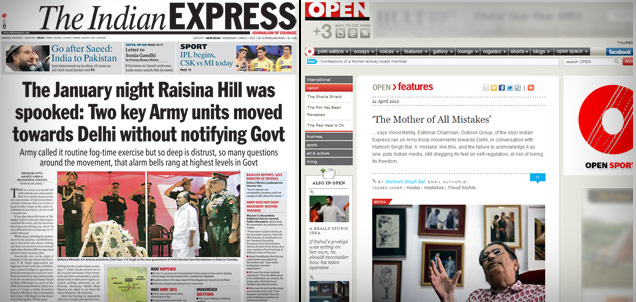
First some background. On April 4, The Indian Express carried a story by editor-in-chief Shekhar Gupta with Ritu Sarin and Pranab Dhal Samanta on two key army units moving towards New Delhi without informing the government. Ajmer Singh contributed to the report.
Vital Links
The Indian Express report (April 4, epaper)
The Open interview (April 21)
The ‘notice’ (May 15, note: source unverified and unknown)
There was outrage and denials issued by all and sundry in the government and armed forces. However, save the outbursts, it wasn’t proven that the Express story was incorrect.
Meanwhile, ever since the report appeared, The Indian Express – while still respected as a no-nonsense, credible newspaper – was the butt of ridicule by commentators and on social networks. Those in print may have been a lot more gentle, but a few television discussions were indeed scathing.
And then came this interview with Outlook’s editorial adviser (and former editor-in-chief) Vinod Mehta in newsmag Open on the issue. The headline of the interview said it all: The Mother of All Mistakes (issue dated April 21, 2012). In his inimitable style, Mr Mehta suggested that Mr Gupta was taken in by a story that was planted on the Express.
While a magazine has a limited readership, since the article was freely available on the internet and it carried a very pointed allegation by one high profile editor on another, the interview viralled in the media fraternity a great deal.
This legal notice by a lawyer representing The Indian Express and the four writers of the story – Shekhar Gupta, Ritu Sarin, Pranab Dhal Samanta and Ajmer Singh – came less than a month of the publication of the interview.
One would’ve let the notice be, but its contents make for interesting reading. So while Mr Mehta may be suggesting in the interview (and he also said amidst some cheer at the Press Club Bombay awards recently) that he quit the Independent owning moral responsibility of an incorrect story, the notice points out that in his memoirs (Lucknow Boy), he projects that he was compelled to do so. “Till now, I am unsure why I had to quit.”
The notice asks for an apology and pulling the story off Open’s internet edition openthemagazine.com. At the time of filing this report, Open hasn’t done either and two senior staffers told MxMIndia that the magazine does not intend to do either.
The notice also demands damages of Rs 100 crore each to the lawyer’s clients. That’s five of them – the Indian Express, Shekhar Gupta, Ritu Sarin, Pranab Dhal Samanta and Ajmer Singh. The Rs 500 crore damages have to be paid regardless of the apology.
MxMIndia asked a few senior editors for their views on the issue. While many of them did not want to be drawn into the controversy, there were a few who told us that they didn’t know enough of the matter to be able to comment.
Our questions were: Is the media too sensitive to criticism? Just as the Express, Shekhar Gupta & Co sent a legal notice to Open and Vinod Mehta, can governments, politicians, businesspersons and even film-makers who are critiqued by the media also send notices and ask for crores as damages?
Here are reactions from four veteran commentators:
Dileep Padgaonkar
Dileep Padgaonkar, former editor-in-chief, The Times of India:
Of course it is… the media is sensitive to criticism. The media thinks it is fit to criticise everyone but the minute everyone points a finger at the media, the media bristles. I think media should take criticism directed against it in its stride, this is part and parcel of democracy. And I don’t think one should be too prickly in these matters unless of course there is a clear case of personal attack, defamation… in that case legal course is available but otherwise one should ignore these things and go on.
As it is, the censorship of cartoons was a dismal warning of the sensitivity of the political establishment. Now if media is going to go at another section of media, there is going to be a free-for-all and the big casualty out here would be good, decent, honest journalism.
Sevanti Ninan
Sevanti Ninan, editor, The Hoot, columnist and media-watcher:
Criticism is not an accurate word for what Vinod Mehta called The Indian Express story. He essentially said it was a planted story and it was a huge mistake to carry it. Considering that the first byline on the story was that of the chief editor, that is quite statement to make. You are saying the chief editor and his colleague are susceptible to plants, thereby seriously questioning their credibility. So I guess the Express could hardly ignore it. IE did come in for a lot of criticism on the import of the story and the display given, including a critical editorial in the Hindu but nothing quite as damning as Mehta’s statements.
This is the 3rd 100 crore notice involving the media over the past year, in any case. So it is becoming more common.
Paranjoy Guha Thakurta
Paranjoy Guha Thakurta, independent journalist and commentator:
I think The Indian Express has over reacted. I think it’s gone a little over the top. They may disagree with what Vinod Mehta has said… my personal view is that it’s a point of view which obviously the Express doesn’t agree with but I don’t think that what Mr Mehta has said can be construed to be criminally defamatory. And the kind of damages sought are excessive. They are as excessive as the damages that Justice Sawant has sought from Times Now and what Times Now has sought from TheHoot. I mean these are ridiculous sums of money.
I think we’ve become an extremely intolerant society. I think people talk about freedom of expression being a fundamental right but I don’t think people are really believing in Article 19(1)A of the Constitution of India. Like so many sections of Indian society, including our political leadership which is very upset about these political cartoons that have appeared in textbooks, I think even sections of the media are becoming extremely intolerant of criticism. If you are in a democracy, you have to give the right to everybody to disagree with you.
Sucheta Dalal
Sucheta Dalal, senior journalist and commentator, consulting editor, Moneylife:
Well, not the media, but The Indian Express is too sensitive to critcism… It’s an interesting thing, it’s the first time it is happening and we should see where this goes, whether they follow through by actually filing a case. It’s the first time that somebody in the media is suing another person in the media, we need to look at how it goes… as I said everybody else is sensitive, everybody else does send defamation notices but I don’t know how many of those notices actually get converted into legal action. So we have to wait and watch.
Otherwise the notice is also a way of making a point, it’s a way of putting pressure. It’s not just Vinod Mehta, if he looks at what was said about that story on the social media, then there are a lot more people that they would probably need to sue. So maybe he is making a case out of Vinod Mehta and Open magazine, we need to see whether they follow through. I would say that the test is not in the legal notice, the test is in seeing whether they are actually going to follow through, stand in court and argue it out.
Delhi and Mumbai. At a pinch add Chennai and Kolkata, because Mamata and Jaya are there to provide copy.
2. Its notion of public opinion
What Twitter, Facebook and smses on TV are saying. Get off the computer and hit the streets to find out what’s happening to those who are not on social networking sites? Na, that’s uncool. Besides being too much work.
3. Its notion of the arts
Movies, movies, Bollywood, Bollywood. Regional stars in the field of writing, art, music: confined to the regional press unless they know how to make the scene in Delhi or Mumbai.
4. What makes news
Political spats, crime, scams. Social issues are for documentary film makers, unless Aamir Khan comes with the package.
5. Its notion of what constitutes progress for both India and Bharat
Sexy industries like telecom and IT. Education reporting means tracking the IITs. Health coverage means celebrity cancer. Primary health centres and anganwadis-what’s that and where would I find them?
Sevanti Ninan is Editor, thehoot.org and Columnist, Mint
With the ‘want to turn the mirror’ on themselves, the latest offering from the world of news is the launch of a website called Newslaundry.com. With their unique and explicit tagline, ‘Newslaundry – sab ki dhulai’, the agenda is set from the very beginning. A website which will work as the media’s watchdog.
The site was launched on February 6 and is the brainchild of one of the pioneers of modern-day news journalism in the country: Madhu Trehan. Ms Trehan founded Newstrack, a video news offering, and newsmagazine India Today.
The website has been launched with a four-member team and a few others on board. Abhinandan Sekhri, one of the founding partners told MxMIndia: “Newslaundry founders are Madhu Trehan, Prashant Sareen, Roopak Kapoor and Abhinandan Sekhri. We have three in-house writers, other than the founders. We have video editors, production people and directors.”
So why did Ms Trehan start this? What did she have in mind before she launched Newslaundry? We have the answer from the lady herself. Madhu Trehan told MxMIndia: “It evolved between my partners – Abhinandan Sehkri, Prashant Sareen and Roopak Kapoor. I have always enjoyed creating a product that doesn’t exist. That happened when I started India Today. The leading magazine at that time was The Illustrated Weekly, which belonged to a dated post colonial time. Newstrack was developed because there was no television news other than Doordarshan. Newslaundry is a product which is not a clone of any other website in the world. The nature of it creates a new space.”
So, could she not have done a similar media analysis show on mainstream television instead of doing it online? Ms Trehan was candid in her reply when she said: “It is because we did a media analysis that showed a channel is a losing proposition, so we chose to go online.”
However, Mr Abhinandan Sekhri indicated that they did try and go the television way at first: “We did try. We mentioned such a show to various TV channels but they were not ready to put it on their own channel. Also we have so many ideas and so many shows we want to make, and no channel will give us that kind of time. Besides, this is the future. The new irreverent generation consumes media online through mobile devices. Sooner than you think, more people will be consuming media in the online space than conventional TV/magazine. Time will tell which ones work better than others but one thing is for sure – there has to be a change in how we tell our contemporary political and social narratives. News has to be more than it is right now.”
On whether there is space for such a media website, Sevanti Ninan, Editor, The Hoot, commented: “Yes, there is. There is so much media and so little media watch. There is room for more entrants in this space.”
Ms Ninan echoed Mr Sekhri’s views on how no television channel is open to self-criticism. “Where is the mainstream TV channel which is willing to carry criticism of itself and its peers?”
Even though slowinternet speeds could be hurdle in an uninterrupted visual experience online, Ms Ninan is sure that the site will ‘click’ with viewers. She said: “Journalists love gossip. I think Newslaundry.com will click with them, particularly on account of the interviews with media biggies. What Barkha Dutt or Karan Thapar or Vinod Mehta say will give them something to gossip about. The interviews are a strong point.”
Ms Trehan believes the website will work because “it answers a need that is not fulfilled yet.” In fact Ms Trehan seemed confident of the differentiating factors that NewsLaundry brings to the table. She said: “The difference is that we are combining all of today’s technologies. We have text articles called Criticles. We have what we call Washboards; these are a combination of text, videos and links. We have TV shows webcast. We have cartoons. You cannot do all that on a TV channel. We have the freedom to be far more irreverent. Mainstream TV does not make journalists or journalism accountable. That’s what we aim to do. We ourselves are open to being accountable.”
On being asked on the revenue channels for the website, Ms Trehan replied that they expect revenues from the usual places. As for now, there are partnerships on with Google (and YouTube). Mr Sekhri added: “Advertising is the obvious immediate way, but in future, this space is going to change dramatically with podcasts and apps. And if anyone wants to put it on air on their channel, we’re more than happy to. We think stuff like this should be on TV too. Being able to take a dig at yourself is a sign of self-confidence which news channels need to have. And if anyone wants to pay us coz they think we deserve it, write in your cheques. Online is the future.”
 ‘The Real Beast’ is the headline this Tuesday, February 25, 2020 of The Telegraph, Calcutta. Across India’s national capital, while the State Machinery was “busy” with US President Donald Trump’s visit to India, the state machinery was busy stoking violence. State BJP leader Kapil Mishra led a rally through North East Delhi and verbally attacked anti-CAA protestors. Soon after, the attacks became physical.
 Media ownership is a worry to the extent that journalists are not able to withstand corporate pressure. For instance, the Birlas started Hindustan Times and the Tatas has a stake in The Statesman (to name just two) and the battle between marketing and editorial is as old as the profession. The problem comes when senior editors capitulate and reader interest is surrendered or sacrificed. I would turn the spotlight back on journalists: are we fighting the good fight?
 Many years back when I asked a leading industrialist why he was keen on starting a news channel he replied with the famed Deewar dialogue (some alcohol in the system did the trick): Aaj mere paas buildingey hai, gaadi hai, bank balance hai, but even then these guys owning newspapers and channels are ruling the world. We were in the late 1990s, and journalists and news media owners were indeed much sought after. That may have waned over the years, but the desire to own news media stays. What hasn’t changed is that the intent of owning the news media goes far beyond returns on investments.






 By Shruti Pushkarna