Tag: set top boxes

  • BudgetSpeak #12: Anirudh Dhoot: Need for incentives for set top boxes

    By Anirudh Dhoot


    The consumer durables industry is all set to ride high with the emergence of the new government, as new policies and initiatives will pave the way for growth and advancement. The newly formed government has already indicated a clear tax policy and interest rate rationalization which would help in the growth of manufacturing industries. With the ensuing Budget aiming to stabilize the economy, we expect a turnaround in the consumer sentiments.  The reduction of excise duty in the Interim Budget from 12% to 10% on products, inputs and parts had come as a great relief for the industry and helped the sector. CEAMA welcomes the Finance Ministry’s move to extend the concise duty concession till December 2014. CEAMA would request for this continued support even beyond December 2014 as the industry is still struggling and Index of industrial production has not shown a healthy growth. CEAMA further foresees an improvement in the industry standards, eradication of grey markets and an overall boost to the sector from the new government.


    The digitization of cable TV has created huge demand for set top boxes in the country and it is likely to reach 75 million units for next one to two years. Thus it is very important to manufacture set top boxes in the country. However, industry would need proper incentives to boost set top boxes manufacturing in the country. CEAMA recommends that the provision of ‘C’ form waver should be applicable to set top boxes. Currently, Indian manufacturers have to pay 12.5 to 14% VAT as Cable and DTH operators do not provide them ‘C’ Form, since they are leasing out boxes. However, DTH operators do not pay any VAT when they import the boxes. Set Top Box industry provides huge potential for economic activity, employment generation and saving valuable foreign exchange and increased revenue for the Govt.


    Recently, CEAMA delegation had a meeting with the Information & Broadcasting Minister and apprised him about the status of DTH industry. We are encouraged on his positive response and expecting a favourable action from the government soon.


    1. Steps should the government take to revive the manufacturing sector, in general, and consumer electronics industry, in particular

    The consumer electronics industry is currently struggling due to sluggish market and bleak weather conditions.  In order for the industry to bounce back, CEAMA has proposed recommendations keeping in mind the twin objectives of manufacturing growth and also increasing demand of the products.


    We strongly propose removal of the Inverted Duty structure on consumer electronics and home appliances, arising due to implementation of free trade agreements.  We also recommend reviewing the existing FTAs. The government should also accelerate implementation of uniform Goods & Service Tax (GST) that will lower transaction costs.


    The government also needs to provide same incentives to Home Appliances Industry which are available to Consumer Electronics Industry under ESDM policy, as Home Appliances contribute substantially to Current Account Deficit of the country. Therefore, there is an urgent need to promote manufacturing of these products and their components within the country.


    FTAs have gravely affected manufacturing in our sector. It has also resulted in loss of revenue to the government. CEAMA strongly recommend review of existing FTAs. We urge speedy implementation of Goods & Service Tax that will ultimately lower transaction costs.


    There is a general consensus in the country on speedy implementation of GST. Introduction of GST is expected to decrease compliance burden for businesses and will bring down the total incidence of taxes by eliminating cascading of taxes on goods and services. We urge that GST should be implemented soon and the tax system should be made simpler and transparent, so that the honest tax payer is not harassed.


    Small TV manufacturers who are making CRT TVs are facing very difficult situation due to demand shrinking rapidly. At present, smaller size LCD/LED TVs are not viable to manufacture due to 10% duty on the panels below 19”.  Therefore we recommended that on smaller size panels, Customs duty should be brought down to 0%, to help TV manufacturers who are SMEs.


    The production of indigenous Colour Picture Tube (CPT) has stopped and TV manufacturers in the country have no option but to import CPTs by paying 10% Customs Duty, we have  recommended that import duty on CPT be brought down to 0%.


    Anirudh Dhoot is Director, Videocon and President, Consumer Electronics and Appliances Manufacturers Association (CEAMA)
     

  • The Anchor: 5 problems that you and I will face thanks to digitization

    By A N Chorrea


    #1 You need a fresh table for the set-top box:


    So you thought the fancy 165-cm Sony Bravia would look fantastic on the bare wall of your living room. Now, where you are going to keep the set-top box? Pain, huh?


    #2 Other paraphernalia for the box:


    Like a sexy little cover for the box so that dust doesn’t settle on it when not in use. Buy an all-in-one remote and if necessary get an additional remote laminated. Build an electricity point for the set-top box.


    #3 Keep tabs on packages:


    Until now it was the cable operator who decided what you saw. Well, kinda. But now with several packages, and a variety of new channels coming on board, get ready to be picking and changing channels and/or packages.


    #4 One more monthly payment to be made


    If your existing arrangement with the cablewallah allowed you to pay just once a year, now you may want to make it a monthly cycle, until you’ve decided what package to take.


    #5 More money


    Set-top boxes for all the help/assistants at home, office, the driver… and the building sweeper and watchman. Guess one of the suggestions that someone should’ve made to the government that is that investments in buying set-top boxes will get you tax exemption. This could be sizeable given the number of boxes you’ll be buying in the immediate future.


  • Only 59% (&not 87%) digitization achieved!


    By Pradyuman Maheshwari


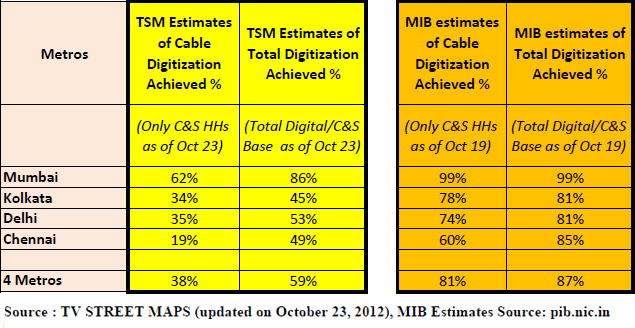
    Only 59 per cent of digitization has been achieved in the four metro as per the first ever independent survey of the extent of digitization in the four metros was conducted by Television Street Maps for MxMIndia. This number is in sharp variance to the claim made by the Ministry of Information and Broadcasting that 87% of the four metro was digitized.


    The figures for the four metros tell the story:


    For Cable & DTH:

    Mumbai: 86% (Govt: 99%)

    Delhi: 45% (81%)

    Kolkata: 53% (81%)

    Chennai: 49% (85%)

    The gap grows when you look at the achievement of digitization only in cable homes.


    Mumbai: 62% (Govt: 99%)

    Delhi: 34% (78%)

    Kolkata: 35% (74%)

    Chennai: 19% (60%)


    On Tuesday, we made a clarion call to the mandarins of the Ministry of Information and Broadcasting urging them to put an end of this charade of make-believe numbers of digitization.


    MxMIndia strongly believes that digitization is THE ONLY way in which the broadcast business can survive and thrive. For too long there has been much confusion amongst stakeholders. With half-baked regulations and guidelines, certain sections of the ecosystem were getting away with unethical practices.


    India has been among the most happening markets in the global broadcast business. Most of the world’s media superpowers are here. What was needed was some order in the business. Which digitization was going to bring in this, as it happened internationally. Unfortunately, the government has appeared to have missed  a trick in its attempt to execute this.


    The Sunset Date for the switch from analogue to digital transmission in the four metros was first fixed as June 30, 2012.  Then it was shifted at the last-minute to October 31.  When this writer mentioned that even that date looks tough to achieve, there were many in the industry who said that the momentum will build eventually.


    Although MxMIndia had been running a series starting 100 days to the June 30 deadline, we didn’t look at digitization in a big way until there 50 days left for November 1. But soon after interacting with all stakeholders, we figured that none of the numbers on the extent of digitization achieved that were being dished out could be believed.


    Jaldi 5 with Joydip Kapadia: Data based on ground-level info + professional & expert assumptions
     

    The government claimed an 87% achievement of digitization while the study conducted for MxMIndia by Television Street Maps showed this achievement to be only 59%. While this figure is for cable and DTH homes, that in cable homes alone is a low 38% as against the I&B ministry claim of 81%. MxMIndia spoke to Joydip Kapadia, Business Head, Television Street Maps on the issue:01. There is a huge variance between the TSM study figures of 59 per cent total digitization as against 87 per cent which the government is quoting. Why do you think do we have this huge difference between the two figures?

    I wouldn’t be in a position to comment on the numbers quoted in other studies. After all, whether its the authorities or TSM or other third parties releasing info about the ground, we all have to resort to diverse methodologies and assumptions. Sometimes the estimates of individual studies could vary due to the underlying assumptions considered. These assumptions work at multiple levels – each or all of these assumptions levels could influence the end result. For instance, differences in defining the areas within the city, definition of Digital TV (including or excluding DTH), total cable homes in a city extrapolated from census and other sources – are just some of the places where assumptions taken upstream within the analysis could produce variations in numbers coming out downstream – at the end of the analysis. All I can say is that our data is based on information obtained from the ground overlaid with our professional and expert assumptions.


    02. By your estimates how much do you see the 59 per cent grow to by October 31?

    It’s difficult to predict given the scale of the initiative and the number of players and variable involved. I wouldn’t like to hazard a guess.


    03. Would you see broadcasters lose out because of the delay (given more carriage fees, the delay in transparency, but then assured reach)

    We have actually not looked at these aspects so I wouldn’t like to say anything on that.


    04. Is there any one thing that you would like to see being done right if there’s a delay in the date and/or for the digitization for the rest of the country?

    We are not direct stakeholders in this and cannot offer any advice in this regard.


    05. 05. Do you think it would be prudent for the government to push the digitization date in the four metros by another three months?

    The math for all stakeholders comes down to what is the overall target to achieve vis-a-vis the seeding pace of the industry to reach that target. If that Math adds up then great, else the verdict would be to budget for greater time.


    It is then that we commissioned Television Street Maps (TSM),  India’s largest and widest channel distribution monitoring service covering over 1500 headends across  675+ cities/towns, to conduct this study. TSM placement monitoring data is provided on a weekly basis to its clients who include names such as Indiacast, One Alliance, Viacom18, MSM, Star, UTV, etc. Besides providing distribution monitoring for analogue and digital for Class-1 towns, TSM has recently started providing distribution monitoring for LC1 towns as well as Digital Track, a system to analyse Digital offerings of MSOs and DTH companies.


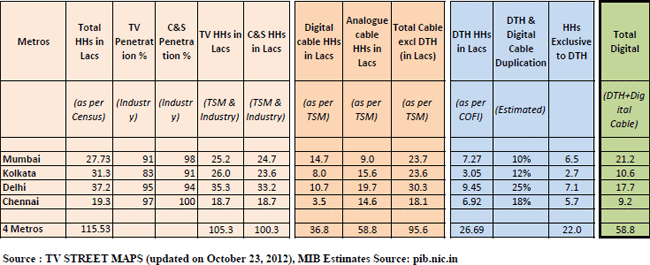
    Over the last two years, TSM has been tracking cable headends on a daily basis and reporting on a weekly level in almost a cable census style – covering every headend for the geographies it represents. While the data provided here are just the toplines we intend to provide detailed insights to our client on DAS. (see box: Jaldi 5 interview with TSM Business Head Joydip Kapadia: Data based on ground-level info + professional & expert assumptions ).


    Methodology of Data Capture:

    Over the last two years, TSM has been capturing TV channel distribution on a daily basis – the expanse of which is now a staggering 1500 headends across 675+ towns. This daily activity has been augmented since August 2012 for the four metros to capture the movement from analogue to digital at a more granular level. This augmentation/ expansion has been done using extensive ground intelligence and multiple verifications due to the criticality of the data. To ensure correctness of the data, more frequent scans were done in the last few days. The current release is for the ground situation as on October 23, 2012.


    The ground info on Analogue versus Digital has been layered with metro universes data collated from census and other third party sources to ultimately validate and put together the digital penetration data for the 4 metros.


    The sharp variance in the numbers as per the TSM survey and those put out by the government is reason for worry. But this is precisely what led MxMIndia to commissioning this study. No one really believes the numbers that are being put out by the government though MxMIndia, like other media, has been publishing these.


    MxM View

    MxMIndia recommends that the government act in a mature way on the issue. While a delay will mean a loss of face, it’s better to schedule for a time when 100 percent digitization is truly achieved. At the time of writing, we’ve heard of rumours that the government may well announce a delay by two months. We would urge the government to not look at December 31 as the Sunset Date. There is a fair amount of special programming on television planned on that day and the government would be well advised to look at a date like January 31.


    However, while doing so, it must get assurances from the governments in West Bengal and Tamil Nadu on compliance. The government must also meet all stakeholders to ensure that everyone is on the same page and is working towards the greater common good. It may be a good idea for it to appoint a full-time Officer on Special Duty for digitization. Either someone from its ranks, or pulled from the industry.


    A note of caution: there is a general election coming up in 2014, possibly earlier. Elections have been lost due to grave national issues and teary ones like onion prices. If there’s any mess-up with digitization, the government can ill-afford a crisis where the masses won’t get to watch their favourite shows on telly. Then, the cry will surely be: alag chahiye!


  • Set-top boxes consume lesser power than CFLs: MIB

    By A Correspondent


    Dismissing apprehensions that Set Top Boxes (STBs) consume lot of electricity, the I&B ministry has released a communique saying that the cable STBs consumes 20 watts of power. As the four metros approach the digitisation deadline of November1, the communique asserted, “It has been wrongly informed that the cable STBs consumes 20 watts of power.” The ministry has also released the table informing about the power rating of various Cable STBs of different makes, and it seems apparent from the table that a cable STB consumes only about 8 watts of power.


    Table 1: Power rating of cable Set Top Boxes of different makes

    STBs Make & Model

    Power consumption (Watts)1

    Active mode

    Standby mode

    Den Entertainment Networks

    Skyworth 7000

    8

    7

    Skyworth 7600

    8

    7

    Skyworth 7631

    8

    7

    DigiCable

    Indieon LDCA 1000

    5.4

    4.5

    Changhong C8899C0

    7.5

    6.9

    Skyworth C371N EN

    10

    8

    IMCL

    SD STB

    12

    10

    MyBox

    7.5

    6.9

    Hathway Datacom

    Skyworth 9000

    8

    7

    HUMA ND-1200C

    15

    5

    WWIL

    Handon 1002C

    6.5

    5.8

    Handon 1041C

    6.5

    5.8

    Arion 5012S

    7.5

    6.9

    Changhong C8899C0

    7.5

    6.9

    MyBox

    7.5

    6.9

    1 Source: Product leaflets of manufacturers


    Power consumption of different electrical household items is indicated in Table 2 below.


    Table 2: Power consumption by different household appliances

    Consumer Devices

    Model

    Power Consumption (Watts)2

    Fridge 210 Liters

    270

    Cooler (Desert) Bajaj DC 2012

    200

    Television Sony KV-SZ292M88 CRT – 29″

    138

    Television LG 14D7RBA CRT

    80

    Television Sony KLV 20S400A LCD

    60

    Television Sony KDL 26EX550 LCD

    50

    Fan Crompton Greaves – 56″

    80

    Fan Orient 32 – Table Fan

    70

    PC (Computer) HP V185E

    60

    PC (Computer) Monitor – 17″

    80

    Light Bulb Incandescent

    100

    DVD Player Sony BDP S350

    26

    Light Fluorescent Tube

    50

    Light CFL

    10

    STB Average for Cable TV

    8

    2 Source: Product leaflets of manufacturers and NPCL website


    The information issued by I&B ministry also clears that even on a standby mode, the STB would consumer less power. “Thus, cable STBs consume very nominal electricity to the tune of 5-6 units in a month which is insignificant in comparison with the electricity consumed by other electric appliances in a house,” said the release.


  • 4 national MSOs announce digital cable TV rates

    By A Correspondent


    Towards achieveing the goal of digitization, four National-level Multi System Operators (MSOs), DEN, Digi Cable, Hathway and WWIL, have announced rates for consumer packages for digital cable.  As per TRAI’s stipulation, the Basic Service Tier (BST) consisting of at least 100 channels for Rs 100 has also been announced by some of them. The bouquet rates for pay channels is:

    Name of the Package No. of Channels Rate in Rs. (exclusive of taxes)

    Digicable

    Basic 145 180
    Gold 151 200
    Premium 165 250

    Hathway Cable and Datacom Ltd.

    Basic 135 160
    Medium 198 220
    Premium 242 275

    DEN

    Pack 1 112 180
    Pack 2 219 225
    Pack 3 235 270

    WWIL

    Janta 118 100
    Popular 1( Kolkata) 151 150
    Popular 2( Mumbai) 153 150
    Popular 3( Delhi) 142 150


    Consumers will also be given the option of choosing channels from an a la carte list. The MSOs had earlier announced a combined promotional rate of STB for Rs 799.  The MSOs have also announced a consumer care service wherein toll-free numbers including consumer charters have also been made available on the respective websites.


  • Mumbai completes 50% digitization target

    By A Correspondent


    A review by the Ministry of Information & Broadcasting has revealed that in Mumbai, 50 per cent of cable TV homes have already been installed with STBs. Mumbai has an estimated requirement of 34.85 lakh STBs, and so far 17.07 lakh STBs have been installed. The MSO-wise installation of STBs in Mumbai is:


    National level MSOs: Hathway – 6.16 lakh, Den – 1.40 lakh, Digicable – 2.57 lakh, IMCL – 4.77 lakh, WWIL – 50,000 Independent MSOs - 1.69 lakh.


    Mr Ashok Mansukhani, President, MSO Alliance and director with Hinduja-owned IndusInd Media & Communications (IMCL) said: “We are committed to complete the installation by the deadline. However, since there is no agreement with the broadcasters, it is acting as a hindrance.”


    In the absence of the agreement, the price of channels cannot be decided, and the same cannot be passed on to the local cable operators (LCOs). The LCOs then have a problem giving a clear price list to the customers.


    The Cable Television Networks (Regulation) Amendment Act, 2011 has made it mandatory for switchover from the existing analogue Cable TV networks to Digital Addressable System (DAS) by December 2014, in the entire country in four phases. In the first phase, four metro cities of Delhi, Mumbai, Kolkata and Chennai are to be covered by October 31.


    The Ministry has been coordinating with the stakeholders regarding the preparedness of the industry for digital switch-over. Installation of Set Top Boxes in cable TV homes is the most crucial precondition for digital switch over of cable television.


    The Ministry is holding fortnightly Task Force meetings with all the stakeholders to take constant stock of the progress and to chalk out the measures to address emerging concerns. So far 14 meetings have taken place. The meetings are held with National level and independent Multi-Systems Operators every 15 days to assess their preparedness in terms of head-end capacities to carry minimum 500 channels from January 1, 2012 and the progress of installation of Set Top Boxes in cable TV homes. They have also been advised to prepare micro plans for completion of the requisite task within the deadline and complete all the infrastructural preparations within time.


    Meanwhile, in order to enable the MSOs to up-load the data on the website of the Ministry, the Ministry has put in place a software and the website has been enabled for the purpose of real-time collection of data. The software will automatically generate analytical information based on the data uploaded, resulting in a clear view of the progress made. This will not only be useful for MSOs and other stakeholders but also for the Ministry, as it will infuse transparency in the system, and enable timely corrective action.


  • Hathway scales up to meet demand for digitization

    By A Correspondent


    Hathway Cable and Datacom Ltd is set to scale up the availability of set top boxes (STBs) over the next four months. In addition to the previously planned deployment of 20 lakh STBs, Hathway has decided to procure another 10 lakh STBs to meet the growing demand.


    Hathway’s move is in line with the Ministry of Information & Broadcasting’s latest order on implementation of DAS (Digital Addressable System) from November 1 in the four metros-Delhi, Mumbai, Chennai and Kolkata. By infusing additional STBs in the market, Hathway believes it is poised to meet the fresh deadline, as well as ensure a smoother transition from analogue to digital for consumers across the four metros.


    Commenting on the development, Mr K Jayaraman, MD & CEO, Hathway Cable and Datacom Ltd said: “Hathway has always been committed to providing consumers with the best digital cable experience and we have been preparing to bring consumers a seamless move from analogue to digital cable TV. The modified deadline presents us with a unique opportunity to reach out to and impact a greater segment of the market. Hathway plans to procure the additional 10 lakh STBs to gear up and leverage this opportunity. Therefore, in total, we plan to deploy 30 lakh digital set top boxes across the Mumbai and Delhi. The rush for digital services will peak around the last fortnight of October and we do not want to disappoint the consumers and drive them towards the costlier option of DTH services.”


    In the first phase of digitization of cable television, all four metros- Delhi, Mumbai, Kolkata and Chennai – will switch from analog to digital transmission from November 1. The rest of the country will move to digital cable by 2014 as per the regulations laid down by the Telecom Regulatory Authority of India (TRAI) in consultation with the MIB. Due to lack of preparedness of the industry, the Ministry had recently postponed the sunset date for Phase I from June 30 to October 31.


  • The Anchor: Rohit Bansal on 5 must-dos for the sun to rise on Digitization on Nov 1

    By Rohit Bansal


    1. Govt and Ambika Soni must stay

    To state the obvious, for The Cable Television Networks (Regulation) Amendment Act, 2011 to kick in the mandatory switchover of the existing analogue cable TV networks to Digital Addressable System (DAS) in the four metros of Delhi, Mumbai, Kolkata and Chennai, the government must survive.


    Even if that’s a given, the minister Mrs Ambika Soni mustn’t be allowed to meander into party work. If she does, a new minister will take his or her own to time settle down, and pernicious lobbies for a status quo will have an upper hand.


    2. Ambika Soni and her babus get three states into action

    Though Shastri Bhavan bears the mantle of implementing the Act, the ministry of information and broadcasting (MIB) has no boots on the ground. So, unless Maharashtra, Tamil Nadu andBengalsee the DAS in their own interest, Mrs Soni, Uday Varma and Rajeev Takru, her two key satraps, won’t make progress beyond impotent bluster.


    3. There’s deeper monitoring and a few scalps on the lamp post

    Albeit coming late, TRAI regulations on Tariff & Interconnection would have had enough time since April 30 to sink in. The Quality of Service Regulations and the Consumer Complaint Redressal Regulations would have existed since May 14, requiring every Broadcaster and MSO to publish its Reference Interconnect Offer within 30 days of issue of the regulation, and the stipulated 30 days for negotiations between Broadcasters and MSOs, and thereafter, the MSOs and LCOs to arrive at agreements for us ordinary Joes would have been exhausted many times over. No one could then cite lack of time for fuzziness over the terms and conditions for installing Set Top Boxes and the prices of channels on an a-la-carte as well as on a bouquet basis. Also, every MSO or its linked Cable Operator would have no excuse for failing to put a Consumer Complaint Redressal System consisting of a complaint centre with toll free consumer care number, web based complaint monitoring system, as well as appoint or designate one or more nodal officers and publish consumer’s charter for DAS.


    Thus Verma and Takru have their tasks cut out. Implementation is their dharma, the concerned states their believers.


    4. ISRO delivers the promised launch

    For any stick that Takru and Varma may hold, the cable operator is wily enough to dodge them. What she can’t is if Indian Space Research Organisation’s much-delayed GSAT-7 multi-band satellite, carrying payloads in UHF [ultra-high frequency], S-band, C-band and Ku-band, leaves the ground and starts doing some work. It would then be left to Doordarshan’s Tripurari Sharan to show his mettle and put together a free-to-air DTH platform of 200+ channels on GSAT-7. If Sharan can swing that, the cablewalla will embrace DAS with a measure of fear if not conviction.


    5. The DTH Gorilla Begins to Maraud

    These folks have sat on their backsides sleeping over the opportunity that “DAS Confusion” presents to them. If only they can get cable operators to become LMOs and leverage some Rs6,000crore residing in their war chests, the pure-play cablewalla will see more in digitization than what the long-arm of the regulation can ever achieve by scaring him.


    Rohit Bansal is CEO & Co-Founder, Hammurabi & Solomon Consulting


  • Can we achieve the October 31 deadline?


    By Shruti Pushkarna


    Under mounting pressure from various stakeholders, the government announced an extension of four months for the first phase of digitization of cable television. Digital Addressable System (DAS) will now be effective from November 1 in the four metros, Delhi, Chennai, Kolkata and Mumbai.


    A press release issued by the I&B Ministry read: “The Cable Television Networks (Regulation) Amendment Act, 2011 has made it mandatory for switchover of the existing analogue Cable TV networks to Digital Addressable System (DAS) by December 2014, in a phased manner. In respect of four metros of Delhi, Mumbai, Kolkata and Chennai, the digital switchover is mandated to be completed by 30th June 2012.”


    But towards the end in the press note, the ministry acknowledged that keeping ground realities in mind, the MIB is compelled to set a new deadline. The statement reads, “…keeping in view public interest and after intensive and extensive consultations, as well as written commitments from all the stakeholders, for fully implementing the regulations of TRAI, the Ministry of Information & Broadcasting has decided to modify the 30th June deadline for a complete switch over to 31st October 2012 for all four Metro Cities i.e Delhi, Mumbai, Chennai and Kolkata. All the TRAI regulations for DAS will come into effect from 1st November, 2012.”


    The extension was announced notwithstanding the pending matters before the Delhi and Bombay High Courts and the TDSAT. The Bombay High Court will hear the petition on June 21 and the Delhi High Court will hear the matter on June 25, which is also the date when TDSAT will hear a similar matter filed by LCOs and IndusInd Media & Communications Ltd.


    Soon after the announcement of the new sunset date, MxMIndia spoke to various stakeholders to get their reactions on the new timeline and to find out if October 31 is an achievable deadline. While some welcomed the government’s decision for postponement to November 1, others felt that the extension issued by the ministry is not enough for the humongous task at hand.


    MSOs welcome the govt’s decision, though some still unsure of achieving the deadline

    Ashok Mansukhani

    Ashok Mansukhani, Director, IndusInd Media & Communications Ltd said: “I think it’s a sensible development and it will help in smooth transition to digitization. The new date is completely achievable, it was fully discussed in the taskforce. I don’t know about Tamil Nadu since the government there is supposed to install the set top boxes but for the other three metros, certainly it will happen. It’s a welcome step and it was fully discussed in the taskforce and it’s a natural result of the taskforce deliberation.”


    JS Kohli, CEO, Digicable said: “We are happy with the postponement. Although it’s not a six month extension but yes we can deliver on the new date. We are satisfied with the extension.”


    JS Kohli

    Ravi Gupta, Independent MSO, Delhi said: “The new sunset date is good although it is two months less than what we were expecting. They should have given a six months extension, I still don’t think we can achieve the task by November 1. A lot of digital headends are under installation and integration is what takes time. I don’t think anyone from the ministry has done a detailed study of this process. No senior official from the ministry or from the TRAI has visited a digital headend. A minimum of six months extension should have come.”


    LCOs happy with the extension but feel four months not enough

    MR Srinivasan, General Secretary, Chennai Metro Cable TV Operators Association said: “It is good in a way because we are not yet ready because in Chennai only 2 lakh boxes are available. But now atleast we have some breathing time. Moreover, the government of Tamil Nadu is planning to start some MSO operation in Chennai, so it’s some relief and we have some time to plan ahead and be ready before the sunset date. Actually we expected an extension upto December but atleast we have got a slight relief, something is better than nothing.”


    Sanjay McGee, Local Cable Operator, East Delhi said: “Although it’s a good decision, in the last meeting between LCOs and I&B Ministry, Rajiv Takru agreed that four months extension was not enough. At first the ministry refused any extension, but when we urged on atleast three months extension, Rajiv Takru stated that if there has to be an extension then take atleast six months. But they have taken a middle path and decided on four months. They shouldn’t have announced the extension at this point, they should have waited till June 29. Now the consumer will not take the deadline seriously and the pace will slow down. If we keep working at the same pace as of today, then we might be able to achieve the new deadline.”


    Swapan Chowdhury, General Secretary, Cable & Broadband Operators’ Welfare Association, Kolkata said: “I am not satisfied because four months will not cover up the whole situation. Government might have given an extension but they have not considered any facts and figures. I say that because 70 per cent in Kolkata still don’t have set top boxes (STBs), so four months are not enough for deployment of such a huge number of STBs. It will not even happen on November 1. Maybe another 20 or 30 per cent seeding will be done up till the new date but what about the remaining numbers. In the June 8 meeting with the I&B Minister it was categorically mentioned that none of the government appointed nodal officers have checked the actual seeding position or the status of ordered material. Unless and until the government studies the ground situation deeply it will again fall back. The actual facts are different from what’s being presented on paper. They should have given an extension upto atleast Jan 1.”


    Broadcasters disappointed with the postponement, suggest on strict penalties for those who don’t adhere to the timelines

    Sunil Lulla

    Sunil Lulla, Managing Director & CEO, Times Television Network said: “It’s a complete disappointment. What is the guarantee that the new date will be held, when there is a date set by law, why should the date be changed? A lot of time, money and effort has gone by broadcasters in promoting and communicating the date and making sure consumers went along. The industry and the consumer suffers because there are some parts of the entire constituent which may not have adhered to these deadlines, may not have implemented the seeding of the boxes. This was announced on the net through a press release, the government hasn’t really notified us. I think it would have made sense for them to invite all stakeholders and agree on a new date if there was to be one and to a process by which these date wont slip.”


    Rahul Sood

    Rahul Sood, Head- Network Distribution & Affiliate Sales, NDTV said: “Basically LCOs were pushing for a Jan 1 timeline and broadcasters were saying that if you have to give an extension, it should be only for three months. So I guess they have taken a middle path by extending it upto October 31. The TRAI guidelines which came out on April 30 were such that within six months there has to be implementation of the same. I think that’s the loophole that MSOs and LCOs were quoting and asking for a minimum six months extension. So keeping all that in mind, I think ministry has taken this step. But if as an industry we have this discussion again on October 20, then it’s a real shame. There should be no excuses now, timelines have been extended, now there has to be a joint willingness to from all stakeholders to make sure this happens. While they have issued this date change, I think with that strict penalties and penalization code should be put in place as well for those who don’t adhere to the new timelines.”


    An independent commentator says new sunset date ill-conceived

    Dinyar Contractor

    Dinyar Contractor, Editor and Executive Publisher, Satellite and Cable TV Magazine said: “This is not going to work, this date is ill-conceived. There is no way that set top boxes can be procured and deployed in that timeframe even if the order is released today. As I’ve mentioned earlier, delivery time on set top boxes alone is around four months so this extension makes no sense except postponing one more extension. Any date prior to end of December is not realistic and is not going to resolve the problems or the issue, which is obtaining and deploying set top boxes. So I feel that the extension is inappropriate.”


  • Cable cos expect major hike in subscriber revs

    By A Correspondent


    TRAI’s argument that carriage fees paid by TV channels to cable MSOs are necessary to fund their digitisation appears to be falling apart scarcely a week after it was made. Instead, large cable distributors have themselves said that one factor alone – a huge six-eight times hike in subscription revenues alone as declarations spiral with addressability – would significantly buttress their already profitable balance sheets.


    With additional revenues from broadband and VAS, industry estimates also say that a bundled digital and broadband + VAS business model will result in the payback period being reduced by a year to 24 months, as opposed to 36 months under a standalone digital cable TV proposition. This comes even as industry reports –including one released five months ago– have been pointing out that all major national MSOs are already adequately funded for Phase I digital deployment (mandatory only in the four metros from July 1).


    Given that the government is also shortly planning to hike FDI for MSOs from 49 per cent to 74 per cent, industry analysts have questioned why TRAI assumed MSOs and cable distributors needed money in the form of mandatory carriage fees by TV channels – an annual recurrence – to fund their upgradation, which is only a one-time investment. This is especially inexplicable, as TRAI’s own April 30 Explanatory Memorandum to the DAS Regulations states: “In the addressable systems, due to transparency in ascertaining the number of subscribers, the subscription revenue is expected to go up. Therefore, the dependence of MSOs on the carriage fee, as a source of revenue, is likely to be reduced.”


    It has been well known that the cable distributors are the profitable, cash rich last mile, with even many smaller operators who under-declare subscribers/taxes, expanding into other activities like real estate, auto agencies, ancillary services, and so on — while most broadcasters have turned sick due to a killer combo of low ad rates, gross subscriber under-declaration and huge carriage/placement fees.


    The national MSOs, are, in fact, almost all profitable, with even newer ones like Den Networks having posted a 20.7 per cent yoy revenue growth in Q3 of the fiscal just ended, including a 6.6 per cent rise in its net profit. That is why the added bonanza of TV channels having to now mandatorily pay MSOs carriage fees caused MSO share prices to jump after the TRAI tariff order was announced– even as listed broadcaster scrips sank.


    Shares of Hathway Cable and Datacom had closed on May 2 at Rs185.40, 19.23 per cent above its previous BSE close, missing the upper circuit by a small margin, Den Networks also touched an intraday high of Rs116.90, before closing at Rs110.80, 2.12 per cent above its previous close.


    Earlier, a Media Partners Asia (MPA) report (Investing in Digital India) of December 2011 had projected a six times increase in subscriber revenues for MSOs, albeit with a 20 per cent subscriber churn to DTH – but MSOs themselves reacted very positively over the TRAI tariff order.


    Hathway Cable & Datacom MD & CEO K Jayaraman told a business daily last week, that his company expects revenue to go up by 250 per cent post-digitisation. “We have 9 million homes and, at the least, we expect to double the subscriber base as 80 to 90 per cent of the carriage revenue will go to MSO. Broadly, after taking churn and loss in the carriage fee, we expect revenue to go up by 250 per cent “, he said. The company’s CFO, G Subramaniam, said during the same interview, that while carriage fees would reduce, the subscription revenue would rise from 10-15 per cent of the revenue mix currently. “This increase is likely to be six-eight times, and will make up for the loss of carriage fee”, he added. Both said that digitisation would help them grow their broadband business – already significant, given that as per Mr Jayaraman,

    Hathway already had 4 lakh broadband subscribers and a Rs 150-crore topline, which he expected would double in the next couple of years.


    Mr Jayaraman also outlined the many sources for his company’s digitisation upgrade: IPO funds and a mix of internal accruals, debt and vendor finance. He said: “The capex will be Rs1,000 crore. Of this, Rs300 crore will be spent in Phase-I and the rest in Phase-II. Phase-I is to be financed from initial public offer proceeds. A mix of internal accruals, debt and vendor finance will be deployed in Phase-II. The funding plan for the second phase is yet to be finalised,” he added.


    The MPA report – which was released five months ago – also states clearly: “According to MPA analysis and interviews, all major national MSOs are adequately funded for Phase I digital deployment. The cost of digital software and hardware has also fallen since 2007, ensuring set top boxes plus the CA card will cost about $30-40 per unit in total including duties, compared with $60 three years ago”, and adds that a number of the MSOs (like Hathway, DEN) are also ordering digital STBs in larger volumes like 1 million per annum, by which costs are lowered to at least $30 per unit.


    For instance, this report also gave company-wise details on the impressive progress they had already made on digitisation, and outlined their excellent financial situation to achieve the same. For instance, it said that Hathway had a debt to equity of 0.3x and a high promoter holding (67 per cent), hence “the company has enough head room to raise further capital”. While it said that DEN had a “comfortable debt to equity stand of 0.2x with a net cash of Rs9.5crore”, it also had sanctioned loans of Rs200 crore, which had not been drawn at the time of the report’s release. Even regional MSOs like Ortel, which might have a comparatively higher debt to equity at 1.6x as per the report, appeared comfortable placed to take care of their digitisation upgrade.


    Source: The Economic Times
    Copyright © 2012, Bennett, Coleman & Co. Ltd. All Rights Reserved


  • Nearly 10 lakh STBs ready for Kolkata

    By A Correspondent


    The Cable Television Networks (Regulation) Amendment Act, 2011 has made it mandatory for switch-over of the existing analogue Cable TV networks to Digital Addressable System (DAS) by December 2014, in a phased manner. In respect of four metros of Delhi, Mumbai, Kolkata and Chennai, the digital switch-over is to be completed by June 30.


    The ministry is very closely monitoring all the activities for the timely implementation and the quality of the Digital Cable TV service. During the high level review meetings by the Ministry, it was revealed that in the case of Kolkata, out of total requirement of about 35 lakhs STBs, over 5 lakhs STBs have already been installed, about 4 lakhs STBs are available in the stock which are being installed and the orders have already been issued for the balance requirements of STBs.


    Further it came to the notice that all the MSOs already have digital head ends and the existing channel capacity in each of the case is over 200, which is the mandatory requirement as per the Telecommunication (Broadcasting and Cable Services) Interconnection Regulation, 2012. The channel capacity is being augmented by the MSOs.


  • 53 Days to D-Day | Govt addresses industry concerns over digitization

    By A Correspondent


    The Cable Television Networks (Regulation) Amendment Act, 2011 has made it mandatory for switch-over of the existing analogue Cable TV networks to Digital Addressable System (DAS) by December 2014, in a phased manner. The digital switch-over is to be completed by June 30 in the four metros -Delhi, Mumbai, Kolkata and Chennai.


    Concerns had been raised by some stakeholders regarding the quality of Set Top Boxes (STBs) and the redressal of grievances of the cable TV subscribers. The necessary provisions have been incorporated in the Cable Television Networks (Amendment) Rules, 2012 to take care of these concerns. As per these Rules, the STBs to be supplied by the Multi System Operators (MSOs) must conform to the quality standards specified by the Telecom Regulatory Authority of India (TRAI).


    The MSOs are also required to devise a mechanism for grievance redressal, as specified by TRAI, and inform the details thereof to the subscribers. The Telecommunication (Broadcasting and Cable Services) Interconnection Regulation, 2012 has a provision that the STBs must be BIS compliant. During a Ministry review meeting with the national level MSOs, it was revealed that out of about one crore STBs required in the four metros, over 22 lakhs STBs have already been installed, about 25 lakhs STBs are available in the stock which are being installed and the orders have already been issued for the balance requirements of STBs.


    MSOs have confirmed that all the indigenously manufactured STBs conform to the BIS standard and the imported STBs not only conform to the international standard but also the BIS standard. Regarding the repair of defective STBs, the MSOs have intimated that within the warranty period of one year, a defective STB will be replaced immediately free of cost. After the expiry of warranty period, a faulty STB will be taken back for repairs by giving a replacement from the available stock.


    The MSOs have further confirmed that the Grievance Cells are being set up for resolution of disputes, if any, and the telephone numbers of the Grievance Cells would be notified.