Tag: SET Max

  • Max ropes in Archana, Shibani to co-host EI IPL

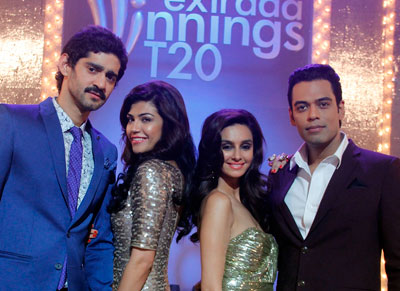
    Extraaa innings anchors-Gaurav Kapur, Archana Vijaya, Shibani Dandekar & Samir Kochhar

    By a correspondent


    Extraaa Innings T20, the flagship match analysis show of IPL T20 has roped in Archana Vijaya and Shibani Dandekar to co-host the show. They will be teaming along with Samir Kochhar and Gaurav Kapur who are regular faces on the show. The glitz and glamour added by the duo has been cherished by audiences in the past and the girls will be seen adding to the aura once again this year.


    Commenting on EI T20, Neeraj Vyas, Executive Vice President and Business Head, MAX said, “Extraaa Innings T20 has always engaged and attracted audiences across ages groups and regions, be it true cricket enthusiasts or viewers who look forward for the entertainment quotient , EI T20 possesses a perfect blend of both. We are very happy that Archana Vijaya and Shibani Dandekar are back to add to the glam quotient along with the proficient anchors Samir Kochhar and Gaurav Kapur.”


    This year, MAX will also offer viewer’s an in-depth analysis in Hindi with comments from the expert panel which include cricket stalwarts like Navjot Singh Sidhu and Ajay Jadeja. For the first time, former Pakistan captain and coach Waqar Younis will be associated with Extraaa Innings along with show regulars like Ramiz Raja, Arun Lal and Isa Guha.


  • ‘Come on, bulaava aaya hai’, says MAX

    By a correspondent


    MAX & SIX, the official broadcasters of the Indian Premier League have announced their mega marketing campaign for the Pepsi IPL 2014 titled ‘Come On, Bulaava Aaya Hai’. The campaign is inspired from the fact that Pepsi IPL is the biggest cricketing extravaganza in the world.


    The campaign kicks off with a series of four films set in diverse situations of different people’s life reaching a crescendo with three films and culminating into a final bulaava film. Be it a runaway bride drawn to the call of the IPL bugle, a son by the side of his ill mother or a priest struggling to free a woman possessed with a spirit, all films have the essence of the key nuance of IPL  ‘Bulaava’  prompting people to literally drop everything to watch Pepsi IPL.


    The entire campaign is the brainchild of the creative agency Havas Worldwide and has been directed and filmed by noted ad film director Rajesh Saathi of Keroscene Films.


    Neeraj Vyas, EVP and Business Head, MAX expressed, “In India, nothing supersedes the passion for cricket and during the IPL, that passion rises to an all-time crescendo. That is where we draw our latest campaign ‘Come On, Bulaava Aaya Hai’  emphasizing that irrespective of anything that takes place in your life, the calling for the IPL will always reign supreme. This enthralling campaign coupled with world class talent on display is sure to entertain our viewers through this edition of IPL.”


    Vivek Rao, Executive Creative Director, Havas Worldwide said, “The campaign idea of ‘Come on, Bulaava Aaya Hai’ is played on a simple truth – no other property provides more action, more entertainment or more opportunity whether you’re a viewer or a player. So no matter what calling you have, it’s the call of the IPL that’s more irresistible. After last year’s campaign, we needed something that would entertain as well as move the IPL brand forward. This seemed instinctively right.”


  • 10 Things about the IPL we never want to see (or hear) again


    By Ranjona Banerji


    Now that the Indian Premier League is over… no, no, I’m not making a forecast to make N Srinivasan’s life even more miserable, I mean this edition of the IPL. Where were we? Right, now that IPL 2013 is over (and who knows what lies in the future), we at MxM and some random members of the general public – like our sons-in-law and nephews – have compiled a list of things we never want to see or hear again.


    1 The Jumping Jhapak or Jhampang or Dhumping Dhapang song

    What were the words exactly? Never understood a word but I somehow objected to Sameer Kocchar and that other man making kissie faces at us. On the other hand, during that pathetic opening ceremony in Kolkata, the Jumping song was the highlight of a lacklustre and long evening. Of course, that was only the first time we heard it. And I watched the opening ceremony on Sony Six HD. Which means there no commercial breaks. Which means that every time SET Max went to an ad break, we had to hear the Jumping song. Which means that by the end of the evening, we were sick of Jumping, Shah Rukh Khan, Pitbull, Deepika Padukone and Katrina Kaif.


    2 Bad Cheerleader Outfits:

    Why do they have to look like they’ve been outfitted by Maganlal Dresswalla of the 1970s? Nothing seems to fit, the lycra or spandex looks cheap and the bizarre attempts to protect “modesty” backfire. Anyway, if Padukone and Kaif could prance around in the costumes they wore for the opening ceremony, why should these cheerleaders be dressed so badly?


    3 A Studio full of Clueless Girls:

    We’re all for gender equality. But what is the point of these women who know nothing about cricket and are more concerned with speaking in incomprehensible accents than saying anything substantial. Every year, this attempt by Sony to glamorise the Extraaa Innings studio gets worse and worse. It’s reached a stage where you almost start missing Mandira Bedi and that’s saying something. I have nothing against these ladies in this edition, but one dressed like she had used upholstery fabric and baroque household artefacts to ornament herself and the other looked like her dress was so tight that she could hardly breathe.


    4 Media Hypocrisy:

    Yes, yes, I know this is wishful thinking. But first the media goes gaga over everything IPL and how wonderful it is. And then when something goes wrong, all the journalists say they always knew it. Bull. If you “always” knew, why didn’t you say something before?


    5 Uncomfortable Looking Board Members and Sponsors at Post-Match Presentation Ceremonies:

    They look like they don’t want to be there and we don’t want them to be there so why are they there?


    6 Owner People Who Have Not Paid Their Staff Salaries and Are in Other Financial Imbroglios:

     Yes, it is disturbing to watch Vijay Mallya and the Roys of Sahara prancing around in this giant extravaganza. Yes, Sahara may or may not be there any more, but still.


    7 Owner People in General:

    We’re just bored of them, no? They look less glamorous than they did before and this dugout business has lost its novelty.


    8 Spot-fixing:

    Why can’t we get self-righteous, eh? It’s not just bringing disrepute to cricket; it’s cheating us, the viewing public and you, the cricket fan.


    9 No More Hysterical Confusion:

    Someone to understand the differences between spot-fixing, betting and living a lavish lifestyle. The three may be connected and they just as easily may not.


    10. No More Rahul Mehra, Sanjay Jha and Boria Majumdar in News Channel Discussions:

    … for a while at least. Please.


    Ranjona Banerji is a senior journalist and commentator based in Mumbai. She is also Contributing Editor, MxMIndia. She can be reached via Twitter at @ranjona. The views here are her own


  • Data reporting is complex as of now: Neeraj Vyas

    The start to the sixth edition of IPL couldn’t have been better. At 100 million, the week 1 numbers from the tournament has generally surpassed expectations. But the sentiment is not as cheerful for Neeraj Vyas, Business Head of SET Max. According to him, the viewership numbers could have been more than what was reported had the digitization exercise not been underway. Especially data being reported from LC1 towns, which is turning out to be problematic for broadcasters, according to Mr Vyas.


    Mr Vyas shares his viewership sentiments with Johnson Napier of MxMIndia, and what he expects from the tournament in the coming weeks.


    The opening week numbers for IPL 6 seem impressive. Has the outcome been along expected lines?

    We have reported 100 million viewers this year compared to 78 million in the first week last year. So in a way it is good. But given the fact that TAM’s reporting of numbers has undergone such a sea change since September 2012 when the DAS exercise kicked off…that is when a change was observed in the Universe size. That was also a time when the LC1 data started to be reported and the weightage again changing to 20-25 per cent of the total Universe…this suddenly resulted in ratings coming out of rural India out of nowhere. If you were to do an apple-to-apple comparison, all of this was not happening last year. Also when the IPL 6 started off was when the phase II of DAS was underway…so it’s a fairly complex data reporting environment right now where there could be a lot of abnormalities. I am not saying there are but there could be. So given all the flux in the market, the fact that we opened to these numbers goes to show that there is a massive appeal in the IPL and that through our efforts we have managed to get viewers to come and sample the property by large numbers again this year.


    But digitization in a sense has helped you to attain high viewership numbers, hasn’t it?

    Digitization has indeed helped; if you see the GRPs of SET Max it has jumped from 134 last week to 245 this week. We have virtually driven the growth with this property.


    Despite the rise in overall viewership, the average match ratings for the first week have remained steady compared to last year. Why haven’t the numbers seen a spike?

    As I said, the LC1 data from markets like MP, UP etc have an audience base of 0-50,000 which translates to very minute and small towns but these places will never give you high ratings because of the problems faced like power shortage for 7-8 hours etc…so television numbers for channels including GECs have only come down due to LC1. Also, the advertiser doesn’t buy a spot in the IPL to reach out to the LC1 audiences…so if you remove the LC1 audiences and compare it to what it was last year then there is a growth at an all-India level of 4.1 and in HSM markets at 4.5. So it’s a hugely successful story for us.


    Do you think you were able to achieve the 100-million mark primarily due to the marketing initiatives undertaken? Any other factors that helped propel you to get there?

    The marketing initiative has indeed worked well for us. The track is something that is being loved and imitated by audiences across age groups. It has helped lift the happiness factor among the masses and the marketing execution has only fuelled in it getting there.


    Does this feat prove wrong the notion that cricket is seeing a downfall in India in recent times?

    IPL is a brilliant mix of cricket and entertainment. The matches have been good so far and the intensity has been phenomenal. So the start has been excellent so far.


    With such a bumper start, what are your expectations from the rest of the tournament?

    It’s too early to predict. As I said, because of the DAS 2 issue there is always going to be a fluctuation in the numbers that get reported…some places digitization is happening in other places it is not..and we are talking about 38 cities here. Had it been any other year I could have given an estimate but that looks difficult right now with the DAS exercise underway.


  • IPL 6: In the mood for Extraaa

    The nine IPL team captains line up after signing the MCC Spirit of Cricket board at the Pepsi Indian Premier League opening ceremony held at the Salt Lake Stadium in Kolkata on April 2. Copyright: BCCI. Photo by Ron Gaunt/SPORTZPICS


    By Johnson Napier


    The opening ceremony of one of today’s most popular and expensive sporting properties may have matched its impressive track record over the years. And the organisers could thank celebrities like Shah Rukh Khan, Katrina Kaif, Deepika Padukone, rapper Pitbull et al who were joined in force by cricket legends as they steered their way into winning the hearts of the audiences. In fact, the viewership numbers being predicted from the opening ceremony this year is expected to exceed 55 million, a fact that is being reported extensively even across foreign media.


    There’s no doubting the effort that has been put in by the organisers and broadcast partner Set Max as the task facing them this year was winning back the audiences that had gone adrift over past few seasons. Apart from a string of new measures and a high-profile marketing campaign, the buzz that was created around IPL 6 was dubbed as being the loudest so far, or so is the claim. Much of the credit to that is being owed to ace choreographer Farah Khan who bought in an element of newness this year with some signature moves involving cricket.


    Highlighting the experience this year, Neeraj Vyas, Business Head, Max said, “Firstly, the sentiments have been very positive around the IPL. It follows India’s recent performance against Australia which has kind of boosted cricket sentiments in the country. The other thing about the IPL is that it is cricket of the highest quality and degree and is extremely competitive and edgy, but there is also a lot of entertainment value attached to it. For example, the IPL campaign that we did around IPL this year is very entertainment-led and had director-choreographer Farah Khan playing host. As you’ll observe she is advocating everyone to not just sit but to be a part of the game by dancing to three key moves commonly associated with cricket – fours, sixes and falling wickets.”


    In fact the campaign has been a huge hit on the online space where it has crossed the 2 million mark on YouTube. “So the whole scale around IPL is much bigger this year than last year. It definitely has managed to arouse enough hype and curiosity. In fact if you see our marketing budgets, we have invested 15 per cent more than last year. There has been a substantial effort that has gone behind the marketing campaign this year. The same can be reflected through the huge buzz and reach that can be sensed everywhere and across all platforms.”


    Not to be left behind in the production department, Set Max has gone the extra mile this year where its studio and expert panelists are concerned. Affirmed Mr Vyas, “We have a brand new set of Extraaa Innings this time around; it is a set that is bigger than any other set that you’ll see in recent times. And joining Gaurav Kapur and Samir Kochhar will be two new hosts, Karishma Kotak and Rochelle Maria Rao. The there’ll also be big names associated with cricket like Navjot Sidhu, Harsha Bhogle, Ajay Jadeja and Sunil Gavaskar. What we’ve also done is added new names to the roster like Kapil Dev and Rameez Raja. They’ll primarily be driving the show in Hindi. So it’s also the best line-up that we have where studio names are concerned.”


    Not wanting to stop at that the broadcasters sensed immense opportunity in reaching out to the masses beyond the metros and tier 2, 3 towns and who until now were denied their share of voice in the affair. The wishes of the many Indians who reside in far-off towns and rural belts will be realised as they can enjoy the matches in Hindi as well. Asserted Vyas, “Another new addition this year is the airing of content in Hindi. That was done to essentially reach out to interior pockets of India who are more comfortable with Hindi commentary. Also, if you saw our coverage last year we had upped our quotient of Hindi usage on XIDs. So there was a lot of Hindi banter that happened between the expert panellists which was a decision that was taken intentionally. And this year we have just expanded that by having a dedicated Hindi feed. So the idea was to reach more and more people.”


    Number-crunching affair

    It has been widely reported on how the IPL this year has heeded the demands of the marketers and have offered them advertising value worth a steal. According to estimates, the channel expects to earn close to Rs 900 crore overall this year and much of this will come from top clients like PepsiCo, which is the title sponsor for the tournament, having signed a deal in the range of Rs 50-60 crore. Set Max has also sealed associate sponsor deals with eight clients including Godrej, Havells, Panasonic, Karbonn Tabs, Usha International, Cadbury, Tata Docomo and Samsung Mobiles.


    Highlighting the response received from the clients this year, particularly new entrant PepsiCo, Mr Vyas said, “The response from the clients goes to show that IPL is still a massive brand and secondly, as I said earlier, it is the reflection around the positive buzz surrounding Indian cricket at the moment. So there has been an extremely positive sentiment from the viewers as well as the advertisers.”


    He added, “Client-wise if you ask me, the best thing to have happened is Pepsi’s association with IPL – who are the on-ground as well as on-air partners. Given their past history, they will naturally bring in their own flavour to the tournament. I know for a fact that they are planning some special campaigns that will begin during the IPL. In a sense, Pepsi probably understands cricket better than most other brands as they have been associated with the sport for around 15-20 years. So one can expect them to bring in their own creativity around cricket, which is always entertaining to say the least.”


    Confirming Mr Vyas’ sentiments, Vinit Karnik, Head of Sports and Live practice at GroupM ESP said through a statement, “We’ve been part of IPL since its inception and we strongly believe that IPL is India’s biggest and the most powerful marketing platform for brands to leverage the combined appeal of cricket and entertainment. This season has been a busy and fruitful season. We had the opportunity to work closely with the Sun Group’s Sunrisers and have enabled the new franchise get off to strong start with 10 on-ground official partnership/sponsorships including Make My Trip, 7UP, Garnier, Kingfisher, Live In Jeans, Manyavar, Sheltrex, RN Sports etc…. We also advised Vodafone backed by a comprehensive valuation exercise based on proprietary data and insights which helped them build a case to renew their on-ground associate sponsorship for another 5 years. Other high profile deals which we managed to facilitate this year included Bajaj Allianz and Mumbai Indians, Flying Machine and Royal Challengers Bangalore among others.” The total value of all the on-ground deals enabled and activated by GroupM ESP in IPL 6 is estimated at US $ 15 mn.


    On to another important number that’s watched closely by all, the ratings for IPL 6 is expected to outdo that put up by the previous season. According to statistics released by MEC-Meritus, average TV rating for the league stage is expected to go up from 3.8 last year to 3.9 – an increase of 2.6% (15+ years, Male/Female, SEC ABC). Also, MI (23%), Chennai (19%) and KKR (14%) are the most popular teams while support for Hyderabad has gone up by 200% (2% to 6%). Further, the study notes that Sachin Tendulkar (80), MS Dhoni (79), Yuvraj Singh (76), Virat Kohli (74) and Virender Sehwag (73) are the most popular Indian players in the League while Chris Gayle (60), Ricky Ponting (55), Brett Lee (51) and Kevin Pietersen (50) are the most popular foreign players.


    T Gangadhar

    T Gangadhar, Managing Director, MEC India, said, “Our study suggests that the IPL seems to have matured as a property. The study clearly establishes that ratings in the first phase (first 18 games) impact the fate of the entire league. With Pepsi activating their title sponsorship in a big way, the BCCI launching the IPL Fantasy League and India’s strong performance against Australia, the first stage of the league could get further momentum.”


    According to Mr Vyas, in terms of ratings expectations, “People need to realise that IPL is now a mature and a long tournament that last 76 games spanning 54 days. Nothing of this scale ever exists in the country. In fact about 30 per cent of the games are played in the afternoon…so despite all these ground realities it sustained an average rating of 3.5 last year, which according to me is nothing short of a miracle. If you look at GEC shows today, no one manages to retain audiences over such long periods. And this despite the fact that about 30 per cent of the matches are played in the afternoon. So we will be happy if we are able to retain the ratings at that level or even better it to around 4 or so.”


    Amin Lakhani

    Agreeing with Mr Vyas, Amin Lakhani, Principal Partner, Mindshare said, “I’ve always maintained from the start that where cricket and especially IPL is concerned, there has been a positive sentiment observed. It kind of picks up in terms of popularity and buzz closer to the start of the tournament. The thing about IPL is that it is now a time-tested property; only last year was an aberration. It has always been a winning property and will continue to do so. It is too early to write it off. And frankly, I am not even bothered about viewership as it a 76-match affair spread across 54 days…whatever ratings it has achieved has been brilliant so far. I can’t think any other property that has managed to do so in such a scale and manner. Where viewership is concerned, I feel even if it manages to hold at 4 or above would be a very good thing.”


    Mona Jain

    But feelings seem to be mixed for Mona Jain, CEO of Vivaki Exchange, who remarked, “I expect the ratings to display a similar trend to that of last year. Also, where the campaign is concerned I believe they should have started that much earlier on mediums like television, outdoor, radio etc. And the fact that IPL is an established property maybe that’s the reason the broadcaster maybe wanting to push the property closer to the start of the event. I guess more emphasis was paid on leveraging the event then trying to build it up.”


    While there may be a few naysayers who’ll be raising questions on the waning demand of the sport in India, SET MAX would want to prove them wrong by posting numbers a notch better than at least the previous season. One will have to wait and watch if King Khan managed to work his charm to at least get the inaugural event off to a flying start.


  • Where the economics stand for 4 key stakeholders post IPL’s fifth season

    By Ravi Teja Sharma


    Beyond the brawls and the bustups, there was cricket. And business, which became steadier and better. As millions continued to watch the cricket, IPL 5 strengthened the league’s business credentials.


    Franchises

    Their costs are mostly fixed and they are squeezing more out of each revenue stream. In the humdrum of IPL3, the operative word was ‘valuation’. The then-IPL chief Lalit Modi proudly announced two new franchises, Kochi at $333 million and Pune at $370 million.


    In other words, Pune’s owner, the Sahara group, was paying 3.3 times the priciest original franchise (Mumbai, $112 million), setting a new benchmark for valuing a team.


    More insanity followed: Modi was dismissed by a tweet, Kochi imploded, and Sahara had second thoughts about its $370 million investment. Sanity returned in season five. “Initially, it was more about valuations, not viability,” said Venky Mysore, CEO of the Kolkata team. More than any other season, IPL 5 has been about viability.


    Not of the surviving kind, but of the thriving kind. “For the first time, most of the franchises will be financially better off,” said IPL commissioner Rajeev Shukla.


    “Many have become profitable after IPL 5.” Like Kolkata. “We reduced our combined losses by about 50 per cent in IPL 4,” said Mr Mysore. “This year was equally good or better than last year…we should wipe out the remaining losses.” Chennai and Delhi say they have been profitable since season three, and that this year was better.


    The economics for a franchise are simple. Every franchise incurs two kinds of costs, and both are essentially of a fixed nature: the licence fee and player costs.


    For a metro franchise, the licence fee is around Rs35 crore a year, while the player cost is Rs55 crore. Add sundry expenses, and a franchise is looking at total costs of Rs100-120 crore. On the revenue side, there are essentially three revenue streams.


    The biggest revenue contributor is the ‘central pool’. All the money the BCCI raises by selling broadcasting rights and sponsorship goes into a common pool. The BCCI keeps part of this and distributes the rest among teams.


    With the BCCI negotiating hard with the broadcaster and sponsors, each franchise’s share of the central pool has steadily increased-from Rs29 crore in season one to Rs40 crore in season four.


    “The central payout will increase to Rs 50-60 crore this year,” said Mr Shukla. The franchises have no control over the central pool. They do have control over the other two main revenue streams: ticket sales and sponsorships, from where the good franchises raised, on an average, Rs30 crore and Rs30-40 crore, respectively.


    In both these areas, IPL-V saw the franchises, with one eye on growth and another on the bottom line, pushing new levers. Teams say they increased ticket prices and reduced the number of passes, and consequently made more.


    “Gate collections in season five would have doubled compared to earlier years,” said Rakesh Singh, joint president, India Cements, the South-based cement company that owns the team, without giving specific numbers.


    Amrit Mathur, CEO of the Delhi team, too declined to share numbers, but described ticket sales as “phenomenal”. “We limited passes only to our contractual agreements,” he said. What teams did more was to reach out to the paying fan.


    Kolkata, for example, had 10 cars going around the city and doubling up as ticket counters. The team also did corporate sales to fill up the 80,000-seater Eden Gardens.


    For next year, it is looking to convert some of those seats into hospitality boxes, whose revenue potential is 20 per cent more. Teams earned more from sponsors too by selling advertising on 10 designated spots on a player’s uniform.


    “We expect it (sponsorship revenues) to be 50-75 per cent higher than year one,” said Mr Mathur. Chennai’s strategy was to cut back on sponsors. “We wanted to clear the clutter and charge more instead,” said Mr Singh of the Chennai team, whose sponsors include Aircel, Gulf, LifeOK, Amrapali and Usha.


    Some other nascent revenue streams are gaining ground, like merchandising. “About 10-12 per cent of our revenues this year came from licensing and merchandising,” said Colonel Arvinder Singh, COO of the Punjab team. And the Delhi Daredevils is looking to lend its name to sports bars, the first of which has come up at the Delhi airport.


    For teams owned by corporates, in addition to a tangible payback, there’s also an intangible one for the main business. For example, all the branding on the Bangalore players is from the liquor and airline brands owned by team owner Vijay Mallya.


    “That has been our main priority,” said Russell Adams, vice president-commercial operations for the Bangalore team. Similarly, India Cements has used IPL to drive into markets other than the South.


    Besides the visibility from player jerseys, it has been wooing cement traders in cities in Gujarat, Madhya Pradesh and Rajasthan with a package of an IPL match in Chennai and a pilgrimage to Tirupati.


    “This was a masterstroke for us: to enter a market dominated by biggies like Ultratech,” said Mr Singh. It all contributed towards viability-of the long-term kind. And valuations, today, stand forgotten.


    Broadcaster

    Viewership addition tapered, but it’s still a critical mass watching. There’s pressure on two of the numbers that matter for SET Max. According to TAM, which tracks TV viewership, the number of people who tuned into IPL grew just 0.4 per cent this year, against 12.9-19.8 per cent in the previous ones. And they watched less.


    If they saw 4.5 per cent of all the minutes they could have in the first three years, they saw 3.5 per cent in 2012, the same as in 2011. Or, a TVR (television viewership rating) of 3.5 per cent. That said, even a TVR of 3.5 per cent is top draw, more so if it comes with a reach of 162.9 million.


    “No programme will give the pan-India reach that IPL does for two months,” said Nandini Dias, COO of media-buying house Lodestar Universal. It is why, she added, SET Max commands a 60-70 per cent premium in pricing over another programme with an identical TVR.


    This year, SET Max charged Rs5 lakh per 10 seconds, the same as in 2011 and 150 per cent more than in 2008. “Ratings fell, but we did not drop our price,” said Rohit Gupta, president of Multi Screen Media, which runs SET Max. Mr Gupta declined to disclose revenues, though he admits it is “lower than 2011”.


    A senior official from the channel, not wanting to be named, said revenues from IPL-IV crossed Rs1,000 crore, against Rs800 crore in IPL 3and Rs260 crore in IPL 1. SET Max’s original deal, struck in 2008, was for $1.02 billion (about Rs 4,000 crore) for 10 years.


    This was revised in 2009 to $1.64 billion (Rs 6,560 crore) for nine years. When the number of matches increased from 60 to 74, in 2010, this number increased further, said Mr Gupta, on a “pro-rata basis”. Back-of-the-envelope calculations show the current deal would be for about Rs 8,000 crore and that SET Max needs an average of Rs 1,050 crore a year over the remaining five years to break even.


    “IPL has become a brand that is big enough to sustain for many more years,” said Piyush Pandey, executive chairman of Ogilvy & Mather India. Added Ms Dias: “If IPL remains in the top five programmes through the coming year, it could still command its 60-70 per cent premium.”


    The other broadcaster, Times Internet, which owns the rights for international broadcast, Internet, mobile and valueadded services, and radio, expects to break even this year. According to CEO Rishi Khiani, Times Internet is paying Rs 67 crore a year to BCCI.


    It reached 26 million viewers this year-an increase of 55 per cent over 2011. “If you sell it right, there is an opportunity,” said Mr Khiani.


    Sponsors

    They got their bang, in different ways. For more, they will likely have to pay higher. IPL’s main sponsors only have good things to say about their pricey tie up. The established talk about reaching a wider audience.


    “We were well-known in the north, but now have spread awareness in other parts as well,” said Rajeev Talwar, group ED at DLF, which paid Rs 40 crore a year for the title sponsorship. The fledgling talk about IPL as the main piece of their brand strategy.


    Karbonn Mobiles started in 2009 and tied up with IPL in 2010. Sashin Devsare, ED, said IPL put Karbonn “in the consideration set of a mobile buyer.” Likewise, Volkswagen, which came to India in 2007.


    “We needed to raise brand awareness,” said Lutz Kothe, head of marketing and PR, Volkswagen Passenger Cars. “All these sponsors would have got five times worth exposure for every rupee spent,” said Hiren Pandit, managing partner with media-buying agency Group M.


    “But over a period of time, that exposure becomes a blind spot if there is no other engagement.” For example, Vodafone used ad campaigns to push specific business ideas: ‘happy to help’ in 2008, the Zoozoos in 2009 and 2010, 3G in 2011, and Internet services this year.


    In contrast, DLF was content being the title sponsor and having an on-ground presence. All sponsorship deals are due for renewal.


    “Most were done on an anticipated performance of the league,” said Basabdutta Chowdhury, CEO of Platinum Media, a unit of Madison World. “Now that it has a proven record, BCCI would be looking at higher value.” The season of BCCI hardball is beginning.


    Promoter

    BCCI’s golden goose is IPL and it is making it work overtime. Just how important the IPL is to the entity that runs cricket in India can be gauged from one statistic. In 2010-11, the IPL accounted for 48 per cent of the revenues of the Board of Control for Cricket in India (BCCI).


    Add revenues from the Champions League Twenty20, which owes its existence to the IPL, the figure shoots up to 60 per cent. IPL is BCCI’s golden goose, and the board is making it lay as many eggs as it can.


    This means birthing new revenues streams by adding more dates to a packed cricketing calendar or earning more from existing streams by negotiating hard with those who want a piece of the IPL. Both have yielded smart financial payoffs for the BCCI.


    Thus, in 2009, was born the Champions League, which essentially gives the BCCI and the top four IPL finishers a revenue kicker. The same year, BCCI renegotiated the TV deal with Set MAX and squeezed out 78 per cent more.


    In 2011, it added two teams to the IPL (one has since folded) at a valuation that was about thrice the maximum from the initial lot in 2008. Overall, the number of matches increased, which translated to higher TV and sponsorship revenues.


    The BCCI earned more. So did the franchisees, as the BCCI shares some part of its broadcast and sponsorship revenues with them. BCCI’s ‘surplus’-the equivalent of a corporate net profit-has increased from Rs 11.6 crore in 2008 to Rs 118.8 crore in 2010.


    Numbers for the last two years are not available, though the BCCI had forecast a surplus of Rs 209.9 crore for season four.


    “BCCI revenues have gone up,” is all that Rajeev Shukla, commissioner of IPL and vice-president of BCCI, is willing to disclose. Revenues could increase further as all sponsorship deals are due for renewal now. And even as it says it will address scheduling concerns, the BCCI has allowed all franchisees to play three T20 matches with teams from tier-II cricketing nations like Canada, the US, Netherlands and Ireland.


    “This will spread awareness about IPL and improve the league’s reach next season,” said Mr Shukla. And also improve the BCCI’s financial health.


    Source: The Economic Times
    Copyright © 2012, Bennett, Coleman & Co. Ltd. All Rights Reserved
     

  • [MJR] IPL symptomatic of the end of civilization

    Ranjona Banerji

    By Ranjona Banerji


    There’s only one newsmaker this morning and that’s the IPL. As Manoj Tiwary hit a four over Chepauk stadium winning the title for the Kolkata Knight Riders, season five of a very successful Indian Premier League comes to an end.


    And what a season it has been – a film star team owner fights with a security guard, another film star team owner castigates a third umpire for being unfair to one of her players, a player assaults a woman at a party, five players are exposed for spot-fixing and the management is exposed for unfair processes in the buying and selling of players… have I left anything out?


    And then there’s been the cricket. The drama over Saurav Ganguly now being with the Pune Warriors, the expectation that Sachin Tendulkar would soon reach his 1000th Test century, the thrilling last ball finishes, the sentiment attached to Rahul Dravid and all the news finds.


    And of course, the media. For some, like the ultra-bore Boria Majumdar parked in the Times of India stable, the IPL is symptomatic of the end of civilisation. The erudite Ram Guha doesn’t like it either. A player misbehaves at a party and a couple of former players threaten to go on a hunger strike – which I don’t think happened. Or at least, everyone forgot soon after. The TV channels also decided that IPL was the thin end of the wedge before the human race sinks into an irreversible path of iniquity. I would say the same thing about TV news as far as the fate of the media in India is concerned but…


    Sharda Ugra in The Indian Express lauds the good things, hopes the BCCI will fix the bad things and then focuses on what was really wrong with the IPL – the terrible pre and post shows on Sony’s SET Max, Extra Innings. I think there may be an extra ‘a’ in there for some inexplicable reason. Having dispensed with the dispensable Mandira Bedi, we have had the unpalatable and hysterical Gaurav Kapoor and those two girls foisted on us. Isa Guha, since she understood cricket and took it seriously, was a rare breath of fresh air. Why those two badly dressed, screeching and oddly accented girls had to interview minor starlets on the grounds was not explained to us. The cheerleaders in the studio were the worst available. I cannot understand a word Navjot Singh Sidhu says so I was spared tearing my hair out. My only concern was that he needed to go on a diet. Ever since Harsha Bhogle had a hair transplant, I cannot but concentrate on his new fringe to the exclusion of his platitudinous and fatuous observations on cricket.

    Ugra, I have to confess, was not this nasty.


    Mid-Day’s headline “Ra.Won” is the winner of the day. The Hindustan Times gave us a sort of truncated report, obviously written in a hurry and the reporter clearly did not like Shah Rukh Khan. The Times of India had a better report – a real surprise since its sports coverage has sunk to new lows recently – but its reporter is clearly no fan of MS Dhoni’s and called him out for his “standard tricks”, in this instance, slow over rate towards the end of the match.


    Now that the IPL is over however, it will be interesting to see how our perpetual moaning machines in the media will fill up their time…