Tag: self-regulation

  • Jaldi 5 with BCCC chief AP Shah: Unedited foreign programmes lead to more complaints

    By Ananya Saha


    The Broadcasting Content Complaints Council received 8,628 complaints and suggestions as of November 30, 2012. Should it be a cause for concern? Should the industry focus more on self-regulation? MxM India spoke to BCCC Chairperson Justice (Retd) AP Shah about the issue.


    1. What kind of role does BCCC play in the regulation of the broadcast medium?

    We have to strike a balance between preserving free speech and expression on the one hand, and on the other see that the guidelines and advisories are followed.


    2. What are the major complaints or suggestions that BCCC gets?

    Broadly 47 percent of complaints are on sex, vulgarity and nudity. Some 30-40 percent pertain to harm and violence. Others are related to religion or are general complaints. I think the complaints have increased due to increase in import of foreign programmes, which are telecast unedited.


    3. What is the advisory you issue on ‘unedited’ programmes?

    Some are asked to go off-air, or some episode is asked to be pulled. Or be put in night slot, which is the restricted slot of 11 pm to 5 am. Or we ask them to modify the content. The good thing is that when it comes to self-regulation, we have had 100 percent compliance from the channels.


    4. What about content on regional entertainment channels?

    Yes, there are concerns in regards to regional channels. We receive a large number of complaints from South but since we do not know the language it becomes a problem. We get complaints in language programmes such as Kannada, Telugu, Tamil; not so much in Malayalam though. We need to have a BCCC person in South India who understands the languages.


    5. Does MIB interfere with BCCC’s advisories?

    No. There are times when the ministry refers a complaint to us. But the ministry has not interfered with our work. We have fairly succeeded in implementing the guidelines.


  • Make ASCI membership compulsory: CII white paper

    By A Correspondent


    The CII National Committee on Marketing has released a white paper on “Self-Regulation in Advertising in India – A critical Evaluation”. The paper identifies key concerns regarding misleading advertisements and analyses the issues. It also critically evaluates the role and responsibilities of all stakeholders – regulators, industry, activists and consumers. The paper further suggests that the solution to the problems posed by misleading advertisements is not to add one more legislation in the form of an Administrative Authority as proposed by Department of Consumer Affairs (DCA), and only in cases of non-compliance of Consumer Complaints Council’s (CCC) decisions should the matter be referred to any other regulatory body.


    Adi Godrej, President, CII, said, “This white paper reinforces that self regulation in advertising works, as seen in over 70 countries already. In India too, we believe in the efficacy of ASCI to regulate misleading advertising and more importantly its ability for speedy redressal. We urge the Department of Consumer Affairs to reconsider its recent proposal to set up a parallel administrative authority, which we strongly feel will delay the process of consumer redressal and be counter-productive to its intent. Instead, we request them to consider partnering with and strengthening the current mechanism of self regulation through ASCI further, a win-win for consumers, industry and the government.”


    The CII advocated that given the Advertising Standards Council of India’s (ASCI) track record in self-regulation of ad content, co-regulation between ASCI and regulators like DCA, Food Safety & Standards Authority of India (FSSAI), Ministry of Information & Broadcasting etc. as an effective solution. Co-regulation will ensure that ASCI and the government work together with all stakeholders to enforce compliance currently vested with ASCI but without any punitive powers. However, the paper suggested following areas of improvements of ASCI:


    • Mandatory membership of ASCI. Membership of ASCI be made compulsory for all industry players with exposure to advertising industry in India – the media vehicles, the advertisers and advertising agencies. For instance, rules in Holland require all organizations releasing ads on TV and Radio to be member of its SRO.
    • Integrate ASCI Code into statutory provisions: Sub rule (9) of rule 7 having Advertising Code of the Cable Television Network Rules, 1994 prohibits TV channels from carrying any advertisement that is in violation of the ASCI Code. Similar provisions may be introduced in other statutes like Press Council of India’s Advertising Code to ensure that advertisements while in conformity with the statutory provisions also adheres to the ASCI Code.
    • Expand coverage of ASCI code to digital and social media: A strong digital outreach programme is required to monitor digital and home shopping networks including outdoor advertising and mobile advertising. Large digital companies like Google, YouTube, and Twitter must join as members and compulsorily sign on to ASCI code.
    • Suspension pending investigation: This is one of the major concerns, and therefore control is required on account of advertising with sexual overtones, religious underpinning, and delivery of magical remedies/promotions in the mushrooming Indian advertising industry. To stop airing such advertisements a special fast track process which involves temporary suspension of an advertisement, which prima facie causes harm to the society, pending final decision by CCC can be implemented.
    • Co-regulation between ASCI and DCA as an effective solution instead of a new legislation. The committee has drawn a parallel with the successful model of Advertising Standards Authority (ASA) in UK, which does not possess any punitive powers but co-regulates with the government bodies to ensure smooth control over the misleading advertisements in that market.


    Thomas Varghese, Chairman, CII National Committee on Marketing 2012-13 and CEO, Textile Business, Aditya Birla Group advocated self-regulation in advertising. While he maintained that awareness about ASCI is low, Nandini Chopra, Partner and Head – FDCG, KPMG India, said, “ASCI is moving from reactive phase to proactive phase. Of course, lack of punitive powers and insufficient awareness needs to be tackled but with a lean budget that ASCI has, the proposed road would make for conducive eco-system.” She also pointed out that 60% of complaints come from competition, which helps in keeping the industry honest and self-regulated.


    Sam Balsara, past Chairman, ASCI and MD, Madison World said, “Everyone knows and understands that advertising is an engine of growth and economy. It is up to the industry to increase the confidence of consumers in advertising. Even as the white paper mildly criticises ASCI, we welcome it. We at ASCI will be looking at all these suggestions. We are also setting up machinery to screen the ads ourselves, before we get complaints,” he added.


  • Jaldi 5 with Sam Balsara: ASCI works despite no teeth

    While the CII National Committee on Marketing released a white paper on ‘Self-regulation in Advertising in India – A Critical Evaluation’ that advocates Advertising Standards Council of India’s track record in self-regulation of ads, MxM India caught up with Sam Balsara, ASCI’s past chairman.


    1. One of the key recommendations of the white paper is the mandatory membership of ASCI. How does ASCI plan to push that?

    Over the last 10 years, ASCI and I personally have taken the initiative to sign up more advertisers, media vehicles, and advertising agencies. With this CII recommendation of ASCI, I am hoping that industry would want to be a past of ASCI.


    2. Why has the industry been so slow to sign up?

    Low awareness can be one. Also, there if they sign up, the contract says that they cannot take us to court. But I am sure that once the industry gets to know of good points about signing up, they would want to associate with ASCI.


    3. Would more members, or less as the case is right now, give more teeth to ASCI?

    The beauty of ASCI lies in the fact that it does not have teeth and still works with the advertisers who make false claims. What happens is if we blacklist an ad, the frustration and anger in the advertiser rises. The bigger the advertiser, greater the anger.


    4. How does this help?

    In self-regulation. Co-regulation in itself helps the environment to become more facilitating. This enables ASCI to have more teeth.


    5. How many ads go off-air after ASCI blacklists them?

    The CII report says that it is close to 80 percent. But this is the number that inform ASCI in writing that they have taken the ad off-air. The number would be greater. Some prefer to pull it off without informing ASCI.


    (As told to Ananya Saha)


  • Is the Indian government right in blocking the digital media?


    By Ananya Saha and Robin Thomas


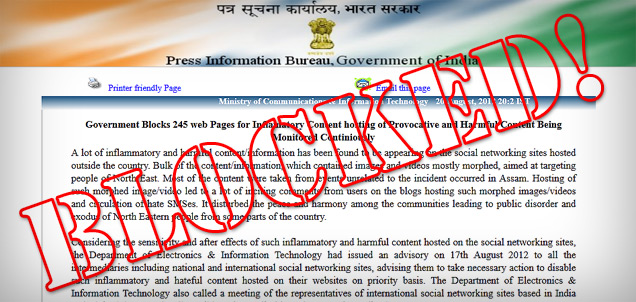
    In the recent wake of violence and riots in Assam, and against north-eastern Indians, the government ordered a ban on bulk SMS and blocked access to over 200 webpages. Even as these recent moves might seem to be curtailing freedom of expression, and have received mixed responses from the industry, the spotlight is now on internet freedom and content regulation.


    Sidharth Mishra

    Sidharth Mishra, Consulting Editor, Millennium Post & President, Centre for Reforms, Development and Justice said, “This is a kneejerk reaction by the government which completely failed to precede what happened with the North East residents. The government is trying to cover up its failure by indulging into such harsh measures on websites. I am not against any monitoring by the government but, there is a difference between monitoring and censorship. The drawbacks of social media domain can be stopped only by prevention and not by reactionary actions which we see from the government. If you ban one website another one will emerge and thus there will be no permanent solution to the problem. The government must therefore be pro-active and keep a vigil on these issues and then take necessary steps as and when required, rather than just putting a blanket ban.”


    As morphed images and hate messages targeted towards a certain community spread like wildfire, the Indian government is trying to tighten its noose on social media, and telecom operators. Twitter, Facebook and YouTube have been warned to pull off and remove the objectionable content by the Indian government, perhaps remembering Arab Spring that relied heavily on protests on the social media in the early stages and helped mobilise public opinion for several key social issues.


    LinkedIn, Yahoo!, and Sify did not participate in the story, but a Google spokesperson clarified, “We understand the gravity of the situation, strongly condemn acts of violence, and continue to work closely with relevant authorities. Content intended to incite violence, such as hate speech, is prohibited on Google products where we host content, including YouTube, Google+ and Blogger. We act quickly to remove such material flagged by our users. We also comply with valid legal requests from authorities wherever possible, consistent with our longstanding policy.”


    P N Vasanti

    But the damage has already been done, according to industry veterans. “The government should have taken steps like these earlier. Even though I am a strong supporter of freedom of internet and media, any instance that triggers communal violence should be strictly dealt with. I do not agree with censorship but penalising those who spread illegal, harmful and abusive material is important,” said P N Vasanti, Director, Centre for Media Studies.


    The government had initiated the Convergence Bill in 2000, with the objective of establishing a new “converged” regulatory framework to promote and develop the communications sector (including broadcasting, telecommunications and multimedia) in an environment of increasing convergence of technologies, services and service providers. In a multi-media environment when procedure of ownership and registration is as doubtful, the Bill would have helped in such a crisis. However, it failed to become operative.


    Pavan Duggal

    Pavan Duggal, Advocate, Supreme Court of India who specialises in the field of Cyberlaw, said, “The freedom of speech is relative, and is subject to relevant restriction. The govt is blocking out the content, which is anti-India. This is a legitimate step, but the govt needs to focus on the steps so that misuse of social media does not happen in the future. Only close to 200 websites have been blocked, which was a necessary step. The govt also needs to come up with specific rules for mobile operators, in time, so that the handheld tool is not misused.”


    Another industry analyst suggested that the government should plan long-term framework on the communication monitoring across the nation on the virtual and mobile platform to avoid similar circumstances in the future.


    BG Mahesh
    BG Mahesh

    BG Mahesh, Founder & MD, Greynium Information Technologies, opined, “SMS limit surely affects many but monitoring of social media, blogs has no effect on the majority as they are not doing anything anti-national. If my tweets are being read by the govt I am perfectly ok with it, after all it is in the public domain already. Free speech is a must but then people should not be posting anti-national content and spreading rumors. At the same time govt too should not be blocking content if it feels the policies are being criticized.”


    Giving a different perspective, Sanjay Aggarwal, CEO, Unicel Technologies, said, “What is effectively a blanket ban is actually not in the public interest. Banning communication systems in such a critical time can worsen the law-and-order situation rather than improving it. The lack of truthful news messages creates an information vacuum which increases anxiety and drives people even more toward unreliable rumors.


    Sanjay Aggarwal

    Despite the ban, person to person messaging is likely to continue as this is virtually impossible to control by the operators.” He further added, “Due to the SMS ban, as an industry we are looking at a 15-20% loss in this quarter, but considering the loss to our customers as well, businesses will take a hit in a multi-crore dimension and the numbers will be big. We have suffered bans in the past, and the financial impact is always large, but their effectiveness in achieving the government’s objectives is questionable.” There already exist solutions like BBM for Blackberry users and Nimbuzz, if the consumers prefer a multi-platform communication platform to avoid the SMS-related communication problems.


    Arunava Sinha, Head, ibnlive.com & cricketnext.com at Web 18, agreed. He said, “If the internet is the trigger, which I really doubt it is, then blocking the access to the websites is not the solution. It does not take much time to create another website. How many sites can only block? The solution is to act proactively, and do prompt campaigns and tell people not to believe in such messages.”


    Just as print media is responsible for it publishes, and follows self-regulation, is it time that internet be also regulated through the same protocols?


    “Any organization that wants to sustain itself will have to maintain some kind of self-regulation. They have to show some kind of responsibility towards the society. So, definitely self regulation is necessary and I am sure that most websites follow self regulation. At the same time some kind of government monitoring is also all right but, there must not be any censorship on the site or the internet,” said Mr Mishra.


  • Paritosh Joshi: Who will cast the first stone?

    By Paritosh Joshi


    You’ve got to give it to Aamir Khan. Any theme he raises through his cinema, and now his television show, instantly becomes the issue du jour. Dyslexia (Taare Zameen Par), rigid education practices (Three Idiots), anguish at the political establishment (Rang de basanti), morality of terrorism (Fanaa) and now in rapid fire succession the weekly episodes of Satyameva Jayate (everything from female foeticide to medical malpractice). If the worlds of the social media are anything to go by, people in the Media & Communications industry are particularly engaged in Aamir’s weekly broadsides. Minutes after the week’s episode goes on air at 11am on Sunday, Twitter is deluged with views and opinions agreeing, and less often disagreeing, with Mr. Khan.


    You would imagine, looking at the stridency of tone that characterizes a lot of the chatter, that we belong to an industry that has solid claim on the high moral ground. Does it?


    I became involved with the Advertising Standards Council of India (ASCI) about 6 years back. As a communication professional, I was conscious of the close and incessant scrutiny that our industry attracted and of the permanent Damocles’ Sword of statutory regulation that hung over it. The ASCI charter’s commitment to self-regulate resonated strongly with me and joining the Consumer Complaints Council, which gives force to the Self Regulatory Code of the ASCI, was a natural next step.


    If Awards Functions like the Abbys and Cannes are the Halls of Fame of the industry, CCC must qualify as its identification parade for the Rogues’ Gallery. Education institutions that claim their superiority, not based upon quality of education facilities they offer, but the acreage of their campus. Cooking oils that assure you of defence against cancer. Fairness potions promising enhanced employability. Malted beverages that deliver anything from height gain to better grades in the exams. A whole spectrum of beers and spirits veiled very thinly under guises of ‘Music CDs’, ‘Unique Events’, ‘Golf Equipment’ or ‘Soda’. Apparatuses that promise the benefits of a cardio workout by merely placing your feet in a harness and allowing them to shake about for a few minutes. Perfumes and deodorants that will instantly cause the user to become a sexual dynamo around whom people of the other gender experience spontaneous orgasms. Plastic beads and metal baubles that will ‘guard against the evil eye’, pacify irate planetary deities and result in a shower of wealth. Or in a particularly horrifying instance, a hospital that advertised radical hysterectomies as a permanent solution against pre-menstrual syndrome. We’ve seen them all.


    While some offenders are no-name businesses, the largest majority are big and prominent businesses that we all hold in high esteem. Indeed, we must look well beyond the brand owners to understand the circle of culpable accessories that enable the offending communication to reach the consumer. The creative work originates in an advertising agency. A marketing team approves it for release. A media agency sets up a media schedule. Multiple media outlets finally convey it to the consumer. In many cases, all the organisations that are involved through this value chain are members of the Advertising Standards Council by virtue of which they are presumably committed to the ASCI Code. While the complaint is made and upheld against the brand owner, the actual burden of guilt correctly lies with all the accessories that participated in the process.


    Interestingly, whenever the issue of legally dodgy, false, misleading or vulgar advertising crop in professional discourse, the ASCI is indicted forthwith, for its abject failure in bringing the perpetrators to book. Of recent days, the Ministry of Consumer Affairs has joined the chorus, promising a ‘National Consumer Protection Agency’ aka the other NCPA, to become the consumer’s paladin against advertising mischief. Apparently the phrase ‘Self-regulation’ is indecipherable to the average communication industry professional.


    Self-regulation begins by a body representing all stakeholders in a particular context agreeing to a code of ethical practice. This code is then widely shared with all stakeholders so that they may understand and assimilate its letter and spirit. Once this has been done, self-regulation transfers the burden of compliance upon the practitioner. The overseeing authority is not a policeman. It is a conscience keeper.


    This is an exhortation. A humble request. How clean is our own escutcheon before we pronounce moral judgment on all and sundry? Or as Aamir might say, “Apne ghirebaan mein jhaank kar dekha hai kabhi?”

    Paritosh Joshi was until recently CEO, Star CJ. He has been a marketer, a mediaperson and been a key officebearer on industry bodies. He can reached via his Twitter handle @paritoshZero

  • Anil Thakraney: The party-pooping media

    By Anil Thakraney


    Newspapers and TV channels have been flooded with pictures of those ‘caught’ at the recent Juhu (Mumbai) ‘rave’ party bust. (We still don’t know if it really was a rave bash, but that’s not the focus of my article.) All these guys and gals desperately trying to conceal their faces in shame. Or, as I believe, because of the fear of being seen by their families and pals in such a tight situation. And each time I watch these images, I get terrified. No, I don’t get invited to many la-di-dah parties (sadly, haha!), and yet that lingering fear… that it could have been me out there.


    Imagine going out with friends to a party and being suddenly accosted by cops just because a few buggers had decided to top up their noses. And being treated brusquely all night, and made to go through unhygienic tests at municipal hospitals. It’s a nightmarish feeling. Still, when you look at it rationally, you have to quietly accept that drugs were found at the venue, and so the cops had to do their duty. So far, so bad.


    But does it surprise you how the media lands up at such busts in full force? It shouldn’t. Obviously, the cops, who want to project themselves as some sort of heroes, invite chosen reporters and cameramen to tag along. And thus more than a crime battle, this turns into a media spectacle. Leading to more stress and agony for the party goers.


    This makes me wonder. Should we in the media broadcast and publish pictures of youngsters cowering with fear and hiding their faces? Is this ethical? Is it not possible that most of them are innocent party goers? Do they deserve to be put under such harsh spotlight? One more issue for all of us in the media to introspect upon. Of course, the reporters have to join in when the cops invite them. Of course, they need to cover the bust. But because, at the time, they don’t know who’s guilty and who’s not, is it correct to put out pictures of the people trapped out there?


    My own view is such pictures must never be made public. And only after the police investigation is done, only after the culprits get booked, must we go public with images. That would be fair. Having said that, I know this practice isn’t going to stop anytime soon. Who cares if some drunk revelers are seen squirming? Who gives a rat’s ass if they are seen being treated like trapped animals? The editor wants pictures, you see. Else, he/she will say there’s no story out here. He/She will kick me out of the newsroom.


    Let’s do some self regulation, people. Before it comes in from outside.


    * * *


    PS: Brilliant ad by Prada. It’s directed by Roman Polanski and features acclaimed actor Ben Kingsley. This is the way to expand market share, I say!


  • Possible for ethics & profit-making to co-exist: Paranjoy Guha Thakurta (Text & Video)


    By Shruti Pushkarna


    As he launched the second expanded edition of his book, ‘Media Ethics: Truth, Fairness and Objectivity’,  in the capital last week, MxMIndia caught up with veteran independent journalist and educator,  Paranjoy Guha Thakurta for an exclusive interaction. In this candid one-on-one, Mr Guha Thakurta spoke at length about ethics in media today, self-regulation vs. regulation; the debate on the freedom of expression on the internet and the need for media to be ethically and socially responsible.


    Mr Guha Thakurta’s experience spanning nearly 35 years, cuts across different media: print, radio, television and documentary cinema. He is a writer, speaker, anchor, interviewer, teacher and commentator in three languages, English, Bengali and Hindi. His main areas of interest are the working ofIndia’s political economy and the media, on which he has authored/co-authored books and produced documentary films. He lectures on these subjects to general audiences and also trains aspiring and working media professionals.


    Mr Guha Thakurta has served as a member of the Press Council of India nominated by the University Grants Commission between January 2008 and January 2011. In April 2010, as a member of a two-member sub-committee of the Council, he co-authored a 36,000-word report entitled ‘Paid News: How Corruption in the Indian Media Undermines Democracy’.


    Does an expanded edition mean a lot more to discuss in media ethics?

    The first edition of this book came out more than three years ago, since then a lot has happened. Moreover, after the book came out, there were a lot of people who came up with suggestions on how this book could be improved. So this book is about 40 per cent bigger and thicker than the earlier edition. There are new chapters – there is an entirely new chapter on corruption in the media based quite a bit on my experience as a member of the sub-committee of the PCI, which inquired into corruption in media and how it undermines democracy, the entire phenomenon of paid news. There’s also a new chapter on reality television and some of the existing chapters have been drastically rewritten and revamped, notably the chapter on the internet because a lot has been happening in the internet space; also the chapter on advertising, which was particularly weak in the first edition – I think it has been strengthened substantially in the new edition.


    Also a whole lot of major developments have taken place concerning the media in the recent past; these have all been incorporated in the new edition. Among these would be the News of the World and Rupert Murdoch controversy in UK, the entire Wikileaks and Julian Assange phenomenon and back home here in India, the entire Niira Radia conversations; all of these have raised significant questions pertaining to media ethics and these have been incorporated in the new edition of the book.


    How important is the ‘code of ethics’ in today’s commercialized scheme of things?

    Ethics is very important in every sphere, particularly so in the case of media, because you are dealing with information which is akin to a public good. The problem essentially arises because this information is being disseminated by privately owned corporate bodies with an important goal to maximize profit; therein lies the conflicts of interest. The problem arises because there are sections of the media that are interested in profit maximization to the exclusion of other goals.


    It’s become a bit of a cliche – once upon a time it used to be said, ‘journalism is a mission’, today journalists work only for a commission. We are seeing the corporatization and commercialization of the media having an impact on the kind of content that is being produced. The viewers of television channels, the readers of newspapers, and the listeners of radio stations are being perceived more as ‘consumers’ rather as citizens. They are ‘consumers’ of products and services which are being provided by companies which advertise.


    Can journalistic ethics and profit-making can co-exist?

    I do believe it can, it’s not easy but it is possible for ethics and profit-making to co-exist.


    What is your view on the issue of regulation v/s self-regulation? What works for you?

    In an ideal world, self-regulation is the best form of regulation. But what do you do with those who cross that proverbial ‘lakshman rekha’, what do you do with those who don’t follow the code of conduct which is supposed to be self-regulatory in nature. I’ll give you an example, in the US, when Janet Jackson had a wardrobe malfunction in the middle of a live broadcast, the channel was fined immediately by the Federal Communications Commission because the wardrobe malfunction happened during a live broadcast, it happened during primetime and the channel had to first pay the fine and then appeal against the decision in a court of law.


    What happens in India? Not very long ago, there was a series of incidents involving Bhanwari Devi Maderna episode in Rajasthan and content was put out during the day on television, which many considered to be pornographic in nature. When the Ministry of Information and Broadcasting issued show cause notices against these TV channels, all of them came to Shastri Bhawan saying, ‘we apologize and we won’t do it again’. That’s the nature of self regulation in this country.


    As far as print is concerned, we have a Press Council of India which has no powers to punish anybody, it cannot impose a fine, leave alone put a person behind bars, and its recommendations are not even binding on the government. We don’t have statutory organizations which are empowered in the manner in which say the Federal Communications Commission is, or the Office of Communications in the UK is. So it’s fine to talk about self regulation but what do you do when somebody doesn’t listen to you, do you have the wherewithal to punish them?


    Do you think we need an independent official regulatory authority for television news channels as against one set up by the channels?

    Yes, I do personally believe that it is possible and desirable to have an independent regulatory authority which is independent of the government as well as the media. Such a regulatory authority can be funded by the government, but it can nevertheless be autonomous and independent of the government, in the manner in which bodies like the Supreme Court of India, or CAG or Election Commission of India function.


    So, I do believe it is possible to have such a communications commission. The problem is that for the last decade we have been debating the need for such a commission and the joke is that every time the government proposes to form such a commission, the government collapses. There have been 10 or 12 avatars of a Bill to set up such a commission; time alone will tell when and if such a commission is established in India.


    Your view on Dirty Picture not being allowed to air during the day on Sony?

    The whole Dirty Picture episode has thrown up a number of issues pertaining to censorship, pertaining to what content is appropriate or not, and if adult content can be shown on television, if so when. I think these issues are contentious and debatable and they are going to be debated for quite some time to come.


    Would you agree with Justice Katju’s view when he says people in media are of poor intellect?

    I think Justice Katju is exaggerating. There are journalists who are dumb and there are journalists who are not dumb. I think Justice Katju is not being fair to the media fraternity but that’s his personal point of view, he also thinks 90 per cent of Indians are fools, I beg to disagree with him.


    There’s a belief that the Indian media doesn’t take too kindly to criticism. Agree?

    Who among us are willingly going to accept criticism? All of us have our egos, in that sense, I don’t think the media is unique. I think there is neither any individual nor any group who likes criticism but the point is if you do believe in democracy, if you believe in fairness, and if you are in the public eye, then you better get used to criticism otherwise you’ll end up like Ms Mamata Banerjee who could not take being lampooned online. This shows not only lack of tolerance on part of individuals, especially public figures, but I think it fails to appreciate the nature of freedom of expression.


    Isn’t it upsetting that all the journalists’ organizations like Press Club, Editors Guild are tightlipped about Paid News?

    I won’t entirely go along with you on that, I mean there was a conspiracy of silence about corruption in media and paid news, even the report of the subcommittee that was prepared by me and my colleague for the PCI, was sought to be suppressed by a powerful lobby of publishers within the PCI. Finally in October 2011, the PCI was literally forced to make that report official, place it on their website with a disclaimer saying that entire council had not approved of its content. But I won’t say all journalists’ organizations conspired to put under wraps this report. There have been sections of the media who have been reticent of highlighting corruption within the media fraternity, but I don’t think it’s true for the entire media.


    Do you think that Public Relations has adversely impacted the quality of journalism?

    No, why blame the PR person…she or he is doing his or her job. You can also say the government has bribed the media, you can say that corporate captains have bribed the media. So I don’t think we need to look for excuses, I think journalists have to look within if they have to introspect about why there is corruption in the media. You can always hold somebody or the other responsible for your sins but at the end of the day, you are yourself responsible I believe.


    Your views on the ongoing debate on the freedom of expression in the internet age

    I think this is a huge debate. The internet is not just the newest medium of mass communication, it’s also a form of personalized communication, and it’s difficult to control. Issues relating to freedom of expression on the internet have acquired many new dimensions and these are very contentious and not easy to resolve. And we’ve seen this debate been going on for a while…the ‘infamous’ Danish cartoons on the prophet Mohammed were all drawn ostensibly to generate a debate on freedom of expression. Yes, that cartoon was widely circulated on the internet, as was the gruesome video showing Daniel Pearl getting beheaded. But it’s also worth remembering and underlining the fact that the mainstream media were restrained in reprinting, publicizing either the Danish cartoon or Daniel Pearl’s beheading.


    The point is, sometimes in the name of freedom of expression, you want to generate a debate but you end up generating one huge controversy which goes out of control. It was the Danish PM who argued that the cartoon controversy was the biggest crisis that small Scandinavian country faced after the Second World War and he was particularly worried because it even had an impact on the economy of Denmark because countries of West Asia stopped buying dairy products made inDenmark.


    So very often we might want to start a debate without realising its wider ramifications. But the bigger question of what constitutes the right to offend, what is freedom of expression and the new dimensions these issues have acquired in the day and age of internet, these are very important, they are being debated and I think these debates are going to go on for quite some time.


    And given all of this, your view on the future of news media in India?

    The future of news media in India is very bright. Unlike many countries in the world, all media in India continue to expand, whether it’s print, radio, TV or internet. According to 2011 census, one out of four persons in India still cannot read or write her or his name, so as more and more people become literate I think all sections of media are going to expand. At the same time, media has to become more responsible, not just socially responsible but also more ethical if it indeed has to contribute to building democracy, to building a better country.


    If you were still a kid getting out of college, would you get into journalism given the ethical standards followed?

    That’s a difficult question…when I became a journalist 35 years ago, the Emergency had just got over. That was a unique 19 month period in the history of the country where for the first and so far the only time in politically independent India, the government of the day sought to abridge freedom of expression. For 19 months, during the Emergency, freedom of expression was sought to be curbed. I don’t think that will happen again, but the very fact that I was a student during that period did influence my decision to become a journalist. If I was born 35 years later, I don’t know if I would have preferred to become a rock star, or an airline pilot or a heart surgeon instead of a journalist.

     

  • @FF12: Day 3: Industry expects thoughts to lead to pertinent actions

    By A Correspondent


    The last day of FICCI Frames 2012 was an eventful day — insightful sessions, a lot of networking, sharing of ideas, deals being cracked — and amongst all of this, the highlight was the session on Women in Media and Entertainment.


    The day started off with a keynote presentation by Ashok Chawla, Chairman, Competition Commission of India (CCI). He said that the media and entertainment (M&E) industry was one of the fastest growing sectors inIndiawith an expected CAGR of 14-15 per cent. He then proceeded to outline the role of the CCI and its importance: “CCI is an overall market regulator whose objective is to ensure that market forces operate with transparency and fair play. It has been put in place to identify the boundaries of behaviour of the industry.


    Mr Chawla opined that self-regulation was of prime importance to avoid infringement of law or market practices and cautioned industry players that consumers should be given primary importance.


    Taking on the Digital threat

    The next session was on “Sustaining Long-term Newspaper Loyalty” by two biggies — N Ram, former Editor-in-Chief, The Hindu and Girish Agarwal, Director, Dainik Bhaskar Group, who shared their views on the future prospects of the newspaper industry.


    Mr N Ram started off his speech by stating that there was ‘anxiety and gloom’ over the fact that journalism was seeing a meltdown in the mature markets. He outlined two media world phenomenon next, where the less developed countries are witnessing increase in circulation of newspapers unlike the mature market. But he added a word of caution when he said that TV, even in the developing world, is going through a crisis which it has so far covered by showing entertainment as part of news. Inspite of this, Mr Ram was optimistic that the medium term prospects for the media industry are looking good.


    As is been spoken widely about, the key factor for the decline in the newspaper is the increasing popularity of the digital media. Mr Ram called this the Digital Age Paradox and added that in recent times the newspapers have seen an increase in the readership of their online editions but have witnessed a “double squeeze” on their revenue, as they have had to subsidise digital journalism, which in turn is cannibalising their circulation.


    On how to sustain loyal readers, he tipped, “Stick to the basic principles of journalism – they can build a relationship with the readers, which it can rent out to the advertisers. And most important – “newspapering” should not be reduced to consumer marketing of news.”


    Mr Girish Agarwal took the stage next. Contrary to Mr Ram’s belief, he said that Indian newspapers are growing in their circulation and readership. He spoke about the need to engage the ‘consumer’ by asking “How relevant are we (newspapers) to the reader?”


    He opined that a newspaper cannot rest on its past glory but should move ahead by acknowledging and understanding what the consumer wants and giving him what they think he needs. On how to keep pace with changing times, Mr Agarwal said that newspapers should have global vision and hyper local content.


    After the speeches the floor was opened to the audience who questioned Mr Ram and Mr Agarwal about threat perception of the culture of medianet and media houses being bought over by MNCs. Mr Ram denounced paid news as a rogue practice which has been rubbished by the Press Council. Mr Agarwal said that ethically media should report anything that may be perceived as defaming by the parent company but the ground reality is not always so rosy.


    Women to the fore

    A big highlight of Day 3 was a session titled   ‘Women in Media & Entertainment circa 2012: Leading from the front’.

    The panel members of this session were Vidya Balan, Actor; Anurradha Prasad, Managing Director, BAG Films; Jeni Tosi, CEO, Film Victoria; Ekta Kapoor, Creative Director, Balaji Telefilms; Barkha Dutt, Group Managing Editor, NDTV; and Usha Uthup, Singer. The session was moderated by Rajeev Masand, Entertainment Editor, CNN-IBN.


    This session discussed the journey of each of the above eminent women personalities and the challenges they faced during their journey. As the moderator, Rajeev Masand put it: “Traditional media, for long, was dominated by men, but not any longer. It’s become outdated.”


    All the eminent women personalities claimed that despite all their challenges they had an incredible journey and the results have been fruitful.  Ms Tosi observed that there would always be obstacles in a woman’s journey but, at the same she also admitted that at times a little bit of luck and timing also plays a part in one’s success nevertheless, she must also be hard working and committed to succeed.

    According to Ms Dutt, the real heroes are the women who came before them i.e. those who made a mark and their presence felt in the male dominated industry.


    One of the topics discussed at the session was whether ambition for men meant one thing and another for women, and how society reacts to ambitious women. Ms Ekta Kapoor agreed that ambition for men is a virtue, but for women it is seen as something negative. “I never took being a woman as a disadvantage. Today I am successful not in spite of being a woman but, because I am a woman,” she added.


    Ms Prasad said: “Today women have become mature, and so have their families. Women have to juggle multiple roles. Had I thought that since I am a woman, I cannot take on a task, then I would not have been successful. If you are happy with what you are doing, you will be successful in life.”


    Ms Uthup was of the view that what has really changed is the audience. “The field of Arts has been a level playing field for women. You really don’t have gender bias. I believe if we want change to take place, the people need to be awakened. Men and women must work together, but then there are things that women can do and men can’t and there are things men can and women can’t do.”


    Ms Balan said: “The Indian actress today has been humanized; she is getting to play a part in the story. I have never seen my gender as a disadvantage, all I knew was I had to be strong to move ahead in life. There is a wide variety of roles for women today and the fact that there is no model code for women any more is liberating.”


    While all these eminent women had plenty of inspiring stories to share, each of them have had to overcome their own tough challenges, change the societal mindset about women being weak and docile, to climb their way to the top.


    The road is set for 2013


    In a session which ran parallel to the one on Women in M&E, a panel of regional TV experts got together to discuss growth avenues. Moderated by Nachiket Pantvaidya, Executive Vice-President, Star Pravah and with speakers like K Madhavan, Managing Director, Asianet and Sharada Sunder, EVP – Regional Channels, Zee, the session concluded that “Regional was the new National.” One issue which was discussed in the session was how to attract talent and also how does regional broadcast channels attract youth, the single largest segment inIndia.


    A session on GEC regulation discussed dos and don’ts as far as content is concerned, what is permissible and what not. It included Justice AP Shah, Prof Jonathan Askin, Ashok Nambissan of Sony Entertainment Television and Naresh Chahal of IBF.


    The general feedback from delegates was that Frames 2012 had pertinent topics discussed. One hopes that industry put the many ideas and resolutions discussed to action.


  • Speed up review process, ASCI told

    By A Correspondent


    At the conference organized by The Advertising Standards Council of India (ASCI), Ambika Soni, I&B Minister and Prof K V Thomas, Minister of State, Ministry of Food, Consumer Affairs & Public Distribution recognized the commendable work done by ASCI in creating best practices through its self-regulatory mechanism and various codes of conduct in advertising content. However, the ministers have urged the ASCI to further improve the self-regulatory mechanism by speeding up the processes and compliance of its codes for advertising content.

    Prof K V Thomas, Minister of State, Ministry of Food, Consumer Affairs & Public Distribution, in his speech at the conference said, “We are reviewing consumer complaints on misleading advertisements & debating how to manage this issue. In this process, we are considering a legal requirement as well as an inter-ministerial committee to look into the issue of misleading and false advertisements. We are open to working with ASCI for a collaborative effort to take this entire matter forward.”

    Information and Broadcasting Minister Ms Ambika Soni urged ASCI to speed up its mechanism to review consumer complaints on misleading advertisements, thereby making the self-regulation machinery more effective. She also added, “Self-regulation is an evolving system in response to the growing aspirations of the consumer or the common man. Advertising is the principal motivator of growth in consumer demand, thus making the role of a creative person extremely significant. The current self-regulation mechanism has evolved as a result of the concern shown by the consumer. The key intention here is that all of us should sensitize ourselves to ensure that 1.2 billion people can enjoy the freedom entrusted to us.”

    Mr I Venkat, Chairman, Advertising Standards Council of India updated the assembly on the various initiatives undertaken by ASCI in recent times. He said, “As part of our evolving self-regulatory system, we have increased the frequency of our Consumer Complaints Council’s meetings to twice a month since November. The Fast Track service announced recently has already received positive response. The CCC has already reviewed eight advertisements until now under the Fast Track system. The support we expect from government will ensure that ASCI continue to create global standards and international benchmarks in self-regulation of advertising content.”

    The conference also included three technical sessions to discuss issues and solutions related to (i) Decency in advertising, (ii) Honesty & truthfulness in advertising and (iii) F&B Advertising. Each interactive session had speakers representing Industry, Regulators and Activists and was moderated by TV anchors with expertise in the field of advertising.

  • All’s well as I&B promises to route content complaints via self-regulators

    By Ritu Midha

    Putting broadcasters’ concerns at rest, the Information and Broadcasting Ministry has said that cases related to the violation of content code would be sent to the News Broadcasting Standards Authority (NBSA).

    Members  of NBA, IBF and BEA met  the Information & Broadcasting Minister Ms Ambika Soni and a few ministry officials in the late afternoon on October 11. According to sources, the meeting ended on a very positive note, with the ministry clarifying that there was no doubt about the broadcast bodies’ self-regulatory capabilities.

    The minister, as per the sources, appreciated the work done by the broadcasters in the area of self regulation, and also stressed on the need of strengthening it further.

    It is now understood that objections, if any, pertaining to the content on any of the private television channels, would be routed to the NBSA, headed by Justice Verma. Action, if any, would be taken post deliberations by NBSA.

    As is known, NBA was not too happy with the proposal for amendment in policy guidelines for uplinking/downlinking of TV channels approved by the Cabinet last Friday. The proposal among other things stated, “Renewal of the permissions of TV channels will be considered for a period of 10 years at a time subject to the condition that the channel should not have been found guilty of violating the terms and conditions of permission including violations of the Programme and Advertisement Code on 5 occasions or more.”