Tag: Saurabh Parmar

  • 8 things Marketers ought to know about Facebook’s new Trending feature

    By Saurabh Parmar


    Facebook recently launched a trending section which is visible on the top right hand side of the homepage for its web visitors (not currently available on Mobile)


    Since this is a major change on the homepage and seems to compete with Twitter’s trending topics it has generated interest amongst marketers. So what does trending mean for us marketers and can we use it to our advantage?


    Here is my take:

    1. First, what is trending?

    It’s a personalized lists of the most mentioned words and phrases at the current time with short explanations of why each is blowing up. A click-through leads to a Page of mentions by friends, Pages, and public posts by anyone who lets people “Follow” them.


    2. What is this ‘Explanation’ feature which Facebook is talking about?
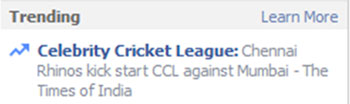
    Facebook's explanation features details why a particular topic is trending

    The challenge with Twitter trends is that a lot of times one is not clear why exactly something is trending on Twitter but the explanation bit on Facebook clarifies that thus stoking a user’s interest and hopefully for Facebook getting more clickthroughs.


    Compare the two trends on the same day.
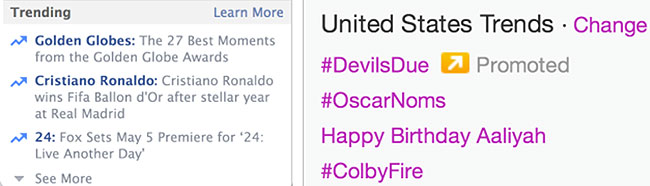


    Facebook explanation makes it clear why a certain topic is trending.


    3. Is Facebook personalizing trends based on a user’s interests?

    Facebook claims “Topics are personalized based on things you’re interested in and what is trending across Facebook overall.” However I haven’t seen this till now.


    A quick analysis of trends basis what I have been seeing on my profile over the last two days:

    Day 1:

    I have hardly liked any sports page and am as uninterested in Microsoft as Justin Beiber (had to clarify the latter). Even on my friends list, there are hardly any people who are talking about Jai Ho the day the trend appeared . In fact more people on my list spoke about it the next day but its not trending then.
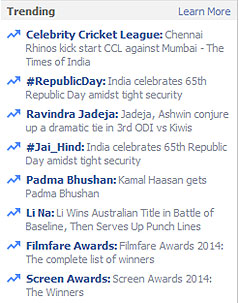


    Day 2

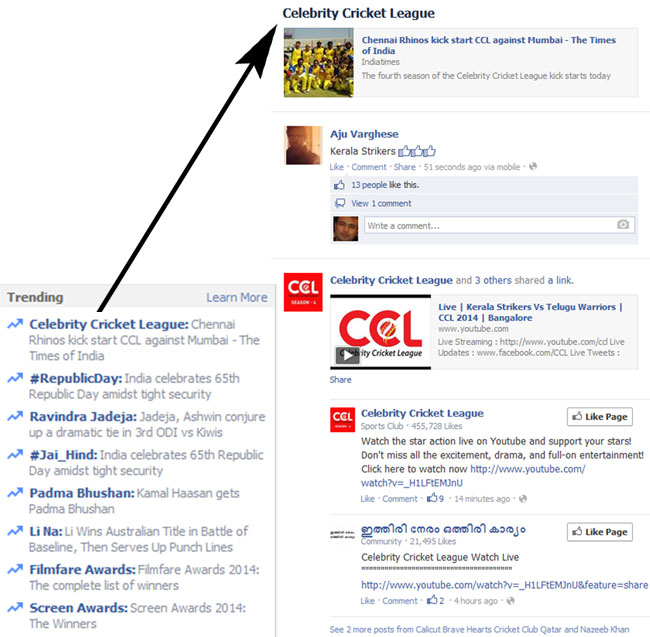
    No one on my list is talking about ‘Celebrity Cricket League’ or ‘Li Na’. On ‘Republic day’ there are definitely a bunch of posts by friends or pages I like but that is still on second place for me.


    So it appears that Facebook seems to take a more macroscopic view of trends, looking at the region (like Twitter-which shows trends on the city level) but nothing seemingly at an individual level.


    4. How are the algorithms different -Facebook vs Twitter trending?

    Facebook Trending aggregates the headlines of the day, while Twitter Trending Topics check the pulse of the moment.  With Trend on internet being something very’ in the moment’, I think in the current avatar more users are would go for the latter than the former.


    5. So can we as marketers use promoted trends?

    Twitter has this feature but Facebook is yet to announce anything like that.


    Even in the near future, I don’t think Facebook trends will directly be used as a revenue source at least not until Facebook gets the product right via various iterations.


    It’s something which seems to be done to:

    1. Build further engagement and clickthroughs via the users and get them to spend more time on the site

    2. Serve Facebook’s objective of being the ultimate news destination (remember Facebook is currently the largest medium in the world.Bigger than any newspaper or TV channel… ever!)

    3. By capturing current consumer interest Facebook could drive more real time marketing/advertising. Real Time is the goldmine which most advertisers are trying to target.This could probably help them in that direction.


    6. Can we as brands tap in at all?

     Apart from brands which are involved in the highly topical stuff like movies, cricket, politics or current events I see this having little benefit to marketers in its current avatar.


    So if you are promoting a new movie which will get mass traction on a specific day or a politician gets talked about a lot on a given day the trending features makes what’s popular more popular , but no it currently can’t make something which people would hardly be interested in trend.


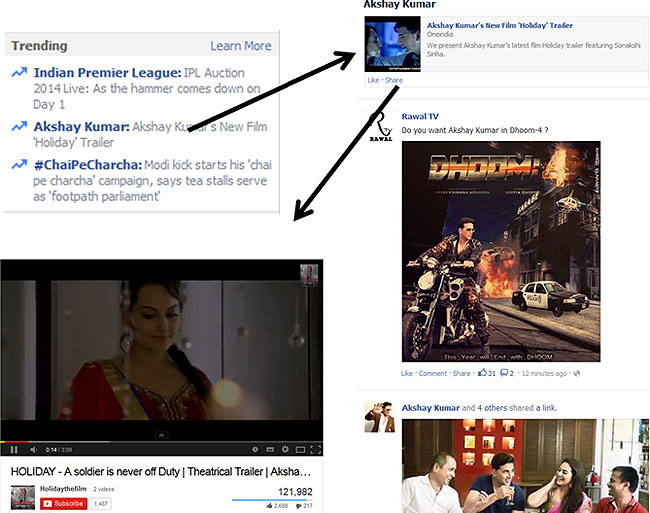
    For example, Akshay Kumar’s new movie ‘Holiday’ probably reached out to a much larger audience since it was trending across the home page of millions of people who logged onto Facebook yesterday in India. On the other hand, over the last two weeks this was one of the few movies which was trending. Parineeta Chopra started trending post the release of her movie when her performance was appreciated and not like this case when the trailer/movie was released. (Since obviously an ‘Akshay Kumar’ release has more interest to begin with)


    7. Does that mean we should # everything and talk about current events?

     No,definitely not!


    The challenge for Facebook is that most users do not make their profile public or allow everyone to follow them. Thus typically brand pages and a few users  (usually celebrities) are the only ones which will be visible when we click on a trend. This would mean brands or celebrities which talk about current news will have more clicks.
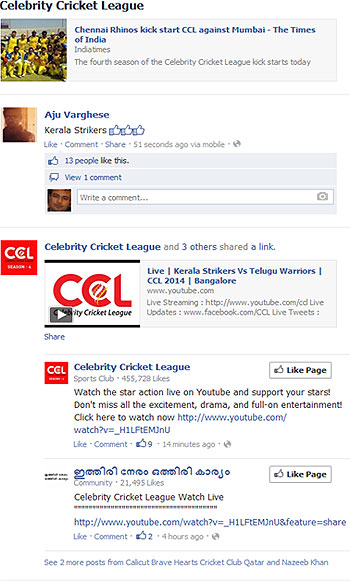
     

    CCL has no conversations from my friends list or pages I like


    Brands can definitely talk more about current events and post news but hopefully most social media agencies won’t be dumb enough to do that.Since:

    1. They will end up alienating their current user base by appearing more of a news site rather than what the brand is about

    2. Even if they do that they will end up competing with news sites & may not even appear on the first page which completely defeats the purpose.


    8.Given Facebook’s popularity in India, will this launch pose a bigger challenge for Twitter in India?

    Not quite .The nature of the products (Their current definition of trends) is different. Facebook Trending aggregates the headlines of the day, while Twitter Trending Topics check the pulse of the moment.


    Also since most content on Twitter is public and therefore I see opinions from people I know or have heard of (thus more personalization) whereas Facebook because of its privacy settings will be more restrictive & thus less personalized.


    The trend for Facebook seems more in its goal of being a one stop news source rather than a brand medium. Brand messages will come up when Facebook as a news source is firmly established in the minds of the consumer.


    And frankly considering the fact that it’s the largest platform in history seems quite possible, but definitely not now. Not this quarter or in the next six months.  That’s all one can predict on the internet!


    Saurabh Parmar is Founder, Brandlogist Communications (www.facebook.com/Brandlogist) and is a visiting faculty at Indian Institute of Mass Communications

     

  • Guest Column by Saurabh Parmar: Branding in today’s digital age of Brand-Consumer Interaction

    By Saurabh Parmar


    In almost every conversation we have with a client or a potential one, the word ‘brand’ comes up. The interesting bit in most cases – I see the interpretation vary. And remember I am talking about marketeers here. I don’t think there is a right or wrong but the definition of what a brand is has evolved in this digital age.


    For me, a brand has never been a logo or a fancy tagline. It’s not even a vision or mission statement. At the end of the day it’s a dynamic entity which lives what it says, it evolves from where it is, it understands from it’s customers.


    It means a lot of those things which are probably taught in brand identity classes – Colours used, shape of the logo, brand identity guidelines, the thought behind the brand  etc. Yet  I earnestly believe – it has always been about something more – How the people perceive the brand.


    Think about brands like Apple, Vodafone or Dominos.. What do you see? What do you feel? And the exact answer will change, depends on who you ask. The logo, tagline, marketing campaign, product remain the same but people’s interpretation of it defines the brand for them and to an extent their social circle.


    This is more so in today’s world – where customers are directly interacting with brands via social media, where there are more brands making more noise via marketing and where technology is changing proximity and interactions between humans themselves. As a result, the dynamic nature of a brand is all the more obvious.


    I like brand X let’s say a restaurant but  if the food was bad last time or whether the waiter was rude or service slow all those things impact brand perception. But it doesn’t take a direct interaction always does it?


    Friends who have been raving about a product or place, a Zomato review or a review in HT or 5 of your friends having already like this new place on Facebook -all these live interactions influence our brand perception over time.


    So what should a brand do? There’s lots it can do, but for me 6 main things which stand out:

    1. (From the above) Remember brand building does not happen on day 1 only it keeps happening till the day you exist and if you are fortunate or maybe unfortunate enough people will have opinions even after you cease to exist. So be open to constant evolution.


    2. Having said that, like any human being you may evolve how you talk, how you interact, what you say but you remain mostly true to your core beliefs. Same goes for brands.


    3. Brands are often afraid of taking a stand, having an opinion. We believe that’s not the way to go, great brands stand for something and they also stand against something.


    4. An often heard statement ‘Great brands need to be larger than life’. I tend to differ and more so in today’s day and age of a cluttered market with enough brands shouting their greatness.


    Brands need to be true to life – They are based on a customer’s needs and aspirations and needn’t look down from a pedestal or exaggerate their own identity which makes it hard for a customer to trust them. (Eg: How many men believe that by spraying a deo, women will start swarming around you but for years brands have failed to go beyond the thought)


    5.Great brands focus on transparency -to their customer, their employees and other stakeholders. An interesting example by McDonald’s http://www.youtube.com/watch?feature=player_detailpageandv=oSd0keSj2W8


    6. They do not look at advertising as a means to display but as a means to communicate. And that brand-consumer interaction does not happen in silos but in an environmental and cultural context.


    Saurabh Parmar is Founder and CEO, Brandlogist Communications


  • The Anchor: 6 ways a digital agency can maximize profits

    By Saurabh Parmar


    #1 Value-addition. Most digital agencies are production focused – websites, banners, applications. For any agency see what you can give as a value to your client. If one can do that price for a client does not become an issue for they see something tangible. Thus, increasing profitability.


    #2 Focus on core competency and do not diverse too much. If you try to be a me-too agency and are focussing on larger chunk of business, your turnover may be higher but your profitability will always be lower. Pick out your core competency and focus on that rather than trying and doing everything under the sun.


    #3 Look at clients’ marketing issues rather than what you as an agency can deliver as digital product. Clients spend crores on marketing. We need to come out with digital solutions that can service the clients’ marketing challenge, rather than suggest properties & add to the clutter. If you can solve the challenges and issues, you will get more profits.


    #4 Analytics. Digital allows you to measure & measure a lot. Right from clicks, conversions to loyalty, recency and amplification. It’s a medium which can help you understand & optimize. Doing this gives the maximum profitability for a client & which in turn ensures maximum profitability for you.


    #5 Embracing web-based tools. In the current world a lot of the agency’s business processes can be outsourced & improved with tools right from finance, CRM, teleconferencing etc. Using off the shelf tools, in a lot of cases their paid versions, has decreased our costs & increased profitability.


    #6 Content. Creating content for new dynamic web is a great area to get into and is a high-value area. It is a high-growth and high-profit area that can be explored by the agencies.


    Saurabh Parmar is Founder & CEO of Brandlogist Communications


  • The Anchor: 5 ways you can never get into a jam in the digital world

    By Saurabh Parmar


    1. Be a good listener:

    Digital is a two way communication medium, so before you start talking, start listening to what your customers are talking.


    2. Now understand:

    Get market research experts and your brand custodians to work on all this data and channel the insights to both your online and offline marketing.


    3. Get together:

    Don’t treat digital in a silo, integrate your touch points both in offline to digital banner campaigns, website, mobile, social media with each other. Integration is not just about giving links but really ‘getting together’ mediums to create a cohesive campaign.


    4. Be useful, fun or informative:

    It’s a crowded world out there with millions of brands and products talking. To connect with your customer make sure your message is either useful (What he is looking for), fun (what he will enjoy reading or sharing) or informative (makes him aware and interested)…just a higher media spend does not guarantee you more customers.


    5. Be real, say sorry:

    We all fu ** up, it’s better to admit it and rectify it rather than your customers creating a petition about you or criticizing you on blogs. Even in the virtual world genuineness is appreciated, especially if the response is prompt and correction faster.


    And the sureshot way…hire a better agency: Well the shortest and the easiest way of course is to hire a better agency


    Saurabh Parmar is Founder & CEO, Brandlogist