Tag: Satya Easwaran

  • M&E to rebound by FY22, notes KPMG


    By A Correspondent


    On Wednesday, on the last day of the second quarter of FY 2020-21, KPMG in India launched the twelfth edition of its Media and Entertainment (M&E) Report, titled ‘A year off script: Time for resilience’. It examines the performance of the M&E sector in “particularly challenging” period that prevails.


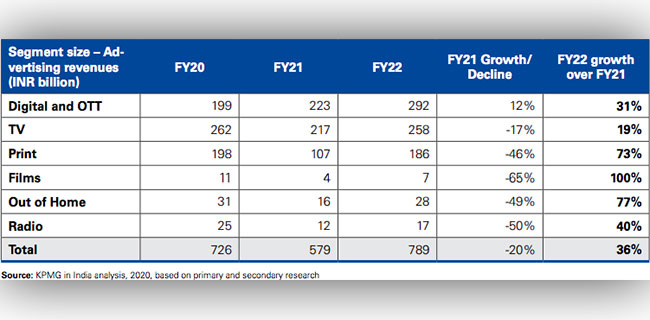
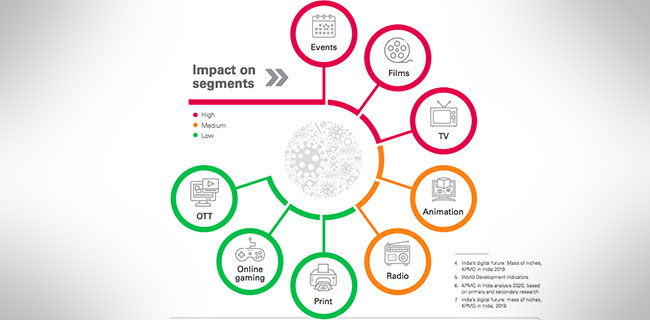
    Notes a communique: “India was already experiencing a slowdown in economic activity even prior to the outbreak of COVID-19 in March, and the onset of the global pandemic and ensuing lockdown dealt a severe blow to the Indian economy. The M&E sector has been affected but to varying degrees: outdoor entertainment formats (films and events) and traditional media (print and TV to some extent) have been badly impacted as people stayed indoors and advertising spends dried up. Digital advertising, OTT and gaming fared much better, with massive spikes in digital consumption during the lockdown across geographies and socio-economic classes. Digital advertising spends are now set to overtake those on TV by FY21, which is an important milestone and turning point in the evolution of M&E in India.


    Said Satya Easwaran, Partner and Head, Technology, Media and Telecom, KPMG in India: “The distinction among segments of M&E has become more pronounced with the experience of the lockdown. Marketing spend has moved perceptibly towards digital media and away from traditional segments like print, radio and to some extent TV. A greater reliance on subscription and other paid options as well as the development of a credible digital business model is going to be inevitable for these traditional media segments.”


    Added Girish Menon, Partner and Head, Media and Entertainment:  “There will be a deeper integration of digital technology across the M&E value chain – from content production to distribution. Technology adoption could however face some challenges in terms of skill development and the shift to a digital-first mindset but will result in operational cost savings and potentially lower lead times over the longer term.”


    According to the report, the M&E sector should recover to its current levels and post a 33 per cent growth in FY22 (following a contraction of 20 per cent in FY21), which still implies a loss of around two years of growth. The two areas that offer encouragement are the continued economic growth of Bharat and the universal acceleration of digital adoption among users across geographies and SECs. As per our revised estimates, India could be home to a billion digital users by 2028 rather than the earlier projected 2030 timeline. There have been several structural changes to digital behaviour on account of the experience of the lockdown resulting in a new homogeneity among users, and it is our belief that many of these changes will translate into a more democratic and sophisticated digital citizenry within the country.


  • Impact of Covid-19 on M&E: KPMG


    By A Correspondent


    Given the ongoing Covid-19 pandemic, KPMG has released a report titled “Covid-19: The many shades of a crisis- A media and entertainment sector perspective” which discusses the impact of Covid-19  in the media and entertainment industry.


    The report highlights that media consumption overtime has tended to be income inelastic, however the current environment could result in a dip in media consumption in the near term; and also foresees key trends across Television, Print media, Films, OTT platforms during Covid-19 along with the recovery time for the same.


    Furthermore, the report highlights that due to Covid-19, traditional media could face some challenges in the near to medium term, and there is likely to be a long-term upward shift in the integration of digital technologies into our everyday lives with media and entertainment being an immediate beneficiary.


    Speaking on the ongoing situation, Satya Easwaran, Partner and Leader – Markets Enablement, Technology, Media and Telecom (TMT), KPMG in India said: “The Covid-19 pandemic has resulted in a drastic cut in advertising expenditure across all media. However, with people being homebound, consumption of media and entertainment – and digital media in particular – has seen considerable growth. Post crisis, we anticipate an even greater integration of technology into our everyday lives with a marked digital progression of Indians across socio-economic classes. Monetisation however might remain a challenge in the near term.”


    Added Girish Menon, Partner and Leader – Media and Entertainment, KPMG in India said “The Covid-19 experience is likely to result in a long-term upward shift in the integration of digital technologies into our everyday lives, with India’s ‘digital billion’ trajectory likely to accelerate materially. We expect greater affinity to be seen for at-home entertainment with subscription models, cord-shaving and streaming to larger screens seeing exponential pick-up in the near to medium term. Outdoor entertainment options including – films, events, theme parks – particularly in Covid-19 hotspots could see lingering risk aversion even in the medium term. With monetisation, particularly ad-spend, under pressure, the focus for M&E companies in the near to medium term would be on cash management and profit protection with greater technology integration. Organisations might need to be risk focused and innovate existing business models and processes to survive and emerge stronger.”


    Below are the key highlights of the report:


    Insights into the crisis and its aftermath:

    • Ad-spend pressures to linger on the back of weak economy and lower domestic consumption

    • Longer time lag to return to normalcy for weaker economic sections of the populations

    • Digital consumption to see rapid incremental growth with India’s digital billion trajectory likely to accelerate materially

    • At-home entertainment options (digital, TV, gaming) to see an upswing as ‘lockdown behaviour’ results in habit formation

    • Outdoor entertainment (films, events, theme parks) particularly in Covid-19 hotspots to see lingering risk aversion even in the medium term. ‘Pent-up’ demand behaviour among some sections of population may provide some respite

    • Delayed expansion plans though digital businesses aggressively target market opportunity


    Impact on the Media and Entertainment sector:

    • Supply chain:

    ¤ Innovations in content pipeline: A focus on building a stronger content bank may result in working capital being locked up across the value chain, leading to higher cash flow requirements

    ¤ Innovations in delivery models: With outdoor entertainment and recreation facing challenges in the near term, innovative outreach and delivery models are likely to evolve

    ¤ Greater emphasis on predictive analytics: Companies could place an increasing amount of reliance on Artificial Intelligence (AI)/ Machine Learning (ML) to predict consumer behaviour in these uncertain times


    • Consumption:

    ¤ India vs. Bharat dichotomy could likely widen

    ¤ At-home consumption, particularly OTT and gaming, to see continued accelerated growth

    ¤ Outdoor media consumption: M&E segments such as films, events and theme parks are looking at a prolonged recovery cycle, owing to risk aversion towards social gatherings, particularly in COVID-19 affected cities and hotspots, which unfortunately includes some of the major cities

    ¤ While India’s media consumption remains upbeat during the lockdown, indulgent expenses around purchase of latest hardware, technology upgrades etc. could be postponed for a while

    • Monetisation:

    ¤ Longer timelines for ad spend recovery

    ¤ Penetration of subscription based digital models to accelerate: Digital subscription revenues could see an upswing post Covid-19 as habit formation in terms of OTT video consumption sets in

    ¤ Print will get a new lease of life

    ¤ Medium term downside risk for outdoor entertainment segments: Aversion to social gatherings in the medium term (particularly in major Covid-19 hotspots) could result in lower footfalls and ticket sales for films, events and theme parks

    ¤ M&E services build on domestic opportunities: There is likely to be a greater emphasis on domestic markets in the services space, particularly in the animation and VFX segments, as global pipelines come under severe pressure


    Framework to help companies work through the transition to normalcy:

    • Immediate focus for companies will be on value preservation and protection

    ¤ Protection of the workforce:Focus first on the physical and mental well-being of the workforce with a gradual reintegration process. Time for leadership to deliver clear messages on organizational priorities and provide a fair assessment of the impact of the crisis on their business to employees

    ¤ Stakeholder communication includes not just employees but also external parties including vendors, partners and customers

    ¤ Identify short-term cash flow challenges and enable cost levers for savings opportunities


    • Medium term objective will be value creation

    ¤ Agree and implement the recovery plan

    ¤ Incorporate learnings from the crisis to streamline processes and potentially provide better insulation from such shocks

    ¤ Devise tactical working capital projections in acknowledgement of the changed environment

    ¤ Invest in upskilling teams to adapt to the new normal


    • Long-term vision will be value realisation

    ¤ Carve-out of non-core businesses to unlock value

    ¤ Identify strategically aligned inorganic growth opportunities

    ¤ Develop deep and credible succession plans


  • An Intelligent, Immersive, Inventive World


    By A Correspondent


    KPMG in India in association with IMC and COAI launched a report on the TMT sector titled ‘Imagine a new connected world: Intelligent, Immersive, Inventive.’ at the India Mobile Congress 2019.  Among other highlights of the report, it notes 5G is slated to potentially add between 0.35 per cent to 0.5 per cent to the GDP of India. With potential still existing from existing technologies (2G, 4G) not fully exploited, India is expected to see a gradual migration to 5G by 2022. 5G is most likely to see widespread adoption by 2025 in India. Until then 2G, 4G and 5G will continue to co-exist. KPMG estimates that India Inc. has the potential to unlock USD48.69 billion (INR3408 billion) through the deployment of 5G over four years and the 5G contribution to annual GDP is likely be in the range of 0.35 – 0.5 per cent.

    The report takes a deep dive into the digital ecosystem enabled through 5G, blockchain technology, IoT, AI, cognitive computing, machine learning and AR/VR to name a few. While the current investment and focus is on creating an enriched omni-channel experience for customers, it is the use of bots and blockchain that are going to be game changers in enhancing customer experience over the next five years, as per the report. Further, on the need to address and allocate strategic importance to digital risk and data privacy, the reported highlighted that 57 per cent of the companies who have commenced work on digital transformation do not have a digital risk strategy, presenting a danger to the very existence of the organisations eventually.

    The report further throws light on the challenges in the implementation of the digital vision like financial stress in telecom industry, the high price of spectrum, inadequacy of a fibre network and the lack of device interoperability standards as well as suggests a way forward on how the industry could mitigate some of these challenges like the adoption of a sustainable and transparent pricing model, creation of Special Purpose Vehicles (SPV) to support international lending organisations, providing substantial investment into digital infra projects at cheaper interest rates, policy interventions in ease of doing business, and establishing funding mechanisms that provide grant funding to emerging tech start-ups.

    Said Satya Easwaran, Partner & Head – Telecom, Media and Technology sector, KPMG in India: “India has never been more alive in the telecom and technology space. We are excited to be a part of IMC 2019, at the core of all the action. There is a fundamental shift underway, with significant disruption and convergence in the roles of telecom and tech companies, as well as other sectors. This is leading to a wave of innovation and invention. It is imperative for companies to stay nimble from a strategic, business and customer experience standpoint, or else face potential losses or even bankruptcy. With the mobile data explosion over the last few years, rapid migration of customers to 4G, the advent of 5G in 2022, and all the associated technological possibilities in the next few years, we couldn’t be poised at a more pivotal juncture. There are some infrastructure and customer adoption challenges however, that we do need to address collectively as an industry. However as things stand right now, we are on the brink of an India which is intelligent, immersive, inventive.”

    Added Purushothaman KG, Partner and Sector Lead – Telecom, KPMG in India: “The future value that will be delivered through telecom operators is not by being the provider of ‘connectivity’ but as being a trusted partner and platform provider offering value and services and experiences to customers. We are living in exciting times where new technologies like 5G, IoT, AI and AR/ VR promise to revolutionise connectivity and unlock value by creating better, more secure and personalised experiences for everyone.”

    Commenting on the industry growth, Rajan S Mathews, Director General, COAI said: “The global digital revolution at present is led by the telecom industry, which is providing services beyond the conventional offerings of access, interconnectivity and applications. A testament to India gaining a competitive edge over its global players is the fact that it has the world’s cheapest mobile data at USD 0.25 per GB, resulting in higher usage by its citizens. Also, India has made great strides in other aspects of internet inclusion such as regional penetration and gender parity parameters. However, in order to deliver value in future, telecom operators will have to go beyond being the connectivity provider and become a trusted partner and platform providing value, services and experiences to customers.”


    Other Key technology trends of the digital ecosystem in India in 2019/2020

    :: Disruptive technologies: table stakes or future stars: KPMG surveyrevealed that while India Inc.’s current table stakes are on data analytics and cloud, IoT, blockchain and AI are projected to be strategic investments and robotics and AR/VR are the future stars

    > IoT will be the most immersive, intelligent and inventive of all technologies, and  soon be ubiquitous, incorporated into how we live, work and play

    > Blockchain is a technology trend that has seen wide implementation during 2019 and its applications will continue to expand beyond cryptocurrency

    > The survey ranked AI, AR/VR, cognitive computing and machine learning as the top technologies that will have the highest potential to generate immersive experiences but are nascent in terms of their evolution and adoption. AR, VR and AI will all come together to form ‘Extended Reality’ (XR)

    :: The transformation and adoption to the digital ecosystem:

    > Transformational changes in the telecom sector, technological advancements, positive policy intervention and increasing connectivity penetration have been key enablers of India’s digital dream.   KPMG in India analysis 2019 survey indicates that 43 per cent of companies have begun work on emerging technologies but almost 31 per cent are yet to develop a roadmap for digital strategy. The importance of digital transformation has been recognised but the journey in transformation is still evolving

    > As per the survey, sectors that are likely to be the most disrupted by emerging technologies are retail, then financial services and technology, in that order

    > 90 per cent of the respondents feel the need for product innovation with newer technologies and approaches is needed to enhance customer experience

    > While the current investment and focus is on creating an enriched omni-channel experience for customers imbibing AI and ML, survey respondents reckon face-to-face video communication, use of bots and blockchain that are going to be a game changer in enhancing customer experience over the next five years


    :: Digital risk and data privacy will need management screen time:With the near ubiquitous nature of digital technologies, digital risk acquires strategic importance and needs to be addressed. Adoption of multiple digital technologies by the enterprises exposes them to a myriad of vulnerabilities impacting consumers’ privacy. A data breach could ruin the reputation of organisations and it is important to note that the average total cost of data breaches in India in 2017 was INR 110 million (USD1.57 million) making it important to mitigate the security concerns.


    :: Challenges in the implementation of the digital vision:

    > Adoption of the National Digital Communications Policy 2018 (NDCP) needs to be done in a more efficient and productive manner

    > Financial stress in telecom industry coupled with high price of spectrum provides limited room for the industry to deploy and scale the digital infrastructure

    > Inadequacy of a fibre network and the lack of device interoperability standards are impacting the quality of technology implementation and limiting innovation in the sector

    > Enactment of the Personal Data Protection bill is a step in the right direction as far as data privacy is concerned but effective implementation and customer education is necessary to improve customer confidence in adoption of digital technologies.


    :: The need of the hour:

    Policy: Policy interventions relating to ‘ease of doing business’, RoW clearance, public-private partnership (PPP) models for infrastructure development, creation of a national portal to monitor and track development and adoption of emerging technologies, expediting the roll-out of smart cities, finalising the Personal Data Protection (PDP) bill, drafting an IoT policy and implementation of a national programme on AI will accelerate the adoption of digital technologies in the country. Additionally, in the long term, the domestic manufacturing for telecom equipment and fibre can be given a boost through direct tax incentives for reducing manufacturing cost, formation of special economic zones, increasing export incentives

    Investments: To promote investments in the sector, the government should create Special Purpose Vehicles (SPVs) to support international lending organisations and provide substantial investment into digital infra projects at cheaper interest rates

    Spectrum: As the country is gearing up for 5G, it is critical that the additional spectrum should comprise a mixture of coverage (i.e., lower frequency) and capacity (i.e., higher frequency) bands to ensure that networks can provide high speed, cost effective services in rural and urban areas

    Easing the financial burden of the sector: With the total levy of between 29 and 32 per cent in the form of GST, licence fee and spectrum usage charge (SUC) on the telecom sector, there is a clear need for levy rationalisation. The Universal Service Obligation Fund (USOF) contribution and SUC could be reduced to three per cent and one per cent respectively, to make the sector competitive. Further declaration of a three-year moratorium on spectrum payments to the government with abeyance on interest charge, refund of accumulated unutilised input tax of USD4.24 billion are some of the other demands of the debt-laden sector. The government could also consider doing away the levy of GST on government payments such as LF and SUC

    Ecosystem: Incubation hubs and accelerators along the lines of the Atal Incubation Centres (AICs) can be established, additional funding mechanisms like the VC funding scheme and Startup India which provide grant funding to emerging tech start-ups to facilitate their operation and business could be started, as well as the adoption of a sustainable and transparent pricing model


  • M&E CAGR of 11.5 per cent over FY15-FY19: KPMG


    By A Correspondent


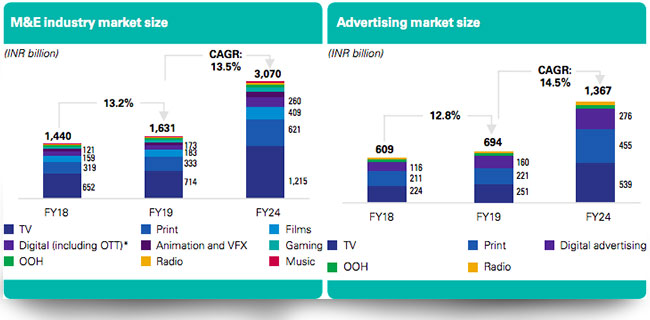
    The M&E industry in India posted a solid growth of 13 per cent during FY19 to reach a size of INR 1631 billion with a CAGR of 11.5 per cent over FY15-FY19. KPMG India launched the 11th edition of its Media and Entertainment (M&E) report titled ‘India’s Digital Future: Mass of Niches’.  Digital has been a recurring theme across all segments of M&E causing disruption in TV and print and fueling growth in digital advertising and gaming. The digital market is poised to become the second largest segment in India after TV, and also attract the maximum advertising spend by FY22.


    The report examines the evolution of India’s digital demography to 2030. It also covers the industry’s performance across segments, along with the key underlying themes and growth drivers.


    The study notes that there are favourable factors for both digital access (smartphone penetration and low data costs) and content supply (investments in original and regional digital content), which together will continue to drive up online consumption. The investments in regional content is an outcome of the growing importance of regional language markets in India, which is another key theme of the report this year. With the digital migration of English-speaking audiences almost complete, most new users coming online – and there are expected to be 500mn of them by 2030 – will access the internet in a local language.


    The 500mn new users by 2030 present digital businesses with an unparalleled market opportunity but not without some complexity. Segmentation will become important as the market evolves into a mass of niches. The report examines major consumer archetypes that together provide a framework to better understand the socio-economic profile as well as media and entertainment consumption patterns and preferences of the projected billion internet users.


    Said Girish Menon, Partner & Head Media & Entertainment, KPMG in India: “The theme of the report this year is India’s digital future – and although the term ‘digital revolution’ has become somewhat of a cliché, there can be no other way to explain the extent of digital integration in our lives today. With no major constraining factors, digital is expected to be a dominant force going forward and in FY23, it is likely to be the second largest segment after TV and attract the highest marketing spend among all media formats. In 2019, as digital behaviour evolves, there seems to be a growing consensus that in the future, subscription models will have a greater role in monetisation of digital platforms. Further, evolving technologies are also presenting opportunities for companies in the media and entertainment industry to achieve greater operational efficiencies.”


    Added Menon: “In the coming years, it will be hard to ignore the pessimistic signals emerging from global economies but they will not have long term impacts on the industry and are unlikely to alter the strong fundamentals and momentum of M&E consumption, especially digital, in India. As an industry, we will remain upbeat on the prospects for both.”


    Said Satya Easwaran, Partner & Head Technology, Media and Telecom, KPMG in India: “By 2030, we estimate that there will be a billion people in India who are connected to the internet. Our initial hypothesis is that the user will primarily be a non-English speaking, mobile phone user, from a developed rural area/ non-metro urban setting who is increasingly willing to pay for content online. But why is the profile of India’s digital demography relevant? The digital disruption has forced a pivot of business models in media and entertainment from an erstwhile B2B2C model to a D2C one. And therefore, segmentation and demographic, psychographic and behavioral profiling will all become increasingly important, as they have historically been in other consumer businesses.”


    Click here for Media Report