Tag: Sanjay Mehta

  • Dear Santa…


    On the occasion of X’mas 2014 so we asked some industry captains to tell us what goodies they would like Santa Claus to bring them this Dec 25. Interviews by Shobhana Nair here goes:

     

    Srinivasan K Swamy, Chairman and Managing Director, RK Swamy BBDO

    If I were to wish for something, then this would be double digit GDP growth of our economy in 2015!



    M G Parameswaran, Member Management Board, FCB Ulka Advertising

    I wish Santa Claus to bring to the advertising agency business a big bottle of confidence tonic! An elixir that will infuse everyone in our exciting world of advertising with extra courage, confidence and spirit; to believe in the industry, to believe in their own competence and contribution to the success of brands and most importantly a unshakeable faith in the greater purpose of advertising: to move consumers from their inertia, to keep the wheels of industry moving, to make the world a better place, one OTS/ one TRP at a time!

     

    Piyush Pandey, Executive Chairman and Creative Director, South Asia

    Ogilvy & Mather India

    I’d like Santa to distribute small and beautiful packets of wisdom for everybody in the industry.



    Satyan Gajwani, CEO, Times Internet

    New consumers are buying smartphones everyday, but for them to be useful, the cost of data needs to reduce. When users want to pay for something, it shouldn’t be as cumbersome as it is today.



    Ashish Bhasin, Chairman & CEO South Asia – Dentsu Aegis Network

    If Santa Claus could meet with the Finance Minister and emphasize upon him that in the forthcoming budget he needs to give a sensible taxation regime, particularly with respect to service tax and VAT applicable on the advertising and marketing communications business, I think it will go a long way in helping our industry grow. A an industry, we want to show our creativity in the area of advertising and not in the area of creative accounting!

     

    Prashant Panday, MD & CEO, ENIL

    The one thing is that Phase-3 auctions get completed before March 31 and migration of 21 Phase-2 licences which are lapsing on March 31st happens on time.



    Anirudh Dhoot, Director, Videocon

    In line with our Prime Minister’s vision of “Make in India”, we expect policies and infrastructural support for electronic components and panel manufacturing in India. India has the potential to become a global electronics manufacturing hub not only for internal consumption but also satiating global requirement.



    Sanjay Mehta, Joint CEO, Social Wavelength

    The one thing that I’d want Santa Claus to bring to our industry, would be Better Retainer Fees :)  For all the hard work that the social media agencies do for clients, from strategy to execution, from creatives to media, from technology to ORM, we still don’t get adequate respect, reflected in terms of decent monthly retainer fees! As we get into 2015, I hope Santa Claus makes our clients acknowledge the role we play and compensate us better!


    Santosh Padhi, Chief Creative Officer & Co-Founder, Taproot India

    I’d want Santa to give us an emotional gift in the form of ‘unity within the industry’. We are fighting so much within ourselves and are even ready to kill each other for business. We are going from bad to worse now. There’s a long list of things that I am seeking from Santa but I definitely feel that people should follow ethics and morals. We need to make it a human industry. There’s just no humanity left and that’s a huge disconnect.

     

    Arvind Sharma, former President, AAAI

    There was a great deal of optimism and hope during BJP’s election campaign. And so far it has translated into foreign investment flowing into financial markets. But as far as the ground is concerned, things have to yet get better. We hope 2015 will bring strong growth in the economy for the overall business. Advertising industry depends on the client’s growing business, their budgets and spends. They have been really tight for the last two-and-a-half years. We hope that will change in the coming year.
     

  • Welcome, Content Marketing


    By Tanushree Bhatia


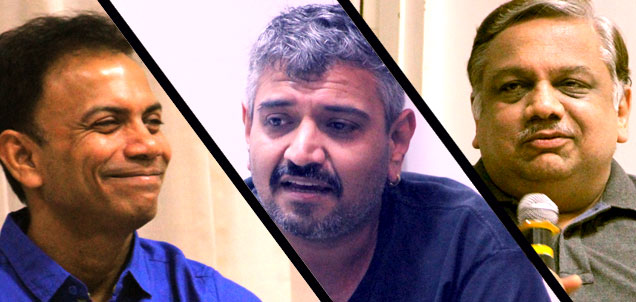
    It’s one of the biggest buzzwords in the media these days: content marketing. Advertising agencies are being forced to look beyond traditional ads to also include this new form of messaging in their offerings. And marketers have had to rejig their teams to be able to manage the new challenges thrown up by this new form of outreach. These and other issues were touch upon at a panel discussion at premier marketing and communications school MICA last Friday. The discussion was part of MICA’s annual marketing management festival Micanvas at its campus in Ahmedabad. The panellists were: Sanjay Tripathy, Senior EVP-Marketing, Product, Digital and e-Commerce, HDFC Life,  Kunal Jeswani, Chief Digital Officer, Ogilvy India, and Sanjay Mehta, Joint CEO, Social Wavelength and the proceeds were moderated by Pradyuman Maheshwari, Editor-in-Chief and CEO, MxMIndia and Consulting Editor, dna of brands.


    Sanjay Tripathy, Senior EVP-Marketing, Product, Digital and e-Commerce, HDFC Life

    Content was always a one-way communication. We then moved to blogs, social media and now there are multiple channels. It has increased manifold. It is very important to understand how the generation is changing. The readership of blogs has diminished over time. It is a checklist generation for example: 5 things to do, 10 things to do. It is all about instant gratification. Nowadays, constant monitoring and responding to user-generated content is more important than content creation.


    You can allocate 5 percent of the spends pie on digital and that can do a great job. I feel our social space is like personal space. Our social spaces are very segregated. You have to have a strategy as to what this strategy is best suited for.


    It’s not easy – but the age-old principle holds true: know your audience. For many companies, that audience is the always-on generation, which represents both their current (and future) customers, so smart marketing with them now can yield invaluable loyalty later on. If one is able to accurately target a few words or phrases that resonate with them, they will conjure a positive memory around your company, and, hopefully your product – so stay ahead of their game.


    Kunal Jeswani, Chief Digital Officer, Ogilvy India

    It’s about push/pull communication. Communication strategy focuses on push whereas content is around pull. It thus need not be created but can be sponsored. The content is designed to be either entertaining or add some value to the consumer. In the process of consuming the content, the consumer makes a brand association.


    My job didn’t exist five years ago. Things are changing and capabilities are being built. The digital medium plays a very important and large role in telecom, finance and auto sector.


    We have started to see things differently and the British Airways ad is the best example. The producer of the ad is not an ad filmmaker in fact he used to make expensive wedding videos. But the characters are real and none of the interactions are scripted. When you start capturing that kind of stuff is what I mean by content and not advertising.


    Consumers are very intelligent that way. No one can be fooled into it. Everything is usually branded example the Google ad. It’s clearly a Google film and no one is misleading you. But you still watch it like a piece of entertainment. What digital does is that it lets you do visuals. The only issue is how interesting you can make each element with a push.


    Sanjay Mehta, Joint CEO, Social Wavelength

    Today every company is a media company and they have a huge onus of creating tens of thousands of pages of content. A dilemma that is often faced by companies is the short attention span of a consumer. Gone are the days when there used to be long stories. We have shifted from emails to Whatsapp from SMS. And now there’s the Yo app. First the companies need to create content and then create content of interest. And who is the competitor? Everyone is a potentially great content producer. The world is rich with the quantity of content that gets created each day. Content has to align the agendas of both the brand and the user.


    There are question marks on user-generated content, but there are enough genuine reviews on the sites. There is a rating of the reviewer also for example in when I go to a Zomato, I see reviews by my connections first.


    This report first appeared in the dna of brands issued dated November 17, 2014


  • JWT acquires majority stake in Social Wavelength


    By A Correspondent


    Leading marketing communications agency network JWT has agreed to acquire a majority stake in leading social media agency Social Wavelength.


    Social Wavelength is a Mumbai-headquartered full-service social media agency specialising in social media offerings right from strategy to execution that includes social media marketing, online reputation management, social CRM and social media for HR.


    “JWT’s acquisition of Social Wavelength is a logical confluence of social media and mainline expertise, coming together to create integrated communication for brands. The rich experience of five years that we have, in this young industry of social and digital media, will find the next leap of growth, through this partnership,” said Hareesh Tibrewala and Sanjay Mehta, Joint CEOs and promoters of Social Wavelength.


    Established in 2009, the agency now has over 170 professionals servicing over 50 brands across their offices in Mumbai, Delhi and Chennai.


    “We want to be a critical resource partner across the many solutions we provide to our clients. As we continue to relentlessly transform our offerings, Social Wavelength adds a huge dimension to our existing clients and the brands we steward,” said Colvyn Harris, CEO, JWT South Asia. This is JWT’s second digital agency acquisition in India, the first being Hungama in June 2012.


    Acquisition part of JWT plan to be future-ready: Colvyn Harris 

    A quick chat with Colvyn Harris, CEO, JWT South Asia on the Social Wavelength acquisition and whether he is looking at any more buys in the future.


    01. This is the second digital agency that JWT has acquired in India. Would you be looking at acquiring any more soon? Or is this it?
    We are transforming the JWT group of companies to be future-ready. And digital is an important part of the mix. We have a definite roadmap on digital and while Hungama has been doing well, when it came to social media, we were looking at a good agency and Social Wavelength was the answer. So, in future, if something good comes along and if we find that we are unable to develop skills and build capabilities and if we think it’s better to acquire, we will do that.


    02. Social Wavelength is known more for work on the implementation and execution than strategising for brands and corporates. Will it stay that way?

    If you look at a specialised space like social media, the strategy that you develop is what you need to execute. Typically, the creative agency will look at the brand and its personality, while Social Wavelength will look at the social media implementation. Now that it is part of JWT, if we identify opportunities for our clients, Social Wavelength will definitely be able to deliver on that proposition. Also, they have their own clients for which they have been doing work and will continue to do so.


    03. Would you see India becoming a hub for servicing digital deliveries for other JWT offices?

    Across the globe, JWT has many digital offerings. In fact there’s a major global push that we have on digital. On being a hub, it all depends on what are the skills we can offer and if there is a requirement for then from within the JWT or WPP fold…


    04. With digital in most agency set-ups being a full-service activity, we now have creative agencies doing media work and vice versa. As an advertising industry veteran, do you think we are headed in the direction where all agencies will turn full-service?

    That may not happen. Media agencies have gone far ahead of the curve. Both media and digital agencies have developed and invested a fair deal expertise. But the client is central to our work so if it means working within the JWT or within the WPP fold, we work very seamlessly.


    05. You acquired Mindset in Hyderabad two years back, Hungama after that and now Social Wavelength. Would JWT be looking at any other acquisition? Any other business – new or old – that you would like to be looking at growing inorganically?

    In JWT, we believe in planning and we have considerable depth in that. Encompass is part of JWT which takes care of activation and big events. But yes, there are areas like mobile and analytics which are growing. We put the client’s business at the centre of what we do and where we identify a gap, we will definitely try and close that gap.


    ‘The JWT structure enables us to continue to be entrepreneurial and reasonably independent: Sanjay Mehta
     

    Q&A with Sanjay Mehta, co-founder and Joint CEO, Social Wavelength


    01. One more homegrown digital firm gets gobbled up. Wouldn’t it have been nicer for you to have stayed independent rather than become a part of a large global advertising network?

    Well, that’s always a dilemma for any entrepreneur. We weighed the pros and cons of the two options, and found it more exciting to join hands with a global major and grow faster.


    The WPP / JWT structure enables us to continue to be entrepreneurial and reasonably independent, and yet derive the benefits of a larger agency network. That looked like a good option for us.


    02. Is this (getting acquired by an international biggie) the only way to go for digital independents?

    Certainly not. One can remain independent and grow. Will there not be a Madison in the digital world? Why not? There would be one (or more) and it could be maturing even as I write this.


    03. From when did you start looking towards getting acquired? And how did the entire process start and how much time did it take?

    We were not consciously looking to get acquired. In the sense that we never mandated someone to find us an acquiring prospect, etc. We did have a few conversations which were all proactive and direct. We were prepared to look at opportunities that came our way, without being in any rush of any kind, as we were growing well, on our own steam. But we were open to strike a deal, if we found the proposal interesting. This one turned out to be that type.


    As for the process, it has taken several months, and we believe it was worth the time. As any relationship involves the getting-to-know-each-other phase, and the time was well utilised for the same.


    04. Is the choice of JWT a case of whoever gave the best price or is there also a fitment of cultures?

    We were genuinely very happy with the chemistry we saw with the folks at JWT. And that was the driving force. There are many other factors, including what the association can create together, and how it can yield benefit to us, over time. And sure, there was a factor of the right price too.


    05. What happens now with Social Wavelength being part of JWT?

    First of all, Social Wavelength remains an independent unit and continues to run its business completely independently. Operationally, some processes of WPP / JWT do get into place, but for most parts, we run the business like we have been doing. Quite independently.


    What we do get is the benefit of JWT’s local and global reach of clients, the best practices, the knowledge resources, etc. Which we reckon, will propel us to higher levels of growth, rapidly.


    06. Will there be synergies with the Hungama part of the business?

    Yes, there are plans to have a great working set up between JWT, Hungama and Social Wavelength. Details will be figured out as we run the course over the next few weeks.


  • Jaldi 5 with Sanjay Mehta: 1 billion users strong, Facebook can influence elections

    Sanjay Mehta

    When Facebook gently proclaimed that it now had touched the magical one billion users figure, most of us just dismissed it as a milestone. But it’s an accomplishment that cannot be ignored by not just individual users – but also marketers, sociologists, governments and all those who need to reach out to the masses.


    We asked Sanjay Mehta, Joint CEO, Social Wavelength some very fundamental questions on this achievement including whether there is any reason to fear the platform being abused of destabilizing nations.


    1 Would it be right to say that a good reason for the Facebook users reaching 1 billion would be thanks to the growth in recent years in India?

    LOL… no. We cannot take too much credit considering the Indian userbase, at this time, being a nominal 50 mn in FB’s total of 1 bn. So while the Indian user base has contributed to the overall numbers, it has been a nominal percentage.


    Would you say that Facebook is the single biggest marketing development of the 2000s?

    Well, I would say Social Media is the single-biggest marketing development. And Facebook is a key player in that social media space. Also though, I would also not claim this to be the greatest development of 2000s. That is a long period, and we have had other key developments including search engine advertising, which have been impactful. But in the last 2-3 years, it has been a clear emergence of social media as a marketing platform, and Facebook is its most significant component!


    With one billion users, Facebook users constitute the single largest community of individuals after China and India? Do you think it’s right for it to be seen like that?

    Well, yes, sure. So let’s take that analogy ahead.  What does a single group – be it citizens or China or India, or registered users of Facebook – mean?  That they do share some characteristics (citizenship in case of countries, Facebook in the latter case), but there are enough differences amongst them too. All citizens are not the same kind of people, nor are all registered users of Facebook. Likewise, there is no easy way for a marketer to reach “all Indian citizens” (wouldn’t THAT be a dream?!), and so also, there is no easy way to reach the billion Facebook users.


    Except perhaps, for the governments and for Facebook!! But the citizens and Facebook users do constitute a ‘group of sorts’ and there are opportunities built in there, for marketers.


    2 Do you think marketing in the present day can be done without a Facebook strategy in the media plan?

    All marketing plans may not need Facebook. So there IS a possibility for a few marketing campaigns to not include Facebook However, Facebook is making constant changes to become interesting for more and more brands and perhaps over time, most campaigns will have a Facebook extension! Or a Facebook core!


    But is there a lot of abuse of Facebook – fake likes, fictitious users and various strategies adopted to alter perception by marketers. Is there reason for skepticism when people refer to success thanks to ‘Facebook marketing’?

    The scepticism is with a few people only, and it is also misplaced. The number of fake accounts or fake likes is a small percentage again, and the matter has been exaggerated. There is also an extent of click fraud in Google ads. But due to good algorithms, this is controlled to a small level. Same is the case with fake profiles and fake likes. It is a small percentage. Facebook does not like these. Recently it identified about 80+ mn fake accounts and went about deleting those.


    Can Twitter be put in the same basket as Facebook for marketers?

    Well, it depends on what you’d call the basket. So yes, it is also part of the social media space, and in a sense, the marketer will reach the social media active user, via Facebook or Twitter. But within that framework, there is a difference between the two platforms. Not just that, within Facebook or Twitter usage also, there are different patterns of usage and user profiles. So marketers cannot just “go to Facebook or Twitter”. There is a further science in terms of what they want to achieve, whom they want to reach, etc., and based on which campaigns are planned and executed.


    3 Just as Orkut was a rage once upon a time and faded out eventually, do you think Facebook could see the same eventuality soon? What do you think is the next big idea?

    If I have learned something in the last 10-15 years observing the tech space, it is that, ‘nothing is permanent’ or ‘no platform / brand / service remains on the top for very long’. Facebook could be the exception to this rule, or it could also fall out of favor in sometime.


    However, at the present moment, stock price apart, Facebook is extremely well-entrenched as a powerful leader in the space.


    If something or someone can displace it from its position, I do not have the crystal ball to gaze into and tell you, what that may be! It could be a platform that is currently present and becomes larger, or it could be something that is being developed in some garage or lab in some part of Silicon Valley or Israel or even Mumbai or Bangalore!


    Let’s keep watching the space and discover when it happens!!


    4 Do you see social media like Facebook being used by politicians to influence public opinion?

    Absolutely! Politicians are also brands that need to be sold, no disrespect meant here! So like any other brand that uses the medium to influence its target market, a politician also needs to do the same, for their communication messaging.


    Whether social media will impact an election result or not, just yet, it hard to say. But it will definitely influence few votes!


    5 Can there ever be a fear of Facebook being misused to destabilize countries… just as there is a fear of various media vehicles?

    We live in interesting times. Many of us are logged into our Gmail accounts all day. There is a decent amount of our web behavior that Google knows about.


    We use applications like Whatspp or Truecaller, and we share our contact lists with these applications. And a lot of us do so, and the applications then, know a lot of our cross connections and relationships.  Likewise we use Facebook, where we share our relationships, we talk about our vacations, put our photos and videos, and let people know our political preferences or movies that we like.


    There is truly a lot of information about us, out there.  And this is with a variety of sources, whom we consciously trust, or sometimes do not realize, but end up giving our trust!  Just as data stored and flowing through electronic pipes is always susceptible to leaks like Wikileaks, so also our personal data is always susceptible to being abused.  Either by means of hackers exploiting some holes, or worse, if the sources that we trust, turn rogue!


    We live in hope that these guys don’t turn rogue, and there is no major abuse of our privacy. Each morning, along with the prayers for your health, wealth and prosperity, you must also pray that Google, Facebook, Whatsapp and other such applications do not turn rogue ever!!


  • The Crucial Social Media Question: Have fans? Now what?

    By Tuhina Anand


    Every marketer worth his salt wants his brand to have a presence on social media. However, the truth is that the marketers are still trying to figure how to navigate this medium.


    Having heard that it’s a ‘cost effective medium, can be tracked and is ‘the’ medium’ where the customers hang out, the marketer obviously wants to be there too. But the social media still has a long way to go before it is seen as the ‘vehicle of choice’ and not just as an afterthought.


    Yes, one agrees that marketers are warming up to the medium but they are still testing waters barring a handful who have taken the medium wholeheartedly.


    Once a marketer decides to go on social media, the next move is to create a presence on Facebook and maybe on Twitter. We have often heard the marketers talking about the large number of fans they have acquired on FB, so what do these number of fans mean to them and how are the marketers leveraging these fans to engage effectively with consumers?


    Chhaya Balachandran Aiyer, Founder and Managing Director, BC Webwise agrees that there is peer pressure to acquire more fans and clients often bow to that demand: “The number of fans and likes is a visible number, hence one can’t write it off completely even though many of the numbers could be dormant fans. These numbers are an opportunity to engage those fans in a meaningful way to create brand loyalty and brand recall.”


    She added: “Two years back, the common demand of a client was to be on Facebook, but we have seen a shift now where they have realized that it’s not the ultimate answer but social media too needs a 360 degree approach.” So it’s clear that there are different kinds of marketers and the early adopters are clearly asking the right kind of questions.


    Some of the brands that have effectively used the communities on FB are Fastrack, Café Coffee Day, Sunsilk while more are getting on the engagement bandwagon. Explaining the significance of the numbers, Rajiv Dingra, CEO, WATConsult, said: “While all readers of an ad do not become buyers of the product, similarly with FB, the marketers become a publisher of its page to reach out to the consumers. The aim is not always conversion to transaction for all people on its FB page, but with a large fan base the number of potential buyers definitely increases.”


    Mr Dingra is clear that there is no replacement for good content. He added that the numbers might reflect various objectives of a brand at different points, but if the content is good, the engagement with brands will become only much more involved and meaningful.


    Vineet Gupta

    Vineet Gupta of 22feet has been relentlessly engaging with brands to enable them to use their social media tools effectively. He explained: “We have brought out exclusive sale for Fastrack fans on FB and the brand has been doing a lot of stuff exclusive to the community. Scale has its own benefit and one can’t deny that. With people becoming familiar with social media, there are lots of activities happening which take people beyond the likes and the fans.”


    The agency has recently done activation for Lee titled ‘Shadows of City’, where people were encouraged to present their photographs of the city and the shadows they create which would then be put up in the stores.


    CCD is another brand that has been using FB to listen to its customers and also engage them via the medium. Ramakrishnan K, President- Marketing at CCD elaborated: “At CCD, we not only have numbers, but also a high level of engagement. Our fan base is 2.6 million and our monthly engagement level is 60 per cent, i.e. 60 per cent of our fans interact in some form with our page every month.”


    He added: “At CCD, we use social media base for regular tailor-made communication on happenings in CCD. We have a direct consumer feedback on cafes across the country which gives us instant information that keeps us on our toes. Most importantly, we use the fan base for co-creating many of our offerings – be it new menu, suggestions for improvement, live tasting of new introductions, choice of music among others. We engage fans to co-create their brand. As a result, we drive a very high level of consumer engagement, which in turn helps us drive sales.”


    One concern is that many fans on FB might be dormant, so then do the numbers really mean anything? Sanjay Mehta, Joint CEO at Social Wavelength explained: “I think that the key is to deliver message to interested people. If people receive the message but not respond, that is not a concern, but if they do not get the message in the first place, then it’s a bigger challenge. I think one should not be dismissive of the dormant numbers, but focus more on getting the right kind of messages that will get them to engage.”


  • The Anchor: 4 reasons why one worries about Google

    By Sanjay Mehta


    So you think Google Plus has its set of challenges, as it ambitiously takes on Facebook? Well, I am not even talking about that. My worry is about Google’s core product and cash earner, Google Search!


    Let’s do a quick dipstick here:


    • When you search on Google for information, how fast do you get to the right information that you need? That is, if you ever get it!
    • If the information that you are looking for is not something as basic as “what is the current time in San Francisco?” or “temperature in New Delhi”, there is every chance that information search is a frustrating experience on Google. Do you agree?


    These are the reasons I am concerned about Google.


    1. Not all search queries produce good results on Google

    While Google has been doing a fair amount of innovation in search, and for certain types of enquiries, you can get to the information faster, there are a whole host of search queries that do not lead to good results, and where as a user, you look out for alternative options.


    2. Google’s revenue model on search worries me

    The revenue model is largely an advertising model. An advertiser takes ads on Google, while mapping search words. In other words, if I am a florist, I will likely buy Google ads, for keywords like “florists in Mumbai” or “Valentine’s day flowers” and so on. In short, when someone is searching for words or phrases of these kinds, then I would like them to see my advertisement on the right side of the page on Google. Because, then I would have the best chance of finding a connect to the particular user, and tempting him to click on my ad, and come to my website.


    The other key thing to know and understand is that advertisers typically pay only when someone clicks on their ad and not otherwise. Also, all advertisers do not pay the same amount. The amount that an advertiser pays per click depends on the budget or rate that he has chosen, and it is based on a dynamic demand-supply situation of advertisers and searchers, for that particular word or phrase.


    But, from the point of view of the advertiser, whatever rate he has agreed to pay per click, is his “cost of acquisition”, or the cost to get an interested user, to visit his website. So, who would spend how much on advertising on Google?


    If your business is transportation of very large-sized goods, you may still use Google advertising to get across to people who are looking for such services. But for you then, this is a marketing campaign, and you want a certain visibility amongst your target group. So you would put money here in campaign bursts, and leave it at that.


    On the other hand, if you are an e-commerce company, selling online, whether it is travel services or products, for you, the Google ad is a direct customer acquisition cost, and all the traffic that you pull in from these ads, you have a chance to get them to buy from you, right away. Since there is a way to map conversion from such clicks also, an e-commerce company can quickly calculate the equivalent cost of acquisition, of not just a visitor to the site, but an actual buyer.


    For those who don’t get this, let me explain with an example. Say, a hotel booking company advertises on Google and spends Rs50 per click. Say, 100 people click on the ad. So the cost is Rs5,000. Mapping for conversions from these 100 clicks, he finds out that 20 of those actually made a booking.


    So to acquire those 20 customers, he has spent Rs5,000 or his per customer acquisition becomes Rs250. Now, if his average booking transaction is Rs10,000, he may have no issues in this kind of spend, and may keep doing the spend forever, unlike the advertiser who spends on marketing campaigns in bursts and then goes away.


    Now here is where the challenge for Google comes in.

    All of the transaction-oriented e-commerce businesses are starting to get their own specialized search engines, which do a far better job than what Google does.


    3. If the searcher moves away from Google, so will the advertiser

    Larger and regular monies are spent on Google ads, by companies who have a quick transaction engine on the web – for them, it is direct customer acquisition. However, for most of such needs, users are finding better options to go and search at; over time, users will move away from Google to search for their needs of hotels, flights, products to purchase, movie tickets, etc.


    If the searcher moves away from Google, so will the advertiser who is looking for that searcher. What constitutes the larger spends on Google ads, will take flight and move to more relevant locations to get better returns for their money.


    You don’t buy this argument? Let’s take the spin. Say, you are searching for tickets from Mumbai toChicago. And you are looking to find options. What do you get?


    What I get on Google.com are a lot of ads, on the top and on the right, and in the main search, I get a few clearly SEO-doctored links, and then a few links to travel websites. So yes, if I play around these links, I will get the information that I am looking for, in a few clicks.


    But, I go to any of the leading travel sites instead and punch the same request – I get a quick response in terms of flight options for Mumbai to Chicago.


    And then I go to a travel comparison site like say, ixigo.com, and I get the same search results from several travel sites, simultaneously. Flight options, prices, all at a quick glance, together on the same page.


    So why would I go via Google at all? If, similarly, I was looking for ‘hotel options in Jodhpur’, the experience will be identical to the above. Question again will be that, if I were looking for hotel options, why would I go to Google at all?


    Let’s consider products. Say I was looking for a book, “The Maverick” by Ricardo Semler. What will be my experience?


    Searching on Google gives me stuff about the book, about Semler, reviews, and 1-2 links to Amazon.com.


    Instead I go to junglee.com (the killer app on Indian e-commerce, I reckon), and I get a bunch of options for purchase of the book, with price details, and seller information. Bang on! Exactly what I need.


    Repeat this for most e-commerce or transaction-oriented categories, and you will find a similar challenge. That Google does not give you what you want. There is a specialist platform that gives you perfect results.


    So the bottom line is that people may not start at Google when they are searching for such transaction-oriented information. And this is where the cheese may be moving away for Google!


    This is where the old time Internet service providers and portals went wrong. Time was when AOL and Prodigy and others were the starting point for anyone in theUS, wanting to get information from the Internet.


    Then came portals and search engines. And the game shifted. Sites like Yahoo and Lycos became the default starting points for people, as they offered best recommendations for news, education, entertainments, science, sports, or whatever.


    Then came specialist sites for finance and matrimony and recruitment, and people went there directly, instead of going via portals. I am seeing a similar movement, away from search engines, or rather, away from Google.


    4. Google’s revenue may see a downward spiral

    Considering that search is the main money earner for Google, if they do not correct, this could be the beginning of the southward movement on the revenue front. And that will hurt Google far more than their experiments with social networks – Wave, Buzz, Google Plus, Orkut, etc not taking off!


    I worry for Google.


    Sanjay Mehta is the Jt. CEO, Social Wavelength


  • How (and why) marketers love social media


    By Rishi Vora


    There is sooooo much happening in Social Media. Every brand – no matter how big or small, every media and entertainment company, especially film and television content (where YouTube has become such a rage!), even a local mall or a retail outlet owner in a small district is looking to be on Social Media, where he feels he should be before his neighbourhood rival is, and win more customers.


    Although this might sound as if Social Media is a disparate measure for brands, the fact is that the market is responding to the rise of a new medium which is a just about a three-year-old phenomenon; one which promises to change the game as far as marketing is concerned.


    There are many cases of brands benefiting from the social space, be the whacky Old Spice videos that did the trick in 2010 – yes, they were a set of videos, but became most popular on Social Media or Kolaveri Di, which became an online sensation. Or whether it is the case of Megan Fox meeting Rose Boy back in 2009, thanks to Kodak that took the initiative of taking it to the masses, through Social Media of course, offering the winner a handsome $5,000. There are many more stories where brands have recognised the opportunity and made the most of it. Celebrities have now become a key asset to the marketing strategies for many online brands.


    Traditional Media:

    Even the radio channels and newspapers danced to the tune of Social Media, a rare case of digital beating traditional media hands down. But the TV Channels and content companies are the ones taking the most advantage of the new medium.


    Akash Chawla, Marketing Head – National Channels, Zee is of the opinion that the percentage spends on digital has seen an increase and social media is one direction where most channels are putting their focus on. “We’re not the only ones to have entered the social space. It’s important to be there. But, the fact is that being on social media is also a fad. It is stylish and fashionable. The medium is highly measurable, and you get real time responses from consumers.”


    Even participants of Zee TV’s flagship reality show Dance India Dance Season 3 claim that watching videos on YouTube has encouraged participation in the show.


    Star Network too has been fairly active in the space, promoting all of its entertainment channels on platforms like Facebook and Twitter. And so as Viacom 18, MSM Group.


    Social Commerce:

    Yet another aspect of the social media – social commerce- as a trend started last year, and as experts believe that 2012 is going to be a year when Social Commerce will take off in a big way. Three of the most upcoming and prominent social commerce platforms are: Facebook (f-commerce), Twitter (t-commerce) and GuruLike.


    F-commerce or f-comm refers to the buying and selling of goods or services through Facebook, either directly or through the Facebook Open Graph. Experts forecast that F-commerce transactions on Facebook will overcome Amazon’s annual sales ($34 Billion) over the next five years.


    The emergence of social media has resulted into a sea change as far as the marketer’s psyche is concerned; who a couple of years back was unsure how the medium fare for the brands. He has now realised the true potential and as a result has started to appoint specialists for the job. This has resulted in the rise of specialist social media agencies- people who evangelised the medium three to four years back and who’re now well-equipped to handle marketing problems, using the power of social media.


    Social Wavelength and Windchimes are the two most popular pure play social media agencies, while there are other digital agencies that offer 360 degree digital solutions (where social becomes one part of the offering). And then there are PR agencies that have now expanded into offering social media services to existing clients. Hanmer & MSL Group, Ketchum Sampark, AdFactors and many others. Though these agencies pitch for social media businesses separately, they have the added advantage of an existing PR clientele.


    Sanjay Mehta
    Sandhya Sadananda

    Social media and creativity:

    Though different agencies follow different processes, there is a misconception which plays in the minds of many that Social Media does not need creativity; there is not much of strategy involved, as against other forms of advertising.


    Sanjay Mehta, Jt. CEO, Social Wavelength clarified: “Executing a good social media strategy is a mix of two disparate skill sets: One is creativity, like that of an ad agency, to differentiate the social media activity of the brand, and second: processes, of the kind that one usually associates with KPOs, as social media is not a campaign, but virtually a day-to-day, minute-to-minute business process.”


    Sandhya Sadananda, who prior to launching Windchimes, was a PR professional, explains how Social Media is not an extension of PR. “Unlike the US and the UK, PR in India is still a media-led activity. When you are in Social Media, you need to rethink the way you look at communication. Social Media cannot be seen as an extension of PR. Unlike PR, here you have the direct control in terms of the content you want to put up. At the end of the day, it is about adding value to the brand. And that could be in terms of content, the creativity, the number of fans and so on.”


    The nuts and bolts:

    So how do Social Media campaigns run? How different the approach needs to be? What are the systems and procedures that need to be followed? How does a social media agency scale the operations?


    Mr Mehta explains: “The starting point is to create a ‘character’ for the brand on social media. All communication, tonality and so on has to be in sync with the brand positioning and the brand’s character. For a TV channel, a social media campaign will typically have one set of conversations centred around the brand, and the other additional set of conversations to go closer to the interests of the target group.”


    From the standpoint of the marketer, however, the question which most often arises is: ‘Does social media help clients improve bottom lines’. This is also one reason why spends on social media are way too less in comparison to other media. Yes, these are early days, but pure play social media agencies have to grow and that is seen as a big challenge.


    Ms Sadananda affirms: “One needs to look at social media, not from a bottom line perspective, but from the point of view of qualitative engagement. The ROI in this business is so much number driven (number of fans, interactions) that people started to equate that with the bottom line. If you’re expecting increase in sales after a social media campaign – that’s not going to happen. One needs to have a different sort of mindset when it comes to social media.”


    She adds: “It’s very easy for marketers to make this just another medium. Agencies need to step in and help them understand the true nature of the medium.”


    Challenges:

    On the challenge for agencies to scale up their businesses, Mehta reckons that one needs to visualise the scale, in terms of the opportunity. And then investigate into various ways of creating an organisation, bringing in leadership levels and correcting/ tweaking the model as business grows to ensure smooth sailing.


    But, broadly, it is content that will decide the fate of specialist agencies. And, that in experts’ mind, is a bigger challenge. Adaptation will be the key as platforms evolve, users evolve. It is an age of e-commerce, and Social Commerce is not far behind.


  • Social Wavelength wins 2 Biggies at WAT Awards, 2012

    By A Correspondent


    SocialWavelength,India’s leading social media agency, has been awarded the ‘Social Media Agency of The Year 2012’ for the outstanding all-round work done in the Social Media space at the recently concluded WAT Awards 2012.


    To make the evening more special, Mr. Sanjay Mehta and Mr Hareesh Tibrewala, serial Internet entrepreneurs and co-founders of Social Wavelength, were also awarded ‘Social Media Entrepreneurs Of The Year 2012’.


    WAT Awards is an initiative of WAT Blog to recognize and felicitate agencies and professionals who have done ground breaking work in the Indian digital media space.


    “The ‘Social Media Entrepreneur Of The Year’ award is a recognition by our peers, for the passion and hard work we have put in to build the organization thus far. It also serves as an inspiration to scale greater heights”, said Hareesh Tibrewala, Joint CEO, on receiving the ‘Social Media Entrepreneurs Of The Year’ award.


    “The double success of being ‘Social Media Agency Of The Year’ and also the ‘Social Media Entrepreneurs Of The Year’ makes for a fabulous start to 2012. Coming as it does after the Red Herring Asia 100 win, it puts us in the perfect mind frame and motivation to make 2012 a big year for us,” added Sanjay Mehta, Joint CEO.


    Mihir Karkare, AVP, said: “Being recognized as the ‘Social Media Agency of the Year’ is a proud moment for our entire team. It makes all the sleepless nights and the hard deadlines worth their while.”


    Social Wavelength is a social media agency, headquartered at Mumbai. It’s suite of services include social media monitoring, online-reputation management, online PR, social media management and building online communities. Social Wavelength has a client portfolio of more than 50 Indian and international brands.