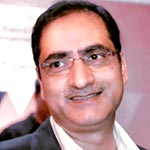
Sanjay Kaul Founder and CEO of Impact Communications has stepped down from his current position. He has three decades of experience in Rural Marketing and has been instrumental in building an Impact as a leading Rural Marketing Practice in India.
Nidhi Singh
Nidhi Singh, who has been part of the founding team will be the new CEO and Kalpana Raina Director Strategy Planning, takes the role of COO. Both of them have been part of the core team from the formative days.
Said Kaul: “My journey of building Impact from scratch has been fulfilling, enriching and nothing less than a celebration. I have been fortunate to have passionate and talented bunch of professionals in my team , who have both been part of my challenges and success, will always cherish those wonderful memories. “I am leaving Impact at the helm of a very creative, experienced and knowledgeable professionals and with a solid foundation. I am sure new leadership has both capacity and capability to take Impact to next level as rural is evolving and changing faster that ever before.”
Recently, Sanjay Kaul, CEO of Impact Communications and President of Rural Marketing Association of India visited Symbiosis Institute of Media and Communication in Pune. He had an interaction with the students studying for MBA in Communication Management and shared his rich experience in rural marketing. Later, I had an interesting interaction with him exploring the changes happening in rural marketing and media, which I would like to share with the readers of this column.
IS:What impact do you think BARC’s Rural TV Ratings will have on rural marketing?
SK: Marketing companies will take more judicious decisions in terms of how much to spend where. Assuming that GECs and other TV channels have access to rural areas, it will not make sense for brands to go one to one, use BTL or other tactical marketing tools in those areas. It will make more sense to leverage TV based on popular ratings for media planning. Earlier these ratings were not available, now a large chunk of the TV viewership seems to be in rural areas, the bigger question is what percentage and at what cost. However, marketers now can take more informed decisions about media spends in rural areas which earlier were considered to be media dark.
IS:So, the marketers’ spends on non-traditional media for rural campaigns will decrease with the availability of Rural TV Ratings?
SK: That is likely to happen. Earlier when we did not have the measurement of TV reach, we relied more on non-traditional media. Now, we have a better understanding of TV penetration in rural areas which is more cost-effective than non-traditional media. But, when we want the audience to experience the product or to give a demonstration of its use that cannot be done through traditional media. There, we will have to use non-traditional media. If you see the urban space today, there you will find more and more use of non-traditional media over and above the traditional media. So, both will exist in the rural space.
IS:With the increase of literacy in rural India, do you think the reach of newspapers can improve in rural areas?
SK: Newspaper penetration and reading habits are different in urban and rural areas which are not just based on literacy. When a copy of a newspaper goes to a rural chaupal, it is read by 20/30 people or more. More educated villagers read out the newspaper to less literate people. News and information get disseminated in the rural areas, but not in the same way as in urban areas where you have newspapers delivered on your doorstep every day. Now one or two persons in a village or establishments like barber shops and tea stalls subscribe to the newspapers and this pattern may not change. Literacy going up may not get huge traction in numbers in terms of circulation of newspapers.
IS:Â How do you think the reach of radio can improve in rural areas?
SK: In the unban space, radio saw a revival through FM. The rejuvenation of content radically changed the listenership of radio. Primary stations of All India Radio need to change their content and make the same more contemporary. FM is not getting penetration in rural areas due to Governments policies and regulations which prohibit acquisition of one FM channel by another. Otherwise players like Reliance would have established huge network of private radio stations. Big FM and some other radio brands are going to smaller towns and are combining activation and events with radio broadcasting with a rural spill over in surrounding areas.
IS: Â You mentioned in your talk that toady mobile is the most viewed screen in rural India. How are the marketers leveraging the growth of mobile in the rural areas?
SK: Mobile is going to be a game-changer.  This is the only thing which is in everybody’s hand in India today. Where there is no media penetration, there is still reach of mobile. Marketers are using it today both for control of their sales forces and facilitation of their business. They are also using it for sustenance of their business, for trade engagements and for pushing ideas. Coke is doing “Coke Sampark†riding on mobile; we are doing for Tata Chemicals a programme called “Sparsh†for various Kishan Kendras through mobile; BBC and Miranda Gates Foundation have done the program “Doctor on Mobileâ€, etc. Mobile is used today in every rural campaign in some or other form. Looking at mobile as a medium, the maximum downloads of entertainment clips from Hangama Digital happening in rural areas, so does the rupee one clippings of the cell phone operators.
IS: Do you think the current structure of rural marketing based on events, activation and mobile screens will continue in Digital India of future?
SK: We are thinking that something like a revolution is going to happen soon with Digital India. But, if we look at the Government’s plan for Digital India, it will take at least 16/17 years before whole India gets digitally connected. Government’s current plan of CSE centres is for facilitating e-commerce and various services offered by the Government. Social media traction is different in rural areas from urban areas. Anyway, rural people are more social and mutually connected than their urban counterparts. Digitization has to be seen more from the point of view of empowerment of rural people than from the point of view of extension of social media. The current structure of rural marketing will continue parallel with our shift towards Digital India for many years.
IS: Finally, do you think with the advancement of technology, rural fairs and festivals can be brought to the urban audience as a virtual experience? Like taking a virtual dip in the Kumbh Mela; or virtually visiting the Pushkar Mela?
SK: I never thought of it in that way. You have given me an idea. Sai Baba Trust offers you the scope of doing a virtual aarti and it may be possible to extend the experience of rural fairs and festivals to urban audience with help of technology.
IS: Â I think it will open the scope of a reverse integration between rural and urban India. Thank you for sharing your experience with our students and for agreeing to do this interview.
Indrani Sen is a media services veteran, having worked with JWT, later Mindshare and then with Emami. In recent years, she is an independent consultant and academic. She is Adjunct Professor in charge of the Media Management programme at the Symbiosis Institute of Media & Communication, Pune. The views expressed here are her own.
Rural marketing expert Pradeep Kashyap was re-elected President of the Rural Marketing Association of India (RMAI) at its eighth annual general meeting held last week (July 12).
Sanjay Kaul, head of Impact Communications, Sanjeev Shukla, Head of Rural Vertical at Hero MotoCorp Ltd and Rajkumar Jha of Ogilvy have also been re-elected as Vice President, Secretary and Treasurer respectively. Besides the above, the other committee members inducted are Seshu Kumar, head of rural retail business at ITC, Himanshu Shah, Chief Mentor of SOI Live Marketing and Vivek Dwivedi, Head – North & East at Percept Limited.
The executive body has been further expanded, given the enhanced potential and opportunities in rural India. Sandip Bansal, Chief Client Officer of Dialog Factory (Group M) and Ranga Rao, Director of RSR Lemon Media Pvt Ltd, have been inducted as Joint Secretaries to spearhead RMAI’s endeavours in West & South respectively.