Tag: Sandeep Menon

  • Tata Trust & Google team up to launch ‘Internet Saathi’

    By Dyanne Coelho


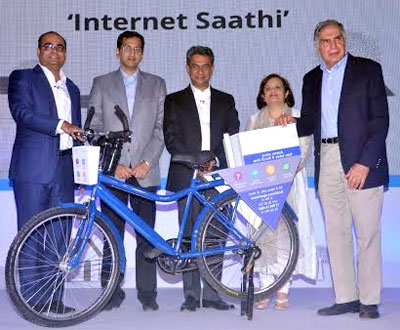
    Sandeep Menon, Country Marketing Director, Google, R Venkataramanan, Executive Trustee, Tata Trusts, Rajan Anandan, VP and Managing Director, Google South East Asia, Debjani Ghosh, Vice President SMG, Managing Director – South Asia, Intel & Ratan Tata, Chairman, Tata Trusts

    There was a time when one had to wait at least seven years to get a phone. Ratan Tata, Chairman of Tata Trusts, certainly remembers that time, and also acknowledges how far we’ve come today with the use of technology. Tata brought this up at the launch of ‘Internet Saathi’, an initiative put together by Tata Trusts and Google, and aimed at empowering rural women and their communities to use the internet to enable development. In fact, the initiative aims to bridge the rather large gender divide as well, when it comes to the use of technology.


    Studies show that only 12 per cent of internet users in rural India are women, according to Sandeep Menon, Country Marketing Director, Google.  said. He highlighted a study carried out in rural India to understand what it is that stops women from using the internet. The key findings were trouble knowing how to use it, the question of what’s in it for them, and lack of a point of access. “While women in the urban areas are making rapid progress using the internet, women in rural areas are getting left behind,” Rajan Anandan, VP and Managing Director, Google South East Asia pointed out.


    With enough statistics in hand to understand the urgent need of women empowerment in the rural areas, vis-à-vis technology, the team has designed a cart, built on the back of a cycle – akin to India’s traditional distribution system which is used to carry everything, from ice-cream to industrial supplies. The cart is fitted with internet-enabled Android One devices, tables and portable chargers, keeping in mind power cuts in many villages. Women will be trained to use these devices, but Menon highlighted that that is the most important thing as the women are curious to know more. “We’ve realised that all we need to do is spark curiosity, and then the women automatically take an initiative to learn the rest themselves and to teach others in the village as well,” he added.


    Debjani Ghosh, Vice President SMG, Managing Director – South Asia, Intel, quoted a UN report which said that across the world, about 25 per cent fewer women than men are using the internet, and the biggest reason for this is that women believe that it is not meant for them. Incidentally, Intel has been a long-term partner of Google India’s Helping Women Get Online (HWGO) initiative.


    Internet Saathi is set to kick off from Gujarat, Rajasthan and Jharkhand, and will eventually be rolled out across the country. It plans to reach 4, 500-odd villages and five lakh women and rural communities over the next 18 months. The internet cart will be available in the village for a minimum of two days every week for over a period of four to six months. It is aimed at creating awareness and will provide adequate training for using the devices. Once the cart has completed the training in a cluster of three villages, it will be moved to the adjoining cluster to complete a similar cycle. The initiative has roped in local self-help group federations and NGO members to help with the training programme.


    While many women in the rural areas still cannot read the language they speak, they use the internet to watch cooking videos or other such material that they find interesting, Ghosh explained, talking about previous initiatives undertaken in the rural areas.


    Asha Devi and Vimla Devi belong to a village called Varkheda in Rajasthan, and were present at the event. Clearly excited about the initiative, they said: “We will be able to get information that earlier we had to go to the city to get.” Added Vimla: “Even after they leave, we teach the other women [how to navigate the internet] and we try to spread the word.”


    “We have a commitment to educate [people] and create prosperity in the villages of India, and we will address it through education and expanding the knowledge base,” Ratan Tata said. “Philanthropy has changed in India over the years. Today, India is a different nation and people demand self-respect and want to be capable of enabling their own livelihood. There is a keen desire to be a part of the world that is today, not the world of yesterday. Digitisation is not only about opening up [a new] India to people, but it’s about connecting them to the rest of the world.” What better way than with the Worldwide Web.

     

  • With YouTube Offline, ‘buffering’ will no longer be a suffering

    By A Correspondent


    In it’s endeavor to improve user experience, YouTube has announced the launch of ‘YouTube Offline’ feature on their mobile app. This new feature allows users to offline their favorite videos on YouTube mobile app and enjoy their favorite videos, whenever they like, on the go without having to worry about poor data connection or data cost and enjoy a buffering free life.


    Buffering can actually ruin the whole experience for an online video watcher as it drives the fun out of watching videos. This was the starting point of the campaign conceived by Lowe Lintas Delhi.


    Commenting on the campaign, Sandeep Menon – Director, Marketing, Google India said, “Indians love watching videos online, and YouTube is the go-to destination for any video content online in India. We wanted to offer our users a great new way to enjoy their favorite content without having to worry about poor data connections and high cost of data. That’s where YouTube Offline feature plays an integral role and allows users to access content at their own pace. We are excited with the way our new film has turned out and hope that the audiences’ will relate to the common issue we all face on our mobile phones and embrace the offline way to enjoy YouTube.


    The TVC is a quirky take on buffering and how it can get people to react in a strange manner while they wait for their videos to download. The reaction from people across the country was captured in the communication, just to re-emphasize how buffering can drive the fun out of you and get you to do strange things.


    Commenting on the creative thought process, Shriram Iyer, Executive Director, Lowe Lintas commented, “YouTube, with its Offline feature, has made the experience even richer. Watching videos online comes with a glitch called ‘buffering’. The stalling of a video spoils the experience. The idea really stems from there‎. Our team explored the idea of visually exploring the ‘buffering’ graphic, in a symbolic manner. Human heads rolling in circles, in a way, aping the buffering sign going round and round, was our comic tribute to the problem all of us face every day while watching videos online. The commercial takes a potshot at the problem and then presents YouTube Offline as the solution to this daily grievance.”


    The TVC has been launched on popular social platform YouTube. It will be followed by a high decibel promotional drive on TV and social media as well.


  • Google unveils #TogetherOnline for first-time women users

    By A Correspondent


    Reports show that only 1/3rd of the total Internet population in India are women and this gap is expected to grow with growth in Internet users. In Nov 2013, Google India launched Helping Women Get Online with the objective of reducing the Internet population gender gap in India. Earlier this year, Google India launched the digital leg of the HWGO campaign to encourage Internet users to step up and help a women get on the Internet and understand how she can use the web to get ahead in life.


    The Internet has completely transformed the way we live our lives. Everyday people are discovering new opportunities and finding newer and better ways of doing things on the web to get ahead in life. #TogetherOnline is an effort to empower women in India with the knowledge of Internet and how they can use it do different things in their daily lives. To take this concept further, Google India along with Lowe Lintas Delhi conceptualized a film to inspire young, Internet-savvy people to help their mothers explore a whole new world – that of the Internet. The film highlights the innocent fear of the first day of stepping into a new world.


    Commenting on the new campaign, Sandeep Menon – Director, Marketing, Google India said, “While there is low awareness about the benefits of Internet amongst women in India, but there are many who want to get online to succeed in life. We’re working with various partners to help spread awareness about the benefits of being online amongst women. And today, we’ve launched a new film to inspire young digital natives to bring their mothers online. There are large number of educated women in India with internet access in their households, but they still do not use the internet. We are making an appeal to their children to hold their mom’s hand as she discovers a new world online.”


    The film is based on a relationship between a mother and a daughter and captures the moment of realization of how at times our parents really need our support to learn and discover new things. Busy youngsters don’t have the time or energy to teach or guide their mothers when it comes to something as alien as the digital world. The only way to connect to them was to tap into an idea that could move them. The task was to capture the correct emotion that would drive young people to give back whatever they could to their mothers. This insight was used as the key trigger. A kid’s first days at school has an emotional similarity with mother’s first days on the Internet – the nervousness, the hesitation, the alien environment, it’s the same. This realisation forms the basic premise of the script.


    Sharing his perspective on the thought process, Amer Jaleel, National Creative Director, Lowe Lintas + Partners said, “We wanted to encourage hand-holding. Our target is the internet-savvy young, who often get easily discouraged when they have to take someone through the basics of online. The barrier is this thought that runs through our heads – ‘Mom don’t worry, tumse nahi hoga, I’ll come and do it’. We wanted to present the reward of not giving up, going through with the teaching and converting them into independent onliners.”


    Commenting on the campaign, Naveen Gaur, President, Lowe Lintas said, “#TogetherOnline is the first campaign from our association with Google and soon you will see a lot more work in the coming months on various other projects. This campaign gave us a unique opportunity to present mother-daughter relationship in a really different way. It’s beautiful to see how roles are reversed as we grow up and as our parents grow old. They need as much support and patience from us as we demanded out of them when we were young. I hope that we manage to motivate the younger generation to spend some time with their mothers and help them break the barrier of initiation into this somewhat intimidating world of Internet.”


  • Google partners with brands to launch #TogetherOnline initiative

    By A Correspondent


    In its efforts to gather support for more women to get on the Internet, Google India announced an initiative #TogetherOnline in association with Snapdeal, Axis Bank, HUL and GSK to encourage Internet users to step up and help a women get on the Internet and understand how she can use the web to get ahead in life.


    The nine week along initiative, will see a number of activities across India, starting with a concert with Farhan Akhtar to raise awareness amongst the youth in metro cities. Axis Bank, will host special digital literacy workshops for women customers in their branches across India. And Snapdeal will run awareness campaigns amongst its shoppers and educate women on the entrepreneurial opportunities on their platform. To take the initiative to interiors of India, Google will also launch custom designed 500 Internet carts that will reach out to 5000 locations to engage women in towns and villages across India.


    On the launch of this initiative, Sandeep Menon, Director Marketing, Google India said “Internet has completely transformed the way we live our lives. Everyday people are discovering new opportunities and finding newer and better ways of doing things on the web to get ahead in life. We want to encourage all these users to extend this power of the web to women in India. #togetheronline is an effort to empower women in India with the knowledge of Internet and how they can use it to do different things in their daily lives. We along with our partners will host a number of initiatives to play our part and we invite all Internet users to play their part and help get more women online.”


    In addition, to this Google has partnered with PopXo to cover easy to know & follow steps for day to day living for various categories. The aim of this partnership is to promote digital literacy amongst women.


    Rajiv Anand, Group Executive & Head – Retail Banking, Axis Bank said, “As Axis Bank, progress is a part of our identity, our DNA. And we believe that empowering women is integral to the progress of our society.With the Indian woman today transforming from being a key influencer to a decision maker, it is important for her to be empowered with information. We are proud to be championing this cause in association with Google, to bring knowledge at the click of a button and help get more and more Indian women online.”


    Prashant Pandey, Marketing Head, GSK Consumer Healthcare India said, “The bond between mothers and daughters has always been a unique and everlasting one. From 1896, Horlicks has been helping mothers make their daughters tall, strong and sharp. Today we are delighted to partner Google for their ‘Helping Women Get Online’ – an initiative that encourages daughters to help their mothers go online to stay aware and connected. This is yet another way of saying #LoveYouMaa like our recent digital film celebrating the universal truth that ‘only mothers can give what they don’t have.”


    Google has already introduced a number of initiatives to help get more women online through partnerships with various state governments and outreach efforts in the states of Madhya Pradesh, Tamil Nadu, Maharashtra, Uttar Pradesh and more recently in Andhra Pradesh. Under the initiative, Google has imparted basic Internet training across 950 educational institutes training over 45000 girl students and over 5000 teachers who can continue to educate and inform more girl students across India.


  • O&M unveils campaign for Android One

    By A Correspondent


    As part of a larger initiative to bring high-quality smartphones to as many people as possible, Google launched the first family of Android One phones in India on September 15, 2014 in New Delhi. The Android One phones offer a high-quality experience, running the latest version of Android (4.4 KitKat). They will be some of the first phones to get the new Android L release – an update that will offer Google’s new material design, improved battery life, enhanced security features, and smarter notifications. The Android One devices will launch across the world with the initiative starting in India with Micromax, Spice and Karbonn phones.


    Sandeep Menon – Director, Marketing, Google India said, “We are very happy to partner with Ogilvy for this initiative. The anthem film for Android One is an integral part of our campaign as it showcases our key message for this initiative. Through this anthem we want to highlight that the Android One is meant for Indians from all walks of life. The team at Ogilvy has developed a great concept and we are very excited to see how people react to the anthem film.”


    Android One phones will have access to over one million apps that allow people to message friends, make video calls, socialize, check news and weather, and play games. Google apps such as Gmail, Google Maps, YouTube, Google Search, and Google Translate will come pre-loaded on the phones. The Android One platform will empower people to access information and get to a high quality smartphone with an affordable price.


    Abhijit Avasthi

    Abhijit Avasthi – National Creative Director, Ogilvy India said, “While working on the campaign our endeavour was to translate this powerful platform philosophy into a message that everyone could connect with. The campaign drives the message that everyone now has equal opportunity and access to experience the best in the world.”


  • Google ‘Pledge to Vote’ film with India’s first voter

    By A Correspondent


    Independent India’s first general elections may have happened in early 1952, but an exception was made for Kinnaur in Himachal Pradesh as snowfall was expected. Hence the polls were held in October 1951 and there lies the story of Shyam Saran Negi, India’s very first voter, and a 97-year-old retired schoolteacher. This is the theme of the new Google commercial in the crafted by leading ad agency Ogilvy.


    Since 1951, Negi has voted in every single election, including each of the 15 Lok Sabha polls held thus far. The years haven’t diminished his belief in democracy and the power of elections. He also continues to be an inspiration to his family, friends and community in Kalpa.


    The film was shot in Mr Negi’s hometown, Kalpa, over several days in early March. The team worked closely with the village folk and Negi.


    Says Sandeep Menon – Director, Marketing, Google India: “Perhaps more than any other election in the past, these elections are about capturing the imagination of millions of both first-time as well as experienced voters. This video has been developed to inspire Indian voters to vote this election. The story of Mr Negi is a testimony of Indian voters’ belief in the power of democracy.”


    Abhijit Avasthi

    The film – part of the #Pledgetovote series – hopes to inspire both – seasoned, as well as first-time voters, said an Ogilvy India spokesperson. Added Abhijit Avasthi, National Creative Director at Ogilvy: “While all of us have cribs about the state of affairs in the country and a cynicism about the government, we forget that the only weapon of change we have in our hands is our vote. Like so many others, Google too wants to motivate people, especially youngsters to exercise their right to vote. But rather than being preachy, it wants to do it the inspirational and emotional way. And who better to inspire us than Mr Negi.” Leading internet services conglomerate Google has been attempting to integrate with the country through ad films that strike a chord. Its film on showing an Indian and Pakistani reuniting for the first time after Partition, has received rave reviews.