Tag: Sandeep Bhushan

  • Instagram highlights influencer marketing impact

    By A Correspondent


    Instagram celebrated its 10th birthday this week and has launche a new campaign called ‘Love Runs Deep’ to redefine the way brands can authentically tell their stories while engaging with influencers.


     

    As part of the campaign, brands are invited to submit their briefs in the ‘Love Runs Deep challenge’, and five of them will be chosen to have exclusive access to 25 creators to work with them free of cost, in addition to support of USD25,000 worth of ad credits to run their campaigns. The brands could be from all over India and could be big or small businesses. The jury making the selection would include Prabha Narasimhan, Executive Director – Home Care for Hindustan Unilever and Vice President – Home Care, Unilever South Asia; Asim Warsi, Senior Vice President & Head E-commerce, Samsung India; Harish Narayanan, CMO, Myntra; Prasanth Kumar, CEO – GroupM, South Asia; Rajdeepak Das, CCO and MD, Leo Burnett, South Asia; and Neha Markanda, Head of Business Marketing, Facebook India.. The selection will be done on the basis of originality, creativity, suitability for mobile and expected business outcome.


    Said Sandeep Bhushan, Director and Head of Global Marketing Solutions, Facebook India: “Instagram is the place where people express themselves creatively, and there’s a natural affinity to interact with public figures, creators and brands. We want to spur this interaction between creators and brands, in a way that redefines the ecosystem, and allows stories to be told with greater business impact.”


    While entries close on November 13, the campaign will continue for a duration of four months. Brands can submit their briefs on the campaign website (www.igloverunsdeep.com).


  • Arun Srinivas to helm Facebook’s Global Business Group

    By A Correspondent


    Arun Srinivas

    Facebook has announced the appointment of Arun Srinivas as Director of Global Business Group to lead the strategy and delivery of the India marketing solutions charter that is focused on large advertisers and agencies. He will have the company’s key business vertical teams, agency teams, and business solutions teams reporting into him.


    Srinivas comes with 24 years of experience in senior sales and marketing roles at companies such as OLA, Unilever, and Reebok. He also did a stint at investment firm WestBridge Capital Partners where he led the consumer vertical. His last assignment was with Ola, where he was Chief Operating Officer (COO) and Global Chief Marketing Officer (CMO) at Ola Mobility. Srinivas started his career with Reebok and then moved to Unilever where he spent more than 15 years across food, beverages, skin care, and personal care categories. He is an alumnus of Indian Institute of Management, Kolkata.


    Said Sandeep Bhushan, Director and Head of Global Marketing Solutions, Facebook India: “Facebook is committed to enabling economic opportunities for businesses, and this charter is more important than ever before as we navigate Covid-19 and the economic crisis. Large businesses and agencies play a crucial role in the country’s digital economy and are critical to driving ecosystem standards for media. I am thrilled to welcome Arun as he joins our team as Director GBG, and leads the mandate to shape the role the Facebook family apps can play in enabling businesses, supporting India’s economic recovery, and building the digital advertising ecosystem of the country.”


  • Facebook-BCG report on new path-to-purchase

    FB-BCG Guidance bo Brands based on Report Findings


    By A Correspondent


    Facebook India in association with Boston Consulting Group has released a report titled ‘Turn the Tide’ that focuses on how Covid-19 has dramatically changed consumer behaviour and altered the path-to-purchase. The report also shares actionable guidance for brands to build for the new consumer journeys in times of Covid -19 and beyond.


    Sandeep Bhushan

    Said Sandeep Bhushan, Director and Head, Global Marketing Solutions, Facebook India: “As business after business joins the dots to understand consumer shifts in both mindsets and behaviours as a result of COVID-19, we have invested in studying the new paths to purchase in continuing our commitment to enabling growth for businesses both large and small. The ‘Turn the Tide’ report outlines the opportunities that businesses need to embrace in the context of new consumer journeys and category needs. In response to consumers embracing the digital medium, brands need to focus on solutions that are relevant for the new normal such as hyper-localization, creating virtual experiences, re-looking at the media-mix to build efficiency, or building messaging around new habits such as DIY and the increased focus on health and hygiene.”


    Facebook and Boston Consulting Group are also expected to share vertical-specific insights to help businesses gain almost real-time insights, enabling them to ‘Turn the Tide’.


    The report delves into key consumer-shifts based on three societal-truths that have emerged as a result of the pandemic – social distancing, increasing focus on health and hygiene, and increasing income uncertainty. Within each of these shifts, the report finds that there are three kinds of behavior change movements that are being observed – reversal of past trends, acceleration of existing trends, and formation of new habits.


    Nimisha Jain

    Added Nimisha Jain, Managing Director and Partner, Boston Consulting Group: “We are experiencing unprecedented shifts in consumer attitudes and behaviors – 80%+ consumers will continue to practice social distancing and are bringing the outside inside, over 40% of consumers are dialing up on health and wellness spends, e-commerce adoption has already advanced by 2-3 years – to name a few. These aren’t just temporary surges, and many will last longer and become more defining traits. Our analysis reveals that only one in six companies emerged stronger in past crises – players who show the agility to reinvent their value propositions, go-to-market plans and business models to address these demand shifts will be the ones that set themselves apart from the pack”


    The reports especially calls out the massive acceleration in digital led by social media, the emergence of micro-market opportunities, an increase in value consciousness leading to more utility-led shopping, consumers embracing digital even in historically offline categories such as education, health, and fitness, the increase in spend on e-commerce in the coming months even for traditionally offline categories, a definite increase in spends on health, hygiene and wellness, and a rise in do-it-yourself (DIY) trends.


    Executive Summary of Turn The Tide report

    The COVID-19 outbreak has proven to be a global pandemic of an unprecedented scale impacting people, communities, and businesses across nations. In India, as with the rest of the world, the first few weeks of the lockdown saw the industry in a wave of panic and uncertainty as the disruption in business continuity threatened to potentially destabilize the economy.


    Facebook has always been committed to developing and sharing industry-leading full-funnel solutions for brands across all categories. As India opens up to limited business activity, this joint collaboration with the Boston Consulting Group  – a consumer sentiment survey, titled  ‘Turn the Tide’ – aims to serve as a reference point on consumer insights, trends, and guidance for the industry, brands, and agencies as they begin to negotiate the commencement of operations.


    What’s different about this report is that it’s not just a research study but that it also provides actionable guidance that brands can deploy right away. It brings together the expertise of BCG’s deep insights and years of consulting experience with Facebook’s experience across thousands of campaigns run on its platforms.


    Covid-19 has impacted lives in 3 big ways:

    :: Social Distancing

    :: Health & Hygiene

    :: Income Uncertainty


    Key points:

    :: Consumer journey has altered; brands need to urgently identify opportunities to build for new consumer journeys.

    :: COVID-19 has fueled the digital medium in an unprecedented manner. Some of these consumer trends are here to stay.

    :: Brands are already leveraging social media platforms to build for the new consumer journeys.


    Consumer Behavior has fundamentally changed: Emerging Trends (11 Uber themes)

    A. Reversal of Past Trends

    1. Bringing the outside inside: 79% people are not going out of house, except work

    2. Trust in Brand above all else: 63% people are paying more attention to origin of product

    3. Trading Down and Bargain Hunting: 43% people are expecting decrease in overall spend in next 6 months

    4. Shopping for Utility: Purchase triggers expected to become more “functional”


    B. Acceleration of Existing Trends

    1. Embracing digital services & experiences: 51% consumers saw an increase in payment via digital wallets

    2. Accelerated adoption of e-commerce and O2O: 50% of all consumers expect to increase e-commerce spend in next 1 month

    3. Strive for Health & Wellness: +40% may increase spend on Health and Wellness

    4. Rise of Smart Shoppers: Informed purchase decision; High salience of digital research


    C. New Habits:

    1. Remote way of living: The new normal

    2. Do It Yourself: Spike in new hobbies and habits

    3. Superior Hygiene and Clean Living: 91% Indian households washing hands more often


  • Facebook summit celebrates creativity in mobile video advtg

    By A Correspondent


    Earlier this week, Facebook India hosted its inaugural Thumbstoppers Summit, a platform in Asia for creativity in mobile video advertising.


    The summit opened with a keynote by Ajit Mohan, MD and VP of Facebook India, talking about the future of video in India, and how Facebook and its family of apps are driving curated video experiences, and enabling social video in the country giving businesses and people a range of ways to create, express, and communicate.


    Speaking about the initiative, Sandeep Bhushan, Director and Head, Global Marketing Solutions (GMS), Facebook India, said: “Video is central to our vision for India, and how we are building for people, communities, businesses in the country. From In-stream on Facebook to Stories on Instagram, there are multiple video ad formats on Facebook that can be used by both large and small businesses to reach their consumers, and drive the desired business results. Thumbstoppers is the most effective way to do storytelling for mobile video advertising, and it’s been heartening to see the marketing and advertising industry create and produce such inspiring Thumbstopping work in just five months.”


    The Summit also served as the concluding event for Thumbstoppers Challenge, which had invited members of the creative and advertising community to submit their short-form video stories with the aim of inspiring creative professionals, brands, and agencies to build for mobile as a medium. The contest saw more than 3500 entries from across the country. Of these, 60 entries were from brands from across verticals and industries with six films from Dove, Sofy, Vodafone, Unilever Sustainability, and Royal Enfield making it to the top 16 films that were recognised and unveiled for the first time today. All 16 winning films have been directed by adfilm maker Prakash Verma and the top four winners stand a chance to travel to Cannes next year.


    The top four winners include Rachita Kotwal from FoxyMoron in the category ‘Products We Love’ for the film ‘Fathers should be a part of their daughter’s menstrual journey’, Samriddhi Shah from Wunderman Thompson in the category ‘Breaking Stereotypes/Social Causes’ for the film ‘Just because home makers don’t earn, doesn’t mean they shouldn’t be respected’, Shib Nath Sen from Wunderman Thompson in the category ‘Start A Habit’ for the film ‘Peeing on roads!’ and Swati Subramanian from Leo Burnett in the category ‘Little Big Moments’ for the film ‘Divisive behaviour in our society towards people with different orientation/preferences’.


  • Facebook partners with leading creative agencies to boost short-form video creativity

    By A Correspondent


    Facebook India has launched ‘Thumbstoppers’, an initiative to “redefine” short-form mobile video creativity in the country. This initiative is in partnership with senior professsionals from Wunderman Thompson, Ogilvy, Leo Burnett, McCann and Mullen Lintas – to “transform storytelling for mobile advertising”.


    The initiative sees the participation of Sukesh Nayak, Chief Creative Officer at Ogilvy India, Senthil Kumar, Chief Creative Officer, Wunderman Thompson, Rajdeepak Das, Chief Creative Officer at Leo Burnett India, Garima Khandelwal, Chief Creative Officer, Mullen Lintas and Ashish Chakravarty, Executive Director, and Head of Creative at McCann Worldgroup. In partnership with Facebook, they will support skilling of their teams, helping them understand and think mobile-first, and execute short-form videos more seamlessly. Thumbstoppers will see experts from Facebook visiting top agency offices in the country to empower them with the required skills and education to create effective short-form video campaigns for their clients.


    Speaking at the launch of the Thumbstoppers campaign in Mumbai, Sandeep Bhushan, Director and Head of Global Marketing Solutions (GMS), at Facebook India, said, “Advertising on Facebook has driven significant business results for all our advertisers – large and small. The opportunity now is to drive the impact even harder with storytelling built for mobile. Facebook’s Thumbstoppers is our partnership with the creative agencies to inspire and showcase short stories that evoke emotions in under 10 seconds”.


  • Facebook educates businesses to drive growth in a mobile first era

    By A Correspondent


    In an attempt to reach out to marketers directly, Facebook hosted “Discover Growth”, an event which brought together marketers and advertisers to discuss key strategies focused on growth marketing and how Facebook solutions can help businesses drive growth.


    Speaking at the event, Sandeep Bhushan, Director, India and South Asia (who is also helming Facebook in India after the exit of Umang Bedi) said: “With over 217 million monthly active users in India – most of whom are active on mobile – Facebook is at the heart of a mobile-first shopping journey. We want to help all marketers and businesses drive revenue growth by tapping into the shift in consumer behaviour towards mobile, and help them adopt practices to drive both penetration and loyalty.”


    According to a communique, attendees at the discussion gained an in-depth insight into Facebook’s mobile solutions that can help marketers grow and engage consumers at every step of the purchase journey. Some of the top strategies included:


    – Acquiring customers and generate intent – consumer journey – with the adoption of products and platforms such as mobile – has changed so much, to wait for people to come to them. Brands need to acquire customers on mobile by reaching people earlier in the purchase journey. They can no longer wait for purchase intent, they need to create it.

    – Creativity: with declining attention spans and impatience on the rise, it is imperative to capture attention quickly with compelling short creatives. The short form creative ad formats on Facebook that are built to deliver better experiences on mobile can not just help drive awareness but also generate purchase intent.

    – Measuring what matters: what ultimately matters is measuring what is actually working so that marketers can refine their marketing spends. Facebook’s people based measurement solutions can help measure what’s working across channels to enable optimized spending to those attributing to the best results.


  • Brand-building via Content Marketing


    Text and Videos by Santosh Jangid


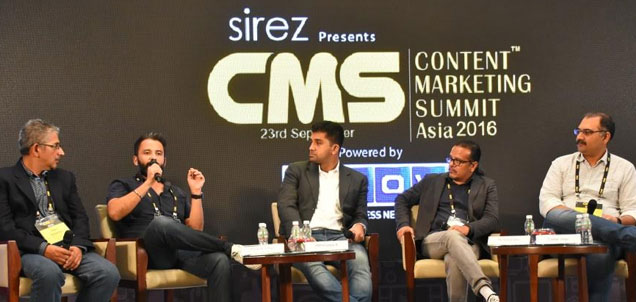
    How critical is Content Marketing to the marketing and media fraternity. It’s growing in acceptance, was the broad verdict from a cross-section of the fraternity at the Content Marketing Summit Asia 2016 held in Mumbai last week. The third edition of the Summit saw over 300 delegates listen in to to a diverse set of speakers. Amarjit Batra, CEO of OLX and the  first keynote speaker, stressed upon the fact how content has become the most important element in marketing today. Sandeep Bhushan of also emphasised that the timing is perfect right now to explore content marketing. Flipkart’s Senjam Rajsekhar spoke on the Flipkart way of storytelling. Using Salman Khan’s dialogues from blockbusters, Ashish Patil of Yashraj Films conveyed how to be a “Sultan” of content marketing. And Rohtash Mal of EM3 Agri Services, the second keynote speaker, encouraged marketing professionals to find a strong purpose of their marketing activities.


    The conference hall started Summit Chairperson RP Singh’s opening address “I am personally satisfied with the response as we continue to raise the bar every year. Unlike other events, we focus only on great content with almost Zero sponsored sessions so that CMS Asia becomes a platform to learn for every one rather than a platform to sell services,” he said while announcing that next edition will be held at Delhi NCR.


    The CMS Asia awards in five categories were also announced on the same day. Y-Films from YRF walked away with Content Marketing Agency of the Year & Content Marketing Innovator of the Year awards. Brooke Bond’s Six Pack Band was declared Content Marketing Campaign of the Year, which was also created by Y-Films. Content Marketing Brand of the Year was awarded to Nescafe and comedian Kapil Sharma was declared Content Marketing Personality of the Year.


    Senjam Raj Sekhar, Head of Corporate Communications, Flipkart

    How does Flipkart use content to reach various stakeholders?

    The way we look at it is that every organisation has interesting stories within itself. stories of customers, stories of employees and stories of the organisation itself or stories on how the organisation is funded. We have a team of writers and storytellers who actually go and hunt for the stories and  who look at what are the stories that will be of interest to readers. We report on ground and we found a lot of customers from Jhumaritalaiya actually shopping on our website. So we send them to Jhumaritalaiya, spent a week there to find out why Jhumaritalaiya is shopping online and from the mobile phone and we found some very interesting insights there. So, essentially if there are stories inside the organisation, then it is our attempt to tell those stories.


    You have said that Flipkart generates a lot of clicks on LinkedIn and Twitter but not on Facebook despite your various attempts to promote your content there. Why is that?

    The kind of content that we have are more long form content. Short videos of say 20-30 seconds work very well on Facebook, short posts work very well but if you look at long form pieces of around 2000 – 3000 words, we find a more engaging relationship on LinkedIn and on Twitter. The clickthrough rates of LinkedIn and Twitter are much more higher, in fact 4-5 times higher than Facebook. So medium to medium it depends on whether you have short form content or long form content. If you have a lot of visual content, then you use Instagram.


    Manish Kalra, Chief Business Officer, Craftsvilla

    Would you say that content marketing has short-term or long-term gains?

    Content marketing is completely a long-term phenomenon and you may not get short-term gains. What you can get is how many repeat visits are you driving to your website, what is the stickiness of the users that you are getting in, how much content consumption in terms of pages view per visit is happening, is it increasing your time spend on the site. So that’s where content marketing becomes very important for e-commerce websites but if you are looking for short term results it’s not at all effective.


    How does one check if content marketing is working or not for the audiences. What are the parameters for measurement of efficacy?

    Some of the parameters are that it will not be direct e-commerce attribution but it will be more around stickiness, repeat visits and pages view.


    Do you think content marketing helps in brand-building or is it just one of the many things one needs to be doing in a marketing activity?

    It is a part of building and connecting with the user in the long-term. It is not a short-term phenomenon. It is something which every brand should do if they want to connect with the user on a subliminal way, in a non intrusive way, in a way that they would like to consume you than the way you would like to get consumed. It’s an important part of the overall marketing mix.


    What are the challenges in content marketing for Crafsvilla?

    In case of content marketing, because we are so niche we need to ensure that the right content gets curated. So, if some handicraft from Kutch, say it’s a dhokra art and then people don’t know what it is, I need to have an expert who can go in and curate, source and shoot that content. So that’s the challenge that we don’t find the right talent which is able to curate the right kind of content for us whether its video or written content but we are evolving and creating internal teams which can help us.


    Bianca Ghose, Chief Content Officer and Head – Content Marketing, HCL Technologies Limited

    What are the challenges of content marketing?

    For a content marketer, creating quality content is something that I think is a major problem area because what you need is partners who understands your business, understands your business goals and the marketing outcomes and understands your audience. Unless you’re able to map all these three together you are not going be able to generate content that cuts through and grabs attention. The second challenge that content marketers today in India and all across the world are facing is also how is it that they are optimising the content to make sure that it’s performing because at the end of the day those form of tools and methodologies to measure the performance of content don’t really exist. But to be able to say that, this is my white paper and this is the kind of engagement that it has generated is difficult because a white paper is not just a white paper. It could be in the form of a blog or it could be translated in the form of a brochure that goes up on the website. How do you measure all those interactions with your piece of content to ensure that you are really taking back to your CxOs the amount of engagement or sales cut through that it has generated? These two are the areas that we still need to figure out as content marketers.


    Does content marketing have any short-term gains or is it a long-term play?

    Content marketing has no short-term gains and I don’t think this a play that can happen in a couple of months. You need to be able to do content marketing seriously, consistently for months on end to be able to generate some kind of impact. Content marketing will be able to take you to places where your sales folks won’t be able to go to. You’re sales folks will be able to leave behind a content asset in a closed door meeting or if you’re able to put in your content into the social browsing habits of your customer or prospect. So content is definitely something that will generate returns to your business but it is something that you have to do well and consistently for it to start showing results.


    Do you think content marketing helps in brand-building or is it just one of the many things one needs to be doing in a marketing activity?

    Content is the heart of a campaign so if you’re talking about a brand strategy or a brand narrative without having your content or your message at the heart of it, you really have a piece of a hollow shell. A lot of content marketers and brand marketers start thinking about the platform before they start thinking about the content strategy which means that you’ve thought through the outer circle without really thinking about what is the message that I’m trying to push out, what is that conversation that I am trying to generate for my audiences. So, unless you’ve really thought through the content, the message, the articulation of that and then the platform you’ve really done it the other way round. So being asked the question or saying that is content important is redundant. The question is how do I do it right to be able to generate the kind of outcomes that I am expecting for my business.