
Tag: Samir Jain

  • The Importance of being Sivakumar Sundaram


    By Pradyuman Maheshwari


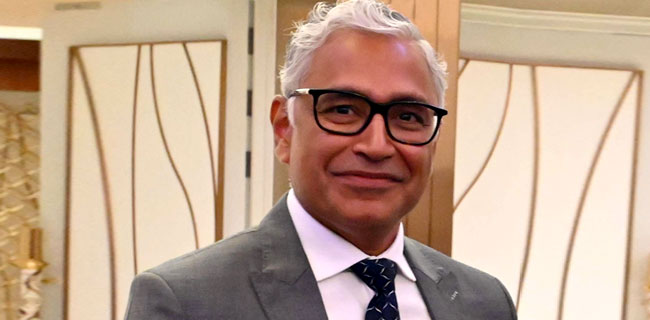
    The photograph doing the rounds of brothers Samir and Vineet Jain signing on the dotted line on the terms of dividing the vast media empire had three gentlemen in the background. One of them was a silver-haired bespectacled gentlemen with his wrists bearing a near-new red holy thread who is, as they say, is Samir Jain’s blue-eyed boy.


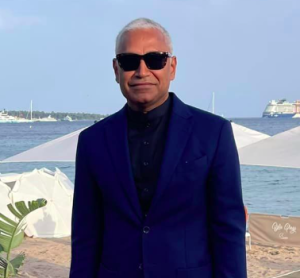
    Sivakumar Sundaram at his morning run at Cannes. Photograph source: Facebook
    Sivakumar Sundaram at his morning run at Cannes. Photograph source: Facebook

    Boy, well, a 55-year-old one. Delhiwallah, from Vijayawada in Andhra Pradesh. Non-MBA, but a Chartered and Cost Accountant, he joined Bennett, Coleman and Company Ltd (BCCL) in 1990 as a Management Trainee – an Assistant Manager in the accounts department, to be precise. Spiritually inclined, he’s an early riser and loves the run. Even at Cannes in France, where is attending an international advertising festival, he was spotted in his running shoes. Proof: Check his Facebook page.


    His credo, as per a LinkedIn post: “There are no right or wrong decisions in life. Any decision taken in compliance to one’s own values is the right decision. Be reliable and invest in yourself because success is the by- product of the well-being of body, mind, and soul.”


    We’re referring to Sivakumar Sundaram, the newly appointed Chief Executive Officer – Publishing. This is after being Chairman of the Executive Committee of Bennett Coleman & Company (BCCL) and a member of the BCCL Board as Executive Director. May appear to be comedown but CEO – Publishing is of course a key executive role, and he naturally becomes decidedly the most powerful professional in print and digital news in the country.


    As per his profile on LinkedIn (LI), Siva, as he is known in the fraternity, has worked across various corporate functions including finance, taxation, M&A, group strategy and innovation, response (BCCL’s sales department) and Brand Capital, the group’s ads-against-equity investment arm.


    Reads the LI note: “During this period, he  has been closely involved in the setting up of every new business of the group – from Times Internet to radio to TV and partnerships/joint ventures with international media houses,” and it continues: “In his immediate prior role, Siva was President – Revenue, responsible for leading response and Brand Capital, which generated nearly 85 percent of BCCL’s revenues. He was instrumental in setting up Brand Capital in 2005, a significant innovation in the global media industry, which now has assets under management of nearly US$ 2 billion and an ecosystem of 800-plus clients. The 1800-plus sales team of Response manages relationships with over 50,000 advertisers in India and abroad.”


    An article in a CA journal notes Sundaram last made his CV in 1994. No-brainer that. He had no reason to. He is Vice-Chairman Samir Jain’s eyes and ears in the organisation. And more.


    Sundaram runs marathons, not just a jog around Lodhi Garden or Shivaji Park. Which needs careful planning, long-term thinking and strong execution. And most importantly: Ironman-like endurance.


    Which Jain (VC, as he’s called) knows Siva has in plenty.


    Hence: the decision to appoint him as incharge of the publishing business was natural.


    Sivakumar Sundaram wearing dark glasses
    The Boss. Sivakumar Sundaram at Cannes. Photograph source: Facebook

    Sundaram though has quite a job ahead of him. At first a shrinking readership, and circulation numbers. The post-1990-born prefers tracking news via notifications, Instagram reels or at most Twitter. Newspaper these days are used more to line cupboard shelves or ripen papayas and mangoes.


    There is a fair amount of mediocrity that has set in and circulation numbers have fallen. The numbers for even Tier-2 cities like Pune where the edition was very strong have gone south. In Goa, the edition is a distant #3. Overall, while the advertising revenues are bright enough for company seniors to go to Cannes, the buzz that the paper once had has diminished.


    And if there’s anyone to blame for this, it’s the leadership at many levels.


    Sundaram knows that. Since he is a numbers person, he knows that they tell a story like a few other things can. He knows where there exists a wastage. And what needs to be propped up.


    Remember, an accounts job can also entail creative thinking.


    The road ahead could be like one of those potholed roads of Mumbai after that first major downpour.


    We spoke with at least a dozen former and current Times of India staffers to get a view on Sundaram’s ascent. And the tasks ahead of him. While most of them spoke with us off the record, there was only one person we spoke with who was willing to be quoted.


    Jaisurya Das
    Jaisurya Das

    Said Jaisurya Das (JD), a senior industry person, advisor and commentator (also a former MxMIndia columnist): “Sivakumar does have a tough mile to walk and I do hope he will as always start with a due diligence of the core departments. This may just be what will make the difference!”


    But we are being naughty. We’ve used a quote from JD to suit our story.


    This is what Das said before: “To be honest, I think this was long overdue and am truly happy to see these changes! The true ‘stars’ all figure in these movements and each one of them are the kind who can do immense justice to their new roles. For me, a clear indication of Samir Jain in the saddle.”


    And he continued: “As for Sivakumar as the CEO, it comes as no surprise since there really is no one better. He is an astute professional whose razor-sharp financial acumen, inclusive management style and unquestionable loyalty to purpose is well-established in the industry, be it BCCL or beyond. And yes, contrary to what anyone may assume, I do not curry favour. This is what it is and no one can refute it, no matter what they think.”


    Das knows BCCL like few others. As not only has he worked in key functions, his brothers Monu (MD Nalapat) and Chinnen have been BCCL veterans.


    As Sivakumar Sundaram returns to India from Southern France, he will certainly set things in motion. Some changes in the top deck have been effected. Some more are likely to happen. Some souls who have been under-performing or misbehaving will see the wrath of Siva’s Third Eye.


    Watch this space. The times, as they say, are surely a-changin’


  • The Split & after


    By Ranjona Banerji


    Ranjona BanerjiMany feel that the split between the Jain brothers of Bennett Coleman was a long time coming.

    The departure of Samir Jain from the operations of the media conglomerate led to a shift in priorities and a change in direction for the group. Younger brother Vineet Jain tried to bring the behemoth that is Bennett Coleman into the 21st century. Or his version of it anyway. Television became the priority and depending on how you look at it, the success or the horror of Times Now is the result. Vineet also foresaw the growth of the internet but Indiatimes could not capitalise on its early mover advantage.

    Are the two brothers the same or different?

    Both are passionately interested in money and growth. Bombastic statements about the group being about money and advertising, but journalism and the media. Then some of the worst methods of monetizing journalism and demeaning journalism to make money have emerged from the large brain of Samir Jain. From schemes like Medianet to “Private Treaties”, every other media house has professed outrage and then meekly followed suit in some manner or the other.

    Vineet Jain has the same money-making impulses, without the same oomph. And without the sort of swashbuckling arrogance of Samir Jain. Let’s be clear. Samir Jain is not a swashbuckling person. He is not a public person either, as his brother has wanted to be. But he is arrogant, self-aware and confident in his decisions. That is where he has been successful in setting the media world on fire.

    And his return to the media, after his self-imposed exile, is bound to have the effect of a new predator entering a quiet jungle. Or, Samir Jain exists on Planet Samir Jain far before Elon Musk decided to become the First Martian. The details of the division are public: print, online and real estate to Samir, while Vineet gets radio, TV, the entertainment wing and Rs 3500 crore from his elder brother.

    This division is intriguing, to say the least.

    Print is seen as old-fashioned and has-been by many, but it still has heft in India. The internet is the future as far as news and information are concerned, and Samir has gained that influence as well.

    Times Now is one of the worst Indian “news” channels. If anyone assumed that the exit of Arnab Goswami and his growing toxicity would improve Times Now, they could not have been more wrong or more naïve. Goswami was replaced by a MiniMe, without even his limited charisma and experience. Between Rahul Shivshankar and Navika Kumar, Times Now has grown in stature to a top class vicious, Islamophobic propaganda machine.

    Is that what Vineet Jain stands for or does he not care about politics? It’s hard to know for sure. He is not a political animal in the traditional sense.

    Samir Jain on the other hand cares about power. He wants to have a hand in the future, he would like to be kingmaker, he will not respect journalists but he respects the power that journalism wields. He is unlikely to become someone else’s mouthpiece unless he sees a massive benefit. He is not easily frightened by government. Unlike many of our other media house owners.

    Both Jain brothers stir up a lot of angry feelings. But if you set those aside, we have interesting times ahead in the media. Tighten your seatbelts. There are gonna be changes!


    Ranjona Banerji is a senior journalist and commentator. She writes on MxMIndia on Tuesdays and Fridays. Her views here are personal.

  • RIP, Indu Jain. Conscience-keeper + Tribute by Sunil Lulla

    Picture courtesy Twitter. Copyright unknown

    Bennett, Coleman and Company Limited chairperson Indu Jain passed away late on Thursday evening after a Covid-related situation. She was 84. Ms Jain will be best remembered in the Indian media for her contribution to ensure that one of the largest and most successful media organisations in the country that she owned and spearheaded with her two sons – Samir and Vineet – also had a purpose. She is widely regarded as the conscience-keeper of the media empire, and helped mainstream spirituality and world peace into the newspapers her group ran. Our deepest condolences to the Sahu Jain family, specifically her sons, and the large number of people -—in the media and outside of it — whose lives she touched, and impacted.

    We invited Mr Sunil Lulla, CEO, BARC India, who has spent nearly a decade with BCCL and had a strong linkages with Ms Jain, to share a short tribute. 


    Spiritual Angel, Ms Indu Jain. A Tribute


    Sunil Lulla

    My life is privileged to be touched by the Spiritual Angel , whom we called Mataji and sometimes Chairperson – Ms Indu Jain. I was a latecomer to the Times group, where most have spent a few decades mastering the craft Times teaches so well.


    She was very enthusiastic in supporting the new/ to-be-started television network  with the rapid acquisition and build out of a generous studio space, in Mumbai.  Her passion has always been to  spread positivity messaging, be it in news or  via music to the youth. She understood the business compulsions and marketplace needs. In balance, she actively encouraged and facilitated by inviting her wise associates Sri Sri Ravishankar  and Sadhguru Jaggi Vasudev to spread their contemporary and positive message of well-being to millions of viewers.


    She bought balance to the space of heated debate and pulsating music in her own sagacious and peaceful way. When she learnt the architects had not followed the right protocol in the construction of the studio and office, she wisely suggested changes. As she stated, the right light, the right direction, sets the tone of success. I have always believed her action gave wings to the success of the Times Television Network.


    She will remain Mataji – forever. May her soul rest in peace.

    Sunil Lulla

    Chief Executive Officer

    BARC India

  • Das ka Dum with Dr Bhaskar Das: In the service of which boss did your soul feel the bestest – the Jains, Subhash Chandra/ Punit Goenka, Girish Agarwal & now Arnab Goswami?

    Bhaskar Das

    We’ve got Dr Bhaskar Das to do what he’s super at: share his gyaan in his inimitable manner. Presenting The Wizard of Words with Das ka Dum. Week 3, Day 4.

     If you want to access the archives, please go to the Das Ka Dum tab on the website’s top navigation bar..


    Q. You have worked with various media mavens in the last decade. Samir and Vineet Jain, Subhash Chandra and Punit Goenka, Girish Agarwal and now Arnab Goswami. Since you are a spiritual person, please tell us: In the service of which boss did your soul feel the bestest?


    A. Any soul is impervious to external triggers. Besides, there is no duality between two interacting souls. I saw them in me and I was in them. At a cognitive level, all the referred names in your question have enriched me and whatever I am today is due to the cumulative enlightenment they have ushered on me.

    I can imagine the answer won’t satiate your vibrant mind. I can assure you that real correctness is apolitical. My answers come from the core of my heart. They are socio-politico agnostic.

  • Time for newspapers to up cover price!


    By Pradyuman Maheshwari


    The print media in India has reason to be sore with the government. Barring a few, most newspapers and magazine weren’t too negative on the previous regime, and in a sense contributed to its return to power. While some publications may indeed have aired anti-Narendra Modi views in the run-up to the elections, the dosage of that was limited and, one may say, controlled.

    Indian newspapers have forever worked on a lopsided business model. Masterminded by Times of India group vice-chairman Samir Jain in the 1980s, newspapers were being sold at very low cover price to attract and retain readers, and combat (and hence bleed) competition. The ‘invitation pricing’ policy was followed relentlessly by TOI and almost every old and new newspaper thereafter. Casseroles, soaps and assorted gifts were offered to readers in the form of subscription offers. But the price of the papers – especially the English-language ones – were far, far below the monies that went into the making of each issue.


    Newspapers that have profited over the last three decades have done so thanks to their leadership and thereby their ability to attract advertising or through allied or dramatically different businesses. Advertising from government or quasi-government organisations ensures that the money registers keep ringing even as the cost to consumer continues to be abysmally low.


    Over the last few years, as in the case of internationally sourced products like crude oil, the price of newsprint has also been rising. This has adversely impacted the bottomline of most print media businesses. In fact in the last few years, price of imported newsprint that is largely deployed by English as well as high quality regional papers, had skyrocketed. It went south in late-2018, but by then the ad volumes on print touched a new low. Adspends have been low for other media too, but print has been hit badly with digital steadily weaning away its readers. The Indian Readership Survey 2019 may have shown growth for newspapers but that’s only with the Total Readership metric. With the more widely acceptable Average Issue Readership, the future doesn’t look very bright – esp in the metros.


    So if the newsprint prices go north, the cover price should’ve also headed the same way, right? No, instead, newspapers have traditionally been quick to cut their content often even rejigging the mix. Publishers are worried that a hike in the cover price will impact their readership, which could well be true, but clearly the newspaper organisations need to integrate their digital operations better and foresee a future that helps them make monies from their e-presence.


    To blame the government for their new-found woes is incorrect. I am sure Prime Minister Narendra Modi will reverse the import duty hike. He has done that in the past, and could do it again.


    Yes, our readers are fickle in their ways. They don’t mind spending Rs 20 or whatever on a vada pav, idli sambar, chaat or jhaal-muri, but they will crib about Rs 10 for a copy of the morning newspaper or Rs 60 or 100 for a glossy and informative magazine.


    Newspaper owners meanwhile need to smell the coffee – or ink – and up the cover price. Over-dependence on government largesse is detrimental to an independent media. And it’s time that consumers learn to pay for quality content.


  • Dalda back with ‘Naye Zamane ka Naya Dalda’ proposition

    By A Correspondent


    Dalda, the oil brand from Bunge India, has launched two television commercials with the new positioning of ‘Naye zamane ka Naya Dalda’. The new commercials are conceived by Leo Burnett, with a message ‘India ke kitchens badal rahe hain aur unke saath badal gaya hai India ka Dalda’.


    Said Samir Jain, Managing Director, Bunge: “Dalda is a unique brand and one of the few heritage brands which have seen the country change over the years. It becomes imperative for the brand to be a part of this changing consumer journey. The films resonate this thought of ‘Aap badal rahein hein, isliye badal raha hain apka Dalda’ to showcase the evolution of kitchens as not just a cooking place but a destination of changing value systems.”


    Speaking about the new Dalda campaign, Rajdeepak Das, Chief Creative Officer, Leo Burnett, South Asia said: “When we think about the India we once grew up in, we realise that it is almost unrecognizable from what it is today. Our society, our norms, the way we look at our value system, everything has changed so much. And yet, we stay rooted. I believe Dalda is a brand that has beautifully tapped into this transformation; it still manages to hold on to its core values, but reflects everything we stand for. The new campaign is a reflection of this dichotomy, and hence is a Humankind idea. It reflects the way we have changed as a people, and yet makes one think how far we have evolved in our thinking.”


  • Samir/Vineet Jain family gallops ahead in Forbes Richest 100 list

    By A Correspondent


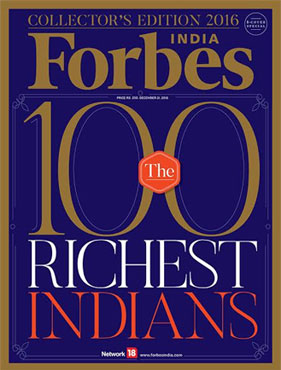
    It’s that time of the year when the Forbes India Rich List is released. The magazine volume, that’s scheduled to hit shopshelves today, has already revealed some numbers. That Mukesh Ambani continues to be the richest. And Acharya Balkrishna, the brain behind the slew of products bearing the Patanjali brand name, is in the Top 50, at #48.


    So how do our media biggies fare?


    We got some advance data from the magazine, and we learnt that there are just three whose primary source of wealth is in the media (or so we presume).


    They are Subhash Chandra (at #18), the Jain Family at #36 and Kalanithi Maran at #40. Interestingly, and as per our headline, the Jain Family – Samir and Vineet Jain’s family – has moved from #57 to #36.


    The others in the table below have investments in media but that’s not the primary source of wealth.


    2016 (in billion dollars) Rank 2016 2015 (in billion dollars) Rank 2015
    Mukesh Ambani

    22.7

    1

    18.9

    1

    Hinduja Bros

    15.2

    3

    14.8

    4

    Subhash Chandra

    5.6

    18

    4.8

    18

    Anil Ambani

    3.4

    32

    2.9

    29

    Jain Family

    3.2

    36

    1.85

    57

    Kalanithi Maran

    2.9

    40

    2.6

    32

    Rajan Raheja

    2.55

    45

    2.04

    46

    Anand Mahindra

    1.42

    90

    1.12

    99

    Sanjiv Goenka

    1.4

    91

    1.17

    97


  • The TOI Story & inside the mind of Samir Jain


    By Sangita P Menon Malhan


    Some interesting insights into Samir Jain’s personality emerge from the days when he was taking on the venerable editors of The Times Group. In many ways, it was also a decisive phase in that it laid the ground for the changes that happened later.


    He may have developed some dislike for journalists and the predominant position they enjoyed. He was uncomfortable with the fact that while the newspaper’s proprietor kept a low profi le, it was the editor, his employee, who was in the limelight. Politicians and bureaucrats pandered to the journalist while the proprietor was a mere bystander.


    There are yet others who concede that there may be a ‘hidden agenda’ against journalists, besides the imperatives for change. An editor, who worked closely with Samir Jain after the reorganization, but did not want to be named, admitted that Samir Jain did hold journalists in ‘deep disdain’ at that time.


    He recalled that sometime in 1986, The Times Group hosted a party in honour of Krishna Kumar, then a Union minister in Rajiv Gandhi’s government. When it was time for dinner and the guests were being ushered in, Krishna Kumar pulled a chair for Girilal Jain to sit. ‘I was standing close to Samir Jain,’ narrates the journalist; ‘he (Jain) said, “This party is thrown by the company and me. Is it not strange that the minister should pull the chair for the editorand not the owner of the paper?”‘


    So determined was Samir Jain to prove that he was superior to the journalists and to keep them in their place that he issued a directive that everyone be addressed by their designations. So, senior editors, who until then had been calling him by his fi rst name, had to switch to calling him JMD (joint managing director) and later, VC for vice chairman.


    When the government had taken control of BCCL for seven years, Samir Jain, then in his early twenties, believed that certain journalists of the paper had started it all by first making allegations of irregularities against the company to the government. It had been a difficult phase, and Samir Jain blamed the paper’s own journalists for creating the mess.


    ‘Samir carried the memory of those years. He thought the editors had to be shown their place,’ recalled Baljit Kapoor. ‘He thought they considered themselves too important. “After all,” he said, “the editor is just one of the employees of the company. He is just a processor of news.”‘


    Samir Jain wanted more control over the newspaper. Editors were taking their autonomy too far. Jain found that he could not appoint people of his choice; that it was tough to get something of his liking included in the paper, among other such ‘restrictions’. These stumbling blocks bothered him. In his early days, one of the top editors tried to belittle Samir Jain by treating him like a probationer. ‘Ladka theek hai. Lekin usey abhi padnaa hai, seekhnaa hai. The boy is okay but let him educate himself fi rst,’ he said. Samir Jain hated that. As a counter, he began circulating articles from The New York Times and other newspapers. He wanted it to be known that he was already educated, and contrary to the editor’s comments, well read.


    He began taking the editors head-on. At one interaction, he is believed to have said: ‘Please, all you editors listen. If you have an appointment with the prime minister, and if I call you, you must cancel the appointment and come to me.’ That quote has stuck. Although editors now make reference to it in a light-hearted way, it is unlikely that anyone violates that diktat even today. When the sensei says something, it is followed.


    He had trouble over the fact that while the goodwill generated by a newspaper accrued to the editor, the negative fallouts went over to the owners. ‘He would often say, “The balance of inconvenience is always with me.” He wanted his team to be completely on his side and fully with him, no matter what he did. And, when that did not happen, there was friction between the sides. Such situations bothered him, and they did not end well,’ recalled Pradeep Guha.


    Independent observers outside the organization have also corroborated Jain’s dislike for journalists. In his acclaimed book, Paper Tigers, Nicholas Coleridge writes: ‘Samir Jain views his editors and journalists as elements whose power needs to be constantly diffused (“those blue-blooded Brahmins of the editorial floor”). He takes pleasure in giving the best offices to his managers instead.’


    A rebellious streak, a certain amount of irreverence for convention and tradition – that constant and regular inverting of the pyramid persist even today. Does he go about it in an authoritarian, my-word-no-matter-what manner?


    Here again, there is no single or simple view. There are those who believe that in his single-mindedness, he brooks no resistance though his manner and approach may be understated. One of the edit page editors at the Times House said, ‘Samir Jain has established his own regime. His staff has to understand and accept him. The VC will not interfere in the day-to-day functioning of the newspapers.


    He is more the Puppet Master. He will throw an idea at you and have you fi gure it out. But you are expected to figure it out. ‘He likes high-quality discussions. He will never call a reporter for a discussion. It will mostly be editors or people on the edit page. He will size you up and treat you accordingly. But he is soft-spoken and gentle and will never give you a direct command. It will all be hints and subtle suggestions, and you will have to pick up cues.


    That makes him both interesting and difficult, depending on how much you are willing to invest in him.’ I asked this editor whether Samir Jain is temperamental, as is often alleged. ‘I have never seen him lose his temper. The VC likes equals. One would often see Swami (Swaminathan Aiyar, former editor-in-chief of The Economic Times, who continues to write a column for the paper and is a consulting editor) and the VC standing in the corridor and talking like old friends. When in a good mood, the VC will start his conversations with his Bengali editors with “Kaemon aachho?” (how are you?). ‘The problem is that most journalists don’t like to be given sermons, and certainly not by their publishers. They will not listen. And that becomes a point of confl ict,’ he said.


    Shubhrangshu Roy, editor of the Financial Chronicle, who earlier served at the ET, drew up a sketch in a matter-of-fact way. ‘Samir Jain is not the despot he is sometimes made out to be. He is not an anarchist. In fact, he is down-to-earth. I have never seen him lose his temper with anyone. He is actually a compassionate man. People have this terrible habit of demonizing him. One either hero-worships him, or tries to make a monster of him. ‘Samir Jain is an editor-publisher; he isn’t anti-journalist. He is, in fact, a better editor than most editors I’ve known; he knows his journalism. Samir Jain is the Holy Ghost of The Times of India – intelligent, intellectual,’ Roy added. He believed that editors have had trouble with him because of their own vested interests somewhere down the line. ‘Every editor who has worked with him has done so with a huge self-interest and an even huger ego,’ he argued.


    ‘In the contest between the publisher and the editor, the publisher wants to be the editor of the newspaper as much as the editor wishes to step into the publisher’s role. There is the classic confrontation between the two. But he tried to delink or demystify this. He transcended it. As an observer of journalism, I truly believe that Samir Jain is indeed a quintessential editor,’ Roy said.


    It is quite clear from talking to his editors that Samir Jain takes a keen interest in what gets carried in the editorial columns of his newspapers, even to this day. The intervention could be subtle – a gentle cue or a hint, sometimes leaving the editor to struggle with deciphering the full import and intent behind it. Or, given his fascination with good language, Samir Jain could actually get down to performing the task of a sub-editor. T.K. Arun, who was the edit page editor at ET when I met him, told me: ‘The VC is an excellent sub (sub-editor). Occasionally, he reads through articles published in the paper and goes about marking out superfluous words and expressions. He is very particular about the correct use of the definite article. In the old days, one thought that the lalas did not know anything about journalism, leave alone language. But he is exceptionally well read’.


    Abheek Barman, consulting editor at ET, seconded his colleague’s comment. He said: ‘The VC is a great one for semantics. He particularly likes interesting words and is very fond of neologisms. Once I used the word “zeitgeist” (German for the spirit of the times) in his presence, and he remarked: “No one uses words like this any more.” On the one hand, he wants the language in his newspapers to be simple and easily understood. But at a personal level, he likes using words that would make a person think’.


    Bal Mukund Sinha of the Navbharat Times said: ‘He pushes your boundaries. He will drop a hint, a clue, and you are encouraged to interpret it. If you get it wrong, he will gently tell you what he had envisaged. He will also often pretend that he knows little about the subject being discussed, and as you wax eloquently, he will listen patiently. Then, he will spring a “guru mantra” at you which will sum up the entire matter. His mind is so powerful…also…because he is so spiritual.’


    In many cases, the intervention initially leaves his editors aghast, until they come round. Samir Jain once came up with the line that it is alright to use words from the English language in the group’s Hindi newspaper. He believed that newspapers are not meant to nurture language. ‘”That is why in our English newspapers, we do not carry Shakespeare; we carry (author) Shobhaa De’s line which says, ‘That neighbourhood boy is very namkeen.‘ People understand this language and speak like this. And we must be able to relate to them,” he would say,’ said the editor from NBT.


    On another occasion, Samir Jain suggested that his Hindi daily do a story that English should be pursued by NBT readers for better career prospects. He wanted the newspaper to conduct a survey, asking readers whether their children studied in English-medium schools, and if so, why? “Expose the puritans,” he would say. “Be real; be practical.”‘ His suggestion wasn’t taken very well but the survey was undertaken. ‘We found out that he was right. Most NBT readers, who were questioned, did aspire for their children to be fluent in English. This is how he intervenes,’ Sinha explained.


    A member of the editorial team at ET said: ‘The VC is civilized and evolved. He will share his views with you. If you understand what he is saying, all the better for you…for you will have all the freedom you need to write your edits. And if he likes what you’ve written, you might even get a small note, with just an ‘S’ for a signoff, and a couple of points written almost illegibly.’Autocratic he may not be. But Samir Jain can be overbearing, like handing out diaries to all the editors, asking them to bring those to their meetings with him, take notes, and refer to them at subsequent interactions, and, being a little uncomfortable when the process isn’t followed by the oddball. Notebooks are promptly arranged for those who come to meetings without them. One is also supposed to write in them as he talks and shares his perspective.


    Here again, some parts of his speech could seem nebulous. ‘Trying to make sense of what he says could sometimes be an uphill task. That is true,’ said an editor at the Times House, without wanting to be identifi ed, of course. ‘He often cites some Vedic philosophy or complex analogies. His gyan (knowledge) monologue sessions are called “chemotherapy sessions” because it becomes very difficult to put up with them.’


    ‘When he doles out some religious funda, and sees that our eyes are glazed over, he would say, “I know you are non-religious people, if not atheists. Even so, you must read the Ashtavakra Gita, which was written as an atheists’ manifesto.” He loves it and knows it by heart. That is clearly his favourite book. But he will never insiston any point. He will generally suggest something like “Perhaps you could take a look at it, and see if you can write something,”‘ the editor said.


    ‘But the sessions with him have to be endured. Those are unstructured monologues. They could start with just two or three people. But if the conversation got interesting, he would keep calling more and more people. He would mention some names and say, “Unko bhi bulaa lijiyey” (Call them as well).’


    ‘And no matter what you are doing or are about to do, you are expected to just go upstairs, to the fourth floor,* equally perplexed, scribble pad in hand, of course, and listen to him basically talk to himself. But the sensitive part of all this is that he will never call you late in the afternoon or evening because he knows that that time is crucial for the edition to leave.’ (* The Fourth Floor is the Mount Olympus at the Times House, Delhi – a hallowed precinct that houses the offi ces of Chairman Indu Jain, Vice Chairman Samir Jain, Managing Director Vineet Jain and the top management of The Times Group. Visits to this part of the building are,more often than not, eventful. Special guests are entertained in the lunch room here. Entry is ‘by invitation only’).


    The editor went on: ‘One way to escape the gyan overdose is to feign a cough or perhaps sneeze in his presence. If you do that, he will immediately tell you, “You are not well. Perhaps you should leave.” By the way, he fusses over his health a lot, sometimes bordering on the hypochondriac. He has a sensitive throat. He is acutely averse to pungent smells and scents – perfumes, pickles and scented hair oils.’


    I was also told that Samir Jain has a time fetish. He will not be late. He usually comes in to office around 10.30 in the morning when the News Management Committee (NMC) meeting is supposed to start, and, if by any chance, it isn’t on, he is disposed to being rattled. On occasion s, he will mutter that they are ‘slackers’. ‘He doesn’t take very well to this lack of order and discipline,’ said one of the members of the NMC at the Times House The other thing about his morning ritual is that he will walk into the editorial side of the offi ce, put his head into a cabin and talk a bit with one of his editors. Or he may choose to ‘prevail upon’ the NMC. ‘He will sit and watch each and every one. Even if he is not directly looking at you, you better be aware that his eyes are on your every move,’ chuckled the man.


    There is a lighter side to Samir Jain, as emerged during a conversation with Gautam Adhikari. I met him in New Delhi in February 2002, the fi rst of three meetings. ‘One thing that most people do not know about Samir Jain is that he has a funny bone in him; he has a huge sense of humour; he can be an absolute imp. Sometimes during meetings with the staff, depending on what struck him as funny, particularly all the nodding and yesmanship, he would wink at me, and later, we would talk about it, and he would burst out laughing,’ he remembered. ‘There is so much to the man. He used to enjoy the comic, Asterix. Inspector Clouseau from the Pink Panther series was a character he was fond of. He liked Agatha Christie’s books and stories with suspense and wit. He has read every book written by P.G. Wodehouse and is very fond of Wodehousian words and sentences. Being from the same school, we spoke a similar, stylized language sometimes. So, we understood each other very well. He had also read enough Shakespeare to quote him back at me. Our conversations would be explosive,’ Adhikari reminisced.


    ‘He loved the stage, drama and musical comedies just as much as he loved the serious stuff. He would ask me to explain the central theme, the essence of a play to Meera (his wife), and then come up with his own interpretation,’ he recalled. ‘But very few people get to see that side of him. They think that he is either a radical innovator or a media mogul who fl oats in a sort of religious ether. But Samir Jain is far more interesting, far more intriguing,’ Adhikari maintained.


    Jug Suraiya is a raconteur with a sense of self-deprecating humour, who in his writings will take potshots at all things ‘sacred’ including The Times Group itself, always going for the ‘jugular’. Senior editors talk about the equation between Samir Jain and Suraiya, who could be the best of friends one moment and arguing animatedly the next. That makes Jug Suraiya one of the chosen few who can provide an incisive look into Samir Jain. I met this aloof, pensive, almost reclusive writer at the Times House when he was in charge of the edit page. He vaguely recognized me from my days at the paper, heard me out and proceeded to answer my questions dispassionately.


    ‘Samir Jain is a visionary,’ Suraiya said.14 ‘He wanted to cater to an entirely new readership. He did not want to listen to precepts,’ he added. ‘When Gorbachov (former president of the Soviet Union) was going to visit America, I wrote a singeing editorial which was supposed to be the third edit (the slot meant for light, off-beat editorials). But Samir liked it so much that he made it the fi rst edit, and said this is how editorials need to be written,’ he recalled. ‘He is a maverick genius. He likes to take risks. Money means nothing to him. Like a samurai, this is, for him, a game. It may even be a spiritual exercise,’ Suraiya surmised. ‘Samir Jain belongs to no one particular school of thought; he comes from the world of imagination.’


    Another person with a long association with Samir Jain, this time from the marketing team, had this to say: ‘Samir Jain is the Howard Hughes of India; a mystery man with an incredible mind. He has no material or worldly ambitions and that seems strange considering his focus on the business. He has no passion for sport, art or money in the raw sense of the word. He is, therefore, highly focused only on his goal.’


    Samir Jain is also mentioned as being empathetic and compassionate. But here again, there are sharp paradoxes to the man. He could swing between supreme unconcern, and an empathy that is so extreme as to be almost unnerving. Guha still cannot get over Samir Jain’s ‘acts of empathy and kindness’. When he spoke to me in August 2011, Guha remembered two instances with emotion. The first was when Guha’s father passed away. Samir Jain landed up at his home in Mumbai with homecooked meals in boxes, saying, ‘None of you must have eaten. Please have this.’ Samir Jain and Guha may no longer be as close as they once were. But the latter insisted he can never forget that gesture.


    ‘And on another occasion,’ Guha recalled, ‘he came back from a trip. He had bought shoes for me, and proceeded to fit my feet into them. He had an idea of the size and of the fit. How did he even do that? It was very surprising. ‘As a person, if he likes you and knows that you are with him fully in everything he does and that your interests – the greater good of the company – are aligned with his interests, then his is an association to cherish,’ Guha maintained. ‘He will look after your needs, your comfort – almost dote over you. He will let you be and allow you to take risks. And he will go all the way to support ideas that are aligned with the overall goal,’ Guha added.


    Several editors I met spoke of how the VC would personally serve food on to their plates at parties, or call for tea and proceed to make it for them. There have also been instances of a gentle reprimand at work, being followed by an invitation to dine at his home.


    Published with the permission of the publisher and writer


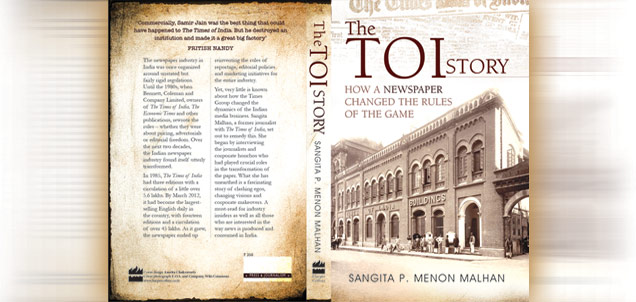
    The TOI Story

    (How a newspaper changed the rules of the game

    By Sangita P Menon Malhan

    HarperCollins Publishers India

    Cover price: Rs 350*

    Paperback, 261 pages

    (check amazon.in, flipkart.com for a lower price)
     

  • Tracking the rise & rise of the Times: Q&A with author


    Delhi-based Sangita P Menon Malhan was trained to be a pilot, but started flying high once she turned a full-time journalist and later got into creative writing. She has worked with The Statesman, Delhi Mid-day and The Times of India and published a book for short stories for children – Rastapherian’s Tales and a collection of poems in Urdu – Nusrat-e-Gham. The TOI Story has been in the works for 13 years, in fact as she told us, she almost gave up writing the book and then picked up the threads yet again to finally see it happen.


    Before you read this interview of Ms Menon Malhan with Pradyuman Maheshwari of MxMIndia, we suggest you read the extract at http://www.mxmindia.com/2013/09/the-toi-story-inside-the-mind-of-samir-jain/


    Would you say the Pritish Nandy quote on the back cover – “Commercially, Samir Jain was the best thing that could have happened to The Times of India. But he destroyed an institution and made it a great big factory” – possibly sums up your book best?

    Absolutely, although the factory seems to be doing a great job as far as net net results are concerned. His was the most explosive of the hundred-odd interviews. He was candid and voluble, and said several things that have not made it to book. His views, in spite of this quote, were pragmatic and honest. He spoke about what worked at The Times, and what did not, which really forms the core of the Bennett, Coleman success story. Decisions are taken based on their projected returns; dispassionately, even ruthlessly; and anything or anyone that comes in the way, is ‘allowed to’ fade out.


    It’s good to see several leading lights going on record. Any one who refused to do so (other than Samir and Vineet Jain) or who spoke and then asked for anonymity?

    Well. If I reveal those names, won’t I have ‘revealed’ it all! J Yes. There are a few who requested/ suggested anonymity. They shall stay ‘Deep Throats’until someone digs up their identity.


    You’ve worked with The Times of India for some years. Do you find many other newspaper groups are now emulating the Times way of doing things? Or should one say the times are such?

    That is undeniably true. Rivals and competitors of the Times began emulating it way back as the early 1990s when they realized that these moves worked. The pricing game, the focus on the citizen rather than the State, the added elements – supplements, religious nooks and corners, the pizzaz and glamour, the focus on profitability… have all been almost directly taken down from The Times’ model for growth and expansion; and for domination. We do live in an age of economics, as we always have. Today, however, there is greater acceptability for the term wealth generation. It is a legitimate pursuit. Like a Salvador Dali painting….you may or may not like it but you will certainly not be able to ignore it. That said, there is yet scope for ethical business.


    Your book and many previous accounts of The Times of India are centered around Samir Jain. Interestingly, it was he who demolished the indispensability of any individual in the team. But his stature (and that of his brother) has indeed grown. So is Times in effect also what we disparagingly call (many Indian managements) a lala company? Or are business and editorial biggies suitably empowered?

    The interesting thing about success stories is that irrespective of how many people or ideas form a team, it is the vision that matters. And, Samir Jain did have a plan, a purpose. He ensured that he had some of the best minds in the country around him so that he could hear them, assimilate what they had to offer and prod on. But the targets were ‘his’. And that makes all the difference. The greatest of leaders have used their armies to get to their destinations. To that extent, they are not redundant. It is the input that is king.


    Samir Jain is a man of enormous contradictions. Despite the aura around him, I do believe it is his squad/ battalion that keeps churning up ideas. I don’t subscribe to the view that Bennett, Coleman is a lala outfit. ‘If you have an idea that will work to benefit the overall aims of the company, you will be empowered at The Times Group’ is what I heard during the research. But you do have to align yourself with the reigning philosophy of the organization. And, I was told that high quality debates and differences of opinion are welcomed.


    He was among the first media barons to hire professionals from FMCG majors to bring in a certain rigour?

    He did that with a vengeance. I remember Satish Mehta telling me how enthusiastic Samir Jain was about having people from the ‘dark side’ around him. These were men and women who brought in a perspective that may have been alien to the editorial cadre at the organization during those tumultuous years in the mid to late 1980s and during the early 1990s.


    Once you’ve decided who are going to be, the strategies do fall into place. Therefore, since you – the newspapers – are a product, how can the ‘old’ shoe… fit!


    The next generation of the family is steadily taking charge? Would you see The Times of India change 30-40 years from now, when the Jain brothers relinquish charge?

    Don’t we all want to know the answer to this question! I’m not too sure if the next generation is adequately excited about this business. I have no evidence to prove what I just said, either. These are things I’ve heard. One can be certain though that a lot of thought is currently being put in at the organization to take on the future. There is no other option.


    I believe change is upon The Times of India already. With the combined pressures and challenges of the medium, the threat from the digital tsunami, the fast-changing needs of the new generation, the power of technology and shrinking revenues from the current streams, the model will have to change. Everything is infotainment-led. Easy access matters. Newspapers may need to change their ‘delivery’ methods.


    Your book mostly interviews and speaks to a lot of people in Delhi and is based on the time when the brothers – Samir and Vineet – took charge. An equally interesting period of the group was before when the editors were gods and Mumbai was where the action was?

    Indeed that was a great period. One can only imagine how power and glory rested elsewhere during those years both in terms of location and with respect to the ‘gods’ who enjoyed them. As a person, I’m fascinated with stories of victory. And, the more troubled and tortured, the better. I was naturally attracted to this tale and kept my focus here. I had heard enough of the ‘golden’ age from my father, who was also a journalist. Besides, the challenge was to unravel this piece, more so because it was reportedly (pun intended) impossible.


    As someone who has studied the group and now chronicled it, what do you think is driving the success of the Times: the business or editorial department?

    Like in the Mahabharata/ the Bhagwad Gita, it is the clear combination of both. I fight to win. That is my value system. I shall stand by it. It is clichéd to accept that the reorientation of the business ‘approach’ worked for The Times. Yet, the focus on the ‘product’ was equally sharp. You can have a great product launch based on claims and hype but if you cannot sustain that… with a genuinely strong product, how far can you go! The editorial department may have had to ‘suffer’ the change more than its marketing/advertising counterpart. But it had to be ‘converted’.


    You took 13 years over the book. Do you find the group has changed in this period? If yes: Anything specific…

    I find that most people who matter in the organization have ‘come around’. I still get a lot of unprintable stories, off-the-record, but there is a general ‘acceptance’ of the norm. Even journalists speak the language of the organization now. They seem quite convinced. The fusion has taken place. The two sides are one, at least for the record. Sitting at a coffee shop, far away from the headquarters, however, some skeletons do tend to tumble out. But appearances are kept up. It is all very well.


    Any reactions from Times House to the book? Or from the Jains? Do you think you’ll still get invited to write for the Times?

    Nothing yet. I did send Mr Jain a copy of the book with a handwritten note. I remember writing to him toward the end of 2000, informing him that I was planning to work on such a book. ‘This is a leadership study. And, it must not be halted,’ I had mentioned. It is creditable that the study was never halted. I walked into Times House so very often and interviewed so many people there. The brand managers at Times House were extremely helpful and courteous with even the most disturbing questions. That, and much else, couldn’t have happened without an ‘all-clear’ from ‘above’. My target was to write the book. How The Times reacts to it is its outlook. It is sheer serendipity that this book has somehow decided to come alive in this the 175th year of the newspaper. It has been written for the consumer of news and information in this country. And, I hope it has a great journey.


    The TOI Story

    (How a newspaper changed the rules of the game)

    By Sangita P Menon Malhan

    HarperCollins Publishers India

    Cover price: Rs 350*

    Paperback, 261 pages

    (check amazon.in, flipkart.com for a lower price)

     

  • The Press has lost its sheen: Kuldip Nayar


    Text and Video by Shruti Pushkarna


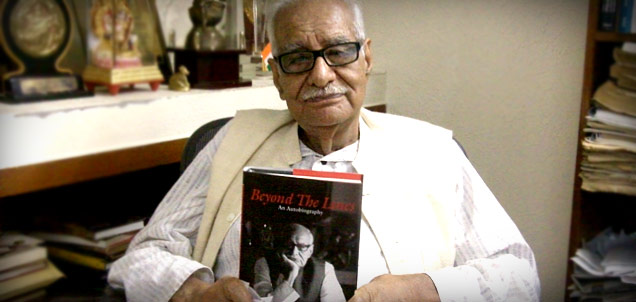
    Veteran journalist Kuldip Nayar memoirs, ‘Beyond the Lines’, are set to be released in the Capital today (July 11). He calls it a ‘political autobiography’ which recounts the political history of not just India, but Pakistan and Bangladesh as well.


    Now 89, Mr Nayar has been a close witness to a series of political events that unfolded in his journalistic career. An author and a human rights activist, Mr Nayar has also been a diplomat and Parliamentarian. He was appointed High Commissioner to Great Britain in 1990 and nominated to the Rajya Sabha in August 1997. He was media advisor to the late Prime Minister Lal Bahadur Shastri.


    He was also the former editor of the Statesman in Delhi, former Managing Editor of news agency UNI and former correspondent of the London Times. He still writes columns and op-eds for newspapers including The Daily Star, The Sunday Guardian, The News (Pakistan), Express Tribune (Pakistan), Dawn (Pakistan).


    A great believer in the power of press, Mr Nayar seems aware, and somewhere disappointed, at the emergence of the new ‘sensational’ journalism in the country. He feels that journalists today editorialize more than they report. As opposed to the ‘profession’ it used to be, Mr Nayar feels journalism today has become an ‘industry’, a ‘product’.


    In this candid one-on-one with MxMIndia, Mr Nayar shares his memories of journalism in the days gone by and the change he is witnessing today. Although he advocates self-regulation of the media, he believes that all journalists should prescribe to a strict code of ethics.


    Excerpts:


    This book is not based on columns. This is a book from my memory, 95 per cent of it is from memory, and only for about 5 per cent, I might have consulted my columns. It’s my political biography and it’s a current history of India, Pakistan and Bangladesh.You were among the first journalists to take your columns to the book form. Do you think that the book works better for a journalist?


    Have you given up on Indian media or Indian publications altogether?

    No, I have not given up entirely, because I still appear as a columnist in so many papers. Only the leading papers don’t publish my columns. I have full confidence in the press but I am disappointed that it has lost the sheen that used to be there in our times.


    Has it changed dramatically from the time when you were an active practitioner?

    Yes it has. Now it has become a product, then we were a profession, now it’s an industry. That way, independence is much less now. The influence of the owners and the corporate sector is much more than there was.


    Any other specific area where you see the change?

    Yes, the way of presenting news and the way of writing has changed. I find very few items of hard news now. In our times, we used to see what was happening in the cabinet and we even used to publish the cabinet agenda. Now it’s less inquisitive than before.


    In the Samir Jain incident you mentioned in the book, do you think the turning point in the treatment of editors by proprietors was when Girilal Jain has said to have slighted Samir Jain?

    That probably is one incident. The real watershed for journalism is the Emergency. That’s when the owners really saw that their pressmen caved in. So the owner thought that if they could cave in under pressure from government, they can also cave under my (owner’s) pressure. So the emergence of the owner started then, earlier the owner was nameless. But now we even see edits by owners and they decide who will write what.


    But there are still newspapers which are editorially driven…

    Very few.


    What’s your view of proprietors as super-editors especially in the regional, non-English media?

    That is a problem. Leading regional papers which have circulation in lakhs are owned by the same family, edited also by the same family and it’s being inherited down the generations, therefore it has become personal property. So this is a very serious issue.


    You’ve been an active votary of Indo-Pak ties, you are known to conduct candlelight marches to the Wagah border…do you think it’s correct for journalists to get ‘activist-y’?

    While I was in active journalism, I had certain views which I expressed, but did not participate in any activity. Now since I am only a columnist, I do take part in human rights violation, Indo-Pak relations and so on, because this is part of my ideology.


    You have also been quoted in the past to say that media plays a spoiler in Indo-Pak ties, that it only sensationalizes and most journalists have no sense of history…

    I think they (current media) don’t seem to have that sensitivity. I think media on both sides are still in the old age of mistrust, hatred and chauvinism. Things have changed in the region, so now we should be talking of conciliation. People on both the sides are willing to meet but media is a spoiler.


    Do you find newspapers having lost out in breaking news journalism vis-a-vis TV and the internet?

    Yes, newspapers are now breaking fewer stories, if at all they do, as compared to earlier. Television does much more. In our time, TV did not exist but now I can say that stories are broken by television network, and take the example of 2G scam, all these came from TV.  Newspapers followed up the story later.


    What’s your view on self-regulation versus government-controlled regulation of the media? You recently opposed the SC’s move to lay reporting guidelines stating that it will muzzle media. Is self-regulation the way forward?

    Yes, and why I say that is because however small regulation there may be, it will be controlled by somebody on the executive council. This question came up during Nehru’s time also, and Nehru said that he would rather have yellow press – sensational press – than controlled press. But I do want journalists to adopt a code of ethics. Editors’ Guild has formulated a code of ethics, Press Council has one, Press Commission had enunciated one. So I think we should have one code of ethics because the new type of journalism which is emerging is, at times, sensational, at times irresponsible and too much of editorializing. News is sacred, it should be conveyed as it is.


    What are your views on Paid news?

    Paid news is a recent phenomenon. This is the newspaper’s innovation and I think one of the biggest newspapers today initiated it. They are now selling space, not for advertisements, but space where the advertiser’s views will be presented as views from their correspondent. So it is really unfair to the reader who believes that news columns are sacred. You are selling the reader something motivated, some propaganda, through the credibility of your paper.


    Coming back to your book, any incident that you forgot to mention in the autobiography that you would like to share?

    Yes, there are quite a few…they were certain incidents about Mrs Gandhi’s regime which I should have included in the book. Also when I was in the Rajya Sabha, I had some exchanges with the Vajpayee government, I could have included those as well. Maybe I will do a sequel.


    Your message to a young entrant in the media…

    He or she should have commitment to certain values, commitment to the Constitution and commitment to the ethos of this country. Democracy, secularism and egalitarianism should be part of him or her while entering the profession.


    MxMIndia has partnered with Roli Books on the promotion of the book