Tag: Sam Balsara

  • Adspends to grow by 20% in 2022 to reach 90,000 crores


    By Our Staff


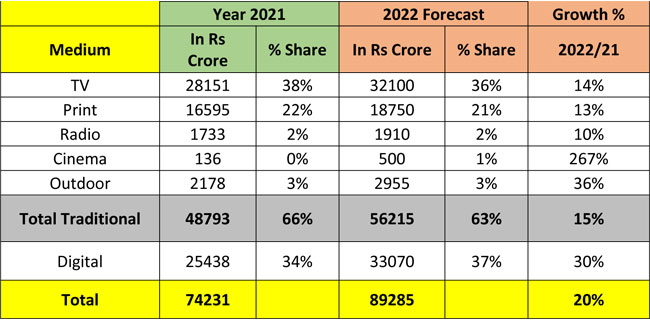
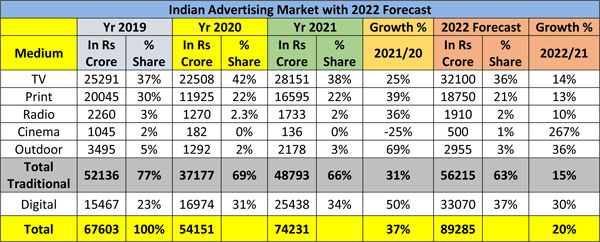
    Madison Media predicts adspends (AdEx) will increase 20% in calendar year 2022. The highlights of the Pitch Madison report were released on Wednesday by Sam Balsara, Chairman, Madison World. According to Madison Media, AdEx is expected to grow by 20% in 2022 and reach Rs. 90,000 crore. This growth is on the back of a dramatic Rs. 20,000 crore increase in 2021 inspite of Covid wave 2. In 2021 Digital grew by 50% and in 2022 is expected to pip television to become the largest contributor to Adex with a share of 37%, compared to TV’s 36%. Print, too has grown dramatically by as much as 39%, retaining its share of 22% in Adex.


    Said Sam Balsara, Chairman, Madison World, “Advertisers seem to be returning to advertising with a vengeance. After Covid year 2020, Global Adex has registered a whopping 21% growth in 2021 and 18% versus pre-covid 2019. Compare this with a compounded annual growth rate of just 5% over 10 years from 2010 to 2019. India infact leads this return, with a growth of 37%, compared to a last 10-year compounded annual growth rate of just 10.4%.”


    Key findings of the Report:

    1. Overall:

    1 • In 2021 total Adex grew by 37%, Traditional Adex by 31% and Digital Adex by as much as 50%.

    2 • In absolute terms, ADEX has grown from Rs. 54,151 crore to Rs. 74,231 crore and comfortably surpassed the 2019 figure of  Rs. 67,603 crore by 10%.

    3 • Traditional Media contributes 66% of total Adex, whereas the global figure is 35%.  Despite a growth of 31% in 2021, Traditional Media at Rs. 48,793 crore, has not reached its 2019 figure of Rs. 52,136 crore.

    4 • Digital Adex has now reached a share of 34% and is in striking distance of TV, the leader of the pack which ended the year with a share of 38%. TV and Digital Adex now account for 72% of Adex.

    5 • Q3 and Q4 2020 contributed to 60% of Adex. Q4 registered a whopping 49% increase over Q4 2019.

    6 • FMCG continues to be the main category, but its share moved down from 38% in 2020 to 34% in 2021.

    7 • Ecommerce emerged as the 2ndbiggest category of Adex and the largest contributor to its growth, doubling in size from Rs. 3,000 crore to Rs. 6,000 crore.

    8 • 15 new-age Companies / start-ups have entered our list of Top 50 advertisers namely, Dream 11, BYJU’s, Phone Pe, Upstox, My 11 Circle, CRED, Netmed, MPL, Policybazaar, Unacademy, WhiteHat Jr, Swiggy, Netflix, Coin Switch Kuber and Coin DCX.


    2. Television

    1 • TV registered a high growth of 25% to reach Rs. 28,151 crore, following a 11% de-growth in 2020. TV is the only traditional medium that has comfortably surpassed the 2019 number of Rs. 25,291 crore, by as much as 11%. TV’s market share is at 38%, down from a high of 42% last year but one percentage point higher than 2019.

    2 • TV Adexwitnessed a 25% spike in Ad volume or FCT in 2021 over 2020 and a 11% increase against 2019. Significantly ad volume in 2021 is higher than 2020 in all four quarters.

    3 • FMCG continues to be the largest contributor to TV Adex with a share of  46%, but lost as much as five percentage points from a high of 51% in 2020. Ecommerce, the 2ndlargest contributor to TV Adex, increased its  share from 11% to 18%, followed by Edtech which increased its share  from 4% to 6%.

    4 • News as a genre has registered a high growth of 19% over 2019 and  29% over 2020. Marathi and Tamil Regionals have also grown dramatically by 36% and 24% respectively over 2019. Second line GECs de-grew by a massive 18% and mainline GECs de-grew by a negligible 3%. Hindi GEC continues to be the largest segment, followed by Sports and then News.

    5 • TV Adex is expected to grow by 14% in 2022 to reach Rs. 32,100 crore, 27% higher than 2019.


    3. Digital

    1 • Digital grows by 50% in 2021 to reach Rs. 25,438 crore and has emerged as a strong No 2  for the 2ndconsecutive year, at 34% share, a little short of TV at 38%. Digital has achieved a CAGR of 27% over last 10 years.

    2 • Q4 was the largest quarter, where Digital Adex touched almost Rs. 10,000 crore and contributed 39% to the full year.

    3 • Video is the highest contributor to Digital with a share of 29%, followed by Social & Display at 20% each.  E-commerce and Search now contribute 16% each to overall digital pie.  In terms of growth rate,  E-commerce has grown significantly by as much as  50%.  Display, Video and Search have also grown substantially at 30%+.

    4 • Programmatic has firmly taken route in India and its share continues to be 42%.

    5 • Ecommerce advertising revenue is rising rapidly and we estimate ecommerce advertising spends in 2021 to be at Rs. 4,100 crore, mainly on the back of Amazon and Flipkart, but newer entrants like Nykaa, Big Basket and JioMart are also finding favour with a relevant set of advertisers.

    6 • Digital is set to grow by 30% in 2022 to reach Rs. 33,070 crore and set to emerge as the single largest contributor to Adex, overtaking TV by almost a 1000 crores.


    4. Print

    1 • Following a 41% decline in 2020, Print Adex grew by a whopping 39% to reach Rs. 16,595 crore. Despite the high growth rate, Print is still only at its 2015 levels and has registered a 16% drop vs 2019.

    2 • With a share of 22% in Adex, India is the Print Capital of the world, along with Germany. Global share of Print is a mere 5%.

    3 • Print volume in terms of CC has also gone up by 31%.

    4 • 3 categories FMCG, Education and Auto make up 45% of total Print Adex. Both FMCG and Auto have come down in share by 2 percentage points each.

    5 • English and Hindi publications put together, contribute to 63% of total  Adex volume. English publications grew 40% over 2020. Hindi publications which are the largest volume contributor, also grew by 30%, Telugu by 37%, Assamese & Marathi by 33% and Bengali by 27%. All languages grew, the least to have grown are Kannada, Gujarati and Punjabi by 18-19%.

    6 • Print Adex is expected to grow by 13% in 2022 to reach Rs. 18,750 crore, but it will still be at the level it reached in 2017.


    5. Other Media

    1 • OOH Adex has registered a high growth of 69%, taking the industry to Rs. 2,178 crore, but still way below 2019 level. Conventional OOH grew by 63% and Transit Outdoor by almost 100%. Digital OOH is also beginning to take root and grew from Rs. 50 crore to Rs 300 crore and has a share of 13.77%, far below the global average of 40%. We expect OOH Adex to grow by 36%, to reach Rs. 3,000 crore, the level it had reached in 2017.

    2 • Radio Adex has grown by 36% to reach Rs. 1,733 crore, with a share of just 2 %. With this Radio is at the level it had reached in 2016. We expect Radio Adex to grow by 10% and reach Rs. 1,900 crore.

    3 • Cinema has been by far the worst affected medium. Because of 2 years of Covid, it has degrown by a further 25% over 2020 to reach 136 crores. We expect Cinema to grow by 267% to reach Rs. 500 crore, almost half of the  pre Covid level of Rs. 1050 crore.


    Figures at a glance:
  • Covid Second Wave notwithstanding, AdEx zooms 37% last year, notes Pitch Madison Report 2022

    By Our Staff


    AdEx in 2021 grew to Rs 74,231 crore, having grown at 37%, despite the Covid Second Wave which for the second year adversely impact the economy and AdEx for the three months of May, June and July, notes a teaser from the Pitch Madison Advertising Report 2022. Contrary to its own forecast of 26% growth in February 2021, which meant AdEx in 2021 would not even reach 2019 levels, AdEx has comfortably surpassed 2019 figures by 10%.


    In a departure from convention, the Pitch Madison Advertising Report 2022 released flash figures of AdEx estimates only for 2021. An exhaustive report giving medium wise figures, forecast for 2022 and commentary will be released three weeks later – February 16, 2022, to be precise.


    The flash report estimates that total AdEx has not registered a 37% increase in the last two decades for which figures are available. The closest it has registered was a growth rate of 22.9% in 2007. For context in 2020, Adex had degrown 20% over 2019.


    Said Sam Balsara, Chairman – Madison World, “The two Covid years of 2020 and 2021 have altered the structure of AdEx, but Indian AdEx has shown that it is resilient and contrary to expectation surpassed 2019 AdEx levels. Whilst the Covid First Wave had a disastrous impact on AdEx, India Inc has taken the more deadly Covid Second Wave in its stride and despite a setback of four months has not only recovered during the year itself but also comfortably surpassed 2019 levels.”


  • HiveMinds expands in Delhi-NCR

    By Our Staff


    Madison World’s Hiveminds Innovative Market Solutions has opened an office in Gurugram, announcing a formal expansion in Delhi-NCR. The company is headquartered in Bengaluru with a team of 200 people spread across Bengaluru, Mumbai and NCR. To head its north branch, Hiveminds has hired Mohit Grover.


    Said Jyothirmayee JT, Founder & CEO of HiveMinds: “As digital transformation takes focus for all businesses, I am delighted to bring in a leader with high ownership & entrepreneurial spirit as our Delhi branch head to ride this wave. With the growing client roster, we feel that a senior team based in the region will be better placed to engage at the strategic level and contribute to overall growth for our clients. We are hiring!”


    Added Sam Balsara, Chairman, Madison World: “With offices opening up gradually, the demand for on-site teams is also coming back. With Mohit at the helm, we’re now poised to expand our presence in North India to attract new clients and service the existing clients better.”


  • Madison Media exits Sri Lanka

    By Our Staff


    The directors of Media Factory have just announced that they have purchased the majority stake held by Sam and Lara Balsara of Madison World in Madison Media SriLanka Pvt. Ltd and the company will now become a fully owned subsidiary of Media Factory Pvt Ltd. The Balsaras  have exited the Sri Lanka business. Sam Balsara has also resigned as a Director of Madison Media Sri Lanka Private Ltd. and the company’s name has been changed to Midas Media Pvt Ltd.


    Both parties have agreed that Midas Media and its affiliates, associates and owners, Media Factory will immediately stop using the Madison name in any manner whatsoever nor claim ownership to the name Madison. Further, Sam and Lara Balsara and Madison in India or Sri Lanka will no longer be liable for any actions or financial liabilities or damages past, present or future of the company nor will they benefit from any financial assets or accruals to the company of the past, present or future for which they have not been compensated. Sam and Lara Balsara will also not claim any right or ownership to the name Midas Media Pvt Ltd.


    Said Sam Balsara, Chairman, Madison World: “We entered the Sri Lanka market, 12 years ago with the launch of Airtel in the country. Over the years we have built some great relationships both personally and professionally and I hope to continue those. I wish the current Directors of Media Factory and Midas Media all the very best”.


    Added Kapila Vidanagamage, Director Media Factory: “Our relationship was based on mutual trust and respect. We understood the expectations at a very early stage and were able to deliver to the complete satisfaction of our local clients, but more importantly our partners in India. I would like to thank Sam and Lara for their trust and eventual friendship and would like to wish them both the best in all their future endeavours.”


  • Back to 2019 levels, as AdEx to grow 26%: Pitch Madison report


    By Our Staff


    It is the most respected of the forecasts of advertising expenditure in the country. We are referring to the Pitch Madison Advertising Outlook report that was unveiled virtually on Wednesday by Sam Balsara, Chairman, Madison World. According to the report, AdEx degrew 20% in 2020 and is expected to grow 26% in Calendar Year 2021.


    Sam Balsara
    Sam Balsara

    Said Balsara, Chairman, Madison World: “A number of macro-economic factors, study of AdEx historical behaviour and stupendous growth in Q4 leads us to make a high projection of 26%. Our full report gives you more details of the basis of our projection and some Advice to Advertisers.”


    Key findings of the report:

    A. Overall:

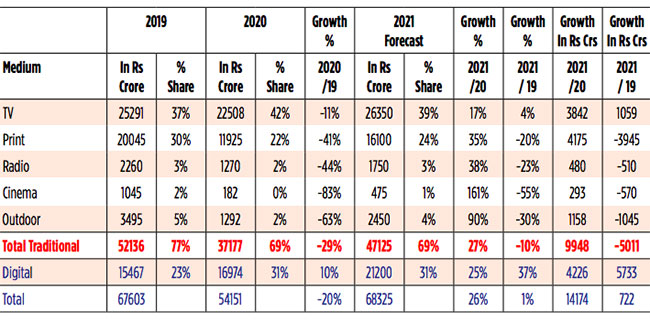
    1) In 2020 total Adex has degrown by 20% and Traditional Adex by as much as 29%.

    2) In absolute terms ADEX has degrown from Rs. 67,603 crore to Rs. 54,151 crore, a drop of a whopping Rs. 13,452 crore, the highest drop in one year ever, in Indian ADEX’s history. Adex is now at 2017 levels, but is expected to reach 2019 level by end of 2021.

    3) Although Traditional Media declined by 29% in 2020, its share in total Adex is as high as 69%, whereas the global average is 41%.

    4) Covid’s negative impact on Indian ADEX has been more severe compared to Global Adex  and many other countries of the world including US where the drop was only 4%.

    5) Q4 2020 has registered a whopping 61% increase over Q3 2020 and a 16% increase over Q4 2019. And this gives us a lot of confidence and hope that both Market and ADEX is going to bounce back sharply in 2021.

    6) Many Advertisers deserted TV, Print and Radio in Q2 2020, but by Q4 almost all Advertisers have returned to the Advertising fold.

    7) FMCG continues to be the main category spender and its share moved up to 38% compared to 33% in full year 2019.

    8) E-commerce and Education are the only two categories that increased spends, by 30% and 9% respectively.

    9) 10 new advertisers entered the Top 50 list of advertisers, key ones being Phone Pe, Pepsico, facebook and Disney Hotstar.


    B. Television

    1) Television media degrew by a mere 11% to reach Rs.22,508 crore, its 2018 level, but has further consolidated its position as the No. 1 medium with 42% market share.

    2) FMCG, continues to be the largest contributor for TV ADEX and further increased its share from 49% to 51%, though in value terms, the category de-grew by 9% almost in line with the TV degrowth of 11%.

    3) The only 2 categories to show a growth in absolute terms are E-commerce, which registered a 95% growth over 2019 and Education, a 193% growth over 2019.  Within e-commerce, in addition to online shopping, mobile wallets and media / entertainment / social media / OTT were the leading categories.

    4) The impact on regional channels has been the least, implying that national brands prioritised campaigns in their strong markets and regional brands came back to ADEX faster than national brands.

    5) TV Adex is expected to grow by 17% in 2021 to reach Rs. 26,350 crore, 4% higher than 2019.


    C. Print

    1) Covid damage to Print has been massive and Print ADEX lost as much as Rs. 8,120 crore or 41% and has gone back to a level it had reached in 2012.

    2) With a drop in share from 30% to 22%, Print lost its No. 2 rank in ADEX.

    3) However, a spike in ADEX during the festive season (Q4 20) has resulted in highest Volume and Ad  revenue.

    4) Print Adex grew by 59% in Q4 2020 vs Q3 2020, however, this is still 15% less than Q4 2019.

    5) All categories in Print seem to have got affected including E-commerce (-57%), Education (-14%), Auto       (-29%) and FMCG (-30%). Education increased its share of Print ADEX by 5 percentage  points, from 10% to 15% and Auto and FMCG by 3 percentage points each, from 13% to 16% and from 14% to 17% respectively. These 3 categories accounted for 47% of Print ADEX.

    6) Newspaper circulation in metros got affected a little more deeply and recovery seems to have taken longer. Because of which contribution of Hindi, in terms of volume has increased from 35% to 38% with English trailing at 24%. Kannada and Malayalam newspapers showed highest resilience and least degrowth in terms of volume, whilst Tamil, Telugu and Marathi publications de-grew the most.

    7) Print Adex is expected to grow by 35% in 2021 to reach Rs. 16,100 crore, but it will still be at the level it reached in 2015.


    D. Digital

    1) Digital is the only medium that grew in 2020 by 10% to reach Rs. 16,974 Digital is now the No. 2 medium, having displaced Print with a share of 31%, up from 23% in 2019.

    2) Digital has grown in 3 quarters and de-grew only in Q2 2019 by 35% when there was a strict lockdown. This drop of 35% must be seen in comparison to the drop of 79% in Print and 61% in Television in the same quarter.

    3) Share of Search has come down significantly by as much as 5 percentage points and now stands at just 18%. This is not because Search has degrown, but other verticals have grown much faster. Video, not only is the largest contributor but has further increased its share from 30% to 32% during the year. Both Social and Display have marginally improved their Share and all three have grown shares at the expense of Search.

    4) Programmatic has taken firm root in Indian Digital Adex and now almost 40% of all Digital spends are through Programmatic.

    5) Digital is set to grow by 25% in 2021 to reach Rs. 21,200 crore.


    E. Other Media

    1) Radio ADEX is the third worst affected medium which de-grew by almost 44% and came down in value from Rs. 2,260 crore to just Rs. 1,270 crore. This sharp drop has taken Radio back to its 2014 level. With this drop, Radio has also lost 1% market share and now has a share of 2%. We expect Radio Adex to grow by 38% and reach Rs. 1,750 crore.

    2) OOH ADEX also de-grew by as much as 63% to a low of Rs. 1,292 crore and its market share dropped by as many as 3% points from 5% in 2019 to 2% in 2020. OOH Adex in 2020 has gone back to its 2007 level. We expect OOH Adex to grow by 90%, to reach Rs. 2,450 crore.

    3) Cinema is by far the worst affected medium because of Covid and in our estimate, suffered an 83% drop, capsizing its low base of around just a little over Rs. 1,000 crore to under Rs 200 crore. We expect Cinema to grow by 161% to reach Rs. 475 crore.


  • Peace or Perish!


    [updated with India Today Group quote & Republic TV statement]

    By Pradyuman Maheshwari


    Ask present and past TV audience measurement professionals who or what is pulling down the reputation of their business, the response would be an emphatic: news channels.


    TAM, a joint venture of Nielsen and Kantar (then owned by WPP and now majority owned by Bain), lost its measurement contracts from broadcasters, advertisers and agencies thanks essentially to news channels warring against it. Premier news network NDTV took TAM to court over allegations of faulty data, and this hastened the effort to set up the joint industry owned body Broadcast Audience Research Council (BARC). Eventually TAM sold its measurement business to BARC.


    Like TAM in the past, the BARC team faced turbulent times from the news channels, and in a letter to the BARC chairman Punit Goenka, the News Broadcasters Association (NBA) is said to have expressed its reservations about the BARC leadership of the past.


    There are murmurs that BARC CEO Sunil Lulla too has experienced some angst from news channels.


    The problem is always with ratings. That some of the channels have deep political connections makes matters worse. So every time there is a peeve, news channels flock to the I&B minister for intervention. In the past, matters have also gone to Parliament and there have been committees set up to examine nuances of the business. And if it’s not the law-makers who assert themselves, it’s regulator Telecom Regulatory Authority of India (TRAI) which intervenes.


    Frankly, the government ought not to have role in the business of news television. Except for running its own Doordarshan news channels, its publicity department DAVP which doles out advertising and monitoring objectionable content and addressing the media on issues and make announcements.


    But by running to the government often, channel owners have invited the ministers and bureaucracy to step into a territory which they shouldn’t be treading on.


    For instance, BARC’s weekly viewership data ensures that advertisers and the agencies make wise media buying decisions. It also helps broadcasters and content-makers better their content, sales and marketing act.


    But the ecosystem dominated by broadcasters inflicted on itself the government’s intervention (or interference?) and got BARC to be governed by a set of rules and regulations.


    There’s nothing new with what happened on Thursday. It occurred when TAM was around and it’s taken place under the BARC regime. There has been pilferage of information on the placement of set-top boxes, but the machinery is well-oiled to issue alerts when necessary.


    That’s what happened when Hansa Research, one of BARC’s vendors on engagement with panel homes, alerted the police about a mess up.


    Was Republic named in any written complaint? We don’t know. An FIR shared with MxM has a mention made of the India Today channel. Both Republic and India Today (by way of a report on the site) have presented their points of view.


    What we did find last night was various channels shaming Republic TV and founder, editor-in-chief and managing director Arnab Goswami. Newspaper reports today – owned by media companies which also run news channels as well as a few others – have also named Republic and Goswami prominently. The reference to other channels and India Today has been understated or is missing.


    So when did it all start? The war of words and ratings began even when Goswami was with Times Now. The channel was doing exceedingly well, on the back of the heated debates that it would air.


    But when Goswami quit the Times Network to start Republic, the daggers were pulled out from all directions. All sides are to blame. Times Now had its issues with Goswami for quitting, hiring some ex-staffers and making no bones of the fact that he was taking on his former employer. The others got on to the act the moment Republic shot to #1 in the ratings roster. ‘News without Noise’, became India Today’s credo.


    Various attempts were made to isolate Republic, including the rest of the news channels pulling out their watermarks so as to boycott BARC. On its part, Republic too countered the others – and compared its ratings with that of the others. Nothing wrong with it, except that the comparison was accompanied by much bombast. Surefire formula to rile others.


    But the war took on a new turn when Goswami launched Republic Bharat. While English news channels are influential and earn fair monies, the real bucks is in Hindi news. Aaj Tak, ABP News, Zee News have been raking in the moolah over the years. While Bharat made its presence felt, it didn’t create much of a dent until the Covid-19 pandemic-led lockdown happened and the Arnab Goswami brand of hyper-aggressive, right of centre journalism took over.


    And then came the controversy around actor Sushant Singh Rajput’s death. The line that Republic Bharat took on the controversy ensured it was numero uno. And not just for one week, but for now many weeks.


    Advertisement buying decisions are not taken in a hurry, but buoyed by its success, Republic Bharat has hiked its ad rates.


    On Thursday evening, the Mumbai police commissioner named Republic TV based on what appear to be unverified complaints and allegations. Later, on its primetime bulletin, Republic TV showed scans of the FIR naming India Today. The joint commissioner of police is reported on the India Today website stating that while India Today was named in the FIR, neither the accused nor the witnesses supported the claim. “On the contrary, the accused and witnesses are specifically mentioning the names of Republic TV…”


    The India Today Group issued a statement late on Friday: “There is a malicious campaign on right now by a few vested interests to drag the name of the India Today Group into the TRP scandal that broke out on October 8, 2020,” adding: “We welcome any probe the police may wish to conduct and are fully confident that we will come out unscathed as we have not acted in any inappropriate manner. What we have right now is nothing but malicious, unsubstantiated allegations by a vested party.”


    Republic TV has taken on the Maharashtra government and Police Commssioner Param Bir Singh over the last few months in Sushant Singh Rajput case. Meanwhile, Goswami has threatened to sue Singh.


    So what next on this? The news channels business in India is a divided house. There is the News Broadcasters Association (NBA) which comprises most of the big players operating nationally and there’s News Broadcasters Federation (NBF) which is spearheaded by Goswami and Republic. Recently TV9 pulled out of the NBA with the association lodging a complaint with BARC saying that the network had used unfair means to forge ahead on the ratings roster. The network is now back as its member.


    Singh was quoted on a channel saying that advertisers may also be called for interrogation. So will Amul managing director R S Sodhi have to make the rounds of the commissioner’s office? Perhaps he will be. Will media agency network bosses Prasanth Kumar of GroupM and Shashi Sinha of IPG Mediabrands also be questioned by the cops? If Sodhi is, surely Kumar and Sinha will be called in.


    It suits the government perfectly well to have channels warring each other. But if the police summons advertisers and agency bosses for questioning, there could be trouble. Large, pedigreed advertisers would prefer to stay away from the murky world of news television. Channel owners would do well to smoke the piece pipe.


    If warring countries and corporates can get together, surely Arnab Goswami and Rajdeep Sardesai can.


    Updates:


    Media agency bosses Sam Balsara, Shashi Sinha and Prasanth Kumar have been called to the police station for seeking information. So these may not be summons, but a request from the cops is never for a chat about the weather. There are rumours that names of certain advertisers have also been handed over to the police.


    The Republic Media Network has issued a press release: https://www.republicworld.com/india-news/general-news/full-news-release-from-republic-media-network.html. “The Republic Media Network has approached the Honourable Supreme Court of India. We have served notices of our legal action to the Maharashtra Government as well. While we will follow the law, we are determined to seek a legal remedy against this atrocious witchhunt,” the release says.


    Although Pradyuman Maheshwari is Editor-in-Chief and CEO of MxMIndia, the views here are personal and are not necessarily that of MxMIndia. He can be reached via Twitter at @pmahesh. A version of this has also appeared on The Wire at The ‘TRP Scam’ Could Open the Doors for the Government to Enter the Picture


  • RSH Global assigns its mandate to Madison

    By A Correspondent


    Leading skincare company RSH Global has appointed Madison Media as its Media Agency of Record (AOR) for its flagship brand ‘Joy’ and its men’s grooming brand ‘X-Men’. The account was awarded following a multi-agency pitch. Madison Media will be responsible for the entire media mandate including print, television, radio, outdoor and digital.


    Said Sunil Agarwal, Chairman, RSH Global Private Limited: “I welcome Sam, Vikram and the entire Madison team for partnering with us to handle our media & digital mandate. I’ve been very impressed with the kind of work they’ve done for many Indian brands over the last two decades and I’m confident they’ll play an instrumental role in the rapid growth of the brand and the business.”


    Added Poulomi Roy, Chief Marketing Officer, RSH Global Private Limited: “We are happy to have Madison as a partner in our journey to strengthen our position in key markets and explore new geographies. We are confident that with the ever-changing media scenario, Madison with their experience and in – depth understanding of the consumers of our country will be able to develop a robust media & digital strategy for our brand and add momentum to all our marketing initiatives.”


    Said Sam Balsara, Chairman, Madison World: “I am super-excited to partner with RSH Global, an ambitious personal care company operating successfully in the tough personal care segment with ambitious plans to help them meet their growing ambition, with Madison’s experience and expertise.”


    Added Vikram Sakhuja, Group CEO Media & OOH, Madison Media: “It’s a big win for Madison coming out of Kolkata. RSH Global is expanding its business and we’re happy to be their choice when it comes to their Media agency. Looking forward to a growth-filled partnership.”


  • 75% advertising drop in Q1. And no support from government, says advertising veteran Sam Balsara

    By A Correspondent


    Madison World founder and CMD Sam Balsara has lamented lack of support from the government to the industry and said that it has completely ignored the sector.


    He was speaking with Kailashnath Adhikari, MD, Governance Now in the Visionary Talk series on the topic ‘Impact of COVID – 19 on media and entertainment industry and the role of governance in the media sector’.


    Said Balsara: “The government needs to provide a stimulus package to the advertising industry and push consumer demand. Perhaps they think if they gave a concession to advertising, then it would be considered a concession to the sector itself. It is not a concession; it is a stimulus package to revive demand and that is how it should be seen by the government and positioned and not as a sop to the media industry.”


    Balsara said that the advertising industry has faced an overall steep drop of almost 75% in the first quarter of the FY 2020-2021 adding that in April it was about 95%, improved slightly in May, and recovered well in June, especially in the TV and digital media. “Print, radio outdoor and cinema are totally in the dumps and will only see some semblance by Diwali provided the govt allows suburban railways in metros and majority offices open. The industry was expecting TV to recover 80%-90% of last year’s levels in Q2 of the FY,” he said.


    Responding to a question that if the government has responded well to the stakeholder’s recommendation of allowing amortisation of advertising expenditure to companies to help the economy back on track and create demand, Balsara lamented a lack of support from the government and wondered why it has completely ignored the sector, saying: “Perhaps they think if they gave a concession to advertising, then it would be considered as a concession to the sector itself. It is not a concession; it is a stimulus package to revive demand and that is how it should be seen by the government and positioned and not as a sop to the media industry.”


    He said that Work From Home is a huge setback to the economy as it could work well for individuals and companies but not create consumer demand. “When advertising is widely recognised as the engine for large no. of consumer companies and drives demand in its absence the economy goes into a downward cycle. To spin out of this de-growth and perk up, a massive dose of advertising is required in July August, September.”


    Balsara also came down heavily on Indian news channels and said that he is disappointed at what they repetitively put out and have to break out of the current rhythm of content. He was referring to the daily headlines of highest number of Covid-19 cases and deaths being reported by news channels which he said look as identical every day as they did four months ago.


    “There are many opportunities for news channels to innovate, be more humane, and capitalize news intake intelligently. But repetitive news content is bringing the viewership down. When in the first week of lockdown viewership of news channels had shot up 300% today it has come down to February levels,” said Balsara


  • Madison Media is amongst Global Top 5 Independent Agencies, as per Recma

    By A Correspondent


    Madison Media has informed  that it ranks fifth in Recma’s Top 16 independent ad agencies list in the globe. Madison Media has the highest country market share of 11.1% amongst largest independent agencies of the world, notes a communique.


    Said Sam Balsara, Chairman, Madison World: “It’s the faith and trust of our clients that have helped us grow over the last 33 years. I’m also proud and thankful to all Madisonites, past and present who have been a part of this journey and help continue to grow our agency. Over the years, we’ve scaled up and continue to do so keeping the Madison values at the core of our work. This discovery is indeed good news for us, coming in the midst of Lockdown!”


    Added Vikram Sakhuja, Partner & Group CEO, Madison Media & OOH: “We always knew we were India’s largest Independent. For RECMA to crown us largest Market Share Independent in the World, and 5th largest in size is awesome. I have always believed that Media is a local game, built on local market expertise and relationships. Madison has always had a stable and highly respected leadership team. The rigour and excellence we have drilled into our people have made us probably the industry’s best talent pool. But the ones we have most to thank are our Clients who have stayed with us for years and from whom we have learnt so much.”


  • Asian Paints rekindles love for homes in second digi film

    By A Correspondent


    Asian Paints has released the second digital film under ‘Har Ghar Chup Chaap Se Kehta Hai’ capturing people’s love for their homes which has been rekindled during the lockdown.


    Conceptualised by Ogilvy India, the film showcases individuals and families taking care of their homes in the current quarantine period. Upkeep of the house, an otherwise trying exercise, has now become a source of joy to family members. Children, grown men, even pets, everyone in the house is chipping in with their share of household chores. This relevant truth is beautifully captured to show how one’s relationship with one’s home, a relationship at the core of brand Asian Paints, is rekindled.


    Voiced by Piyush Pandey and directed by Neha Kaul of Corcoise Films, this video will surely bring a smile on everyone’s face and remind them what their home has been to them; a place of security.


    Speaking about this new ad, Amit Syngle, MD and CEO, Asian Paints: “Our second video is a very different take on the emotions associated with Homes, wherein the Home personification and its relationship with the people who live there comes to light in a very beautiful, interconnected way. The whole camaraderie between the home and the members, bring the joy in reliving those real moments which strongly define the emotional connect. Relationships rekindle the fun routines and some lively activities, combined with daily chores, bringing the social message of Stay Home Stay Safe alive.”


    Added Sukesh Nayak, Chief Creative Officer, Ogilvy India: “Staying at home we found a new corner in our home which has become our favourite spot and we found places to clean that we never did before. We found new love for our homes and we decided to capture this love in our film.”


    Sharing his thoughts on the film, Sam Balsara, Chairman and MD, Madison World said: “Asian Paints has done an amazing job of staying alive in the consumers’ mind, not by eulogizing their paint but empathizing with their consumers by highlighting to them the joys of doing household chores, staying at home; thereby making the most of the unfortunate circumstances that consumers find themselves in today. My compliments to Team Asian Paints and Ogilvy for the idea and producing not just one but two digital films from home. This move will earn Asian Paints tremendous goodwill of its customers which will benefit the Company for time to come. Asian Paints is not only the leader in Paints, but has behaved like one.”


  • RIP, Goutam Rakshit


    For 38 years, Goutam Rakshit ran Advertising Avenues before turning a full-time consultant and strategic advisor to SMEs, start-ups and all those daring to be different. Advertising Avenues was one of the hottest agencies in India and was indeed the envy of every asperson from when it started its journey in 1982.  After an MBA from Jamnalal Bajaj Institute in Mumbai, Rakshit joined Cadbury’s (now Mondelez) and then moved on to Clarion before starting Advertising Avenues in 1982. The rest as they say is history. His role with industry associations is well-known and he ensured Indian advertising was recognised the world over. Rakshit breathed his last in Mumbai. He was 71. A prayer meeting will be held post the National Lockdown.

     

    Goutam Rakshit, advertising leader and doyen no more


    By Ramesh Narayan


    To say that Goutam Rakshit was a multi-faceted person is far from a cliche.


    As an advertising professional he was one of the finest minds this industry had.


    After early stints in Cadbury’s (where he mentored young men like Sam Balsara), to Clarion, to founding an independent advertising agency, Advertising Avenues, Goutam was one of the most sought-after professionals of his time.


    Avenues, as it was called, was run by Goutam, Ashok (the wordsmith) Roy and Gopi (the art genius) Kukde.


    And the three created advertising history. Of course the best known campaign was ‘Neighbour’s Envy, Owner’s Pride’ for Onida TV’s where he literally broke all accepted norms, used a negative emotion like envy, a brilliant caricature of the Devil and smashed a TV screen (no bad luck) to propel the relatively unknown Onida brand to the status of a leader. And his Agency to the top of the Abby Awards charts.


    But it wasn’t just Onida that broke away from the norm VIP Frenchie had this well-built man dressed in nothing but his underwear rescuing a young lady on a high street, while a headline boldly said “If you think this is stretching things too far… You should see the product”.


    UFO jeans showed a label lit up by the flame of a lighter that showed a headline “Statutory Warning. Not having this label on your jeans could be injurious to your ego”.


    The magic of Gopi and Ashok, held together by the glue that Goutam was, showed itself in the launch of TNT Skypak in a fabulous comic-caricature series.


    I could go on. From Feelings women’s innerwear to Akai Bush from Today contraceptives to Skybags and Royal Toothbrush, Advertising Avenues lorded it over the advertising scene in the late eighties and the nineties.


    And there was Goutam Rakshit, the industryperson. Three times President of the AAAI, President of the ABC and ASCI. His relationships with the media bosses was legendary. He didn’t need AAAI and INS to help recover his dues in one famous case. Pradeep Guha and N Murali were sufficient. And then the President of the Asian Federation of Advertising Associations (AFAA) when the historic AdAsia was held in Jaipur. He was also a three-times Chairman of the Judging Committee of the Abby Awards when it was the property of the Advertising Club.


    But all this wouldn’t do justice to Goutam, the man. Affable, witty, mischievous but never malicious, very wise, a great friend and a wonderful human being.


    I was privileged to write the Citation when he was honoured with the Lifetime Achievement Award by the Advertising Agencies Association of India. It breaks my heart to write this tribute to my friend.


    Goodbye, Amader Chairman!


    By Bharat Kapadia


    It was around 7.30pm on March 6, 2020. Goutam opened the door and welcomed me with his signature smile and warmth at his Jeevan Asha building apartment on Peddar Road. He hugged me and congratulated me for completing my first full marathon and told his grandson proudly: ‘Uncle can make you run 42kms…’. As always, he would put others before him.


    He was in good mood to talk about the consultancy he had started and went into a flashback saying: “I was doing quite well at Cadbury’s but was always wanted to be on my own as routine was getting quite boring. I went to Subroto Sen and revealed my desire to start something independently. He had started Clarion Advertising agency along with stalwarts like Tara Sinha, film director Satyajit Ray and S N Banerji after the British agency D J Keymer shut shop.”


    “He told me to join and I entered the ad agency business,” Goutam said, adding:


    “Although intially I was hesitant and told him that I know nothing about ad agency business. And then Subroto smiled and said: ‘You have been on the other side of the table and you will do well this site too!’ Every few months, I would go to Subroto and tell him that I was feeling the same stagnancy as I had felt in Cadbury’s, he would ask me to hang on for a while.”


    Goutam was in a mood to reminisce. “I learnt a lot from him and colleagues about the Indian ethos and how ad strategies would work for different products in changing Indian market. Years later, I ventured on my own and launched Advertising Avenues along with Ashok Roy.”


    He then spoke about the legendary Onida campaign which broke all rules and also the records of achievements. “Do you know, Mr Mirchandani of Onida was very reluctant about the devil concept? But after we convinced him there was no looking back.”


    He narrated his journey and we were almost lost in some of splendid stories till his wife came and politely asked: “What will you have?’’..


    We spoke for hours and he said next time we meet, I’ll introduce you to my clients..


    Besides his iconic campaigns and successful ad agency business he also represented ad fraternity in many avtaars. He was the first Indian Chaiman of AFAA (Asian Federation of Advertising Associations) and ever since we used to fondly address him as ‘Amader Chairman!’ (or Our Chairman, in Bangla).


    This early morning when I hear he is no more, I couldn’t believe the news. Goutam, in this lockdown, no one is supposed to leave the house and you left Jeevan Asha to go to another world? Not done!


  • Traditional media grew 6% in 2019. Forecast for 2020: 5.1%: Pitch Madison report


    By A Correspondent


    The annual Pitch Madison Advertising Report 2020 was released on Thursday in Mumbai with the message that didn’t need much spelling out: traditional media grew only 6% in 2019 and actually degrew in the third and further quarter. The forecast for growth in 2020 is down to 5.1%. But digital media is galloping ahead. It grew 32 in 2019, and the forecast for 2020 is 28.4%.


    Said Sam Balsara, Chairman, Madison World: “Whilst 2019 has been a tumultuous year for AdEx, I believe Adex will grow dramatically over the next five years given that we are one of the larger growing economies of the world and already growing at twice the rate of global AdEx (11% vs 5.4%). Despite this India’s contribution to global AdEx is under 2%, which is bound to go up. Advertisers need to experiment more with media and do things differently to harness the power of media for Brands.”


    Key findings of the report:

    A. Overall:

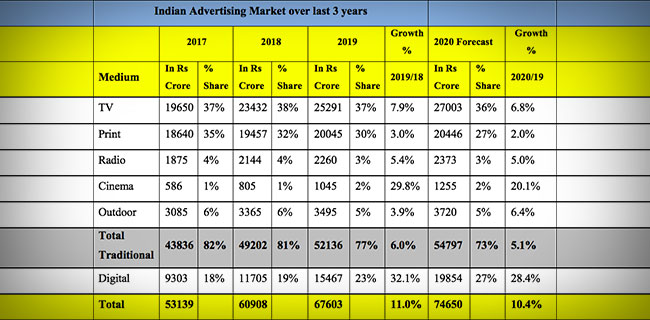
    1) In absolute terms, AdEx has grown from Rs. 60,908 crore to Rs. 67,603 crores, an addition of 6,695 crores or 11%. This makes it the 2ndhighest addition to AdEx in a single year in the entire last decade.

    2) The growth rate of 11% in 2019 is lower than the PMAR mid-year projection of 13.4% and last year’s growth of 15%.

    3) 56% of this growth has been contributed by Digital, which has expectedly grown by as much as 32%.  Traditional media has grown by mere 6%

    4) TV still continues to be the largest contributor to AdEx with 37.4% share, followed by Print at 29.7%, Digital at 22.9%. Outdoor at 5.2%, Radio at 3.3% and Cinema at 1.5%. All mediums except Digital and Cinema have lost share.

    5) A quarter-wise analysis shows that unlike in most years, when Quarter 4 shows a blip because of the festive season, this year Quarter 2 showed a blip on the back of IPL, World Cup and General Elections and in fact Quarter 3 and Quarter 4 show a de-growth of 3% and 7% respectively.


    B. TV:

    1) After a rocking 2018 when TV AdEx grew by 19%, TV grew by only 8% in 2019.

    2) TV lost 1% share point and its share in the total AdEx stands at 37%, demonstrating that it is vulnerable.

    3) FMCG continues to rule the roost in TV AdEx, contributing 49% although its contribution came down by 1% share point in 2019. Telecom and Auto follow with 12% and 7% contribution respectively. Ecommerce category also gained dramatically during the year by as much as 20% and has reached Rs. 1,320 crore.

    4) The main categories that have fueled the overall growth of Rs. 1,860 crore in 2019 is FMCG (Rs. 740 crore), Telecom (275 crore) and Ecommerce (Rs. 220 crore). Predictably contribution of the Auto sector to the overall growth is negative in 2019 at -4%.

    5) There is a marginal decline in total FCT that has been telecast in 2019, perhaps because of disappearance of the FTA channels, unlike in most previous years when FCT has gone up year on year.

    6) In terms of revenue, Sports genre has grown the highest by as much as 47% and Hindi GEC by about 7%, which leads us to conclude that despite a soft market, these two genres have been able to command a rate increase.


    C. Print

    1) Print grew by 3% in 2019, lower than PMAR’s mid-year projected rate of 5%. Whilst this is the 3rdconsecutive year Print has grown less than 5%, it continues to be the 2nd highest contributor after TV with a share of 30%.

    2) Print share in AdEx has gone down from 42% in 2011 to 30% today.

    3) FMCG, Auto, Education, Real Estate and Retail continue to be the main cash cows and contributed almost 50% to Adex in 2019. Ecommerce is fast emerging as an important category for Print and grew 14%, over 2018. Political Parties are estimated to have contributed Rs. 200 crore on account of  Lok Sabha Elections.

    4) Nearly 65% of Print’s growth of Rs. 588 crore is accounted for by 4 categories – Education, Ecommerce, Real Estate and Retail.

    5) In terms of volume there is a 3% decline in 2019. Hindi publications continue to maintain the lead over English Publications, contributing 35% followed by English at a distant 25%.


    D. Digital

    1) Digital Adex made impressive gains during the year and achieved a growth rate of 32.1% in 2019, the highest growth achieved by any medium in the year taking Digital AdEx to Rs. 15,467 crore.

    2) Digital has grown at a compound annual growth rate of more than 30% over last 5 years and now contributes 23% of AdEx, an increase of 4% share points over last year.

    3) Search, Social, Video & Display have all equally contributed to the growth of Digital AdEx, with each contributing between 20% to 30% to the total.

    4) Consumption of video is going up year on year and in 2019 video spends grew by as much as 59% beating the Digital AdEx growth of 32%. Almost all of Digital AdEx (94%) is on mobile.

    5) 52% of Digital AdEx came from “classical advertising” ie display banners (22%) and online video (30%).

    6) If we were to combine TV+ Online Video, TV growth of 8% would increase to 16%.


    E. Forecast

    1. The PMAR Forecast for 2020 for AdEx is muted. In arriving at the projected growth figure for the whole year at 10.4%, the report is guided by the expectation that the economy should bounce back in the 2ndhalf of 2020 as indicated in the government’s Economic Survey published on January 31, 2020. PMAR therefore sees a subdued H1 for AdEx and a buoyant H2, specially Q4.

    2. We also expect a wide variation of growth rates across mediums with Digital medium leading the growth at 28.4% and ending the year with 27% share of AdEx at Rs. 19,854 to be precise.

    3. TV will continue to be the largest medium with a 36% share of AdEx, but will have a subdued growth rate of 6.8%.

    4. Print will lose 3 percentage points in terms of share of AdEx and end up with a 27% share registering a 2% growth.

    5. Radio and Outdoor are expected to grow at 5% and 6% respectively and maintain their share at 3% and 5%.

    6. Cinema, amongst traditional media should grow at a high growth rate of 20.1% taking its spend to Rs. 1255 crore.