By Shailesh Kapoor
 In context of a report Ormax Media is publishing next week, a staggering data point was brought to my attention. Forty-five per cent of Hindi theatrical business in 2023 till the weekend of December 3 has come from franchise films, i.e., films that were already a part of a franchise or a franchise universe at the time of their release.
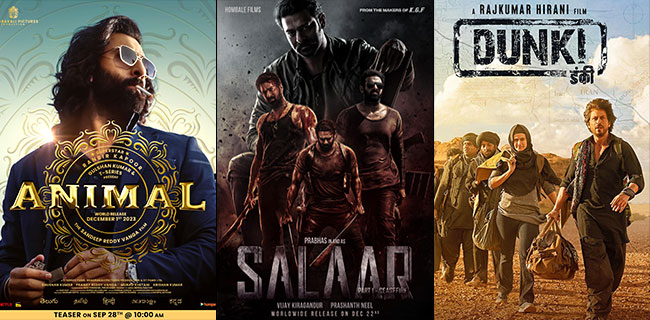
With Animal and Dunki being non-franchise films, and Salaar: Part 1 being the first of its franchise, this proportion will drop to 35-40% by the end of the year. But the staggering-ness is not in the 45% itself. It’s in the year-on-year comparison.
Proportion of Hindi box-office from franchise films was only 19% in 2019, and increased to 31% in 2022 (the interim years were pandemic-disrupted). Within two full years, the contribution of franchise films to the Hindi box-office has doubled.
The equivalent number in Hollywood has been in the high 70s or 80s for a while now, depending on the year we look at. Clearly, Hindi cinema is moving in that direction. It could be a matter of another couple of years that we hit 60%, if not even higher.
Even on OTT, franchises are beginning to dominate, now that the category is somewhat settled in India. Amazon Prime Video has done a particularly good job of building strong franchises, none less than The Family Man and Panchayat. The latter is produced by TVF, which is a franchise factory of sorts, with a long list of illustrious web original franchises, such as Kota Factory, Gullak, Aspirants, Permanent Roommates, Pitchers, Hostel Daze, etc.
Linear television’s attempts with franchise creation have been less emphatic, but that’s only because the approach to having seasons does not exist, and it’s impossible to do a Season 2 if Season 1 is the ever-running season anyway. Yet, Zee TV has managed to create some sort of a quasi-franchise, which some young audiences even have a name for: The Bhagya Universe. It has three largely-unconnected shows in it: Kumkum Bhagya (2014), Kundali Bhagya (2017) and Bhagya Lakshmi (2021), all three produced by Balaji Telefilms.
The rise of franchise content is an interesting phenomenon. At one end, audiences crave for new stories and characters, because fresh and imaginative ideas is generally a strong driver of content consumption. But at the other end is the comfort in watching something familiar. This continuum of original to familiar is a compelling one, because both ends of it are strong on intrinsic benefits related to why content is watched to begin with.
There are franchise films and shows that manage to re-imagine their world, and provide freshness within the familiar. Some of the early Marvel films, leading up to Avengers: Endgame, managed to do this very well. But those are far and few in between, and in general, franchise content willingly lets go of new imagination, and focuses on the familiarity factor.
So, if franchise content is becoming stronger than before, does it mean that audiences prefer comfort of the familiar to the excitement of something original and imaginative? That’s not an evident piece of truth. The real difference lies in the differing risk levels. Franchise properties are significantly safer than non-franchise ones. The latter must get the idea, however original it maybe, right. In the former, that’s already been tested.
But we need a healthy mix, because if franchises begin to dominate to the extent of 70-80%, which is a real possibility soon, the originality will get sucked out of the content ecosystem, leading to a decline in business at some stage in the cycle.
Be that as it may, in the short-term future, we can expect franchises to dominate Hindi cinema and OTT categories, in a way India may have never seen before.